ref. 52062aafBern, Georg Sonnleitner M DC LXVII / Bern in Hoch-Oberkeitlicher Truckerey, M DCC XVI, 1667 / 1716, gr. in-4to, 1) Titelbl. mit schön gest. Druckermarke + 2 Bl. + 58 S. + 9 Bll. (Index), vereinzelt etwas gebräunt, stockfl. / 2) 24 S., Titelbl. mit schönem grosser gest. Druckermarke, papierbedingt stark gebräunt, rezentes gestoch. ‘Ex-Libris Dr. C. Perrochet’ (mit Bildnis Erasmus), Pappband mit Buntpapier, hs. Titel auf dem Rücken, Vorderdeckel unten teils etwas braunfleckig, teils leicht berieben, Kapitel und Gelenke beschabt, Rotschnitt.
1925222 pages including index and glossary. Fold-out map at page 15. Black and white photographic plates. "This book is the outcome of forty years residence amongst the Haidas, and is an accurate description of what I have seen and heard in the villages and homes. Through my knowledge of their language I have been enabled to get all my information regarding their customs, traditions and social organization direct from the principal chiefs, men who at that time were from sixty to eighty years old." - from Preface. Chapters include: Queen Charlotte Islands; Early History; The Haidas; Haida Customs; Births, Marriages, Divorce, Death and Burial Ceremonies; Tools, Ornaments and Ceremonial Masks; Industries and Medicines; The Sa-ag-ga or Shaman; The Haida Pantheon; Haida Legends; The Haida Traditions of Creation; Chief Edenshaw; The Natural History of the Islands; Geology of the Islands and Natural Resources. Appendix lists cranial measurements. Average wear. Binding intact. Red cloth-covered boards. Black lettering and decoration legible upon spine. Prior owner's stamp to bottom edge, front fixed and free endpapers, and title page. Faint bookseller's stamp to back fixed endpaper. A sound copy. Edwards & Lort 1668, Thibault 2,231. Book
1689ref. 73061689 Amsterdam, 1689 , traduit de l'Anglais par Brunet ... Deux ouvrages du même auteur dans le même volume , in 12 plein veau dos orné , plats aux armes du Comte d'Hoym 120 pages, 55 pour le premier titre
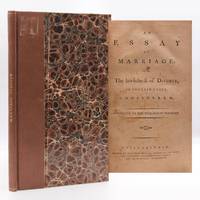
1788ref. 373977Philadelphia: Printed by Zachariah Poulson Junior on the west side of Fourth-Street between Market and Arch-Streets 1788. Only edition. 28 pp. 8vo. Later quarter buckram over marbled boards gilt-lettered spine. Toning to text light foxing to title and final leaf. Very good. Only edition. 28 pp. 8vo. An early American argument in favor of divorce as a remedy for unhappy marriages. The preface notes that the author was inspired to write the Essay by a newspaper account of a Philadelphia woman who resorted to suicide without the option of divorce. "America has been famous for her love of liberty" the anonymous author declares "and hatred of tyranny of every kind; she has not only by arms expelled her foreign foes but generously extended her liberality in a great measure even unto the African slaves. Therefore it is hoped the same spirit of indulgence will extend still further-to those unhappy individuals mixed among every class of mankind who are frequently united together in the worst of bondage to each other" 3. The author further develops the comparison between enslavement and unhappy marriage remarking that "as slave-keeping is justly becoming detestable in this country it may not be improper in this place to make a comparison.so that a relief may appear as necessary to the one as to the other" 15. ESTC W9421; Evans 21076 Printed by Zachariah Poulson, Junior, on the west side of Fourth-Street, between Market and Arch-Streets unknown books
1788ref. 373977Philadelphia: Printed by Zachariah Poulson Junior on the west side of Fourth-Street between Market and Arch-Streets 1788. Only edition. 28 pp. 8vo. Later quarter buckram over marbled boards gilt-lettered spine. Toning to text light foxing to title and final leaf. Very good. Only edition. 28 pp. 8vo. An early American argument in favor of divorce as a remedy for unhappy marriages. The preface notes that the author was inspired to write the Essay by a newspaper account of a Philadelphia woman who resorted to suicide without the option of divorce. "America has been famous for her love of liberty" the anonymous author declares "and hatred of tyranny of every kind; she has not only by arms expelled her foreign foes but generously extended her liberality in a great measure even unto the African slaves. Therefore it is hoped the same spirit of indulgence will extend still further-to those unhappy individuals mixed among every class of mankind who are frequently united together in the worst of bondage to each other" 3. The author further develops the comparison between enslavement and unhappy marriage remarking that "as slave-keeping is justly becoming detestable in this country it may not be improper in this place to make a comparison.so that a relief may appear as necessary to the one as to the other" 15. ESTC W9421; Evans 21076 Printed by Zachariah Poulson, Junior, on the west side of Fourth-Street, between Market and Arch-Streets unknown
1774ref. 002365Amsterdam et Paris Delalain 1774
1790ref. 000261Paris Veuve Duchesne et Fils, de l'Imprimerie de Monsieur 1790
1612ref. 002970Paris, Jean du Brayet et Nicolas Rousset, 1612
1801ref. 5554London: J. Wright; Philanthropic Reform 1801. First editions. Two pamphlets bound together in modern quarter calf over marbled boards with morocco label to spine. Measuring 203 x 120mm and both collating complete: 4 136; 27 1 blank. Toning throughout both tracts with closed tears to pages 69-70 and 77-80 with no loss of text; contemporary pencil annotations throughout the first tract documenting one reader's responses to the controversial claims. Numbers 2 and 4 in ink to headers of each title suggest these were part of a larger compilation of legal tracts likely the set of four that were offered for sale in the 1923 Walpole Galleries sale which bear matching marks. Each scarce OCLC reports approximately 20 copies of the first title and ESTC locates 3 copies of the second title; they are the only examples currently in trade. Two scarce pamphlets engaging in a longstanding debate about whether how and when divorce should be socially and legally acceptable. These two take up the issue of women's sexual agency and Thoughts on the Propriety specifically espouses the notion that women who have engaged in adultery should not be allowed to divorce an existing spouse in order to marry a man with whom they've been unfaithful. Biblical justifications for this ban are presented throughout; but the hypocrisy woven into the argument makes it clear that its author is manufacturing a problem in order to punish and shame the few women for whom this circumstance even exists. Marriages at the time could only be dissolved through divorce in an Act of Parliament; thus divorces were only available to the titled and the wealthy. Additionally at the time of Thoughts on the Propriety's publication in 1800 no woman had ever successfully petitioned Parliament for divorce and been granted one. This landmark would come in 1801 the year of publication for Nuptiae Sacra when Jane Campbell successfully petitioned to divorce Edward Addison on the grounds of abuse. "Of the 314 divorce Acts issued before 1857 all but five were initiated by men. Of the five women who petitioned for divorce Jane Campbell was the first to successfully unbind herself from her husband" History of Parliament. Whether the author of Thoughts anticipated such a ruling or not it is clear that the issue at stake was not so much women gaining divorces as women more openly at the turn of the century engaging in pre and extra marital sexual relationships or even in some cases paid sex work. This was in fact occurring; and it was the subject of numerous satires erotic works and religious diatribes dealing with cuckoldry and whoredom. The desire to shame and control women who expressed sexual subjecthood and the impulse to position them as the sinning parties rather than the men who equally engaged in the behavior with them is telling and predicts how future divorce laws would unfold. J. Wright; Philanthropic Reform unknown books
1801ref. 5554London: J. Wright; Philanthropic Reform 1801. First editions. Two pamphlets bound together in modern quarter calf over marbled boards with morocco label to spine. Measuring 203 x 120mm and both collating complete: 4 136; 27 1 blank. Toning throughout both tracts with closed tears to pages 69-70 and 77-80 with no loss of text; contemporary pencil annotations throughout the first tract documenting one reader's responses to the controversial claims. Numbers 2 and 4 in ink to headers of each title suggest these were part of a larger compilation of legal tracts likely the set of four that were offered for sale in the 1923 Walpole Galleries sale which bear matching marks. Each scarce OCLC reports approximately 20 copies of the first title and ESTC locates 3 copies of the second title; they are the only examples currently in trade. Two scarce pamphlets engaging in a longstanding debate about whether how and when divorce should be socially and legally acceptable. These two take up the issue of women's sexual agency and Thoughts on the Propriety specifically espouses the notion that women who have engaged in adultery should not be allowed to divorce an existing spouse in order to marry a man with whom they've been unfaithful. Biblical justifications for this ban are presented throughout; but the hypocrisy woven into the argument makes it clear that its author is manufacturing a problem in order to punish and shame the few women for whom this circumstance even exists. Marriages at the time could only be dissolved through divorce in an Act of Parliament; thus divorces were only available to the titled and the wealthy. Additionally at the time of Thoughts on the Propriety's publication in 1800 no woman had ever successfully petitioned Parliament for divorce and been granted one. This landmark would come in 1801 the year of publication for Nuptiae Sacra when Jane Campbell successfully petitioned to divorce Edward Addison on the grounds of abuse. "Of the 314 divorce Acts issued before 1857 all but five were initiated by men. Of the five women who petitioned for divorce Jane Campbell was the first to successfully unbind herself from her husband" History of Parliament. Whether the author of Thoughts anticipated such a ruling or not it is clear that the issue at stake was not so much women gaining divorces as women more openly at the turn of the century engaging in pre and extra marital sexual relationships or even in some cases paid sex work. This was in fact occurring; and it was the subject of numerous satires erotic works and religious diatribes dealing with cuckoldry and whoredom. The desire to shame and control women who expressed sexual subjecthood and the impulse to position them as the sinning parties rather than the men who equally engaged in the behavior with them is telling and predicts how future divorce laws would unfold. J. Wright; Philanthropic Reform unknown
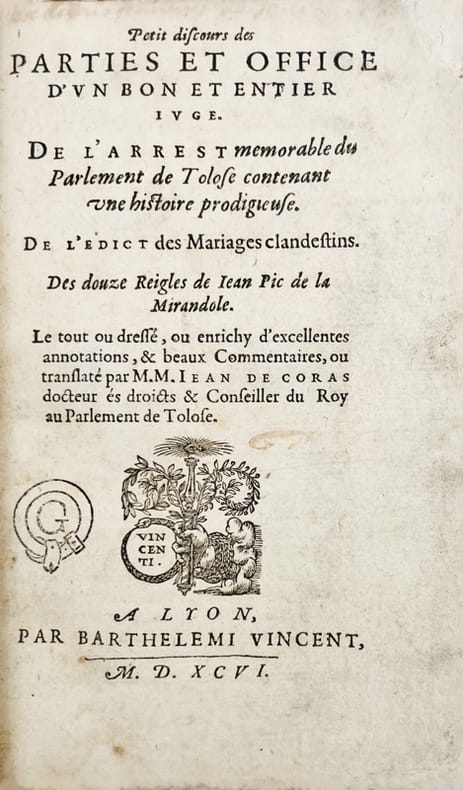
1596ref. 44490Lyon, Barthelemi Vincent, 1596. 3 parties en 1 vol. petit in-8 de 80-(16)-160 pp., 16 ff., maroquin havane, dos titré à nerfs, armes dorées au centre des plats et super-libris en pied, roulette dorée sur les chasses et double filet doré sur les coupes, signet de soie verte, tranches dorées (Niédrée).
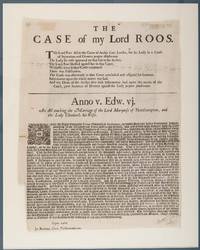
1690ref. 857911690. 12-1/2" x 9-3/4" 32 x 25.1 cm. 12-1/2" x 9-3/4" 32 x 25.1 cm. A Rare Late Seventeenth-Century Broadside on the Precedents for Parliamentary Divorce Broadside. Divorce. Manners John 1638-1711 Lord Roos. The Case of My Lord Roos. London: S.n. c. 1690. 12-1/2" x 9-3/4" 32 x 25.1 cm broadside single-column text in two parts separated by rule below headline second part begins "Anno v. Edw. vj." attractively matted and glazed in a modern frame. 20" x 16-1/4" 50 x 41.4 cm. Moderate toning a few faint later pencil notes small tears along horizontal fold lower left edge excised without loss of text. Very good not examined out of frame. $3500. A rare ephemeral publication setting out two leading precedents for the dissolution of marriage by Act of Parliament on grounds of adultery. The first concerns John Manners then Lord Roos whose 1670 divorce established a model combining separation bastardization of issue and the right of remarriage. The second recounts the more protracted Tudor proceedings involving William Parr 1547-1552 including the subsequent reversal under Mary I of England. Broadsides of this character functioned as vehicles of legal and political argument distilling complex precedents into accessible form for circulation in support of pending or anticipated legislation. The present example is plausibly connected with the campaign surrounding the attempted divorce of Henry Howard whose efforts in the 1690s and again in 1700 generated related printed advocacy. This copy formerly in the library of Lawrence Stotter and recently dispersed. OCLC Library Hub and the ESTC locate 1 copy British Library. English Short-Title Catalogue R173542. See also Stotter To Put Asunder: The Laws of Matrimonial Strife 115-117 this copy. unknown books
1690ref. 857911690. 12-1/2" x 9-3/4" 32 x 25.1 cm. 12-1/2" x 9-3/4" 32 x 25.1 cm. A Rare Late Seventeenth-Century Broadside on the Precedents for Parliamentary Divorce Broadside. Divorce. Manners John 1638-1711 Lord Roos. The Case of My Lord Roos. London: S.n. c. 1690. 12-1/2" x 9-3/4" 32 x 25.1 cm broadside single-column text in two parts separated by rule below headline second part begins "Anno v. Edw. vj." attractively matted and glazed in a modern frame. 20" x 16-1/4" 50 x 41.4 cm. Moderate toning a few faint later pencil notes small tears along horizontal fold lower left edge excised without loss of text. Very good not examined out of frame. $3500. A rare ephemeral publication setting out two leading precedents for the dissolution of marriage by Act of Parliament on grounds of adultery. The first concerns John Manners then Lord Roos whose 1670 divorce established a model combining separation bastardization of issue and the right of remarriage. The second recounts the more protracted Tudor proceedings involving William Parr 1547-1552 including the subsequent reversal under Mary I of England. Broadsides of this character functioned as vehicles of legal and political argument distilling complex precedents into accessible form for circulation in support of pending or anticipated legislation. The present example is plausibly connected with the campaign surrounding the attempted divorce of Henry Howard whose efforts in the 1690s and again in 1700 generated related printed advocacy. This copy formerly in the library of Lawrence Stotter and recently dispersed. OCLC Library Hub and the ESTC locate 1 copy British Library. English Short-Title Catalogue R173542. See also Stotter To Put Asunder: The Laws of Matrimonial Strife 115-117 this copy. unknown