TROTSKY, l [TROTSKI, TROTSKII].Biblio.com

428 résultats
1924réf. 58185Berlin 1924. Original printed wrappers. A bit of browning to wrappers and a bit loose at the inner hinges. But overall in very nice condition. 59pp. First edition in the extremely scarce separate off-print of this seminal essay which appeared in October 1924 as the preface to the third volume of Trotsky's collected works. The essay now counts as a work in its own and was subsequently reprinted numerous times on its own by the Trotskyist movement. This seminal essay came to play a defining role in the development of post-Lenin politics in Russia. It was extremely critical of the purported revolutionary failings of two key members of the collective leadership that ruled Soviet Russia in the months after Lenin's death Grigory Zinoviev and Lev Kamenev and Trotsky was seen as main threat to the accession of power. The publication of his foundational essay on the October Revolution was used as a pretext for the Soviet leadership to isolate and attack Trotsky. It now constitutes a cornerstone of post-Revolutionaly Russian politics. "When Lenin was stricken with his first cerebral hemorrhage in May 1922 the question of eventual succession to the leadership of Russia became urgent. Trotsky owing to his record and his charismatic qualities was the obvious candidate in the eyes of the party rank and file but jealousy among his colleagues on the Politburo prompted them to combine against him. As an alternative the Politburo supported the informal leadership of the troika composed of Grigory Zinovyev Lev Kamenev and Stalin.In the winter of 1922-23 Lenin recovered partially and turned to Trotsky for assistance in correcting the errors of the troika particularly in foreign trade policy the handling of the national minorities and reform of the bureaucracy. In December 1922 warning in his then secret "Testament" of the danger of a split between Trotsky and Stalin Lenin characterized Trotsky as a man of "exceptional abilities" but "too far-reaching self-confidence and a disposition to be too much attracted by the purely administrative side of affairs." Just before he was silenced by a final stroke in March 1923 Lenin invited Trotsky to open an attack on Stalin but Trotsky chose to bide his time possibly contemplating an alliance against Zinovyev. Stalin moved rapidly to consolidate his hold on the Central Committee at the 12th Party Congress in April 1923.By fall alarmed by inroads of the secret police among party members and efforts to weaken his control of the war commissariat Trotsky decided to strike out against the party leadership. In October he addressed a wide-ranging critique to the Central Committee stressing especially the violation of democracy in the party and the failure to develop adequate economic planning. Reforms were promised and Trotsky responded with an open letter detailing the direction they should take. This however served only as the signal for a massive propaganda counterattack against Trotsky and his supporters on grounds of factionalism and opportunism. At this critical moment Trotsky fell ill of an undiagnosed fever and could take no personal part in the struggle. Because of Stalin's organizational controls the party leadership easily won and the "New Course" controversy was terminated at the 13th Party Conference in January 1924 the first substantially stage-managed party assembly with the condemnation of the Trotskyist opposition as a Menshevik-like illegal factional deviation. Lenin's death a week later only confirmed Trotsky's isolation. Convalescing on the Black Sea coast Trotsky was deceived about the date of the funeral failed to return to Moscow and left the scene to Stalin. His eulogy for the late party leader was in effect delivered in a biography of Lenin that Trotsky wrote for the 13th edition 1926 of the Encyclopædia Britannica.Attacks on Trotsky did not cease. When the 13th Party Congress in May 1924 repeated the denunciations of his violations of party discipline Trotsky vainly professed his belief in the omnipotence of the party. The following fall he took a different tack in his essay "The Lessons of October 1917" linking the opposition of Zinovyev and Kamenev to the October Revolution with the failure of the Soviet-inspired German communist uprising in 1923. The party leadership replied with a wave of denunciation counterposing Trotskyism to Leninism denigrating Trotsky's role in the Revolution and denouncing the theory of permanent revolution as a Menshevik heresy. In January 1925 Trotsky was removed from the war commissariat." Encycl. Britt. unknown
1936réf. 97388New York: Pioneer Publishers 1936. First edition of this collection of writings and speeches by Trotsky. Octavo original cloth. Presentation copy inscribed by the author on the front free endpaper in the year of publication "To Comrade Max Sterling fraternally Leon Trotsky 8/7 1936 Weksel Norway." After being exiled from the Soviet Union Trotsky lived in a number of places Norway among them. The Norwegian Labor Party which rose to power in 1935 had had previous affiliations with the Communist International and the Second International prompting Trotsky to seek and obtain a visa from Oslo. Bookplate to the front pastedown very good in a very good dust jacket. Translated by John G. Wright. With an introduction and explanatory notes by Max Shachtman. Uncommon signed and inscribed. Written in 1928 this is Trotsky's alternative to Stalin's course toward gutting the revolutionary program of the Communist International. "An international communist program is in no case the sum total of national programs or an amalgam of their common features" Trotsky wrote. "In the present epoch to a much larger extent than in the past the national orientation of the proletariat must and can flow only from a world orientation and not vice versa." Suppressed by Stalin in the Soviet Union its publication elsewhere in the world helped gather the forces that continued the fight to build a revolutionary international movement of the working class. Pioneer Publishers hardcover
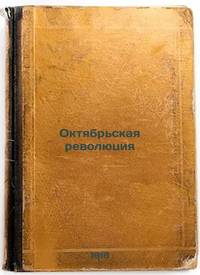
réf. 9175495Short description: In Russian. Trotsky Lev Davidovich. October Revolution. Moscow; Petrograd: Communist 1918. The image is provided for reference only. It may reflect condition of one of the available copies or only help in identifying the edition. Please feel free to contact us for a detailed description of the copies available. SKU9175495 unknown