TROTSKY, LeonBiblio.com

639 risultati
rif. 119200London Thornton Butterworth Limited 1930. . First edition in English; large 8vo 24 x 16.5 cm; portrait frontispiece occasional light spotting more pronounced to prelims offsetting to final f. of text; modern half red morocco spine lettered in gilt top-edge gilt others rough-trimmed very good; 512pp. The first edition in English of the Russian revolutionary Leon Trotsky's autobiography My Life. The Rise and Fall of a Dictator. Trotsky 1879-1940 wrote the text during his exile from the Soviet Union following his expulsion in 1929. The book contains a frank account from his fall from power in the years following Lenin's death in 1924 after which a 'division began to reveal itself between the leaders who expressed the historical line of the class and could see beyond the apparatus and the apparatus itselfa huge cumbrous heterogeneous thing that easily sucked in the average communist' p.428. London, Thornton Butterworth, Limited, 1930. unknown
rif. DADAX0333918061New unknown
1974rif. mon0000935560Pathfinder Press 1974T. paperback. Good. in x in x in. 1970 printing 2nd printing. Pathfinder Press paperback
1943rif. DAVI-0087-07-17-2024New International Pubishing Co 1943. paperback. Good. 0x0x0. 1965 used hardcover copy MISSING dust jacketHas previous owner name sunning to pages no pen markings stains or stickers fast shipping with tracking number. New International Pubishing Co paperback
1974rif. 70516Rodolfo Alonso Editor 1974. paperback. Bueno. Buenos Aires 1974. Rodolfo Alonso Editor. Colección Argumentos. 120 pp. 18x13. Rústica. Firma anterior propietario. Rodolfo Alonso, Editor paperback
1973rif. 71860El Yunque Editora 1973. paperback. Bueno. Buenos Aires 1973. El Yunque Editora. Ediciones el Yunque nº 8. 294 pp. 18x13. Rústica. Firma anterior propietario. El Yunque, Editora paperback
1968rif. 82876Paris: Voix Ouvrière 1968. Fine. Voix Ouvrière Paris s. d. circa 1968 15 x 20 cm broché Reprint of the very rare first edition of the French translation printed by Voix ouvrière in 1939. Unlettered cloth spine. Rare and handsome copy. Voix Ouvrière hardcover
1968rif. 82924Paris: Voix Ouvrière 1968. Fine. Voix Ouvrière Paris s. d. circa 1968 15 x 20 cm broché Reprint of the very rare first edition of the French translation printed by Voix ouvrière in 1939. Cloth spine unlettered. A rare and handsome copy. Voix Ouvrière hardcover
rif. 6131352970Papeback. New. pp. 182 unknown
rif. DADAX0367230585New unknown
rif. GOR012059486Paperback. Very Good. paperback
rif. 0873488296.Gpaperback. Good. Access codes and supplements are not guaranteed with used items. May be an ex-library book. paperback
1920rif. 68450Paris: Editions & librairie 1920. Fine. Editions & librairie Paris 1920 14 x 20.50 cm broché First edition of the French translation of which there were no deluxe copies. Spine slightly faded and wrinkled with two small tears with minimal lacks at head and foot. Cover illustrated with a vignette. Editions & librairie unknown
1924rif. 58185Berlin 1924. Original printed wrappers. A bit of browning to wrappers and a bit loose at the inner hinges. But overall in very nice condition. 59pp. First edition in the extremely scarce separate off-print of this seminal essay which appeared in October 1924 as the preface to the third volume of Trotsky's collected works. The essay now counts as a work in its own and was subsequently reprinted numerous times on its own by the Trotskyist movement. This seminal essay came to play a defining role in the development of post-Lenin politics in Russia. It was extremely critical of the purported revolutionary failings of two key members of the collective leadership that ruled Soviet Russia in the months after Lenin's death Grigory Zinoviev and Lev Kamenev and Trotsky was seen as main threat to the accession of power. The publication of his foundational essay on the October Revolution was used as a pretext for the Soviet leadership to isolate and attack Trotsky. It now constitutes a cornerstone of post-Revolutionaly Russian politics. "When Lenin was stricken with his first cerebral hemorrhage in May 1922 the question of eventual succession to the leadership of Russia became urgent. Trotsky owing to his record and his charismatic qualities was the obvious candidate in the eyes of the party rank and file but jealousy among his colleagues on the Politburo prompted them to combine against him. As an alternative the Politburo supported the informal leadership of the troika composed of Grigory Zinovyev Lev Kamenev and Stalin.In the winter of 1922-23 Lenin recovered partially and turned to Trotsky for assistance in correcting the errors of the troika particularly in foreign trade policy the handling of the national minorities and reform of the bureaucracy. In December 1922 warning in his then secret "Testament" of the danger of a split between Trotsky and Stalin Lenin characterized Trotsky as a man of "exceptional abilities" but "too far-reaching self-confidence and a disposition to be too much attracted by the purely administrative side of affairs." Just before he was silenced by a final stroke in March 1923 Lenin invited Trotsky to open an attack on Stalin but Trotsky chose to bide his time possibly contemplating an alliance against Zinovyev. Stalin moved rapidly to consolidate his hold on the Central Committee at the 12th Party Congress in April 1923.By fall alarmed by inroads of the secret police among party members and efforts to weaken his control of the war commissariat Trotsky decided to strike out against the party leadership. In October he addressed a wide-ranging critique to the Central Committee stressing especially the violation of democracy in the party and the failure to develop adequate economic planning. Reforms were promised and Trotsky responded with an open letter detailing the direction they should take. This however served only as the signal for a massive propaganda counterattack against Trotsky and his supporters on grounds of factionalism and opportunism. At this critical moment Trotsky fell ill of an undiagnosed fever and could take no personal part in the struggle. Because of Stalin's organizational controls the party leadership easily won and the "New Course" controversy was terminated at the 13th Party Conference in January 1924 the first substantially stage-managed party assembly with the condemnation of the Trotskyist opposition as a Menshevik-like illegal factional deviation. Lenin's death a week later only confirmed Trotsky's isolation. Convalescing on the Black Sea coast Trotsky was deceived about the date of the funeral failed to return to Moscow and left the scene to Stalin. His eulogy for the late party leader was in effect delivered in a biography of Lenin that Trotsky wrote for the 13th edition 1926 of the Encyclopædia Britannica.Attacks on Trotsky did not cease. When the 13th Party Congress in May 1924 repeated the denunciations of his violations of party discipline Trotsky vainly professed his belief in the omnipotence of the party. The following fall he took a different tack in his essay "The Lessons of October 1917" linking the opposition of Zinovyev and Kamenev to the October Revolution with the failure of the Soviet-inspired German communist uprising in 1923. The party leadership replied with a wave of denunciation counterposing Trotskyism to Leninism denigrating Trotsky's role in the Revolution and denouncing the theory of permanent revolution as a Menshevik heresy. In January 1925 Trotsky was removed from the war commissariat." Encycl. Britt. unknown
1936rif. 97388New York: Pioneer Publishers 1936. First edition of this collection of writings and speeches by Trotsky. Octavo original cloth. Presentation copy inscribed by the author on the front free endpaper in the year of publication "To Comrade Max Sterling fraternally Leon Trotsky 8/7 1936 Weksel Norway." After being exiled from the Soviet Union Trotsky lived in a number of places Norway among them. The Norwegian Labor Party which rose to power in 1935 had had previous affiliations with the Communist International and the Second International prompting Trotsky to seek and obtain a visa from Oslo. Bookplate to the front pastedown very good in a very good dust jacket. Translated by John G. Wright. With an introduction and explanatory notes by Max Shachtman. Uncommon signed and inscribed. Written in 1928 this is Trotsky's alternative to Stalin's course toward gutting the revolutionary program of the Communist International. "An international communist program is in no case the sum total of national programs or an amalgam of their common features" Trotsky wrote. "In the present epoch to a much larger extent than in the past the national orientation of the proletariat must and can flow only from a world orientation and not vice versa." Suppressed by Stalin in the Soviet Union its publication elsewhere in the world helped gather the forces that continued the fight to build a revolutionary international movement of the working class. Pioneer Publishers hardcover
rif. DADAX1859844413New unknown
rif. DADAX0415232511New unknown
1971rif. DADAX0873487389Pathfinder 1971-12-31. paperback. New. 5.24x0.65x8.24. Buy with confidence. Excellent Customer Service & Return policy. Pathfinder paperback
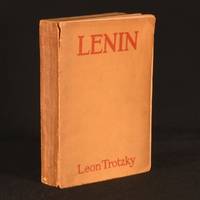
1925rif. 1007H31London: George G Harrap and Co. Ltd. 1925. Paperback. Good. 7.5" by 5". None. A very scarce copy of the first authorised English edition of Trotsky"s study of Lenin. In the publisher's original paper wraps. First English edition. Authorised translation. A concise political and biographical study of Lenin by one of his closest collaborators examining his role in the Bolshevik movement. Leon Trotsky 1879-1940 was a central figure in the Russian Revolution and founder of the Red Army. In the publisher's original paper wraps. Externally a little worn. Front free endpaper full detached but present. Cracking to gutter with front wrap slightly loosened but holding. Creasing to spine with one or two closed tears. Closed tearing to extremities of joint. The odd minor handling mark to wraps more so to rear wrap. Internally generally firmly bound. Hinges slightly strained in places but firm. Pages bright and clean if characteristically age toned. Good George G Harrap and Co. Ltd. paperback
1918rif. 87406Granite City IL: Съюзната Соц. Книжарница и Печатница = Union Social Bookstore and Printing House 1918. First Bulgarian Edition in America. 12mo. Brown woven cloth titled in black on spine and front cover; 134pp. Trace of rubbing at spine ends still a tight Very Good or better copy. Translation into Bulgarian of Trotsky's "The Bolsheviki and World Peace" made from the English version published by Boni & Liveright earlier the same year. The Boni edition was in fact a new translation from the German of Trotsky's 1914 pamphlet "The War and the International." Whether this translation was made with Boni & Liveright's permission or even knowledge is questionable though the verso of the title page does credit B&L with the original copyright. Granite City Illinois just across the Mississippi River from St. Louis in the extreme southwestern corner of the state was founded in 1896 as a company town by the Niedringhaus Brothers manufacturers of graniteware kitchen utensils. Between 1906 and 1908 the city became a destination for immigrant laborers from Bulgaria Macedonia and Hungary; by the early 1910s it was known as the Bulgarian Capital of America boasting the country's only general-circulation Bulgarian-language newspaper. The presence of so many working-class Slavic speakers made Granite City a natural target for radical organizing and a number of socialist presses thrived there during the first three decades of the Twentieth Century. Like all Granite City imprints we've encountered the current title is scarce and is of special interest for likely being the earliest Slavic-language printing of Trotsky's text in North America. OCLC notes only three physical holdings NYPL LC UI. Съюзната Соц. Книжарница и Печатница [= Union Social Bookstore and Printing House] unknown
1960rif. 86826Ann Arbor: The University of Michigan Press 1960. Second Printing. Octavo 24cm; gray cloth-covered boards with titling and blocking stamped in black and red on spine; dustjacket; xxi23-5044pp. Modest rubbing of cloth to front cover and board edges with soil to edges of textblock; Very Good. Dustwrapper designed by George Lenox price-clipped with modest shelf-wear and rubbing with slight effect to titling two 1" tears to upper spine folds 1" triangular chip to lower front flap fold tiny nicks to panels and tiny tears to extremities; Good. Text includes Volume One "The Overthrow of Tzarism" Volume Two "The Attempted Counter-Revolution" and Volume Three "The Triumph of the Soviets" with a concluding appendix section chronological table and index. 87826. The University of Michigan Press unknown
1957rif. 84355New York: Russell & Russell 1957. First Russell & Russell printing first published 1925. Octavo 21cm; tan cloth hardcover; dustjacket; 236pp. Clean straight tight and unmarked; Near Fine. In uncommon original dustwrapper unclipped priced $3.75 on front flap; toned on spine panel and margins with a few tiny nicks at spine ends Very Good. Possibly Trotsky's most enduring theoretical work of which historian and critic Alan Wald has written ".it is hard to think of another book in world history with an equivalent agenda of complex and burning issues" Writing from the Left. NY: 1994; p.129. This is a reprint of the Rose Strunsky translation originally issued by International Publishers in 1925. 84355. Russell & Russell unknown
1970rif. 520202505Pathfinder Press 1970. Softcover. Near Fine in glossy wraps. 8vo. 252 pp. Edited with an introduction by Paul N. Siegel. Pathfinder Press unknown
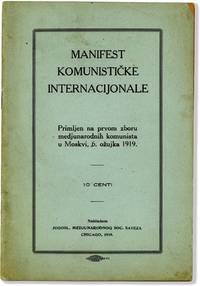
1919rif. 83563Chicago: Jugosl. Medjunarodnog Soc. Saveza 1919. 12mo 17cm. Staple-bound printed pale blue wrappers; 28pp. Mild toning and soil to wrapper edges; expected tanning to text; Very Good. Scarce American Croat translation of Trotsky's Manifesto of the Communist International which had originally appeared in Issue no. 1 of The Communist International the Comintern's theoretical organ. The translator of this edition is unidentified; nor is there any mention of Trotsky as author. Hoover Institution only in OCLC. Jugosl. Medjunarodnog Soc. Saveza unknown
1980rif. 1-0873488296Pathfinder Pr 1980. Paperback. New. 1340 pages. 8.25x5.25x2.00 inches. Pathfinder Pr paperback