Malthus, T RBiblio.com

457 risultati
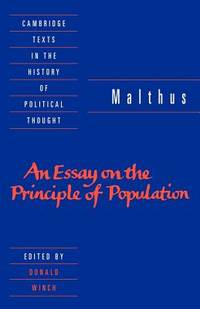
2011rif. DADAX052118410XCambridge University Press 2011-02-17. paperback. New. 6.00x0.82x9.00. Buy with confidence. Excellent Customer Service & Return policy. Cambridge University Press paperback
1992rif. DADAX0521429722Cambridge University Press 1992-08-28. Revised ed. paperback. New. 5.50x1.08x8.50. Buy with confidence. Excellent Customer Service & Return policy. Cambridge University Press paperback
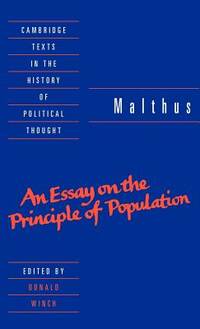
2004rif. DADAX0521588715Cambridge University Press 2004-07-19. hardcover. New. 6.25x1.00x9.25. Buy with confidence. Excellent Customer Service & Return policy. Cambridge University Press hardcover
1992rif. DADAX0521419549Cambridge University Press 1992-08-28. hardcover. New. 5.75x1.00x9.00. Buy with confidence. Excellent Customer Service & Return policy. Cambridge University Press hardcover
2010rif. DADAX1168127580Kessinger Publishing 2010-09-10. paperback. New. 6.00x0.86x9.00. Buy with confidence. Excellent Customer Service & Return policy. Kessinger Publishing paperback
2010rif. DADAX1160877718Kessinger Publishing 2010-03-19. paperback. New. 6.00x0.86x9.00. Buy with confidence. Excellent Customer Service & Return policy. Kessinger Publishing paperback
rif. 9506202141.Gpaperback. Good. Access codes and supplements are not guaranteed with used items. May be an ex-library book. paperback
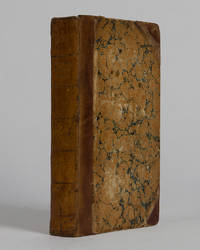
1820rif. 66825London: John Murray 1820. If Only Malthus Instead of Ricardo Had Been the Parent Stem From Which Nineteenth-Century Economics Proceeded What a Much Wiser and Richer Place the World Would be Today" MALTHUS Thomas Robert. Principles of Political Economy. Considered with a View to Their Practical Application. London: John Murray 1820. First edition. Octavo. vi 12-601602. Original boards uncut. With original paper label on spine. Hinges expertly and almost invisibly repaired. Old bookplate from "The Library of Victoria" with no other library markings. A very clean copy internally fine. Very scarce in original boards. Housed in a custom quarter black morocco clamshell gilt-stamped. First edition of Malthus' principal contribution to economic theory. Schumpeter describes Malthus' work in relation to that of his predecessors Adam Smith and Ricardo as follows: "Ricardo's work.started with the Wealth of Nations and recoined the latter's theoretical contents by a method that centered in the concept of value. Exactly the same thing is evidently true of the work of Malthus.except for his theory of saving and investment which on the face of it seems to be Malthus's own all the elements that enter into the analytic apparatus of that work and even its terminological arrangements point to the First book of the Wealth of Nations. Only whereas Ricardo recoined the doctrine of Wealth by means of the labor-quantity theory of value Malthus recoined it by the means of the theory of value that A. Smith actually used namely the theory of supply and demand.whereas Ricardo's analytic apparatus is geared to the problem of distribution.Malthus. geared his apparatus to the analysis of the whole economic process.Therefore Malthus should.stand in the history of analysis not only as the author of a valid alternative to Ricardo's theory but as the sponsor or rather as one of the sponsors of the victorious one." "Although Malthus is best known for the views on population contained in his Essay on Population.there can be no doubt that his importance for economists today rests mainly on his Principles of Political Economy 1820. It was because of the latter work that J. M. Keynes reinstated Malthus as a major figure in modern economic thought". New Palgrave. Cress C577. HBS 66825. $6500. John Murray unknown
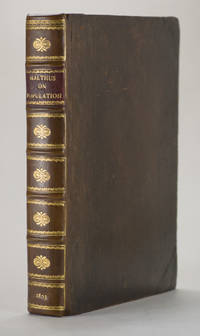
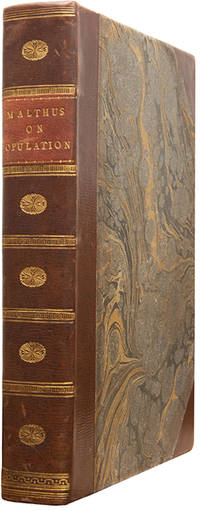
1803rif. 65276London: Printed for J. Johnson.by T. Bensley 1803. The Economics of Population MALTHUS Thomas Robert. An Essay on the Principle of Population; Or a view of its past and present effects on Human Happiness; With an Inquiry into our prospects respecting the future removal or mitigation of the evils which it occasions. A new edition very much enlarged. London: Printed for J. Johnson. by T. Bensley 1803. Second edition enlarged and revised. Quarto. viii 4 610 pp. Contemporary calf skillfully rebacked to style and with corners renewed. Spine decoratively tooled in gilt compartments with burgundy morocco gilt lettering label. Endpapers renewed. Occasional light foxing. Title-page with publisher's diagonal paper flaw crease. Overall very good. A completely revised and greatly expanded edition of the most influential work on population ever written. Malthus published the first edition of his Essay in 1798 and was apparently unprepared for the torrent of controversy that his ideas provoked. His response to the public outcry was to spend the next five years refining and expanding his theories for this second edition so much so that "in its present shape it may be considered a new work and I should probably have published it as such omitting the few parts of the former which I have retained but that I wished it to form a whole of itself and not to need a continual reference to the other." preface Malthus' basic argument--that population increases geometrically at a greater rate than does the means of subsistence which increases arithmetically--was one of the earliest modern economic and social theories and his contention that it would eventually become necessary for society to impose some form of restraint on over-population provided the premise for heated socio-economic debate for almost two centuries. Kress B4701. See Printing and the Mind of Man 251. HBS 65276. $6500. Printed for J. Johnson...by T. Bensley unknown
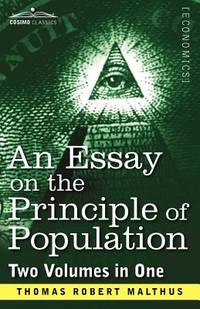
2011rif. SONG1616405708Cosimo Classics 2011-12-01. paperback. Used: Good. 5.50x1.35x8.50. Buy with confidence. Excellent Customer Service & Return policy. Cosimo Classics paperback
2008rif. SONG0521071348Cambridge University Press 2008-09-04. Reissue. paperback. Used: Good. 6.00x1.16x9.00. Buy with confidence. Excellent Customer Service & Return policy. Cambridge University Press paperback
rif. 6397214Cambridge University Press CUP . Papeback. New. pp. 680 Cambridge University Press CUP unknown
rif. 6395417Cambridge University Press CUP . Papeback. New. pp. 464 Cambridge University Press CUP unknown
1988rif. SONG082040490XPeter Lang Gmbh Internationaler Verlag Der Wissenschaften 1988-05-01. New. hardcover. Used: Good. 0.00x0.00x0.00. Buy with confidence. Excellent Customer Service & Return policy. Peter Lang Gmbh, Internationaler Verlag Der Wissenschaften hardcover
2008rif. SONG0521075939Cambridge University Press 2008-09-04. 1. paperback. Used: Good. 6.00x1.29x9.00. Buy with confidence. Excellent Customer Service & Return policy. Cambridge University Press paperback
rif. 123522London John Murray 1820. . First edition; 8vo 21 x 13.5 cm; moderate spotting front free endpaper just starting to become loose at head of gutter margin remains of a library label to front pastedown; contemporary half calf marbled paper boards spine lettered in gilt dulled; vi 601 1pp. The first edition of Malthus' treatise on political economy. The book was conceived as a series of tracts rather than a comprehensive and systematic treatise though Malthus published it to establish his own position against that of Ricardo with whom he had been having an ongoing debate about the nature of labour demand and profit. 'In his 'Principles of Political Economy' Malthus was proposing investment in public work and private luxury as a means of increasing effective demand and hence as a palliative to economic distress. The nation he thought must balance the power to produce and the will to consume' DSB. 'The Principles had only a limited impact at the time and was severely criticized by J. R. McCulloch and Ricardo; the latter prepared extensive critical notes. More recently it has received greater recognition largely as a result of the comments by J. M. Keynes in the 1930s. Keynes argued that Malthus's theory of effective demand provided a scientific explanation of unemployment and that the hundred-year domination of Ricardo over Malthus had been a disaster for the progress of economics. Keynes believed that if economics had followed Malthus instead of being constrained by Ricardo in an artificial groove the world would be a much wiser and richer place.' ODNB. Goldsmiths' 22767; Kress C.577. London, John Murray, 1820. hardcover
rif. DADAX0270329129Wentworth Press 2018-07-26. hardcover. New. 6.14x1.19x9.21. Buy with confidence. Excellent Customer Service & Return policy. Wentworth Press hardcover
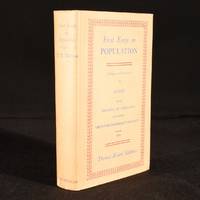
1966rif. 948Q29London: Macmillan 1966 . Cloth. Fine/Near Fine. 8.5" by 5.5". None. An excellent facsimile edition of Thomas Robert Malthus's eighteenth-century essay on population with the publisher's dust wrapper. A reprint in facsimile of Thomas Robert Malthus' 'An Essay on the Principle of Population'. Bound in the publisher's cloth with the original price-clipped dust wrapper. Originally published in 1798 this work was written by English economist scholar and cleric Thomas Robert Malthus. In 'An Essay on the Principle of Population' Malthus proposed that an increase in a nation's food production would lead to population growth meaning the initial benefits would only be temporary. With notes by Scottish historian and economist James Bonar to the rear of the work. Bound in the publisher's cloth with the original price-clipped dust wrapper. Externally excellent with minor shelf wear only. Dust wrapper is also excellent with light edge wear and a touch of sunning to the spine. Internally firmly bound. Pages are bright and clean. Fine Macmillan hardcover
1933rif. 955T81London: J. M. Dent & Sons Ltd. 1933-1941. Cloth. Near Fine/Good. 7" by 4.5". None. A smart set of this important treatise on population from English economist Thomas Robert Malthus. Complete in two volumes. Everyman's Library. Volume one is dated 1941 and volume two is dated 1933. An abridged version of Malthus' An Essay on the Principle of Population first published anonymously in 1798. This study warned of future difficulties on an interpretation of the population increasing in geometric progression while food production increased in an arithmetic progression which would result in the want of food and famine unless birth rates decreased. Written by Thomas Robert Malthus an English economist cleric and scholar influential in the fields of political economy and demography. In the original full cloth binding. Externally very smart with minor wear and light fading to the spines. Original unclipped dust wrappers are sound with light wear and sunning to the extremities. Light loss to the head and tails of the spines with a 2" closed tear to the head of the spine of volume two. Internally firmly bound. Pages are very bright with the odd small spot. Near Fine J. M. Dent & Sons Ltd. hardcover
rif. 112135London T. Bensley for J. Johnson 1803. . Second edition substantially revised; 4to 27.5 x 22 cm; a few pencil annotations C4 cancelled and signed C3 title neatly tipped on to following leaf small chip lower edge b2 occasional spotting; modern half brown morocco gilt spine in 6 compartments contrasting red morocco lettering-piece very good; viii 4 610pp. The second edition substantially revised and in essence a 'new work'. The second edition substantially revised and in essence a 'new work' in which Malthus defends his views against a host of critics Preface. 'The central idea of the essay and the hub of Malthusian theory was a simple one. The population of a community Malthus suggested increases geometrically while food supplies increased only arithmetically. If the natural increase in population occurs the food supply becomes insufficient and the size of the population is checked by 'misery' that is the poorest sections of the community suffer disease and famine. The Essay was highly influential in the progress of thought in early nineteenth-century Europe' PMM. In this enlarged edition Malthus made clear what was only implicit in the first that prudential restraint should if humanly possible be 'moral restraint' that is delayed marriage accompanied by strictly moral pre-marital behaviour although he admitted that moral restraint would not be easy and that there would be occasional failures. Whereas in the first edition he had said that all the checks to population would involve either misery or vice in the second edition he attempted to lighten this 'melancholy hue' first edition p.iv and 'to soften some of the harshest conclusions of the first essay' second edition p.vii by arguing that moral restraint if supported by an education emphasising the immorality of bringing children into the world without the means of supporting them would tend to increase rather than diminish individual happiness. 'His work was an important influence on both Darwin and Wallace in their formulation of the concept of natural selection. It also had a profound influence on the decrease in size of families down to the present time' Garrison-Morton. Cf.PMM 251; Garrison-Morton 1693; Goldsmiths 18640; Kress B.4701. London, T. Bensley for J. Johnson, 1803. unknown
rif. bo5R.08-05-2022.20:28:01Leather Bound. New. hardcover
rif. 95379Altona I. F. Hammerich 1807. . First German edition 2 vols 8vo 20 x 12.5 cm. pp. xvi 368; pp. vii 358; very slight spotting to vol. 1. Contemporary half-brown leather binding; flat spine gilt bands separating compartments compartments 1 3 5 and 6 contain gilt floral decoration compartments 2 and 4 contain gilt lettering including translator's name and title gilt library stamp to both upper boards library stamps to verso of both upper boards and title pages pencil markings to verso of upper boards and endpapers; rubbed water or possibly glue marks to verso of upper boards and endpapers. Rare first German edition and first translation into a foreign language of this important work by the father of Malthusianism. Malthus' original work written in English was first published anonymously in 1798. It discusses the problem of the gap between population growth which is potentially exponential and the growth of food supply which is not. The work arose from a discussion between Malthus and his father about the possibility of a better society and went on to have an enormous impact on social policy. Ultimately Malthus believed population growth would always outrun food supply and therefore the betterment of society was impossible without stern limits on reproduction. For this reason he is often associated with Darwin. His views became popular again in the XX century largely due to the work of John Maynard Keynes. 'The essay exercised a strong influence on European intellectual development at the beginning of the nineteenth century. the Socialists fought him unanimously. and the Conservatives were happy that somebody was fighting against the spread of revolutionary ideas from the continent.' Carter/Muir. Thomas Malthus 1766 - 1834 was born into a family of intellectuals and his father was a great friend of the philosopher David Hume. He took holy orders in 1797 but in 1805 decided to become a professor teaching history and the relatively new subject of political economy at the East India Company college in Haileybury. He was elected a member of the Royal Society in 1819 and in 1834 founded the Statistical Society of London. Altona, I. F. Hammerich, 1807. hardcover
rif. 95378London John Murray 1820. . First edition; 8vo; small ownership stamp to lower outside corner of title-page small early 20th century bookseller's label to lower outside corner of verso of upper free endpaper a little age-toning and small ink smudge to title nineteenth century half calf over marbled boards rubbed at extremities spine faded a very good copy; vi 601 pp. The book was conceived as a series of tracts rather than a comprehensive and systematic treatise though Malthus published it to establish his own position against that of Ricardo with whom he had been having an ongoing debate about the nature of labour demand and profit. 'In his 'Principles of Political Economy' Malthus was proposing investment in public work and private luxury as a means of increasing effective demand and hence as a palliative to economic distress. The nation he thought must balance the power to produce and the will to consume' DSB. 'The Principles had only a limited impact at the time and was severely criticized by J. R. McCulloch and Ricardo; the latter prepared extensive critical notes. More recently it has received greater recognition largely as a result of the comments by J. M. Keynes in the 1930s. Keynes argued that Malthus's theory of effective demand provided a scientific explanation of unemployment and that the hundred-year domination of Ricardo over Malthus had been a disaster for the progress of economics. Keynes believed that if economics had followed Malthus instead of being constrained by Ricardo in an artificial groove the world would be a much wiser and richer place.' ODNB. Goldsmiths' 22767; Kress C.577. London, John Murray, 1820. hardcover
2009rif. DADAX1120497418Kessinger Publishing 2009-11-06. paperback. New. 6.00x0.86x9.00. Buy with confidence. Excellent Customer Service & Return policy. Kessinger Publishing paperback
2009rif. DADAX1120503574Kessinger Publishing 2009-11-06. paperback. New. 6.00x0.94x9.00. Buy with confidence. Excellent Customer Service & Return policy. Kessinger Publishing paperback