604 Ergebnisse
Best.-Nr. DADAX0415381134New unknown
Best.-Nr. DADAX0521178630New unknown
Best.-Nr. DADAX0521071321New unknown
1992Best.-Nr. DADAX0521419549Cambridge University Press 1992-08-28. hardcover. New. 5.75x1.00x9.00. Buy with confidence. Excellent Customer Service & Return policy. Cambridge University Press hardcover
2008Best.-Nr. SONG0521071348Cambridge University Press 2008-09-04. Reissue. paperback. Used: Good. 6.00x1.16x9.00. Buy with confidence. Excellent Customer Service & Return policy. Cambridge University Press paperback
2011Best.-Nr. SONG052118410XCambridge University Press 2011-02-17. paperback. Used: Good. 6.00x0.82x9.00. Buy with confidence. Excellent Customer Service & Return policy. Cambridge University Press paperback
Best.-Nr. SONG0804691053Used: Good unknown
1986Best.-Nr. C66294London: Pickering 1986. First Edition Thus. Hardback. No Dust Jacket. Hardback Hardcover. Fine. First Edition Thus. Hardback. No Dust Jacket. 8vo. pp 139. Original publisher's burgundy cloth lettered gilt at the spine. Volume 1 only. First published in 1798. ISBN: 1851960015 Fine. Pickering, hardcover
2015Best.-Nr. SBBI-mon0000150877Penguin Classics 2015. paperback. Good. Our good condition books are generally good for reading but not for gifting or collecting. They could have imperfections such as creasing fanning inscriptions margin notes yellowing staining on edge or cover or pages bumps scuffs etc etc sometimes multiple of these. It's a wide category that encompasses anything that isn't almost-new down to anything that is slightly better than poor. We would NOT recommend gifting Good books - these should be considered reading copies. Our books are dispatched from a Yorkshire former cotton mill. We list via barcode/ISBN so please note that the images are stock images and may not be the exact copy you receive furthermore the details about edition and year might not be accurate as many publishers reuse the same ISBN for multiple editions and as we simply scan a barcode or enter an ISBN we do not check the validity of the edition data when listing. If you're looking for an exact edition please don't order at least not without checking with us first although we don't always have time to check. We aim to dispatch prompty the service used will depend on order value and book size. We can ship to most countries see our shipping policies. Payment is via Abe only. Penguin Classics paperback
1820Best.-Nr. 948P11London: John Murray 1820. First edition. Cloth. Very Good. 9" by 6". None. The first edition of this important economic work by the influential writer Thomas Robert Malthus. The first edition.'Principles of Political Economy' is now regarded as a very influential study on economics in which the author explains the historical economic depression in Europe and why they occur. The work rejects the idea of Say's law and Ricardo's 1817 Principles of Political Economy and Taxation generally. Malthus argued that any rise in wages above the subsistence level would encourage population growth which in turn would drive wages back down to subsistencea dynamic often referred to as the "Malthusian trap." By the economist scholar and cleric Thomas Robert Malthus. He published this work to rival David Ricardo's 1817 work 'Principles of Political Economy and Taxation'."The Principles had only a limited impact at the time and was severely criticized by J. R. McCulloch and Ricardo; the latter prepared extensive critical notes. But more recently it has received greater recognition largely as a result of the comments by J. M. Keynes in the 1930s. Keynes argued that Malthus's theory of effective demand provided a scientific explanation of unemployment and that the hundred-year domination of Ricardo over Malthus had been a disaster for the progress of economics. Keynes believed that if economics had followed Malthus instead of being constrained by Ricardo in an artificial groove the world would be a much wiser and richer place" DNBVery rarely seen eight pages of adverts to the rear dated April 1820. In a rebacked cloth binding. Externally generally smart. Spine label is rubbed with light marks and a small amount of loss. Minor bumping to the extremities. Light marks and a small amount of rubbing to the cloth. Internally firmly bound. Pages are lightly age-toned and generally clean with scattered spots. Tidemark to pages 159 to 194. Very Good John Murray hardcover
1803Best.-Nr. 924F45DLondon: J. Johnson by T. Bensley 1803. Leather. Very Good. 11" by 9". None. The important and heavily revised second edition of Thomas Robert Malthus's discussion of the problems of a growing human population. First published in 1798 this is the substantially revised enlarged and re-written second edition of Malthus's important work.Malthus's work - which posits that the human population will outgrow the supply of food and resources - fuelled the debate on the size of the British population and contributed to the passion of the Census Act of 1800.A key argument within the book was dedicated to what is now known as the Malthusian Law of Population theorising that growing population rates will lead to a rising supply of labour inevitably lowering wages and leading to poverty.With the armorial bookplate of James Frampton to the front pastedown along side the former owner's ink inscription of N.B. Hobbs. Hobbs's inscription is also present to the recto of a front blank.This second edition incorporated details of population controls that had been used in various countries and periods. In a contemporary calf binding with light rubbing to boards. Minor loss to tail of spine label. Hinges neatly repaired. Retaining the original endpapers. Bookplate and inscription to front pastedown with further inscription to a front blank. Internally firmly bound. Significant spotting to endpapers and to first and final leaves. Pages bright with scattered further areas of concentrated spotting throughout. Very Good J. Johnson, by T. Bensley hardcover
Best.-Nr. 6100890702Other. New. pp. ix 396 unknown
1807Best.-Nr. 55024London: Printed for J. Johnson in St Paul's Church-Yard by T. Bensley 1807. Fourth edition. Octavo 22cm in two volumes. In contemporary brown calf seven sets of double gilt rules to spine titled in gilt on red leather spine label numbered on black leather spine labels blind tool to board edges all edges sprinkled grey; plain endpapers; vol. I: i-xvi 1-580pp; vol. II: i-viii 1-484 60pp. Sturdy copies much rubbed vol. I slightly cocked lower front joint of vol. I and upper front joint of vol. II cracking vol. II lacking spine label scratch to upper board of vol. II endleaves and some prelims foxed but otherwise internally free from soil: Good or better. The fourth edition of Malthus' widely influential discussion of overpopulation. Malthus 1766-1834 argued that population "increases geometrically while food supplies increase only arithmetically" and that some misery was inevitable unless population growth could be restrained. He proposed "moral restraint" as a solution. Many of his theories have now been largely rejected but "the Essay was highly influential in the progress of thought in early nineteenth-century Europe" and "his influence on social policy whether for good or evil was considerable." The first edition was shorter; "later editions were considerably altered and grew bulkier as Malthus defended his views against a host of critics" Printing and the Mind of Man. KRESS B.5219. GOLDSMITHS 19373. PMM 251 1st edn. Printed for J. Johnson in St Paul's Church-Yard, by T. Bensley unknown
1817Best.-Nr. 720P18London: John Murray 1817. First edition. Hardback. Very Good. 9" by 5.5". None. The first edition of this additions volume to Thomas Robert Malthus' immensely influential essay on the issue of growing population. The first edition of this work.This work is Malthus' additions to his influential book 'An Essay on the Principle of Population' added to the fourth and earlier editions.'An Essay on the Principle of Population' is a treatise warning of the future difficulties with a growing population on Earth.The essay was not the first work to be published on population but it was incredibly influential as contributed to the passing of the 1800 Census Act.This addition volume highlights key issues in the original work and expands upon them giving the reader a wider understanding of the issue of population.Written by Thomas Robert Malthus a scholar who is best known for this work and for his influential economics.Bound without publisher's adverts. In the original publisher's marbled paper boards. Externally smart. A small amount of bumping to the head and tail of the spine and to the extremities. A little rubbing to the boards and spine resulting in fading of the marble pattern. Internally firmly bound. Pages are lightly age-toned and generally clean with some scattered spotting. Very Good John Murray hardcover
Best.-Nr. 697393041Cosimo Incorporated . Papeback. New. pp. 610 Cosimo, Incorporated unknown
1820Best.-Nr. 66825London: John Murray 1820. If Only Malthus Instead of Ricardo Had Been the Parent Stem From Which Nineteenth-Century Economics Proceeded What a Much Wiser and Richer Place the World Would be Today" MALTHUS Thomas Robert. Principles of Political Economy. Considered with a View to Their Practical Application. London: John Murray 1820. First edition. Octavo. vi 12-601602. Original boards uncut. With original paper label on spine. Hinges expertly and almost invisibly repaired. Old bookplate from "The Library of Victoria" with no other library markings. A very clean copy internally fine. Very scarce in original boards. Housed in a custom quarter black morocco clamshell gilt-stamped. First edition of Malthus' principal contribution to economic theory. Schumpeter describes Malthus' work in relation to that of his predecessors Adam Smith and Ricardo as follows: "Ricardo's work.started with the Wealth of Nations and recoined the latter's theoretical contents by a method that centered in the concept of value. Exactly the same thing is evidently true of the work of Malthus.except for his theory of saving and investment which on the face of it seems to be Malthus's own all the elements that enter into the analytic apparatus of that work and even its terminological arrangements point to the First book of the Wealth of Nations. Only whereas Ricardo recoined the doctrine of Wealth by means of the labor-quantity theory of value Malthus recoined it by the means of the theory of value that A. Smith actually used namely the theory of supply and demand.whereas Ricardo's analytic apparatus is geared to the problem of distribution.Malthus. geared his apparatus to the analysis of the whole economic process.Therefore Malthus should.stand in the history of analysis not only as the author of a valid alternative to Ricardo's theory but as the sponsor or rather as one of the sponsors of the victorious one." "Although Malthus is best known for the views on population contained in his Essay on Population.there can be no doubt that his importance for economists today rests mainly on his Principles of Political Economy 1820. It was because of the latter work that J. M. Keynes reinstated Malthus as a major figure in modern economic thought". New Palgrave. Cress C577. HBS 66825. $6500. John Murray unknown
1803Best.-Nr. 65276London: Printed for J. Johnson.by T. Bensley 1803. The Economics of Population MALTHUS Thomas Robert. An Essay on the Principle of Population; Or a view of its past and present effects on Human Happiness; With an Inquiry into our prospects respecting the future removal or mitigation of the evils which it occasions. A new edition very much enlarged. London: Printed for J. Johnson. by T. Bensley 1803. Second edition enlarged and revised. Quarto. viii 4 610 pp. Contemporary calf skillfully rebacked to style and with corners renewed. Spine decoratively tooled in gilt compartments with burgundy morocco gilt lettering label. Endpapers renewed. Occasional light foxing. Title-page with publisher's diagonal paper flaw crease. Overall very good. A completely revised and greatly expanded edition of the most influential work on population ever written. Malthus published the first edition of his Essay in 1798 and was apparently unprepared for the torrent of controversy that his ideas provoked. His response to the public outcry was to spend the next five years refining and expanding his theories for this second edition so much so that "in its present shape it may be considered a new work and I should probably have published it as such omitting the few parts of the former which I have retained but that I wished it to form a whole of itself and not to need a continual reference to the other." preface Malthus' basic argument--that population increases geometrically at a greater rate than does the means of subsistence which increases arithmetically--was one of the earliest modern economic and social theories and his contention that it would eventually become necessary for society to impose some form of restraint on over-population provided the premise for heated socio-economic debate for almost two centuries. Kress B4701. See Printing and the Mind of Man 251. HBS 65276. $6500. Printed for J. Johnson...by T. Bensley unknown
1998Best.-Nr. DADAX0521581389Cambridge University Press 1998-02-13. hardcover. New. 6.50x0.75x9.50. Buy with confidence. Excellent Customer Service & Return policy. Cambridge University Press hardcover
1992Best.-Nr. DADAX0521429722Cambridge University Press 1992-08-28. Revised ed. paperback. New. 5.50x1.08x8.50. Buy with confidence. Excellent Customer Service & Return policy. Cambridge University Press paperback
2004Best.-Nr. DADAX0521588715Cambridge University Press 2004-07-19. hardcover. New. 6.25x1.00x9.25. Buy with confidence. Excellent Customer Service & Return policy. Cambridge University Press hardcover
Best.-Nr. 62111499Cambridge University Press CUP . Papeback. New. pp. 166 Cambridge University Press CUP unknown
Best.-Nr. 6395413Cambridge University Press CUP . Papeback. New. pp. 404 Cambridge University Press CUP unknown
Best.-Nr. 6380363Cambridge University Press CUP . Hardback. New. pp. 430 Index Cambridge University Press CUP hardcover
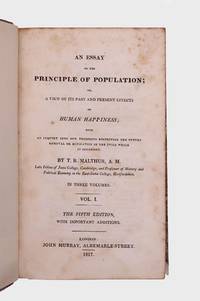
1817Best.-Nr. 378979London: John Murray 1817. Fifth edition. xvi 496; iv 507 1; iv 500pp. 3 vols. 8vo. Modern quarter calf and marbled paper covered boards vellum tips flat spines gilt with green morocco lettering pieces. Very good. Fifth edition. xvi 496; iv 507 1; iv 500pp. 3 vols. 8vo. "The central idea of the essay - and the hub of Malthusian theory - was a simple one. The population of a community . increases geometrically while food supplies increase only arithmetically. If the natural increase in population occurs the food supply becomes insufficient and the size of the population is checked by 'misery' . The Essay was highly influential in the progress of thought in early 19th-century Europe . his influence on social policy whether for good or evil was considerable" PMM 251. Darwin among others credited Malthus as a source for his theory of natural selection. "The achievement of Malthus was the exposition of the theory of population; and his name has been associated so closely with this theory that like Darwin's it has added a new adjective to the language of civilized peoples" Palgrave II 670-71. First published anonymously in 1798 subsequent editions were exanded and this fifth edition published a decade after the fourth with "important additions" viz. adding substantial updates regarding public policy trade and data. The changes to this edition were so substantial that the changes were sold as a separate supplementary book titled Additions to the Fourth and Former Editions. The penultimate edition issued with Malthus's revisions during his lifetime and is often considered textually the best edition. Palgrave II 667-675; Kress B-6974. See PMM 251 John Murray unknown
1872Best.-Nr. 64545London & Edinburgh UK: Reeves and Turner 195 Strand 1872. 8vo. xv 1 551 1 pp. plus 8 pp. publisher’s ads. Tables. Plum-coloured publisher’s cloth brown claysized endpapers rebacked minor wear to corners slight bumping to couple corners still VG- copy from the libraries of John S. Oliver 8 Greenhill Park Edinburgh member of the Edinburgh Geological Society from 1870-1883 and Elof Axel Carlson 1931-2025 noted geneticist historian of science and fierce opponent of eugenics. Seventh edition of this groundbreaking and very significant work was one of the very few complete Victorian printings of the work and coincided with intense reform movements in the British Epire during the 1870’s with heightened discussions on poverty working class living and working conditions and the emergence of neo-Malthusian birth control advocacy groups. Although Malthus is best known for the 1798 original essay this first edition was a very short and limited work which served as a response to Godwin and would be significantly expanded and revised through six editions with additional data points from censuses and vast changes in world populations through the first three decades of the 19th Century. More importantly this work served as a catalyst for Charles Darwin in his development of the hypothesis on Natural Selection after his reading of Malthus in the last half of 1838 which would eventually underpin his 1859 “On the Origin of Species.” Reeves and Turner, 195 Strand, hardcover