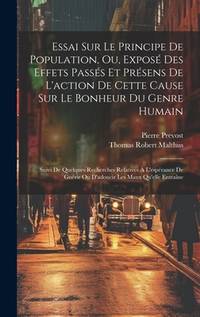
457 résultats
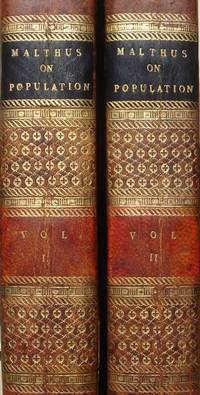
réf. elala6131Washington City: Roger Chew Weightman 1809. First American Edition based on the revised and enlarged third London edition of 1806 of one of the most important and influential works in the history of economic and social thought. “’Malthus’s law’ that population increases at a greater rate than the means of subsistence was one of the first and is still one of the most widely debated of modern economic theories. The work aroused a storm of controversy since Malthus held that checks on the growth of population would be necessary a theory which is still not finally extinguished. Malthus has exercised a strong influence not merely in economics but in the whole realm of social theory.” PMM Goldsmiths’ 19819. Kress B.5542. Palgrave II pp. 668-677. Shaw & Shoemaker 17975. cfNCBEL III 1294. cfGarrison & Morton 1693. cfPrinting and the Mind of Man. 251. 2 Volumes. 8vo. pp. xvi 510 xxxivindex; vii 1 542. complete with half-titles. contemporary tree calf rebacked several small library rubberstamps some foxing & browning throughout as usual – more extensive on outer leaves. elala6131 Washington City: Roger Chew Weightman, 1809 unknown
1826réf. 2411260086London: John Murray 1826. Hardcover. Acceptable. Malthus' Classic Work on the Economics of Population Growth Sold with all faults. Vol. 1 only. xviii 535 pages Important note: lacking pages 531-534. Good candidate for rebind. Binding broken boards detached lacking half of spine leather. Marbled boards. Clean unmarked pages. Vol. 1 of the 6th expanded edition of Essay on the Principle of Population. In this work Malthus argues that there is a disparity between the rate of growth of population which increases geometrically and the rate of growth of agriculture which increases only arithmetically. He then explores how populations have historically been kept in check. The final edition in Malthus' lifetime. Goldsmiths' 24893; Kress C1724 John Murray hardcover
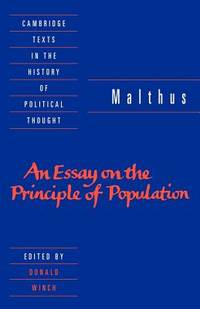
1992réf. Cambridge-9780521429726Cambridge University Press 1992. PAPERBACK. New. Cambridge University Press paperback
réf. 19070His Majesty's Receipt of Exchequer London. 9 February no year . 1p. 8vo. In poor condition aged and worn with loss to edges and holing around the signature. Begins with manuscript text in square brackets: 'The -9 Day of ffebry <.> Received by me Daniel Malthus Execd as P Margin Of the Right Honourable Robert Earl of Northampton One of the Four Tellers of His Majesty's Receipt of Exchequer the Sum of Fifty Pounds .'. The annuity has been raised on 'Rates and Duties upon all Wines imported into Great Britain and for raising a certain Sum of Money for the Service of the year 1745'. According to T. R. Malthus's entry in the Oxford DNB his father 'being an only son of seven children appears to have inherited considerable wealth and property and these independent means enabled him to travel and to cultivate his literary artistic theatrical and scientific interests. He entered Queen's College Oxford in 1747 but did not graduate. He was an admirer of Rousseau who once visited The Rookery when Malthus was an infant. He was said to have published some literary pieces anonymously but the statement by an obituarist that he had translated works from French and German was firmly contradicted by Malthus. He supported the views of the marquis de Condorcet and William Godwin on the perfectibility of mankind but also encouraged his son's publication of opposing views. Aspects of his behaviour—for example the unconventional education he chose for Malthus and his refusal to allow his wife to wear her wedding ring—were regarded as eccentric and perhaps show the influence of Rousseau. He married on 6 May 1752 Henrietta Catherine Graham 1733–1800 his second cousin the daughter of Daniel Graham 1695–1778 apothecary to George II and George III. She can be seen as a young girl with her brother and two sisters in Hogarth's painting The Graham Children 1742 now in the National Gallery London. Malthus was the sixth of their seven children two boys and five girls. His Majesty's Receipt of Exchequer, London. 9 February [ no year ]. unknown
réf. 126979 May 1827. 'L. I. Fields' i.e. Lincolns Inn Fields London. 2pp. 12mo. 40 lines. Bifolium. Good on aged paper. The reverse of the second leaf carries half of a red wax seal as well as the address to 'James Loch Esqr Bloomsbury Square'. The letter begins: 'My dear Loch Some friends of mine from the Country are desirous of seeing Lord Stafford's & Lord Grosvenor's pictures some time next week; & they understand that the obtaining of Tickets is not a matter of course but that some little interest is necessary.' He asks for assistance 'with regard to Cleveland House . for Mrs Johnston & party about 5 or 6 persons'. He is going 'to the Cambridge Election' on the following day and thinks that it will be 'very keenly contested'. On his return he hopes 'to attend the Council of the London University' when he hopes 'that Horner's business will be finally & satisfactorily settled'. He has heard 'nothing more about Silk Gowns' but 'Willy Brougham . persists in retaining his appointment and will not be scared into resignation like Plunkett by the Chancery Lawyers.' In the last paragraph he deprecates the news that 'Lord Exeter is to have one of the blue Ribbands though he is no friend of Canning's & indeed closely connected with the high Tory opposition'. This is in his view 'one among many instances of C's weakness & entire dependence upon the higher power.' There is no mention of Loch in Lady Seymour's 'The "Pope" of Holland House Selections from the Correspondence of John Whishaw and his Friends 1813-1840' 1906 and the year 1827 is skirted over. 9 May [1827]. 'L. I. Fields' [i.e. Lincolns Inn Fields, London]. unknown
1999réf. 3592London: Thoemmes Press / Routledge 1999 Two-Volume set of the Fourth Edition facsimile edition in red boards no remainder marks no defects an exemplary pristine set no dust jackets as issued; 2 thick 8vos: 580 484pp index. Extra shipping charge REQUIRED for priority or overseas delivery of this heavy set extra charge SUBSTANTIAL for overseas shipment. Hard Cover. As New. Thoemmes Press / Routledge hardcover
1893réf. 11039Torino: Ermanno Loescher 1893. 1893. Good. - Small quarto 9-5/8 inches high by 6-3/4 inches wide rebound without original wraps in dark green cloth titled in gilt with decorations in gilt on the spine. The covers are slightly warped & the binding is bumped & rubbed affecting the titling. The head of the spine is chipped & frayed. 167 pages plus errata/corrigenda page. The pastedowns & endpapers are darkened & there is scattered foxing & light staining. Good. First edition. The text is in Italian. The book is inscribed by the author but the inscription & signature have been partially cut off in rebinding. "This interesting work proposes to examine by the light of scientific criticism the theory of Malthus and the principal objections that have been brought against it. The author turns his attention first to pointing out the irrefutability of the biological tendency as Malthus has shown it and the necessity which devolves upon political economy to recognize it as a fundamental law. Lebrecht does not ignore the objections raised by various writers against this tendency; on the contrary he estimates them with praiseworthy impartiality; yet after careful examination he believes that they are not destructive of the theory.He does not deny that the coefficient of procreation is essentially economic and that poverty is one of its potent factors; yet he affirms that the prolific action of poverty can be remedied by moral influences. From a review of the book by Achille Loria and Cornelia H. B. Rogers in "Annals of the American Academy of Political and Social Science Vol. 4 May 1894 p. 134. Rare. Torino: Ermanno Loescher, 1893. paperback
réf. 3368910574.Ghardcover. Good. Access codes and supplements are not guaranteed with used items. May be an ex-library book. hardcover
réf. 1019175761.Ghardcover. Good. Access codes and supplements are not guaranteed with used items. May be an ex-library book. hardcover
réf. 1020075929.Ghardcover. Good. Access codes and supplements are not guaranteed with used items. May be an ex-library book. hardcover
1836réf. 3620869William Pickering 1836. Spine in poor conidition. Browning of pages.This book has hardback covers. Ex-library With usual stamps and markings In poor condition suitable as a reading copy. No dust jacket. Please note the Image in this listing is a stock photo and may not match the covers of the actual item750grams ISBN: William Pickering hardcover
1951réf. 1247116Augustus M. Kelley INC. Collectible - Acceptable/No Dust Wrapper. 1951. Ex-Library Clean Content. Hard Cover. Ex-Library G456 . Augustus M. Kelley INC. hardcover
1821réf. 1512140034Boston: Wells and Lilly 1821-01-01. First Edition. Hardcover. Very Good. First American edition. Bound in marbled boards spine rebacked in modern leather. Burgundy Moroccan leather spine label. Clean unmarked pages. Marginal browning to pages. Internally very good. The first English edition was printed by John Murray in 1820 this is the 1st American edition printed in 1821 in Boston.J.M. Keynes "argued that Malthus's theory of effective demand provided a scientific explanation of unemployment and that the hundred-year domination of Ricardo over Malthus had been a disaster for the progress of economics. Keynes believed that if economics had followed Malthus . the world would be a much wiser and richer place" ODNB. The last chapter of the book was devoted to rebutting Say's law and argued that the economy could stagnate with a lack of "effectual demand". In other words wages if less than the total costs of production cannot purchase the total output of industry causing prices to fall; price falls decrease incentives to invest creating a downward spiral. Refs for 1st English ed: Goldsmiths 22767; Kress C577. Early signature of E.W. Paige Schenectady NY and his book plate on front paste down. Eugene W. Paige 1852-1919 served in the New York legislature in the 19th century. Boston: Wells and Lilly hardcover
1701réf. 1508040041John Murray 1817-01-01. 5th. Hardcover. Acceptable. 2 volumes of 3. Vol. 1 and 3 only. 1/4 contemporary leather over marbled boards. Boards detached. 22 cm. 5th edition with important additions. John Murray hardcover
1815réf. BOOKS062718ILondon: John Murray 1815. HC. very good bound in maroon buckram cloth hardcover SEE NOTE. . AND GENERAL WEALTH OF THE COUNTRY. An exceptionally nice original copy of the Third Edition however in the right margin there is a pinhole not affecting text through the pages. 48pp. John Murray unknown
1807réf. 52022HANDSOME COPY IN CONTEMPORARY BOLDLY SPECKLED CALF 2 vols. tall 8vo. iii-xvi 580; iii-viii 484 58 indexpp. contemporary boldly speckled calf smooth spines richly decorated in gilt in panels using two different designs black lettering and russet numbering labels gilt board edges gilt rolled spines a trifle chaffed at headbands some cracking at ends of some joints but overall a very nice copy. Near contemporary pencilled shelf number "D198" of Lord Dunraven of Adare Manor Co. Limerick on endpaper. KRESS B5219 This is edition incorporates the substantial revisions and additions which Malthus had made for his third edition of 1806. They are listed and described in full in his preliminary 'Advertisement' to that edition also printed here. The most substantial of the changes made was that "The chapters which were the fourth and sixth of the second book are nearly rewritten on account of an error into which the author had fallen in an attempt to estimate the fruitfulness of marriages and the number born living to be married from the data in registers" 'Advertisement'. Furthermore he added as an appendix here vol.2 p.429-484 his important Reply to the Chief Objections to the second edition of 1803. This appendix he had also published separately in quarto "for the accomodation of the purchasers of the former edition" 'Advertisement'.Malthus recommends that "those who have not the leisure or inclination to read the entire work will find in the appendix such notice of its most prominent arguments as will give them a good general idea of the aim and bent of the whole". In it he writes "My object is to correct some of the misrepresentations which have gone abroad respecting two or three of the most important points of the Essay. . The first grand objection that has been made to my principles is that they contradict the original command of the Creator to increase and multiply and replenish the earth . The next grand objection which has been urged against me is my denial of the right of the poor to support. . and lastly and rather a matter of feeling than of argument. Many persons have accused him of excessive pessimism in throwing a darker shade over our views of human nature and tending particularly to narrow our prospects of future improvement". All of these objections he attempts to refute. From the library of Edwin R. W. Wyndham-Quin Viscount Adare F.R.S. of Adare Manor Co. Limerick. Printed for J. Johnson .. by T. Bensley hardcover
2014réf. 2083002115708617Iwanamishoten 2014. Soft Cover. Fine. Number of pages: 203p Size: 15cm Number of books: 1 Iwanamishoten paperback
réf. 2083002115900542Chuokoronsha N.A. Soft Cover. Fine. Number of pages: 242p Size: 16cm Chuokoronsha paperback
1984réf. 2081402110003380Iwanamishoten 1984. Soft Cover. Fine. Number of books: 1 Iwanamishoten paperback
1987réf. 2081402110001891Not Available 1987. Soft Cover. Fine. Number of books: 1 Not Available paperback
1989réf. 2080502106913526Not Available 1989. Soft Cover. Fine. The book is in fine condition. Not Available paperback
1976réf. 2080502107001749Iwanamishoten 1976. Soft Cover. Fine. Number of pages: 295p Plate size: 15cm Iwanamishoten paperback
2014réf. 2080502107001178Iwanamishoten 2014. Soft Cover. Fine. Number of pages: 203p Size: 15cm Iwanamishoten paperback
1968réf. 2080502107000631Iwanamishoten 1968. Soft Cover. Fine. Size: 15cm Number of books: 2 Iwanamishoten paperback