592 resultados
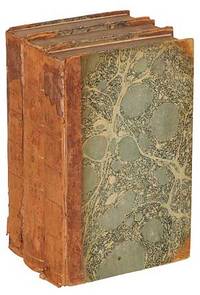
1821ref. 267479London: J. Porter 1821. Hardcover. Fair. First edition. Volumes 94-96 Complete three volume set for 1821. Octavos. Contemporary half calf and marbled paper boards. Overall scuffing to the spine and boards chipping to the spine backs else a good sound set. Contains reviews of Shelley's "The Cenci A Tragedy" and "Prometheus Unbound" William Edward Parry's two "Journals" of a Voyage for the Discovery of a North-West Passage and a Voyage of Discovery to the Arctic Regions the "Principles of Political Economy" by Malthus "The History of British India" by James Mill and much more. J. Porter hardcover
ref. 1175428353.Gpaperback. Good. Access codes and supplements are not guaranteed with used items. May be an ex-library book. paperback
ref. 1179178939.Gpaperback. Good. Access codes and supplements are not guaranteed with used items. May be an ex-library book. paperback
ref. 1178902412.Gpaperback. Good. Access codes and supplements are not guaranteed with used items. May be an ex-library book. paperback
ref. 1680922580.Gpaperback. Good. Access codes and supplements are not guaranteed with used items. May be an ex-library book. paperback
ref. 052118410X.Gpaperback. Good. Access codes and supplements are not guaranteed with used items. May be an ex-library book. paperback
1824ref. 000011084London: John Murray 1824. Disbound. Good. 8vo. 24 cm x 13.5 cm. 1 298-334 pp. Pamphlet. The Quarterly Review was a British periodical that began in 1809. This is a review of Thomas Malthus' Principles of Political Economy and the writers of this review frequently compare Malthus' work to Adam Smith's The Wealth of Nations. A fascinating look at what Malthus' contemporaries thought of his work a work which would later be praised by J.M. Keynes the twentieth-century economist. This article was once bound in a compendium of the Quarterly review but now lacks boards and wraps. The stitching is present on the side and the final leaf is starting from the stitching. John Murray unknown
ref. 0366353764.Gpaperback. Good. Access codes and supplements are not guaranteed with used items. May be an ex-library book. paperback
1807ref. AQ28409London: Printed for J. Johnson.by T. Bensley 1807. In two volumes. xvi 580; vii 484pp 60. With half-titles. Contemporary gilt-ruled half-calf marbled paper boards contrasting green and tan calf lettering-pieces marbled edges. Lightly rubbed corners exposed. Hinges exposed later inked ownership inscription of Arthur Johnson to recto of front blank fly-leaf of Vol. I very occasional light spotting. The fourth edition greatly extended from the anonymous first of 1798 of this cornerstone of early studies of demography and an influential work in the history of political economy. Contrary to the prevailing Whig theory of history English cleric and scholar Thomas Robert Malthus 1766-1834 argued that the agricultural output of modern Britain would not be able to support the rapid population growth witnessed in the eighteenth-century and thus that society would return to earlier subsistence levels following catastrophic outbreaks of disease and famine. The second edition of 1803 was substantially revised and extended to include observations made from European data and most notably the recognition that human agency and especially moral restraint could alleviate the plight of the poorest elements of society. The third edition of 1806 added an appendix in which Malthus replied to his many contemporary critics. This fourth edition incorporates all of the previous revisions and additions. Provenance: Arthur Henry Johnson 1845-1927 historian and chaplain of All Souls College Oxford; author of inter alia The history of the Worshipful Company of the Drapers of London Oxford 1914-22 and The disappearance of the small landowner Oxford 1909. . Fourth edition. 8vo. Printed for J. Johnson...by T. Bensley hardcover
ref. 0259108820.Gpaperback. Good. Access codes and supplements are not guaranteed with used items. May be an ex-library book. paperback
ref. 1020555610.Ghardcover. Good. Access codes and supplements are not guaranteed with used items. May be an ex-library book. hardcover
ref. 1019370831.Ghardcover. Good. Access codes and supplements are not guaranteed with used items. May be an ex-library book. hardcover
1989ref. 52510130017Cambridge University Press 1989. First Edition. Hardcover. New. HARDCOVERS. 2 VOLUME SET. Unused unmarked and unblemished copies. 1ST PRINTING 1989. Covers are brown cloth boards with gilt lettering inside burgundy circle.; 100% Satisfaction Guaranteed! Ships same or next business day! Cambridge University Press hardcover
ref. 3368102427.Gpaperback. Good. Access codes and supplements are not guaranteed with used items. May be an ex-library book. paperback
ref. 1022934678.Ghardcover. Good. Access codes and supplements are not guaranteed with used items. May be an ex-library book. hardcover
ref. 1169188095.Ghardcover. Good. Access codes and supplements are not guaranteed with used items. May be an ex-library book. hardcover
1821ref. 040304Boston MA: Wells and Lilly 1821. Book. Very Good. Full-Leather. First American Edition. 8vo - over 7¾" - 9¾" tall. Original full tree calf gilt on burgundy title label mounted on upper spine. Rubbed along edges some surface cracking/crazing rubbed joints and spine extremities. Foxed endpapers some toning and scattered foxing to interior but otherwise intact with firm binding. Former owner's signature on front flyleaf. viii472 pp. Exceptionally scarce first American edition issued a year after the first British edition of 1820. Wells and Lilly Hardcover
ref. 1161421459.Ghardcover. Good. Access codes and supplements are not guaranteed with used items. May be an ex-library book. hardcover
ref. 1161444564.Ghardcover. Good. Access codes and supplements are not guaranteed with used items. May be an ex-library book. hardcover
ref. 1016362838.Ghardcover. Good. Access codes and supplements are not guaranteed with used items. May be an ex-library book. hardcover
1826ref. 5784691John Murray 1826. Volume 1. This is an ex-library book and may have the usual library/used-book markings inside.This book has hardback covers. In good all round condition. Sixth edition. Medium 8vo with marbled boards and black leather half binding. Raised bands gilt lettering and gilt borders on backstrip. Bumped corners and some minor chipping and general wear. Interior is secure clean and clear save for some foxing. Trimmed. Please note the Image in this listing is a stock photo and may not match the covers of the actual item850grams ISBN: John Murray hardcover
1809ref. 12840Paris and Geneva: Chez J.J. Paschoud 1809. 3 volumes. First Edition in French. Provenance: With the contemporary engraved bookplate of H. Trouchin and that of the subsequent owner Pierre Sciclounoff. 8vo very handsomely bound in a fine French binding of contemporary half calf over speckled boards spines with gilt ruled bands red morocco title label and green morocco volume label lettered in gilt. xxiii 424 3 ad; 395 3; 392. A very fine and handsome set very clean and sturdy in absolutely period state. The first French edition of Malthus’ landmark work. The translation from the English is by Pierre Prevost probably from the third English edition which was corrected and expanded by Malthus. French editions of Malthus are uncommon and this set is in exceptional condition in its original and contemporary state. Originally written in response to a discussion with the author's father on the perfectibility of society the book was reprinted several times with many alterations and additions as Malthus defended his views against a host of critics. "The central idea of the essay--and the hub of Malthusian theory--was a simple one. The population of a community Malthus suggested increases geometrically while food supplies increase only arithmetically. If the natural increase in population occurs the food supply becomes insufficient and the size of the population is checked by 'misery'--that is the poorest sections of the community suffer disease and famine. Malthus recognized two other possible checks to population expansion: first 'vice'--that is homosexuality prostitution and abortion all totally unacceptable to Malthus; and second 'moral restraint'--the voluntary limitation of the production of children by the postponement of marriage. This was the solution to the population problem that Malthus advocated. The 'Essay' was highly influential in the progress of thought in early nineteenth-century Europe" PMM. Marx Engels Paley Darwin Wallace Keynes and Ricardo were all influenced by Malthus--either working off his ideas or reacting against them. Chez J.J. Paschoud hardcover
ref. 0521187478.Gpaperback. Good. Access codes and supplements are not guaranteed with used items. May be an ex-library book. paperback
ref. 46332563like new. unknown