Poursin J.-M. , Dupuy G.MareMagnum

596 résultats
1975in 16 (18x11) Brossura; pp.165; buono
1980réf. 273698Paris Dunod / Bordas 1980. XIV, 269 S. Lit.verz. Br.
1923réf. B296Berlin, Hans Robert Engelmann, 1923. kartoniert, 8°, 175 S., Inhalt: Der drohende Mangel an Brennstoff und die hieraus sich ergebenden Gefahren - Die drohende Überbevölkerung und ihre Gefahren (Die todbringenden Ursachen der Verminderung der Völker, Die einer Volksvermehrung vorbeugenden Ursachen, Die jetzige Überbevolkerung und ihre Gefahren, Die Notwendigkeit einer Nachkommenschaftseinschränkung) - Der Weltkrieg und die Weltnot
1973pp. 128, cm 19x12, bross., tracce di fioriture
1973In-16°, in brossura editoriale, pp. 128. Della collana Uomini e Problemi.
réf. 41917 x 23,5 The Journal of European Economic History, volume 27, number 1 (Spring 1998), 137-202. Extract. Couverture cartonnée de la revue, agrafes au dos. Exemplaire en parfait état.(C11) Livre
réf. 41917 x 23,5 The Journal of European Economic History, volume 27, number 1 (Spring 1998), 137-202. Extract. Couverture cartonnée de la revue, agrafes au dos. Exemplaire en parfait état.(C11) Livre
1998Mm 140x215 Brossura editoriale con bandelle, pagine 350.Opera in buone condizioni. SPEDIZIONE IN 24 ORE DALLA CONFERMA DELL'ORDINE. WORLDWIDE DELIVERY.
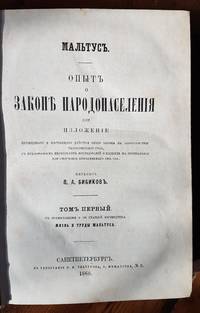
1868réf. 178Scarce first Russian edition of a major landmark of economic literature the Essay on the Principle of Population first published in English in 1798. With much added material. The translator P. A. Bibikov was a historian philosopher and literary critic who had already translated Smith's Wealth of Nations in 1866. With this background he added a wealth of material to this edition making it more than just a translation but also an a posteriori analysis. Next to the 80 pages on Malthus' life and works Bibikov added in a rich appendix translations of foreign commentators as well as his own footnotes relating to Russia. Very interestingly he updated and commented the many pages Malthus had already devoted to the Russian case. The appendix includes texts by Townsend Garnier Chernyshevskiy and Prudhon as well as a convenient 20-pp. alphabetical index. "The central idea of the essay - and hub of the Malthusian theory - was a simple one. If the natural increase in population occurs the food supply becomes insufficient and the size of the population is checked by 'misery' - that is the poorest sections of the community suffer disease and famine. Malthus recognises two other possible checks to population expansion: first 'vice' - that is homosexuality prostitution and abortion all totally unacceptable to Malthus; and second 'moral restraint' - the voluntary limitation of the product of children by the postponement of marriage." PMM. Provenance: Unidentified symbolistic booklabel to upper endpapers; small Baltic bookseller's stamps to lower endpapers. Physical description:Two volumes 8vo. 476 pp. incl. half-title title and table of contents at end; 468 pp. incl. table of contents. Later plain brown cloth author titled in ink on the spines. Condition:Very occasional light spotting. Glazunov, Skt. Peterburg, hardcover
1987réf. 2081402110001891Not Available 1987. Soft Cover. Fine. Number of books: 1 Not Available paperback
1986réf. 2091502133901796Iwanami Bunko white belt 107-5 1986. Soft Cover. Fine. Volume: 1 Iwanami Bunko white belt (107-5) paperback
1827réf. 122073London: John Murray 1827. First Edition. hardcover. near fine. viii 261pp. 8vo rebound in 3/4 red leather gilt-lettered spine; half-title expertly repaired otherwise fine. London: John Murray 1827. First Edition. Near fine. A critique of the terms used by French economists Adam Smith Jean-Baptiste Say James Mill David Ricardo J.R. McCulloch and Samuel Bailey followed by the author's classification. Kress C. 1924. NCBEL III 1294. Palgrave II p.677. John Murray unknown books
1809réf. 191317Georgetown: J. Milligan 1809. 1st American Edition. Hardcover. Fair missing covers leather spine heavily worn pages have foxing spots binding split and several pages loose but all appear to be present with minor tears here and there Sold as a reading copy or binding set WAF. Missing covers and worn leather spine. Vol. 1: XVI 510 XXXIV pp. Vol. 2: vii 1 542 pp. This is the first American edition. Volumes 1 2 of a 2 volume set. Includes index. Scarce and worthy of rebinding. J. Milligan hardcover books
1960A clean, unmarked book with a tight binding. Full green cloth boards. Previous owner's name label on copyright page. Price-clipped dust jacket shows light wear. 602 pages.
1809réf. 40999Washington City: Roger Chew Weightman 1809. 2 volumes 8vo. 8 1/4 x 5 inches. Vol. 1 xvi 510 xxxiv pp.; Vol. 2 vii 542 pp. Contemporary tree calf skilfully rebacked. Spines gilt ruled forming six compartments lettering pieces in the second compartmenrs Provenance: Possibly John Barclay 1749-1824 former Mayor of Philadelphia from 1791 to 1793 First American edition of a fundamental text of Modern Economics. Thomas Robert Malthus was an English economist cleric and scholar influential in the fields of political economy and demography. Malthus came to prominence for his publication of the present work first published in 1798. Between 1798 and 1826 Malthus published six versions of the essay updating each edition to incorporate new material to address criticism and to convey changes in his own perspectives on the subject. Writing in response to Jean-Jacques Rousseau and William Godwin specifically their approaches to the improvement of society Malthus opposed the optimistic view in 18th-century Europe that saw society as improving and in principle as perfectible. Malthus saw population growth as inevitable whenever conditions improved thereby precluding real progress towards a utopian society: "The power of population is indefinitely greater than the power in the earth to produce subsistence for man." Malthus laid the "theoretical foundation of the conventional wisdom that has dominated the debate both scientifically and ideologically on global hunger and famines for almost two centuries" Daoud. He remains a much-debated writer. Shaw 17975; Daoud Ade "Robbins and Malthus on scarcity abundance and sufficiency: The missing sociocultural element" in American Journal of Economics and Sociology 69.4: 1206-1229; Harvey David "Population Resources and the Ideology of Science"in Economic Geography 503: 256277. Roger Chew Weightman unknown books
2007réf. 448692007. ISBN-13: 9781584777281; ISBN-10: 1584777281. One of the Most Influential Works on Political Economy Malthus Thomas Robert. An Essay on the Principle of Population as it Affects the Future Improvement of Society with Remarks On the Speculation of Mr. Godwin M. Condorcet and Others. Originally published: London: J. Johnson 1798. ix 396 pp. Reprinted 2007 by The Lawbook Exchange Ltd. ISBN-13: 9781584777281; ISBN-10: 1584777281. Hardcover. New. $49.95 Reprint of the very rare first edition. One of the most influential works on political economy it had a profound effect on social policy during the nineteenth century especially on the development of harsher poor laws in Great Britain. It was the guiding spirit behind the Poor Law Amendment Act of 1834. The central point of the Essay is that population increases geometrically while food supplies increase arithmetically which will eventually lead to starvation and disease in the poorest sections of the community. In order to prevent this from happening he posits people especially the poor should have children later in life and limit the size of their families. unknown books
1827réf. 170223003London: John Murray 1827. First Edition. Hardcover. Very Good. First edition first printing. Finely bound in brown leather with raised bands and gilt stamping. Contents lightly toned light restoration to several pages evident. Title page and text of last chapter show light evidence of erased pencil markings. Previous owner name on half title page. An important and early work on economic methodology. John Murray hardcover books
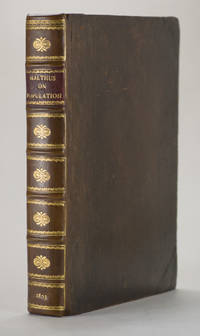
1803réf. 65276London: Printed for J. Johnson.by T. Bensley 1803. The Economics of Population MALTHUS Thomas Robert. An Essay on the Principle of Population; Or a view of its past and present effects on Human Happiness; With an Inquiry into our prospects respecting the future removal or mitigation of the evils which it occasions. A new edition very much enlarged. London: Printed for J. Johnson. by T. Bensley 1803. Second edition enlarged and revised. Quarto. viii 4 610 pp. Contemporary calf skillfully rebacked to style and with corners renewed. Spine decoratively tooled in gilt compartments with burgundy morocco gilt lettering label. Endpapers renewed. Occasional light foxing. Title-page with publisher's diagonal paper flaw crease. Overall very good. A completely revised and greatly expanded edition of the most influential work on population ever written. Malthus published the first edition of his Essay in 1798 and was apparently unprepared for the torrent of controversy that his ideas provoked. His response to the public outcry was to spend the next five years refining and expanding his theories for this second edition so much so that "in its present shape it may be considered a new work and I should probably have published it as such omitting the few parts of the former which I have retained but that I wished it to form a whole of itself and not to need a continual reference to the other." preface Malthus' basic argument--that population increases geometrically at a greater rate than does the means of subsistence which increases arithmetically--was one of the earliest modern economic and social theories and his contention that it would eventually become necessary for society to impose some form of restraint on over-population provided the premise for heated socio-economic debate for almost two centuries. Kress B4701. See Printing and the Mind of Man 251. HBS 65276. $6500. Printed for J. Johnson...by T. Bensley unknown books
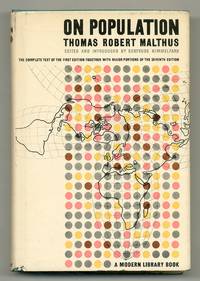
1960réf. 552967New York: Modern Library 1960. Hardcover. Very Good/Very Good. Later printing. Edited and introduced by Gertrude Himmelfarb. xxxvi 602pp. Very good with a small amount of pen marginalia and the spine cocked in a very good dust jacket with toning rubbing and edgewear. Modern Library 309. Modern Library hardcover books
1820réf. 66825London: John Murray 1820. If Only Malthus Instead of Ricardo Had Been the Parent Stem From Which Nineteenth-Century Economics Proceeded What a Much Wiser and Richer Place the World Would be Today" MALTHUS Thomas Robert. Principles of Political Economy. Considered with a View to Their Practical Application. London: John Murray 1820. First edition. Octavo. vi 12-601602. Original boards uncut. With original paper label on spine. Hinges expertly and almost invisibly repaired. Old bookplate from "The Library of Victoria" with no other library markings. A very clean copy internally fine. Very scarce in original boards. Housed in a custom quarter black morocco clamshell gilt-stamped. First edition of Malthus' principal contribution to economic theory. Schumpeter describes Malthus' work in relation to that of his predecessors Adam Smith and Ricardo as follows: "Ricardo's work.started with the Wealth of Nations and recoined the latter's theoretical contents by a method that centered in the concept of value. Exactly the same thing is evidently true of the work of Malthus.except for his theory of saving and investment which on the face of it seems to be Malthus's own all the elements that enter into the analytic apparatus of that work and even its terminological arrangements point to the First book of the Wealth of Nations. Only whereas Ricardo recoined the doctrine of Wealth by means of the labor-quantity theory of value Malthus recoined it by the means of the theory of value that A. Smith actually used namely the theory of supply and demand.whereas Ricardo's analytic apparatus is geared to the problem of distribution.Malthus. geared his apparatus to the analysis of the whole economic process.Therefore Malthus should.stand in the history of analysis not only as the author of a valid alternative to Ricardo's theory but as the sponsor or rather as one of the sponsors of the victorious one." "Although Malthus is best known for the views on population contained in his Essay on Population.there can be no doubt that his importance for economists today rests mainly on his Principles of Political Economy 1820. It was because of the latter work that J. M. Keynes reinstated Malthus as a major figure in modern economic thought". New Palgrave. Cress C577. HBS 66825. $6500. John Murray unknown books
1966réf. 106186London:: Cambridge University Press. Very Good in Very Good dust jacket. 1966. Hardcover. Edited by Patricia James. First edition thus. Previous owner's book-plate on front paste-down else very good in a very good price clipped dust jacket. . Cambridge University Press, hardcover books
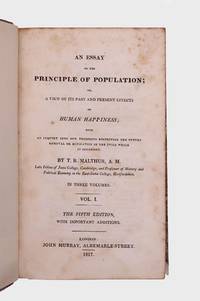
1817réf. 378979London: John Murray 1817. Fifth edition. xvi 496; iv 507 1; iv 500pp. 3 vols. 8vo. Modern quarter calf and marbled paper covered boards vellum tips flat spines gilt with green morocco lettering pieces. Very good. Fifth edition. xvi 496; iv 507 1; iv 500pp. 3 vols. 8vo. "The central idea of the essay - and the hub of Malthusian theory - was a simple one. The population of a community . increases geometrically while food supplies increase only arithmetically. If the natural increase in population occurs the food supply becomes insufficient and the size of the population is checked by 'misery' . The Essay was highly influential in the progress of thought in early 19th-century Europe . his influence on social policy whether for good or evil was considerable" PMM 251. Darwin among others credited Malthus as a source for his theory of natural selection. "The achievement of Malthus was the exposition of the theory of population; and his name has been associated so closely with this theory that like Darwin's it has added a new adjective to the language of civilized peoples" Palgrave II 670-71. First published anonymously in 1798 subsequent editions were exanded and this fifth edition published a decade after the fourth with "important additions" viz. adding substantial updates regarding public policy trade and data. The changes to this edition were so substantial that the changes were sold as a separate supplementary book titled Additions to the Fourth and Former Editions. The penultimate edition issued with Malthus's revisions during his lifetime and is often considered textually the best edition. Palgrave II 667-675; Kress B-6974. See PMM 251 John Murray unknown books
1820réf. 1015London: John Murray 1820. First Edition. Recent full calf in a contemporary style. Very good with some minor spotting at points. 8vo vi 1 - 601 1 - blank pp. Malthus published this book at a time when Ricardo's ideas were established orthodoxy. The Principles is the first complete statement of his economic theories. In it the theory of rent is clearly stated and the three main points of debate with Ricardo addressed. The principle of the value theory based on labor costs demand affects value in a limited way finally that profits are determined by the cultivation and fertility of the least arable land were central to Ricardo. Malthus challenges each of these ideas and what he termed Ricardo's ' new school of political economy ' . This is Malthus' intellectual manifesto with important sections on the theory of rent employment wages and the question of value. A key book in the development of modern economic theory. Kress C-577; Einaudi #3680; See Palgrave for a lengthy entry. John Murray unknown books
1964réf. 105619NY:: Augustus M. Kelley. Good. 1964. Hardcover. A reprint of the 1836 second edition. Ex-library copy with typical markings thus only good in burgundy cloth. No dust jacket. . Augustus M. Kelley, hardcover books
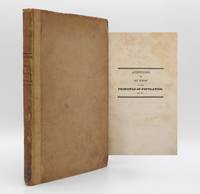
1831réf. 376545Georgetown D. C.: Published by Charles Cruikshank Rind's Press 1831. First American edition first published in London in 1817. 8vo. Original cloth backed tan boards printed paper label reading "Additions / to an / Essay /on / Population / by T.B. Malthus" uncut partially unopened. Some spotting and browning of binding rubbing with some wear to extremities some foxing and spotting of leaves insect trail along lower inner hinge marginal tears on R4 and Cc4 not affecting text. A very good copy in brown cloth clamshell box with leather spine label. First American edition first published in London in 1817. 8vo. Very scarce. This work contains new chapters additions and corrections included in the fifth edition separately published with a new title page and pagination for those who already had the earlier editions. The Contents leaf lists: Book II Chapters I Checks to Population in France and VII Checks to Population in England; Book III Chapters II Of Systems of Equality IV Of Emigration VI Of Poor Laws VIII-XIV the Agricultural and Commercial Systems Corn Laws Exportation and Importation and "Of increasing Wealth as it affects the Condition of the Poor; Book IV Chapters VI "Effects of the Knowledge of the Principal Cause of Poverty on Civil Liberty" XII "Different Plans of Improving the Condition of the Poor considered" and the Appendix. There are new chapters on the Poor and Corn Laws. A revised chapter on rent and especially the change in Chapter III which formely dealt with Godwin and his "Systems of Equality" now relate to Robert Owen his Utopian systems and his "New View of Society". In 1817 at the height of his success Robert Owen addressed the House of Commons speaking on his methods and ideas. Owen had disagreed with Malthus' theories of population. In 1824 Owen had come to America and purchased what became New Harmony a communal society experiment. It was not successful and Owen returned to England in 1828. The Appendix contains Malthus' responses to the publication of Principles of Population and Production by Mr. Wayland and An Inquiry into the Principle of Population by James Grahame. Each chapter notes where the additions should be placed referring to the English edition of 1807 and American edition of 1809. Goldsmiths' Kress Library 26723.2; Kress C2883; Kress B6973 Goldsmiths' 21762 Einaudi 3664 last three for London ed. Published by Charles Cruikshank, Rind's Press unknown books