592 Ergebnisse
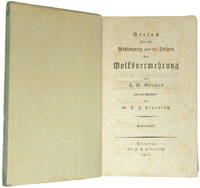
1807Best.-Nr. 52195Altona J.F. Hammerich 1807. Contemp. hcalf. Gilt spine titlelabel in leather letters worn. Light wear to top of spine and corners. Spine rubbed. Some wear to edges of covers. A stamp on title-page. XVI 368; VIII 358 2 pp. A few leaves in the first quire disbound. Scattered brownspots and a few marginal underlinings on the first 20 leaves. Rare first German edition of this political and economic classic which constitutes Malthus' first major publication and his main work because of which he is considered the father of demography and one of the main sources of inspiration for Darwin and Wallace. It is the first translation of the "Principle on Population" into any language and it influenced German politics tremendously.The first edition was printed anonymously in London in 1798 and in 1803 the second edition which also according to Malthus himself can be said to constitute a new work appeared; -the great quarto edition from 1803 is thoroughly revised and much enlarged the title has been changed and Malthus' name appears on the title-page for the first time it is on this edition that all the preceding editions are based and in consequence also the early translations. All the later editions were minor revisions of the second one. In 1806 the third edition appeared and as soon as 1807 the first German one which is translated from the revised third edition "Die gegenwärtige Uebersetzung ist nach der dritten Ausgabe Oktav London 1806. Die Quartausgabe ist minder vollständig" Vorwort p. V. New revisions of the text kept appearing till the sixth edition in 1826. The book then as now is considered highly controversial and it has influenced all demographers ever since as well as being of immense importance to the study of economic theory and genetic inheritance. "The "Essay" was highly influential in the progress of thought in the early nineteenth-century Europe. "Parson" Malthus as Cobbett dubbed him was for many a monster and his views were often grossly misinterpreted. But his influence on social policy whether for good or evil was considerable. The Malthusian theory of population came at the right time to harden the existing feeling against the Poor Laws and Malthus was a leading spirit behind the Poor Law Amendment Act of 1834." PMM 251.Thomas Robert Malthus 1766-1834 called the "enfant terrible" of the economists was an English demographer statistician and political economist who is best known for his groundbreaking views on population growth presented in his "Essays on the Principle of Population" which is based on his own prediction that population would outrun food supply causing poverty and starvation. Among other things this caused the legislation which lowered the population of the poor in England. Malthus actually turned political economic and social thought upside down with this work which has caused him to be considered one of the 100 most influential persons in history Hart The 100: A Ranking of the most Influential Persons in History 1978. Of course he was condemned by Marx and Engels and opposed by the socialists universally but the work was of immense impact on not only politics economics social sciences etc but also on natural sciences. "Later in the "Origin of Species" he Darwin wrote that the struggle for existence "is the doctrine of Malthus applied with manifold force to the whole animal and vegetable kingdoms; for in this case there can be no artificial increase of food and no prudential restraint from marriage" p. 63. Alfred Russel Wallace who arrived at a worked-out formulation of the theory of evolution at almost precisely the same time as Darwin acknowledged that "perhaps the most important book I read was Malthus's "Principles of Population" My Life p. 232. Although there were four decennial censuses before Malthus' death he did not himself analyze the data although he did influence Lambert Quetelet and Pierre Verhulst who made precise statistical studies on growth of populations in developed countries and showed how the early exponential growth changed to an S curve." DSB IX p. 69. As Malthus realized that his theories were not satisfactorily presented or sufficiently demonstrated in the first edition from 1798 he travelled for three years through Europe gleaning statistics and then published the second edition in 1803. Among other places he travelled through Northern Germany and his detailed diaries of these journeys provided him with some of the evidence necessary for the development of his theory on population growth. The observational information that he gathered on his travels in Europe were crucial to the development of his theories which also means that the work is of great interest for other European countries and not only Britain. "In 1819 the Royal Society elected Malthus to a fellowship. He was also a member of the French Institute and the Berlin Academy and a founding member of the Statistical Society 1834." DSB IX p. 67. Printing and the Mind of Man 251 first edition. hardcover
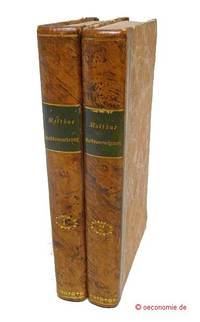
1807Best.-Nr. 31326Altona J.F. Hammerich 1807. 8vo. Bound in the two orig. blue cardboardbindings. The backs have been professionally restored preserving the orig. printed paper title-labels and cont. paper library-labels at lower backs. Occasional brownspotting due to the paper-quality but all in all a very nice and attractive copy. XVI 4 368; VIII 358 1 pp. Some of the first leaves of the "Erstes Buch" in the first volume have been misbound but are all present. Rare first German edition of this political and economic classic which constitutes Malthus' first major publication and his main work because of which he is considered the father of demography and one of the main sources of inspiration for Darwin and Wallace. It is the first translation of the "Principle on Population" into any language and it influenced German politics tremendously.The first edition was printed anonymously in London in 1798 and in 1803 the second edition which also according to Malthus himself can be said to constitute a new work appeared; -the great quarto edition from 1803 is thoroughly revised and much enlarged the title has been changed and Malthus' name appears on the title-page for the first time it is on this edition that all the preceding editions are based and in consequence also the early translations. All the later editions were minor revisions of the second one. In 1806 the third edition appeared and as soon as 1807 the first German one which is translated from the revised third edition "Die gegenwärtige Uebersetzung ist nach der dritten Ausgabe Oktav London 1806. Die Quartausgabe ist minder vollständig" Vorwort p. V. New revisions of the text kept appearing till the sixth edition in 1826. The book then as now is considered highly controversial and it has influenced all demographers ever since as well as being of immense importance to the study of economic theory and genetic inheritance. "The "Essay" was highly influential in the progress of thought in the early nineteenth-century Europe. "Parson" Malthus as Cobbett dubbed him was for many a monster and his views were often grossly misinterpreted. But his influence on social policy whether for good or evil was considerable. The Malthusian theory of population came at the right time to harden the existing feeling against the Poor Laws and Malthus was a leading spirit behind the Poor Law Amendment Act of 1834." PMM 251.Thomas Robert Malthus 1766-1834 called the "enfant terrible" of the economists was an English demographer statistician and political economist who is best known for his groundbreaking views on population growth presented in his "Essays on the Principle of Population" which is based on his own prediction that population would outrun food supply causing poverty and starvation. Among other things this caused the legislation which lowered the population of the poor in England. Malthus actually turned political economic and social thought upside down with this work which has caused him to be considered one of the 100 most influential persons in history Hart The 100: A Ranking of the most Influential Persons in History 1978. Of course he was condemned by Marx and Engels and opposed by the socialists universally but the work was of immense impact on not only politics economics social sciences etc but also on natural sciences. "Later in the "Origin of Species" he Darwin wrote that the struggle for existence "is the doctrine of Malthus applied with manifold force to the whole animal and vegetable kingdoms; for in this case there can be no artificial increase of food and no prudential restraint from marriage" p. 63. Alfred Russel Wallace who arrived at a worked-out formulation of the theory of evolution at almost precisely the same time as Darwin acknowledged that "perhaps the most important book I read was Malthus's "Principles of Population" My Life p. 232. Although there were four decennial censuses before Malthus' death he did not himself analyze the data although he did influence Lambert Quetelet and Pierre Verhulst who made precise statistical studies on growth of populations in developed countries and showed how the early exponential growth changed to an S curve." DSB IX p. 69. As Malthus realized that his theories were not satisfactorily presented or sufficiently demonstrated in the first edition from 1798 he travelled for three years through Europe gleaning statistics and then published the second edition in 1803. Among other places he travelled through Northern Germany and his detailed diaries of these journeys provided him with some of the evidence necessary for the development of his theory on population growth. The observational information that he gathered on his travels in Europe were crucial to the development of his theories which also means that the work is of great interest for other European countries and not only Britain. "In 1819 the Royal Society elected Malthus to a fellowship. He was also a member of the French Institute and the Berlin Academy and a founding member of the Statistical Society 1834." DSB IX p. 67. Printing and the Mind of Man 251 first edition. unknown
1807Best.-Nr. 36928Altona J.F. Hammerich 1807. 8vo. Bound in the two nice cont. uniform cardboardbindings w. marbled paper. Gilt lines and gilt title-labels to spines. Some wear w. minor loss of paper to capitals hinges and corners. Small hole to paper as well as to leather title-label of spine of volume two. Some brownspotting but overall a nice and atrractive copy. Lacking the half-tilte for the first book merely stating "Erstes Buch". XVI 368; VIII 358 1 pp. Rare first German edition of this political and economic classic which constitutes Malthus' first major publication and his main work because of which he is considered the father of demography and one of the main sources of inspiration for Darwin and Wallace. It is the first translation of the "Principle on Population" into any language and it influenced German politics tremendously.The first edition was printed anonymously in London in 1798 and in 1803 the second edition which also according to Malthus himself can be said to constitute a new work appeared; -the great quarto edition from 1803 is thoroughly revised and much enlarged the title has been changed and Malthus' name appears on the title-page for the first time it is on this edition that all the preceding editions are based and in consequence also the early translations. All the later editions were minor revisions of the second one. In 1806 the third edition appeared and as soon as 1807 the first German one which is translated from the revised third edition "Die gegenwärtige Uebersetzung ist nach der dritten Ausgabe Oktav London 1806. Die Quartausgabe ist minder vollständig" Vorwort p. V. New revisions of the text kept appearing till the sixth edition in 1826. The book then as now is considered highly controversial and it has influenced all demographers ever since as well as being of immense importance to the study of economic theory and genetic inheritance. "The "Essay" was highly influential in the progress of thought in the early nineteenth-century Europe. "Parson" Malthus as Cobbett dubbed him was for many a monster and his views were often grossly misinterpreted. But his influence on social policy whether for good or evil was considerable. The Malthusian theory of population came at the right time to harden the existing feeling against the Poor Laws and Malthus was a leading spirit behind the Poor Law Amendment Act of 1834." PMM 251.Thomas Robert Malthus 1766-1834 called the "enfant terrible" of the economists was an English demographer statistician and political economist who is best known for his groundbreaking views on population growth presented in his "Essays on the Principle of Population" which is based on his own prediction that population would outrun food supply causing poverty and starvation. Among other things this caused the legislation which lowered the population of the poor in England. Malthus actually turned political economic and social thought upside down with this work which has caused him to be considered one of the 100 most influential persons in history Hart The 100: A Ranking of the most Influential Persons in History 1978. Of course he was condemned by Marx and Engels and opposed by the socialists universally but the work was of immense impact on not only politics economics social sciences etc but also on natural sciences. "Later in the "Origin of Species" he Darwin wrote that the struggle for existence "is the doctrine of Malthus applied with manifold force to the whole animal and vegetable kingdoms; for in this case there can be no artificial increase of food and no prudential restraint from marriage" p. 63. Alfred Russel Wallace who arrived at a worked-out formulation of the theory of evolution at almost precisely the same time as Darwin acknowledged that "perhaps the most important book I read was Malthus's "Principles of Population" My Life p. 232. Although there were four decennial censuses before Malthus' death he did not himself analyze the data although he did influence Lambert Quetelet and Pierre Verhulst who made precise statistical studies on growth of populations in developed countries and showed how the early exponential growth changed to an S curve." DSB IX p. 69. As Malthus realized that his theories were not satisfactorily presented or sufficiently demonstrated in the first edition from 1798 he travelled for three years through Europe gleaning statistics and then published the second edition in 1803. Among other places he travelled through Northern Germany and his detailed diaries of these journeys provided him with some of the evidence necessary for the development of his theory on population growth. The observational information that he gathered on his travels in Europe were crucial to the development of his theories which also means that the work is of great interest for other European countries and not only Britain. "In 1819 the Royal Society elected Malthus to a fellowship. He was also a member of the French Institute and the Berlin Academy and a founding member of the Statistical Society 1834." DSB IX p. 67. Printing and the Mind of Man 251 first edition. hardcover
Best.-Nr. 12420:1Altona bei J. F. Hammerich 1807. XVI 368; VIII 358 S. 1 S. Verbesserungen 2 Bde. HLdr. . -- Borst 819. Carpenter; Bestsellers XXXII 5. Humpert 13008. Kress B.5222. - "An Essay On The Principle Of Population." London 1806 - Erste deutsche Ausgabe. Altona, bei J. F. Hammerich, 1807. unknown
1872Best.-Nr. 64545London & Edinburgh UK: Reeves and Turner 195 Strand 1872. 8vo. xv 1 551 1 pp. plus 8 pp. publisher’s ads. Tables. Plum-coloured publisher’s cloth brown claysized endpapers rebacked minor wear to corners slight bumping to couple corners still VG- copy from the libraries of John S. Oliver 8 Greenhill Park Edinburgh member of the Edinburgh Geological Society from 1870-1883 and Elof Axel Carlson 1931-2025 noted geneticist historian of science and fierce opponent of eugenics. Seventh edition of this groundbreaking and very significant work was one of the very few complete Victorian printings of the work and coincided with intense reform movements in the British Epire during the 1870’s with heightened discussions on poverty working class living and working conditions and the emergence of neo-Malthusian birth control advocacy groups. Although Malthus is best known for the 1798 original essay this first edition was a very short and limited work which served as a response to Godwin and would be significantly expanded and revised through six editions with additional data points from censuses and vast changes in world populations through the first three decades of the 19th Century. More importantly this work served as a catalyst for Charles Darwin in his development of the hypothesis on Natural Selection after his reading of Malthus in the last half of 1838 which would eventually underpin his 1859 “On the Origin of Species.” Reeves and Turner, 195 Strand, hardcover
Best.-Nr. 64429London: for J. Johnson St. Paul's Church-Yard By T. Bensley 1806. Demography FIRST TWO VOLUME EDITION. Octavos 22 x 14 x 8cm pp.xvi; 505; 63 pp.viii; 559; 1. Brown half calf marbled paper over boards. Gilt ruling and red labels containing gilt titles to spines. All edges speckled blue. Interior relatively bright and clean a few leaves spotted/marked. Infrequent pencil annotations throughout each volume. Small ownership inscription in both volumes to a front blank leaf. Toning to corners of all endpapers. Marbled boards rubbed some wear to calf spines and extremities. Very good. Rev. Thomas Robert Malthus FRS 1766-1834 known as Thomas Malthus or Robert Malthus his preference was an English demographer and political economist. He is best known for his pessimistic but highly influential views on population growth. In 'An Essay on the Principle of Population' 1798 Malthus made the famous prediction that population would outrun food supply leading to a decrease in food per person. London: for J. Johnson, St. Paul's Church-Yard, By T. Bensley, 1806 unknown
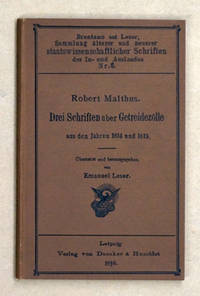
Best.-Nr. 94314Leipzig Duncker & Humblot 1896. 8° XXIV 129 S. OLwd. Stemp. a Vors. sonst tadell. 010 Leipzig, Duncker & Humblot, 1896 unknown
1820Best.-Nr. 46619London: John Murray 1820. First edition 8vo vi 601 1 pp. Contemporary black half calf a little rubbed covers very slightly damp stained and bowed gilt spine and red label. "The Principles had only a limited impact at the time. more recently it has received greater recognition largely as a result of the comments by J. M. Keynes in the 1930s. Keynes argued that Malthus's theory of effective demand provided a scientific explanation of unemployment and that the hundred-year domination of Ricardo over Malthus had been a disaster for the progress of economics. Keynes believed that if economics had followed Malthus instead of being constrained by Ricardo in an artificial groove the world would be a much wiser and richer place." ODNB. Goldsmiths 22767. Kress C577. London: John Murray unknown
1820Best.-Nr. 8125London: John Murray 1820. 1820 vi 601 1 p. First edition. It has a good quality mid-twentieth century binding with a polished morocco spine marbled boards and vellum corners. The spine with gold lines and a contrasting label. Minor rubs to the spine ends otherwise in very good condition. There is an undated pencil note on the title page '£45 Repair'. The text with a few signs of use and some pale paper toning. IMPORTANT COOPERATIVE MOVEMENT PROVENANCE: The title page is inscribed at the head 'Society for promoting Working Men's Assocns / 34 Castle Place -- Oxford Street with a shelfmark R31'. The Society was founded in 1849 by the Christian Socialists in an attempt to found self governing workshops. Lower down the title page is the oval stamp of Ormond Street Working Mens College which still exists in Camden. Founded in 1854 by Frederick Denison Maurice Wiki describes it as 'The Working Men's College is among the earliest adult education institutions established in the United Kingdom and Europe's oldest extant centre for adult education. Founded by Christian socialists at its inception it was at the forefront of liberal education philosophy.' At different times its teachers included Thomas Hughes whose latin lectures were apparently not so popular as his boxing club F.J. Furnival and E.M. Forster. London: John Murray, hardcover
1821Best.-Nr. 040304Boston MA: Wells and Lilly 1821. Book. Very Good. Full-Leather. First American Edition. 8vo - over 7¾" - 9¾" tall. Original full tree calf gilt on burgundy title label mounted on upper spine. Rubbed along edges some surface cracking/crazing rubbed joints and spine extremities. Foxed endpapers some toning and scattered foxing to interior but otherwise intact with firm binding. Former owner's signature on front flyleaf. viii472 pp. Exceptionally scarce first American edition issued a year after the first British edition of 1820. Wells and Lilly Hardcover
1836Best.-Nr. 3620869William Pickering 1836. Spine in poor conidition. Browning of pages.This book has hardback covers. Ex-library With usual stamps and markings In poor condition suitable as a reading copy. No dust jacket. Please note the Image in this listing is a stock photo and may not match the covers of the actual item750grams ISBN: William Pickering hardcover
1820Best.-Nr. 884511London: 1820. Some light foxing to the title page otherwise a superior copy in the original papercovered boards with paper spine label. Malthus' Principles of Political Economy did not have its full impact on economic theory until it was revived by J.M. Keynes and P. Sraffa in the twentieth century. Math and technology aside Malthus argues not that society tends toward cannibalistic starvation but that either society will "preventatively" control its population or nature will "correctively" reduce population"Several philosophers and speculatists had supposed that a certain state of society very different from any that has hitherto existed was in itself practicable; and that if it were realised it would be productive of a far greater degree of human happiness than is compatible with the present institutions of society."21 Malthus' argument as stated by Hazlitt is that if man were to give up his existing social institutions then there would be as much bad as good come of it. "For says Mr Malthus though this improved state of society were actually realized it could not possibly continue but must soon terminate in a state of things pregnant with evils for more insupportable than any we at present endure.". First Edition. Contemporary Blue Cloth. Excellent. 8vo. Hardcover
Best.-Nr. 1991072058.Ghardcover. Good. Access codes and supplements are not guaranteed with used items. May be an ex-library book. hardcover
1650Best.-Nr. WB15505Paris 1650. Hardcover. Near Fine. Second edition. 4to. Engraved title 2 plates 28 illustrations 27 of which are full page. Bound in contemporary mottled calf. A very nice copy. Malthus was an Englishman employed in France. This work similar to others he published consists of five treatises: the first on artillery in general; the second on bombs and mortars; the third on "artificial fire"; the fourth on the mining and undermining of walls; the fifth concerns fireworks. hardcover
Best.-Nr. 1019700157.Ghardcover. Good. Access codes and supplements are not guaranteed with used items. May be an ex-library book. hardcover
1716Best.-Nr. 3115621716. 4 pp. Small splits at old folds old reinforcement to center fold very good. 4 pp. The bill of one John Boundy as issued by Daniel Malthus 1651-1717 apothecary to Queen Anne and George I and great-grandfather of the economist Thomas Robert Malthus. Items charged include various juleps cordials and draughts linseed oil chamomile flowers marshmallow leaves purging potions King's drops quieting powders etc. Attested paid to estate of Mr. Malthus at end by Tho. Graham and docketed paid £58 July 10 1718. With 4 small circular stamps with the motto of the Earl of Fortescue "Forte Scutum Salus Ducum" "A Strong Shield is the Salvation of Leaders" unknown books
1716Best.-Nr. 3115621716. 4 pp. Small splits at old folds old reinforcement to center fold very good. 4 pp. The bill of one John Boundy as issued by Daniel Malthus 1651-1717 apothecary to Queen Anne and George I and great-grandfather of the economist Thomas Robert Malthus. Items charged include various juleps cordials and draughts linseed oil chamomile flowers marshmallow leaves purging potions King's drops quieting powders etc. Attested paid to estate of Mr. Malthus at end by Tho. Graham and docketed paid £58 July 10 1718. With 4 small circular stamps with the motto of the Earl of Fortescue "Forte Scutum Salus Ducum" "A Strong Shield is the Salvation of Leaders" unknown
1988Best.-Nr. 3700685Peter Lang Publishing Inc 1988. This is an ex-library book and may have the usual library/used-book markings inside.This book has hardback covers. Clean from markings. In good all round condition. No dust jacket. French text. Please note the Image in this listing is a stock photo and may not match the covers of the actual item800grams ISBN:082040490X Peter Lang Publishing Inc hardcover
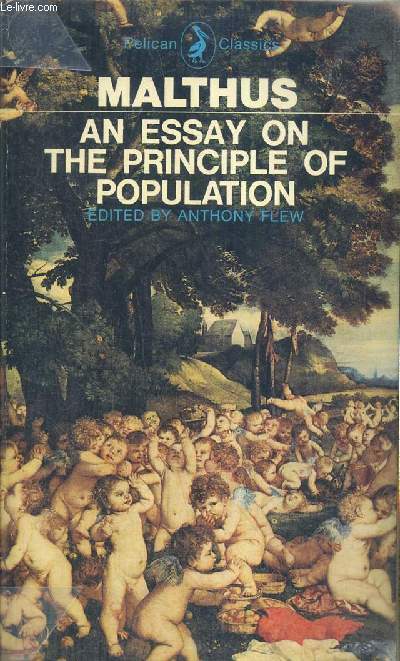
1979Best.-Nr. RO80260974Penguin Books. 1979. In-12. Broché. Bon état, Couv. convenable, Dos satisfaisant, Papier jauni. 291 pages. Annotation au stylo en page de titre. Texte en anglais.. . . . Classification Dewey : 420-Langue anglaise. Anglo-saxon
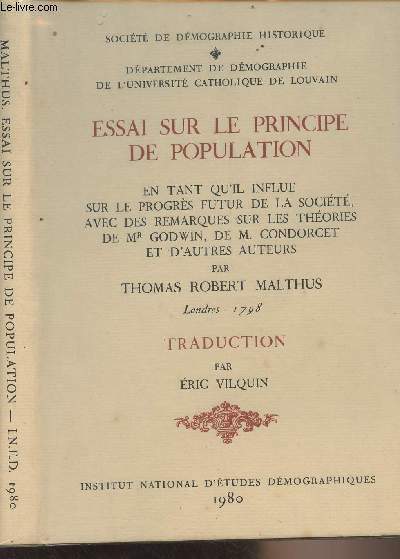
1980Best.-Nr. R300278306Institut national d'études démographiques. 1980. In-8. Relié. Bon état, Couv. convenable, Dos satisfaisant, Intérieur acceptable. 166 pages. Jaquette convenable.. Avec Jaquette. . . Classification Dewey : 304.6-Démographie
1826Best.-Nr. 857601826. MALTHUS Thomas Robert. An Essay on the Principle of Population; or A View of its Past and Present Effects on Human Happiness. London: John Murray 1826. Two volumes. Octavo contemporary full diced brown calf raised bands black and red morocco spine labels marbled endpapers and edges. Housed in a custom slipcase. $2600.1826 edition of MalthusÕ controversial Essay the final one published in his lifetime in contemporary calf.""One of the founders of modern economics"" Malthus first published his highly contested Essay on the Principles of Population in 1798. This landmark work ""was originally the product of a discussion on the perfectibility of society with his father who urged him to publish. Thus the first edition published anonymously was essentially a fighting tract but later editions were considerably altered and grew bulkier as Malthus defended his views against a host of criticsÉ The Essay was highly influential in the progress of thought in early 19th-century Europe and his influence on social policy was considerableÉ Both Darwin and Wallace clearly acknowledged Malthus as a source of the idea of 'the struggle for existence"" PMM 251. ""The achievement of Malthus was the exposition of the theory of population; and his name has been associated so closely with this theory that like Darwin's it has added a new adjective to the language of civilized peoples"" Palgrave II:670-1. This is the sixth edition the final one to be published in his lifetime. Lowndes 1459. Goldsmiths 24893. Early owner signatures dated 1874.Text quite fresh and clean Volume II with small chip to rear free endpaper slight rubbing edge-wear to contemporary boards. An extremely good copy. hardcover books
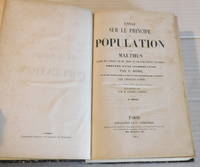
1852Best.-Nr. 101094Paris: Guillaumin et Cie Libraires 1852. 1852. Good. - Octavo 9-5/8 inches high by 6-1/2 inches wide. Hardcover bound into black & white marbled boards backed with a black cloth spine titled & ruled in gilt on the spine. The covers are rubbed & soiled. lvi & 688 pages. There is foxing throughout particularly at the front & rear. Good. Paris: Guillaumin et Cie, Libraires, 1852. hardcover
1826Best.-Nr. 857601826. MALTHUS Thomas Robert. An Essay on the Principle of Population; or A View of its Past and Present Effects on Human Happiness. London: John Murray 1826. Two volumes. Octavo contemporary full diced brown calf raised bands black and red morocco spine labels marbled endpapers and edges. Housed in a custom slipcase. $2600.1826 edition of MalthusÕ controversial Essay the final one published in his lifetime in contemporary calf.""One of the founders of modern economics"" Malthus first published his highly contested Essay on the Principles of Population in 1798. This landmark work ""was originally the product of a discussion on the perfectibility of society with his father who urged him to publish. Thus the first edition published anonymously was essentially a fighting tract but later editions were considerably altered and grew bulkier as Malthus defended his views against a host of criticsÉ The Essay was highly influential in the progress of thought in early 19th-century Europe and his influence on social policy was considerableÉ Both Darwin and Wallace clearly acknowledged Malthus as a source of the idea of 'the struggle for existence"" PMM 251. ""The achievement of Malthus was the exposition of the theory of population; and his name has been associated so closely with this theory that like Darwin's it has added a new adjective to the language of civilized peoples"" Palgrave II:670-1. This is the sixth edition the final one to be published in his lifetime. Lowndes 1459. Goldsmiths 24893. Early owner signatures dated 1874.Text quite fresh and clean Volume II with small chip to rear free endpaper slight rubbing edge-wear to contemporary boards. An extremely good copy. hardcover
Best.-Nr. PJH55320J. P. Aillaud Paris 1820. VG bright set in contemporary slightly worn and scuffed calf bindings with red and black title labels to each spine. 501 452pp. 1st French Edition published same year as the English Edition. Two Volumes. From the collection of Professor Malcolm Deas 1941-2023 an Emeritus Fellow of St Antony's College Oxford and University Lecturer in the Government and Politics of Latin America 1966-2008 J. P. Aillaud (Paris) 1820 unknown
1820Best.-Nr. 76151Paris: Aillaud 1820. Due volumi di cm. 20 pp. 4 xxxii 501 1; 4 452. Solida ed elegante legatura coeva in mezza pelle dorsi a nervi con titoli ed impressioni a secco ed in oro. Poche arrossature ma esemplare genuino ed in ottimo stato di conservazione. Prima edizione francese apparsa l'anno dell'originale inglese. Cfr. Kress C 576; non in Einaudi. Aillaud unknown