M. T. R. MALTHUSLivre Rare Book
MALTHUSLivre Rare Book
Principes d'économie politique
1969réf. 46734Calmann Levy Paris, Calmann Levy 1969. In-8 broché de 366 pages. Très bon état

Librairie Gil - Artgil SARL · Rodez, France14,00 €
577 résultats
1820réf. RO30109165J. P. AILLAU. 1820. In-8. Broché. Etat passable, Couv. défraîchie, Dos abîmé, Quelques rousseurs. 501+452 pages. Tome premier : Charnières fendues, Manques coiffes. Tome second : Charnières fendues, coiffes abîmées, couverture défraichie.. . . . Classification Dewey : 330-Economie
1969réf. 46734Calmann Levy Paris, Calmann Levy 1969. In-8 broché de 366 pages. Très bon état
1820réf. 104886P., J.-P. Aillaud, 1820, 2 vol. in-8°, xxxii-501 et 452 pp, brochés, couvertures muettes de l'époque, bon état. Edition originale (Goldsmiths, 22768 ; Kress, C.576 ; manque à Einaudi)
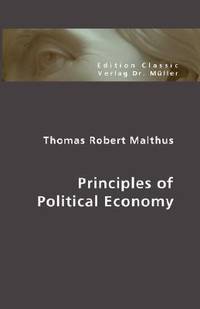
2026réf. LRB53000624Paris: Editions Recreasoft 2026 Language: English. Approximately 558 pages. English: Print-on-demand reprint. Original edition : 1826. Text in English. This sixth edition of Thomas Robert Malthus's seminal work on population dynamics examines the relationship between population growth and resources with a focus on its historical and contemporary impacts on human welfare. The text remains a foundational work in sociology and economics offering insights into demographic trends and their implications for societal development. Book images are non-contractual. Editions Recreasoft. Softcover. New. Editions Recreasoft paperback
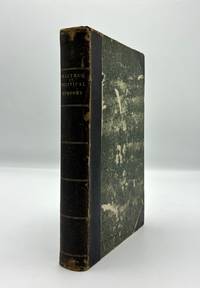
1836réf. 1857London: William Pickering. 1836. Second edition "with considerable additions from the author's own manuscript and an original memoir". Richard Cobden's copy with engraved bookplate to the front pastedown for "Dunford Library" Cobden's home incorporating the initials "R. C.". Octavo. Contemporary half diced plum roan over marbled boards the spine ruled in gilt and with titles in gilt. pp. liv 2 446. A very good copy the binding firm albeit with a little cracking to the front hinge heavy rubbing to the boards rubbing to the joints and spine ends and wear to the corners. The contents with some light spotting to the preliminary pages and a minor crease to the bottom corner of a handful of pages are otherwise in very good order throughout. The second expanded edition of this key work of economic theory by Thomas Malthus originally published as a rebuttal to David Ricardo's 'On the Principles of Political Economy and Taxation' in 1820. This subsequent edition was substantially revised by Malthus himself and published posthumously two years after his death in 1834; it also includes the first appearance of William Otter's notable essay regarding his friend's life a "Memoir of Robert Malthus". Malthus had set about editing his Principles almost immediately after it appeared in print incorporating changes both minor and major particularly with regards to the important chapter on value theory building on the work of Adam Smith. Hollander 'The Economics of Thomas Robert Malthus' p. 4. An interesting association copy coming from the library of the contemporary radical politician campaigner for free trade and co-founder of the Anti-Corn Law League Richard Cobden 1804-1865. Provenance: From the library of Richard Cobden at his home Dunford House. London: William Pickering. hardcover
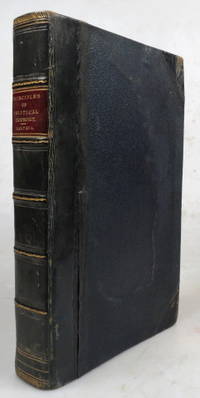
1820réf. 46619London: John Murray 1820. First edition 8vo vi 601 1 pp. Contemporary black half calf a little rubbed covers very slightly damp stained and bowed gilt spine and red label. "The Principles had only a limited impact at the time. more recently it has received greater recognition largely as a result of the comments by J. M. Keynes in the 1930s. Keynes argued that Malthus's theory of effective demand provided a scientific explanation of unemployment and that the hundred-year domination of Ricardo over Malthus had been a disaster for the progress of economics. Keynes believed that if economics had followed Malthus instead of being constrained by Ricardo in an artificial groove the world would be a much wiser and richer place." ODNB. Goldsmiths 22767. Kress C577. London: John Murray unknown
1820réf. 8125London: John Murray 1820. 1820 vi 601 1 p. First edition. It has a good quality mid-twentieth century binding with a polished morocco spine marbled boards and vellum corners. The spine with gold lines and a contrasting label. Minor rubs to the spine ends otherwise in very good condition. There is an undated pencil note on the title page '£45 Repair'. The text with a few signs of use and some pale paper toning. IMPORTANT COOPERATIVE MOVEMENT PROVENANCE: The title page is inscribed at the head 'Society for promoting Working Men's Assocns / 34 Castle Place -- Oxford Street with a shelfmark R31'. The Society was founded in 1849 by the Christian Socialists in an attempt to found self governing workshops. Lower down the title page is the oval stamp of Ormond Street Working Mens College which still exists in Camden. Founded in 1854 by Frederick Denison Maurice Wiki describes it as 'The Working Men's College is among the earliest adult education institutions established in the United Kingdom and Europe's oldest extant centre for adult education. Founded by Christian socialists at its inception it was at the forefront of liberal education philosophy.' At different times its teachers included Thomas Hughes whose latin lectures were apparently not so popular as his boxing club F.J. Furnival and E.M. Forster. London: John Murray, hardcover
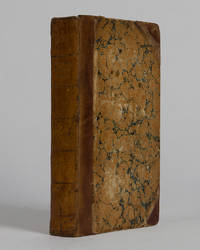
1821réf. 040304Boston MA: Wells and Lilly 1821. Book. Very Good. Full-Leather. First American Edition. 8vo - over 7¾" - 9¾" tall. Original full tree calf gilt on burgundy title label mounted on upper spine. Rubbed along edges some surface cracking/crazing rubbed joints and spine extremities. Foxed endpapers some toning and scattered foxing to interior but otherwise intact with firm binding. Former owner's signature on front flyleaf. viii472 pp. Exceptionally scarce first American edition issued a year after the first British edition of 1820. Wells and Lilly Hardcover
1836réf. 3620869William Pickering 1836. Spine in poor conidition. Browning of pages.This book has hardback covers. Ex-library With usual stamps and markings In poor condition suitable as a reading copy. No dust jacket. Please note the Image in this listing is a stock photo and may not match the covers of the actual item750grams ISBN: William Pickering hardcover
1820réf. 884511London: 1820. Some light foxing to the title page otherwise a superior copy in the original papercovered boards with paper spine label. Malthus' Principles of Political Economy did not have its full impact on economic theory until it was revived by J.M. Keynes and P. Sraffa in the twentieth century. Math and technology aside Malthus argues not that society tends toward cannibalistic starvation but that either society will "preventatively" control its population or nature will "correctively" reduce population"Several philosophers and speculatists had supposed that a certain state of society very different from any that has hitherto existed was in itself practicable; and that if it were realised it would be productive of a far greater degree of human happiness than is compatible with the present institutions of society."21 Malthus' argument as stated by Hazlitt is that if man were to give up his existing social institutions then there would be as much bad as good come of it. "For says Mr Malthus though this improved state of society were actually realized it could not possibly continue but must soon terminate in a state of things pregnant with evils for more insupportable than any we at present endure.". First Edition. Contemporary Blue Cloth. Excellent. 8vo. Hardcover
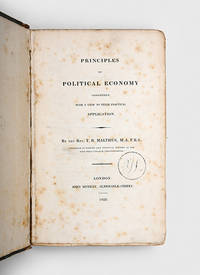
réf. 123522London John Murray 1820. . First edition; 8vo 21 x 13.5 cm; moderate spotting front free endpaper just starting to become loose at head of gutter margin remains of a library label to front pastedown; contemporary half calf marbled paper boards spine lettered in gilt dulled; vi 601 1pp. The first edition of Malthus' treatise on political economy. The book was conceived as a series of tracts rather than a comprehensive and systematic treatise though Malthus published it to establish his own position against that of Ricardo with whom he had been having an ongoing debate about the nature of labour demand and profit. 'In his 'Principles of Political Economy' Malthus was proposing investment in public work and private luxury as a means of increasing effective demand and hence as a palliative to economic distress. The nation he thought must balance the power to produce and the will to consume' DSB. 'The Principles had only a limited impact at the time and was severely criticized by J. R. McCulloch and Ricardo; the latter prepared extensive critical notes. More recently it has received greater recognition largely as a result of the comments by J. M. Keynes in the 1930s. Keynes argued that Malthus's theory of effective demand provided a scientific explanation of unemployment and that the hundred-year domination of Ricardo over Malthus had been a disaster for the progress of economics. Keynes believed that if economics had followed Malthus instead of being constrained by Ricardo in an artificial groove the world would be a much wiser and richer place.' ODNB. Goldsmiths' 22767; Kress C.577. London, John Murray, 1820. hardcover
1820réf. 002253London England: John Murray 1820. 1st Edition . Half-Leather. Fair. Contemporary calf with hand marbled covers; leather spine dry flaking and rubbed with small piece missing and gold stamped title barely visiible; covers detached; front paste down with previous owner's book plate and name neatly in black ink; foxing throughout text otherwise very good without markings; 8vo; with 601 pages. John Murray hardcover
réf. 5070583-nnew. unknown
réf. 5070583like new. unknown
réf. 45125897-nnew. unknown
réf. 45125897like new. unknown
1990réf. 12049Verona: Stamperia Valdonega per COFIDE Compagnia Finanziaria De Benedetti 1990. Ottimo stato. Mezza pelle editoriale con cofanetto cm 25x17 pp 16 388 6. Prefazione di Carlo De Benedetti. Strenna della Compagnia Finanziaria De Benedetti stampata dalla Stamperia Valdonega in 349 esempari su carta Magnani di Pescia. Esemplare #274. Stamperia Valdonega per COFIDE Compagnia Finanziaria De Benedetti unknown
réf. 44962932-nnew. unknown
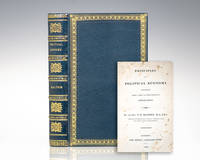
1820réf. 143844London: John Murray 1820. Rare first edition of Malthus' classic work. Octavo bound in full diced morocco raised bands gilt titles and tooling to the spine front and rear panels marbled endpapers. In near fine condition. An exceptional presentation. Thomas Malthus was an English economist known for his work in the fields of political economics and demography. His theory that prosperity and production lead not to utopia but to population growth and thereby back to social imbalance known as the "Malthusian trap" was expounded in his Essay on the Principle of Population 1789 one of his most notable and debated works. His Principles of Political Economy was written as a polemic against David Ricardo's On the Principles of Political Economy and Taxation and Say's Law arguing that demand did not grow simultaneously with supply but that they should be analyzed independent of each other expounding ideas which became influential on Keynsian economics. Both these works were divisive incurring backlash and support amongst notable economists. The bleak message of his Principle of Population rendered Malthus a notorious figure: Ebenezer Scrooge from A Christmas Carol for example justifies his refusal to give charity as a Malthusian attempt to control the population. John Murray hardcover
1820réf. 168311London: John Murray 1820. In the original boards First edition of the author's major late work a re-examination of his economic work in the early 1800s and a point-by-point response to David Ricardo's Principles of Political Economy 1817. Notably Keynes held that "if economics had followed Malthus instead of being constrained by Ricardo in an artificial groove the world would be a much wiser and richer place" ODNB. In the Principles Malthus summarizes his earlier writing on rents currency food prices and corn laws. The book was conceived as a series of tracts rather than a comprehensive and systematic treatise though Malthus published it to establish his own position against that of Ricardo with whom he disagreed about the nature of labour demand and profit. "In his Principles of Political Economy Malthus was proposing investment in public work and private luxury as a means of increasing effective demand and hence as a palliative to economic distress. The nation he thought must balance the power to produce and the will to consume" DSB. In the 20th century the Principles received recognition "largely as a result of the comments by J. M. Keynes in the 1930s. Keynes argued that Malthus's theory of effective demand provided a scientific explanation of unemployment and that the hundred-year domination of Ricardo over Malthus had been a disaster for the progress of economics" ODNB. This copy includes an extremely early reback presumably by the original bookseller. The reback preserves the original blue boards while a section has been cut from the cloth backstrip to expose the original printed label. Octavo. Uncut in original blue boards early reback in brown cloth preserving original printed paper label. Circular "Y.S." ink stamp to title. Light bumping and wear moderate foxing to endpapers and contents front hinge cracked and lacking front free endpaper holding firm slight separations between and within several gatherings small hole to head of K4: a very good copy. Goldsmiths' 22767; Kress C.577; Mattioli 2221. hardcover
réf. 3865507549.Gpaperback. Good. Access codes and supplements are not guaranteed with used items. May be an ex-library book. paperback
réf. 1015455816.Ghardcover. Good. Access codes and supplements are not guaranteed with used items. May be an ex-library book. hardcover
réf. 1015461166.Gpaperback. Good. Access codes and supplements are not guaranteed with used items. May be an ex-library book. paperback
1821réf. 048324Boston: Wells and Lilly 1821. First Edition. Hardcover Full Leather. Good Condition. Original full calf worn at edges and hinges slight bowing to covers. Internally with dampstains to upper corner heavy browning to half title and final pages and pervasive but mostly mild staining throughout not affecting legibility. Nearly very good overall. viii 472pp. Though largely overlooked at the time of publication it is in the principles that Keynes found "scientific explanation of unemployment" and that "the hundred-year domination of Ricardo over Malthus had been a disaster for the progress of economics" ODNB. Malthus's theory that spending on both public works and private luxuries could alleviate recessions and downturns by creating demand and prosperity were well ahead of his time. This is the first US edition. Size: Octavo 8vo. Quantity Available: 1. Shipped Weight: Under 1 kilo. Category: Economics; Americana. Inventory No: 048324. Wells and Lilly hardcover
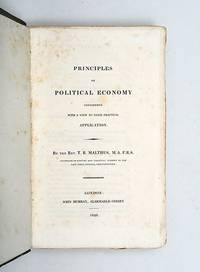
1820réf. 151433London: John Murray 1820. First edition. The book was conceived as a series of tracts rather than a comprehensive and systematic treatise though Malthus published it to establish his own position against that of Ricardo with whom he had been having an ongoing debate about the nature of labour demand and profit. "In his 'Principles of Political Economy' Malthus was proposing investment in public work and private luxury as a means of increasing effective demand and hence as a palliative to economic distress. The nation he thought must balance the power to produce and the will to consume" DSB. "The Principles had only a limited impact at the time and was severely criticized by J. R. McCulloch and Ricardo; the latter prepared extensive critical notes. But more recently it has received greater recognition largely as a result of the comments by J. M. Keynes in the 1930s. Keynes argued that Malthus's theory of effective demand provided a scientific explanation of unemployment and that the hundred-year domination of Ricardo over Malthus had been a disaster for the progress of economics. Keynes believed that if economics had followed Malthus instead of being constrained by Ricardo in an artificial groove the world would be a much wiser and richer place" ODNB. Octavo. Uncut and unopened in the original drab paper-backed blue boards printed paper spine label. Housed in a dark blue quarter morocco solander box by the Chelsea Bindery. Engraved book plate "Bibliothèque de Mr de Barante" to front pastedown paper library shelf label to foot of spine. Head of spine chipped front joint cracked rear joint cracked at head spine label a little chipped all still very strong; a very good copy. Goldsmiths' 22767; Kress C.577. hardcover