1068 resultados
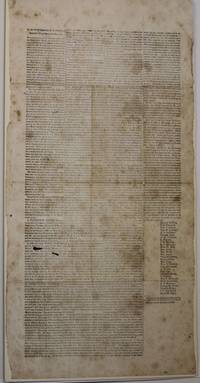
1844ref. 39908Towanda PA 1844. Folio broadside 10-1/8" x 21." Printed in four columns each column separated by a rule. Light to moderate foxing light wear. Good. Signed in type at the bottom by thirty disillusioned local Democrats. Towanda is the county seat of Bradford County the residence of many of the signers including Judge Edward Herrick the first signer. This evidently unrecorded broadside illustrates the impending split in the Democratic Party along sectional lines over the issue of slavery. The signers are "steadfast" Democrats distraught that their Party has nominated James K. Polk of Tennessee as its 1844 presidential candidate. Polk known as the "Dark Horse" candidate "was thrust upon the party as the candidate by the intrigues and management of the NULLIFIERS! italics in original. The instructions and pledges of the delegates were disregarded and Mr. V. Buren and the Democratic party betrayed!" Clay "a statesman of the first order" has always sought to advance the national interest as opposed to parochial concerns. The signers defend his support of protective tariffs and the American System. They applaud his opposition to the annexation of Texas and his warnings that a war with Mexico would result in an expansion of the "odious" system of slavery. Not in Sabin or American Imprints. Not located on OCLC or the online sites of AAS U Penn U TN as of March 2025. unknown books
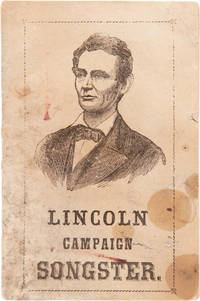
1864ref. 62679Philadelphia: Published by Mason & Co. 1864. Singing for Lincoln in '64 A pocket songster printed to support Lincoln's reelection campaign in 1864 featuring a rather youthful portrait of the president on the front wrapper and twelve spirited pro-Union songs. The titles largely military in theme include such works as "Give us Noble Leaders" "The Veteran Volunteer" "Cast Your Votes for Abraham" "For Lincoln or McClellan you'll be called on to decide/ The one to save the union the other to divide" and "We are Coming Father Abraham 600000 More." The advertisements on the rear wrapper encourage readers to purchase a wide variety of Lincoln campaign badges emblems pins and photographs from the publishers. Despite Lincoln's overwhelming electoral victory in 1864 the race was rather close in Pennsylvania where this was printed – Lincoln took Philadelphia County by a scant few percent and actually failed to secure a majority in neighboring Montgomery and Bucks counties. 16mo. Original pictorial wrappers. Wrappers soiled and stained. Largely clean internally. Advertisements on rear wrapper shaved slightly at outer edge as issued. Good plus. MONAGHAN 323. unknown books
1944Original Progressive Conservative Party of Canada Speakers' Handbook for use in the run-up to the Canadian federal election of 1945. Printing date not stated but was most likely 1944, possibly 1945. Unpaginated. Two inches thick. Provides the full spectrum of PC policies and points with which to attack the Liberal and C.C.F. parties. Contents divided into the following sections: Table of Contents; Leadership - with considerable biographical information on PC leader John Bracken; War Policy and Veterans; Agriculture; Labour; Reconstruction and Natural Resources; Transportation; International Problems; Liberal Policy; C.C.F. Policy. The sections on Liberal and C.C.F. policies extensively document the perceived weaknesses of these parties and were no-doubt intended to serve as the arsenal of attack ads and talking points to be used against these parties. Unmarked. Average wear and soiling. Due to wartime restrictions these handbooks were string-bound. Provides a comprehensive snapshot of the Canadian federal political scene prior to the election of 1945, as seen from the PC perspective. A unique and highly-informative WWII-era Canadian federal political memento. Book
1823ref. 34261Raleigh 1823. 15 1 blank pp. Caption title as issued. Disbound. Scattered light and moderate foxing. Good. Signed at the end in type: "November 1823. CAROLINA." A scarce pro-Calhoun anti-Crawford piece for the 1824 presidential election. When Calhoun decided to seek the presidency in 1824 "both Crawford and Adams the acknowledged front-runners felt betrayed" Crawford because Calhoun had reportedly assured him that he would defer to the older man and wait his turn; and Adams because Calhoun had said that "for the good of the country.the next President should come from the North." Peterson THE GREAT TRIUMVIRATE 116. Miles 3. Thornton 1750. AI 12071 1- DLC. OCLC 42212191 3- NYHS Duke UNC as of December 2024. unknown
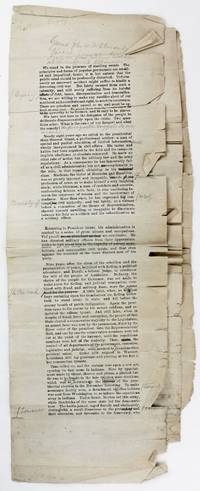
1877ref. 5770N.p. likely Springfield Il: ca. January 8 1877. Good. Three long galley leaves each approximately 6.5 x 19 inches and printed on rectos only with numerous pencil emendations. Old folds and creases numerous chips and tears to margins pervasive wrinkling making reading a bit challenging at times but with no loss to text. Small portion of third leaf containing the last eight lines of text detached but present. Not in great shape but seemingly unique. A galley proof of a speech by General John A. McClernand in the midst of the contentious Election of 1876 which was so far as we can determine neither delivered nor published. A pencil note at top reveals his authorship and notes the speech was intended to be delivered January 8 at the “Great Citizens Convention” in Springfield Illinois almost certainly in 1877 following the recent election in the Fall of 1876. McClernand was an Illinois contemporary of Lincoln's a Democratic Congressman and War Democrat. He was also an ally of another Illinois politician and Lincoln adversary Stephen A. Douglas. He was appointed a general during the Civil War largely through political maneuvering and was generally considered incompetent. McClernand greatly resented the authority of Grant who finally relieved him of command in June 1863. Following the war McClernand became a leading critic of Congressional Reconstruction as well as the Grant Administration in general. He also chaired the 1876 Democratic National Convention which nominated Tilden for the presidency. Here McClernand bitterly attacks Grant his presidential Administration and Reconstruction. According to McClernand Grant's "tastes and habits had been acquired in the field and the camp -- in implicit obedience or absolute command. He knew no other rule of action but the military law and army regulations. As a consequence he has lamentably failed as a civil administrator." As President fraudulently and illegally Grant "joined with Kellog a political adventurer and Durell a federal judge to overthrow the will of the people of Louisiana." Law and order says McClernand "lay prostrate and panting at the feet of her remorseless tyrants." McClernand also assails Grant's highhanded tactics in the other Southern States. Now says McClernand "the president and his accomplices have now applied themselves to defeat the will of the people by a parliamentary device. They claimed for the President of the Senate the right and power to count the electoral votes and to declare the result and by implication that that right and power would be so exercised as to count Tilden out of his election and to count Hayes into one." He wasn't wrong. In one of the closest most hotly-contested and highly-controversial elections in American history to put it simply Hayes effectively stole the election by agreeing to remove northern soldiers from the South and end Reconstruction. It would be interesting to know what McClernand thought of the ultimate result -- he didn't get Tilden but he did get the end of Reconstruction. "Yet another prominent Illinoian who played a role in the Civil War John Alexander McClernand was born in Breckinridge County Kentucky before moving to Shawneetown Illinois at a young age. Similar to fellow Illinoian Abraham Lincoln McClernand was a largely self-taught lawyer who began practicing in Shawneetown in 1835. Also like Lincoln McClernand served in the Black Hawk War. However McClernand was a staunch Democrat. In 1835 he established the newspaper Shawneetown Democrat. He was active in Democratic politics at both the state and federal level serving in the Illinois House of Representatives and eventually Congress. In Congress McClernand was a stalwart Jacksonian Democrat who strongly disliked abolitionists. He strongly opposed the Wilmot Proviso which banned slavery in the territory gained after the Mexican-American War. He became a key ally of fellow Democrat and Illinoian Stephen A. Douglas helping him pass the Compromise of 1850. As tensions rose approaching the election of 1860 McClernand campaigned for Douglas’s presidency and became a Unionist. After war broke out in the following April McClernand helped raise volunteers for the Union Army. Because Lincoln needed to retain a wide base of support and retain connections with Democrats in Illinois he appointed McClernand a brigadier general on May 17 1861. McClernand’s military career would be defined by an ongoing clash with fellow Illinoian General Ulysses S. Grant. Grant a seasoned West Pointer who served in Mexico was irritated by McClernand a political general with little military experience. Further exacerbating relations was McClernand’s tendency to boast about his exploits and diminish the achievements of other commanders" - American Battlefield Trust's entry on John A. McClernand. ca. January 8 unknown
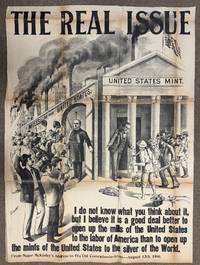
1896ref. 41421Chicago: Edwards Deutsch & Heitmann 1896. Elephant folio broadside 36" x 48" mounted on linen at time of manufacture. A graphic black-and-white campaign broadside for Republican William McKinley's 1896 presidential contest against Democrat William Jennings Bryan. Early folds with significant wear and splitting along folds including the backing several archival cloth tape repairs on verso. Moderate toning at the fold lines. Good only. "McKinley welcomes workers to U.S. mills W.J. Bryan welcomes foreign silver." Library of Congress copy of this print but reprinted in 1900 with the addition of large red type "McKinley was Right in 1896." Democrat Bryan favoring free coinage of silver and elimination of tariffs welcomes foreigners bringing to the Mint silver from India Germany England Mexico Japan China and elsewhere. Republican McKinley favoring the gold standard and tariffs to protect American industries welcomes prosperous American workers to American mills. "From Major McKinley's Address to His Old Comrades = In = Arms. - August 12th 1896." OCLC 20499606 1- Detroit Pub. Lib. as of April 2026. Edwards, Deutsch & Heitmann unknown
1823ref. 34261Raleigh 1823. 15 1 blank pp. Caption title as issued. Disbound. Scattered light and moderate foxing. Good. Signed at the end in type: "November 1823. CAROLINA." A scarce pro-Calhoun anti-Crawford piece for the 1824 presidential election. When Calhoun decided to seek the presidency in 1824 "both Crawford and Adams the acknowledged front-runners felt betrayed" Crawford because Calhoun had reportedly assured him that he would defer to the older man and wait his turn; and Adams because Calhoun had said that "for the good of the country.the next President should come from the North." Peterson THE GREAT TRIUMVIRATE 116. Miles 3. Thornton 1750. AI 12071 1- DLC. OCLC 42212191 3- NYHS Duke UNC as of December 2024. unknown books
1877ref. 5770N.p. likely Springfield Il: ca. January 8 1877. Good. Three long galley leaves each approximately 6.5 x 19 inches and printed on rectos only with numerous pencil emendations. Old folds and creases numerous chips and tears to margins pervasive wrinkling making reading a bit challenging at times but with no loss to text. Small portion of third leaf containing the last eight lines of text detached but present. Not in great shape but seemingly unique. A galley proof of a speech by General John A. McClernand in the midst of the contentious Election of 1876 which was so far as we can determine neither delivered nor published. A pencil note at top reveals his authorship and notes the speech was intended to be delivered January 8 at the “Great Citizens Convention” in Springfield Illinois almost certainly in 1877 following the recent election in the Fall of 1876. McClernand was an Illinois contemporary of Lincoln's a Democratic Congressman and War Democrat. He was also an ally of another Illinois politician and Lincoln adversary Stephen A. Douglas. He was appointed a general during the Civil War largely through political maneuvering and was generally considered incompetent. McClernand greatly resented the authority of Grant who finally relieved him of command in June 1863. Following the war McClernand became a leading critic of Congressional Reconstruction as well as the Grant Administration in general. He also chaired the 1876 Democratic National Convention which nominated Tilden for the presidency. Here McClernand bitterly attacks Grant his presidential Administration and Reconstruction. According to McClernand Grant's "tastes and habits had been acquired in the field and the camp -- in implicit obedience or absolute command. He knew no other rule of action but the military law and army regulations. As a consequence he has lamentably failed as a civil administrator." As President fraudulently and illegally Grant "joined with Kellog a political adventurer and Durell a federal judge to overthrow the will of the people of Louisiana." Law and order says McClernand "lay prostrate and panting at the feet of her remorseless tyrants." McClernand also assails Grant's highhanded tactics in the other Southern States. Now says McClernand "the president and his accomplices have now applied themselves to defeat the will of the people by a parliamentary device. They claimed for the President of the Senate the right and power to count the electoral votes and to declare the result and by implication that that right and power would be so exercised as to count Tilden out of his election and to count Hayes into one." He wasn't wrong. In one of the closest most hotly-contested and highly-controversial elections in American history to put it simply Hayes effectively stole the election by agreeing to remove northern soldiers from the South and end Reconstruction. It would be interesting to know what McClernand thought of the ultimate result -- he didn't get Tilden but he did get the end of Reconstruction. "Yet another prominent Illinoian who played a role in the Civil War John Alexander McClernand was born in Breckinridge County Kentucky before moving to Shawneetown Illinois at a young age. Similar to fellow Illinoian Abraham Lincoln McClernand was a largely self-taught lawyer who began practicing in Shawneetown in 1835. Also like Lincoln McClernand served in the Black Hawk War. However McClernand was a staunch Democrat. In 1835 he established the newspaper Shawneetown Democrat. He was active in Democratic politics at both the state and federal level serving in the Illinois House of Representatives and eventually Congress. In Congress McClernand was a stalwart Jacksonian Democrat who strongly disliked abolitionists. He strongly opposed the Wilmot Proviso which banned slavery in the territory gained after the Mexican-American War. He became a key ally of fellow Democrat and Illinoian Stephen A. Douglas helping him pass the Compromise of 1850. As tensions rose approaching the election of 1860 McClernand campaigned for Douglas’s presidency and became a Unionist. After war broke out in the following April McClernand helped raise volunteers for the Union Army. Because Lincoln needed to retain a wide base of support and retain connections with Democrats in Illinois he appointed McClernand a brigadier general on May 17 1861. McClernand’s military career would be defined by an ongoing clash with fellow Illinoian General Ulysses S. Grant. Grant a seasoned West Pointer who served in Mexico was irritated by McClernand a political general with little military experience. Further exacerbating relations was McClernand’s tendency to boast about his exploits and diminish the achievements of other commanders" - American Battlefield Trust's entry on John A. McClernand. ca. January 8 unknown books
1896ref. 41421Chicago: Edwards Deutsch & Heitmann 1896. Elephant folio broadside 36" x 48" mounted on linen at time of manufacture. A graphic black-and-white campaign broadside for Republican William McKinley's 1896 presidential contest against Democrat William Jennings Bryan. Early folds with significant wear and splitting along folds including the backing several archival cloth tape repairs on verso. Moderate toning at the fold lines. Good only. "McKinley welcomes workers to U.S. mills W.J. Bryan welcomes foreign silver." Library of Congress copy of this print but reprinted in 1900 with the addition of large red type "McKinley was Right in 1896." Democrat Bryan favoring free coinage of silver and elimination of tariffs welcomes foreigners bringing to the Mint silver from India Germany England Mexico Japan China and elsewhere. Republican McKinley favoring the gold standard and tariffs to protect American industries welcomes prosperous American workers to American mills. "From Major McKinley's Address to His Old Comrades = In = Arms. - August 12th 1896." OCLC 20499606 1- Detroit Pub. Lib. as of April 2026. Edwards, Deutsch & Heitmann unknown books
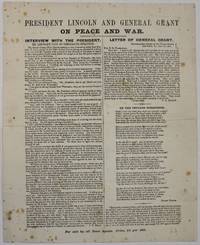
1864ref. 40032New York: For sale by all News Agents. Price $1 per 100. 1864. Broadside 9 1/2" x 11 1/4". Printed in two columns. Light foxing Old white tape remnants at upper margin of blank verso. Very Good. The broadside prints Judge Mills's report of his interview with President Lincoln who strongly defends the use of black troops in the war effort. General Grant's letter to E.B. Washbourne sic reports "The Rebels have now in their ranks their last man. The little boys and old men are guarding prisoners guarding railroad bridges and forming a good part of their garrisons for entrenched positions." Bayard Taylor's poem on the Democrats' presidential nominating convention 'On the Chicago Surrender' is also printed. "Judge Mills" was Joseph T. Mills of Wisconsin an attorney and judge who had also been a State Assemblyman. Bartlett 2725. Sabin 41157. Weinstein Against the Tide 141. Not in Monaghan. For sale by all News Agents. Price, $1 per 100. unknown
1864ref. 40032New York: For sale by all News Agents. Price $1 per 100. 1864. Broadside 9 1/2" x 11 1/4". Printed in two columns. Light foxing Old white tape remnants at upper margin of blank verso. Very Good. The broadside prints Judge Mills's report of his interview with President Lincoln who strongly defends the use of black troops in the war effort. General Grant's letter to E.B. Washbourne sic reports "The Rebels have now in their ranks their last man. The little boys and old men are guarding prisoners guarding railroad bridges and forming a good part of their garrisons for entrenched positions." Bayard Taylor's poem on the Democrats' presidential nominating convention 'On the Chicago Surrender' is also printed. "Judge Mills" was Joseph T. Mills of Wisconsin an attorney and judge who had also been a State Assemblyman. Bartlett 2725. Sabin 41157. Weinstein Against the Tide 141. Not in Monaghan. For sale by all News Agents. Price, $1 per 100. unknown books
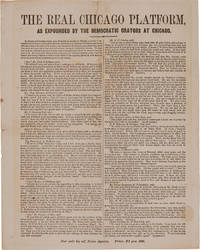
1864ref. 65929New York: National Union Executive Committee 1864. Scarce Anti-Copperhead Broadside A scarce anti-Copperhead broadside printed during the election of 1864 purporting to reveal "the real Chicago Platform" and providing excerpts from speeches given at the Democratic National Convention. The convention met in Chicago on August 29 1864 where the Copperheads quickly established dominance over the outnumbered War Democrats and established peace with the South at any cost as the core of their platform. McClellan accepted the nomination alongside staunch Copperhead George Pendleton despite his open opposition to the peace platform; this seeming hypocrisy was mercilessly lampooned by the opposition contributing to the abject failure of the joint War and Peace ticket. The present broadside presents statements made at the convention by "a number of distinguished Democratic orators" which they deem "sufficient to show the temper and purpose of all." Some choice excerpts include: "I love our Southern friends; they are a noble a brave and a chivalrous people cheers" Representative James S. Rollins of Missouri; "Show me a War Democrat to-day and I will show you a shoddy Abolitionist in disguise.He is a Judas and should be cast out as an enemy to humanity and to God.Soon the net is to be drawn that will gather in its half million more to feed the insatiable thirst for blood of the Negro God" J.A. McMaster arrested for libel at the start of the war; "If Democrats catch Lincoln's bloody satrap spies among them they must cut their damned throats that's all. Applause" Captain William J. Kountz known troublemaker and personal antagonist of General Grant dishonorably discharged in 1863; and "We are one and all for peace and with this magic word upon our banner we shall sweep over the course and roll into oblivion the black negro-loving negro-hugging worshippers of old Abe Lincoln" Isaiah Rynders Tammany Hall tough and former Know-Nothing. The broadside was clearly printed with intention of wide dispersal among potential Lincoln supporters with a noted price of "$1 per 100." The American Antiquarian Society reasonably suggests that this broadside was printed by the National Union Executive Committee of New York based on typographically similar items in their collection. A representative document from one of the nation's most fraught elections. Old folds. Light tanning and staining. Small holes at two cross-folds short closed tear to upper margin and left edge. About very good. SABIN 68234. unknown
1864ref. 65929New York: National Union Executive Committee 1864. Scarce Anti-Copperhead Broadside A scarce anti-Copperhead broadside printed during the election of 1864 purporting to reveal "the real Chicago Platform" and providing excerpts from speeches given at the Democratic National Convention. The convention met in Chicago on August 29 1864 where the Copperheads quickly established dominance over the outnumbered War Democrats and established peace with the South at any cost as the core of their platform. McClellan accepted the nomination alongside staunch Copperhead George Pendleton despite his open opposition to the peace platform; this seeming hypocrisy was mercilessly lampooned by the opposition contributing to the abject failure of the joint War and Peace ticket. The present broadside presents statements made at the convention by "a number of distinguished Democratic orators" which they deem "sufficient to show the temper and purpose of all." Some choice excerpts include: "I love our Southern friends; they are a noble a brave and a chivalrous people cheers" Representative James S. Rollins of Missouri; "Show me a War Democrat to-day and I will show you a shoddy Abolitionist in disguise.He is a Judas and should be cast out as an enemy to humanity and to God.Soon the net is to be drawn that will gather in its half million more to feed the insatiable thirst for blood of the Negro God" J.A. McMaster arrested for libel at the start of the war; "If Democrats catch Lincoln's bloody satrap spies among them they must cut their damned throats that's all. Applause" Captain William J. Kountz known troublemaker and personal antagonist of General Grant dishonorably discharged in 1863; and "We are one and all for peace and with this magic word upon our banner we shall sweep over the course and roll into oblivion the black negro-loving negro-hugging worshippers of old Abe Lincoln" Isaiah Rynders Tammany Hall tough and former Know-Nothing. The broadside was clearly printed with intention of wide dispersal among potential Lincoln supporters with a noted price of "$1 per 100." The American Antiquarian Society reasonably suggests that this broadside was printed by the National Union Executive Committee of New York based on typographically similar items in their collection. A representative document from one of the nation's most fraught elections. Old folds. Light tanning and staining. Small holes at two cross-folds short closed tear to upper margin and left edge. About very good. SABIN 68234. unknown books
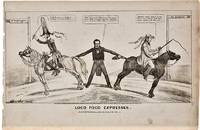
1838ref. 38949New York: H.R. Robinson 1838. Oblong lithograph broadside 13-1/4" x 20." Shallow blank left margin chips from a prior mounting. Light outer margin darkening. A clean image signed 'Blanks fecit' perhaps Edward Williams Clay. Very Good. A satiric commentary on thwarted Democratic hopes to control New York City. Whigs dashed Democratic expectations in the New York municipal elections of spring 1838. Successful Whig mayoral candidate Aaron Clark holds and restrains two horses by their tails: 'Stop my good fellows you are going on a fools errand you are counting your chickens before they are hatched'." His victory has delayed if not destroyed Loco Foco hopes of political dominance. On the right a Loco Foco supporter in the garb of a carman or driver sits on a horse and tries to ride toward Albany to fulfill his ambitions: 'Marcy must resign in my favor and I'll be next Governor myself for this job!' Reilly suggests the man is either Isaac Varian the Loco Foco mayoral candidate or Democratic Congressman C.C. Cambreling. On the left a uniformed Jacksonian Democrat sits on his horse. He wants to go to Washington: 'I shall insist on Matty's making me next Collector.' He is probably Tammany leader Jesse Hoyt who indeed was successful in his quest to be Collector of the Port of New York. Reilly 1838-11. Weitenkampf 52. OCLC 299944597 1- DLC 1136565725 1- AAS as of December 2025. Not at NYPL or NYHS web sites. H.R. Robinson unknown books
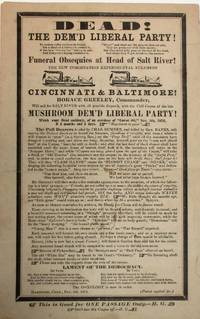
1872ref. 38915Hartford 1872. Broadside 6" x 9-1/2" text surrounded by mourning border. A few spots Very Good. Illustrations of two steamers. At the bottom: "This is Good for ONE PASSAGE Only. - H.G." Dated at Hartford November 5 1872. "Salt River" is 19th century American slang: a losing candidate for office was taking a trip "up Salt River." Tickets for passage "up Salt River" were frequently printed to mock supporters of losing candidates. This humorous scarce broadside taunts Horace Greeley and other defectors from the Republican Party for their support of Greeley in 1872. "On the overwhelming defeat of the Liberal Republican Party and its candidate Horace Greeley in the presidential election of 1872. Greeley had been nominated at a Liberal Republican convention at Cincinnati in May and at the Democratic National Convention at Baltimore in July 1872" AAS description. Pall bearers include Charles Sumner and General Banks prominent Republican supporters of Greeley. OCLC 191231113 2- AAS Middlebury 47090036 1- CT Hist. Soc. as of August 2025. unknown books
1888ref. 160431888 /1889. Very good; two tiny holes and minor water spot; colors are strong. Color printed cotton with portraits of Harrison and George Washington below American flags and an eagle. It meas. appx. 23 x 17 inches. Apparently an inaugural artifact souvenir for Benjamin Harrison. Washington's inaugural was in New York City a century before Harrison. Hence the pairing of the two on this printed cotton artifact. A handsome piece of election memorabilia. Absent from Threads of History. unknown books
1936ref. 24942This sheet contains five rough sketches of graphics calling on the workers and voters of America to support Franklin D. Roosevelt's reelection in 1936. They did in record numbers. PRESIDENTIAL ELECTION OF 1936. Typed Document Signed. Artwork by Franz Felix and Ideas and Copy by Richard Barron "Set of Rough Sketches Containing Some Suggested Promotion Ideas to be Used in the 1936 Democratic Presidential Campaign" July 2 1936. 1 p. 12 x 10½ in. Excerpts: "1. Sounding the call against 'economic royalists' in the spirit of 1776." "2. Appropriating the well-known symbol of violence upraised fist diverting it to peaceful democratic use. To include the farmer phrase the appeal: TOILERS OF AMERICA – UNITE FOR ROOSEVELT." "3. The statue of 'The Thinker' as a symbol of the man today who thinks the toiler with brawn and brain.everyman." "4. Direct appeal to radical labor and leftists in general." "5. Another way of appealing to the working class men and women." "This collaborative effort respectfully submitted for consideration to the Chairman of the Democratic National Committee Mr. James A. Farley." Historical Background After unseating incumbent Republican President Herbert Hoover in 1932 President Franklin D. Roosevelt ran for reelection in 1936. His Republican opponent was Governor Alf Landon of Kansas. Although the Great Depression had entered its eighth year Roosevelt's New Deal policies were broadly popular. He won the highest share of the popular and electoral vote since the uncontested 1820 election. Roosevelt attracted more than 60 percent of the popular vote and won the electoral votes of 46 states; Landon won the electoral votes of only Maine and Vermont. Democratic Party chairman James Farley had predicted that Roosevelt would lose only Maine and Vermont. After the results of the 1936 election Farley quipped that the nation needed to revise the conventional political wisdom of "As Maine goes so goes the nation" to "As Maine goes so goes Vermont." These ideas for campaign imagery employed or modified common images to support Roosevelt's campaign. One drew on the imagery of artist Archibald Willard's 1875 painting The Spirit of '76 and employed three figures of workers to match the subjects of Willard's image. Another appropriated the upraised fist as a symbol of violence and repurposed it as a symbol of defiant unity against "economic royalists." A third used an image of The Thinker by French sculptor Auguste Rodin 1840-1917 to appeal to thinking voters. Another image appeals to the fears of radicals that the alternative to Roosevelt is "Reaction." Richard Barron and artist Franz Felix submitted these ideas to Democratic National Committee chairman James A. Farley on July 2 1936 three weeks before the Democratic Party held its convention in Philadelphia. There is no evidence that these images were used in the campaign and it is possible that Farley rejected them. At the end of the campaign the Democratic National Committee had a campaign deficit of approximately $850000. To help offset those expenses the treasurer convinced President Roosevelt to sign 2500 brief Forewords which were bound into The Democratic Book 1936 and sent to donors of $250. Purchases brought in more than $400000 for the party and led Republicans to charge corrupt practices for allowing corporations to contribute to the campaign by buying copies. Franz Felix 1892-1967 was born in Vienna Austria and developed an ability as a child to draw portraits in charcoal. He studied portraiture in Vienna and immigrated to the United States shortly after World War I. He settled in San Francisco where he established himself as a portrait artist and commercial illustrator. In the late 1920s he moved to New York and established a studio in the suburb of Spring Valley where he produced book and magazine illustrations. During World War II he painted a series of murals of wartime activities of Spring Valley residents. James A. Farley 1888-1976 was born in New York into an Irish Catholic family. After his father died he helped his mother with a small business to support the family. After graduating from Packard Business College in New York City where he studied bookkeeping and other business skills Farley got a job with the U.S. Gypsum Corporation. He served as a Democratic town clerk in Stony Point New York and became chairman of the county's Democratic Party in 1918. He organized upstate Democrats and helped elect Alfred E. Smith as Governor that year. He served in the New York State Assembly in 1923 but was defeated at the next election for supporting the repeal of Prohibition. As chair of the state Athletic Commission Farley fought for the civil rights of African American athletes. Farley founded he General Builders Corporation from smaller firms to become New York City's largest building supply company. Farley directed Franklin D. Roosevelt's narrowly successful New York gubernatorial campaign in 1928 and his reelection in 1930. Farley served as chairman of the New York State Democratic Committee from 1930 to 1944 and helped build the national New Deal coalition that elected Roosevelt to the Presidency four times. In 1932 Farley became the chairman of the Democratic National Committee and in 1933 U.S. Postmaster General. He held both positions until 1940. Farley and Roosevelt broke on the two-term tradition of the Presidency in 1940 and he later helped propose the 22nd Amendment to the U.S. Constitution limiting a person to two elections as president approved by Congress in 1947 and ratified in 1951. Farley became chairman of the board of the Coca-Cola Export Corporation in 1940 and held that position for more than thirty years.
1936ref. 24942This sheet contains five rough sketches of graphics calling on the workers and voters of America to support Franklin D. Roosevelt's reelection in 1936. They did in record numbers. PRESIDENTIAL ELECTION OF 1936. Typed Document Signed. Artwork by Franz Felix and Ideas and Copy by Richard Barron "Set of Rough Sketches Containing Some Suggested Promotion Ideas to be Used in the 1936 Democratic Presidential Campaign" July 2 1936. 1 p. 12 x 10½ in. Excerpts: "1. Sounding the call against 'economic royalists' in the spirit of 1776." "2. Appropriating the well-known symbol of violence upraised fist diverting it to peaceful democratic use. To include the farmer phrase the appeal: TOILERS OF AMERICA – UNITE FOR ROOSEVELT." "3. The statue of 'The Thinker' as a symbol of the man today who thinks the toiler with brawn and brain.everyman." "4. Direct appeal to radical labor and leftists in general." "5. Another way of appealing to the working class men and women." "This collaborative effort respectfully submitted for consideration to the Chairman of the Democratic National Committee Mr. James A. Farley." Historical Background After unseating incumbent Republican President Herbert Hoover in 1932 President Franklin D. Roosevelt ran for reelection in 1936. His Republican opponent was Governor Alf Landon of Kansas. Although the Great Depression had entered its eighth year Roosevelt's New Deal policies were broadly popular. He won the highest share of the popular and electoral vote since the uncontested 1820 election. Roosevelt attracted more than 60 percent of the popular vote and won the electoral votes of 46 states; Landon won the electoral votes of only Maine and Vermont. Democratic Party chairman James Farley had predicted that Roosevelt would lose only Maine and Vermont. After the results of the 1936 election Farley quipped that the nation needed to revise the conventional political wisdom of "As Maine goes so goes the nation" to "As Maine goes so goes Vermont." These ideas for campaign imagery employed or modified common images to support Roosevelt's campaign. One drew on the imagery of artist Archibald Willard's 1875 painting The Spirit of '76 and employed three figures of workers to match the subjects of Willard's image. Another appropriated the upraised fist as a symbol of violence and repurposed it as a symbol of defiant unity against "economic royalists." A third used an image of The Thinker by French sculptor Auguste Rodin 1840-1917 to appeal to thinking voters. Another image appeals to the fears of radicals that the alternative to Roosevelt is "Reaction." Richard Barron and artist Franz Felix submitted these ideas to Democratic National Committee chairman James A. Farley on July 2 1936 three weeks before the Democratic Party held its convention in Philadelphia. There is no evidence that these images were used in the campaign and it is possible that Farley rejected them. At the end of the campaign the Democratic National Committee had a campaign deficit of approximately $850000. To help offset those expenses the treasurer convinced President Roosevelt to sign 2500 brief Forewords which were bound into The Democratic Book 1936 and sent to donors of $250. Purchases brought in more than $400000 for the party and led Republicans to charge corrupt practices for allowing corporations to contribute to the campaign by buying copies. Franz Felix 1892-1967 was born in Vienna Austria and developed an ability as a child to draw portraits in charcoal. He studied portraiture in Vienna and immigrated to the United States shortly after World War I. He settled in San Francisco where he established himself as a portrait artist and commercial illustrator. In the late 1920s he moved to New York and established a studio in the suburb of Spring Valley where he produced book and magazine illustrations. During World War II he painted a series of murals of wartime activities of Spring Valley residents. James A. Farley 1888-1976 was born in New York into an Irish Catholic family. After his father died he helped his mother with a small business to support the family. After graduating from Packard Business College in New York City where he studied bookkeeping and other business skills Farley got a job with the U.S. Gypsum Corporation. He served as a Democratic town clerk in Stony Point New York and became chairman of the county's Democratic Party in 1918. He organized upstate Democrats and helped elect Alfred E. Smith as Governor that year. He served in the New York State Assembly in 1923 but was defeated at the next election for supporting the repeal of Prohibition. As chair of the state Athletic Commission Farley fought for the civil rights of African American athletes. Farley founded he General Builders Corporation from smaller firms to become New York City's largest building supply company. Farley directed Franklin D. Roosevelt's narrowly successful New York gubernatorial campaign in 1928 and his reelection in 1930. Farley served as chairman of the New York State Democratic Committee from 1930 to 1944 and helped build the national New Deal coalition that elected Roosevelt to the Presidency four times. In 1932 Farley became the chairman of the Democratic National Committee and in 1933 U.S. Postmaster General. He held both positions until 1940. Farley and Roosevelt broke on the two-term tradition of the Presidency in 1940 and he later helped propose the 22nd Amendment to the U.S. Constitution limiting a person to two elections as president approved by Congress in 1947 and ratified in 1951. Farley became chairman of the board of the Coca-Cola Export Corporation in 1940 and held that position for more than thirty years. books
ref. 012954Paris Plon 0 4 volumes in-8 brochés, couvertures illustrée
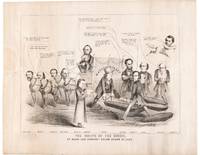
1864ref. 40557New York: Bromley & Company 1864. 19" x 24" lithograph broadside cartoon. Old tears repaired with tape on verso. Long horizontal tear at center has been reinforced by tape on verso. Light wrinkling and toning. The cartoon remains bold solid and intact. Good. "The first in a series of four harsh anti-Lincoln satires published by Bromley & Co. in New York. An imaginary dream of Jack Downing a comic Yankee character created in the 1830s by Seba Smith has Lincoln and some of his supporters and cabinet members as a band of undertakers about to inter the Constitution. "In 1862 displeased by Attorney General Edward Bates's slowness in enforcing the Conspiracies Act the President took matters into his own hands and issued a proclamation 'directing trial by court martial or military commissions of all persons who impeded the draft discouraged enlistments or committed other disloyal acts.' Around thirty-eight thousand people were arrested denied the right of habeas corpus and held in jail until brought to trial. This heavy-handed act provides the fuel for the artist's attack here. "Secretary Stanton is shown driving a hearse 'War Democracy' drawn by four horses with the heads of War Democrats left to right: John Cochrane Benjamin F. Butler Thomas Francis Meagher and Daniel S. Dickinson. Secretary Stanton says 'My jackasses had a load but they pull'd it through bravely. Cochrane: 'I pull for the side that pays the best always.' Butler: 'A million of dollars from New-Orleans'. . . "At right journalist Horace Greeley and Massachusetts senator Charles Sumner bury a casket labeled 'Constitution. Three other caskets 'Union' 'Habeas Corpus' and 'Free Speech Charge Express' wait nearby. Greeley: 'I guess we'll bury it so deep that it will never get up again.' Sumner: 'Be still you old fool. Let us first be sure that it is all under.' "A sober Lincoln watches with folded arms asking 'Chase will it stay down" Beside him treasury secretary Salmon P. Chase responds '. . . It must stay down. Or we shall all go up!' . . . "Abolitionist clergyman Henry Ward Beecher presides over the ceremony with a black child in his arms praying 'Not thy will oh Lord! But mine be done.' Above them Secretary of War Edwin M. Stanton who has the legs and tail of a demon and holds a dagger flies off crying 'If it were done when 'tis done'." Reilly Reilly 1864-37. Weitenkampf 141. OCLC 647912979 2- AAS Clements 299947771 1- DLC as of December 2024. Bromley & Company unknown
1864ref. 40557New York: Bromley & Company 1864. 19" x 24" lithograph broadside cartoon. Old tears repaired with tape on verso. Long horizontal tear at center has been reinforced by tape on verso. Light wrinkling and toning. The cartoon remains bold solid and intact. Good. "The first in a series of four harsh anti-Lincoln satires published by Bromley & Co. in New York. An imaginary dream of Jack Downing a comic Yankee character created in the 1830s by Seba Smith has Lincoln and some of his supporters and cabinet members as a band of undertakers about to inter the Constitution. "In 1862 displeased by Attorney General Edward Bates's slowness in enforcing the Conspiracies Act the President took matters into his own hands and issued a proclamation 'directing trial by court martial or military commissions of all persons who impeded the draft discouraged enlistments or committed other disloyal acts.' Around thirty-eight thousand people were arrested denied the right of habeas corpus and held in jail until brought to trial. This heavy-handed act provides the fuel for the artist's attack here. "Secretary Stanton is shown driving a hearse 'War Democracy' drawn by four horses with the heads of War Democrats left to right: John Cochrane Benjamin F. Butler Thomas Francis Meagher and Daniel S. Dickinson. Secretary Stanton says 'My jackasses had a load but they pull'd it through bravely. Cochrane: 'I pull for the side that pays the best always.' Butler: 'A million of dollars from New-Orleans'. . . "At right journalist Horace Greeley and Massachusetts senator Charles Sumner bury a casket labeled 'Constitution. Three other caskets 'Union' 'Habeas Corpus' and 'Free Speech Charge Express' wait nearby. Greeley: 'I guess we'll bury it so deep that it will never get up again.' Sumner: 'Be still you old fool. Let us first be sure that it is all under.' "A sober Lincoln watches with folded arms asking 'Chase will it stay down" Beside him treasury secretary Salmon P. Chase responds '. . . It must stay down. Or we shall all go up!' . . . "Abolitionist clergyman Henry Ward Beecher presides over the ceremony with a black child in his arms praying 'Not thy will oh Lord! But mine be done.' Above them Secretary of War Edwin M. Stanton who has the legs and tail of a demon and holds a dagger flies off crying 'If it were done when 'tis done'." Reilly Reilly 1864-37. Weitenkampf 141. OCLC 647912979 2- AAS Clements 299947771 1- DLC as of December 2024. Bromley & Company unknown books
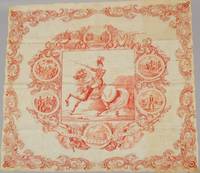
1840ref. 211221840. As issued. Very good; clean; occasional small spot; old folds. Printed red on white cotton; meas. appx. 27 x 26 inches. An election bandanna for William Henry Harrison's presidential campaign in 1840. As such it is among the first to be issued for any campaign in the nation. From the early 1800s through the 1870s kerchiefs laden with visual symbols glorified presidential aspirants as military heroes and venerable statesmen. Long-standing custom discouraged candidates from actively campaigning for public office a practice viewed as undignified and "unduly ambitious". As a result kerchiefs and other propaganda devices played a key role in image advertising. William Henry Harrisons 1840 bid for the presidency during a time of an expanding mass electorate ushered in a new era of campaigning marked by the appropriation of symbols and slogans - in Harrisons case the log cabin hard cider barrel and slogan Tippecanoe and Tyler Too - and the vigorous production of campaign propaganda. The American campaign kerchief officially arrived with the presidential bid of William Henry Harrison in 1840 after Democratic opponents labeled the 67-year-old Harrison an old has been content to retire to his log cabin and drink hard cider. Whigs seized upon the intended insult and turned log cabins and hard cider barrels into positive emblems of the campaign championing Harrison as a man of the people. A flood of political kerchiefs featured the ubiquitous log cabin and barrels. Ironically the man perennially portrayed as a simple frontiersman was actually an aristocratic Virginian who lived in a stately residence. Like George Washington and Andrew Jackson before him William Henry Harrison was promoted as a military hero in this equestrian portrait. Known as The Hero of Tippecanoe for his victory over the Shawnees at Tippecanoe Indiana in 1811 Harrison also distinguished himself during the War of 1812. The figure is surrounded by scenes depicting his log cabin home the Battle of Tippecanoe Battle of Thames the farmer US Capitol and the Treaty. Threads of History #131; Campaigns on Cotton New York Historical Society. unknown books
ref. LB9in-4° demi veau à nerfs, caissons ornés de fleurons, pièce de titre. Garde blanche, Frontispice double page représentant la statue équestre de Louis XV inaugurée le 20 juin 1763 sur ce qui deviendra la place de la Concorde, Titre double page, Discours préléminaire i à viij , carte des généralités et intendances double page en couleur, carte générale des 22 élections de la généralité de Paris, double page, couleur , Description de la Généralité de Paris i à xxxiv [contient les principales foires avec leur durée] , Election de Beauvais carte couleur double page , description de l'élection de Beauvais 1 à 4 , Election de Compiègne carte couleur double page , description de l'élection de Compiègne 5 à 8 , Election de Mantes carte couleur double page , description de l'élection de Mantes 9 à 12 , Election de Pontoise carte couleur double page , description de l'élection de Pontoise 13 à 16 , Election de Senlis carte couleur double page , description de l'élection de Senlis 17 à 20 , Election de Dreux carte couleur double page , description de l'élection de Dreux 21 à 24 , Election de Monfort-l'Amaury carte couleur double page , description de l'élection de Montfort-l'Amaury 25 à 28 , Plan général de la ville et faubourgs de Paris , double page couleur , nouvelle élection et environs de Paris , double page couleur , description de l'élection de Paris 29 à 52 , Election de Meaux carte couleur double page , description de l'élection de Meaux 53 à 60 , Election de Coulommiers carte couleur double page , description de l'élection de Coulommiers , 61 à 64 , Election de Rosoy carte couleur double page , description de l'élection de Rosoy, 65 à 68 , Election d'Etampes carte couleur double page , description de l'élection d'Etampes , 69 à 71 , Election de Melun carte couleur double page , description de l'élection de Melun , 73 à 80 , Election de Provins carte couleur double page , description de l'élection de Provins , 81 à 84 , Election de Nemours carte couleur double page , description de l'élection de Nemours 85 à 88 , Election de Montereau-Fault-Yonne carte couleur double page , description de l'élection de Montereau-Fault-Yonne 89 à 92 , Election de Sens carte couleur double page , description de l'élection de Sens, 93 à 100 , Election de Nogent carte couleur double page , description de l'élection de Nogent 97 à 100 [sic] , Election de Joigny carte couleur double page , description de l'élection de Joigny, 101 à 104 , Election de Saint-Florentin carte couleur double page , description de l'élection de Saint-Florentin 109 [mauviase pagination, sans manque comme le prouve la remarque en p. 104] à 112 , Election de Tonnerre carte couleur double page , description de l'élection de Tonnerre , 113 à 118 , Election de Vézelay carte couleur double page , description de l'élection de Vézelay , 119 à 122 , Avis et errata, 2 p. non foliotées, Table générale des matières j à xj , garde blanche.
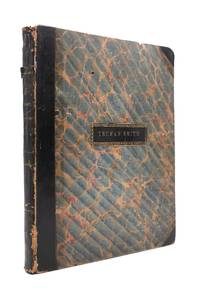
1848ref. 346068Washington D.C.: George S. Gideon 1848. Vol. 1 Numbers 1-18 plus a November 16 extra all published. 312pp. 4to. Contemporary half black morocco and marbled paper boards worn at joints and edges. Provenance: Truman Smith morocco label on the upper cover. Vol. 1 Numbers 1-18 plus a November 16 extra all published. 312pp. 4to. Scarce complete run of the weekly political newspaper "devoted to the support of Taylor and Fillmore" published during their campaign in the Election of 1848 which pitted the Whig Zachary Taylor against the Democrat Lewis Cass. The masthead features a woodcut of a horseback Taylor with his Mexican War troops firing a canon at Cass. In the final post-election Extra which includes the news of Taylor's victory the masthead has changed to the canon blowing Cass to pieces. The final page of the Extra comprises a prospectus for a New Series of the Battery. This example with provenance to ardent Taylor supporter Senator Truman Smith of Connecticut who served on the Whig Executive Committee of Congress and who contributed within the pages of the campaign newspaper. George S. Gideon unknown books
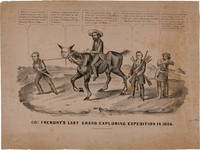
1856ref. 63167New York: Nathaniel Currier 1856. Fremont as an Overland Explorer for the Presidency A cutting satirical cartoon aimed at the great western explorer John C. Fremont and his main supporters in his 1856 bid for the White House. Fremont was the Republican nominee for the presidency and ran on an anti-slavery platform. He was backed by New York Tribune editor Horace Greeley and radical abolitionist minister Henry Ward Beecher. In the image Fremont rides a horse - called the "abolition nag" - that has the face of Greeley. Fremont says "This is pretty hard riding - but if he only carries me to the White house in safety I will forgive my friends for putting me astride of such a crazy Old Hack." The horse is led toward the Salt River a metaphor for political disaster by leading Republican William Seward who proclaims that "Which ever road I travel always brings me to this confounded river I thought we had a sure thing this time on the Bleeding Kansas dodge." Mountains in the background are identified as Kansas and Nebraska. The Greeley-headed horse addresses Seward: "Seward it seems to me we are going the same Road we did in 'fifty two' but as long as you lead I'll follow if I 'go it blind.'" Henry Ward Beecher who was known to have furnished antislavery emigrants with firearms to participate in the Kansas struggles follows behind Fremont's horse his arms laden with rifles. A mountain man - evoking Fremont's exploring past - cautions the Pathfinder: "Ah! Colonel - you've got into a bad crowd - you'll find that dead Horse on the prairie is better for the Constitution than Abolition Soup or Wooly head stew in the White house." The embossed seal to the bottom left corner is that of F.A. Caspari of Baltimore "Dealer in Books & Stationery." This print is scarce. The Currier & Ives catalogue raisonné locates only the copies at the Chicago Historical Society and the Library of Congress. OCLC adds only two copies one at the American Antiquarian Society and another at the University of Rochester. A fine satirical print of John Fremont and his abolitionist supporters in the 1856 presidential election. Light even tanning lightly foxed. Old vertical fold running the length of right edge. Closed tears with repairs to the right and left edges plus small closed tear to top right edge along fold. Contemporary dealer's embossed seal to bottom left corner. Three small pieces of linen tape to top of the verso some discoloration from old tape since removed on verso. Very good. REILLY AMERICAN POLITICAL PRINTS 1856-20. WEITENKAMPF p.117. PETERS CURRIER & IVES 1635a. GALE CURRIER & IVES: A CATALOGUE RAISONNÉ 1309. OCLC 192110863. OCLC 1136567691. unknown