1326 resultados
1880ref. 197421880. Caption title as issued. 8pp with light wear and old folds. 'No. 86.' printed at top of first page. Good. A Republican campaign pamphlet arguing that the triumph of the 'Solid South' would impoverish the country. Southerners have "the conceit of political sagacity. It is their boast that this country will never be properly governed until Southern statesmanship shall again bear sway." But when the numbers are crunched the South has lagged behind the North in every index of economic prosperity. The Solid South's share of the "commercial industrial financial and educational interests of the country" is disproportionately small. Its pretensions to "dictate the course of the National Government" is absurd. OCLC locates 12 under two accession numbers. unknown books
1840ref. 15487Albany N.Y. 1840. pp 89-96 large folded folio sheet printed in triple columns. Caption title as issued scattered light foxing Very Good. An Extra denominated No. 12 from the Rough-Hewer a Democratic Party campaign publication published from February - December The Address supports the Democrats' presidential candidate and New York's favorite son Martin Van Buren against the Whig candidate William Henry Harrison. The Whigs descendants of the aristocratic Federalists are "constantly struggling to create distinctions in society by legislation for the special benefit of individuals and classes thereby throwing into their hands a power and influence strong enough to control the suffrages of the people or set them at defiance." Resolutions and discussion of the issues all presented with great passion ensue. FIRST EDITION. AI 40-5891 5. Lomazow 392. Not in Mott. unknown books
1872ref. 15895np 1872. 8pp. Folded with caption title as issued. Light wear trimmed closely at the top without loss of text but affecting several page numbers. Good. Demonstating the abuses heaped upon our great presidents beginning with George Washington and ending with Grant. Charles Sumner whose criticisms of corrupt practices in the first Grant Administration were particularly sharp is excoriated. unknown books
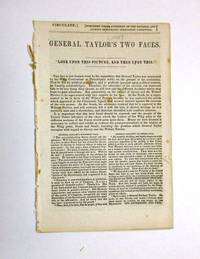
1848ref. 20489Washington 1848. 8pp printed in double columns caption title as issued. Disbound else Very Good. A scarce 1848 campaign pamphlet attacking Whig presidential candidate Zachary Taylor who "has no political principles and is perfectly ignorant upon political matters." On the burning issue of the Wilmot Proviso-- whether slavery ought to exist in the territories acquired from Mexico-- Taylor is a hypocrite: "At the North he is represented to be in favor of the Wilmot Proviso." But "at the South his advocates contend that he is opposed.because he is a southern man and a slaveholder and therefore identified with southern interests." A Louisiana slaveholder Taylor surprised everyone after his election when he supported immediate statehood for California with its anti-slavery Constitution. Wise & Cronin 44 Taylor. Not in Sabin Miles Eberstadt Decker LCP. unknown books
1844ref. 11033New-York 1844. 16mo. 152 28 adv. pp. Sewn lacks wraps. A bit of chipping at edges. Good to Good. An attack on the turncoat John Tyler who was the Whig Harrison's Vice President but betrayed the Whig cause after his own accession to the Presidency upon Harrison's death in 1841. The author supports Henry Clay for President. BAL 11051. AI 44-3548 5. unknown books
1848ref. 17436Boston: Eastburn's Press 1848. Stitched 11pp. Scattered foxing blank top margin of title page cut down with no text affected upper blank forecorner chewed. Good. Massachusetts Whigs put forth a valiant but unsuccessful effort in behalf of Daniel Webster's candidacy for the Whig presidential nomination in He is "A man who respecting all the 'arrangements and compromises of the Constitution' and the rights of all under them will yet never suffer them to be extended or increased to the destruction of our political equality." FIRST EDITION. 4 NUC 0070701 2. Not in Sabin Eberstadt Decker Miles. Eastburn's Press unknown books
1872ref. 20482Washington: National Democratic Executive Resident Committee 1872. 8pp disbound with light inner margin wear else Very Good. August Belmont and the Democrats pillory Grant promise not to mess with the Reconstruction Amendments to the Constitution and laud Greeley and his fellow Liberal Republicans for opposing corruption in the Grant administration. A rare pamphlet also printed at the Globe Office in Washington OCLC noting 3 copies of the Globe printing. OCLC 47184217 1- W. Res. Hist. Soc. National Democratic Executive Resident Committee unknown books
1880ref. 12838np 1880. 4pp folded sheet caption title light upper corner spotting. Very Good. The pamphlet supports the Republican platform urges payment in full of the public debt and protection for the Nation's bondholders. Denouncing the Democrats for urging an infusion of paper money which would injure the bondholders it reminds the voters that "In our desperate struggle with the rebellion it was the spotless credit of the Government that enabled us to conquer and to preserve the Union." Democrats then sought to undermine the public credit just as they do now. FIRST EDITION. 489 NUC 0186372 1. unknown books
1876ref. 14342np Des Moines 1876. Caption title as issued folded folio leaf untrimmed and uncut. Last leaf with some wear Good to Good. The Hayes and Wheeler Club of Des Moines rejoices in the defection of General Tuttle an old War Democrat to the Republican team. His renunciation of the Democratic Party "and its two-faced ticket" occurred "in response to a serenade by" the Club. Tuttle's speech re-fights the Civil War charging that Democrats have never accepted the War's results. Wheeler the Vice Presidential nominee warns of the evil designs of the former Slave States. FIRST EDITION. 605 NUC 0402645 2. unknown books
1844ref. 15877Washington: Whig Executive Cong. Committee 1844. 16pp. Disbound. Good. A Whig argument for protection from foreign competition explaining the ruinous effects of Free Trade and the necessity to protect mechanics and industrialists alike from the dumping of foreign goods on the United States. The Whig ticket from Clay on down must be supported. FIRST EDITION. AI 44-6587 4. Not in Sabin. Whig Executive Cong. Committee unknown books
1848ref. 15121Columbus 1848. 6 2 blanks pp. Caption title as issued disbound. Scattered foxing. Good. Ohio's Whig State Central Committee seeks to galvanize its lethargic troops for the upcoming presidential election. Zachary Taylor is as one of his letters printed here assures "A WHIG AND SHALL EVER BE DEVOTED IN INDIVIDUAL OPINION TO THE PRINCIPLES OF THAT PARTY." A "decided" Whig he is "not ultra." FIRST EDITION. Morgan Collection 8256. Not in Sabin Miles Wise & Cronin Taylor Eberstadt Decker. OCLC 1035828858 1- AAS as of April 2025. Apparently the Ohio Historical Society and Western Reserve also own a copy. unknown books
2002ref. 11263Washington DC: Brookings Institution Press 2002. First Edition. Illustrated Paperback. Near fine. Report of the National Commission on Federal Election Reform signed by President Jimmy Carter. This report was produced by Brookings Institution with co-chairs being: Jimmy Carter Gerald R. Ford Lloyd N. Cutler and Robert H. Michel. Octavo vii 358pp. Illustrated paperback title on cover and spine. This copy appears unread. Signed by President Jimmy Carter on the half title with a full signature. In the wake of the 2000 presidential election a commission was established to look at the integrity of voting systems around the United States. The commission proposed improvements to federal state and local voting systems. The recommendations resulted in landmark legislation called the Help America Vote Act signed by President George W. Bush in 2002. Brookings Institution Press paperback books
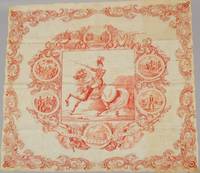
1840ref. 211221840. As issued. Very good; clean; occasional small spot; old folds. Printed red on white cotton; meas. appx. 27 x 26 inches. An election bandanna for William Henry Harrison's presidential campaign in 1840. As such it is among the first to be issued for any campaign in the nation. From the early 1800s through the 1870s kerchiefs laden with visual symbols glorified presidential aspirants as military heroes and venerable statesmen. Long-standing custom discouraged candidates from actively campaigning for public office a practice viewed as undignified and "unduly ambitious". As a result kerchiefs and other propaganda devices played a key role in image advertising. William Henry Harrisons 1840 bid for the presidency during a time of an expanding mass electorate ushered in a new era of campaigning marked by the appropriation of symbols and slogans - in Harrisons case the log cabin hard cider barrel and slogan Tippecanoe and Tyler Too - and the vigorous production of campaign propaganda. The American campaign kerchief officially arrived with the presidential bid of William Henry Harrison in 1840 after Democratic opponents labeled the 67-year-old Harrison an old has been content to retire to his log cabin and drink hard cider. Whigs seized upon the intended insult and turned log cabins and hard cider barrels into positive emblems of the campaign championing Harrison as a man of the people. A flood of political kerchiefs featured the ubiquitous log cabin and barrels. Ironically the man perennially portrayed as a simple frontiersman was actually an aristocratic Virginian who lived in a stately residence. Like George Washington and Andrew Jackson before him William Henry Harrison was promoted as a military hero in this equestrian portrait. Known as The Hero of Tippecanoe for his victory over the Shawnees at Tippecanoe Indiana in 1811 Harrison also distinguished himself during the War of 1812. The figure is surrounded by scenes depicting his log cabin home the Battle of Tippecanoe Battle of Thames the farmer US Capitol and the Treaty. Threads of History #131; Campaigns on Cotton New York Historical Society. unknown books
1888ref. 160431888 /1889. Very good; two tiny holes and minor water spot; colors are strong. Color printed cotton with portraits of Harrison and George Washington below American flags and an eagle. It meas. appx. 23 x 17 inches. Apparently an inaugural artifact souvenir for Benjamin Harrison. Washington's inaugural was in New York City a century before Harrison. Hence the pairing of the two on this printed cotton artifact. A handsome piece of election memorabilia. Absent from Threads of History. unknown books
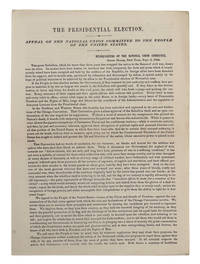
1864ref. 68899New York: National Union Executive Committee Sept. 9 1864. National Union Party Denounces the Chicago Platform A scarce National Union Party circular from the 1864 presidential election responding to the infamous Democratic Nation Convention in Chicago and asserting that "every rebel organ in the rebel States or in foreign lands-- every hater of Democratic Freedom and the Rights of Man longs and labors for the overthrow of the Administration and the expulsion of Abraham Lincoln from the Presidential chair." The committee urges voters "not to arrest the blow which is just ready to descend upon the rebellion now tottering to its fall; not to give the rebels time to renew their strength for fresh conflicts; not to aid those who would aid them in overthrowing our Government in destroying our Union in plunging into a chaos of anarchy the great communities of which the Constitution makes one great and glorious nation and in thus extinguishing finally and forever the hopes of all who have faith in Freedom and the Rights of Man." The missive is signed in type by Henry J. Raymond as Chairman and twenty other members of the National Union Committee. Whether thanks to their extensive literature output or merely a reflection of the existing public will the National Union Party's aim was carried in 1864 by a historic margin with Lincoln winning over ninety percent of the electoral vote. An uncommon fine piece of Civil War political ephemera. Light foxing and soiling to edges. Near fine. unknown books
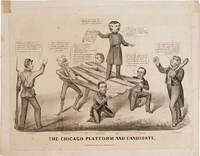
1864ref. 63169New York: Published by Currier & Ives 1864. A Political Cartoon Exposing McClellan's Hypocrisy A rare Currier and Ives print from the presidential election of 1864 satirizing the Democratic presidential candidate and former general George B. McClellan as an equivocating hypocrite. As Neely and Holzer explain the presidential campaign of 1864 inspired a flurry of "separate-sheet display cartoons: thought-provoking witty but often cruel lampoons that struck hard at the most divisive political and personal issues of 1864. In these cartoons one can see illustrated vividly the raw toughness of the campaign as well as the skill of the artists who covered it." These prints they note could be "vicious: personal mean-spirited cruel race-baiting and divisive" and in this context McClellan "the military man now running on a peace platform made for one obvious target." The image here shows a two-faced McClellan at center standing atop rickety planks - a literal representation of the Democratic party's Chicago peace platform - and holding a copy of his letter of acceptance. The planks are supported precariously at each corner on the shoulders of four figures: Confederate president Jefferson Davis; New York congressman and prominent Copperhead Fernando Wood; another Copperhead and the author of the Chicago platform Clement Vallandigham; and "Jeffs friend" the devil. Standing on opposite sides of the image are representatives of each of the constituencies to whom the two-faced McClellan is pandering: a uniformed "Union Soldier" and a "Peace Democrat" caricatured here as a club-wielding simian Irishman. From the face addressing the Peace Democrat McClellan says "You see my friend I accept the nomination and of course stand on the platform" to which the Peace Democrat replies "All right General! if yere in favor of resistin the draft killing the Nagurs and pace wid the Southerners I'll knock any man on the head that'll vote aginye." From his other face addressing the Union soldier McClellan contradicts himself saying "If you don't like the Platform I refer you to my letter of acceptance" a copy of which McClellan holds in his and which reads "War! - preservation Union - could not look my gallant Comrades in the - face; ---" The soldier says "Its no use General! you can't stand on that platform and come that blarney over me; I smell brimstone!" Below McClellan the devil speaking to Jefferson Davis gives expression to the futility of the lost cause: "Well Jeff it's no use trying to hold up this rickety old platform I guess I'll leave you to your fate!" Davis says in reply "I'm in a pretty fix! Weldon road gone!! Atlanta taken!!! Mobile Forts surrendered!!!! Early licked!!!!! and now when my last hope is in keeping up this platform and getting Mac elected you who led me into the scrape threaten to leave me!!!!!" Meanwhile an exasperated Vallandingham exclaims "Confound that letter! I've a good mind to bolt and let the whole concern go to a smash!" Fernando tries to reassure his fellow Copperhead: "Hold on Val. don't you see it's only his little game to ring in the war men if he is elected he is bound to carry out our policy and nothing else!" The image mocks the seeming hypocrisy of McClellan a military man running on his war record who has just accepted the nomination of a party whose platform calls for an end to the war even as the candidate himself expresses his support for the war in his acceptance letter. Reilly notes that the cartoon was probably drawn by the prolific artist Louis Maurer. This print is scarce. The Currier & Ives catalogue raisonné locates only the copies at the Chicago Historical Society and the Library of Congress. OCLC locates another two copies at the time of cataloguing one at the Ohio History Center and another at the Clements Library. We find additional copies at the American Antiquarian Society the Library Company of Philadelphia and the Metropolitan Museum of Art. A rare and stinging political cartoon from the bitter war-time election of 1864. Tanned with some scattered foxing. Small pinholes to top center and to top and bottom of left margin. Two small pieces of linen tape to top edge of verso; some soiling to verso and some discoloration from old tape since removed showing through to recto. Very good. REILLY AMERICAN POLITICAL PRINTS 1864-20. WEITENKAMPF p.143. PETERS CURRIER & IVES 1621. GALE CURRIER & IVES: A CATALOGUE RAISONNÉ 1126. NEELY & HOLZER UNION IMAGE pp.132 134 137 144-45. Bryan F. Le Beau Currier & Ives: America Imagined Washington: Smithsonian Institution Press 2001 pp.280-81. OCLC 818725064 1292629697. unknown books
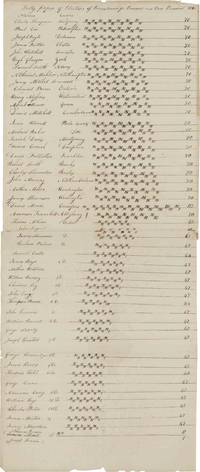
1812ref. 68222Pennsylvania. 1812. Pennsylvania Elects Madison in 1812 An interesting early American political manuscript listing fifty-one electors by county or district with tallies next to their names which are then added in a final column. Among the more notable of the electors listed are Charles Thompson and Thomas McKean. In the election Pennsylvania voted overwhelmingly for the Democratic-Republican candidate James Madison who defeated Federalist candidate DeWitt Clinton. An unusual piece of political Americana. Old folds light tanning and wear. Very good. unknown books
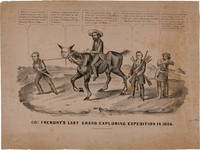
1856ref. 63167New York: Nathaniel Currier 1856. Fremont as an Overland Explorer for the Presidency A cutting satirical cartoon aimed at the great western explorer John C. Fremont and his main supporters in his 1856 bid for the White House. Fremont was the Republican nominee for the presidency and ran on an anti-slavery platform. He was backed by New York Tribune editor Horace Greeley and radical abolitionist minister Henry Ward Beecher. In the image Fremont rides a horse - called the "abolition nag" - that has the face of Greeley. Fremont says "This is pretty hard riding - but if he only carries me to the White house in safety I will forgive my friends for putting me astride of such a crazy Old Hack." The horse is led toward the Salt River a metaphor for political disaster by leading Republican William Seward who proclaims that "Which ever road I travel always brings me to this confounded river I thought we had a sure thing this time on the Bleeding Kansas dodge." Mountains in the background are identified as Kansas and Nebraska. The Greeley-headed horse addresses Seward: "Seward it seems to me we are going the same Road we did in 'fifty two' but as long as you lead I'll follow if I 'go it blind.'" Henry Ward Beecher who was known to have furnished antislavery emigrants with firearms to participate in the Kansas struggles follows behind Fremont's horse his arms laden with rifles. A mountain man - evoking Fremont's exploring past - cautions the Pathfinder: "Ah! Colonel - you've got into a bad crowd - you'll find that dead Horse on the prairie is better for the Constitution than Abolition Soup or Wooly head stew in the White house." The embossed seal to the bottom left corner is that of F.A. Caspari of Baltimore "Dealer in Books & Stationery." This print is scarce. The Currier & Ives catalogue raisonné locates only the copies at the Chicago Historical Society and the Library of Congress. OCLC adds only two copies one at the American Antiquarian Society and another at the University of Rochester. A fine satirical print of John Fremont and his abolitionist supporters in the 1856 presidential election. Light even tanning lightly foxed. Old vertical fold running the length of right edge. Closed tears with repairs to the right and left edges plus small closed tear to top right edge along fold. Contemporary dealer's embossed seal to bottom left corner. Three small pieces of linen tape to top of the verso some discoloration from old tape since removed on verso. Very good. REILLY AMERICAN POLITICAL PRINTS 1856-20. WEITENKAMPF p.117. PETERS CURRIER & IVES 1635a. GALE CURRIER & IVES: A CATALOGUE RAISONNÉ 1309. OCLC 192110863. OCLC 1136567691. unknown books
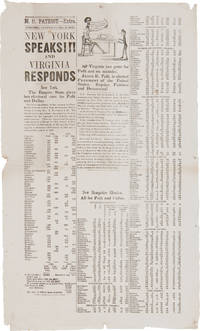
1844ref. 66208Concord: Hill & Moore November 9 1844. New Hampshire Democrats Celebrate Polk's Victory An ebullient "Extra" issue of the staunchly Democratic New Hampshire Patriot & Daily Gazette celebrating the not-quite-confirmed victory of James K. Polk in the 1844 presidential election. Published by lifelong Democratic partisan and former New Hampshire governor Isaac Hill the New Hampshire Patriot was a long-running political newspaper in that stronghold of Northern Democracy and this illustrated extra issue printed on Saturday November 9 displays the extent to which the editors and indeed the people of Concord rejoiced at the news. The main headline "New York Speaks!!!" refers to the pivotal flip of New York state from Whig to Democrat a fact which when combined with the expected news of a comfortable victory in Virginia more or less clinched the victory for Polk despite the results being out on several other states. While the optimistic figures in this article report a whopping majority for Polk in reality the Democrats won New York by a narrow margin of just one percent. A short article following this news offhandedly reports on a fatal local celebration noting that "A most shocking casualty occurred in Concord last evening while the democrats were celebrating the triumph of Polk and Dallas in New York by the firing of cannon. Mr. John L. Haynes of this town one of the officers of the Columbian Artillery had his left arm almost entirely blown off his right arm dreadfully shattered and his face shockingly burned in the act of ramming down a cartridge. The discharge took place in consequence of the vent not being stopped in the excitement and hurry of the firing." At the top of the central column a small cartoon depicts a man with an oversized steak knife and glass of wine declaring "That roast beef fetch it on!-and them 'two dollars a day!'" referencing William Henry Harrison's 1840 campaign slogan of "Harrison two dollars a day and roast beef." The remainder of the text reports the election results by county in New Hampshire which voted for Polk by a margin of nearly nineteen percent including votes for the ballot issues "On amending Constitution" and "On abolishing capital punishment." An entertaining and ephemeral piece printed at the culmination of a pivotal election. Old folds. Light tanning a few small chips and tears at edges. Very good. BRIGHAM p.444. unknown books
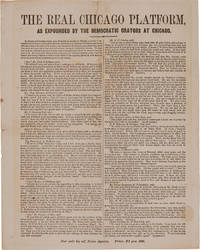
1864ref. 65929New York: National Union Executive Committee 1864. Scarce Anti-Copperhead Broadside A scarce anti-Copperhead broadside printed during the election of 1864 purporting to reveal "the real Chicago Platform" and providing excerpts from speeches given at the Democratic National Convention. The convention met in Chicago on August 29 1864 where the Copperheads quickly established dominance over the outnumbered War Democrats and established peace with the South at any cost as the core of their platform. McClellan accepted the nomination alongside staunch Copperhead George Pendleton despite his open opposition to the peace platform; this seeming hypocrisy was mercilessly lampooned by the opposition contributing to the abject failure of the joint War and Peace ticket. The present broadside presents statements made at the convention by "a number of distinguished Democratic orators" which they deem "sufficient to show the temper and purpose of all." Some choice excerpts include: "I love our Southern friends; they are a noble a brave and a chivalrous people cheers" Representative James S. Rollins of Missouri; "Show me a War Democrat to-day and I will show you a shoddy Abolitionist in disguise.He is a Judas and should be cast out as an enemy to humanity and to God.Soon the net is to be drawn that will gather in its half million more to feed the insatiable thirst for blood of the Negro God" J.A. McMaster arrested for libel at the start of the war; "If Democrats catch Lincoln's bloody satrap spies among them they must cut their damned throats that's all. Applause" Captain William J. Kountz known troublemaker and personal antagonist of General Grant dishonorably discharged in 1863; and "We are one and all for peace and with this magic word upon our banner we shall sweep over the course and roll into oblivion the black negro-loving negro-hugging worshippers of old Abe Lincoln" Isaiah Rynders Tammany Hall tough and former Know-Nothing. The broadside was clearly printed with intention of wide dispersal among potential Lincoln supporters with a noted price of "$1 per 100." The American Antiquarian Society reasonably suggests that this broadside was printed by the National Union Executive Committee of New York based on typographically similar items in their collection. A representative document from one of the nation's most fraught elections. Old folds. Light tanning and staining. Small holes at two cross-folds short closed tear to upper margin and left edge. About very good. SABIN 68234. unknown books
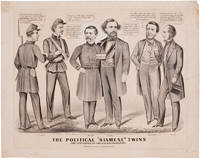
1864ref. 63056New York: Currier & Ives 1864. Unlikely Running Mates Conjoined by "Party Ties" A rare Currier and Ives political print from the 1864 presidential election likening the unusual marriage of McClellan and his running mate Copperhead leader George Pendleton to the famous "Siamese twins" Chang and Eng Bunker. Chang and Eng first came to the United States in 1829 where their great popularity as a touring act gave birth to the phrase "Siamese twins" as a term for conjoined twins. After years of touring in Europe and America the pair settled down in North Carolina for over a decade before returning to the stage in the 1860s. Their renewed popularity and enduring cultural relevance are both evidenced by this election-year cartoon. "In the center McClellan left is attached to the side of his running mate by 'The Party Tie.' McClellan says apologetically to the two Union soldiers at his left 'It was not I that did it fellow Soldiers!! but with this unfortunate attachment I was politically born at Chicago!' The Democratic national convention took place in Chicago on August 29 1864. The soldier with his arm in a sling responds angrily 'Good bye little Mac' if thats your company! Uncle Abe gets my vote.' The soldier at far left says 'I would vote for you General if you were not tied to a "peace" Copperhead who says that Treason and Rebellion ought to triumph!!' Pendleton addresses the two 'Copperheads' at his right: Clement Laird Vallandigham author of the Democrats' peace plank and Horatio Seymour governor of New York and chairman of the Democratic national convention. Pendleton says 'I dont care how many letters Mac writes if it brings him votes; for every vote for him count one for me!!' Vallandigham concurs 'Yes Pen that's the only reason that I support the ticket; if you are elected both Jeff…and I will be triumphant!" Seymour far right replies 'With Pendleton as Vice; Val.secretary of State; Wood i.e. Fernando Wood an organizer of the Peace Democrats in the treasury and I Govr. of New-York we will have peace at any price the rebels "our friends" in this copy choose to ask for it'" – Reilly. Interestingly the copy described by Reilly differs slightly from the other recorded copies. In the Library of Congress copy Seymour refers to "the rebels" directly; in our copy and most others he instead refers to them as "our friends" in quotation marks alluding to his famous or infamous "My Friends" speech delivered during the New York draft riots. OCLC records copies only at the University of Michigan and Peabody Essex Museum though we locate additional copies at the Library of Congress Library Company of Philadelphia Princeton and the Metropolitan Museum of Art. A rare and visually striking political cartoon evocative of the fraught 1864 election and contemporary popular culture. Light foxing and soiling. Closed tear in right edge into platemark but not touching illustration. Faint dampstain near center. Very good overall. REILLY 1864-19. PETERS CURRIER & IVES 1671. CURRIER & IVES: CATALOGUE RAISONNÉ 5232. OCLC 191120100. unknown books
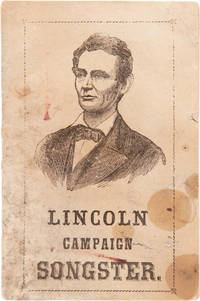
1864ref. 62679Philadelphia: Published by Mason & Co. 1864. Singing for Lincoln in '64 A pocket songster printed to support Lincoln's reelection campaign in 1864 featuring a rather youthful portrait of the president on the front wrapper and twelve spirited pro-Union songs. The titles largely military in theme include such works as "Give us Noble Leaders" "The Veteran Volunteer" "Cast Your Votes for Abraham" "For Lincoln or McClellan you'll be called on to decide/ The one to save the union the other to divide" and "We are Coming Father Abraham 600000 More." The advertisements on the rear wrapper encourage readers to purchase a wide variety of Lincoln campaign badges emblems pins and photographs from the publishers. Despite Lincoln's overwhelming electoral victory in 1864 the race was rather close in Pennsylvania where this was printed – Lincoln took Philadelphia County by a scant few percent and actually failed to secure a majority in neighboring Montgomery and Bucks counties. 16mo. Original pictorial wrappers. Wrappers soiled and stained. Largely clean internally. Advertisements on rear wrapper shaved slightly at outer edge as issued. Good plus. MONAGHAN 323. unknown books
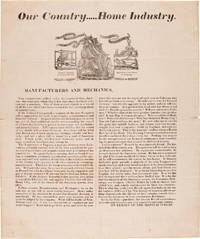
1824ref. 62431N.p. but likely New York. 1824. Rare Illustrated Anti-Jackson Broadside A very rare illustrated anti-Jackson broadside from the hotly-contested election of 1824 addressed to "manufacturers and mechanics." The presidential election of 1824 was a complicated four-candidate affair with frontrunners Andrew Jackson and John Quincy Adams trailed by Henry Clay and William Crawford each drawing considerable support in certain districts. In fact the race was so close that no candidate won a sufficient majority of the electoral vote and Adams was elected by the House of Representatives under the provisions of the Twelfth Amendment despite carrying four fewer states than Jackson and the glow of the "Era of Good Feeling" was dimmed once and for all. Addressed to "Manufacturers and Mechanics" this broadside focuses primarily on Jackson's economic policies specifically his anti-tariff stance. "If the Jackson Party prevail" the text proclaims "the next Congress will be opposed to the tariff to mechanics manufacturers and domestic industry.The consequence will be that the sound of the shuttle will no longer be heard. Our stores will be filled with British and Scotch ginghams shirtings checks and bed-ticks; and not a place will be found for a yard of American cloth.Don't suffer yourselves to be deceived by stories that General Jackson is your friend.What will his battle of New Orleans avail you if you are thrown out of employment and made beggars" Even Jackson's campaign materials they claim are made from British exports. The text seems targeted at a New York and New England audience pointing out South Carolina and "the southern section of the country" as the fervent opponents of domestic industry and warning readers not to be "the dupes of such men as William Coleman" owner of The New York Evening Post. Throughout the broadside maintains a strong anti-British stance and suggests that Jackson and his supporters including Coleman are better friends of Great Britain than America: "Coleman is the man who exulted when a British fleet lay off the Hook. The Evening Post was received wet from his office on board their ships every day. Nothing but respect for the laws prevented our incensed countrymen from demolishing the press and types that printed the diabolical treason." While the text espouses Henry Clay as the man of the hour "the truest ablest and best friend you ever had" the woodcut illustration places a ship named the "John Quincy Adams of Washington" front and center. It flies banners reading "Free Trade & Sailors Rights" and "No Colonial Subjection" and is flanked on either side by vignettes subtitled "National industry is National Wealth" and "Agriculture is the Source of Prosperity." Ironically the largest controversy in Jackson's presidency a decade later would be over his lack of action against tariffs when his failure to repeal Adams' 1828 "Tariff of Abominations" resulted in the Nullification Crisis and threats of civil war. We locate only one other copy of this broadside at the Library of Congress. A rare and interesting illustrated political broadside from a highly contentious election. Old folds minor splitting at right edge of central horizontal fold. Lightly tanned. Very good. REILLY AMERICAN POLITICAL PRINTS 1824-3. OCLC 299947334. hardcover books
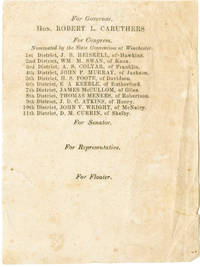
1863ref. 53688Winchester 1863. Running for State Office in Confederate Tennessee An exceedingly rare Confederate Tennessee state election ticket from 1863 nominating Robert L. Caruthers for governor and eleven others as state senators. In 1863 state elections were due in Tennessee. The state was fractured by war and secession and both Unionists and Confederates expressed the desire to hold elections for state government. Confederate supporters held a convention in Winchester and nominated a governor the State Legislature and members for the Confederate Congress. It was a bit of a fool's errand. Isham G. Harris who still considered himself the governor of Tennessee issued a proclamation calling for the election to be held on the first Thursday in August. Just who voted and how many or how few will probably never be known. According to historians the State Archives in Nashville are scant and inconclusive; returns from only thirty-two counties are found some of which reported the vote of only one civil district. Not a single report was from West Tennessee counties and only eight Middle Tennessee counties made returns. Robert L. Caruthers was elected governor on the face of returns but he was never inaugurated and thus never served a day as governor of Tennessee. No Confederate State Legislature ever convened either. The Confederate Congressmen were the only lucky ones. Those who were elected in 1863 took their seats in Richmond however briefly. George Webb notes this copy in his NOT IN ALLEN bibliography in 2013. Not in Parrish & Willingham. The only other copy or shall we say copies resides at the Library of Virginia in an uncut sheet of six tickets. This will likely be the only copy ever available in the marketplace. Toned minor soiling and wrinkling. Very good. WEBB NOT IN ALLEN 199 this copy. unknown books
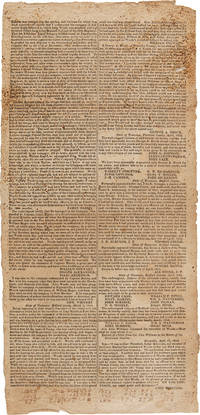
1828ref. 56513N.p. 1828. A Very Rare Broadsheet Attack on Andrew Jackson in 1828 A rare broadside recounting Andrew Jackson's infamous execution of Private John Woods published in 1828 by Jackson's opponents during the 1828 election. There was considerable mud-slinging between the Jackson and Adams camps during that campaign which eventually saw the defeat of incumbent John Quincy Adams and the election of Andrew Jackson. This dense broadside recounts the events of March 1814 at Fort Strother during the Creek Campaign when Jackson charged John Woods an eighteen-year-old militiaman with disobedience disrespect and mutiny. According to the text the trial itself only occurred because Jackson's soldiers would not shoot Woods at the moment of the offense despite Jackson's cries to "Shoot the damned rascal!.blow ten balls through the damned rascal!" The court martial followed soon after; Woods was found guilty and sentenced to die. Some testimonies here state that Jackson offered to spare Woods' life if he would enlist in the regular army but Woods refused; others disagree. He was executed thirty-six hours later. Then follows the sworn testimony of several witnesses: Thomas Couch Robert Ferguson Samuel Hanna George A. Brock Isaac Roberts James Harris William Stewart Joseph Alexander Isaac Anderson Abm. Whitney and John Williams all fellow soldiers of Woods who witnessed or had personal knowledge of the facts in the case. Their accounts of Woods' supposed mutiny substantially downplay the severity of Woods' disobedience suggesting that it was likely a misunderstanding; they also emphasize the draconian nature of the punishment and make several mentions of Woods' aging and infirm parents. Williams' account closes: "It is not true that Woods on the ground of Execution with oaths and defiance refused to promise obedience. On the contrary he wept loud and bitterly." All of the testimonies are datelined in Tennessee in the first few months of 1828. The nature of the printing lends itself to the possibility of a Tennessee press. Though not as famous as the "Coffin Handbills" that appeared at the same time listing Woods' execution among many other crimes by Jackson this was definitely addressed to the same audiences. John Spencer Bassett in his Life of Andrew Jackson notes that the "execution of mutinous militiamen in the campaigns of 1813 and 1814 was recalled to show Jackson's ferocious temper; and when a Philadelphia editor published a hand-bill showing a coffin with the victims standing by its side the idea was caught up eagerly and repeated in all parts of the country." Not in Wise & Cronin and we could find no listing for this broadside in OCLC or in American Imprints. It has only appeared at auction twice and then not since 1925 when Anderson Galleries offered a copy as part of the sale of the Henry De Puy collection which was strong in Andrew Jackson material. The only copy in the trade seems to be one offered by the Eberstadts in 1939. Broadsheet 19 x 9 inches text printed in two columns on both sides. Old folds some chips to edges minor loss to upper left corner and closed tear to bottom edge no text affected. Two small holes affecting just one word a few areas of soiling light foxing even tanning. Manuscript annotations to verso. About very good. unknown books