[Election of 1876]Biblio.com

1172 resultados
1876ref. 32441Washington 1876. 8pp caption title as issued. Disbound a bit roughly in the blank inner margin. Good. Despite its claims the Democratic Party is not "devoted to a pure high-toned efficient well-conducted civil service." In control of the House of Representatives the Democrats have turned out Union soldiers in droves and have appointed former Confederates to office in their place. Several columns listing names prove the point. OCLC records a number of institutional locations. unknown
1844ref. 11033New-York 1844. 16mo. 152 28 adv. pp. Sewn lacks wraps. A bit of chipping at edges. Good to Good. An attack on the turncoat John Tyler who was the Whig Harrison's Vice President but betrayed the Whig cause after his own accession to the Presidency upon Harrison's death in 1841. The author supports Henry Clay for President. BAL 11051. AI 44-3548 5. unknown books
1844ref. 11033New-York 1844. 16mo. 152 28 adv. pp. Sewn lacks wraps. A bit of chipping at edges. Good to Good. An attack on the turncoat John Tyler who was the Whig Harrison's Vice President but betrayed the Whig cause after his own accession to the Presidency upon Harrison's death in 1841. The author supports Henry Clay for President. BAL 11051. AI 44-3548 5. unknown
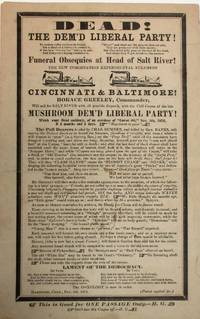
1872ref. 38915Hartford 1872. Broadside 6" x 9-1/2" text surrounded by mourning border. A few spots Very Good. Illustrations of two steamers. At the bottom: "This is Good for ONE PASSAGE Only. - H.G." Dated at Hartford November 5 1872. "Salt River" is 19th century American slang: a losing candidate for office was taking a trip "up Salt River." Tickets for passage "up Salt River" were frequently printed to mock supporters of losing candidates. This humorous scarce broadside taunts Horace Greeley and other defectors from the Republican Party for their support of Greeley in 1872. "On the overwhelming defeat of the Liberal Republican Party and its candidate Horace Greeley in the presidential election of 1872. Greeley had been nominated at a Liberal Republican convention at Cincinnati in May and at the Democratic National Convention at Baltimore in July 1872" AAS description. Pall bearers include Charles Sumner and General Banks prominent Republican supporters of Greeley. OCLC 191231113 2- AAS Middlebury 47090036 1- CT Hist. Soc. as of August 2025. unknown books
1872ref. 38915Hartford 1872. Broadside 6" x 9-1/2" text surrounded by mourning border. A few spots Very Good. Illustrations of two steamers. At the bottom: "This is Good for ONE PASSAGE Only. - H.G." Dated at Hartford November 5 1872. "Salt River" is 19th century American slang: a losing candidate for office was taking a trip "up Salt River." Tickets for passage "up Salt River" were frequently printed to mock supporters of losing candidates. This humorous scarce broadside taunts Horace Greeley and other defectors from the Republican Party for their support of Greeley in 1872. "On the overwhelming defeat of the Liberal Republican Party and its candidate Horace Greeley in the presidential election of 1872. Greeley had been nominated at a Liberal Republican convention at Cincinnati in May and at the Democratic National Convention at Baltimore in July 1872" AAS description. Pall bearers include Charles Sumner and General Banks prominent Republican supporters of Greeley. OCLC 191231113 2- AAS Middlebury 47090036 1- CT Hist. Soc. as of August 2025. unknown
in-8 étroit, 175 pages,broché. Bel exemplaire. [NV-4]
ref. 10916Watermark 1818; Circa 1820. The original printed by 'Fleet Printer Brighton'. Folio 1 p. On paper watermarked 'J WHATMAN 1818'. Written out in a very neat hand over thirty lines over the 'signature' 'Edward Thunder.' and with the printer's slug reproduced in the bottom left-hand corner.Begins 'How I Mourn For the Blindness of my Countrymen!' The writer expresses outrage that the electors are 'endeavouring to send those to form the next Parliament who are likely to increase instead of diminish this never-to-be discharged National Debt.' The text of this poster is reproduced without the line breaks or the printer's slug in 'An Account of the Sussex election held at Chichester March 13 1820' Chichester: W. Mason 1820 pp.159-160. [Watermark 1818; Circa 1820.] The original printed by 'Fleet, Printer, Brighton'. unknown
ref. elala2053Alnwick: 1826-32. An album containing 36 engraved and etched caricatures including at least 25 dealing with the Alnwick Northumberland election of 1826 some additional dealing with the Northumberland election of 1832 and 3 broadsides 2 illustrated. various sized sheets 25 hand-coloured most mounted on larger uniform sheets. bound as an oblong folio in later half morocco extremities worn short splits in lower joints scattered soiling & foxing several sheets folded & some torn but with no loss of image. ownership entry of William Graham Richardson North Shields. The 1826 Alnwick election for two parliamentary representatives for Northumberland was a hotly contested one marked by much rancour and animosity among the candidates and the voters. Some voters engaged in the practice of plumping or voting for only a single candidate rather than two. Of the four contestants Henry Thomas Liddell Liddle Tory Matthew Bell Tory Thomas Wentworth Beaumont at the time an Independent Reformer and Henry George Grey Viscount Howick Whig Liddell and Bell emerged victorious. Another figure appearing in some of the caricatures is John George Lambton later first Earl of Durham Governor General of Canada 1837 and author of the celebrated Durham Report 1839. While supporting the candidature of his brother-in-law Lord Howick Lambton fought a bloodless duel with T.W.Beaumont. A full listing of the broadsides and caricatures some of which carry the imprint of W.Stephenson or W.Davison is available upon request. [Alnwick]: 1826-32. unknown
194870 pages. Articles: Scandals in Veterans' Housing (part 1 of 2); The Secret Papers of Harry L. Hopkins (part 6) - Roosevelt's Greatest Dilemma; Six Artists and a Model - Edith Franklin's posing is a steppingstone to her stage career; Good-Time Street - the most raucous and colorful block in New York; Truman's recent troubles hurt his chance of election; The Hot-Potato Olympics - what price international amity at this year's Games in London; How to Catch a Husband - Mr. Lamb's job is to bringem' back when they stray. Fiction: Cupid with Celluloid Wings; Guirls Like Me; Squaw Medicine; The Bramble Bush (part 4 of 5); Sweet revenge; Errors of Judgment. Ads include: Old Thompson Whiskey; Pepsodent - with photo of Mary Louise Shine; Western Electric; Schlitz; beer; the New York Stock Exchange (NYSE); Ford cars (2 pages); Macmillan Oil - featuring Douglas Moone of San Antonio, TX; Samsonite Luggage; Pontiac cars; Milky Way chocolate bars (back cover). Unmarked with moderate wear. A sound vintage copy. Book
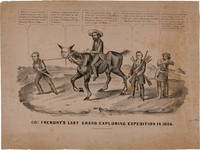
1856ref. 63167New York: Nathaniel Currier 1856. Fremont as an Overland Explorer for the Presidency A cutting satirical cartoon aimed at the great western explorer John C. Fremont and his main supporters in his 1856 bid for the White House. Fremont was the Republican nominee for the presidency and ran on an anti-slavery platform. He was backed by New York Tribune editor Horace Greeley and radical abolitionist minister Henry Ward Beecher. In the image Fremont rides a horse - called the "abolition nag" - that has the face of Greeley. Fremont says "This is pretty hard riding - but if he only carries me to the White house in safety I will forgive my friends for putting me astride of such a crazy Old Hack." The horse is led toward the Salt River a metaphor for political disaster by leading Republican William Seward who proclaims that "Which ever road I travel always brings me to this confounded river I thought we had a sure thing this time on the Bleeding Kansas dodge." Mountains in the background are identified as Kansas and Nebraska. The Greeley-headed horse addresses Seward: "Seward it seems to me we are going the same Road we did in 'fifty two' but as long as you lead I'll follow if I 'go it blind.'" Henry Ward Beecher who was known to have furnished antislavery emigrants with firearms to participate in the Kansas struggles follows behind Fremont's horse his arms laden with rifles. A mountain man - evoking Fremont's exploring past - cautions the Pathfinder: "Ah! Colonel - you've got into a bad crowd - you'll find that dead Horse on the prairie is better for the Constitution than Abolition Soup or Wooly head stew in the White house." The embossed seal to the bottom left corner is that of F.A. Caspari of Baltimore "Dealer in Books & Stationery." This print is scarce. The Currier & Ives catalogue raisonné locates only the copies at the Chicago Historical Society and the Library of Congress. OCLC adds only two copies one at the American Antiquarian Society and another at the University of Rochester. A fine satirical print of John Fremont and his abolitionist supporters in the 1856 presidential election. Light even tanning lightly foxed. Old vertical fold running the length of right edge. Closed tears with repairs to the right and left edges plus small closed tear to top right edge along fold. Contemporary dealer's embossed seal to bottom left corner. Three small pieces of linen tape to top of the verso some discoloration from old tape since removed on verso. Very good. REILLY AMERICAN POLITICAL PRINTS 1856-20. WEITENKAMPF p.117. PETERS CURRIER & IVES 1635a. GALE CURRIER & IVES: A CATALOGUE RAISONNÉ 1309. OCLC 192110863. OCLC 1136567691. unknown books
1856ref. 63167New York: Nathaniel Currier 1856. Fremont as an Overland Explorer for the Presidency A cutting satirical cartoon aimed at the great western explorer John C. Fremont and his main supporters in his 1856 bid for the White House. Fremont was the Republican nominee for the presidency and ran on an anti-slavery platform. He was backed by New York Tribune editor Horace Greeley and radical abolitionist minister Henry Ward Beecher. In the image Fremont rides a horse - called the "abolition nag" - that has the face of Greeley. Fremont says "This is pretty hard riding - but if he only carries me to the White house in safety I will forgive my friends for putting me astride of such a crazy Old Hack." The horse is led toward the Salt River a metaphor for political disaster by leading Republican William Seward who proclaims that "Which ever road I travel always brings me to this confounded river I thought we had a sure thing this time on the Bleeding Kansas dodge." Mountains in the background are identified as Kansas and Nebraska. The Greeley-headed horse addresses Seward: "Seward it seems to me we are going the same Road we did in 'fifty two' but as long as you lead I'll follow if I 'go it blind.'" Henry Ward Beecher who was known to have furnished antislavery emigrants with firearms to participate in the Kansas struggles follows behind Fremont's horse his arms laden with rifles. A mountain man - evoking Fremont's exploring past - cautions the Pathfinder: "Ah! Colonel - you've got into a bad crowd - you'll find that dead Horse on the prairie is better for the Constitution than Abolition Soup or Wooly head stew in the White house." The embossed seal to the bottom left corner is that of F.A. Caspari of Baltimore "Dealer in Books & Stationery." This print is scarce. The Currier & Ives catalogue raisonné locates only the copies at the Chicago Historical Society and the Library of Congress. OCLC adds only two copies one at the American Antiquarian Society and another at the University of Rochester. A fine satirical print of John Fremont and his abolitionist supporters in the 1856 presidential election. Light even tanning lightly foxed. Old vertical fold running the length of right edge. Closed tears with repairs to the right and left edges plus small closed tear to top right edge along fold. Contemporary dealer's embossed seal to bottom left corner. Three small pieces of linen tape to top of the verso some discoloration from old tape since removed on verso. Very good. REILLY AMERICAN POLITICAL PRINTS 1856-20. WEITENKAMPF p.117. PETERS CURRIER & IVES 1635a. GALE CURRIER & IVES: A CATALOGUE RAISONNÉ 1309. OCLC 192110863. OCLC 1136567691. unknown
ref. 31656Chez Veuve Gaude a Nimes, 1er juin 1834. Format 15x22 cm, broche, 171 pages.Bon etat.
ref. 31660Chez Veuve Gaude a Nimes, 1er juin 1834. Format 15x22 cm, broche, 171 pages. Couverture froissee, interieur intact.Bon etat.
1995ref. 2090502126803112New Japan Hoki Publishing 1995. Soft Cover. Fine. Number of pages: 1567 pages Size: A5 size New Japan Hoki Publishing paperback
ref. 0666387826.Ghardcover. Good. Access codes and supplements are not guaranteed with used items. May be an ex-library book. hardcover
ref. 1333207549.Gpaperback. Good. Access codes and supplements are not guaranteed with used items. May be an ex-library book. paperback
ref. 0366495623.Ghardcover. Good. Access codes and supplements are not guaranteed with used items. May be an ex-library book. hardcover
ref. 0365763632.Gpaperback. Good. Access codes and supplements are not guaranteed with used items. May be an ex-library book. paperback
ref. 0666288267.Ghardcover. Good. Access codes and supplements are not guaranteed with used items. May be an ex-library book. hardcover
ref. 0666319693.Gpaperback. Good. Access codes and supplements are not guaranteed with used items. May be an ex-library book. paperback
ref. 0666320330.Ghardcover. Good. Access codes and supplements are not guaranteed with used items. May be an ex-library book. hardcover
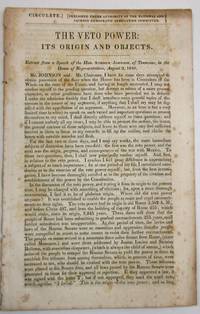
1848ref. 7855Washington 1848. 8pp caption title as issued. Disbound else Very Good. A rare 1848 Democratic campaign pamphlet defending President Polk's vetoes. The veto power says his supporter Andrew Johnson "was established to enable the people to resist and repel encroachments on their rights." Since the country's founding Presidents have exercised the veto only 25 times. The document also includes Virginia Congressman Bayly's 1848 speech concurring with Johnson; and "Judge Story's Opinion on the Veto" taken from his Commentaries. Not in Sabin Eberstadt. OCLC 24637860 1- Lancaster Hist. Soc. 976424705 1- U VA as of January 2021. unknown books
1848ref. 19495np 1848. 16pp caption title as issued. Tanned several leaves trimmed closely at the fore-edge with slight loss. Good. A rare 1848 campaign pamphlet attacking Taylor and sketching the biography of Lewis Cass a man "of the highest order of talent" who has filled "almost every grade of office from the lowest to the highest and most responsible in the service of his country. From the first start in life he has been a Democrat. He received the first office he ever held from that great apostle of Democracy Thomas Jefferson in 1807." Taylor by contrast is a "spectacle" as a candidate-- lacking any political opinions and without even a political party to which he can claim loyalty. A General in the Mexican War he nevertheless allowed himself to be the candidate of the Whigs "who have sympathised with the public enemy who have traitorously given him 'aid and comfort' who have voted for the disgrace of their country in Congress by alleging that the war was unconstitutionally commenced." FIRST EDITION. Not in Sabin Miles Eberstadt Decker. Not located in NUC or on OCLC. unknown books
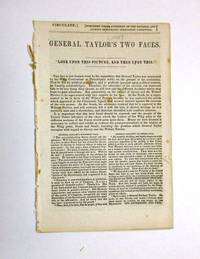
1848ref. 20489Washington 1848. 8pp printed in double columns caption title as issued. Disbound else Very Good. A scarce 1848 campaign pamphlet attacking Whig presidential candidate Zachary Taylor who "has no political principles and is perfectly ignorant upon political matters." On the burning issue of the Wilmot Proviso-- whether slavery ought to exist in the territories acquired from Mexico-- Taylor is a hypocrite: "At the North he is represented to be in favor of the Wilmot Proviso." But "at the South his advocates contend that he is opposed.because he is a southern man and a slaveholder and therefore identified with southern interests." A Louisiana slaveholder Taylor surprised everyone after his election when he supported immediate statehood for California with its anti-slavery Constitution. Wise & Cronin 44 Taylor. Not in Sabin Miles Eberstadt Decker LCP. unknown books
1848ref. 7855Washington 1848. 8pp caption title as issued. Disbound else Very Good. A rare 1848 Democratic campaign pamphlet defending President Polk's vetoes. The veto power says his supporter Andrew Johnson "was established to enable the people to resist and repel encroachments on their rights." Since the country's founding Presidents have exercised the veto only 25 times. The document also includes Virginia Congressman Bayly's 1848 speech concurring with Johnson; and "Judge Story's Opinion on the Veto" taken from his Commentaries. Not in Sabin Eberstadt. OCLC 24637860 1- Lancaster Hist. Soc. 976424705 1- U VA as of January 2021. unknown