[PRESIDENTIAL ELECTION OF 1936]Biblio.com

1172 risultati
1936rif. 24942This sheet contains five rough sketches of graphics calling on the workers and voters of America to support Franklin D. Roosevelt's reelection in 1936. They did in record numbers. PRESIDENTIAL ELECTION OF 1936. Typed Document Signed. Artwork by Franz Felix and Ideas and Copy by Richard Barron "Set of Rough Sketches Containing Some Suggested Promotion Ideas to be Used in the 1936 Democratic Presidential Campaign" July 2 1936. 1 p. 12 x 10½ in. Excerpts: "1. Sounding the call against 'economic royalists' in the spirit of 1776." "2. Appropriating the well-known symbol of violence upraised fist diverting it to peaceful democratic use. To include the farmer phrase the appeal: TOILERS OF AMERICA – UNITE FOR ROOSEVELT." "3. The statue of 'The Thinker' as a symbol of the man today who thinks the toiler with brawn and brain.everyman." "4. Direct appeal to radical labor and leftists in general." "5. Another way of appealing to the working class men and women." "This collaborative effort respectfully submitted for consideration to the Chairman of the Democratic National Committee Mr. James A. Farley." Historical Background After unseating incumbent Republican President Herbert Hoover in 1932 President Franklin D. Roosevelt ran for reelection in 1936. His Republican opponent was Governor Alf Landon of Kansas. Although the Great Depression had entered its eighth year Roosevelt's New Deal policies were broadly popular. He won the highest share of the popular and electoral vote since the uncontested 1820 election. Roosevelt attracted more than 60 percent of the popular vote and won the electoral votes of 46 states; Landon won the electoral votes of only Maine and Vermont. Democratic Party chairman James Farley had predicted that Roosevelt would lose only Maine and Vermont. After the results of the 1936 election Farley quipped that the nation needed to revise the conventional political wisdom of "As Maine goes so goes the nation" to "As Maine goes so goes Vermont." These ideas for campaign imagery employed or modified common images to support Roosevelt's campaign. One drew on the imagery of artist Archibald Willard's 1875 painting The Spirit of '76 and employed three figures of workers to match the subjects of Willard's image. Another appropriated the upraised fist as a symbol of violence and repurposed it as a symbol of defiant unity against "economic royalists." A third used an image of The Thinker by French sculptor Auguste Rodin 1840-1917 to appeal to thinking voters. Another image appeals to the fears of radicals that the alternative to Roosevelt is "Reaction." Richard Barron and artist Franz Felix submitted these ideas to Democratic National Committee chairman James A. Farley on July 2 1936 three weeks before the Democratic Party held its convention in Philadelphia. There is no evidence that these images were used in the campaign and it is possible that Farley rejected them. At the end of the campaign the Democratic National Committee had a campaign deficit of approximately $850000. To help offset those expenses the treasurer convinced President Roosevelt to sign 2500 brief Forewords which were bound into The Democratic Book 1936 and sent to donors of $250. Purchases brought in more than $400000 for the party and led Republicans to charge corrupt practices for allowing corporations to contribute to the campaign by buying copies. Franz Felix 1892-1967 was born in Vienna Austria and developed an ability as a child to draw portraits in charcoal. He studied portraiture in Vienna and immigrated to the United States shortly after World War I. He settled in San Francisco where he established himself as a portrait artist and commercial illustrator. In the late 1920s he moved to New York and established a studio in the suburb of Spring Valley where he produced book and magazine illustrations. During World War II he painted a series of murals of wartime activities of Spring Valley residents. James A. Farley 1888-1976 was born in New York into an Irish Catholic family. After his father died he helped his mother with a small business to support the family. After graduating from Packard Business College in New York City where he studied bookkeeping and other business skills Farley got a job with the U.S. Gypsum Corporation. He served as a Democratic town clerk in Stony Point New York and became chairman of the county's Democratic Party in 1918. He organized upstate Democrats and helped elect Alfred E. Smith as Governor that year. He served in the New York State Assembly in 1923 but was defeated at the next election for supporting the repeal of Prohibition. As chair of the state Athletic Commission Farley fought for the civil rights of African American athletes. Farley founded he General Builders Corporation from smaller firms to become New York City's largest building supply company. Farley directed Franklin D. Roosevelt's narrowly successful New York gubernatorial campaign in 1928 and his reelection in 1930. Farley served as chairman of the New York State Democratic Committee from 1930 to 1944 and helped build the national New Deal coalition that elected Roosevelt to the Presidency four times. In 1932 Farley became the chairman of the Democratic National Committee and in 1933 U.S. Postmaster General. He held both positions until 1940. Farley and Roosevelt broke on the two-term tradition of the Presidency in 1940 and he later helped propose the 22nd Amendment to the U.S. Constitution limiting a person to two elections as president approved by Congress in 1947 and ratified in 1951. Farley became chairman of the board of the Coca-Cola Export Corporation in 1940 and held that position for more than thirty years.
rif. 012954Paris Plon 0 4 volumes in-8 brochés, couvertures illustrée
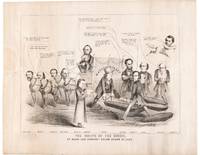
1864rif. 40557New York: Bromley & Company 1864. 19" x 24" lithograph broadside cartoon. Old tears repaired with tape on verso. Long horizontal tear at center has been reinforced by tape on verso. Light wrinkling and toning. The cartoon remains bold solid and intact. Good. "The first in a series of four harsh anti-Lincoln satires published by Bromley & Co. in New York. An imaginary dream of Jack Downing a comic Yankee character created in the 1830s by Seba Smith has Lincoln and some of his supporters and cabinet members as a band of undertakers about to inter the Constitution. "In 1862 displeased by Attorney General Edward Bates's slowness in enforcing the Conspiracies Act the President took matters into his own hands and issued a proclamation 'directing trial by court martial or military commissions of all persons who impeded the draft discouraged enlistments or committed other disloyal acts.' Around thirty-eight thousand people were arrested denied the right of habeas corpus and held in jail until brought to trial. This heavy-handed act provides the fuel for the artist's attack here. "Secretary Stanton is shown driving a hearse 'War Democracy' drawn by four horses with the heads of War Democrats left to right: John Cochrane Benjamin F. Butler Thomas Francis Meagher and Daniel S. Dickinson. Secretary Stanton says 'My jackasses had a load but they pull'd it through bravely. Cochrane: 'I pull for the side that pays the best always.' Butler: 'A million of dollars from New-Orleans'. . . "At right journalist Horace Greeley and Massachusetts senator Charles Sumner bury a casket labeled 'Constitution. Three other caskets 'Union' 'Habeas Corpus' and 'Free Speech Charge Express' wait nearby. Greeley: 'I guess we'll bury it so deep that it will never get up again.' Sumner: 'Be still you old fool. Let us first be sure that it is all under.' "A sober Lincoln watches with folded arms asking 'Chase will it stay down" Beside him treasury secretary Salmon P. Chase responds '. . . It must stay down. Or we shall all go up!' . . . "Abolitionist clergyman Henry Ward Beecher presides over the ceremony with a black child in his arms praying 'Not thy will oh Lord! But mine be done.' Above them Secretary of War Edwin M. Stanton who has the legs and tail of a demon and holds a dagger flies off crying 'If it were done when 'tis done'." Reilly Reilly 1864-37. Weitenkampf 141. OCLC 647912979 2- AAS Clements 299947771 1- DLC as of December 2024. Bromley & Company unknown
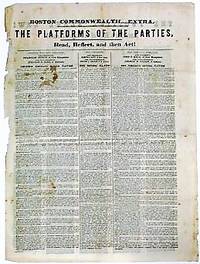
1852rif. 36045Boston: Boston Commonwealth. Extra. 1852. Broadsheet 21-3/4" x 16". Recto printed in three columns; verso printed in five columns. Untrimmed light edge wear a few spots and old folds with several light crimps and one or two small separations at fold intersection affecting three or four letters. Good. "Boston Commonwealth. Extra." at head of title. The broadsheet a dramatic illustration of the growing split in the Democratic Party supports the "Free Democratic" Party led by Senator John Hale of New Hampshire and George Julian of Indiana. A precursor of the Republican Party the Free Democratic Party was created by Northern Democrats who broke with the national Democratic Party which was dominated by southern pro-slavery men. The Free Democrats pledged "NO MORE SLAVE STATES NO SLAVE TERRITORY NO NATIONALIZED SLAVERY and NO NATIONAL LEGISLATION FOR THE EXTRADITION OF SLAVES." That bold promise is contrasted with the temporizing pro-slavery Platforms of the two major Parties-- the "Compromise Democratic Nominations" of Franklin Pierce; and the Whigs headed by Winfield Scott. The verso is headed in bold type: "The Fugitive Slave Law! America's Bill of Abominations!!" Its text with the signature in bold type of President Millard Fillmore is printed in five columns at the top half of the verso. The lower half is an address by "Alexander" "To the People of the United States!--- The Issue before the Nation!" Unlike the Whigs and Democrats the "Free Democracy will favor the early policy of the country to limit localize and discourage slavery. the immediate repeal of the Fugitive Slave Law." The Free Democratic Platform is printed along with that of the Democrats and Whigs. OCLC 83679097 2- NYHS Peabody-Essex 45737584 2- Boston Public Wellesley as of October 2019. Not located at the online site of AAS. Boston Commonwealth... Extra. unknown books
rif. LB9in-4° demi veau à nerfs, caissons ornés de fleurons, pièce de titre. Garde blanche, Frontispice double page représentant la statue équestre de Louis XV inaugurée le 20 juin 1763 sur ce qui deviendra la place de la Concorde, Titre double page, Discours préléminaire i à viij , carte des généralités et intendances double page en couleur, carte générale des 22 élections de la généralité de Paris, double page, couleur , Description de la Généralité de Paris i à xxxiv [contient les principales foires avec leur durée] , Election de Beauvais carte couleur double page , description de l'élection de Beauvais 1 à 4 , Election de Compiègne carte couleur double page , description de l'élection de Compiègne 5 à 8 , Election de Mantes carte couleur double page , description de l'élection de Mantes 9 à 12 , Election de Pontoise carte couleur double page , description de l'élection de Pontoise 13 à 16 , Election de Senlis carte couleur double page , description de l'élection de Senlis 17 à 20 , Election de Dreux carte couleur double page , description de l'élection de Dreux 21 à 24 , Election de Monfort-l'Amaury carte couleur double page , description de l'élection de Montfort-l'Amaury 25 à 28 , Plan général de la ville et faubourgs de Paris , double page couleur , nouvelle élection et environs de Paris , double page couleur , description de l'élection de Paris 29 à 52 , Election de Meaux carte couleur double page , description de l'élection de Meaux 53 à 60 , Election de Coulommiers carte couleur double page , description de l'élection de Coulommiers , 61 à 64 , Election de Rosoy carte couleur double page , description de l'élection de Rosoy, 65 à 68 , Election d'Etampes carte couleur double page , description de l'élection d'Etampes , 69 à 71 , Election de Melun carte couleur double page , description de l'élection de Melun , 73 à 80 , Election de Provins carte couleur double page , description de l'élection de Provins , 81 à 84 , Election de Nemours carte couleur double page , description de l'élection de Nemours 85 à 88 , Election de Montereau-Fault-Yonne carte couleur double page , description de l'élection de Montereau-Fault-Yonne 89 à 92 , Election de Sens carte couleur double page , description de l'élection de Sens, 93 à 100 , Election de Nogent carte couleur double page , description de l'élection de Nogent 97 à 100 [sic] , Election de Joigny carte couleur double page , description de l'élection de Joigny, 101 à 104 , Election de Saint-Florentin carte couleur double page , description de l'élection de Saint-Florentin 109 [mauviase pagination, sans manque comme le prouve la remarque en p. 104] à 112 , Election de Tonnerre carte couleur double page , description de l'élection de Tonnerre , 113 à 118 , Election de Vézelay carte couleur double page , description de l'élection de Vézelay , 119 à 122 , Avis et errata, 2 p. non foliotées, Table générale des matières j à xj , garde blanche.
1848rif. 346068Washington D.C.: George S. Gideon 1848. Vol. 1 Numbers 1-18 plus a November 16 extra all published. 312pp. 4to. Contemporary half black morocco and marbled paper boards worn at joints and edges. Provenance: Truman Smith morocco label on the upper cover. Vol. 1 Numbers 1-18 plus a November 16 extra all published. 312pp. 4to. Scarce complete run of the weekly political newspaper "devoted to the support of Taylor and Fillmore" published during their campaign in the Election of 1848 which pitted the Whig Zachary Taylor against the Democrat Lewis Cass. The masthead features a woodcut of a horseback Taylor with his Mexican War troops firing a canon at Cass. In the final post-election Extra which includes the news of Taylor's victory the masthead has changed to the canon blowing Cass to pieces. The final page of the Extra comprises a prospectus for a New Series of the Battery. This example with provenance to ardent Taylor supporter Senator Truman Smith of Connecticut who served on the Whig Executive Committee of Congress and who contributed within the pages of the campaign newspaper. George S. Gideon unknown
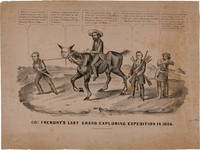
1856rif. 63167New York: Nathaniel Currier 1856. Fremont as an Overland Explorer for the Presidency A cutting satirical cartoon aimed at the great western explorer John C. Fremont and his main supporters in his 1856 bid for the White House. Fremont was the Republican nominee for the presidency and ran on an anti-slavery platform. He was backed by New York Tribune editor Horace Greeley and radical abolitionist minister Henry Ward Beecher. In the image Fremont rides a horse - called the "abolition nag" - that has the face of Greeley. Fremont says "This is pretty hard riding - but if he only carries me to the White house in safety I will forgive my friends for putting me astride of such a crazy Old Hack." The horse is led toward the Salt River a metaphor for political disaster by leading Republican William Seward who proclaims that "Which ever road I travel always brings me to this confounded river I thought we had a sure thing this time on the Bleeding Kansas dodge." Mountains in the background are identified as Kansas and Nebraska. The Greeley-headed horse addresses Seward: "Seward it seems to me we are going the same Road we did in 'fifty two' but as long as you lead I'll follow if I 'go it blind.'" Henry Ward Beecher who was known to have furnished antislavery emigrants with firearms to participate in the Kansas struggles follows behind Fremont's horse his arms laden with rifles. A mountain man - evoking Fremont's exploring past - cautions the Pathfinder: "Ah! Colonel - you've got into a bad crowd - you'll find that dead Horse on the prairie is better for the Constitution than Abolition Soup or Wooly head stew in the White house." The embossed seal to the bottom left corner is that of F.A. Caspari of Baltimore "Dealer in Books & Stationery." This print is scarce. The Currier & Ives catalogue raisonné locates only the copies at the Chicago Historical Society and the Library of Congress. OCLC adds only two copies one at the American Antiquarian Society and another at the University of Rochester. A fine satirical print of John Fremont and his abolitionist supporters in the 1856 presidential election. Light even tanning lightly foxed. Old vertical fold running the length of right edge. Closed tears with repairs to the right and left edges plus small closed tear to top right edge along fold. Contemporary dealer's embossed seal to bottom left corner. Three small pieces of linen tape to top of the verso some discoloration from old tape since removed on verso. Very good. REILLY AMERICAN POLITICAL PRINTS 1856-20. WEITENKAMPF p.117. PETERS CURRIER & IVES 1635a. GALE CURRIER & IVES: A CATALOGUE RAISONNÉ 1309. OCLC 192110863. OCLC 1136567691. unknown
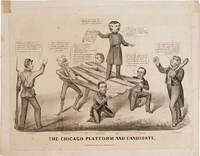
1864rif. 63169New York: Published by Currier & Ives 1864. A Political Cartoon Exposing McClellan's Hypocrisy A rare Currier and Ives print from the presidential election of 1864 satirizing the Democratic presidential candidate and former general George B. McClellan as an equivocating hypocrite. As Neely and Holzer explain the presidential campaign of 1864 inspired a flurry of "separate-sheet display cartoons: thought-provoking witty but often cruel lampoons that struck hard at the most divisive political and personal issues of 1864. In these cartoons one can see illustrated vividly the raw toughness of the campaign as well as the skill of the artists who covered it." These prints they note could be "vicious: personal mean-spirited cruel race-baiting and divisive" and in this context McClellan "the military man now running on a peace platform made for one obvious target." The image here shows a two-faced McClellan at center standing atop rickety planks - a literal representation of the Democratic party's Chicago peace platform - and holding a copy of his letter of acceptance. The planks are supported precariously at each corner on the shoulders of four figures: Confederate president Jefferson Davis; New York congressman and prominent Copperhead Fernando Wood; another Copperhead and the author of the Chicago platform Clement Vallandigham; and "Jeffs friend" the devil. Standing on opposite sides of the image are representatives of each of the constituencies to whom the two-faced McClellan is pandering: a uniformed "Union Soldier" and a "Peace Democrat" caricatured here as a club-wielding simian Irishman. From the face addressing the Peace Democrat McClellan says "You see my friend I accept the nomination and of course stand on the platform" to which the Peace Democrat replies "All right General! if yere in favor of resistin the draft killing the Nagurs and pace wid the Southerners I'll knock any man on the head that'll vote aginye." From his other face addressing the Union soldier McClellan contradicts himself saying "If you don't like the Platform I refer you to my letter of acceptance" a copy of which McClellan holds in his and which reads "War! - preservation Union - could not look my gallant Comrades in the - face; ---" The soldier says "Its no use General! you can't stand on that platform and come that blarney over me; I smell brimstone!" Below McClellan the devil speaking to Jefferson Davis gives expression to the futility of the lost cause: "Well Jeff it's no use trying to hold up this rickety old platform I guess I'll leave you to your fate!" Davis says in reply "I'm in a pretty fix! Weldon road gone!! Atlanta taken!!! Mobile Forts surrendered!!!! Early licked!!!!! and now when my last hope is in keeping up this platform and getting Mac elected you who led me into the scrape threaten to leave me!!!!!" Meanwhile an exasperated Vallandingham exclaims "Confound that letter! I've a good mind to bolt and let the whole concern go to a smash!" Fernando tries to reassure his fellow Copperhead: "Hold on Val. don't you see it's only his little game to ring in the war men if he is elected he is bound to carry out our policy and nothing else!" The image mocks the seeming hypocrisy of McClellan a military man running on his war record who has just accepted the nomination of a party whose platform calls for an end to the war even as the candidate himself expresses his support for the war in his acceptance letter. Reilly notes that the cartoon was probably drawn by the prolific artist Louis Maurer. This print is scarce. The Currier & Ives catalogue raisonné locates only the copies at the Chicago Historical Society and the Library of Congress. OCLC locates another two copies at the time of cataloguing one at the Ohio History Center and another at the Clements Library. We find additional copies at the American Antiquarian Society the Library Company of Philadelphia and the Metropolitan Museum of Art. A rare and stinging political cartoon from the bitter war-time election of 1864. Tanned with some scattered foxing. Small pinholes to top center and to top and bottom of left margin. Two small pieces of linen tape to top edge of verso; some soiling to verso and some discoloration from old tape since removed showing through to recto. Very good. REILLY AMERICAN POLITICAL PRINTS 1864-20. WEITENKAMPF p.143. PETERS CURRIER & IVES 1621. GALE CURRIER & IVES: A CATALOGUE RAISONNÉ 1126. NEELY & HOLZER UNION IMAGE pp.132 134 137 144-45. Bryan F. Le Beau Currier & Ives: America Imagined Washington: Smithsonian Institution Press 2001 pp.280-81. OCLC 818725064 1292629697. unknown
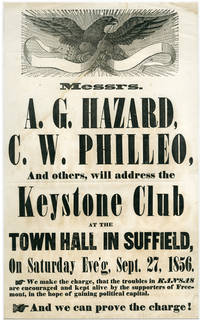
1856rif. WRCAM53064Suffield Ct 1856. Broadside 17 x 10 1/2 inches visible area. Matted and framed. Light dampstaining at top edge light foxing. Very good. An attractive broadside advertisement that promotes a meeting of James Buchanan supporters the "Keystone Club" in Suffield Connecticut on Sept. 27 1856. The poster promises a number of speeches against the candidate of the newly-formed Republican Party John C. Fremont that assert the complicity of his supporters in the violence roiling Kansas. The key and virulent disagreement between the Democratic party for whom Buchanan was the nominee and the Republicans was over the Kansas-Nebraska Act and the issue of popular sovereignty which would allow the residents of new states to vote on the existence of slavery within their borders. This broadside accuses anti-slavery and pro-Fremont partisans in Kansas of fomenting violence there for political gain. The text reads in full: "Messrs. A.G. Howard C.W. Philleo and others will address the Keystone Club at the Town Hall in Suffield on Saturday Eve'g Sept. 27 1856. We make the charge that the troubles in Kansas are encouraged and kept alive by the supporters of Freemont sic in the hope of gaining political capital. And we can prove the charge!" The text is headed by an American eagle gripping arrows and olive branch in the style of the Great Seal. OCLC records only two copies of this interesting broadside at the Connecticut Historical Society and Connecticut State Library. unknown books
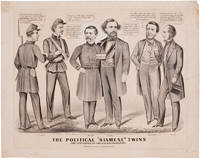
1864rif. 63056New York: Currier & Ives 1864. Unlikely Running Mates Conjoined by "Party Ties" A rare Currier and Ives political print from the 1864 presidential election likening the unusual marriage of McClellan and his running mate Copperhead leader George Pendleton to the famous "Siamese twins" Chang and Eng Bunker. Chang and Eng first came to the United States in 1829 where their great popularity as a touring act gave birth to the phrase "Siamese twins" as a term for conjoined twins. After years of touring in Europe and America the pair settled down in North Carolina for over a decade before returning to the stage in the 1860s. Their renewed popularity and enduring cultural relevance are both evidenced by this election-year cartoon. "In the center McClellan left is attached to the side of his running mate by 'The Party Tie.' McClellan says apologetically to the two Union soldiers at his left 'It was not I that did it fellow Soldiers!! but with this unfortunate attachment I was politically born at Chicago!' The Democratic national convention took place in Chicago on August 29 1864. The soldier with his arm in a sling responds angrily 'Good bye little Mac' if thats your company! Uncle Abe gets my vote.' The soldier at far left says 'I would vote for you General if you were not tied to a "peace" Copperhead who says that Treason and Rebellion ought to triumph!!' Pendleton addresses the two 'Copperheads' at his right: Clement Laird Vallandigham author of the Democrats' peace plank and Horatio Seymour governor of New York and chairman of the Democratic national convention. Pendleton says 'I dont care how many letters Mac writes if it brings him votes; for every vote for him count one for me!!' Vallandigham concurs 'Yes Pen that's the only reason that I support the ticket; if you are elected both Jeff…and I will be triumphant!" Seymour far right replies 'With Pendleton as Vice; Val.secretary of State; Wood i.e. Fernando Wood an organizer of the Peace Democrats in the treasury and I Govr. of New-York we will have peace at any price the rebels "our friends" in this copy choose to ask for it'" – Reilly. Interestingly the copy described by Reilly differs slightly from the other recorded copies. In the Library of Congress copy Seymour refers to "the rebels" directly; in our copy and most others he instead refers to them as "our friends" in quotation marks alluding to his famous or infamous "My Friends" speech delivered during the New York draft riots. OCLC records copies only at the University of Michigan and Peabody Essex Museum though we locate additional copies at the Library of Congress Library Company of Philadelphia Princeton and the Metropolitan Museum of Art. A rare and visually striking political cartoon evocative of the fraught 1864 election and contemporary popular culture. Light foxing and soiling. Closed tear in right edge into platemark but not touching illustration. Faint dampstain near center. Very good overall. REILLY 1864-19. PETERS CURRIER & IVES 1671. CURRIER & IVES: CATALOGUE RAISONNÉ 5232. OCLC 191120100. unknown
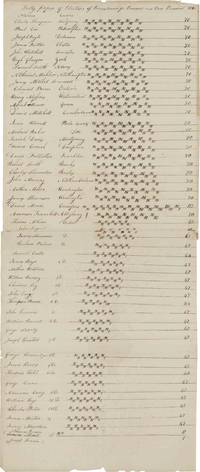
1812rif. 68222Pennsylvania. 1812. Pennsylvania Elects Madison in 1812 An interesting early American political manuscript listing fifty-one electors by county or district with tallies next to their names which are then added in a final column. Among the more notable of the electors listed are Charles Thompson and Thomas McKean. In the election Pennsylvania voted overwhelmingly for the Democratic-Republican candidate James Madison who defeated Federalist candidate DeWitt Clinton. An unusual piece of political Americana. Old folds light tanning and wear. Very good. unknown
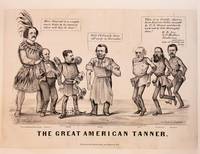
1868rif. 36501New York: Currier & Ives 1868. Lithograph illustrated broadside by Currier & Ives oblong 11" x 15-1/2". Matted. Light dusting Near Fine. Cartoon characters identified by name; in lower right corner "on Stone by Cameron." John Cameron was a talented artist employed at Currier & Ives. In lower left corner "Thos. Worth. Sketch." Worth designed many cartoon broadsides for Currier & Ives. "An election-year cartoon invoking both Grant's humble beginnings as a tanner and his successful Civil War military career. Popular New York governor John Thompson Hoffman dressed as an Indian the 'Great Sachem of Tammany' presents Democratic candidates Horatio Seymour and Francis P. Blair Jr. to Grant. He addresses Grant 'Here General is a couple more hides to be tanned when will they be done' Grant smokes a cigar and wears the leather apron of a tanner rolled-up sleeves exposing his muscular arms. He replies 'Well I'll finish them off early in November.' "At right corner former Confederate generals Robert E. Lee Simon Bolivar Buckner and John C. Pemberton hold their rumps and hop about in pain. They announce 'This is to Certify that we have had our hides tanned and that the work was by him thoroughly done." Reilly AAS's entry asserts "Issued well before 1868 election." Reilly 1868-11. Weitenkampf 159. OCLC 191119896 1- Villanova 1136555720 1- AAS as of October 2024. Currier & Ives unknown
1868rif. 36501New York: Currier & Ives 1868. Lithograph illustrated broadside by Currier & Ives oblong 11" x 15-1/2". Matted. Light dusting Near Fine. Cartoon characters identified by name; in lower right corner "on Stone by Cameron." John Cameron was a talented artist employed at Currier & Ives. In lower left corner "Thos. Worth. Sketch." Worth designed many cartoon broadsides for Currier & Ives. "An election-year cartoon invoking both Grant's humble beginnings as a tanner and his successful Civil War military career. Popular New York governor John Thompson Hoffman dressed as an Indian the 'Great Sachem of Tammany' presents Democratic candidates Horatio Seymour and Francis P. Blair Jr. to Grant. He addresses Grant 'Here General is a couple more hides to be tanned when will they be done' Grant smokes a cigar and wears the leather apron of a tanner rolled-up sleeves exposing his muscular arms. He replies 'Well I'll finish them off early in November.' "At right corner former Confederate generals Robert E. Lee Simon Bolivar Buckner and John C. Pemberton hold their rumps and hop about in pain. They announce 'This is to Certify that we have had our hides tanned and that the work was by him thoroughly done." Reilly AAS's entry asserts "Issued well before 1868 election." Reilly 1868-11. Weitenkampf 159. OCLC 191119896 2- AAS Villanova as of January 2020. Currier & Ives unknown books
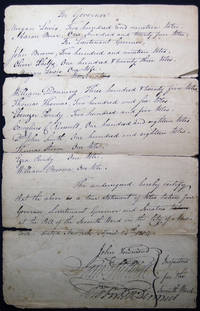
1804rif. 030071New York City NY 1804. Signed by the inspectors John Townsend Samuel Stillwell and Robert McDermut in the Gubernatorial & Senate elections and providing the vote count for these offices. For Governor Morgan Lewis ran against Aaron Burr 1756 - 1836 revolutionary soldier U.S. senator and vice president of the United States. ".In 1804 the Republican leaders replaced Burr as the party's vice presidential candidate. That same year he ran for governor of New York against Morgan Lewis the regular Jeffersonian candidate. During the campaign Burr refused to accept assistance from New England Federalists in exchange for a promise to combine New York with New England in a secessionist scheme. In addition Hamilton continued his opposition to the vice president by circulating letters that contained disparaging remarks about Burr. Although most Federalists voted for the vice president despite Hamilton's remarks and Burr's opposition to disunion plans Lewis easily won the election with help from the Clinton and Livingston factions. Following the election Burr became increasingly angry at those he held responsible for his political downfall…Burr felt that the most effective response would be through the code duello. In June the vice president issued a challenge to Hamilton after Hamilton refused to make a comprehensive disclaimer of his derogatory comments of Burr uttered during the gubernatorial campaign. Hamilton accepted Burr's challenge and the two men met in Weehawken New Jersey on 11 July 1804. As a result Hamilton suffered a fatal wound as a ball lodged in his spine…Hamilton died the next day." Steven E. Siry in the ANB Approx. 8" x 12 1/2" size; age wear chipping and splitting along old lines; in about good condition. Manuscript. Good.
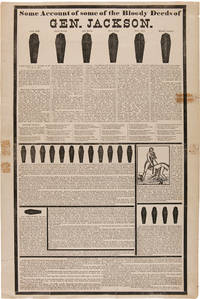
1828rif. WRCAM56438N.p. 1828. Broadside 20 3/4 x 14 inches. Old folds small closed tears along most folds some separation at center fold. Residue and mild staining from previous tape repairs one older tape repair still in place. Minor edge wear and a few small chips even tanning. About very good. One version of the infamous "Coffin Broadsides" attacking Andrew Jackson in the presidential campaign of 1828. There was considerable mud-slinging between the Jackson and Adams camps during that campaign which eventually saw the defeat of incumbent John Quincy Adams and the election of Andrew Jackson. Across the top of the present broadside are six woodcut coffins bearing the names of six militiamen shot for mutiny on Jackson's orders during the War of 1812; an account of their wrongful execution follows. Below that there are more accounts of Jackson's evil and murderous deeds including twelve regular soldiers shot for desertion despite their "not guilty" pleas complete with twelve more coffin woodcuts; Jackson assaulting another man Samuel Jackson in the streets of Nashville and running him through with a sword while Samuel bent over to pick up a rock for defense with a woodcut of a demonic Jackson committing the murderous act; the tale of another soldier unfairly executed another woodcut coffin; and a brief account of some Indian prisoners executed on Jackson's orders four more coffins. The bottom portion includes a testimonial by Thomas Hart Benton who himself had fought a duel with Jackson. The "Coffin Handbill" was printed and reprinted in several sizes and formats. Sabin quotes John Spencer Bassett in his LIFE OF ANDREW JACKSON who notes that the "execution of mutinous militiamen in the campaigns of 1813 and 1814 was recalled to show Jackson's ferocious temper; and when a Philadelphia editor published a hand-bill showing a coffin with the victims standing by its side the idea was caught up eagerly and repeated in all parts of the country." SABIN 86569. OCLC 18042341 45888498. unknown books
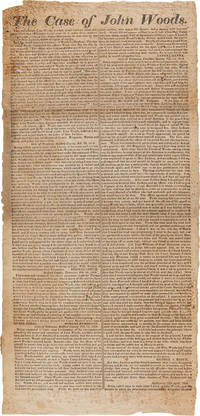
1828rif. WRCAM56513N.p. 1828. Broadsheet 19 x 9 inches text printed in two columns on both sides. Old folds some chips to edges minor loss to upper left corner and closed tear to bottom edge no text affected. Two small holes affecting just one word a few areas of soiling light foxing even tanning. Manuscript annotations to verso. About very good. A rare broadside recounting Andrew Jackson's infamous execution of Private John Woods published in 1828 by Jackson's opponents during the 1828 election. There was considerable mud-slinging between the Jackson and Adams camps during that campaign which eventually saw the defeat of incumbent John Quincy Adams and the election of Andrew Jackson. This dense broadside recounts the events of March 1814 at Fort Strother during the Creek Campaign when Jackson charged John Woods an eighteen year-old militiaman with disobedience disrespect and mutiny. According to the text the trial itself only occurred because Jackson's soldiers would not shoot Woods' at the moment of the offense despite Jackson's cries to "Shoot the damned rascal!.blow ten balls through the damned rascal!" The court martial followed soon after; Woods was found guilty and sentenced to die. Some testimonies here state that Jackson offered to spare Woods' life if he would enlist in the regular army but Woods refused; others disagree. He was executed thirty-six hours later. Then follows the sworn testimony of several witnesses: Thomas Couch Robert Ferguson Samuel Hanna George A. Brock Isaac Roberts James Harris William Stewart Joseph Alexander Isaac Anderson Abm. Whitney and John Williams all fellow-soldiers of Woods who witnessed or had personal knowledge of the facts in the case. Their accounts of Woods' supposed mutiny substantially downplay the severity of Woods' disobedience suggesting that it was likely a misunderstanding; they also emphasize the draconian nature of the punishment and make several mentions of Woods' aging and infirm parents. Williams' account closes: "It is not true that Woods on the ground of Execution with oaths and defiance refused to promise obedience. On the contrary he wept loud and bitterly." All of the testimonies are datelined in Tennessee in the first few months of 1828. The nature of the printing lends itself to the possibility of a Tennessee press. Though not as famous as the "Coffin Handbills" that appeared at the same time listing Woods' execution among many other crimes by Jackson this was definitely addressed to the same audiences. John Spencer Bassett in his LIFE OF ANDREW JACKSON notes that the "execution of mutinous militiamen in the campaigns of 1813 and 1814 was recalled to show Jackson's ferocious temper; and when a Philadelphia editor published a hand-bill showing a coffin with the victims standing by its side the idea was caught up eagerly and repeated in all parts of the country." Not in Wise & Cronin and we could find no listing for this broadside in OCLC or in American Imprints. It has only appeared at auction twice and then not since 1925 when Anderson Galleries offered a copy as part of the sale of the Henry De Puy collection which was strong in Andrew Jackson material. The only copy in the trade seems to be one offered by the Eberstadts in 1939. unknown books
1828rif. 56513N.p. 1828. A Very Rare Broadsheet Attack on Andrew Jackson in 1828 A rare broadside recounting Andrew Jackson's infamous execution of Private John Woods published in 1828 by Jackson's opponents during the 1828 election. There was considerable mud-slinging between the Jackson and Adams camps during that campaign which eventually saw the defeat of incumbent John Quincy Adams and the election of Andrew Jackson. This dense broadside recounts the events of March 1814 at Fort Strother during the Creek Campaign when Jackson charged John Woods an eighteen-year-old militiaman with disobedience disrespect and mutiny. According to the text the trial itself only occurred because Jackson's soldiers would not shoot Woods at the moment of the offense despite Jackson's cries to "Shoot the damned rascal!.blow ten balls through the damned rascal!" The court martial followed soon after; Woods was found guilty and sentenced to die. Some testimonies here state that Jackson offered to spare Woods' life if he would enlist in the regular army but Woods refused; others disagree. He was executed thirty-six hours later. Then follows the sworn testimony of several witnesses: Thomas Couch Robert Ferguson Samuel Hanna George A. Brock Isaac Roberts James Harris William Stewart Joseph Alexander Isaac Anderson Abm. Whitney and John Williams all fellow soldiers of Woods who witnessed or had personal knowledge of the facts in the case. Their accounts of Woods' supposed mutiny substantially downplay the severity of Woods' disobedience suggesting that it was likely a misunderstanding; they also emphasize the draconian nature of the punishment and make several mentions of Woods' aging and infirm parents. Williams' account closes: "It is not true that Woods on the ground of Execution with oaths and defiance refused to promise obedience. On the contrary he wept loud and bitterly." All of the testimonies are datelined in Tennessee in the first few months of 1828. The nature of the printing lends itself to the possibility of a Tennessee press. Though not as famous as the "Coffin Handbills" that appeared at the same time listing Woods' execution among many other crimes by Jackson this was definitely addressed to the same audiences. John Spencer Bassett in his Life of Andrew Jackson notes that the "execution of mutinous militiamen in the campaigns of 1813 and 1814 was recalled to show Jackson's ferocious temper; and when a Philadelphia editor published a hand-bill showing a coffin with the victims standing by its side the idea was caught up eagerly and repeated in all parts of the country." Not in Wise & Cronin and we could find no listing for this broadside in OCLC or in American Imprints. It has only appeared at auction twice and then not since 1925 when Anderson Galleries offered a copy as part of the sale of the Henry De Puy collection which was strong in Andrew Jackson material. The only copy in the trade seems to be one offered by the Eberstadts in 1939. Broadsheet 19 x 9 inches text printed in two columns on both sides. Old folds some chips to edges minor loss to upper left corner and closed tear to bottom edge no text affected. Two small holes affecting just one word a few areas of soiling light foxing even tanning. Manuscript annotations to verso. About very good. unknown
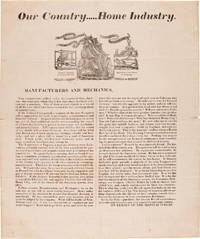
1824rif. 62431N.p. but likely New York. 1824. Rare Illustrated Anti-Jackson Broadside A very rare illustrated anti-Jackson broadside from the hotly-contested election of 1824 addressed to "manufacturers and mechanics." The presidential election of 1824 was a complicated four-candidate affair with frontrunners Andrew Jackson and John Quincy Adams trailed by Henry Clay and William Crawford each drawing considerable support in certain districts. In fact the race was so close that no candidate won a sufficient majority of the electoral vote and Adams was elected by the House of Representatives under the provisions of the Twelfth Amendment despite carrying four fewer states than Jackson and the glow of the "Era of Good Feeling" was dimmed once and for all. Addressed to "Manufacturers and Mechanics" this broadside focuses primarily on Jackson's economic policies specifically his anti-tariff stance. "If the Jackson Party prevail" the text proclaims "the next Congress will be opposed to the tariff to mechanics manufacturers and domestic industry.The consequence will be that the sound of the shuttle will no longer be heard. Our stores will be filled with British and Scotch ginghams shirtings checks and bed-ticks; and not a place will be found for a yard of American cloth.Don't suffer yourselves to be deceived by stories that General Jackson is your friend.What will his battle of New Orleans avail you if you are thrown out of employment and made beggars" Even Jackson's campaign materials they claim are made from British exports. The text seems targeted at a New York and New England audience pointing out South Carolina and "the southern section of the country" as the fervent opponents of domestic industry and warning readers not to be "the dupes of such men as William Coleman" owner of The New York Evening Post. Throughout the broadside maintains a strong anti-British stance and suggests that Jackson and his supporters including Coleman are better friends of Great Britain than America: "Coleman is the man who exulted when a British fleet lay off the Hook. The Evening Post was received wet from his office on board their ships every day. Nothing but respect for the laws prevented our incensed countrymen from demolishing the press and types that printed the diabolical treason." While the text espouses Henry Clay as the man of the hour "the truest ablest and best friend you ever had" the woodcut illustration places a ship named the "John Quincy Adams of Washington" front and center. It flies banners reading "Free Trade & Sailors Rights" and "No Colonial Subjection" and is flanked on either side by vignettes subtitled "National industry is National Wealth" and "Agriculture is the Source of Prosperity." Ironically the largest controversy in Jackson's presidency a decade later would be over his lack of action against tariffs when his failure to repeal Adams' 1828 "Tariff of Abominations" resulted in the Nullification Crisis and threats of civil war. We locate only one other copy of this broadside at the Library of Congress. A rare and interesting illustrated political broadside from a highly contentious election. Old folds minor splitting at right edge of central horizontal fold. Lightly tanned. Very good. REILLY AMERICAN POLITICAL PRINTS 1824-3. OCLC 299947334. hardcover
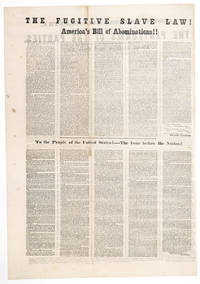
1852rif. 27980Boston Fugitive Slave Law Printing on Free Soil Party Broadsheet "a vote for either of the former candidates is as truly a vote in favor of the sustenance defence and encouragement of American slavery in all its hideousness as a vote for the devil were a vote in favor of sin…" This broadsheet prints a summary of the three major party platforms—the "Compromise Democratic" Party the Whig Party and the Free Democratic Free Soil Party—headed with the injunction to "Read Reflect and then Act!" The second page includes the text of the Fugitive Slave Law or "America's Bill of Abominations!!" passed in September 1850 and an editorial by "Alexander" that explains the benefits of the Free Soil Party over the other two parties. ELECTION OF 1852. FUGITIVE SLAVE LAW. Printed Broadsheet Boston Commonwealth Extra July 1852. 2 pp. 25½ x 22 in. Excerpts "The Platforms of the Parties. Read Reflect and then Act!" p1 "The Fugitive Slave Law! America's Bill of Abominations!!" p2 "…Section 6 And be it further enacted That when a person held to service or labor in any State or Territory of the United States has heretofore or shall hereafter escape into another State or Territory of the United States the person or persons to whom such service or labor may be due or his her or their agent or attorney duly authorized by power of attorney in writing acknowledged and certified under the seal of some legal officer or court of the State or Territory in which the same may be executed may pursue and reclaim such fugitive person either by procuring a warrant from some one of the courts judges or commissioners aforesaid of the proper circuit district or county for the apprehension of such fugitive from service or labor or by seizing and arresting such fugitive where the same can be done without process and by taking or causing such person to be taken forthwith before such court judge or commissioner whose duty it shall be to hear and determine the case of such claimant in a summary manner; and upon satisfactory proof being made by deposition or affidavit in writing to be taken and certified by such court judge or commissioner or by other satisfactory testimony duly taken and certified by some court magistrate justice of the peace or other legal officer authorized to administer an oath and take depositions under the laws of the State or Territory from which such person owing service or labor may have escaped with a certificate of such magistracy or other authority as aforesaid with the seal of the proper court or officer thereto attached which seal shall be sufficient to establish the competency of the proof and with proof also by affidavit of the identity of the person whose service or labor is claimed to be due as aforesaid that the person so arrested does in fact owe service or labor to the person or persons claiming him or her in the State or Territory from which such fugitive may have escaped as aforesaid and that said person escaped to make out and deliver to such claimant his or her agent or attorney a certificate setting forth the substantial facts as to the service or labor due from such fugitive to the claimant and of his or her escape from the State or Territory in which he or she was arrested with authority to such claimant or his or her agent or attorney to use such reasonable force and restraint as may be necessary under the circumstances of the case to take and remove such fugitive person back to the State or Territory whence he or she may have escaped as aforesaid. In no trial or hearing under this act shall the testimony of such alleged fugitive be admitted in evidence; and the certificates in this and the first fourth section mentioned shall be conclusive of the right of the person or persons in whose favor granted to remove such fugitive to the State or Territory from which he escaped and shall prevent all molestation of such person or persons by any process issued by any court judge magistrate or other person whomsoever. Section 7 And be it further enacted That any person who shall knowingly and willingly obstruct hinder or prevent such claimant his agent or attorney or any person or persons lawfully assisting him her or them from arresting such a fugitive from service or labor either with or without process as aforesaid or shall rescue or attempt to rescue such fugitive from service or labor from the custody of such claimant his or her agent or attorney or other person or persons lawfully assisting as aforesaid when so arrested pursuant to the authority herein given and declared; or shall aid abet or assist such person so owing service or labor as aforesaid directly or indirectly to escape from such claimant his agent or attorney or other person or persons legally authorized as aforesaid; or shall harbor or conceal such fugitive so as to prevent the discovery and arrest of such person after notice or knowledge of the fact that such person was a fugitive from service or labor as aforesaid shall for either of said offences be subject to a fine not exceeding one thousand dollars and imprisonment not exceeding six months by indictment and conviction before the District Court of the United States for the district in which such offence may have been committed or before the proper court of criminal jurisdiction if committed within any one of the organized Territories of the United States; and shall moreover forfeit and pay by way of civil damages to the party injured by such illegal conduct the sum of one thousand dollars for each fugitive so lost as aforesaid to be recovered by action of debt in any of the District or Territorial Courts aforesaid within whose jurisdiction the said offence may have been committed…" "To the People of the United States!—The Issue Before the Nation!" p2 "We present you this Document for the Campaign in order that its doctrines may be scanned before the minds of men become steeled against the power of just reasoning by the intense zeal and party prejudice of an exciting election. It is a simple and earnest appeal to reason." p2/c1 "The Free Democracy will favor the early policy of the country to limit localize and discourage slavery—the separation of national funds from banking institutions cheap postage a moderate revenue—the election of civil officers by the people—such internal improvements as are national and constitutional—the cordial reception of emigrants and exiles from the old world—the grant of the Public Lands free of cost to landless settlers—the immediate repeal of the Fugitive Slave Law—the recognition of the independence of Hayti—an arrangement in future treaties… "And the said party will oppose the exercise of doubtful constitutional powers—the demand for more slave States new slave territories and the nationalization of slavery—foreign interference with the right of a nation to govern itself." p2/c2 "The intrepid Free Democracy have sought the arena of political strife with a determination to oppose each of these powerful clock-work organizations. They publish a platform which presents a point-blank contrast to either and both the others. They claim the support of the people because their policy is founded in Right and Justice; and because the application of that policy to governmental affairs cannot be secured by the triumph of any other party." p2/c3-4 "While the attitude of the Free Democracy is that of a general championship of the rights of the humbler classes … its position upon the slavery question affords the great contrast and entitles it to the support of the lovers of Freedom and Right." p2/c4 "Whigs and Democrats would sanction slavery by law. The Free Democracy forbid the high-handed endeavor." p2/c4 "It follows that a vote for either of the former candidates is as truly a vote in favor of the sustenance defence and encouragement of American slavery in all its hideousness as a vote for the devil were a vote in favor of sin." p2/c4-5 Historical Background The author of the editorial may have been Alexander De Witt 1798-1879 a former Democrat who joined the Free Soil Party and was one of the six signatories of the "Appeal of the Independent Democrats" in January 1854 in opposition to the Kansas-Nebraska Act. President Zachary Taylor a Whig died in July 1850. His successor Millard Fillmore supported the Compromise of 1850 and enforcement of its stronger Fugitive Slave Law which made him unpopular in the North. At the Whig National Convention in Baltimore the delegates took 53 ballots to choose General Winfield Scott of New Jersey as their presidential candidate. At the Democratic convention also in Baltimore it took 48 ballots to select dark-horse choice Senator Franklin Pierce of New Hampshire as their presidential candidate. The Free Soil Party which opposed the extension of slavery chose Senator John P. Hale of New Hampshire as their presidential candidate. After the Compromise of 1850 many Barnburner Democrats and Conscience Whigs returned to their parties at the expense of the Free Soil Party. With no major policy differences between the Democrats and Whigs the election became a contest of personalities between Scott the anti-slavery war hero of the Mexican War and the pro-slavery Pierce who though eighteen years younger had also served in the war. In the election on November 2 1852 Pierce won 50.8 percent of the popular vote carrying 27 states with 254 electoral votes. Scott's 43.9 percent carried only 4 states with 42 electoral votes. Hale attracted 4.9 percent of the popular vote taking no electoral votes. The Commonwealth 1851-1853 was a newspaper published in Boston daily with occasional supplements under the motto "Circulate the documents." In 1852 it became the official newspaper of the Free Soil Party in Massachusetts. Condition: Very good overall. Boston Commonwealth
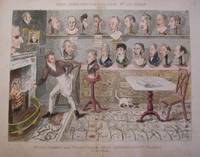
rif. elala2053Alnwick: 1826-32. An album containing 36 engraved and etched caricatures including at least 25 dealing with the Alnwick Northumberland election of 1826 some additional dealing with the Northumberland election of 1832 and 3 broadsides 2 illustrated. various sized sheets 25 hand-coloured most mounted on larger uniform sheets. bound as an oblong folio in later half morocco extremities worn short splits in lower joints scattered soiling & foxing several sheets folded & some torn but with no loss of image. ownership entry of William Graham Richardson North Shields. The 1826 Alnwick election for two parliamentary representatives for Northumberland was a hotly contested one marked by much rancour and animosity among the candidates and the voters. Some voters engaged in the practice of plumping or voting for only a single candidate rather than two. Of the four contestants Henry Thomas Liddell Liddle Tory Matthew Bell Tory Thomas Wentworth Beaumont at the time an Independent Reformer and Henry George Grey Viscount Howick Whig Liddell and Bell emerged victorious. Another figure appearing in some of the caricatures is John George Lambton later first Earl of Durham Governor General of Canada 1837 and author of the celebrated Durham Report 1839. While supporting the candidature of his brother-in-law Lord Howick Lambton fought a bloodless duel with T.W.Beaumont. A full listing of the broadsides and caricatures some of which carry the imprint of W.Stephenson or W.Davison is available upon request. [Alnwick]: 1826-32. unknown
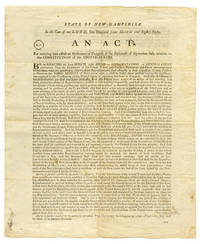
1788rif. WRCAM52937Portsmouth N.H. 1788. Broadsheet approximately 14 1/4 x 11 3/4 inches. Previously folded with one small hole at lower central fold line. Slight curling at edges very light tanning and foxing. Very good. A rare broadsheet calling for New Hampshire representatives to be appointed to the Electoral College for the first presidential election under the Constitution in 1788. On Sept. 13 1788 Congress passed a resolution that electors should be appointed and in response this November 12 act of the New Hampshire legislature declared December 15 as the date to elect the state's representatives to both houses of Congress and to determine its electors for the Electoral College. New Hampshire was the first of the ten states that had ratified the Constitution at this point to hold its federal elections. We locate only two other copies at the American Antiquarian Society and Dartmouth. BRISTOL B6753. WHITTEMORE NEW HAMPSHIRE 458. unknown books
rif. 8525Paris, de l’imprimerie Royale, le 24 janvier 1789. Placard in folio, 565x860mm.Sur papier fort. Texte sur 4 colonnes séparées par un filet noir. Pliures, ainsi qu’une mouillure (sans gravité). Il s’agit de l’acte initial de la Révolution Française. La détresse financière à la veille de la Révolution. Il ne se trouve plus personne qui veuille prêter au ROI et les privilèges résistent opiniâtrement à toute création d’impôt les atteignant dans leur privilège ; le gouvernement de Louis XVI se trouve ainsi acculé à la nécessité de s’adresser à la Nation pour en obtenir de l’argent et convoquer pour cela, les Etats-Généraux. Cette convocation, aboutissement d’un conflit d’ordre fiscal entre le ROI et les privilégiés, est l’acte décisif qui ouvre l’ère Révolutionnaire. Les privilégiés, en la réclamant, le ROI en l’accordant, fournissent à la Nation l’instrument nécessaire avec lequel elle va faire la REVOLUTION. Cette grande affiche règle les modalités d'élection des députés aux Etas-Généraux et la confection des cahiers de doléances. Rare et précieux document