1.177 Ergebnisse
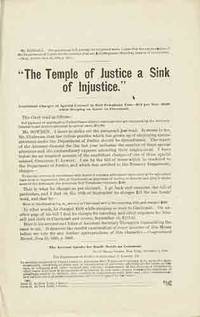
1888Best.-Nr. 37352n.p.: n.p. 1888. First edition. Self wrappers. A very good copy. 4 pp. 8vo. First section title reads "Exorbitant Charge of Special Counsel in Bell Telephone Case - $75 per day - $100 while Sleeping en Route to Cincinnati." Goes on to accuse the Department of Justice of rights violations and cronyism. "The Citizen and his rights trampled upon in every direction through processes of law." Extensively quotes Samuel Jackson Randall 1828-1890 Democratic member of the United States House of Representatives from Pennsylvania whose power was waning at the time. OCLC locates only two copies: Library of Michigan and the Wisconsin Historical Society. n.p. unknown books
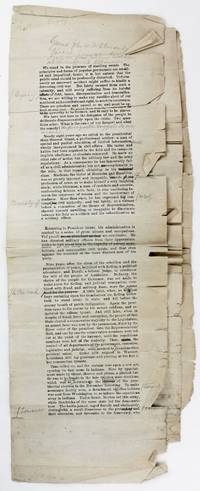
1877Best.-Nr. 5770N.p. likely Springfield Il: ca. January 8 1877. Good. Three long galley leaves each approximately 6.5 x 19 inches and printed on rectos only with numerous pencil emendations. Old folds and creases numerous chips and tears to margins pervasive wrinkling making reading a bit challenging at times but with no loss to text. Small portion of third leaf containing the last eight lines of text detached but present. Not in great shape but seemingly unique. A galley proof of a speech by General John A. McClernand in the midst of the contentious Election of 1876 which was so far as we can determine neither delivered nor published. A pencil note at top reveals his authorship and notes the speech was intended to be delivered January 8 at the “Great Citizens Convention” in Springfield Illinois almost certainly in 1877 following the recent election in the Fall of 1876. McClernand was an Illinois contemporary of Lincoln's a Democratic Congressman and War Democrat. He was also an ally of another Illinois politician and Lincoln adversary Stephen A. Douglas. He was appointed a general during the Civil War largely through political maneuvering and was generally considered incompetent. McClernand greatly resented the authority of Grant who finally relieved him of command in June 1863. Following the war McClernand became a leading critic of Congressional Reconstruction as well as the Grant Administration in general. He also chaired the 1876 Democratic National Convention which nominated Tilden for the presidency. Here McClernand bitterly attacks Grant his presidential Administration and Reconstruction. According to McClernand Grant's "tastes and habits had been acquired in the field and the camp -- in implicit obedience or absolute command. He knew no other rule of action but the military law and army regulations. As a consequence he has lamentably failed as a civil administrator." As President fraudulently and illegally Grant "joined with Kellog a political adventurer and Durell a federal judge to overthrow the will of the people of Louisiana." Law and order says McClernand "lay prostrate and panting at the feet of her remorseless tyrants." McClernand also assails Grant's highhanded tactics in the other Southern States. Now says McClernand "the president and his accomplices have now applied themselves to defeat the will of the people by a parliamentary device. They claimed for the President of the Senate the right and power to count the electoral votes and to declare the result and by implication that that right and power would be so exercised as to count Tilden out of his election and to count Hayes into one." He wasn't wrong. In one of the closest most hotly-contested and highly-controversial elections in American history to put it simply Hayes effectively stole the election by agreeing to remove northern soldiers from the South and end Reconstruction. It would be interesting to know what McClernand thought of the ultimate result -- he didn't get Tilden but he did get the end of Reconstruction. "Yet another prominent Illinoian who played a role in the Civil War John Alexander McClernand was born in Breckinridge County Kentucky before moving to Shawneetown Illinois at a young age. Similar to fellow Illinoian Abraham Lincoln McClernand was a largely self-taught lawyer who began practicing in Shawneetown in 1835. Also like Lincoln McClernand served in the Black Hawk War. However McClernand was a staunch Democrat. In 1835 he established the newspaper Shawneetown Democrat. He was active in Democratic politics at both the state and federal level serving in the Illinois House of Representatives and eventually Congress. In Congress McClernand was a stalwart Jacksonian Democrat who strongly disliked abolitionists. He strongly opposed the Wilmot Proviso which banned slavery in the territory gained after the Mexican-American War. He became a key ally of fellow Democrat and Illinoian Stephen A. Douglas helping him pass the Compromise of 1850. As tensions rose approaching the election of 1860 McClernand campaigned for Douglas’s presidency and became a Unionist. After war broke out in the following April McClernand helped raise volunteers for the Union Army. Because Lincoln needed to retain a wide base of support and retain connections with Democrats in Illinois he appointed McClernand a brigadier general on May 17 1861. McClernand’s military career would be defined by an ongoing clash with fellow Illinoian General Ulysses S. Grant. Grant a seasoned West Pointer who served in Mexico was irritated by McClernand a political general with little military experience. Further exacerbating relations was McClernand’s tendency to boast about his exploits and diminish the achievements of other commanders" - American Battlefield Trust's entry on John A. McClernand. ca. January 8 unknown books
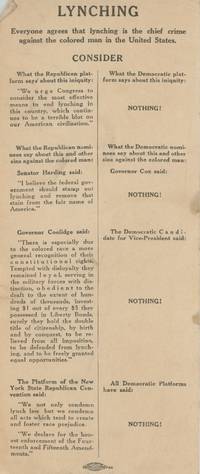
1920Best.-Nr. List2706Chicago or New York 1920. 6 x 9 inches single sided. Toning several small stains small fold at top left corner; near fine. An anonymous handbill decrying lynching in the United States and advertising the differences in anti-lynching policy between the Republican and Democratic parties. The header states that “Everyone agrees that lynching is the chief crime against the colored man in the United States” and the remainder illustrates the great disagreement over just what to do about it. The left column quotes the Republican platform and its then-nominees Warren G. Harding and Calvin Coolidge who would shortly be elected to office on their support for federal anti-lynching legislation. The right column points out that the Democratic platform and its nominees James M. Cox and Franklin D. Roosevelt all “said: NOTHING!” on this issue. Lynching would not be made a federal hate crime until 2022 nearly 100 years later. As of writing we find no other copies of this handbill in OCLC. unknown books
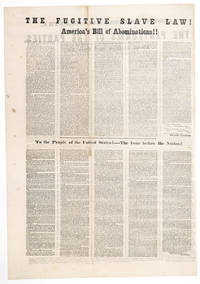
1852Best.-Nr. 27980Boston Fugitive Slave Law Printing on Free Soil Party Broadsheet "a vote for either of the former candidates is as truly a vote in favor of the sustenance defence and encouragement of American slavery in all its hideousness as a vote for the devil were a vote in favor of sin…" This broadsheet prints a summary of the three major party platforms—the "Compromise Democratic" Party the Whig Party and the Free Democratic Free Soil Party—headed with the injunction to "Read Reflect and then Act!" The second page includes the text of the Fugitive Slave Law or "America's Bill of Abominations!!" passed in September 1850 and an editorial by "Alexander" that explains the benefits of the Free Soil Party over the other two parties. ELECTION OF 1852. FUGITIVE SLAVE LAW. Printed Broadsheet Boston Commonwealth Extra July 1852. 2 pp. 25½ x 22 in. Excerpts "The Platforms of the Parties. Read Reflect and then Act!" p1 "The Fugitive Slave Law! America's Bill of Abominations!!" p2 "…Section 6 And be it further enacted That when a person held to service or labor in any State or Territory of the United States has heretofore or shall hereafter escape into another State or Territory of the United States the person or persons to whom such service or labor may be due or his her or their agent or attorney duly authorized by power of attorney in writing acknowledged and certified under the seal of some legal officer or court of the State or Territory in which the same may be executed may pursue and reclaim such fugitive person either by procuring a warrant from some one of the courts judges or commissioners aforesaid of the proper circuit district or county for the apprehension of such fugitive from service or labor or by seizing and arresting such fugitive where the same can be done without process and by taking or causing such person to be taken forthwith before such court judge or commissioner whose duty it shall be to hear and determine the case of such claimant in a summary manner; and upon satisfactory proof being made by deposition or affidavit in writing to be taken and certified by such court judge or commissioner or by other satisfactory testimony duly taken and certified by some court magistrate justice of the peace or other legal officer authorized to administer an oath and take depositions under the laws of the State or Territory from which such person owing service or labor may have escaped with a certificate of such magistracy or other authority as aforesaid with the seal of the proper court or officer thereto attached which seal shall be sufficient to establish the competency of the proof and with proof also by affidavit of the identity of the person whose service or labor is claimed to be due as aforesaid that the person so arrested does in fact owe service or labor to the person or persons claiming him or her in the State or Territory from which such fugitive may have escaped as aforesaid and that said person escaped to make out and deliver to such claimant his or her agent or attorney a certificate setting forth the substantial facts as to the service or labor due from such fugitive to the claimant and of his or her escape from the State or Territory in which he or she was arrested with authority to such claimant or his or her agent or attorney to use such reasonable force and restraint as may be necessary under the circumstances of the case to take and remove such fugitive person back to the State or Territory whence he or she may have escaped as aforesaid. In no trial or hearing under this act shall the testimony of such alleged fugitive be admitted in evidence; and the certificates in this and the first fourth section mentioned shall be conclusive of the right of the person or persons in whose favor granted to remove such fugitive to the State or Territory from which he escaped and shall prevent all molestation of such person or persons by any process issued by any court judge magistrate or other person whomsoever. Section 7 And be it further enacted That any person who shall knowingly and willingly obstruct hinder or prevent such claimant his agent or attorney or any person or persons lawfully assisting him her or them from arresting such a fugitive from service or labor either with or without process as aforesaid or shall rescue or attempt to rescue such fugitive from service or labor from the custody of such claimant his or her agent or attorney or other person or persons lawfully assisting as aforesaid when so arrested pursuant to the authority herein given and declared; or shall aid abet or assist such person so owing service or labor as aforesaid directly or indirectly to escape from such claimant his agent or attorney or other person or persons legally authorized as aforesaid; or shall harbor or conceal such fugitive so as to prevent the discovery and arrest of such person after notice or knowledge of the fact that such person was a fugitive from service or labor as aforesaid shall for either of said offences be subject to a fine not exceeding one thousand dollars and imprisonment not exceeding six months by indictment and conviction before the District Court of the United States for the district in which such offence may have been committed or before the proper court of criminal jurisdiction if committed within any one of the organized Territories of the United States; and shall moreover forfeit and pay by way of civil damages to the party injured by such illegal conduct the sum of one thousand dollars for each fugitive so lost as aforesaid to be recovered by action of debt in any of the District or Territorial Courts aforesaid within whose jurisdiction the said offence may have been committed…" "To the People of the United States!—The Issue Before the Nation!" p2 "We present you this Document for the Campaign in order that its doctrines may be scanned before the minds of men become steeled against the power of just reasoning by the intense zeal and party prejudice of an exciting election. It is a simple and earnest appeal to reason." p2/c1 "The Free Democracy will favor the early policy of the country to limit localize and discourage slavery—the separation of national funds from banking institutions cheap postage a moderate revenue—the election of civil officers by the people—such internal improvements as are national and constitutional—the cordial reception of emigrants and exiles from the old world—the grant of the Public Lands free of cost to landless settlers—the immediate repeal of the Fugitive Slave Law—the recognition of the independence of Hayti—an arrangement in future treaties… "And the said party will oppose the exercise of doubtful constitutional powers—the demand for more slave States new slave territories and the nationalization of slavery—foreign interference with the right of a nation to govern itself." p2/c2 "The intrepid Free Democracy have sought the arena of political strife with a determination to oppose each of these powerful clock-work organizations. They publish a platform which presents a point-blank contrast to either and both the others. They claim the support of the people because their policy is founded in Right and Justice; and because the application of that policy to governmental affairs cannot be secured by the triumph of any other party." p2/c3-4 "While the attitude of the Free Democracy is that of a general championship of the rights of the humbler classes … its position upon the slavery question affords the great contrast and entitles it to the support of the lovers of Freedom and Right." p2/c4 "Whigs and Democrats would sanction slavery by law. The Free Democracy forbid the high-handed endeavor." p2/c4 "It follows that a vote for either of the former candidates is as truly a vote in favor of the sustenance defence and encouragement of American slavery in all its hideousness as a vote for the devil were a vote in favor of sin." p2/c4-5 Historical Background The author of the editorial may have been Alexander De Witt 1798-1879 a former Democrat who joined the Free Soil Party and was one of the six signatories of the "Appeal of the Independent Democrats" in January 1854 in opposition to the Kansas-Nebraska Act. President Zachary Taylor a Whig died in July 1850. His successor Millard Fillmore supported the Compromise of 1850 and enforcement of its stronger Fugitive Slave Law which made him unpopular in the North. At the Whig National Convention in Baltimore the delegates took 53 ballots to choose General Winfield Scott of New Jersey as their presidential candidate. At the Democratic convention also in Baltimore it took 48 ballots to select dark-horse choice Senator Franklin Pierce of New Hampshire as their presidential candidate. The Free Soil Party which opposed the extension of slavery chose Senator John P. Hale of New Hampshire as their presidential candidate. After the Compromise of 1850 many Barnburner Democrats and Conscience Whigs returned to their parties at the expense of the Free Soil Party. With no major policy differences between the Democrats and Whigs the election became a contest of personalities between Scott the anti-slavery war hero of the Mexican War and the pro-slavery Pierce who though eighteen years younger had also served in the war. In the election on November 2 1852 Pierce won 50.8 percent of the popular vote carrying 27 states with 254 electoral votes. Scott's 43.9 percent carried only 4 states with 42 electoral votes. Hale attracted 4.9 percent of the popular vote taking no electoral votes. The Commonwealth 1851-1853 was a newspaper published in Boston daily with occasional supplements under the motto "Circulate the documents." In 1852 it became the official newspaper of the Free Soil Party in Massachusetts. Condition: Very good overall. Boston Commonwealth books
1936Best.-Nr. 24942This sheet contains five rough sketches of graphics calling on the workers and voters of America to support Franklin D. Roosevelt's reelection in 1936. They did in record numbers. PRESIDENTIAL ELECTION OF 1936. Typed Document Signed. Artwork by Franz Felix and Ideas and Copy by Richard Barron "Set of Rough Sketches Containing Some Suggested Promotion Ideas to be Used in the 1936 Democratic Presidential Campaign" July 2 1936. 1 p. 12 x 10½ in. Excerpts: "1. Sounding the call against 'economic royalists' in the spirit of 1776." "2. Appropriating the well-known symbol of violence upraised fist diverting it to peaceful democratic use. To include the farmer phrase the appeal: TOILERS OF AMERICA – UNITE FOR ROOSEVELT." "3. The statue of 'The Thinker' as a symbol of the man today who thinks the toiler with brawn and brain.everyman." "4. Direct appeal to radical labor and leftists in general." "5. Another way of appealing to the working class men and women." "This collaborative effort respectfully submitted for consideration to the Chairman of the Democratic National Committee Mr. James A. Farley." Historical Background After unseating incumbent Republican President Herbert Hoover in 1932 President Franklin D. Roosevelt ran for reelection in 1936. His Republican opponent was Governor Alf Landon of Kansas. Although the Great Depression had entered its eighth year Roosevelt's New Deal policies were broadly popular. He won the highest share of the popular and electoral vote since the uncontested 1820 election. Roosevelt attracted more than 60 percent of the popular vote and won the electoral votes of 46 states; Landon won the electoral votes of only Maine and Vermont. Democratic Party chairman James Farley had predicted that Roosevelt would lose only Maine and Vermont. After the results of the 1936 election Farley quipped that the nation needed to revise the conventional political wisdom of "As Maine goes so goes the nation" to "As Maine goes so goes Vermont." These ideas for campaign imagery employed or modified common images to support Roosevelt's campaign. One drew on the imagery of artist Archibald Willard's 1875 painting The Spirit of '76 and employed three figures of workers to match the subjects of Willard's image. Another appropriated the upraised fist as a symbol of violence and repurposed it as a symbol of defiant unity against "economic royalists." A third used an image of The Thinker by French sculptor Auguste Rodin 1840-1917 to appeal to thinking voters. Another image appeals to the fears of radicals that the alternative to Roosevelt is "Reaction." Richard Barron and artist Franz Felix submitted these ideas to Democratic National Committee chairman James A. Farley on July 2 1936 three weeks before the Democratic Party held its convention in Philadelphia. There is no evidence that these images were used in the campaign and it is possible that Farley rejected them. At the end of the campaign the Democratic National Committee had a campaign deficit of approximately $850000. To help offset those expenses the treasurer convinced President Roosevelt to sign 2500 brief Forewords which were bound into The Democratic Book 1936 and sent to donors of $250. Purchases brought in more than $400000 for the party and led Republicans to charge corrupt practices for allowing corporations to contribute to the campaign by buying copies. Franz Felix 1892-1967 was born in Vienna Austria and developed an ability as a child to draw portraits in charcoal. He studied portraiture in Vienna and immigrated to the United States shortly after World War I. He settled in San Francisco where he established himself as a portrait artist and commercial illustrator. In the late 1920s he moved to New York and established a studio in the suburb of Spring Valley where he produced book and magazine illustrations. During World War II he painted a series of murals of wartime activities of Spring Valley residents. James A. Farley 1888-1976 was born in New York into an Irish Catholic family. After his father died he helped his mother with a small business to support the family. After graduating from Packard Business College in New York City where he studied bookkeeping and other business skills Farley got a job with the U.S. Gypsum Corporation. He served as a Democratic town clerk in Stony Point New York and became chairman of the county's Democratic Party in 1918. He organized upstate Democrats and helped elect Alfred E. Smith as Governor that year. He served in the New York State Assembly in 1923 but was defeated at the next election for supporting the repeal of Prohibition. As chair of the state Athletic Commission Farley fought for the civil rights of African American athletes. Farley founded he General Builders Corporation from smaller firms to become New York City's largest building supply company. Farley directed Franklin D. Roosevelt's narrowly successful New York gubernatorial campaign in 1928 and his reelection in 1930. Farley served as chairman of the New York State Democratic Committee from 1930 to 1944 and helped build the national New Deal coalition that elected Roosevelt to the Presidency four times. In 1932 Farley became the chairman of the Democratic National Committee and in 1933 U.S. Postmaster General. He held both positions until 1940. Farley and Roosevelt broke on the two-term tradition of the Presidency in 1940 and he later helped propose the 22nd Amendment to the U.S. Constitution limiting a person to two elections as president approved by Congress in 1947 and ratified in 1951. Farley became chairman of the board of the Coca-Cola Export Corporation in 1940 and held that position for more than thirty years. books
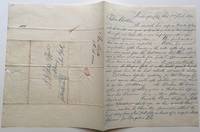
1840Best.-Nr. 273086Washington 1840. unbound. 2 pages front and back 10 x 8 inches written by George Folts of Washington City to his brother James at Albany New York October 3rd 1840 concerning their misguided notion that Martin Van Buren the Democratic Party nominee for President would win the State of Ohio in the Presidential election despite the fact that his Whig opponent William Henry Harrison resides there in part: ".We have assurances from the best sources that Ohio will be ours in November.at all events from present appearances our chance seems much the best. All eyes are turned towards the Empire State it is the battle ground if she will prove true to her best interests and all will be well. Mr. Durham the bearer of this formerly of Albany now a Clerk in this office leaves tomorrow. He is a clever fellow and a good Democrat." Note: George Folts received his Clerks job in Washington through the patronage system. Usual folds plus some pencil underlining; very good- condition. "We have assurances from the best sources that Ohio will be ours in November" unknown books
1868Best.-Nr. 252282Washington: Union Republican Congressional Committee 1868. First. pamphlet. very good-. Stewart and Nye of Nevada Delivered in the United States Senate.July 9th and 10th 1868 on the bill offered by Senator Edmunds of Vermont to regulate the counting of the Electoral Vote. 8pp. in double columns. 8vo one sheet folded into 8 pages light foxing to margins otherwise very good. Washington: Union Republican Congressional Committee 1868. First Edition. Speeches that are pro-Republican and pro-Union. The speeches advocate that the Democratic Party is in favor of Southern rights and not hard enough on the South in enforcing Reconstruction. Sabin 51020 Union Republican Congressional Committee unknown books
Best.-Nr. 205133unbound. very good. Below are printed the names of the Presidential Electors and Republican statewide candidates from Connecticut for the election of 1884. Included are the successfully elected candidates for Governor and Lieutenant Governor Henry B. Harrison and Lorrin A. Cooke. N.p. 1884. Very good unknown books
Best.-Nr. 179321First Edition. 20pp. 8vo disbound; browning to text. Philadelphia: John Binns 1812. The Committee of Correspondence consisted of Republican Pennsylvanian state legislators. Address is for the re-election of James Madison and against the candidacy of De Witt Clinton. Last page lists the names of the Pennsylvania Electoral Ticket. S&S 25254. unknown books
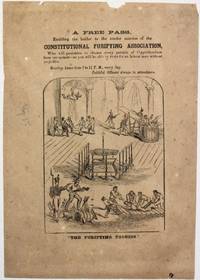
1864Best.-Nr. 40035np 1864. Broadside 6.25" x 9" with two-thirds of the sheet consisting of a wood engraving entitled "The Purifying Process." Toned with a few short blank edge chips. Good. This scarce political broadside mocks the Copperheads who opposed the Lincoln Administration and the Civil War. The broadside depicts humorous rituals imposed on the Copperheads designed to purge Copperhead-ism from their natures. Weitenkampf and OCLC call this an 1864 broadside with the Lincoln-McClellan election the subject of this piece. Weitenkampf page 140. OCLC 14137917 4- Lincoln Presidential Library Brown U IL Princeton 1360327631 1- DLC 1085916488 1- AAS as of May 2024. unknown books
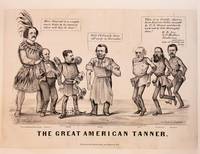
1868Best.-Nr. 36501New York: Currier & Ives 1868. Lithograph illustrated broadside by Currier & Ives oblong 11" x 15-1/2". Matted. Light dusting Near Fine. Cartoon characters identified by name; in lower right corner "on Stone by Cameron." John Cameron was a talented artist employed at Currier & Ives. In lower left corner "Thos. Worth. Sketch." Worth designed many cartoon broadsides for Currier & Ives. "An election-year cartoon invoking both Grant's humble beginnings as a tanner and his successful Civil War military career. Popular New York governor John Thompson Hoffman dressed as an Indian the 'Great Sachem of Tammany' presents Democratic candidates Horatio Seymour and Francis P. Blair Jr. to Grant. He addresses Grant 'Here General is a couple more hides to be tanned when will they be done' Grant smokes a cigar and wears the leather apron of a tanner rolled-up sleeves exposing his muscular arms. He replies 'Well I'll finish them off early in November.' "At right corner former Confederate generals Robert E. Lee Simon Bolivar Buckner and John C. Pemberton hold their rumps and hop about in pain. They announce 'This is to Certify that we have had our hides tanned and that the work was by him thoroughly done." Reilly AAS's entry asserts "Issued well before 1868 election." Reilly 1868-11. Weitenkampf 159. OCLC 191119896 1- Villanova 1136555720 1- AAS as of October 2024. Currier & Ives unknown books
1989Best.-Nr. 272186Philadelphia: POPEC 1989. Six panel brochure folded to 3.5x8.5 inches Q&A format purpose & goals very good. POPEC unknown books
1934Best.-Nr. 10852New York: the Committee 1934. Pamphlet. 23p. staplebound pamphlet toned minor closed tears otherwise good condition 4x6 inches. the Committee unknown books
Best.-Nr. 4023S.l.:: s.n. Single sheet printed on one side only folded horizontally then vertically to business-letter size Contents—8 pp including self covers. Page. 1 Portrait of Mr.& Mrs. Nixon; pp. 2/3 blank; p. 4 “Give California a Decisive Leader!”; p. 5 “Luncheon”—choice of three hot entrées; 3 Salads and 3 Sandwiches; pp. 6/7 blank; p. 8 “Win with Nixon!”Nixon was running against Pat Brown the incumbent who won the election. Nixon famously blamed the press for being biased in Brown’s favor and commented that that it was his "last press conference" and "You won't have Nixon to kick around anymore." In 1968 Nixon was elected President! S.l.:: s.n.,. unknown books
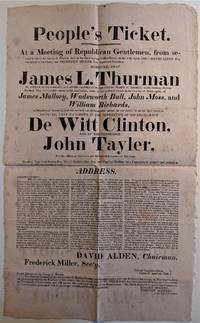
1820Best.-Nr. 703Caldwell New York 1820. Folio broadside. 465 x 280mm. 18" x 11 inches. Folded in quarters couple of tiny separations along folds. Lightly toned moderately foxing. An attractive untrimmed copy. Signed in type by David Alden and Frederick Miller Chairman and Sec'y of the meeting respectively as well as by members of the Republican Central Committee at conclusion. A handsome broadside utilizing a good deal of large bold type. Warren County is situated north of Glens Falls on the eastern border of New York encompassing almost all of Lake George. Caldwell N.Y. now the village of Lake George at the foot of the lake was for a time the county seat of Warren Co. It had a newspaper from the eighteen-teens and separate imprints from as early as 1820. The Lake George Coffee House served as the first county court and the Republican i.e. Democratic Central Committee had its office in Caldwell. Not in OCLC or American Imprints for 1820. unknown books
1852Best.-Nr. 18550np. 1852. Disbound with some loosening 8pp. Printed in double columns. Caption title as issued. Light tan and wear Good. An attempt to tar General Winfield Scott the Whigs' 1852 presidential candidate with abolitionism; and to promote Franklin Pierce who by contrast is "devoted to the constitution and defended the rights guarantied by that sacred instrument." The Whigs have pandered to the extreme abolitionists the Liberty Party crew and seek to "absorb the friends and followers of James G. Birney and Wendall sic Phillips into the bosom of the whig party which is now under the leadership of Wm. H. Seward who will be the controlling spirit of the government should General Scott be elected." Birney Phillips and Seward were of course anathema to southerners and indeed to many northern Whigs and Democrats who did not wish the slavery issue to threaten the maintenance of the Union. FIRST EDITION. LCP 11125. Not in Sabin Miles Eberstadt Decker. unknown
1848Best.-Nr. 70790Richmond VA 1848. Printed Whig party electoral ticket 6 ½ x 3 ¾ inches the text enclosed within a double-thin rule border. OCLC locates two copies Virginia Library of Virginia. Very good. unknown
2016Best.-Nr. x-1358261946Palala Press 2016. Hardcover. New. 220 pages. 6.14x0.56x9.21 inches. Palala Press hardcover
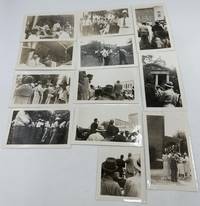
1938Best.-Nr. 70032Winder GA 1938. This rally at least in part involved the primary challenge of Eugene Talmadge to incumbent U.S. Senator Walter George a portion of a poster for Talmadge is pictured in one photo; George was eventually re-elected handily as was Governor Eurith Rivers. "Georgia / 1938" in pencil on verso of one photo the business sign for J. L. Saul Co. clearly pictured in another. Very good lot. unknown
1860Best.-Nr. 69456NP: np 1860. Narrow printed broadside 26 x 10 cm. Edge tears repaired on verso with Japanese paper. Claiborne F. Jackson won the Governorship of Missouri and began his term of office in January 1861. The debate over whether Missouri would secede from the Union began shortly after he took office and he aligned himself with the Confederacy. The state legislature vacated his election and a provisional governor was appointed to replace him. Jackson and his supporters removed to Arkansas after the Battle of Pea Ridge. see: his brief biography on the Missouri State Archives Digital Heritage site. np unknown
Best.-Nr. A9780366299065Hardback. New. hardcover
Best.-Nr. A9780267092628Hardback. New. hardcover
2002Best.-Nr. x-0815706316Brookings Inst Pr 2002. Paperback. New. 358 pages. 9.00x6.00x1.00 inches. Brookings Inst Pr paperback
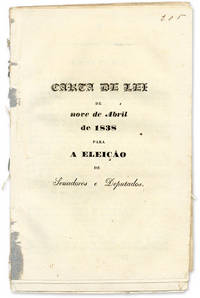
1838Best.-Nr. 609821838. Portugal Election Law. Carta De Lei De Nove De Abril De 1838 Para E Eleicao de Senadores E Deputados Half-title. Porto: Imprensa Constitucional 1838. 33 pp. Folding table. Disbound stab-stitched pamphlet. Light toning foxing to a few leaves early hand-lettered page numbers to upper corners of leaves. $75. The Portuguese law of 1838 governing national elections containing 92 articles with numerous statistical tables relating to district representation. unknown
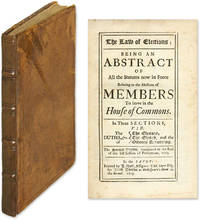
1713Best.-Nr. 539311713. London 1713. 2d ed. London 1713. 2d ed. Scarce Eighteenth-Century English Treatise on Election Law Election Law. Great Britain. The Law of Elections: Being an Abstract of All the Statutes Now in Force Relating to the Election of Members to Serve in the House of Commons: In Three Sections Viz. The Duties &c. of the Electors The Elected And the Officers Returning. London: Printed for J. Nutt Assignee of Ed. Sayer Esq. for Jacob Tonson 1713. vi 126 6 21 3 pp. Half-title lacking. Octavo 6-1/2" x 4". Contemporary sheep blind frames and fillets to boards raised bands to spine rebacked retaining original backstrip hinges mended. Some rubbing with wear to corners a few large scuffs to boards. Toning to portions of text light foxing to a few leaves internally clean. $150. Second edition "continued to the end of the last session of Parliament 1713" which adds an addenda to the first edition of 1708. It was one of the earliest books on the subject. According to Sweet & Maxwell the first studies were Freedom of Elections to Parliament 1680 and Observations Concerning the Regulation of Elections for Parliament 1689 a work attributed to the Earl of Shaftsbury. OCLC locates 6 copies 3 in North America at the Library of Congress Harvard Law School and Stanford University. The ESTC locates 9 copies 8 in Great Britain 1 in North America at the University of Indiana. Sweet & Maxwell A Legal Bibliography of the British Commonwealth 1:151 20. English Short-Title Catalogue ESTC T108633. unknown