1,373 results
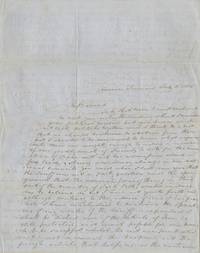
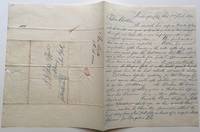
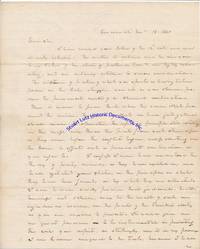
ref. 5149PRESIDENTIAL ELECTION OF 1840. ALS. 2pgs. November 18 1840. Cincinnati Ohio. An autograph letter signed J Burnet by Ohio lawyer and politician Jacob Burnet 1770-1853. It is addressed to James Dunlap of Pittsburg. Burnet replies to Dunlaps letter stating his concerns about Pennsylvania politics in light of the recent 1840 Presidential election in which William Henry Harrison defeated Martin Van Buren. Harrison would die only a month into his Presidency. Mentioning a schism at one point Burnet seems to anticipate the national divide that would eventually lead to the American Civil War although this may have referred to economic issues rather than the question of slavery: Dear Sir I have received your letter of the 12th inst and read it with interest. The matter it containsthe view you have taken of the state of parties in Penna are highly interesting and are certainly entitled to serious consideration. The mixture of parties of which you speak as having taken place in the late struggle can not as you observeThere is reason to fear that when the cause whichthe union the fruits of which we have just gathered shall warn so often at the repelling principlewill throw the parts from each other as far as they win before the conflict began unless something can be done to effect such a permanent combination as you refer to. I confess I now have understood the theory of partyas they have existed in and have agitated your state or the principles on which they have been found or by which they areI can however easilyschism may be the result of such an injudicious course on the part of theyou are anxious to prevent. It would give mow me great pleasure to be instrumental in preventing the wit you depict so strikingly were it in my power. I was known unequal to the task because I have no claims to the confidence of the General beyond those of his friends generally not because in addition to this I could not point him to the parties or the persons as to whom he ought to be on his guard. A frank communication from a confidential friend in Penna who understands the whole subject would receive the attention it deserves. An intelligent Pennacan communicate the specific information necessary to show him the danger and the mode of avoiding it. Advice or caution in a care like this to have its proper influence should come from the power of information. Your views on the subject of claims founded on services rendered in the late political contest are precisely those I entertain and express on all occasions and I have reason to believe the General looks on the subject though the same medium and views it in the same light. If our motives have been patriotic our labor has been done for the country and success is our only legitimate reward. If they have been personal they are not praiseworthy and ought not to be rewarded. I am confident that president elect views the matter in that light and that he does not feel personal obligations to any body on account of no part taken in the contest. If this be not so I have very much misunderstood his character. Yours very respectfully J Burnet. The letter is in very good condition with a loss to the back page that does not affect any content. A reminder of the eternal contention and controversy in American political elections. unknown books
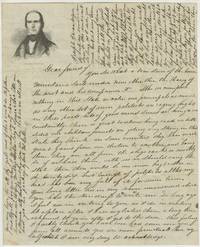
1844ref. List3860N.p. 1844. Folded letter on Henry Clay campaign lettersheet with portrait of Clay and printed caption: "And Frelinghuysen." Addressed to Mr. Joseph Griswold Benson Rutland County Vermont. Blue circular postmark and manuscript postage. Milgram No. HC-2 with listing example illustrated in James W. Milgram's Presidential Campaign Illustrated Envelopes and Letter Paper 1840-1872 p. 41. Light toning to address panel minor fold flaws; very good. A long 1844 letter from T. W. Goodrich to Joseph Griswold written on a Henry Clay campaign lettersheet during the presidential contest between Clay and James K. Polk. The printed lettersheet shows Clay's portrait with the caption "And Frelinghuysen" referring to Theodore Frelinghuysen Clay's Whig running mate. The letter opens with direct campaign content identifying the writer as a supporter of "the Harry of the West and his companion F-": "You see what a true Son of the Green Mountains sails under none other than the Harry of the West and his companion F-. Altho we accomplish nothing in this State we value our principals as much as any other set of men. Politics are raging high in these parts. Bets of good round sums are being made constantly. There is great exertions being made on both sides." Goodrich then gives the letter its strongest political passage complaining that abolitionists were gaining strength and drawing support away from the Whig ticket: "Our abolition friends are getting very strong in this State. They think in some counties they have made great gains from one election to another and hang them they are all from the Whig ranks or mostly so. If we had them with us we should carry the State. Then there would be one more bright star in the twenty six." The remainder of the letter turns to family visits courtship gossip local marriages schoolteaching music lessons and delays in correspondence. Goodrich teases Griswold about his interest in "Say" or Sarah closing with the advice to "not sigh oftener for her than she does for you. Sigh not but act." A good 1844 campaign lettersheet combining a printed Clay-Frelinghuysen design with manuscript political content on the Whigs abolitionist defections and the electoral consequences of antislavery politics. . unknown books
1845ref. List3867Hanover Furnace New Jersey 1845. 3 pp autograph letter signed "Richard Jones" written on an embossed Henry Clay campaign lettersheet from the 1844 presidential election. Letter written on Henry Clay lettersheet identified as HC-9 in Milgram's reference on presidential letterhead. 8 ¼ x 10 ½ inches. Some small tears to final page intersecting with text; else Near Fine condition. A strong post-election Whig letter written shortly before James K. Polk's inauguration discussing Texas annexation slavery the tariff manufacturing and the defeat of Henry Clay. Jones writes to a friend whose "political heresies" he rejects asking what could have induced "a member of our goodly society of Friends" to support annexation. His objection is not only to territorial expansion but to the political consequences of adding Texas to the Union: "will not her admission secure a free trade & slavery ascendency always in our national councils." He then turns to the tariff from the perspective of a furnace operator or manufacturer worrying that repeal would damage his works and the broader market for manufactured goods. The Clay campaign lettersheet is itself part of the letter's content: Jones calls it paper "with the brand of the last campaign upon it" declares himself "a true Whig" and says he may save some sheets until 1848 though he dislikes "that silly looking coon in the corner." Full text follows. "Hanover Furnace Feby 5 1845 Resp. Friend "For by that term I must continue to call you notwithstanding what I consider your political heresies but you know we do not talk politicks together and I think it is best that we should continue to abstain from them but I should like very much to know what arguments there are weighty enough to induce a member of our goodly society of Friends to vote for the annexation of Texas will not her admission secure a free trade & slavery ascendency always in our national councils. You said when I last saw you that the tariff was not a party question and the open ground that the advocates some of them in this part of the country of I or V. Polk would induce me to believe so but I have not quite found so and although contrary to the advice of some of my friends I have concluded to continue the operations of my works if the tariff is repealed I shall be dished even if the article of is still protected as it is not possible for one branch to be successful whilst the rest are prostrated as it is not so much the keeping out the foreign article that helps us as the customers that general prosperity enables to consume the article manufactured. I did not sit down to write a political letter but would like your judgment with regard to the course which will be pursued by the next administration & congress with regard to the Tariff. "I do not think it requires an apology from me for writing to you upon paper with the brand of the last campaign upon it for you know me to be a true Whig and as such shall keep my Banner flying to the last. I am come of a Welsh tribe who have never been conquered and I think of keeping a few of these sheets until 48 although I do not like that silly looking coon in the corner and I hope by that time that nothing but sterling argument will be used and our congressional candidates will be forced to stump it face to face but I will not tire you with my foolishness. I cannot give you much information as to the tone of Public conversation but I never knew any matter of great importance to be before congress that has excited so little feeling as the annexation of Texas there is not one man in twenty that knows any thing about it. The Whigs beaten and disappointed feel themselves powerless for the present and do not think it worth while to agitate themselves about things they cannot help but let me assure you that they feel themselves only beaten but not conquered and when the occasion comes they will raise in their might mighty and woe unto those who legislate for any other view than the good of their country. But I am like a lady I have come to the postscript before I begin to write about what I commenced for. Mr. Spencer says you have been making some enquiries about some Atkins claims upon McDonald Branch and I have promised Black that I will commence proceedings against him as soon as I have your opinion now if you have formed one upon the subject let me have it if not will you give it your attention when you come home and can also devote some time to the Polebridge affair in the Spring. I am very desirous that should be settled as well as some other things and you are the only man that can do it for me.I remain as I always have been and always hope to be your personal friend Richard Jones" An interesting letter from the aftermath of the 1844 election with unusually direct content on Texas annexation slavery free trade tariff protection and Whig political identity. The letter is also a good use of campaign stationery: Jones not only writes on a Henry Clay lettersheet but comments on the "brand of the last campaign" the Whig "Banner" and the campaign imagery itself. . unknown books
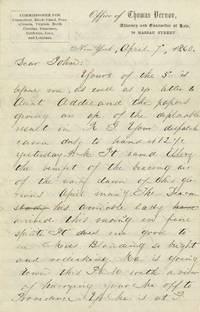
1860ref. List38104New York City 1860. Autograph letter signed "W." to "Dear John" written on the printed letterhead of Thomas Vernon attorney Nassau Street New York. 4 pp. on a single 8 x 10 inch sheet folded to make four pages of approximately 8 x 5 inches. Fine condition. An April 1860 political letter written in the months before the presidential election with the writer discussing the recent Rhode Island election and the way it was being read in New York. The letter refers to the April 4 1860 Rhode Island gubernatorial election in which William Sprague IV running as a Democratic/Conservative fusion candidate defeated Republican Seth Padelford. Outside Rhode Island the result was read by many as a meaningful Republican setback in the tense months before the presidential election. The author describes the result as producing "a profound sensation" among Democrats and Republicans and worries that outside Rhode Island it appeared as though "New England sentiment was faltering" on the "non-extension of Slavery." The letter also includes family news travel to Providence and Perth Amboy and legal/business matters relating to Ohio notes and accounts. Full text follows. "New York April 7th 1860 Dear John: "Yours of the 5th is before me as well as your letter to Aunt Addie and the papers giving an a/c of the deplorable result in R.I. Your despatch came duly to hand at 12-1/2 yesterday P.M. It saved Ellery the benefit of the bracing air of the early dawn of this glorious April morning. The Deacon & his amiable lady arrived this morning in fine spirits. It does me good to see Miss. Blanding so bright and rollicking. Ma is going down this P. M. with a view of hurrying your Ma off to Providence. Your Ma is at P. Amboy and I do hope she will go on to Prov. She has been subjected to too much wear and tear and anxiety & looks very much worn and depressed. She needs some cheerful faces and absence from constant and present trouble. I wish I could see some opening in the clouds. When I reflect upon the sorrows and exalted natures of Uncle Thomas and Aunt Addie it confers upon me the truth of another state where worth and purity will find reward. I do not think that Aunt Addie carries out however her favorite idea of the claims of parents as paramount to those of children. I think that she practically ignores her own claims or regards them as altogether subordinate. She has never given herself a chance and acts with a single view to the views of her children. "The news of the R.I. Election created a profound sensation here on Thursday morn'g. The joy of the Democrats was unbounded while the Republicans regarded it as the severest blow that their party has rec'd more disastrous than the national defeat of /56; for it looks to the County at large who do not understand the local issues upon which the contest went off as the New England sentiment was faltering in its devotion to the cause of non-extension of Slavery. "It is everywhere out of R.I. heralded as a Democratic triumph & hence inspires the Democrats while it depresses the Republicans. I hope that those deluded Republicans who voted for Sprague under the apprehension that they were not voting practically for the Democracy may be at some time able to forgive themselves and also receive the forgiveness of their country after due penance and probation. I am much obliged to you for the papers. "We are about foreclosing some of those Ohio notes and the delay is now caused by my inability to discover whether James Gregory's Thos. Bowen's & Anthony R. Jenkins' notes to your Father are paid or how much is paid on a/c of said notes. Do write me at once all you know. Uncle T. knows nothing about it. I have just rec'd the expected remittance from Brown on ac of the new sale of the 80 acre lot but have not yet Ex'd B's a/c. He says it took him all day to make it out and he hopes it is satisfactory. An a/c from Brown is a wonder indeed worth remarking. Do keep Aunt Addie a month. My love to Addie whom I hope to see soon. G.T.O. has gone to Newport 'via' Boston today. I saw Slater at the 5th Ave. Hotel on Thursday. Ma has just gone to P. Amboy. Aff'y W." A useful prewar political letter strongest for the writer's immediate reaction to the Rhode Island election of 1860 as understood from New York. Its interest lies less in the local election itself than in the way the result was taken as a national sign encouraging Democrats and discouraging Republicans over the issue of slavery's extension. . unknown books
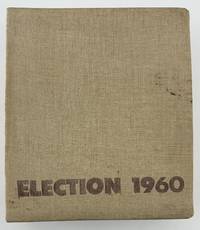
1960ref. 4337Various locations in and around Chicago Il: likely early November 1960. Very good plus. Title leaf plus 25 leaves illustrated with forty-seven silver gelatin photographs pasted one per leaf or page all about 5.5 x 7.5 inches plus five loose images two duplicates and three other images not pasted in. Square quarto. Contemporary tan cloth custom photograph album metal-hinged spine front cover printed with title reading "ELECTION 1960." Minor wear and soiling to album. Light occasional thumb-soiling to album leaves ownership signature reading "G. Robert Hillman" on title leaf. Photographs in excellent condition. An utterly charming vernacular photograph album assembled during the seminal Presidential Election of 1960 one of the closest presidential elections in United States history which pitted Vice President Richard Nixon against the junior Senator from Massachusetts John F. Kennedy. The album features about fifty original photographs on the campaign trail in Illinois beginning with about a dozen-and-a-half images of Richard Nixon and his local supporters. The photographs capture various angles of Nixon during his stump speech a young boy waving an "I'm for Nixon" handmade sign another young boy with a Nixon button on his coat crowd scenes a large campaign sign for Nixon-Lodge outside a local store and more. One image featuring a mixed crowd of Nixon and Kennedy supporters transitions into the next section of photographs which concentrates on JFK's campaign. The first image in this section is a closeup of a "Kennedy for President" hat followed by four images of JFK's campaign manager Robert Kennedy making a speech three images of Eleanor Roosevelt stumping for Kennedy five images of Lyndon Johnson and his airplane numerous shots of Kennedy supporters and crowd shots outside Chicago Blackhawks stadium. The photographs then feature the inside of Chicago Auditorium where the first three images depict John F. Kennedy - the first shaking hands with Chicago's longtime Mayor Richard Daley and two during his speech likely his speech of November 4 1960 - just four days before Election Day. The final three images show supporters of both candidates. The 1960 United States Presidential Election was a watershed moment for the campaign politics of the country. Senator Kennedy won the election with a clear Electoral College margin of 303 to 219. However Vice President Nixon won three more states than Kennedy and lost the popular vote only by about 110000 votes out of more than 68 million votes cast. The election set the course for most of the remainder of the 1960s but left Nixon soured and suspicious that the election had been stolen from him - a feeling he never let go and one with ominous echoes today. As indicated in the present album the 1960 presidential election was passionate on both sides with each candidate drawing large enthusiastic crowds for their appearances. The signature on the title leaf of the present album likely identifies the compiler. G. Robert Hillman is a Senior Editor for Politico. Hillman was born in Peoria and grew up on a farm near Flanagan Illinois about a hundred miles from Chicago. He went to college at the University of Illinois at Urbana-Champaign and began his career at Chicago Today and the Chicago Sun-Times. Hillman would have been in middle school during the 1960 election campaign not too precocious for a young man obsessed with politics especially during one of the most heated and media-intensive campaigns of the 20th century. likely early November unknown books
1856ref. 41369Albany NY: Comstock & Cassidy 1856. First edition. Self wrappers. A very good copy with a fold removed from a bound volume; small tears along fore edge. Unpaged 4 pp. 27 1/2 x 21 1/4 inches. Supports the Democratic Party. Extensive coverage of the 1856 elections with large ad for James Buchanan for President and John C. Breckinridge for Vice President. Also notice for the sale of Delaware Indian Lands at Fort Leavenworth Kansas Territory moving the sale until the 17th of November with a list of tracts. Comstock & Cassidy unknown books
1852ref. 43708Boston: Beals Greene & Co 1852. First edition. Stitched self wrappers. A very good copy scant foxing to wrappers vertical mail fold. 24 pp. Two columns. 8vo. At head of title: From the Boston post. Written in response to rumors and allegations from the Whig party that Franklin Pierce was religiously intolerant especially aimed at Irish Catholics. "in American political contests the searching questions ought to be ever as to a candidate ’Is he honest is he capable Is He Faithful to the Constitution’ while an approach to any thing like the popery cry of the British Tory party or an appeal to a sect as such ought to be severely denounced as violative of the spirit of our institutions." Also includes "vote of the towns" the convention of 1850 and the religious test amendments of the Constitution concerning religion Catholic sentiment and more. Not in Miles. Not in Sabin. Beals, Greene, & Co unknown books
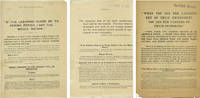
1894ref. 43553n.p.: Hartman & Cadick 1894. First editions. Self wrappers. Good to very good. 8 pp. 8 pp. 8 pp. 8vo. The mid-term elections of 1884 were a disaster for the Democrats led by Grover Cleveland. Republicans and Populists in large part due to the efforts of Joseph Weeks Babcock 1850-1909 a Republican Congressman from Wisconsin who helped organize the Republican Congressional Campaign Committee in 1893 and was a major force in routing the Democrats in the 1894 House elections which cost the Democrats 113 of their 218 seats. They are most likely printed by Hartman & Cadick Republican printers. All follow the same format of quoting leading figures and using bold face type. 1: Caption title "If the Laboring Class be to Perish I Say the Whole Nation." A the head of the title: No. 1 - From the Congressional Record. The caption title is from the English Reformer William Cobbett followed by "You cannot reduce the laborer to a state of starvation and degradation without also destroying national prosperity" a quote from Joseph Norton Dolph 1835-1897 Senator from Oregon from one of his many speeches quoted here. OCLC locates only a single copy at the Rutherford B. Hayes Presidential Center. A very good copy docketed on front wrapper mail fold. 2: Caption title "The industrial side of the tariff controversy must not be overlooked. The four millions of people who work in our factory system are the most potent factors outside of agriculture in our civilization." - Hon. J. W. Babcock Wisconsin. A the head of the title: Record No. 3. Apparently unrecorded. We could find no copies in OCLC NUC or other reference sources. Chip to front wrapper else very good with docketing stamp. 3: Caption title "When you Rob the Laboring Men of their Employment you Rob the Farmers of their Customers." The quote from the caption title belongs to Charles Curtis 1860-1936 Republican from Kansas who would go on to become Hoover's Vice President. OCLC locates one copy at the Western Reserve Historical Society Library. A good copy browned some minor chipping docketing stamp on front wrapper. [Hartman & Cadick?] unknown books
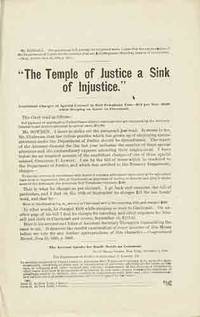
1888ref. 37352n.p.: n.p. 1888. First edition. Self wrappers. A very good copy. 4 pp. 8vo. First section title reads "Exorbitant Charge of Special Counsel in Bell Telephone Case - $75 per day - $100 while Sleeping en Route to Cincinnati." Goes on to accuse the Department of Justice of rights violations and cronyism. "The Citizen and his rights trampled upon in every direction through processes of law." Extensively quotes Samuel Jackson Randall 1828-1890 Democratic member of the United States House of Representatives from Pennsylvania whose power was waning at the time. OCLC locates only two copies: Library of Michigan and the Wisconsin Historical Society. n.p. unknown books
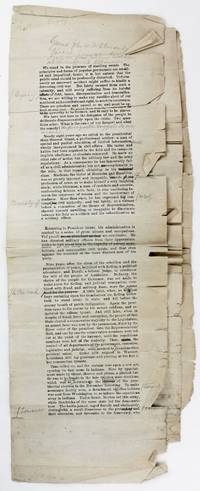
1877ref. 5770N.p. likely Springfield Il: ca. January 8 1877. Good. Three long galley leaves each approximately 6.5 x 19 inches and printed on rectos only with numerous pencil emendations. Old folds and creases numerous chips and tears to margins pervasive wrinkling making reading a bit challenging at times but with no loss to text. Small portion of third leaf containing the last eight lines of text detached but present. Not in great shape but seemingly unique. A galley proof of a speech by General John A. McClernand in the midst of the contentious Election of 1876 which was so far as we can determine neither delivered nor published. A pencil note at top reveals his authorship and notes the speech was intended to be delivered January 8 at the “Great Citizens Convention” in Springfield Illinois almost certainly in 1877 following the recent election in the Fall of 1876. McClernand was an Illinois contemporary of Lincoln's a Democratic Congressman and War Democrat. He was also an ally of another Illinois politician and Lincoln adversary Stephen A. Douglas. He was appointed a general during the Civil War largely through political maneuvering and was generally considered incompetent. McClernand greatly resented the authority of Grant who finally relieved him of command in June 1863. Following the war McClernand became a leading critic of Congressional Reconstruction as well as the Grant Administration in general. He also chaired the 1876 Democratic National Convention which nominated Tilden for the presidency. Here McClernand bitterly attacks Grant his presidential Administration and Reconstruction. According to McClernand Grant's "tastes and habits had been acquired in the field and the camp -- in implicit obedience or absolute command. He knew no other rule of action but the military law and army regulations. As a consequence he has lamentably failed as a civil administrator." As President fraudulently and illegally Grant "joined with Kellog a political adventurer and Durell a federal judge to overthrow the will of the people of Louisiana." Law and order says McClernand "lay prostrate and panting at the feet of her remorseless tyrants." McClernand also assails Grant's highhanded tactics in the other Southern States. Now says McClernand "the president and his accomplices have now applied themselves to defeat the will of the people by a parliamentary device. They claimed for the President of the Senate the right and power to count the electoral votes and to declare the result and by implication that that right and power would be so exercised as to count Tilden out of his election and to count Hayes into one." He wasn't wrong. In one of the closest most hotly-contested and highly-controversial elections in American history to put it simply Hayes effectively stole the election by agreeing to remove northern soldiers from the South and end Reconstruction. It would be interesting to know what McClernand thought of the ultimate result -- he didn't get Tilden but he did get the end of Reconstruction. "Yet another prominent Illinoian who played a role in the Civil War John Alexander McClernand was born in Breckinridge County Kentucky before moving to Shawneetown Illinois at a young age. Similar to fellow Illinoian Abraham Lincoln McClernand was a largely self-taught lawyer who began practicing in Shawneetown in 1835. Also like Lincoln McClernand served in the Black Hawk War. However McClernand was a staunch Democrat. In 1835 he established the newspaper Shawneetown Democrat. He was active in Democratic politics at both the state and federal level serving in the Illinois House of Representatives and eventually Congress. In Congress McClernand was a stalwart Jacksonian Democrat who strongly disliked abolitionists. He strongly opposed the Wilmot Proviso which banned slavery in the territory gained after the Mexican-American War. He became a key ally of fellow Democrat and Illinoian Stephen A. Douglas helping him pass the Compromise of 1850. As tensions rose approaching the election of 1860 McClernand campaigned for Douglas’s presidency and became a Unionist. After war broke out in the following April McClernand helped raise volunteers for the Union Army. Because Lincoln needed to retain a wide base of support and retain connections with Democrats in Illinois he appointed McClernand a brigadier general on May 17 1861. McClernand’s military career would be defined by an ongoing clash with fellow Illinoian General Ulysses S. Grant. Grant a seasoned West Pointer who served in Mexico was irritated by McClernand a political general with little military experience. Further exacerbating relations was McClernand’s tendency to boast about his exploits and diminish the achievements of other commanders" - American Battlefield Trust's entry on John A. McClernand. ca. January 8 unknown books
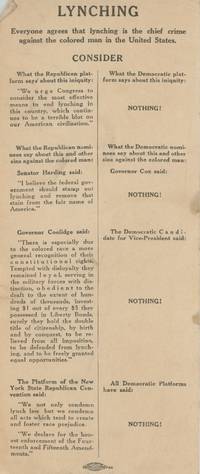
1920ref. List2706Chicago or New York 1920. 6 x 9 inches single sided. Toning several small stains small fold at top left corner; near fine. An anonymous handbill decrying lynching in the United States and advertising the differences in anti-lynching policy between the Republican and Democratic parties. The header states that “Everyone agrees that lynching is the chief crime against the colored man in the United States” and the remainder illustrates the great disagreement over just what to do about it. The left column quotes the Republican platform and its then-nominees Warren G. Harding and Calvin Coolidge who would shortly be elected to office on their support for federal anti-lynching legislation. The right column points out that the Democratic platform and its nominees James M. Cox and Franklin D. Roosevelt all “said: NOTHING!” on this issue. Lynching would not be made a federal hate crime until 2022 nearly 100 years later. As of writing we find no other copies of this handbill in OCLC. unknown books
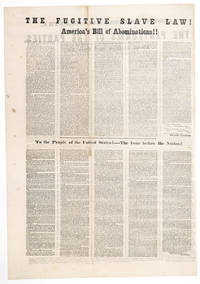
1852ref. 27980Boston Fugitive Slave Law Printing on Free Soil Party Broadsheet "a vote for either of the former candidates is as truly a vote in favor of the sustenance defence and encouragement of American slavery in all its hideousness as a vote for the devil were a vote in favor of sin…" This broadsheet prints a summary of the three major party platforms—the "Compromise Democratic" Party the Whig Party and the Free Democratic Free Soil Party—headed with the injunction to "Read Reflect and then Act!" The second page includes the text of the Fugitive Slave Law or "America's Bill of Abominations!!" passed in September 1850 and an editorial by "Alexander" that explains the benefits of the Free Soil Party over the other two parties. ELECTION OF 1852. FUGITIVE SLAVE LAW. Printed Broadsheet Boston Commonwealth Extra July 1852. 2 pp. 25½ x 22 in. Excerpts "The Platforms of the Parties. Read Reflect and then Act!" p1 "The Fugitive Slave Law! America's Bill of Abominations!!" p2 "…Section 6 And be it further enacted That when a person held to service or labor in any State or Territory of the United States has heretofore or shall hereafter escape into another State or Territory of the United States the person or persons to whom such service or labor may be due or his her or their agent or attorney duly authorized by power of attorney in writing acknowledged and certified under the seal of some legal officer or court of the State or Territory in which the same may be executed may pursue and reclaim such fugitive person either by procuring a warrant from some one of the courts judges or commissioners aforesaid of the proper circuit district or county for the apprehension of such fugitive from service or labor or by seizing and arresting such fugitive where the same can be done without process and by taking or causing such person to be taken forthwith before such court judge or commissioner whose duty it shall be to hear and determine the case of such claimant in a summary manner; and upon satisfactory proof being made by deposition or affidavit in writing to be taken and certified by such court judge or commissioner or by other satisfactory testimony duly taken and certified by some court magistrate justice of the peace or other legal officer authorized to administer an oath and take depositions under the laws of the State or Territory from which such person owing service or labor may have escaped with a certificate of such magistracy or other authority as aforesaid with the seal of the proper court or officer thereto attached which seal shall be sufficient to establish the competency of the proof and with proof also by affidavit of the identity of the person whose service or labor is claimed to be due as aforesaid that the person so arrested does in fact owe service or labor to the person or persons claiming him or her in the State or Territory from which such fugitive may have escaped as aforesaid and that said person escaped to make out and deliver to such claimant his or her agent or attorney a certificate setting forth the substantial facts as to the service or labor due from such fugitive to the claimant and of his or her escape from the State or Territory in which he or she was arrested with authority to such claimant or his or her agent or attorney to use such reasonable force and restraint as may be necessary under the circumstances of the case to take and remove such fugitive person back to the State or Territory whence he or she may have escaped as aforesaid. In no trial or hearing under this act shall the testimony of such alleged fugitive be admitted in evidence; and the certificates in this and the first fourth section mentioned shall be conclusive of the right of the person or persons in whose favor granted to remove such fugitive to the State or Territory from which he escaped and shall prevent all molestation of such person or persons by any process issued by any court judge magistrate or other person whomsoever. Section 7 And be it further enacted That any person who shall knowingly and willingly obstruct hinder or prevent such claimant his agent or attorney or any person or persons lawfully assisting him her or them from arresting such a fugitive from service or labor either with or without process as aforesaid or shall rescue or attempt to rescue such fugitive from service or labor from the custody of such claimant his or her agent or attorney or other person or persons lawfully assisting as aforesaid when so arrested pursuant to the authority herein given and declared; or shall aid abet or assist such person so owing service or labor as aforesaid directly or indirectly to escape from such claimant his agent or attorney or other person or persons legally authorized as aforesaid; or shall harbor or conceal such fugitive so as to prevent the discovery and arrest of such person after notice or knowledge of the fact that such person was a fugitive from service or labor as aforesaid shall for either of said offences be subject to a fine not exceeding one thousand dollars and imprisonment not exceeding six months by indictment and conviction before the District Court of the United States for the district in which such offence may have been committed or before the proper court of criminal jurisdiction if committed within any one of the organized Territories of the United States; and shall moreover forfeit and pay by way of civil damages to the party injured by such illegal conduct the sum of one thousand dollars for each fugitive so lost as aforesaid to be recovered by action of debt in any of the District or Territorial Courts aforesaid within whose jurisdiction the said offence may have been committed…" "To the People of the United States!—The Issue Before the Nation!" p2 "We present you this Document for the Campaign in order that its doctrines may be scanned before the minds of men become steeled against the power of just reasoning by the intense zeal and party prejudice of an exciting election. It is a simple and earnest appeal to reason." p2/c1 "The Free Democracy will favor the early policy of the country to limit localize and discourage slavery—the separation of national funds from banking institutions cheap postage a moderate revenue—the election of civil officers by the people—such internal improvements as are national and constitutional—the cordial reception of emigrants and exiles from the old world—the grant of the Public Lands free of cost to landless settlers—the immediate repeal of the Fugitive Slave Law—the recognition of the independence of Hayti—an arrangement in future treaties… "And the said party will oppose the exercise of doubtful constitutional powers—the demand for more slave States new slave territories and the nationalization of slavery—foreign interference with the right of a nation to govern itself." p2/c2 "The intrepid Free Democracy have sought the arena of political strife with a determination to oppose each of these powerful clock-work organizations. They publish a platform which presents a point-blank contrast to either and both the others. They claim the support of the people because their policy is founded in Right and Justice; and because the application of that policy to governmental affairs cannot be secured by the triumph of any other party." p2/c3-4 "While the attitude of the Free Democracy is that of a general championship of the rights of the humbler classes … its position upon the slavery question affords the great contrast and entitles it to the support of the lovers of Freedom and Right." p2/c4 "Whigs and Democrats would sanction slavery by law. The Free Democracy forbid the high-handed endeavor." p2/c4 "It follows that a vote for either of the former candidates is as truly a vote in favor of the sustenance defence and encouragement of American slavery in all its hideousness as a vote for the devil were a vote in favor of sin." p2/c4-5 Historical Background The author of the editorial may have been Alexander De Witt 1798-1879 a former Democrat who joined the Free Soil Party and was one of the six signatories of the "Appeal of the Independent Democrats" in January 1854 in opposition to the Kansas-Nebraska Act. President Zachary Taylor a Whig died in July 1850. His successor Millard Fillmore supported the Compromise of 1850 and enforcement of its stronger Fugitive Slave Law which made him unpopular in the North. At the Whig National Convention in Baltimore the delegates took 53 ballots to choose General Winfield Scott of New Jersey as their presidential candidate. At the Democratic convention also in Baltimore it took 48 ballots to select dark-horse choice Senator Franklin Pierce of New Hampshire as their presidential candidate. The Free Soil Party which opposed the extension of slavery chose Senator John P. Hale of New Hampshire as their presidential candidate. After the Compromise of 1850 many Barnburner Democrats and Conscience Whigs returned to their parties at the expense of the Free Soil Party. With no major policy differences between the Democrats and Whigs the election became a contest of personalities between Scott the anti-slavery war hero of the Mexican War and the pro-slavery Pierce who though eighteen years younger had also served in the war. In the election on November 2 1852 Pierce won 50.8 percent of the popular vote carrying 27 states with 254 electoral votes. Scott's 43.9 percent carried only 4 states with 42 electoral votes. Hale attracted 4.9 percent of the popular vote taking no electoral votes. The Commonwealth 1851-1853 was a newspaper published in Boston daily with occasional supplements under the motto "Circulate the documents." In 1852 it became the official newspaper of the Free Soil Party in Massachusetts. Condition: Very good overall. Boston Commonwealth books
1936ref. 24942This sheet contains five rough sketches of graphics calling on the workers and voters of America to support Franklin D. Roosevelt's reelection in 1936. They did in record numbers. PRESIDENTIAL ELECTION OF 1936. Typed Document Signed. Artwork by Franz Felix and Ideas and Copy by Richard Barron "Set of Rough Sketches Containing Some Suggested Promotion Ideas to be Used in the 1936 Democratic Presidential Campaign" July 2 1936. 1 p. 12 x 10½ in. Excerpts: "1. Sounding the call against 'economic royalists' in the spirit of 1776." "2. Appropriating the well-known symbol of violence upraised fist diverting it to peaceful democratic use. To include the farmer phrase the appeal: TOILERS OF AMERICA – UNITE FOR ROOSEVELT." "3. The statue of 'The Thinker' as a symbol of the man today who thinks the toiler with brawn and brain.everyman." "4. Direct appeal to radical labor and leftists in general." "5. Another way of appealing to the working class men and women." "This collaborative effort respectfully submitted for consideration to the Chairman of the Democratic National Committee Mr. James A. Farley." Historical Background After unseating incumbent Republican President Herbert Hoover in 1932 President Franklin D. Roosevelt ran for reelection in 1936. His Republican opponent was Governor Alf Landon of Kansas. Although the Great Depression had entered its eighth year Roosevelt's New Deal policies were broadly popular. He won the highest share of the popular and electoral vote since the uncontested 1820 election. Roosevelt attracted more than 60 percent of the popular vote and won the electoral votes of 46 states; Landon won the electoral votes of only Maine and Vermont. Democratic Party chairman James Farley had predicted that Roosevelt would lose only Maine and Vermont. After the results of the 1936 election Farley quipped that the nation needed to revise the conventional political wisdom of "As Maine goes so goes the nation" to "As Maine goes so goes Vermont." These ideas for campaign imagery employed or modified common images to support Roosevelt's campaign. One drew on the imagery of artist Archibald Willard's 1875 painting The Spirit of '76 and employed three figures of workers to match the subjects of Willard's image. Another appropriated the upraised fist as a symbol of violence and repurposed it as a symbol of defiant unity against "economic royalists." A third used an image of The Thinker by French sculptor Auguste Rodin 1840-1917 to appeal to thinking voters. Another image appeals to the fears of radicals that the alternative to Roosevelt is "Reaction." Richard Barron and artist Franz Felix submitted these ideas to Democratic National Committee chairman James A. Farley on July 2 1936 three weeks before the Democratic Party held its convention in Philadelphia. There is no evidence that these images were used in the campaign and it is possible that Farley rejected them. At the end of the campaign the Democratic National Committee had a campaign deficit of approximately $850000. To help offset those expenses the treasurer convinced President Roosevelt to sign 2500 brief Forewords which were bound into The Democratic Book 1936 and sent to donors of $250. Purchases brought in more than $400000 for the party and led Republicans to charge corrupt practices for allowing corporations to contribute to the campaign by buying copies. Franz Felix 1892-1967 was born in Vienna Austria and developed an ability as a child to draw portraits in charcoal. He studied portraiture in Vienna and immigrated to the United States shortly after World War I. He settled in San Francisco where he established himself as a portrait artist and commercial illustrator. In the late 1920s he moved to New York and established a studio in the suburb of Spring Valley where he produced book and magazine illustrations. During World War II he painted a series of murals of wartime activities of Spring Valley residents. James A. Farley 1888-1976 was born in New York into an Irish Catholic family. After his father died he helped his mother with a small business to support the family. After graduating from Packard Business College in New York City where he studied bookkeeping and other business skills Farley got a job with the U.S. Gypsum Corporation. He served as a Democratic town clerk in Stony Point New York and became chairman of the county's Democratic Party in 1918. He organized upstate Democrats and helped elect Alfred E. Smith as Governor that year. He served in the New York State Assembly in 1923 but was defeated at the next election for supporting the repeal of Prohibition. As chair of the state Athletic Commission Farley fought for the civil rights of African American athletes. Farley founded he General Builders Corporation from smaller firms to become New York City's largest building supply company. Farley directed Franklin D. Roosevelt's narrowly successful New York gubernatorial campaign in 1928 and his reelection in 1930. Farley served as chairman of the New York State Democratic Committee from 1930 to 1944 and helped build the national New Deal coalition that elected Roosevelt to the Presidency four times. In 1932 Farley became the chairman of the Democratic National Committee and in 1933 U.S. Postmaster General. He held both positions until 1940. Farley and Roosevelt broke on the two-term tradition of the Presidency in 1940 and he later helped propose the 22nd Amendment to the U.S. Constitution limiting a person to two elections as president approved by Congress in 1947 and ratified in 1951. Farley became chairman of the board of the Coca-Cola Export Corporation in 1940 and held that position for more than thirty years. books
1840ref. 273086Washington 1840. unbound. 2 pages front and back 10 x 8 inches written by George Folts of Washington City to his brother James at Albany New York October 3rd 1840 concerning their misguided notion that Martin Van Buren the Democratic Party nominee for President would win the State of Ohio in the Presidential election despite the fact that his Whig opponent William Henry Harrison resides there in part: ".We have assurances from the best sources that Ohio will be ours in November.at all events from present appearances our chance seems much the best. All eyes are turned towards the Empire State it is the battle ground if she will prove true to her best interests and all will be well. Mr. Durham the bearer of this formerly of Albany now a Clerk in this office leaves tomorrow. He is a clever fellow and a good Democrat." Note: George Folts received his Clerks job in Washington through the patronage system. Usual folds plus some pencil underlining; very good- condition. "We have assurances from the best sources that Ohio will be ours in November" unknown books
1868ref. 252282Washington: Union Republican Congressional Committee 1868. First. pamphlet. very good-. Stewart and Nye of Nevada Delivered in the United States Senate.July 9th and 10th 1868 on the bill offered by Senator Edmunds of Vermont to regulate the counting of the Electoral Vote. 8pp. in double columns. 8vo one sheet folded into 8 pages light foxing to margins otherwise very good. Washington: Union Republican Congressional Committee 1868. First Edition. Speeches that are pro-Republican and pro-Union. The speeches advocate that the Democratic Party is in favor of Southern rights and not hard enough on the South in enforcing Reconstruction. Sabin 51020 Union Republican Congressional Committee unknown books
ref. 205133unbound. very good. Below are printed the names of the Presidential Electors and Republican statewide candidates from Connecticut for the election of 1884. Included are the successfully elected candidates for Governor and Lieutenant Governor Henry B. Harrison and Lorrin A. Cooke. N.p. 1884. Very good unknown books
ref. 179321First Edition. 20pp. 8vo disbound; browning to text. Philadelphia: John Binns 1812. The Committee of Correspondence consisted of Republican Pennsylvanian state legislators. Address is for the re-election of James Madison and against the candidacy of De Witt Clinton. Last page lists the names of the Pennsylvania Electoral Ticket. S&S 25254. unknown books
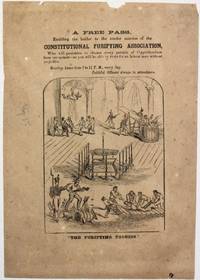
1864ref. 40035np 1864. Broadside 6.25" x 9" with two-thirds of the sheet consisting of a wood engraving entitled "The Purifying Process." Toned with a few short blank edge chips. Good. This scarce political broadside mocks the Copperheads who opposed the Lincoln Administration and the Civil War. The broadside depicts humorous rituals imposed on the Copperheads designed to purge Copperhead-ism from their natures. Weitenkampf and OCLC call this an 1864 broadside with the Lincoln-McClellan election the subject of this piece. Weitenkampf page 140. OCLC 14137917 4- Lincoln Presidential Library Brown U IL Princeton 1360327631 1- DLC 1085916488 1- AAS as of May 2024. unknown books
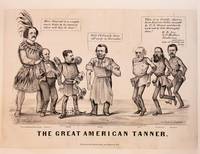
1868ref. 36501New York: Currier & Ives 1868. Lithograph illustrated broadside by Currier & Ives oblong 11" x 15-1/2". Matted. Light dusting Near Fine. Cartoon characters identified by name; in lower right corner "on Stone by Cameron." John Cameron was a talented artist employed at Currier & Ives. In lower left corner "Thos. Worth. Sketch." Worth designed many cartoon broadsides for Currier & Ives. "An election-year cartoon invoking both Grant's humble beginnings as a tanner and his successful Civil War military career. Popular New York governor John Thompson Hoffman dressed as an Indian the 'Great Sachem of Tammany' presents Democratic candidates Horatio Seymour and Francis P. Blair Jr. to Grant. He addresses Grant 'Here General is a couple more hides to be tanned when will they be done' Grant smokes a cigar and wears the leather apron of a tanner rolled-up sleeves exposing his muscular arms. He replies 'Well I'll finish them off early in November.' "At right corner former Confederate generals Robert E. Lee Simon Bolivar Buckner and John C. Pemberton hold their rumps and hop about in pain. They announce 'This is to Certify that we have had our hides tanned and that the work was by him thoroughly done." Reilly AAS's entry asserts "Issued well before 1868 election." Reilly 1868-11. Weitenkampf 159. OCLC 191119896 1- Villanova 1136555720 1- AAS as of October 2024. Currier & Ives unknown books
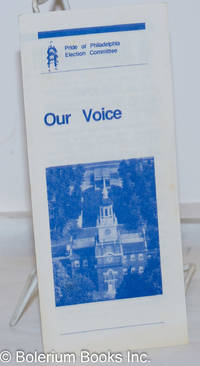
1989ref. 272186Philadelphia: POPEC 1989. Six panel brochure folded to 3.5x8.5 inches Q&A format purpose & goals very good. POPEC unknown books
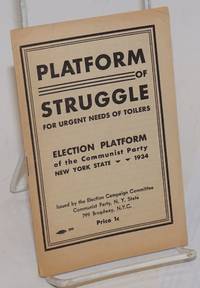
1934ref. 10852New York: the Committee 1934. Pamphlet. 23p. staplebound pamphlet toned minor closed tears otherwise good condition 4x6 inches. the Committee unknown books
ref. 4023S.l.:: s.n. Single sheet printed on one side only folded horizontally then vertically to business-letter size Contents—8 pp including self covers. Page. 1 Portrait of Mr.& Mrs. Nixon; pp. 2/3 blank; p. 4 “Give California a Decisive Leader!”; p. 5 “Luncheon”—choice of three hot entrées; 3 Salads and 3 Sandwiches; pp. 6/7 blank; p. 8 “Win with Nixon!”Nixon was running against Pat Brown the incumbent who won the election. Nixon famously blamed the press for being biased in Brown’s favor and commented that that it was his "last press conference" and "You won't have Nixon to kick around anymore." In 1968 Nixon was elected President! S.l.:: s.n.,. unknown books
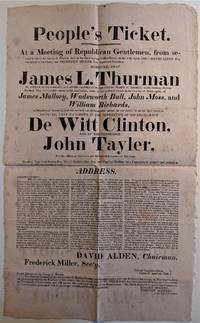
1820ref. 703Caldwell New York 1820. Folio broadside. 465 x 280mm. 18" x 11 inches. Folded in quarters couple of tiny separations along folds. Lightly toned moderately foxing. An attractive untrimmed copy. Signed in type by David Alden and Frederick Miller Chairman and Sec'y of the meeting respectively as well as by members of the Republican Central Committee at conclusion. A handsome broadside utilizing a good deal of large bold type. Warren County is situated north of Glens Falls on the eastern border of New York encompassing almost all of Lake George. Caldwell N.Y. now the village of Lake George at the foot of the lake was for a time the county seat of Warren Co. It had a newspaper from the eighteen-teens and separate imprints from as early as 1820. The Lake George Coffee House served as the first county court and the Republican i.e. Democratic Central Committee had its office in Caldwell. Not in OCLC or American Imprints for 1820. unknown books
2016ref. x-1358261946Palala Press 2016. Hardcover. New. 220 pages. 6.14x0.56x9.21 inches. Palala Press hardcover
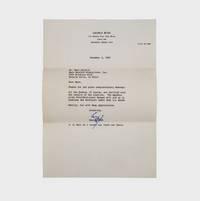
1980ref. 375940Washington D.C. 1980. 8vo. Single sheet his personal stationery signed in blue pen recto only. With a large franked envelope White House stationery. 8vo. "Dear Mace Thanks for the great congratulatory message. All the Bushes of course are thrilled with the results of the election. The mandate given President-elect Reagan will aid us in tackling the difficult tasks that lie ahead. Hastily but with deep appreciation. Sincerely George P. S. Well do I recall our lunch out there. unknown