1 068 résultats
1856réf. 40839Washington 1856. 30 2 blank pp. Disbound else Very Good. This campaign document charges Republicans with stirring up "wild excitement" in Kansas. Democrats refuse "to undertake to determine why the God of nature made the African inferior to the white man; or why He permitted England to fasten the institution of slavery upon the colonies against their repeated and earnest remonstrances. Nor can we tell what Heaven in its wisdom may intend to work out of the relations of master and slave." This item supports Pierce Administration policies in the Kansas-Nebraska struggle and urges the decisive defeat of Republicans. FIRST EDITION. Sabin 35271. unknown books
1860réf. 33068Washington City: Issued by the National Democratic Executive Committee 1860. 8pp caption title as issued. Disbound with light wear Good. Breckinridge Buchanan's Vice President was the 1860 presidential standard-bearer of the Southern Rights branch of the Democratic Party which had split with Stephen Douglas supporters during the 1860 nominating convention. Douglas had defied Buchanan and broken with him over the Kansas issue. This campaign piece demonstrating Northern support for the Breckinridge-Lane ticket charges the Douglas faction with unfairness hypocrisy and illegal attempts to silence the Southern Democrats at the abortive Democratic Convention at Baltimore. LCP 4504. Issued by the National Democratic Executive Committee unknown books
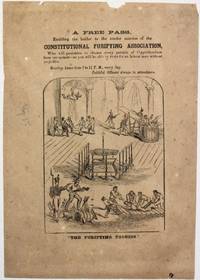
1864réf. 40035np 1864. Broadside 6.25" x 9" with two-thirds of the sheet consisting of a wood engraving entitled "The Purifying Process." Toned with a few short blank edge chips. Good. This scarce political broadside mocks the Copperheads who opposed the Lincoln Administration and the Civil War. The broadside depicts humorous rituals imposed on the Copperheads designed to purge Copperhead-ism from their natures. Weitenkampf and OCLC call this an 1864 broadside with the Lincoln-McClellan election the subject of this piece. Weitenkampf page 140. OCLC 14137917 4- Lincoln Presidential Library Brown U IL Princeton 1360327631 1- DLC 1085916488 1- AAS as of May 2024. unknown books
1864réf. 40219Downieville CA 1864. Broadside ticket 2-3/4" x 3-7/8." Small mounting remnants on blank verso. Very Good. "Sierra County Republican ticket for the election of 1864 in which the national Republican Party temporarily adopted the name National Union Party. Henry Molineux was treasurer of Sierra County Calif. of which Downieville is the seat; see N.Z.R. Molyneux History genealogical and biographical of the Molyneux families Syracuse N.Y.: C.W. Bardeen 1904 p. 99-102." OCLC entry. OCLC 78931206 Brown BYU as of July 2024. The Lincoln Financial Foundation also owns a copy. unknown books
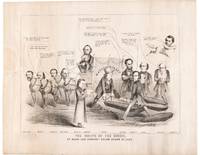
1864réf. 40557New York: Bromley & Company 1864. 19" x 24" lithograph broadside cartoon. Old tears repaired with tape on verso. Long horizontal tear at center has been reinforced by tape on verso. Light wrinkling and toning. The cartoon remains bold solid and intact. Good. "The first in a series of four harsh anti-Lincoln satires published by Bromley & Co. in New York. An imaginary dream of Jack Downing a comic Yankee character created in the 1830s by Seba Smith has Lincoln and some of his supporters and cabinet members as a band of undertakers about to inter the Constitution. "In 1862 displeased by Attorney General Edward Bates's slowness in enforcing the Conspiracies Act the President took matters into his own hands and issued a proclamation 'directing trial by court martial or military commissions of all persons who impeded the draft discouraged enlistments or committed other disloyal acts.' Around thirty-eight thousand people were arrested denied the right of habeas corpus and held in jail until brought to trial. This heavy-handed act provides the fuel for the artist's attack here. "Secretary Stanton is shown driving a hearse 'War Democracy' drawn by four horses with the heads of War Democrats left to right: John Cochrane Benjamin F. Butler Thomas Francis Meagher and Daniel S. Dickinson. Secretary Stanton says 'My jackasses had a load but they pull'd it through bravely. Cochrane: 'I pull for the side that pays the best always.' Butler: 'A million of dollars from New-Orleans'. . . "At right journalist Horace Greeley and Massachusetts senator Charles Sumner bury a casket labeled 'Constitution. Three other caskets 'Union' 'Habeas Corpus' and 'Free Speech Charge Express' wait nearby. Greeley: 'I guess we'll bury it so deep that it will never get up again.' Sumner: 'Be still you old fool. Let us first be sure that it is all under.' "A sober Lincoln watches with folded arms asking 'Chase will it stay down" Beside him treasury secretary Salmon P. Chase responds '. . . It must stay down. Or we shall all go up!' . . . "Abolitionist clergyman Henry Ward Beecher presides over the ceremony with a black child in his arms praying 'Not thy will oh Lord! But mine be done.' Above them Secretary of War Edwin M. Stanton who has the legs and tail of a demon and holds a dagger flies off crying 'If it were done when 'tis done'." Reilly Reilly 1864-37. Weitenkampf 141. OCLC 647912979 2- AAS Clements 299947771 1- DLC as of December 2024. Bromley & Company unknown books
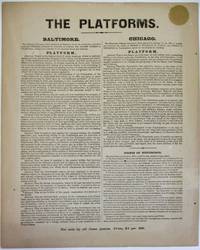
1864réf. 38115New York: For sale by all News Agents. Price $1 per 100 1864. Broadside 9" x 11 1/2". One margin spot from removal of a gum label light uniform toning. Very Good. Printed in two columns separated by a rule. The Column on the left is headed "Baltimore Platform" for the National Union Republican Party; the right hand column is headed "Chicago Platform" for the Democrat-Copperhead Party. A Republican recitation of the Democrats' Platform and the Republicans' Platform in 1864 and an analysis of their 'Points of Difference.' "The Union platform looks to the ending of the war through the defeat and overthrow of the Rebellion while the Democratic contemplates peace through the virtual triumph of the traitors." The broadside exhorts "Freemen of the United States! read mark weigh resolve and VOTE! This is preeminently a contest regarding important principles and measures compared with which personal considerations are of small account." We conclude that this broadside was printed in New York as the legend "For sale by all News Agents. Price $1 per 100" appears in similar broadside material with a New York imprint. Sabin 63348. Not in Bartlett. For sale by all News Agents. Price, $1 per 100 unknown books
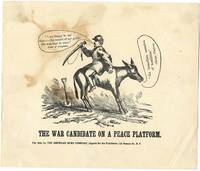
1864réf. 40123New York: For Sale by the AMERICAN NEWS COMPANY Agents for the Publishers. 121 Nassau St. 1864. Oblong broadside 8" x 9-3/8." Couple of light fox spots not affecting illustration. Very Good. The broadside mocks the dissonance in the Democrats' 1864 presidential campaign. Candidate McClellan's acceptance speech supported a continued War Effort; but his Party's platform called for an end to the War. McClellan sitting backward on a jackass says "I am happy to say that -- the record of my public life was kept in view". The jackass however facing the other direction says quoting from the Chicago Platform "An immediate cessation of hostilities." Weitenkampf 145. Not in Reilly. OCLC 57744783 2- Boston Ath. NYHS as of June 2024. AAS also owns a copy For Sale by the AMERICAN NEWS COMPANY, (Agents for the Publishers.) 121 Nassau St. unknown books
1864réf. 32264Albany: Weed Parsons and Company 1864. 81-96 pages as issued. Each page printed in two columns. Disbound and lightly foxed Good. Emphasizing Lincoln's support among all lovers of the Union regardless of Party this campaign pamphlet paints the Democrats as treasonous followers of the Copperhead Congressman Clement Vallandigham. "The Vallandigham platform is merely an attempt of the Richmond authorities to run the blockade of Northern ballot boxes Montgomery Constitution in hand." Not in Sabin Monaghan or Bartlett. OCLC records eleven locations as of July 2015 under two accession numbers. Weed, Parsons and Company unknown books
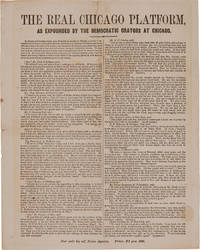
1864réf. 65929New York: National Union Executive Committee 1864. Scarce Anti-Copperhead Broadside A scarce anti-Copperhead broadside printed during the election of 1864 purporting to reveal "the real Chicago Platform" and providing excerpts from speeches given at the Democratic National Convention. The convention met in Chicago on August 29 1864 where the Copperheads quickly established dominance over the outnumbered War Democrats and established peace with the South at any cost as the core of their platform. McClellan accepted the nomination alongside staunch Copperhead George Pendleton despite his open opposition to the peace platform; this seeming hypocrisy was mercilessly lampooned by the opposition contributing to the abject failure of the joint War and Peace ticket. The present broadside presents statements made at the convention by "a number of distinguished Democratic orators" which they deem "sufficient to show the temper and purpose of all." Some choice excerpts include: "I love our Southern friends; they are a noble a brave and a chivalrous people cheers" Representative James S. Rollins of Missouri; "Show me a War Democrat to-day and I will show you a shoddy Abolitionist in disguise.He is a Judas and should be cast out as an enemy to humanity and to God.Soon the net is to be drawn that will gather in its half million more to feed the insatiable thirst for blood of the Negro God" J.A. McMaster arrested for libel at the start of the war; "If Democrats catch Lincoln's bloody satrap spies among them they must cut their damned throats that's all. Applause" Captain William J. Kountz known troublemaker and personal antagonist of General Grant dishonorably discharged in 1863; and "We are one and all for peace and with this magic word upon our banner we shall sweep over the course and roll into oblivion the black negro-loving negro-hugging worshippers of old Abe Lincoln" Isaiah Rynders Tammany Hall tough and former Know-Nothing. The broadside was clearly printed with intention of wide dispersal among potential Lincoln supporters with a noted price of "$1 per 100." The American Antiquarian Society reasonably suggests that this broadside was printed by the National Union Executive Committee of New York based on typographically similar items in their collection. A representative document from one of the nation's most fraught elections. Old folds. Light tanning and staining. Small holes at two cross-folds short closed tear to upper margin and left edge. About very good. SABIN 68234. unknown books
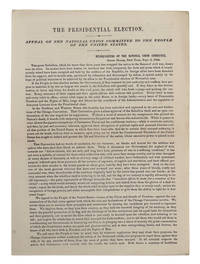
1864réf. 68899New York: National Union Executive Committee Sept. 9 1864. National Union Party Denounces the Chicago Platform A scarce National Union Party circular from the 1864 presidential election responding to the infamous Democratic Nation Convention in Chicago and asserting that "every rebel organ in the rebel States or in foreign lands-- every hater of Democratic Freedom and the Rights of Man longs and labors for the overthrow of the Administration and the expulsion of Abraham Lincoln from the Presidential chair." The committee urges voters "not to arrest the blow which is just ready to descend upon the rebellion now tottering to its fall; not to give the rebels time to renew their strength for fresh conflicts; not to aid those who would aid them in overthrowing our Government in destroying our Union in plunging into a chaos of anarchy the great communities of which the Constitution makes one great and glorious nation and in thus extinguishing finally and forever the hopes of all who have faith in Freedom and the Rights of Man." The missive is signed in type by Henry J. Raymond as Chairman and twenty other members of the National Union Committee. Whether thanks to their extensive literature output or merely a reflection of the existing public will the National Union Party's aim was carried in 1864 by a historic margin with Lincoln winning over ninety percent of the electoral vote. An uncommon fine piece of Civil War political ephemera. Light foxing and soiling to edges. Near fine. unknown books
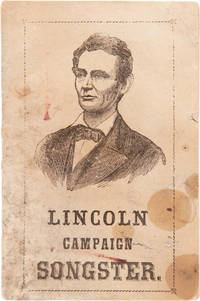
1864réf. 62679Philadelphia: Published by Mason & Co. 1864. Singing for Lincoln in '64 A pocket songster printed to support Lincoln's reelection campaign in 1864 featuring a rather youthful portrait of the president on the front wrapper and twelve spirited pro-Union songs. The titles largely military in theme include such works as "Give us Noble Leaders" "The Veteran Volunteer" "Cast Your Votes for Abraham" "For Lincoln or McClellan you'll be called on to decide/ The one to save the union the other to divide" and "We are Coming Father Abraham 600000 More." The advertisements on the rear wrapper encourage readers to purchase a wide variety of Lincoln campaign badges emblems pins and photographs from the publishers. Despite Lincoln's overwhelming electoral victory in 1864 the race was rather close in Pennsylvania where this was printed – Lincoln took Philadelphia County by a scant few percent and actually failed to secure a majority in neighboring Montgomery and Bucks counties. 16mo. Original pictorial wrappers. Wrappers soiled and stained. Largely clean internally. Advertisements on rear wrapper shaved slightly at outer edge as issued. Good plus. MONAGHAN 323. unknown books
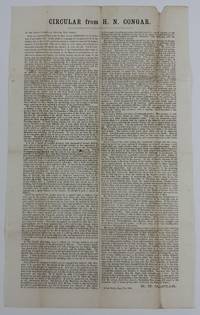
1864réf. 3721N.p. but most likely Newark N.J. 1864. Good plus. Letterpress broadside printed in two columns 16.5 x 10 inches. Old folds small chip to top outer margin two tiny holes affecting just a few letters. A very rare Unionist broadside supporting the re-election of Abraham Lincoln in the critical presidential contest of 1864. The present broadside was authored in early June 1864 by New Jersey Republican Party stalwart Horace N. Congar an editor diplomat and politician who was at that time serving as U.S. consul to Hong Kong. In this rather stirring broadside which Congar writes from his position in Hong Kong he lauds "the thousands of earnest faithful men who are giving freely of their blood and treasure to the suppression of this infamous rebellion" and "the noble daring the undaunted courage and the determined valour of our brave soldiers of Freedom" and urges that "in November New Jersey will stand in the unbroken rank of States giving their verdict for the Party of Union." He also spends considerable space discussing the clear role of "the social moral and political evil" of slavery as the precipitating event of the Civil War. Congar writes that "the evil it has wrought was as natural as the poisoned breath of the Upas tree." Stated clearly Congar writes "I heartily rejoice at the destruction of slavery" and looks forward to the time when "I shall tread my native land with a newer life if within its boundless domain there shall not be heard the clanking chain or the cry of the suffering and the oppressed." "Horace Newton Congar 1817-1893 was a radical republican politician during the midnineteenth century and served on both the state and national levels. Mr. Congar had a great love for his party and hope for its success which is reflected in his writing . Horace Newton Congar was born in Newark on July 31 1817. He married Isabell Reeves and had two children; a daughter Ella and a son Horace Junior. Horace Congar taught school for a while and he studied law in his leisure time. He was admitted to the New Jersey State Bar in 1847 and later Cornelius Boice of Plainfield and Lewis Grove of Newark were his law partners. Congar was a friend of the abolitionist cause and he was one of the founders of the antislavery Free Soil Party in New Jersey. The party slogan 'Free Soil Free Speech Free Labor and Free Men' basically described the party platform. Congar later became a delegate from New Jersey to the Republican National Convention in 1848 which was held in Buffalo. He supported the nomination of Van Buren for president and Adams for vice-president" - New Jersey Historical Society. A rare and unusual Lincoln campaign broadside with just two physical copies in OCLC at AAS and Middlebury College. unknown books
1876réf. 32441Washington 1876. 8pp caption title as issued. Disbound a bit roughly in the blank inner margin. Good. Despite its claims the Democratic Party is not "devoted to a pure high-toned efficient well-conducted civil service." In control of the House of Representatives the Democrats have turned out Union soldiers in droves and have appointed former Confederates to office in their place. Several columns listing names prove the point. OCLC records a number of institutional locations. unknown books
1876réf. 32440Washington 1876. Caption title as issued printed in double columns. 15 1 adv. pp. Disbound else Very Good. A presidential-year attack on the Democratic Party for its "guerrila" tactics "striking in the dark using any and every means or weapon within reach." The Party's sad history reflects its "open rebellion for the destruction of the nation." The last page is an advertisement for The Republic "A Political Science Monthly Magazine" devoted to the principles of the Republican Party. OCLC 27289630 1- Johns Hopkins as of October 2015. unknown books
1877réf. 5770N.p. likely Springfield Il: ca. January 8 1877. Good. Three long galley leaves each approximately 6.5 x 19 inches and printed on rectos only with numerous pencil emendations. Old folds and creases numerous chips and tears to margins pervasive wrinkling making reading a bit challenging at times but with no loss to text. Small portion of third leaf containing the last eight lines of text detached but present. Not in great shape but seemingly unique. A galley proof of a speech by General John A. McClernand in the midst of the contentious Election of 1876 which was so far as we can determine neither delivered nor published. A pencil note at top reveals his authorship and notes the speech was intended to be delivered January 8 at the “Great Citizens Convention” in Springfield Illinois almost certainly in 1877 following the recent election in the Fall of 1876. McClernand was an Illinois contemporary of Lincoln's a Democratic Congressman and War Democrat. He was also an ally of another Illinois politician and Lincoln adversary Stephen A. Douglas. He was appointed a general during the Civil War largely through political maneuvering and was generally considered incompetent. McClernand greatly resented the authority of Grant who finally relieved him of command in June 1863. Following the war McClernand became a leading critic of Congressional Reconstruction as well as the Grant Administration in general. He also chaired the 1876 Democratic National Convention which nominated Tilden for the presidency. Here McClernand bitterly attacks Grant his presidential Administration and Reconstruction. According to McClernand Grant's "tastes and habits had been acquired in the field and the camp -- in implicit obedience or absolute command. He knew no other rule of action but the military law and army regulations. As a consequence he has lamentably failed as a civil administrator." As President fraudulently and illegally Grant "joined with Kellog a political adventurer and Durell a federal judge to overthrow the will of the people of Louisiana." Law and order says McClernand "lay prostrate and panting at the feet of her remorseless tyrants." McClernand also assails Grant's highhanded tactics in the other Southern States. Now says McClernand "the president and his accomplices have now applied themselves to defeat the will of the people by a parliamentary device. They claimed for the President of the Senate the right and power to count the electoral votes and to declare the result and by implication that that right and power would be so exercised as to count Tilden out of his election and to count Hayes into one." He wasn't wrong. In one of the closest most hotly-contested and highly-controversial elections in American history to put it simply Hayes effectively stole the election by agreeing to remove northern soldiers from the South and end Reconstruction. It would be interesting to know what McClernand thought of the ultimate result -- he didn't get Tilden but he did get the end of Reconstruction. "Yet another prominent Illinoian who played a role in the Civil War John Alexander McClernand was born in Breckinridge County Kentucky before moving to Shawneetown Illinois at a young age. Similar to fellow Illinoian Abraham Lincoln McClernand was a largely self-taught lawyer who began practicing in Shawneetown in 1835. Also like Lincoln McClernand served in the Black Hawk War. However McClernand was a staunch Democrat. In 1835 he established the newspaper Shawneetown Democrat. He was active in Democratic politics at both the state and federal level serving in the Illinois House of Representatives and eventually Congress. In Congress McClernand was a stalwart Jacksonian Democrat who strongly disliked abolitionists. He strongly opposed the Wilmot Proviso which banned slavery in the territory gained after the Mexican-American War. He became a key ally of fellow Democrat and Illinoian Stephen A. Douglas helping him pass the Compromise of 1850. As tensions rose approaching the election of 1860 McClernand campaigned for Douglas’s presidency and became a Unionist. After war broke out in the following April McClernand helped raise volunteers for the Union Army. Because Lincoln needed to retain a wide base of support and retain connections with Democrats in Illinois he appointed McClernand a brigadier general on May 17 1861. McClernand’s military career would be defined by an ongoing clash with fellow Illinoian General Ulysses S. Grant. Grant a seasoned West Pointer who served in Mexico was irritated by McClernand a political general with little military experience. Further exacerbating relations was McClernand’s tendency to boast about his exploits and diminish the achievements of other commanders" - American Battlefield Trust's entry on John A. McClernand. ca. January 8 unknown books
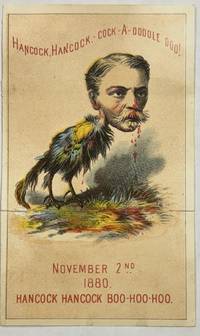
1880réf. 40342New York: Copyright by Geo. H. Hanks 1880. Metamorphic card 3-1/4" x 5-3/8" fully opened. Richly colored light wear Very Good. The unopened illustration depicts a dignified serious Hancock as a rooster in elaborate feathers. But when opened Hancock has lost his feathers is emaciated and bleeding from the mouth. The caption reads "November 2nd. 1880 Hancock Hancock Boo-Hoo-Hoo." Winfield Scott Hancock a decorated Civil War general and a hero of Gettysburg was the losing Democrats' presidential candidate in 1880 opposing Republican James A. Garfield. The verso entitled 'Rhymes for Young Democrats' brilliantly skewers the overt racism of the Democratic Party. It begins: "Sing a song of shotguns Pocket full of knives Four-and- twenty black men Running for their lives; When the polls are open Shut the nigger's mouth Isn't that a bully way To make a solid South" OCLC 32320004 1- Brown as of August 2024. Copyright by Geo. H. Hanks unknown books
1880réf. 12838np 1880. 4pp folded sheet caption title light upper corner spotting. Very Good. The pamphlet supports the Republican platform urges payment in full of the public debt and protection for the Nation's bondholders. Denouncing the Democrats for urging an infusion of paper money which would injure the bondholders it reminds the voters that "In our desperate struggle with the rebellion it was the spotless credit of the Government that enabled us to conquer and to preserve the Union." Democrats then sought to undermine the public credit just as they do now. FIRST EDITION. 489 NUC 0186372 1. unknown books
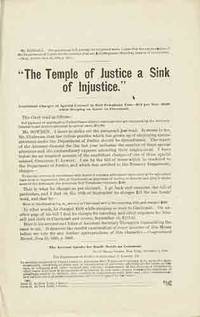
1888réf. 37352n.p.: n.p. 1888. First edition. Self wrappers. A very good copy. 4 pp. 8vo. First section title reads "Exorbitant Charge of Special Counsel in Bell Telephone Case - $75 per day - $100 while Sleeping en Route to Cincinnati." Goes on to accuse the Department of Justice of rights violations and cronyism. "The Citizen and his rights trampled upon in every direction through processes of law." Extensively quotes Samuel Jackson Randall 1828-1890 Democratic member of the United States House of Representatives from Pennsylvania whose power was waning at the time. OCLC locates only two copies: Library of Michigan and the Wisconsin Historical Society. n.p. unknown books
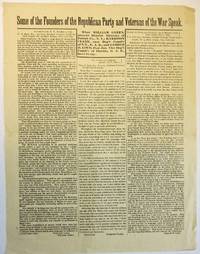
1892réf. 36912New York 1892. Folio broadside 10" x 13" printed in three columns beneath caption title. Minor wear at blank upper edge Very Good plus. "The Republican party of 1860 was the exponent of the grandest ideas and the most ennobling sentiments but to what abysmal depths has it fallen in these times. It now stands for nothing more than a corrupting combination between plutocrats and politicians to plunder the people." Three former Republicans express their dismay at their Party's moral collapse in the Gilded Age and their indignation at Republican mistreatment of Union Civil War veterans. They announce their plans to vote for Grover Cleveland the Democratic candidate in the upcoming presidential election. They are confident "that the interests of the old soldiers are safe with the Democratic party and Grover Cleveland who has always been sincere who has always kept his promises." The three are William Green District Attorney of Fulton County NY; Harrison Clark "once Dep't Comd'r of N.Y. G.A.R. and George B. Loud Past Jun. Vice Dep't Comd'r of Florida G.A.R." They express their disappointment and anger in these printed letters dated in early October 1892 to Theodore F. Reed Secretary of the National Veterans' Tariff Reform League. Not located on OCLC as of September 2024 or the online sites of AAS NYPL or NYHS. unknown books
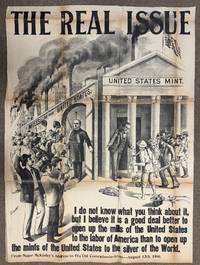
1896réf. 41421Chicago: Edwards Deutsch & Heitmann 1896. Elephant folio broadside 36" x 48" mounted on linen at time of manufacture. A graphic black-and-white campaign broadside for Republican William McKinley's 1896 presidential contest against Democrat William Jennings Bryan. Early folds with significant wear and splitting along folds including the backing several archival cloth tape repairs on verso. Moderate toning at the fold lines. Good only. "McKinley welcomes workers to U.S. mills W.J. Bryan welcomes foreign silver." Library of Congress copy of this print but reprinted in 1900 with the addition of large red type "McKinley was Right in 1896." Democrat Bryan favoring free coinage of silver and elimination of tariffs welcomes foreigners bringing to the Mint silver from India Germany England Mexico Japan China and elsewhere. Republican McKinley favoring the gold standard and tariffs to protect American industries welcomes prosperous American workers to American mills. "From Major McKinley's Address to His Old Comrades = In = Arms. - August 12th 1896." OCLC 20499606 1- Detroit Pub. Lib. as of April 2026. Edwards, Deutsch & Heitmann unknown books
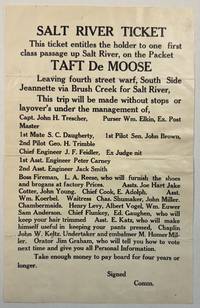
1912réf. 40330Westmoreland County PA 1912. 4to broadside in bold type faces and fonts. A rather clumsy repair on blank verso to a horizontal fold split. Else Very Good. This broadside is a Who's Who of Jeanette Westmoreland County Pennsylvania citizenry. They apparently backed the losers in the three-way 1912 presidential election President Taft; former President Roosevelt who ran on the Bull Moose Ticket. John H. Trescher Proprietor and co-founder of Jeannette Dispatch. William Elkin postmaster. S. Clark Daugherty Drugs and Books. George H. Trimble Proprietor of Hotel Marian. Peter W. Carney occupation listed as "lab". John "Jack" Smith occupation listed as lab. Lowry A. Reese Shoes. Joseph M. Hart Bartender at Hotel Kramer. Jacob Cotter Bartender at the Miller House. John H. Young Bartender at the Hotel Jeannette. Elias Adolph Proprietor of New McKee. William C. Koerbel of Koerbel Brothers florists and sheet metal workers. Charles S. Shumaker of Shumaker Ringer & Foster. Henry Levy Levy Brothers Clothing and Men's Furnishings. Albert Vogel baker. William Euwer Furniture and Carpets. Edward M. Gaughen barber. Eleazer Katz clerk at Union Clothing Store. John W. Keltz cashier at First National Bank. H. Homer Miller Insurance and Real Estate Funeral Director and Embalmer. Taken from R.L. Polk & Co.'s Greensburg Derry Jeannette and Latrobe Directory for 1913 accessed at Ancestry website August 2024. Not located on OCLC as of August 2024. unknown books
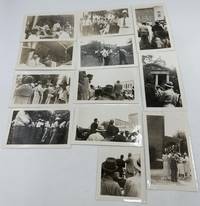
1938réf. 70032Winder GA 1938. This rally at least in part involved the primary challenge of Eugene Talmadge to incumbent U.S. Senator Walter George a portion of a poster for Talmadge is pictured in one photo; George was eventually re-elected handily as was Governor Eurith Rivers. "Georgia / 1938" in pencil on verso of one photo the business sign for J. L. Saul Co. clearly pictured in another. Very good lot. unknown books
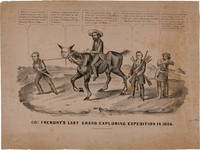
1856réf. 63167New York: Nathaniel Currier 1856. Fremont as an Overland Explorer for the Presidency A cutting satirical cartoon aimed at the great western explorer John C. Fremont and his main supporters in his 1856 bid for the White House. Fremont was the Republican nominee for the presidency and ran on an anti-slavery platform. He was backed by New York Tribune editor Horace Greeley and radical abolitionist minister Henry Ward Beecher. In the image Fremont rides a horse - called the "abolition nag" - that has the face of Greeley. Fremont says "This is pretty hard riding - but if he only carries me to the White house in safety I will forgive my friends for putting me astride of such a crazy Old Hack." The horse is led toward the Salt River a metaphor for political disaster by leading Republican William Seward who proclaims that "Which ever road I travel always brings me to this confounded river I thought we had a sure thing this time on the Bleeding Kansas dodge." Mountains in the background are identified as Kansas and Nebraska. The Greeley-headed horse addresses Seward: "Seward it seems to me we are going the same Road we did in 'fifty two' but as long as you lead I'll follow if I 'go it blind.'" Henry Ward Beecher who was known to have furnished antislavery emigrants with firearms to participate in the Kansas struggles follows behind Fremont's horse his arms laden with rifles. A mountain man - evoking Fremont's exploring past - cautions the Pathfinder: "Ah! Colonel - you've got into a bad crowd - you'll find that dead Horse on the prairie is better for the Constitution than Abolition Soup or Wooly head stew in the White house." The embossed seal to the bottom left corner is that of F.A. Caspari of Baltimore "Dealer in Books & Stationery." This print is scarce. The Currier & Ives catalogue raisonné locates only the copies at the Chicago Historical Society and the Library of Congress. OCLC adds only two copies one at the American Antiquarian Society and another at the University of Rochester. A fine satirical print of John Fremont and his abolitionist supporters in the 1856 presidential election. Light even tanning lightly foxed. Old vertical fold running the length of right edge. Closed tears with repairs to the right and left edges plus small closed tear to top right edge along fold. Contemporary dealer's embossed seal to bottom left corner. Three small pieces of linen tape to top of the verso some discoloration from old tape since removed on verso. Very good. REILLY AMERICAN POLITICAL PRINTS 1856-20. WEITENKAMPF p.117. PETERS CURRIER & IVES 1635a. GALE CURRIER & IVES: A CATALOGUE RAISONNÉ 1309. OCLC 192110863. OCLC 1136567691. unknown
1856réf. 63167New York: Nathaniel Currier 1856. Fremont as an Overland Explorer for the Presidency A cutting satirical cartoon aimed at the great western explorer John C. Fremont and his main supporters in his 1856 bid for the White House. Fremont was the Republican nominee for the presidency and ran on an anti-slavery platform. He was backed by New York Tribune editor Horace Greeley and radical abolitionist minister Henry Ward Beecher. In the image Fremont rides a horse - called the "abolition nag" - that has the face of Greeley. Fremont says "This is pretty hard riding - but if he only carries me to the White house in safety I will forgive my friends for putting me astride of such a crazy Old Hack." The horse is led toward the Salt River a metaphor for political disaster by leading Republican William Seward who proclaims that "Which ever road I travel always brings me to this confounded river I thought we had a sure thing this time on the Bleeding Kansas dodge." Mountains in the background are identified as Kansas and Nebraska. The Greeley-headed horse addresses Seward: "Seward it seems to me we are going the same Road we did in 'fifty two' but as long as you lead I'll follow if I 'go it blind.'" Henry Ward Beecher who was known to have furnished antislavery emigrants with firearms to participate in the Kansas struggles follows behind Fremont's horse his arms laden with rifles. A mountain man - evoking Fremont's exploring past - cautions the Pathfinder: "Ah! Colonel - you've got into a bad crowd - you'll find that dead Horse on the prairie is better for the Constitution than Abolition Soup or Wooly head stew in the White house." The embossed seal to the bottom left corner is that of F.A. Caspari of Baltimore "Dealer in Books & Stationery." This print is scarce. The Currier & Ives catalogue raisonné locates only the copies at the Chicago Historical Society and the Library of Congress. OCLC adds only two copies one at the American Antiquarian Society and another at the University of Rochester. A fine satirical print of John Fremont and his abolitionist supporters in the 1856 presidential election. Light even tanning lightly foxed. Old vertical fold running the length of right edge. Closed tears with repairs to the right and left edges plus small closed tear to top right edge along fold. Contemporary dealer's embossed seal to bottom left corner. Three small pieces of linen tape to top of the verso some discoloration from old tape since removed on verso. Very good. REILLY AMERICAN POLITICAL PRINTS 1856-20. WEITENKAMPF p.117. PETERS CURRIER & IVES 1635a. GALE CURRIER & IVES: A CATALOGUE RAISONNÉ 1309. OCLC 192110863. OCLC 1136567691. unknown books
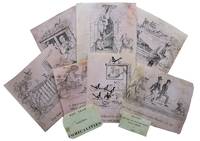
1833réf. AQ25008Birmingham: Printed by William Wood 1833. Seven trimmed woodcut engravings printed on pink paper with a further trimmed title and imprint panel on white paper. Browned and marked. An apparently unknown example of pictorial electoral satire removed from an album by a previous owner where the items were by repute grouped together with the title and imprint panel albeit printed on different paper - suggesting that these perhaps issued in book form but have since sunk without trace. The seven captioned images are: 'Reading the Riot Act' 'A Crane two Walkers and a Barker or the Political Dis-Union' 'A Fry-er setting a trap for the Consumers of Corn and longing for a Broil' 'A Maiden Speech or an Orator and his note book' 'A windfall to the Friars assistant in the shape of a Stoner' 'Cock Robin and Cock Robin's son' 'Negro head short cut pigtail and York returns or a boat about until the ferry no glee' The issues raised including radicalism the corn laws and the riot act all and the reference to a 'new year' election all suggest that these were issued around the time of the 1832/3 General Election; the first conduced after the introduction of the Reform Act which expanded the electorate especially in cities like Birmingham where in this election two radicals were elected unopposed. Entirely unrecorded in OCLC; neither the title nor the captions of any of the seven images elicits any locations in institutional collections. . Dimensions at maximum 100 x 110 mm. Printed by William Wood unknown