1 172 résultats
1848réf. 70790Richmond VA 1848. Printed Whig party electoral ticket 6 ½ x 3 ¾ inches the text enclosed within a double-thin rule border. OCLC locates two copies Virginia Library of Virginia. Very good. unknown
réf. 1331006414.Gpaperback. Good. Access codes and supplements are not guaranteed with used items. May be an ex-library book. paperback
1872Contains Acts relating to: Land Registry Ordinance; Justice of the Peace; Mineral Ordinance; Gold Mining; Municipality Act; Election of MLAs; Office of Sheriff; The Public School Act; Public Works Act; Drainage, Dyking, and Irrigation; Wild Land Tax; Road Ordinance; Election of MLAs; Gold Mining; Courts Merger; MPs ineligible to be MLAs; Fireman's Protection Act; Proof under Oath; Suits against the Crown; Supply of Water to Victoria; Land Ordinance, 1870; William Creek Fire Brigade; Esquimalt and Nanaimo Railway Company (E&N), Incorporation of; Replevin; The Public Inquiries Aid Act; An Act to Secure Wives and Children; Indemnification of members of the Legislative Assembly; Asylums for the Insane; Rights of the Property of Married Women; Bills of Sale; The Constitution Act, 1871; Scale of Fees to be taken by certain officers; Agricultural Societies; Allowances to Jurors in Criminal Cases; the Legislative Assembly Privileges Act; Game Ordinance; Attorneys of the Supreme Court to be called to the bar of said court; The Homestead Ordinance; Defraying the expenses of civil government; Indemnification of Members of the Executive Council and others; Practitioners in the County Courts and other inferior Courts; Privileges of the members of the Legislative Assembly; An act to render legitimate, children born out of lawful wedlock. Above-average wear. Usual library markings. Book
1832réf. 19544Albany: Printed by Packard and Van Benthuysen 1832. 24pp. Disbound light fox and wear Good. Jackson and his first Vice President John C. Calhoun had become enemies in the Nullification Crisis their polar opposition bringing them into conflict. New York's Martin Van Buren leader of Northern Democrats and a skilled political manipulator was the easy choice. These Proceedings record the Delegates by State the balloting and its result and the "Address of the Republican Delegates of the State of New-York" defending the President's record tracing Jacksonians' roots to Thomas Jefferson and warmly endorsing their Favorite Son. FIRST EDITION. Sabin 93603. AI 13888 1. Not in Eberstadt or Decker. Printed by Packard and Van Benthuysen unknown
1832réf. 19544Albany: Printed by Packard and Van Benthuysen 1832. 24pp. Disbound light fox and wear Good. Jackson and his first Vice President John C. Calhoun had become enemies in the Nullification Crisis their polar opposition bringing them into conflict. New York's Martin Van Buren leader of Northern Democrats and a skilled political manipulator was the easy choice. These Proceedings record the Delegates by State the balloting and its result and the "Address of the Republican Delegates of the State of New-York" defending the President's record tracing Jacksonians' roots to Thomas Jefferson and warmly endorsing their Favorite Son. OCLC locates only four copies under two accession numbers. FIRST EDITION. Sabin 93603. AI 13888 1. Not in Eberstadt or Decker. Printed by Packard and Van Benthuysen unknown books
1970réf. 2090502113717607Not Available 1970. Soft Cover. Fine. The book is in fine condition. Not Available paperback
1828réf. WRCAM53763Boston 1828. 8pp. Dbd. loose sheets. Minor toning and foxing. Good. A rare anti-Adams newspaper supplement published during the contentious election of 1828. THE BOSTON STATESMAN was established in 1821 by David Henshaw and his friends. The eventual editor was Nathaniel Greene who had trained at the New Hampshire PATRIOT in Concord N.H. Henshaw and Greene organized a dinner in Boston on Jan. 8 1828 in Andrew Jackson's honor and actively campaigned for him. Here the STATESMAN recounts the history of John Quincy Adams' political party which they label the "monarchy men of 1787." Additionally the paper covers Hamilton Adams and the Sedition Act along with the party's disloyal actions during the War of 1812 and the subsequent Hartford Convention. Rare and seemingly unrecorded in OCLC. unknown books
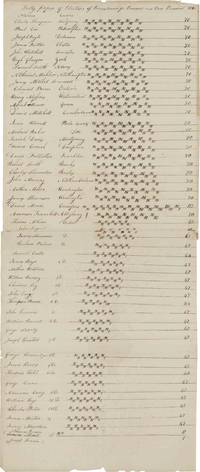
1812réf. 68222Pennsylvania. 1812. Pennsylvania Elects Madison in 1812 An interesting early American political manuscript listing fifty-one electors by county or district with tallies next to their names which are then added in a final column. Among the more notable of the electors listed are Charles Thompson and Thomas McKean. In the election Pennsylvania voted overwhelmingly for the Democratic-Republican candidate James Madison who defeated Federalist candidate DeWitt Clinton. An unusual piece of political Americana. Old folds light tanning and wear. Very good. unknown
1844réf. 15877Washington: Whig Executive Cong. Committee 1844. 16pp. Disbound. Good. A Whig argument for protection from foreign competition explaining the ruinous effects of Free Trade and the necessity to protect mechanics and industrialists alike from the dumping of foreign goods on the United States. The Whig ticket from Clay on down must be supported. FIRST EDITION. AI 44-6587 4. Not in Sabin. Whig Executive Cong. Committee unknown
1844réf. 15877Washington: Whig Executive Cong. Committee 1844. 16pp. Disbound. Good. A Whig argument for protection from foreign competition explaining the ruinous effects of Free Trade and the necessity to protect mechanics and industrialists alike from the dumping of foreign goods on the United States. The Whig ticket from Clay on down must be supported. FIRST EDITION. AI 44-6587 4. Not in Sabin. Whig Executive Cong. Committee unknown books
1848réf. 15121Columbus 1848. 6 2 blanks pp. Caption title as issued disbound. Scattered foxing. Good. Ohio's Whig State Central Committee seeks to galvanize its lethargic troops for the upcoming presidential election. Zachary Taylor is as one of his letters printed here assures "A WHIG AND SHALL EVER BE DEVOTED IN INDIVIDUAL OPINION TO THE PRINCIPLES OF THAT PARTY." A "decided" Whig he is "not ultra." FIRST EDITION. Morgan Collection 8256. Not in Sabin Miles Wise & Cronin Taylor Eberstadt Decker. OCLC 1035828858 1- AAS as of April 2025. Apparently the Ohio Historical Society and Western Reserve also own a copy. unknown
1848réf. 15121Columbus 1848. 6 2 blanks pp. Caption title as issued disbound. Scattered foxing. Good. Ohio's Whig State Central Committee seeks to galvanize its lethargic troops for the upcoming presidential election. Zachary Taylor is as one of his letters printed here assures "A WHIG AND SHALL EVER BE DEVOTED IN INDIVIDUAL OPINION TO THE PRINCIPLES OF THAT PARTY." A "decided" Whig he is "not ultra." FIRST EDITION. Morgan Collection 8256. Not in Sabin Miles Wise & Cronin Taylor Eberstadt Decker. OCLC 1035828858 1- AAS as of January 2021. Apparently the Ohio Historical Society and Western Reserve also own a copy. unknown books
réf. B9789976973600Paperback / softback. New. paperback
réf. A9789976973600Paperback / softback. New. paperback
1856réf. 41369Albany NY: Comstock & Cassidy 1856. First edition. Self wrappers. A very good copy with a fold removed from a bound volume; small tears along fore edge. Unpaged 4 pp. 27 1/2 x 21 1/4 inches. Supports the Democratic Party. Extensive coverage of the 1856 elections with large ad for James Buchanan for President and John C. Breckinridge for Vice President. Also notice for the sale of Delaware Indian Lands at Fort Leavenworth Kansas Territory moving the sale until the 17th of November with a list of tracts. Comstock & Cassidy unknown
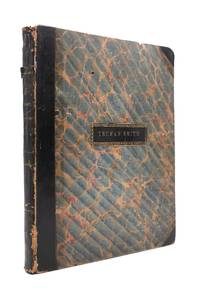
1848réf. 346068Washington D.C.: George S. Gideon 1848. Vol. 1 Numbers 1-18 plus a November 16 extra all published. 312pp. 4to. Contemporary half black morocco and marbled paper boards worn at joints and edges. Provenance: Truman Smith morocco label on the upper cover. Vol. 1 Numbers 1-18 plus a November 16 extra all published. 312pp. 4to. Scarce complete run of the weekly political newspaper "devoted to the support of Taylor and Fillmore" published during their campaign in the Election of 1848 which pitted the Whig Zachary Taylor against the Democrat Lewis Cass. The masthead features a woodcut of a horseback Taylor with his Mexican War troops firing a canon at Cass. In the final post-election Extra which includes the news of Taylor's victory the masthead has changed to the canon blowing Cass to pieces. The final page of the Extra comprises a prospectus for a New Series of the Battery. This example with provenance to ardent Taylor supporter Senator Truman Smith of Connecticut who served on the Whig Executive Committee of Congress and who contributed within the pages of the campaign newspaper. George S. Gideon unknown
1828réf. 34260Albany: Printed for the Albany Argus 1828. 32pp disbound and stitched. Title and several other leaves browned widely scattered foxing. Good. This is one of three 1828 issues all scarce printed in the heated presidential race of that year. Anti-Jackson forces charged that his unrestrained martial personality-- highlighted by executing six militia men after the Battle of New Orleans-- unfitted him for the presidency. New York Democrats defend Jackson denounce the falsehoods surrounding that incident and call the official record of the inquiry "useless rubbish." Howes J4. Wise & Cronin 232. Sabin 56778. Printed for the Albany Argus unknown
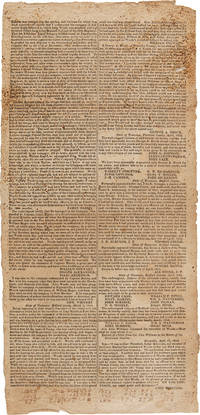
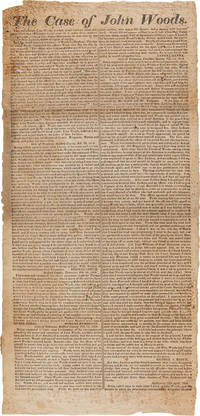
1828réf. 56513N.p. 1828. A Very Rare Broadsheet Attack on Andrew Jackson in 1828 A rare broadside recounting Andrew Jackson's infamous execution of Private John Woods published in 1828 by Jackson's opponents during the 1828 election. There was considerable mud-slinging between the Jackson and Adams camps during that campaign which eventually saw the defeat of incumbent John Quincy Adams and the election of Andrew Jackson. This dense broadside recounts the events of March 1814 at Fort Strother during the Creek Campaign when Jackson charged John Woods an eighteen-year-old militiaman with disobedience disrespect and mutiny. According to the text the trial itself only occurred because Jackson's soldiers would not shoot Woods at the moment of the offense despite Jackson's cries to "Shoot the damned rascal!.blow ten balls through the damned rascal!" The court martial followed soon after; Woods was found guilty and sentenced to die. Some testimonies here state that Jackson offered to spare Woods' life if he would enlist in the regular army but Woods refused; others disagree. He was executed thirty-six hours later. Then follows the sworn testimony of several witnesses: Thomas Couch Robert Ferguson Samuel Hanna George A. Brock Isaac Roberts James Harris William Stewart Joseph Alexander Isaac Anderson Abm. Whitney and John Williams all fellow soldiers of Woods who witnessed or had personal knowledge of the facts in the case. Their accounts of Woods' supposed mutiny substantially downplay the severity of Woods' disobedience suggesting that it was likely a misunderstanding; they also emphasize the draconian nature of the punishment and make several mentions of Woods' aging and infirm parents. Williams' account closes: "It is not true that Woods on the ground of Execution with oaths and defiance refused to promise obedience. On the contrary he wept loud and bitterly." All of the testimonies are datelined in Tennessee in the first few months of 1828. The nature of the printing lends itself to the possibility of a Tennessee press. Though not as famous as the "Coffin Handbills" that appeared at the same time listing Woods' execution among many other crimes by Jackson this was definitely addressed to the same audiences. John Spencer Bassett in his Life of Andrew Jackson notes that the "execution of mutinous militiamen in the campaigns of 1813 and 1814 was recalled to show Jackson's ferocious temper; and when a Philadelphia editor published a hand-bill showing a coffin with the victims standing by its side the idea was caught up eagerly and repeated in all parts of the country." Not in Wise & Cronin and we could find no listing for this broadside in OCLC or in American Imprints. It has only appeared at auction twice and then not since 1925 when Anderson Galleries offered a copy as part of the sale of the Henry De Puy collection which was strong in Andrew Jackson material. The only copy in the trade seems to be one offered by the Eberstadts in 1939. Broadsheet 19 x 9 inches text printed in two columns on both sides. Old folds some chips to edges minor loss to upper left corner and closed tear to bottom edge no text affected. Two small holes affecting just one word a few areas of soiling light foxing even tanning. Manuscript annotations to verso. About very good. unknown
1828réf. WRCAM56513N.p. 1828. Broadsheet 19 x 9 inches text printed in two columns on both sides. Old folds some chips to edges minor loss to upper left corner and closed tear to bottom edge no text affected. Two small holes affecting just one word a few areas of soiling light foxing even tanning. Manuscript annotations to verso. About very good. A rare broadside recounting Andrew Jackson's infamous execution of Private John Woods published in 1828 by Jackson's opponents during the 1828 election. There was considerable mud-slinging between the Jackson and Adams camps during that campaign which eventually saw the defeat of incumbent John Quincy Adams and the election of Andrew Jackson. This dense broadside recounts the events of March 1814 at Fort Strother during the Creek Campaign when Jackson charged John Woods an eighteen year-old militiaman with disobedience disrespect and mutiny. According to the text the trial itself only occurred because Jackson's soldiers would not shoot Woods' at the moment of the offense despite Jackson's cries to "Shoot the damned rascal!.blow ten balls through the damned rascal!" The court martial followed soon after; Woods was found guilty and sentenced to die. Some testimonies here state that Jackson offered to spare Woods' life if he would enlist in the regular army but Woods refused; others disagree. He was executed thirty-six hours later. Then follows the sworn testimony of several witnesses: Thomas Couch Robert Ferguson Samuel Hanna George A. Brock Isaac Roberts James Harris William Stewart Joseph Alexander Isaac Anderson Abm. Whitney and John Williams all fellow-soldiers of Woods who witnessed or had personal knowledge of the facts in the case. Their accounts of Woods' supposed mutiny substantially downplay the severity of Woods' disobedience suggesting that it was likely a misunderstanding; they also emphasize the draconian nature of the punishment and make several mentions of Woods' aging and infirm parents. Williams' account closes: "It is not true that Woods on the ground of Execution with oaths and defiance refused to promise obedience. On the contrary he wept loud and bitterly." All of the testimonies are datelined in Tennessee in the first few months of 1828. The nature of the printing lends itself to the possibility of a Tennessee press. Though not as famous as the "Coffin Handbills" that appeared at the same time listing Woods' execution among many other crimes by Jackson this was definitely addressed to the same audiences. John Spencer Bassett in his LIFE OF ANDREW JACKSON notes that the "execution of mutinous militiamen in the campaigns of 1813 and 1814 was recalled to show Jackson's ferocious temper; and when a Philadelphia editor published a hand-bill showing a coffin with the victims standing by its side the idea was caught up eagerly and repeated in all parts of the country." Not in Wise & Cronin and we could find no listing for this broadside in OCLC or in American Imprints. It has only appeared at auction twice and then not since 1925 when Anderson Galleries offered a copy as part of the sale of the Henry De Puy collection which was strong in Andrew Jackson material. The only copy in the trade seems to be one offered by the Eberstadts in 1939. unknown books
1848réf. 6729Washington: Towers 1848. 8pp disbound else Very Good with caption title as issued. A Whig attack on Michigan Senator Cass the Democrats' 1848 presidential nominee. His "love of the people's money" is evidenced by his expense vouchers-- printed here-- as Secretary of Indian Affairs. The failure of the Seminole campaign resulted from his "incompetency" as Secretary of War. He is "an old Federalist who denies his ancestry." The pamphlet attacks his 'Nicholson Letter' in which for the first time the concept of Popular Sovereignty-- permitting Territorial inhabitants rather than Congress to determine whether slavery should exist there-- was articulated. Sabin 11350. Streeter MI 612. Towers unknown
1848réf. 6729Washington: Towers 1848. 8pp disbound else Very Good with caption title as issued. A Whig attack on Michigan Senator Cass the Democrats' 1848 presidential nominee. His "love of the people's money" is evidenced by his expense vouchers-- printed here-- as Secretary of Indian Affairs. The failure of the Seminole campaign resulted from his "incompetency" as Secretary of War. He is "an old Federalist who denies his ancestry." The pamphlet attacks his 'Nicholson Letter' in which for the first time the concept of Popular Sovereignty-- permitting Territorial inhabitants rather than Congress to determine whether slavery should exist there-- was articulated. Sabin 11350. Streeter MI 612. Towers unknown books
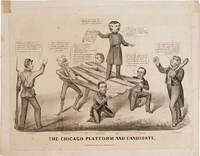
1864réf. 63169New York: Published by Currier & Ives 1864. A Political Cartoon Exposing McClellan's Hypocrisy A rare Currier and Ives print from the presidential election of 1864 satirizing the Democratic presidential candidate and former general George B. McClellan as an equivocating hypocrite. As Neely and Holzer explain the presidential campaign of 1864 inspired a flurry of "separate-sheet display cartoons: thought-provoking witty but often cruel lampoons that struck hard at the most divisive political and personal issues of 1864. In these cartoons one can see illustrated vividly the raw toughness of the campaign as well as the skill of the artists who covered it." These prints they note could be "vicious: personal mean-spirited cruel race-baiting and divisive" and in this context McClellan "the military man now running on a peace platform made for one obvious target." The image here shows a two-faced McClellan at center standing atop rickety planks - a literal representation of the Democratic party's Chicago peace platform - and holding a copy of his letter of acceptance. The planks are supported precariously at each corner on the shoulders of four figures: Confederate president Jefferson Davis; New York congressman and prominent Copperhead Fernando Wood; another Copperhead and the author of the Chicago platform Clement Vallandigham; and "Jeffs friend" the devil. Standing on opposite sides of the image are representatives of each of the constituencies to whom the two-faced McClellan is pandering: a uniformed "Union Soldier" and a "Peace Democrat" caricatured here as a club-wielding simian Irishman. From the face addressing the Peace Democrat McClellan says "You see my friend I accept the nomination and of course stand on the platform" to which the Peace Democrat replies "All right General! if yere in favor of resistin the draft killing the Nagurs and pace wid the Southerners I'll knock any man on the head that'll vote aginye." From his other face addressing the Union soldier McClellan contradicts himself saying "If you don't like the Platform I refer you to my letter of acceptance" a copy of which McClellan holds in his and which reads "War! - preservation Union - could not look my gallant Comrades in the - face; ---" The soldier says "Its no use General! you can't stand on that platform and come that blarney over me; I smell brimstone!" Below McClellan the devil speaking to Jefferson Davis gives expression to the futility of the lost cause: "Well Jeff it's no use trying to hold up this rickety old platform I guess I'll leave you to your fate!" Davis says in reply "I'm in a pretty fix! Weldon road gone!! Atlanta taken!!! Mobile Forts surrendered!!!! Early licked!!!!! and now when my last hope is in keeping up this platform and getting Mac elected you who led me into the scrape threaten to leave me!!!!!" Meanwhile an exasperated Vallandingham exclaims "Confound that letter! I've a good mind to bolt and let the whole concern go to a smash!" Fernando tries to reassure his fellow Copperhead: "Hold on Val. don't you see it's only his little game to ring in the war men if he is elected he is bound to carry out our policy and nothing else!" The image mocks the seeming hypocrisy of McClellan a military man running on his war record who has just accepted the nomination of a party whose platform calls for an end to the war even as the candidate himself expresses his support for the war in his acceptance letter. Reilly notes that the cartoon was probably drawn by the prolific artist Louis Maurer. This print is scarce. The Currier & Ives catalogue raisonné locates only the copies at the Chicago Historical Society and the Library of Congress. OCLC locates another two copies at the time of cataloguing one at the Ohio History Center and another at the Clements Library. We find additional copies at the American Antiquarian Society the Library Company of Philadelphia and the Metropolitan Museum of Art. A rare and stinging political cartoon from the bitter war-time election of 1864. Tanned with some scattered foxing. Small pinholes to top center and to top and bottom of left margin. Two small pieces of linen tape to top edge of verso; some soiling to verso and some discoloration from old tape since removed showing through to recto. Very good. REILLY AMERICAN POLITICAL PRINTS 1864-20. WEITENKAMPF p.143. PETERS CURRIER & IVES 1621. GALE CURRIER & IVES: A CATALOGUE RAISONNÉ 1126. NEELY & HOLZER UNION IMAGE pp.132 134 137 144-45. Bryan F. Le Beau Currier & Ives: America Imagined Washington: Smithsonian Institution Press 2001 pp.280-81. OCLC 818725064 1292629697. unknown
12mo, drop-head title, 4pp., disbound. Relates to 1803 contested Nottingham election between Daniel P. Coke and J. Birch. In the form of a drama set in the house of D. P. Coke at Derby. University of Nottingham copy only on Copac.
1880réf. 197421880. Caption title as issued. 8pp with light wear and old folds. 'No. 86.' printed at top of first page. Good. A Republican campaign pamphlet arguing that the triumph of the 'Solid South' would impoverish the country. Southerners have "the conceit of political sagacity. It is their boast that this country will never be properly governed until Southern statesmanship shall again bear sway." But when the numbers are crunched the South has lagged behind the North in every index of economic prosperity. The Solid South's share of the "commercial industrial financial and educational interests of the country" is disproportionately small. Its pretensions to "dictate the course of the National Government" is absurd. OCLC locates 12 under two accession numbers. unknown
1880réf. 197421880. Caption title as issued. 8pp with light wear and old folds. 'No. 86.' printed at top of first page. Good. A Republican campaign pamphlet arguing that the triumph of the 'Solid South' would impoverish the country. Southerners have "the conceit of political sagacity. It is their boast that this country will never be properly governed until Southern statesmanship shall again bear sway." But when the numbers are crunched the South has lagged behind the North in every index of economic prosperity. The Solid South's share of the "commercial industrial financial and educational interests of the country" is disproportionately small. Its pretensions to "dictate the course of the National Government" is absurd. OCLC locates 12 under two accession numbers. unknown books