Edgar PoeLivre Rare Book

10 résultats
réf. 500359755Livre de Poche Sans date. Ce grand roman d'amour de Douglas Kennedy nous transporte dans l'Amérique des années 1950 secouée par le maccarthysme et raconte une histoire oubliée faite de passions et de choix
1953réf. ABE-159152767104816 PAGES-QU'EST-CE QUE LE MACCARTHYSME? I LES DEMAGOGUES AFFRONTENT LE DRAGON ROUGE, PAR MARCELLE HENRY, DEMI PAGE-L'ESTHETIQUE COMMUNISTE FOUGERON PENDU EN EFFIGIE PAR ARAGON, PAR ANDRE CHASTEL-A TRAVERS LES GALERIES: KISLING, GALERIE DROUANT DAVID- PROPOS DE LETTRES INEDITES LE RAYONNEMENT DE MAURICE DENIS, PAR JACQUES HENRY BORNECQUE, DEMI PAGE-POUR AVOIR PASSE SON DOIGT SUR UN DESSIN PREHISTORIQUE M.ANDRE BRETON COMPARAIT DEMAIN DEVANT LE TRIBUNAL CORRECTIONNEL DE CAHORS-QUINZE MOIS APRES L'ASSASSINAT DE LA FAMILLE DRUMMOND REBONDISSEMENT DE L'AFFAIRE DE LURS?, RECONSTITUTION-COMPLET
réf. 56090L'Harmattan 1999 livre étude 21,5*13,5 582 pages champs visuels
1954réf. 53992Chicago: Henry Regnery Co. 1954. 8vo. xv 3 413 1 pp. Tan cloth black lettering on spine minor shelfwear rubbing minor bumping to couple corners w/ d.j. cover design by Ed Bedno chipping tears w/ o spine chipping to fore-edges VG/Fair w/ taped-in signature of Joe McCarthy tipped-in on ffep. obituary article offprints from the National Review after McCarthy’s death in 1957 laid-in. First edition w/ signed ruled paper slip taped-in of this decidedly skewed and supporting conservative critique of the infamous senator best remembered for his demagogic attacks and reckless pursuit of supposed communist infiltration of American Institutions. Buckley and his fellow conservatives criticized McCarthy of being disorderly reckless and impulsive thereby resulting in his downfall and yet supports his basic beliefs. McCarthy signatures are rather uncommon. Henry Regnery Co., hardcover
1950réf. 174161950. Civil Rights Congress Jailed Until They "Talk" circa 1950 denounces the imprisonment of suspected Communists in Los Angeles and documents a Cold War legal-defense campaign against grand jury contempt proceedings. The broadside identifies anti-Communist prosecution as a system of political coercion showing the mechanisms by which federal authorities allegedly pressured witnesses to inform on others and used contempt charges against those who refused. It provides primary evidence for the study of McCarthy-era civil liberties left-wing legal defense anti-Communist enforcement and the contested boundaries of the Bill of Rights during early Cold War domestic politics. Jailed Until They "Talk." Civil Rights Congress. Los Angeles: Civil Rights Congress circa 1950. 12 x 8 inches. The broadside demands "The immediate dismissal of the witch-hunt grand jury! Immediate release on bail for those convicted of contempt! Dismissal of the frame-up contempt charges!" It names "Los Angeles' latest victims of Tom Clark" and argues that the Truman administration and U.S. Attorney General Tom Clark used grand jury proceedings to detain suspected Communists until they cooperated. Its warning "If this trick works the Bill of Rights will have been thrown out of the window" places the item within contemporary radical and civil-liberties opposition to loyalty investigations contempt prosecutions and political surveillance. The broadside belongs to the period when the Communist Party affiliated organizations and left-leaning cultural figures faced federal investigation prosecution and public exposure through grand juries Smith Act cases and legislative hearings. Unlike later summaries of McCarthyism this item preserves the immediate language of resistance from a legal-defense organization addressing arrests and jailings as they unfolded in Los Angeles. Light handling wear; very good. A forceful Cold War civil-liberties broadside documenting local resistance to anti-Communist legal pressure and coerced testimony. unknown
1950réf. 174161950. Civil Rights Congress Jailed Until They "Talk" circa 1950 denounces the imprisonment of suspected Communists in Los Angeles and documents a Cold War legal-defense campaign against grand jury contempt proceedings. The broadside identifies anti-Communist prosecution as a system of political coercion showing the mechanisms by which federal authorities allegedly pressured witnesses to inform on others and used contempt charges against those who refused. It provides primary evidence for the study of McCarthy-era civil liberties left-wing legal defense anti-Communist enforcement and the contested boundaries of the Bill of Rights during early Cold War domestic politics. Jailed Until They "Talk." Civil Rights Congress. Los Angeles: Civil Rights Congress circa 1950. 12 x 8 inches. The broadside demands "The immediate dismissal of the witch-hunt grand jury! Immediate release on bail for those convicted of contempt! Dismissal of the frame-up contempt charges!" It names "Los Angeles' latest victims of Tom Clark" and argues that the Truman administration and U.S. Attorney General Tom Clark used grand jury proceedings to detain suspected Communists until they cooperated. Its warning "If this trick works the Bill of Rights will have been thrown out of the window" places the item within contemporary radical and civil-liberties opposition to loyalty investigations contempt prosecutions and political surveillance. The broadside belongs to the period when the Communist Party affiliated organizations and left-leaning cultural figures faced federal investigation prosecution and public exposure through grand juries Smith Act cases and legislative hearings. Unlike later summaries of McCarthyism this item preserves the immediate language of resistance from a legal-defense organization addressing arrests and jailings as they unfolded in Los Angeles. Light handling wear; very good. A forceful Cold War civil-liberties broadside documenting local resistance to anti-Communist legal pressure and coerced testimony. unknown books
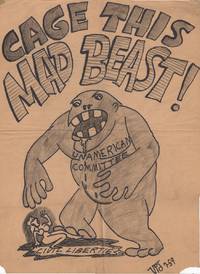
1959réf. 42835np: np 1959. Very good. An outstanding example of presumably amateur political protest art depicting the House Un-American Activities Committee as a rabid King Kong on the verge of seizing the helpless damsel Civil Liberties. 1959 was the Committee's 21st year of existence and it had by then become quite commonplace to condemn the HUAC's extremism so much so that President Truman in April of that year called the committee "the most un-American thing in the country today." Still it would take sixteen more years for HUAC to be officially abolished. We've been unable to trace the artist but he again we presume was clearly skilled striking just the right balance between cartoon and editorial styles. A vivid piece of vernacular propaganda from the early days of the HUAC's decline. Light-brown paper hand-drawn in felt-tip marker; 24" by 18" approx. Evidence of having been hung up at corners: small pieces of tape at upper edge; two chips at bottom; plus 2" tear at center of bottom edge. Shallow creases folded into eighths. Else clean if mildly toned. Very good. Signed by an artist "Vid" and dated in July 1959. np unknown
1959réf. 42835np: np 1959. Very good. An outstanding example of presumably amateur political protest art depicting the House Un-American Activities Committee as a rabid King Kong on the verge of seizing the helpless damsel Civil Liberties. 1959 was the Committee's 21st year of existence and it had by then become quite commonplace to condemn the HUAC's extremism so much so that President Truman in April of that year called the committee "the most un-American thing in the country today." Still it would take sixteen more years for HUAC to be officially abolished. We've been unable to trace the artist but he again we presume was clearly skilled striking just the right balance between cartoon and editorial styles. A vivid piece of vernacular propaganda from the early days of the HUAC's decline. Light-brown paper hand-drawn in felt-tip marker; 24" by 18" approx. Evidence of having been hung up at corners: small pieces of tape at upper edge; two chips at bottom; plus 2" tear at center of bottom edge. Shallow creases folded into eighths. Else clean if mildly toned. Very good. Signed by an artist "Vid" and dated in July 1959. np unknown
1959réf. 42835np: np 1959. Very good. An outstanding example of presumably amateur political protest art depicting the House Un-American Activities Committee as a rabid King Kong on the verge of seizing the helpless damsel Civil Liberties. 1959 was the Committee's 21st year of existence and it had by then become quite commonplace to condemn the HUAC's extremism so much so that President Truman in April of that year called the committee "the most un-American thing in the country today." Still it would take sixteen more years for HUAC to be officially abolished. We've been unable to trace the artist but he again we presume was clearly skilled striking just the right balance between cartoon and editorial styles. A vivid piece of vernacular propaganda from the early days of the HUAC's decline. Light-brown paper hand-drawn in felt-tip marker; 24" by 18" approx. Evidence of having been hung up at corners: small pieces of tape at upper edge; two chips at bottom; plus 2" tear at center of bottom edge. Shallow creases folded into eighths. Else clean if mildly toned. Very good. Signed by an artist "Vid" and dated in July 1959. np unknown books
1959réf. 42835np: np 1959. Very good. An outstanding example of presumably amateur political protest art depicting the House Un-American Activities Committee as a rabid King Kong on the verge of seizing the helpless damsel Civil Liberties. 1959 was the Committee's 21st year of existence and it had by then become quite commonplace to condemn the HUAC's extremism so much so that President Truman in April of that year called the committee "the most un-American thing in the country today." Still it would take sixteen more years for HUAC to be officially abolished. We've been unable to trace the artist but he again we presume was clearly skilled striking just the right balance between cartoon and editorial styles. A vivid piece of vernacular propaganda from the early days of the HUAC's decline. Light-brown paper hand-drawn in felt-tip marker; 24" by 18" approx. Evidence of having been hung up at corners: small pieces of tape at upper edge; two chips at bottom; plus 2" tear at center of bottom edge. Shallow creases folded into eighths. Else clean if mildly toned. Very good. Signed by an artist "Vid" and dated in July 1959. np unknown books