912 résultats
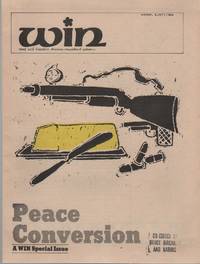
1977réf. 41969Brooklyn NY: Win 1977. First Edition. Very good. Weekly pacifist publication this a special issue focused on nuclear disarmament edited by Bruce Birchard a Quaker activist and leader of the watchdog group National Action/Research on the Military Industrial Complex. The issue's theme is "peace conversion" the concept of converting war industries to civilian production. Includes articles on three community-based disarmament and peace conversion projects in Denver Oahu and Santa Clara County California. Wraps. 8" x 10.75" approx. in self wraps. Light toning else fine. 31pp. Win unknown books
1842réf. 86607Newcastle & London: J. Barker / Charles Gilpin 1842. First Edition. First impression. Penny pamphlet 19cm x 12cm. Sewn self-wrappers; 24pp. Sewing perished; mild wear at corners; still complete and Very Good. Publisher's imprint printed vertically at bound edge of first page of text. A tract on pacifist non-resistance with strong anti-statist content - a clear presentation of the proto-anarchist Christianity of militant pacifist-abolitionists of the era of which Wright and Barker were exemplars. Wright 1797-1870 a defrocked Presbyterian minister would become one of the most radical American voices for abolitionism and pacifism in the years before the Civil War even being ejected from the American Anti-Slavery Society for espousing too radical an abolitionist viewpoint. Joseph Barker 1806-1875 a British controvertialist clergyman who like Wright had been rejected by his denomination was in many ways Wright's analogue in Great Britain espousing a militant interpretation of Christ's teachings that repudiated all entities that survived upon compulsion of their members - including enslavement marriage most religion and government itself. Barker would later relocate to the United States where he became a leader of the abolitionist cause in Ohio before returning to England just prior to the outbreak of the Civil War. The present pamphlet very scarce; not traced in commerce with only five physical holdings noted in OCLC. J. Barker / Charles Gilpin unknown books
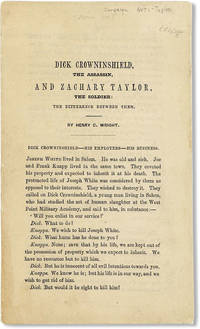
réf. 80612N.p. n.d. Hopedale: 1848. 16mo 15cm. Sewn self-wrappers; 12pp. A worn copy stain on first leaf bleeds with diminishing effect through entire text; marginal loss to final leaf not costing text; still complete and Good. Issued without imprint but likely printed at Adin Ballou's Hopedale Community where Wright was a resident but see note below. Date of composition is given as Jan. 24 1848 at close of text; this pamphlet was likely printed soon after that date as Wright's sequel titled The Employers of Dick Crowninshield was composed in March of the same year and makes reference to the current work in its foreword. In typical Wright fashion a contrarian point of view - here radical non-resistance - is stretched to its logical limits by unflattering analogy. Wright the idiosyncratic radical abolitionist feminist pacifist freethinker and proto-anarchist compares Zachary Taylor's actions at the Battle of Monterey to nothing more than murder for hire building his analogy around the notorious 1830 murder of a Salem ship's-captain Joseph White by a paid assassin the Dick Crowninshield of the title. After laying out the details of each man's purported deeds including a quite lurid account of the Battle of Monterey Wright follows with a long list of "The Differences" between them concluding in the end that there is no difference in kind: ".The assassin killed a man whom he knew to be innocent; the soldier did the same.The assassin killed the innocent at the instigation of his employers; so did the soldier.The assasin entered into a contract with his employers voluntarily; so did the soldier." etc. In the end the only noteworthy difference is that "Zachary's deeds are said by the priests and churches to be God-approved and Christ-like; the assassin's are denounced by them as evil and only evil." At least three separate editions of the pamphlet were issued with priority likely as follows: 1 a Hopedale imprint issued with a full title page dated 1848 in which the title subject's name is misspelled "Crowningshield;" 2 the current edition undated issued with drop-title the subject's name corrected to "Crowninshield"; no imprint clearly from a different setting of type from the first - but based on close comparison with digital sources likely from the same font of type as the first hence our suggestion of Hopedale as the likely place of printing for this edition; 3 a stated Second Edition undated published in Edinburgh probably the same year. All editions are uncommon; 4 locations noted in OCLC for this edition. No copies traced in commerce. unknown books
1972réf. 61845Nyack NY: CONAME ca 1972. 5 manila envelopes 12"x9" with printed labels containing a total of 29 reprinted articles and 6 introductory sheets. All housed within large manila envelope 13"x9.5" labeled in manuscript. External envelope rubbed and worn with some dustsoil: Good only. Internal manila envelopes slightly rubbed with minor rust to metal closures; enclosed articles with mild foxing and browning one or two bent corners only gently rubbed: overall Very Good. An information packet distributed by the Committee On New Alternatives in the Middle East CONAME a pacifist organization founded in 1969 by a group of Jewish-Americans among them Noam Chomsky. Their aim was to pursue peace in the Middle East by promoting peaceful dialogue in the U.S. "Founding director Allan Solomonow described it as 'a forum and a resource for peace-seeking alternatives to the currently internecine status quo; we are the gadfly to the consciences of the resigned of the apathetic of those mired in propaganda and dogma.' To that end the organization's principal work was educational: disseminating articles touring speakers and organizing Middle East delegations to mitigate "the pervasive polarization of opinion that has characterized the Middle East crisis'". This is one of the informational packets CONAME assembled and distributed probably in 1972. It contains reprints of previously published articles dating from 1969-1972 organized in envelopes labeled as follows: 1. Who Are the Palestinians 6 articles 2. The Israeli Peace Movement 4 3. Israel's Arab Minority 5 4. Alternatives for Middle East Peace 9 5. In Search of Middle East Information 5 Article authors include Edward Said Alan Dershowitz Ahmed Khalidi Atallah Mansour M. Cherif Bassiouni Nora Levin Edward Said Shlomo Avineri Amos Kenan Siach Amnon Rubinstein Israel Shahak and Sabri Jiryis. The packets also contain copies of a few periodicals e.g. New Outlook and The Middle East News Review. Though this example equivocates about possible resolutions to the conflict and prioritizes providing background information CONAME eventually advocated for Israeli-Palestianian dialogue and a two-state solution. The organization collaborated with other American pacifist organizations such as the Jewish Peace Fellowship War Resisters League Quaker Action Group and Women Strike for Peace. However after the founding of Breira and the Fellowship of Reconciliation CONAME's Executive Director and Assistant Director departed and the organization dissolved in 1975. See the article on CONAME on btvshalom. org the website for the Jewish Alliance for Justice & Peace. An ephemeral and uncommon survival; we have traced no similar examples. #61845. CONAME unknown books
1969réf. 63304Washington DC: New Mobilization Committee 1969. First Edition. Original illustrated poster offset printed in red and black on white stock measuring 38cm x 59cm ca 15" x 23". Mild handling a few vertical creases smoothed out with a handful of small closed tears to the margins; unbacked; Very Good. Poster issued in advance of the New Mobe's November 1969 March on Washington with the illustration printed by permission of the artist. New Mobilization Committee unknown books
1941réf. 62276Bombay: Thacker & Co 1941. Second edition. Octavo. Green cloth hardcover with printed paper cover label; 301pp; portrait frontispiece. A few spots of soil and discoloration to cloth consistent with age; still a tight unmarked copy Very Good or better. In pictorial dustwrapper somewhat soiled and edgeworn with some old celotape reinforcements to verso; just VG. Biography of Gandhi by this Oxford-educated journalist and memoirist grandson of the esteemed Gujarati journalist and historian of the same name author of a well-known history of the Parsis 1884. Karaka the younger was the first colonial President of the Oxford Union and a vocal advocate for the rights of coloured citizens in Great Britain as well as for Indian independence. The current work issued by an English-language publisher in Bombay is decidedly uncommon; rarely seen in commerce with fewer than 20 copies noted in OCLC of any edition. Thacker & Co unknown books
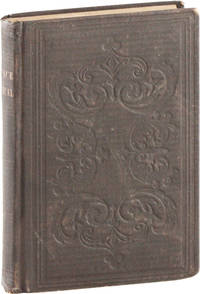
1847réf. 56398Boston: American Peace Society 1847. First Edition. First printing. Brown cloth blindstamped titled in gilt; pink endpapers; 252pp. Presentation bookplate of the American Peace Society to front pastedown. Straight tight and unfaded paper lightly browned with occasional spots pencil notes to endpapers: Very Good. The structure and outline of the book are very similar to Thomas Upham's Manual of Peace reprinted with an introduction by Beckwith in 1842 but the text is substantively different. SABIN 4262. American Peace Society unknown books
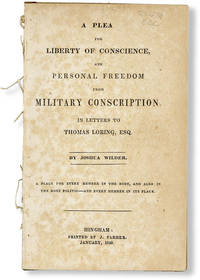
1840réf. 49178Hingham MA: J. Farmer 1840. First Edition. 12mo 17.5cm.; removed; 45pp. Some foxing to preliminaries else Very Good and sound. Errata printed on p. 46. Uncommon statement advocating the principles of conscientious objection to military conscription composed in a series of six letters. Wilder concludes that "The Conscriptive Military Laws of the State are not only injurious to all whom they oppressively effect but also like all of Nature's Laws far more injurious to those who covet to themselves some exclusive easements or indulgences" p. 35. An uncommon work; about ten copies appear in OCLC no other copies traced in commerce. SABIN 103983. J. Farmer unknown books
1986réf. 43529New York: Coalition for a Nuclear-Free Harbor / Staten Island Disarmament Campaign Coalition 1986. Original illustrated poster offset printed in colors on white stock measuring 45.5cm x 60.75cm 18" x 24". A few faint folds smoothed out staple holes along left and right margins with a few faint creases and small stains; Very Good. Poster produced by the New York-based Coalition for a Nuclear Free Harbor promoting a July 4 1986 event billed as "an alternative to the July 4th parade of warships led by the Battleship Iowa flagship of the proposed NY nukeport." Not found in OCLC. Coalition for a Nuclear-Free Harbor / Staten Island Disarmament Campaign Coalition unknown books
1968réf. 41019Nyack NY: The Fellowship of Reconciliation 1968. Original photographic broadside offset printed in black on white stock measuring 36.75cm x 55.75cm 14.5" x 22". Old folds BOSS Archives rubber-stamp at upper right margin else Near Fine. Attractive broadside issued by the US arm of The Fellowship of Reconciliation FOR a religious nonviolent group founded in 1915 by 68 pacifists who claim to be "the largest oldest interfaith peace and justice organization in the United States." The contents reproduced from their appearance in the New York Times June 16 1968 and Los Angeles Times June 23 1968 came closely on the heels of Robert F. Kennedy's assassination. Beside photographic portraits of Kennedy Martin Luther King Jr. and John F. Kennedy the broadside calls the abolition of small artms and for American citizens to disarm themselves: "But Americans have permitted a climate of violence to grow in their society. They have allowed advertising to fill their television screens with simple-minded glamorization of violence and pressure groups to block legislation that would make it harder for sick men to possess the weapons of murder." Listed are an "honor roll of self-disarmers" suggestions for how one could get on the honor roll and a mail-in pledge card at lower right corner. Scarce; not found in OCLC though we note an example held in the Martin Luther King Jr. collection at Beloit College. The Fellowship of Reconciliation unknown books
1978réf. 43524New York: Mobilization for Survival 1978. Original illustrated poster offset printed in four colors on white stock measuring 40.5cm x 55.5cm 16" x 22". Mild handling to extremities faint corner crease and a tiny tear to upper edge with a staple hole toward upper margin; Near Fine. Poster produced by Mobilization for Survival a national coalition of peace and justice groups based in Philadelphia who advocated for denuclearization and an end to the arms race. Planet Earth prominently featured at center swallowed by a large mushroom cloud in the background. Not found in OCLC though we note an example held at OMCA. Mobilization for Survival unknown books
1980réf. 41765New York & Washington: Mobilization Against the Draft 1980. Offset lithographed poster in colors 60cm x 45.5cm ca 24" x 18". Slight edgewear with small closed tear and crease at upper right margin away from central image; Very Good. Striking graphic produced for the anti-conscription rally in Washington D.C. of March 22 1980 - a seminal punk-era event that attracted more than 30000 marchers many of them young men of high school age who had been mobilized by President Jimmy Carter's proposal to reinstate Selective Service for all U.S. males age 18 and older. The design striking in its graphic simplicity marks a clear shift away from the political graphics of the Sixties and Seventies towards a more postmodern industrial aesthetic that would become a hallmark of much 1980s graphic design. Scarce; not at CSPG; OCLC one copy only Museum of Modern Art. Mobilization Against the Draft unknown books
1979réf. 43527Philadelphia: Mobilization for Survival 1979. Original illustrated poster offset printed in three colors on yellow stock measuring 45.5cm x 58cm ca.18" x 23". Old folds smoothed out tiny pin-hole to upper margin with a short tear at lower edge and holograph local contact information pasted at lower right corner; Very Good. Poster produced by Mobilization for Survival a national coalition of peace and justice groups based in Philadelphia who advocated for denuclearization and an end to the arms race. The group states their demands above silhouettes of nuclear cooling towers and missiles of various sizes: Stop research production and use of nuclear weapons; stop operation and construction of nuclear power plants; guarantee adequate heating fuel for the poor during the winter. Not found in OCLC though we note an example held at OMCA. Mobilization for Survival unknown books
1947réf. 41677Philadelphia: Greater Philadelphia Committee Against Peacetime Conscription n.d. but ca. 1947. First Edition. Octavo 20.5cm.; publisher's pictorial staplebound self-wrappers printed in blue; 12pp. Upper cover rather unevenly toned else Very Good and sound. Post-World War II arguments against universal military training; upper cover illustration signed in image by Bernard Seaman depicting Uncle Sam presenting the U.N. with a document reading simply "Disarmament" while holding behind his back another document which reads "We gotta have conscription!!!" One separately catalogued copy in OCLC as of August 2018 at the IISH. Greater Philadelphia Committee Against Peacetime Conscription unknown books
1980réf. 18404San Diego: Bay Area Coalition to Oppose War Preparations 1980. Original screenprint in four colors; 35" x 22-1/2" ca 89cm x 57cm. Very minor surface rubbing else Fine Grade A. Superb mushroom-cloud graphic with a quotation from folk/rock musician Holly Near advertising a "Teach-In" at Laney College in Oakland. Designed and printed by the San Diego radical screenprinting collective Insurgent Squeegee. Bay Area Coalition to Oppose War Preparations unknown books
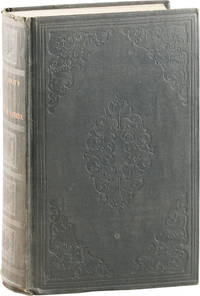
1840réf. 55353Boston: Whipple & Damrell for the American Peace Society 1840. First Edition. First printing. Octavo 24cm. In original dark brown cloth blind-stamped on boards titled in gold on spine; plain endpapers; xiii vi xii 13 14-706pp. A straight tight copy spine sunned rubbed at extremities with inch-long crack to base of lower joint; minor foxing throughout but otherwise bright: Very Good. In the 1830s the American Peace Society held an essay contest "on the subject of a Congress of Nations" judged by John Quincy Adams James Kent and Daniel Webster iii v. This volume collected the best essays as well as Ladd's own contribution--intended as a summary of rejected essays but in fact an outline of his own concept of a "congress and a supreme court of nations" modeled on the American government. This scheme was "mainly reponsible for engendering the international peace movement of the mid-nineteenth century under the leadership of Elihu Burritt" ANB. Ladd's essay was also published separately in 1840 as An Essay on a Congress of Nations priority unknown; see American Imprints 40-3846. See Brock Pacifism in the United States p.487. AMERICAN IMPRINTS 40-5565. Whipple & Damrell for the American Peace Society unknown books
1419réf. 55423London: Union of Democratic Control 1914-1921. Collection of 63 publications including 25 numbered pamphlets ca 12-32pp each and 38 leaflets 1-16pp each. Generally ca 20cm x 14cm with slight variations; printed paper wrappers. Variable light to moderate wear but complete Good or better overall. A comprehensive collection of materials published under the auspices of the Union of Democratic Control a British political advocacy group which sought during the years of the First World War and its aftermath to increase the role of democratic processes and parliamentary control in British government especially with regards to its foreign relations. During the Great War the UDC stopped short of outright pacifism; after 1918 the organization plotted a more intentionally anti-war course ultimately publishing its pacifist manifesto Arthur Ponsonby's Now is the Time in 1925 not included here. The Union's members included many of the most prominent liberal and labour politicians and intellectuals of the era including Arthur Ponsonby Bertrand Russell Norman Angell Ramsay MacDonald and others. Given the prominence of its members the Union exerted considerable influence on British foreign policy in the interwar period and though its influence waned steeply after the Thirties the Union survived well into the post-WW2 era finally dissolving in 1966. While UDC publications are not generically rare this is the largest collection of their publications we have encountered at one time offering a representative view of the group's political advocacy over its most active period. A catalog of the collection follows all published London: Union of Democratic Control unless otherwise specified:. Pamphlet Series: 1. The Morrow of the War. 16pp. n.d. 1914 2. Angell Norman. Shall This War End German Militarism 24pp. n.d. 1914 3. Russell Bertrand. War: the Offspring of Fear. n.d. 16pp. 1914 4. Brailsford H.N. The Origins of the Great War. 24pp. 1914 5. Ponsonby Arthur. Parliament and Foreign Policy. 12pp. n.d. 1914 5a. Ponsonby Arthur. The Control of Foreign Policy. 16pp. 1918 6. Asquith H.H.; Winston Churchill Edward Grey et al. The National Policy As Set Forth By. 16pp. 1914 7. The International Industry of War. n.d. 16pp. 8. MacDonald J. Ramsay. War and the Workers: a Plea for Democratic Control. 20pp. n.d. 1915 9. Why we should state Terms of Settlement. 8pp. n.d. 10. Rolland Romain et al. Towards an International Understanding. Being the Opinions of some Allied & Neutral Writers. 28pp. n.d. 11. Swanwick H.M. Women and War. 16pp. NOTE: Covers detached but present. 1915. 12. By "A Pole." The Polish Problem. 20pp. n.d. 13. Angell Norman. The Prussian in our Midst. 28pp. 1915 14a. The Balance of Power. 2nd Edition. 24pp. 1915. 15a. Hobson J.A. A League of Nations. 20pp. 1915. 16a. Hobson J.A. Labour and the Costs of War. 16pp. 1916. 18a. Brailsford H.N. Turkey and the Roads of the East. 24pp. 1916. 19a. Dickinson G. Lowes. Economic War After the War. 20pp. 1916. 20a. Angell Norman. America and the Cause of the Allies. 16pp. 1916. 21a. "By a Soldier." The War to End War: a Plea to Soldiers by a Soldier. 20pp. 1917. 22a. Morel E.D. The African Problem and the Peace Settlement. 32pp. 1917. 23a. Gooch G.P. The Races of Austria-Hungary. 24pp. 1917. 27a. Peace Overtures and Their Rejection December 1916 - March 1918. 21pp. 1918. 42a. Demartial M. Georges. Patriotism Truth and War Guilt. 30pp. 1921. Leaflet Series: Unnumbered. Fundraising Prospectus. Broadside 1pp. N.d. ca 1914-15. Signed in print by E.A. Morel. No. 3: Why Have the People take no Interest in Foreign Affairs. Broadside 1pp. n.d. 1914 No. 4: What is the Balance of Power Broadside 1pp. n.d. 1914 No. 5: "Crushing Germany". 4pp. n.d. 1914 No. 6: What is a Treaty Broadside 1pp. n.d. 1914 No. 8: Our Soldiers and the Union of Democratic Control. Letters from Officers and Men. 4pp. 1915. No. 9: Do Nations Want to Fight Broadsheet 2pp. n.d. 1915 No. 10. Ponsonby Arthur. Why We Should Think About Peace. 4pp. n.d. 1915 No. 11. Morel E.D. War and Diplomacy. Being a Speech delivered at a Public Meeting.May 14th 1915. 12pp. 1915. No. 14b. The Union of Democratic Control What It Is and What It Is Not. Second Edition. Broadsheet 2pp. 1915. No. 15b. Mr. Ponsonby and Mr. Trevelyan in the House of Commons. 11pp. 1915. No. 16b. Earl Loreburn & Lord Courtney of Penwith in the House of Lords. 8pp. 1915. No. 17b. What the Press Now Says: More Support for the U.D.C. Broadsheet 2pp. 1915. No. 18b. Terms of Peace. Mr. C.R. Buxton on a Basis for Discussion. 4pp. n.d. 1915. No. 19b. Secret Diplomacy a Menace to the Security of the State. The National and Imperial Problem. 8pp. 1915 No. 20b. The Attack upon Freedom of Speech. The Broken-Up Meeting at the Memorial Hall 29th November 1915. 3rd ed. 24pp. 1915 No. 21b. The Attack upon Freedom of Speech. Astound Official Defence. House of Commons Sequel to the Broken up Meeting. 2nd ed. 28pp. 1915. No. 22b. Our Ultimate Objects in the War. From a Speech by Mr. E.D. Morel.November 22nd 1915. 4pp. 1915 No. 26b. The Prime Minister's Declaration. Its Effect on Germany. 4pp. 1916 No. 27b. Trevelyan Charles. The Case for Negotiation. 4pp. 1916. No. 28b. What Our Allies Think About Economic War. 8pp. 1916. No. 29b. Ponsonby Arthur. Why Must the War Go On 4pp. 1916. No. 30b. Resolutions Passed at the Second Annual Meeting of the General Council of the Union of Democratic Control. Broadside 1p. 1916. No. 31b. America and Permanent Peace. Speech of President Wilson to the American League to Enforce Peace.4pp. 1916. No. 32b. Must the War go on till Russia gets Constantinople Broadside 1pp. 1916. No. 33b. President Wilson's Message to the World. 8pp. 1917 No. 34b. British Working-Men - Observe! French Workers Support Wilson. Broadside 1pp. 1917 No. 35b. French Members of Parliament and the "Knock-out Blow." Broadside 1pp. 1917 No. 36b. Manifesto of Russian Workers & Soldiers. Broadside 1pp. 1917 No. 37b. Free Russia and the Union of Democratic Control. A Common Policy. 4pp. 1917 No. 38b. Then Why Go On Broadside 1pp. 1917 No. 39b. Russia's Real Aims: an Appeal to British Democracy. By the Minister of Agriculture in the Russian Provisional Government. Broadsheet 2pp. 1917. No. 40b. Secret Diplomacy No. 1. Lies That Helped to Make the War. 4pp. 1917. No. 41b. Secret Diplomacy No. 2. Peace Proposals: What are the Real Facts. Broadsheet 2pp. 1917 No. 42b. Vindication of Mr. Morel in the House of Commons. 4pp. 1917 No. 43b. Secret Diplomacy No. 3. Secret Treaties Between the Allies. 4pp. 1917. No. 44b. How to Get a Permanent Peace. Being a short statement of the objects and policy of the Union of Democratic Control. 16pp. 1917. No. 45b. How to Get Permanent Peace.With Full Particulars Showing You How You Can Help. 14pp. 1917. Union of Democratic Control unknown books
1848réf. 45010Edinburgh: H. Armour n.d. but 1848. First U.K. Edition. 12mo 18cm.; publisher's side-stitched self-wrappers; 11pp. Light dust-soil tiny soil spot to rear wrapper else Very Good to Near Fine. Anti-Zachary Taylor pamphlet issued by the pacifist and marriage reform advocate Henry C. Wright 1797 - 1870 during Taylor's successful 1848 bid for the presidency. Here the author compares Taylor's career to that of Richard Crowninshield's 1804-1830 who was hired in 1830 to murder the 82-year-old captain and former slave trader Joseph White. H. Armour unknown books
1949réf. 4269Scottdale Pa 1949. Very good. Four pamphlets paginations below. Small quartos in light card wrappers stapled. Minor soiling and wear. A group of four tracts on the Mennonite pacifist philosophy and its consequences. The titles present are as follows: 1 Horsch John. The Principle of Nonresistance As Held by the Mennonite Church. Scottdale Pa.: Mennonite Publishing House 1939. 2nd Edition Revised and enlarged. 74pp. 2 Yoder Edward. Compromise with War: A Brief Critique of the War Philosophy of Charles Clayton Morrison. Scottdale Pa.: Mennonite Central Committee 1944. 14pp. 3 Yoder Edward and Don Smucker. The Christian and Conscription: An Inquiry As a Preface to Action. Scottdale Pa.: Herald Press 1945. 124pp. 4 Gingerich Melvin. What of Noncombatant Service: A Study of Alternatives Facing the Conscientious Objector. Scottdale Pa. 1949. 2nd Edition. 48pp. unknown books
2017br. A differenza dei tanti uomini pronti a misurarsi in quella che considerarono un'eroica ed elettrizzante avventura, le donne italiane non invocarono la guerra. Ci fu poi un gruppo di utopiste, legate a una rete internazionale di militanti, che avanzò una ferma critica al sistema di potere maschile. Per quella élite di femministe e di suffragiste erano gli uomini a capo dei governi e della diplomazia, che sceglievano di dirimere i conflitti tra le nazioni attraverso lo strumento della guerra, a provocare dolore e spargimenti di sangue. Per questo motivo, negli anni a cavallo tra Ottocento e Novecento e nel corso del primo conflitto mondiale, chiesero più diritti e più democrazia per le donne e sollecitarono la loro partecipazione nelle decisioni sulle vicende nazionali e internazionali.
2004br. In questa conferenza tenuta a Berlino nel 1927, Max Scheler applica al clima politico dell'epoca i principi che aveva sviluppato in una delle sue opere più importanti, "Il formalismo nell'etica e l'etica materiale dei valori". Scheler s'interroga sulla "pace perpetua" davanti a un uditorio di uomini politici e diplomatici che di lì a poco sarebbero saliti alla ribalta in Germania. Ma non si tratta di uno scritto occasionato da un clima culturale che prepara la strada a Hitler; è invece il ragionamento lucido in risposta all'idea che da un conflitto di portata mondiale possa venire una pace eterna.
2019ril. L'ideologia pacifista, la strenua, indefessa fiducia nella necessità della non violenza, la difesa dei diritti e della libertà del singolo e dei popoli, l'uguaglianza delle genti, la sacralità del lavoro e della famiglia rappresentano per Gandhi non tanto un messaggio nuovo e rivoluzionario da propagandare al mondo intero, quanto dei valori costitutivi e inalienabili dell'uomo che fanno parte della sua intima natura e come tali vanno sostenuti. Di qui la purezza, la linearità, la sincerità del pensiero di Gandhi, che abbraccia ogni aspetto del vivere singolo e collettivo ed emerge in queste pagine in tutta la sua limpida onestà morale e con tutta la forza e il coraggio che solo la fede più profonda nella propria verità riesce a generare.
2019br. Un pellegrinaggio di pace che tutti dovremmo compiere. Se al loro apparire "Lettere contro la guerra" hanno rappresentato una delle riflessioni più importanti sul «dopo 11 Settembre», oggi questo piccolo libro incandescente, sgorgato dal suo autore in pochi, drammatici mesi, ma frutto di una vita di viaggi e conoscenze, ci parla non più di una guerra, bensì di tutte le guerre, e contro di esse fa sentire la sua voce limpida, ormai al di là della cronaca. In un'epoca in cui nessuno accetta più lezioni da nessuno, le Lettere di Tiziano Terzani sono invece una lezione preziosissima, non soltanto contro la violenza, ma anche contro l'intolleranza, l'ipocrisia, le semplificazioni e l'indifferenza.
2020br. In un mondo ancora attraversato da violenze, conflitti, guerre spesso dimenticate o nascoste, il movimento pacifista fatica a trovare spazi. La stagione della grande mobilitazione d'inizio millennio appare lontana anni luce. Cosa è cambiato rispetto a quando il movimento arcobaleno era capace di riempire piazze e di spingere gli italiani a esporre la bandiera della pace alla finestra? Molto meno di vent'anni dopo, la cronaca descrive un paesaggio assai diverso. Il linguaggio della pace non è più pop. Eppure una mobilitazione, soprattutto tra i più giovani, sta crescendo: quella che impone l'ambientalismo come tema globale, irrinunciabile per l'agenda politica. E dalla crisi del movimento pacifista quale lezione può trarre chi oggi scende in piazza contro il cambiamento climatico? Insieme a professori, studiosi, attivisti, politici, abbiamo indagato le possibili cause esterne e interne che hanno contribuito alla "mutazione arcobaleno". Riflettere su questo potrebbe aiutarci anche a comprendere la portata della nuova ondata di partecipazione e, magari, a non commettere gli stessi errori del passato.