923 risultati
rif. DADAX1436583217New unknown
rif. DADAX0226811271New unknown
rif. DADAX0195057155New unknown
rif. DADAX0415405831New unknown
rif. DADAX0367484498New unknown
rif. DADAX0367590867New unknown
rif. DADAX0367572273New unknown
rif. DADAX019538363XNew unknown
rif. DADAX027594784XNew unknown
rif. DADAX0415335817New unknown
rif. DADAX0567026418New unknown
rif. DADAX0877227799New unknown
rif. DADAX0567026752New unknown
1840rif. 55353Boston: Whipple & Damrell for the American Peace Society 1840. First Edition. First printing. Octavo 24cm. In original dark brown cloth blind-stamped on boards titled in gold on spine; plain endpapers; xiii vi xii 13 14-706pp. A straight tight copy spine sunned rubbed at extremities with inch-long crack to base of lower joint; minor foxing throughout but otherwise bright: Very Good. In the 1830s the American Peace Society held an essay contest "on the subject of a Congress of Nations" judged by John Quincy Adams James Kent and Daniel Webster iii v. This volume collected the best essays as well as Ladd's own contribution--intended as a summary of rejected essays but in fact an outline of his own concept of a "congress and a supreme court of nations" modeled on the American government. This scheme was "mainly reponsible for engendering the international peace movement of the mid-nineteenth century under the leadership of Elihu Burritt" ANB. Ladd's essay was also published separately in 1840 as An Essay on a Congress of Nations priority unknown; see American Imprints 40-3846. See Brock Pacifism in the United States p.487. AMERICAN IMPRINTS 40-5565. Whipple & Damrell for the American Peace Society unknown
1419rif. 55423London: Union of Democratic Control 1914-1921. Collection of 63 publications including 25 numbered pamphlets ca 12-32pp each and 38 leaflets 1-16pp each. Generally ca 20cm x 14cm with slight variations; printed paper wrappers. Variable light to moderate wear but complete Good or better overall. A comprehensive collection of materials published under the auspices of the Union of Democratic Control a British political advocacy group which sought during the years of the First World War and its aftermath to increase the role of democratic processes and parliamentary control in British government especially with regards to its foreign relations. During the Great War the UDC stopped short of outright pacifism; after 1918 the organization plotted a more intentionally anti-war course ultimately publishing its pacifist manifesto Arthur Ponsonby's Now is the Time in 1925 not included here. The Union's members included many of the most prominent liberal and labour politicians and intellectuals of the era including Arthur Ponsonby Bertrand Russell Norman Angell Ramsay MacDonald and others. Given the prominence of its members the Union exerted considerable influence on British foreign policy in the interwar period and though its influence waned steeply after the Thirties the Union survived well into the post-WW2 era finally dissolving in 1966. While UDC publications are not generically rare this is the largest collection of their publications we have encountered at one time offering a representative view of the group's political advocacy over its most active period. A catalog of the collection follows all published London: Union of Democratic Control unless otherwise specified:. Pamphlet Series: 1. The Morrow of the War. 16pp. n.d. 1914 2. Angell Norman. Shall This War End German Militarism 24pp. n.d. 1914 3. Russell Bertrand. War: the Offspring of Fear. n.d. 16pp. 1914 4. Brailsford H.N. The Origins of the Great War. 24pp. 1914 5. Ponsonby Arthur. Parliament and Foreign Policy. 12pp. n.d. 1914 5a. Ponsonby Arthur. The Control of Foreign Policy. 16pp. 1918 6. Asquith H.H.; Winston Churchill Edward Grey et al. The National Policy As Set Forth By. 16pp. 1914 7. The International Industry of War. n.d. 16pp. 8. MacDonald J. Ramsay. War and the Workers: a Plea for Democratic Control. 20pp. n.d. 1915 9. Why we should state Terms of Settlement. 8pp. n.d. 10. Rolland Romain et al. Towards an International Understanding. Being the Opinions of some Allied & Neutral Writers. 28pp. n.d. 11. Swanwick H.M. Women and War. 16pp. NOTE: Covers detached but present. 1915. 12. By "A Pole." The Polish Problem. 20pp. n.d. 13. Angell Norman. The Prussian in our Midst. 28pp. 1915 14a. The Balance of Power. 2nd Edition. 24pp. 1915. 15a. Hobson J.A. A League of Nations. 20pp. 1915. 16a. Hobson J.A. Labour and the Costs of War. 16pp. 1916. 18a. Brailsford H.N. Turkey and the Roads of the East. 24pp. 1916. 19a. Dickinson G. Lowes. Economic War After the War. 20pp. 1916. 20a. Angell Norman. America and the Cause of the Allies. 16pp. 1916. 21a. "By a Soldier." The War to End War: a Plea to Soldiers by a Soldier. 20pp. 1917. 22a. Morel E.D. The African Problem and the Peace Settlement. 32pp. 1917. 23a. Gooch G.P. The Races of Austria-Hungary. 24pp. 1917. 27a. Peace Overtures and Their Rejection December 1916 - March 1918. 21pp. 1918. 42a. Demartial M. Georges. Patriotism Truth and War Guilt. 30pp. 1921. Leaflet Series: Unnumbered. Fundraising Prospectus. Broadside 1pp. N.d. ca 1914-15. Signed in print by E.A. Morel. No. 3: Why Have the People take no Interest in Foreign Affairs. Broadside 1pp. n.d. 1914 No. 4: What is the Balance of Power Broadside 1pp. n.d. 1914 No. 5: "Crushing Germany". 4pp. n.d. 1914 No. 6: What is a Treaty Broadside 1pp. n.d. 1914 No. 8: Our Soldiers and the Union of Democratic Control. Letters from Officers and Men. 4pp. 1915. No. 9: Do Nations Want to Fight Broadsheet 2pp. n.d. 1915 No. 10. Ponsonby Arthur. Why We Should Think About Peace. 4pp. n.d. 1915 No. 11. Morel E.D. War and Diplomacy. Being a Speech delivered at a Public Meeting.May 14th 1915. 12pp. 1915. No. 14b. The Union of Democratic Control What It Is and What It Is Not. Second Edition. Broadsheet 2pp. 1915. No. 15b. Mr. Ponsonby and Mr. Trevelyan in the House of Commons. 11pp. 1915. No. 16b. Earl Loreburn & Lord Courtney of Penwith in the House of Lords. 8pp. 1915. No. 17b. What the Press Now Says: More Support for the U.D.C. Broadsheet 2pp. 1915. No. 18b. Terms of Peace. Mr. C.R. Buxton on a Basis for Discussion. 4pp. n.d. 1915. No. 19b. Secret Diplomacy a Menace to the Security of the State. The National and Imperial Problem. 8pp. 1915 No. 20b. The Attack upon Freedom of Speech. The Broken-Up Meeting at the Memorial Hall 29th November 1915. 3rd ed. 24pp. 1915 No. 21b. The Attack upon Freedom of Speech. Astound Official Defence. House of Commons Sequel to the Broken up Meeting. 2nd ed. 28pp. 1915. No. 22b. Our Ultimate Objects in the War. From a Speech by Mr. E.D. Morel.November 22nd 1915. 4pp. 1915 No. 26b. The Prime Minister's Declaration. Its Effect on Germany. 4pp. 1916 No. 27b. Trevelyan Charles. The Case for Negotiation. 4pp. 1916. No. 28b. What Our Allies Think About Economic War. 8pp. 1916. No. 29b. Ponsonby Arthur. Why Must the War Go On 4pp. 1916. No. 30b. Resolutions Passed at the Second Annual Meeting of the General Council of the Union of Democratic Control. Broadside 1p. 1916. No. 31b. America and Permanent Peace. Speech of President Wilson to the American League to Enforce Peace.4pp. 1916. No. 32b. Must the War go on till Russia gets Constantinople Broadside 1pp. 1916. No. 33b. President Wilson's Message to the World. 8pp. 1917 No. 34b. British Working-Men - Observe! French Workers Support Wilson. Broadside 1pp. 1917 No. 35b. French Members of Parliament and the "Knock-out Blow." Broadside 1pp. 1917 No. 36b. Manifesto of Russian Workers & Soldiers. Broadside 1pp. 1917 No. 37b. Free Russia and the Union of Democratic Control. A Common Policy. 4pp. 1917 No. 38b. Then Why Go On Broadside 1pp. 1917 No. 39b. Russia's Real Aims: an Appeal to British Democracy. By the Minister of Agriculture in the Russian Provisional Government. Broadsheet 2pp. 1917. No. 40b. Secret Diplomacy No. 1. Lies That Helped to Make the War. 4pp. 1917. No. 41b. Secret Diplomacy No. 2. Peace Proposals: What are the Real Facts. Broadsheet 2pp. 1917 No. 42b. Vindication of Mr. Morel in the House of Commons. 4pp. 1917 No. 43b. Secret Diplomacy No. 3. Secret Treaties Between the Allies. 4pp. 1917. No. 44b. How to Get a Permanent Peace. Being a short statement of the objects and policy of the Union of Democratic Control. 16pp. 1917. No. 45b. How to Get Permanent Peace.With Full Particulars Showing You How You Can Help. 14pp. 1917. Union of Democratic Control unknown
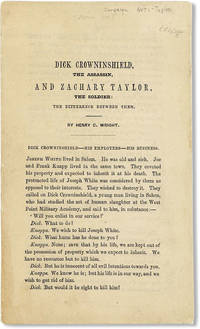
1848rif. 45010Edinburgh: H. Armour n.d. but 1848. First U.K. Edition. 12mo 18cm.; publisher's side-stitched self-wrappers; 11pp. Light dust-soil tiny soil spot to rear wrapper else Very Good to Near Fine. Anti-Zachary Taylor pamphlet issued by the pacifist and marriage reform advocate Henry C. Wright 1797 - 1870 during Taylor's successful 1848 bid for the presidency. Here the author compares Taylor's career to that of Richard Crowninshield's 1804-1830 who was hired in 1830 to murder the 82-year-old captain and former slave trader Joseph White. H. Armour unknown
1949rif. 4269Scottdale Pa 1949. Very good. Four pamphlets paginations below. Small quartos in light card wrappers stapled. Minor soiling and wear. A group of four tracts on the Mennonite pacifist philosophy and its consequences. The titles present are as follows: 1 Horsch John. The Principle of Nonresistance As Held by the Mennonite Church. Scottdale Pa.: Mennonite Publishing House 1939. 2nd Edition Revised and enlarged. 74pp. 2 Yoder Edward. Compromise with War: A Brief Critique of the War Philosophy of Charles Clayton Morrison. Scottdale Pa.: Mennonite Central Committee 1944. 14pp. 3 Yoder Edward and Don Smucker. The Christian and Conscription: An Inquiry As a Preface to Action. Scottdale Pa.: Herald Press 1945. 124pp. 4 Gingerich Melvin. What of Noncombatant Service: A Study of Alternatives Facing the Conscientious Objector. Scottdale Pa. 1949. 2nd Edition. 48pp. unknown
2017br. A differenza dei tanti uomini pronti a misurarsi in quella che considerarono un'eroica ed elettrizzante avventura, le donne italiane non invocarono la guerra. Ci fu poi un gruppo di utopiste, legate a una rete internazionale di militanti, che avanzò una ferma critica al sistema di potere maschile. Per quella élite di femministe e di suffragiste erano gli uomini a capo dei governi e della diplomazia, che sceglievano di dirimere i conflitti tra le nazioni attraverso lo strumento della guerra, a provocare dolore e spargimenti di sangue. Per questo motivo, negli anni a cavallo tra Ottocento e Novecento e nel corso del primo conflitto mondiale, chiesero più diritti e più democrazia per le donne e sollecitarono la loro partecipazione nelle decisioni sulle vicende nazionali e internazionali.
2004br. In questa conferenza tenuta a Berlino nel 1927, Max Scheler applica al clima politico dell'epoca i principi che aveva sviluppato in una delle sue opere più importanti, "Il formalismo nell'etica e l'etica materiale dei valori". Scheler s'interroga sulla "pace perpetua" davanti a un uditorio di uomini politici e diplomatici che di lì a poco sarebbero saliti alla ribalta in Germania. Ma non si tratta di uno scritto occasionato da un clima culturale che prepara la strada a Hitler; è invece il ragionamento lucido in risposta all'idea che da un conflitto di portata mondiale possa venire una pace eterna.
2019ril. L'ideologia pacifista, la strenua, indefessa fiducia nella necessità della non violenza, la difesa dei diritti e della libertà del singolo e dei popoli, l'uguaglianza delle genti, la sacralità del lavoro e della famiglia rappresentano per Gandhi non tanto un messaggio nuovo e rivoluzionario da propagandare al mondo intero, quanto dei valori costitutivi e inalienabili dell'uomo che fanno parte della sua intima natura e come tali vanno sostenuti. Di qui la purezza, la linearità, la sincerità del pensiero di Gandhi, che abbraccia ogni aspetto del vivere singolo e collettivo ed emerge in queste pagine in tutta la sua limpida onestà morale e con tutta la forza e il coraggio che solo la fede più profonda nella propria verità riesce a generare.
2019br. Un pellegrinaggio di pace che tutti dovremmo compiere. Se al loro apparire "Lettere contro la guerra" hanno rappresentato una delle riflessioni più importanti sul «dopo 11 Settembre», oggi questo piccolo libro incandescente, sgorgato dal suo autore in pochi, drammatici mesi, ma frutto di una vita di viaggi e conoscenze, ci parla non più di una guerra, bensì di tutte le guerre, e contro di esse fa sentire la sua voce limpida, ormai al di là della cronaca. In un'epoca in cui nessuno accetta più lezioni da nessuno, le Lettere di Tiziano Terzani sono invece una lezione preziosissima, non soltanto contro la violenza, ma anche contro l'intolleranza, l'ipocrisia, le semplificazioni e l'indifferenza.
2020br. In un mondo ancora attraversato da violenze, conflitti, guerre spesso dimenticate o nascoste, il movimento pacifista fatica a trovare spazi. La stagione della grande mobilitazione d'inizio millennio appare lontana anni luce. Cosa è cambiato rispetto a quando il movimento arcobaleno era capace di riempire piazze e di spingere gli italiani a esporre la bandiera della pace alla finestra? Molto meno di vent'anni dopo, la cronaca descrive un paesaggio assai diverso. Il linguaggio della pace non è più pop. Eppure una mobilitazione, soprattutto tra i più giovani, sta crescendo: quella che impone l'ambientalismo come tema globale, irrinunciabile per l'agenda politica. E dalla crisi del movimento pacifista quale lezione può trarre chi oggi scende in piazza contro il cambiamento climatico? Insieme a professori, studiosi, attivisti, politici, abbiamo indagato le possibili cause esterne e interne che hanno contribuito alla "mutazione arcobaleno". Riflettere su questo potrebbe aiutarci anche a comprendere la portata della nuova ondata di partecipazione e, magari, a non commettere gli stessi errori del passato.
2016br. Dopo il '45 è sembrato che l'Europa riuscisse a mettere fuori gioco la guerra, sconfessando così gran parte del suo stesso passato. Ora però essa è nuovamente circondata da una conflittualità minacciosa, e per le nostre democrazie si sta forse annunciando un appuntamento fatale con la storia: un appuntamento nel quale mille indizi sembrano indicare che la guerra possa tornare d'attualità. Ma l'Europa saprà ritrovarne le categorie culturali, prima ancora che le armi? Provenienti dal mondo della storia, della geopolitica, della filosofia e della letteratura, quattro autorevoli voci fanno i conti con l'evoluzione dell'atteggiamento europeo sulla guerra: Massimo Cacciari; Lucio Caracciolo, Ernesto Galli della Loggia, Elisabetta Rasy.
2013br. L'intellettuale statunitense Henry David Thoreau (Concord, Massachusetts, 1817-1862) è stato uno dei protagonisti del "rinascimento americano" di metà Ottocento, e un vero precursore di quella che sarà la cultura libertaria del Novecento. Di Thoreau questo libro raccoglie tre brevi saggi che ne testimoniano la biografia e il pensiero. Il primo è "Disobbedienza civile" (Resistance to Civil Government, 1849), testo che teorizza l'obiezione di coscienza, e appunto la disobbedienza civile, quali azioni di lotta nonviolenta individuale contro le iniquità del potere e i soprusi delle maggioranze. Il secondo è "Apologia per John Brown" (A Plea for Captain John Brown, 1859): un'appassionata orazione-tributo dedicata all'attivista antischiavista John Brown, eroico protagonista della lotta armata contro la schiavitù, impiccato il 2 dicembre 1859. Il terzo è "Camminare" (Walking, 1863): pubblicato postumo, questo breve saggio racchiude l'essenza del pensiero di Thoreau sulla necessità di un pieno rapporto dell'essere umano con la natura quale percorso di elevazione spirituale.