Posocco, FrancoBiblio.com
9 709 résultats
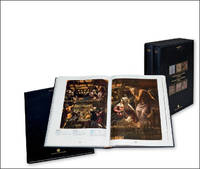
2011réf. 92212Franco Cosimo Panini Acc. New. Hardcover. FREE UPGRADE to Courier/Priority Shipping Upon Request - IN STOCK AND IMMEDIATELY AVAILABLE FOR SHIPMENT - Flawless copy brand new pristine never opened -- TWO 2 VOLUME SET. 774 pages; 619 illustrations including 402 in color. -- with a bonus offer--; Mirabilia Italiae; The Scuola Grande di San Rocco considered the Sistine Chapel of Venice houses the most acclaimed works of the city's greatest painter Jacopo Tintoretto as well as the masterpiece of Italian carving the magnificent wooden choir-stalls by Francesco Pianta. . 2011. 882480344X . Franco Cosimo Panini (Acc) hardcover
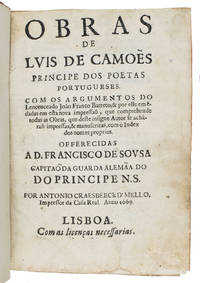
1669réf. LB5CV0F176R3Lisbon: Antonio Craesbeeck de Mello 1669. Later mottled calf red spine labels red edges. 8vo. With 8 woodcut tailpieces. 3 volumes bound as 1. Rare edition of the collected works of Luis de Camões including Os Lusiadas and three Rimas. In the same year Antonio Craesbeeck published another edition with the same title but with less content and with a different frontispiece. This collection of works is made up of separate publications.Os Lusiadas is the great epic poem of Portuguese exploration in the original Portuguese a monument of Portuguese literature that gave a Homeric aura to Renaissance voyages of discovery and colonial conquests here together with the other works of Camões. Camões's work was first published in Portuguese at Lisbon in 1572. In the early 1530s the great Portuguese historian João de Barros most famous for his Decadas de Asia had called for an epic poem of Portuguese exploration and discovery. Luis de Camões 1524-1580 answered that call four decades later. Camões was educated in a monastic school in Coimbra and produced poetry and plays at an early age. In his early twenties he was banished from Lisbon after producing a play considered disparaging to the royal family. He served as a soldier in the Portuguese forces besieging Ceuta in North Africa where he lost an eye. Camões returned to Lisbon in 1550 but found himself in more trouble and was pardoned by the King on condition that he serve the Crown in India for five years. He arrived at Goa in late 1553 and stayed there briefly before joining an expedition to the Malabar Coast. Later he participated in a campaign against pirates on the shores of Arabia. In 1556 he left Goa again for the East Indies taking part in the military occupation of Macao where he remained for many months. On his return trip to India he was shipwrecked off the Mekong and wandered in Cambodia before reaching Malacca and eventually returning to Goa. He did not return to Lisbon until 1570. The Lusiads gives a fine description not only of Portuguese exploits in the East but also of the flora and fauna of Asia and India the ethnographic details of the peoples there and the geography of the region informed by Camões's own experiences as well as his familiarity with Ptolemy and Barros. With the bookplate of "Aulo-Gélio" 1961 with a view of Lisbon. First few pages slightly worn with some repairs. Stained throughout. Some contemporary annotations in ink in the margins.l Bibliotheca Lusitana p. 62; Inocêncio vol. 14 p. 78; José de Canto 37. Antonio Craesbeeck de Mello, unknown
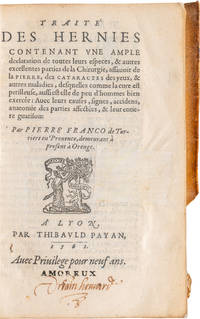
1561réf. 954Lyon: Thibauld Payan 1561. Second edition of Franco's most famous work greatly expanding the 1st 1556 with 25 new woodcuts 22 instruments and 3 skeletons. 8vo 175 x 119mm pp. 34 554 2. Contemporary ink ownership inscription to the title page title with old paper restoration 30mmx40mm to blank right margin paper reinforcements to lower margin of G2 ‘F2’ T6 Bb8 Ii2 worming to the final 26 leaves not effecting text errata with a 28mmx44mm piece of the lower blank margin removed and the whole page laid down some very minor sporadic foxing and browning else internally clean very good. Bound in contemporary vellum remnants of from an old manuscript chipped at the lower rear corner lacking the ties toned else very good. Only 3 other copies at auction in at least 85 years. Norman 828. Pierre Franco's "Traité des Hernies" is a groundbreaking work in the history of medicine originally published in 1556 and greatly expanded in this second edition from 1561. Franco one of the most innovative surgeons of the Renaissance despite his humble origins made significant contributions to the field of operative surgery elevating it from the hands of charlatans and itinerant 'cutters' and bringing it back into the realm of respected medical practice. Born to a poor family in Provence Franco never received formal university education—a remarkable detail considering his impact. Instead he trained as a barber-surgeon a less prestigious position that provided extensive practical experience. Franco's importance stems from several groundbreaking achievements. The Traité represents the first comprehensive text dedicated entirely to hernias and their surgical treatment. Franco meticulously documented various types of hernias and standardized their classification when most practitioners relied on unstructured knowledge passed through apprenticeship. Franco introduced new techniques and instruments such as performing the first documented suprapubic lithotomy removal of bladder stones in 1556 on a child when traditional approaches proved impossible a technique that eventually became standard practice. He also refined techniques for cataract treatment perfecting the "couching" method and pioneering early forms of lens extraction. His work on hernia surgery was particularly groundbreaking as he developed a method for performing herniotomies without castration a common practice at the time. Unlike many contemporaries who deferred to ancient authorities Franco prioritized direct observation and experience. By publishing in French rather than Latin he made surgical knowledge accessible to practicing surgeons without classical education. The detailed work on specific procedures laid the groundwork for surgical specialization and the woodcuts in this expanded second edition featuring 25 new illustrations not found in the first edition documented specialized instruments many of Franco's own design serving as prototypes for surgical tool development well into the 19th century. Franco's systematic approach established standards that elevated the reputation of surgery as a legitimate medical discipline. He directly influenced later surgical giants including Ambroise Paré who acknowledged Franco's contributions. This 1561 edition represents a crucial moment in the development of modern surgery documenting techniques that established principles that remain relevant in contemporary surgical practice nearly five centuries later. “… influential in bringing operative surgery back into the realm of regular surgical practice recapturing it from the ignorant hands of charlatans and itinerant ‘cutters'”. Thibauld Payan unknown
1561réf. 954Lyon: Thibauld Payan 1561. Second edition of Franco's most famous work greatly expanding the 1st 1556 with 25 new woodcuts 22 instruments and 3 skeletons. 8vo 175 x 119mm pp. 34 554 2. Contemporary ink ownership inscription to the title page title with old paper restoration 30mmx40mm to blank right margin paper reinforcements to lower margin of G2 ‘F2’ T6 Bb8 Ii2 worming to the final 26 leaves not effecting text errata with a 28mmx44mm piece of the lower blank margin removed and the whole page laid down some very minor sporadic foxing and browning else internally clean very good. Bound in contemporary vellum remnants of from an old manuscript chipped at the lower rear corner lacking the ties toned else very good. Only 3 other copies at auction in at least 85 years. Norman 828. Pierre Franco's "Traité des Hernies" is a groundbreaking work in the history of medicine originally published in 1556 and greatly expanded in this second edition from 1561. Franco one of the most innovative surgeons of the Renaissance despite his humble origins made significant contributions to the field of operative surgery elevating it from the hands of charlatans and itinerant 'cutters' and bringing it back into the realm of respected medical practice. Born to a poor family in Provence Franco never received formal university education—a remarkable detail considering his impact. Instead he trained as a barber-surgeon a less prestigious position that provided extensive practical experience. Franco's importance stems from several groundbreaking achievements. The Traité represents the first comprehensive text dedicated entirely to hernias and their surgical treatment. Franco meticulously documented various types of hernias and standardized their classification when most practitioners relied on unstructured knowledge passed through apprenticeship. Franco introduced new techniques and instruments such as performing the first documented suprapubic lithotomy removal of bladder stones in 1556 on a child when traditional approaches proved impossible a technique that eventually became standard practice. He also refined techniques for cataract treatment perfecting the "couching" method and pioneering early forms of lens extraction. His work on hernia surgery was particularly groundbreaking as he developed a method for performing herniotomies without castration a common practice at the time. Unlike many contemporaries who deferred to ancient authorities Franco prioritized direct observation and experience. By publishing in French rather than Latin he made surgical knowledge accessible to practicing surgeons without classical education. The detailed work on specific procedures laid the groundwork for surgical specialization and the woodcuts in this expanded second edition featuring 25 new illustrations not found in the first edition documented specialized instruments many of Franco's own design serving as prototypes for surgical tool development well into the 19th century. Franco's systematic approach established standards that elevated the reputation of surgery as a legitimate medical discipline. He directly influenced later surgical giants including Ambroise Paré who acknowledged Franco's contributions. This 1561 edition represents a crucial moment in the development of modern surgery documenting techniques that established principles that remain relevant in contemporary surgical practice nearly five centuries later. “… influential in bringing operative surgery back into the realm of regular surgical practice recapturing it from the ignorant hands of charlatans and itinerant ‘cutters'”. Thibauld Payan unknown books
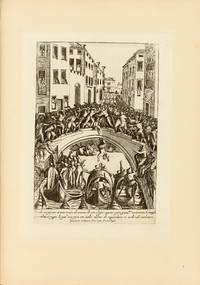
réf. NY24Venice Giacomo Franco Forma in Frezzaria al Insegna del Sole con privilegio s.d. 1610. Small folio volume. "1 . title engraved with same view of Venice than the one for "Habiti delle Donne" 1 l. not numbered dedication to Vincent de Gonzague de Mantoue dated 1st January 1610 and printed in roman characters 25 plates out of pagination and not numbered. Those plates represent 34 figures of men and women in very rich Venitian costumes life scenes festivities." Colas n° 1108. 360 x 260 mm. Dimensions of the engravings: 258 x 190 mm. Very rare first edition of one of the most famous books on Venice its festivities costumes and activities around 1600. Colas Bibliographie Générale du Costume n°1108 col. 384-5; Katalog Der Freiherrlich Von Lipperheide'schen Kostümbibliothek repr. 1963 n°1324 p. 527. "This collection offers great interest in the costumes of Venice during its greatness. It is sought after today especially as it has become extremely rare ". Vinet Bibliographie méthodique des Beaux-Arts. This collection is so rare that Brunet never found a complete copy and only described an incomplete one Brunet II 1378. As for Vinet he doubts the number of plates following the number 24 with a "" Vinet col 283 n° 2291. The copy of the British Museum only contains 20 plates out of 25 and one title leaf is missing. Title engraved with a birds 'eye view of Venice on an architectural frame with a view of the Rialto bridge and 24 extremely fine engravings. The book shows in an extraordinary detailed way the various festivities processions and past times of the city as well as great moments in its history. "Assimilated to the genre of the costume book the work by Giacomo Franco 1556 - 1620 drawer and engraver born in Venice also shows engravings of a strong interest for the history of manners and customs of the Serenissima in the 16th and 17th centuries: festivals entertainment maritime games regattas… and carnival. The 1610 edition is probably the first. The number and order of the engravings vary greatly from one edition to another and between copies of the same edition. The copy is composed of 26 copper plates including one double plate all except one signed by Giacomo Franco. The engraving named Feste che si sogliono fare per la città della caccia del toro amazzar la Gata col capo raso pigliar l'anadre pigliar l'occa nell'acqua et altro features games with animals: a bear fighting with dogs a tied up cat a goose being plunged into water a duck hanging from a mast and a chased bull. Attested since the Middle Ages bull hunting is a traditional carnival game in the Renaissance particularly in Rome and Venice". Virtual exhibition organized by the Mazarine Library Libri italiani lecteurs français "Balls festivals and banquets". "This book of engravings depicts the costumes festivals and social life of early seventeenth-century Venetians. There is no text other than a short descriptive sentence at the bottom of each engraving. Major Venetian landmarks are easily recognizable and the small ovoid map on the title-page is regarded by some scholars as an important example of early Venetian cartography. Very little is known about the Venetian engraver Giacomo Franco. The son of painter Giovanni-Battista Franco 1510-1561 with whom he began his artistic training at the age of eleven he worked as a painter engraver woodcutter and dealer in graphics and books. For a while he studied in Bologna with Agostino Carracci 1557-1602. In the early 1580s they opened a private teaching academy that soon became a center for progressive art. In their teaching they laid special emphasis on drawing from life and clear draughtsmanship became a quality particularly associated with their school. In 1595 Franco took over his father's workshop and eventually became a well-known publisher. Although he was not documented as belonging to the booksellers' or printers' guilds he is recorded in 1606 and again in 1619 as belonging to the painters' guild. Franco's determination to be recognized as an artist is reflected in his will in which he refers to himself as a "designer." The Habiti d'huomini is a potpourri of depictions of Venetian costumes processions and celebrations. Citizens are seen watching regattas fighting on bridges conversing in the Piazza San Marco and on the Rialto Bridge and marching in ceremonial procession into the Doge's Palace with flags flying and horns and flutes playing. Even the ubiquitous laundry is seen hanging on the line in the background. Men with rifles hunt ducks in the lagoon. The Doge's mighty Bucintoro warship returns from battle escorted by gondolas and saluted by cannon explosions. Carnival of course has a page of its own which depicts citizens in masks some of whom seem to be making best use of the cover of darkness to contact a prospective lover. The appropriately dressed widow is pictured heavily veiled and a married gentlewoman has two outfits from which to choose one for inside the house another for outside. The men are almost as ornately dressed as the women. The Doge in his palace wearing fine brocade and a crown moves his hand in a sort of blessing as – through a window behind him – life in the Piazza San Marco goes on". The Boston Athenaeum Museum "From the middle of the 15th century the Venetian institutions came to maturity which allows Venice to parade every week in the fullness of its myth under the eyes of the Venetians and the whole world Urbi et orbi - including the Turks and the Chinese. Venice then shows itself united eternal strong and indestructible. " One of the great moments of this frenzied proclamation of the political perfection of Venice is the rite of the trionfo - or ducal procession - where hierarchy order harmony and collective respect are the characteristics of this state liturgy. This urban rite we could even say ritual is a great moment in the political life - and in the life itself - of Venice. Indeed the ducal procession is intended to be a proclamation of the cohesion of the State and its strong structure in the eyes of the Venetians as in the eyes of foreigners who will necessarily receive echoes. The Milanese Pietro Casolo passing through Venice at the end of the 16th century was impressed by the unchanging - and disciplined - ordering of these Venetian processions: In my opinion one man seemed to rule all things and he was obeyed by all without resistance. It filled me with admiration as I have never seen such a discipline at similar shows. They walk two by two behind the doge in a completely different order from what I have seen in many religious or secular courts where as soon as the prince has passed everything goes in all directions and in disorder. Here in front and behind everything is as in a perfect order as possible. The ordering and place of each are not the result of chance but the result of a rigorously thought out and unchanging ceremony. This immutability is demonstrated by the existence of commented engravings that is to say that the artists note the order of the succession of the characters as an element as perennial as the architectures that frame this ceremony. An example the engraving of Giacomo Franco which shows us the beginning of the procession which enters the basilica. The frieze arrangement evokes the Roman triumphs of the Ara Pacis or Trajan's Column." Marie-Viallon The Ducal procession in Venice. Precious and beautiful copy coming from the library of the 19th century A. Brölemann with ex-libris. Français : Venice Giacomo Franco Forma in Frezzaria al Insegna del Sole con privilegio s.d. 1610. Petit in-folio. " 1 f. titre gravé avec la même vue de Venise que pour " Habiti delle Donne " 1 f. non chiffr. dédicace à Vincent de Gonzague de Mantoue datée du 1er janvier 1610 et imprimée en caractères romains 25 planches h. t. gr. non chiffr. Ces planches portent 34 figures d'hommes et de dames dans de très riches costumes vénitiens des scènes de mœurs des réjouissances. " Colas n° 1108. Le présent exemplaire compte 1 titre gravé avec vue de Venise et 24 planches portant 30 figures d'hommes et de dames ; manquent le feuillet de dédicace et une planche portant 4 figures mais le nombre et l'ordonnancement des gravures sont très variables entre les exemplaires d'une même édition " this fine collection of detailed views and scenes of Venetian life and costume was issued with varying numbers of plates ". Qq. rousseurs en marge du frontispice. Le tout monté sur grand papier et relié vers 1850 par Duru en demi-maroquin rouge à coins. 360 x 260 mm. Dimensions des gravures : 258 x 190 mm. Edition originale rarissime de l'un des livres les plus célèbres sur Venise ses fêtes costumes et activités vers l'année 1600. Colas Bibliographie Générale du Costume n°1108 col. 384-5; Katalog Der Freiherrlich Von Lipperheide'schen Kostümbibliothek repr. 1963 n°1324 p. 527. " Ce recueil offre un grand intérêt pour les costumes de Venise pendant sa grandeur. On le recherche aujourd'hui d'autant plus qu'il est devenu d'une extrême rareté ". Vinet Bibliographie méthodique des Beaux-Arts. Ce recueil est si rare que Brunet n'a jamais rencontré d'exemplaire complet et ne décrit qu'un exemplaire incomplet Brunet II 1378. Quant à Vinet il doute du nombre de planches faisant suivre le chiffre 24 d'un " " Vinet col 283 n° 2291. L'exemplaire du British Museum ne contient que 20 planches sur 25 et il manque le feuillet de titre. Titre gravé avec vue à vol d'oiseau de Venise dans un cartouche architectural surmonté d'une vue sur le pont du Rialto et 24 gravures extrêmement fines. Le livre montre avec un détail extraordinaire les différentes festivités processions et temps passés de la ville ainsi que de grands moments de son histoire. " Assimilé au genre du livre de costumes l'ouvrage de Giacomo Franco 1556 - 1620 dessinateur et graveur né à Venise montre également des gravures d'un fort intérêt pour l'histoire des mœurs et coutumes de la Sérénissime aux XVIe et XVIIe siècles : fêtes divertissements joutes maritimes régates… et carnaval. L'édition de 1610 est probablement la première. Le nombre et l'ordonnancement des gravures sont très variables d'une édition à l'autre et entre les exemplaires d'une même édition. L'exemplaire exposé comporte 26 planches gravées sur cuivre dont une double planche toutes sauf une signées de Giacomo Franco. La gravure intitulée Feste che si sogliono fare per la città della caccia del toro amazzar la Gata col capo raso pigliar l'anadre pigliar l'occa nell'acqua et altro met en scène des jeux avec des animaux : un ours se battant avec des chiens un chat ligoté une oie que l'on plonge dans l'eau un canard accroché à un mât et un taureau pourchassé. Attestée depuis le Moyen Âge la chasse au taureau est un jeu traditionnel du carnaval à la Renaissance en particulier à Rome et à Venise ". Exposition virtuelle organisée par la Bibliothèque Mazarine Libri italiani lecteurs français " Bals fêtes et banquets ". "This book of engravings depicts the costumes festivals and social life of early seventeenth-century Venetians. There is no text other than a short descriptive sentence at the bottom of each engraving. Major Venetian landmarks are easily recognizable and the small ovoid map on the title-page is regarded by some scholars as an important example of early Venetian cartography. Very little is known about the Venetian engraver Giacomo Franco. The son of painter Giovanni-Battista Franco 1510-1561 with whom he began his artistic training at the age of eleven he worked as a painter engraver woodcutter and dealer in graphics and books. For a while he studied in Bologna with Agostino Carracci 1557-1602. In the early 1580s they opened a private teaching academy that soon became a center for progressive art. In their teaching they laid special emphasis on drawing from life and clear draughtsmanship became a quality particularly associated with their school. In 1595 Franco took over his father's workshop and eventually became a well-known publisher. Although he was not documented as belonging to the booksellers' or printers' guilds he is recorded in 1606 and again in 1619 as belonging to the painters' guild. Franco's determination to be recognized as an artist is reflected in his will in which he refers to himself as a "designer." The Habiti d'huomini is a potpourri of depictions of Venetian costumes processions and celebrations. Citizens are seen watching regattas fighting on bridges conversing in the Piazza San Marco and on the Rialto Bridge and marching in ceremonial procession into the Doge's Palace with flags flying and horns and flutes playing. Even the ubiquitous laundry is seen hanging on the line in the background. Men with rifles hunt ducks in the lagoon. The Doge's mighty Bucintoro warship returns from battle escorted by gondolas and saluted by cannon explosions. Carnival of course has a page of its own which depicts citizens in masks some of whom seem to be making best use of the cover of darkness to contact a prospective lover. The appropriately dressed widow is pictured heavily veiled and a married gentlewoman has two outfits from which to choose one for inside the house another for outside. The men are almost as ornately dressed as the women. The Doge in his palace wearing fine brocade and a crown moves his hand in a sort of blessing as – through a window behind him – life in the Piazza San Marco goes on". The Boston Athenaeum Museum " Dès le milieu du XVe siècle les institutions vénitiennes sont parvenues à maturité ce qui permet à Venise de parader chaque semaine dans la plénitude de son mythe sous les yeux des Vénitiens et du monde entier Urbi et orbi - y compris les Turcs et les Chinois. Venise se montre alors unie forte éternelle et indestructible." Un des grands moments de cette proclamation forcenée de la perfection politique de Venise est le rite du trionfo - ou procession ducale - où hiérarchie ordre harmonie et respect collectif se veulent les caractéristiques de cette liturgie d'État. Ce rite voire rituel urbain est un grand moment de la vie politique - et de la vie tout court - de Venise. En effet la procession ducale se veut une proclamation de la cohésion de l'État et de sa forte structuration aux yeux des Vénitiens comme aux yeux des étrangers qui en recevront nécessairement des échos. Le milanais Pietro Casolo de passage à Venise à la fin du XVIe siècle a été impressionné par l'ordonnancement immuable - et discipliné - de ces processions vénitiennes : Selon moi un seul homme semblait ordonner toutes choses et il était obéi de tous sans résistance. Cela m'a rempli d'admiration car je n'ai jamais assisté à une telle discipline lors de spectacles similaires. Ils marchent deux par deux derrière le doge dans un ordre tout différent de ce que j'ai vu dans de nombreuses cours religieuses ou profanes où dès que le prince est passé tout part dans tous les sens et en désordre. Ici devant et derrière tout est aussi parfaitement en ordre que possible. L'ordonnancement et la place de chacun ne sont pas le fruit du hasard mais le résultat d'un cérémonial rigoureusement pensé et immuable. Cette immuabilité est démontrée par l'existence de gravures commentées c'est-à-dire que les artistes notent l'ordre de la succession des personnages comme un élément aussi pérenne que les architectures qui encadrent cette cérémonie. Un exemple la gravure de Giacomo Franco qui nous montre le début de la procession qui entre dans la basilique. L'ordonnancement en frise évoque les triomphes romains de l'Ara pacis ou de la colonne Trajane. " Marie-Viallon La procession ducale à Venise. Précieux et bel exemplaire provenant de la bibliothèque du XIXe siècle A. Brölemann avec ex-libris. hardcover
réf. LCS-17886Édition originale et très bel exemplaire provenant de la bibliothèque A. Brolemann. Venice, Giacomo Franco Forma in Frezzaria al Insegna del Sole con privilegio, s.d. [1610]. Petit in-folio. « 1 f. (titre gravé avec la même vue de Venise que pour « Habiti delle Donne »), 1 f. non chiffr. (dédicace à Vincent de Gonzague de Mantoue datée du 1er janvier 1610 et imprimée en caractères romains), 25 planches h. t. gr. non chiffr. Ces planches portent 34 figures d’hommes et de dames dans de très riches costumes vénitiens, des scènes de mœurs, des réjouissances. » (Colas, n° 1108). Le présent exemplaire compte 1 titre gravé avec vue de Venise et 24 planches portant 30 figures d’hommes et de dames ; manquent le feuillet de dédicace et une planche portant 4 figures mais le nombre et l’ordonnancement des gravures sont très variables entre les exemplaires d’une même édition (« this fine collection of detailed views and scenes of Venetian life and costume was issued with varying numbers of plates »). Qq. rousseurs en marge du frontispice. Le tout monté sur grand papier et relié vers 1850 par Duru en demi-maroquin rouge à coins. 360 x 260 mm. Dimensions des gravures : 258 x 190 mm.
1479réf. ABC_49714Colophon on i6v: Gouda: Geraert Leeu 1479. Modern vellum sewn on 4 vellum tapes laced through the joints gold-tooled spine with a burgundy morocco title label lettered in gold. Small folio ca. 26 x 20 cm. The text is set in Gothic type in double columns of 35 lines to a page with large manuscript initials in red ink at the start of every chapter rubricated throughout. Further with Geraert Leeu's printer's device and his initials below the colophon on i5v. Extremely rare early Dutch incunable edition of Dat scaecspel printed by Geraert Leeu in Gouda; one of the earliest editions of the Dutch translation of the celebrated classic work titled De ludo scachorum by the Italian Dominican friar Jacobus de Cessolis ca. 1250-ca. 1322. It is likely the earliest precisely dated edition of this text in Dutch. The colophon clearly states the date of printing: "Int iaer ons heren dusent vier-hondert ende neghentseventich op ten anderden dach van october ." = 2 October 1479. Another early edition exists which was printed in Zwolle ca. 1478-1480 but this edition is not clearly dated and thus could have been printed after the present edition. We have not been able to trace any other copies of the present 1479 edition in sales records of the last 100 years.De ludo scachorum is a moral allegory in which the rules and pieces of the game of chess serve as a framework for reflections on society duty and governance. It had already become one of the most popular didactic texts of the later Middle Ages and with the publication of De Cessolis' text in print in several European languages it definitively became a classic in European literary tradition. The present work is the first book in the Dutch language to concern the game of chess and the first printed edition of the Latin text was also produced in the Netherlands by the printers Nicolaus Ketelaer and Gerardus de Leempt in Utrecht in 1474.The original text in Latin consisted of four parts each divided into chapters. The first part discusses the origins of chess and the purposes behind its creation: to reform the misconduct of rulers to ward off idleness and melancholy and to provide endless novelty through the games variety. The next two parts interpret the chess pieces as symbols of the different social estates with each class illustrated through stories and examples. The final part turns to the game itself: the board is likened to the city of Babylon the starting positions of the pieces are described and their movements are explained in detail. The present Dutch translation mainly focuses on the first 3 parts which are here divided into 14 chapters. It focuses more on the moralising allegory of the text than on the way game of chess itself is played. It does include an epilogue by the adapter/translator named Franco leaf i5v.With a manuscript annotation in reddish-brown pencil on the recto of the first leaf "Dat Scaecspell". The blank spaces before each chapter except the first are filled with manuscript summaries of that chapter in a 17th-century hand. Further with some contemporary in red and 17th-century in brown annotations in the margins mostly numbers and small asterisks etc. The first and last leaves are somewhat browned some minor restorations to the paper in the margins not affecting the text and some dust soiling and minor foxing throughout. Otherwise in very good condition. A rare copy of a captivating 14th-century allegorical treatise on the game of chess that became a classic in European literary tradition.l BMC IX pp. 32-33; Campbell-Kronenberg 419; Elloitt-Loose 318; Gesamt Kat. Wiegendrucke 06535; Goff C411; Hain-Copinger 4904; Heel De Goudse drukkers en hun uitgaven. I Gerard Leeu p. 8; ISTC ic00411000 8 copies incl. 2 incomplete; Pellechet 3507; Polain 2158; Proctor 8917; Thienen IDL 1217; Thienen & Goldfinch ILC 553; USTC 435433 7 copies; WorldCat 1079782638 7450101 1415095142 5 copies. Geraert Leeu, hardcover
2003ARMANDO EDITORE 2003 285 PP. FONDO DI MAGAZZINO: CENNO DI PIEGA IN QUARTA DI COPERTINA, COME DA FOTO, SEGNI DEL TEMPO, VOLUME INTONSO, MAI SFOGLIATO. Il volume affronta le tematiche relative alle questioni educative, scolastiche e politiche di più stringente attualità, servendosi di un impianto scientifico di sicuro rigore e di utili itinerari di carattere operativo. E' proprio questo continuio rimando tra teoria e prassi a costituire il filo rosso di una argomentazione che si dipana tra riflessioni epistemologiche ed emergenze sociali, alla luce di una prospettiva pedagogica in senso sociale. Questo libro rappresenta un agile testo istituzionale, una guida alla ricerca, uno strumento di lavoro per quanti operano nel sociale, siano essi insegnanti, educatori, operatori sociali o ricercatori.
1030174