1.950 Ergebnisse
1945Very Good Turkish, Ottoman (1500-1928) Original manuscript autograph letter signed (ALS) signed by Behçet Kemal Çaglar, addressed to Turkish female poet Halide Nusret Zorlutuna, (1901-1984). 21x14 cm. In Ottoman script written on a paper with letterhead 'TBMM' [i.e. Grand National Assembly of Turkey]. 1 p. 17 lines. No date. It starts as "Sevgili Nusret ablacigim...". Çaglar graduated as a senior mining engineer in 1929. He served as a regional manager at MTA (Turkish Mining Survey and Research Department), and for a short while, was a Member of Parliament. In 1949, Çaglar published the magazine Sadirvan. He also directed the radio program "Siir Dünyamiz" (meaning Our World of Poetry in Turkish). Common themes in his poetry included Kemalism and populism. Behcet Kemal Caglar taught Turkish Literature at Robert College (Robert College is an American College founded in 1862 in Istanbul, Turkey).
1945Very Good Turkish, Ottoman (1500-1928) Original manuscript autograph letter signed (ALS) signed by Behçet Kemal Çaglar, addressed to Turkish female poet Halide Nusret Zorlutuna, (1901-1984). 21x16,5 cm. In Ottoman script. 1 p. 24 lines. Full. No date. It starts as "Sevgili ablam...". He mentions the book written by Zorlutuna published newly in its period, and requests critics from Zorlutuna for his article he works on. Çaglar graduated as a senior mining engineer in 1929. He served as a regional manager at MTA (Turkish Mining Survey and Research Department), and for a short while, was a Member of Parliament. In 1949, Çaglar published the magazine Sadirvan. He also directed the radio program "Siir Dünyamiz" (meaning Our World of Poetry in Turkish). Common themes in his poetry included Kemalism and populism. Behcet Kemal Caglar taught Turkish Literature at Robert College (Robert College is an American College founded in 1862 in Istanbul, Turkey).
1945Very Good Turkish, Ottoman (1500-1928) Original manuscript autograph letter signed (ALS) signed by Behçet Kemal Çaglar, addressed to Turkish female poet Halide Nusret Zorlutuna, (1901-1984). 20,5x15,5 cm. In Ottoman script. 1 p. 15 lines. No date. It starts as "Canim ablam...". Çaglar graduated as a senior mining engineer in 1929. He served as a regional manager at MTA (Turkish Mining Survey and Research Department), and for a short while, was a Member of Parliament. In 1949, Çaglar published the magazine Sadirvan. He also directed the radio program "Siir Dünyamiz" (meaning Our World of Poetry in Turkish). Common themes in his poetry included Kemalism and populism. Behcet Kemal Caglar taught Turkish Literature at Robert College (Robert College is an American College founded in 1862 in Istanbul, Turkey).
1961Very Good Turkish, Ottoman (1500-1928) Original autograph letter signed by Cevat Rifat Atilhan sent to an unnamed recipient. 30x23 cm. In Ottoman script. 15 lines. Full with letterheads. Dated 1961/8/26 with Arabic numbers. A good paper with only an 'extra strong' watermark. It's a feverish letter mentioning the ideas of the readers of Italian and the Turkish nation to an unnamed recipient. Very interesting content. Atilhan was a Turkish career officer and antisemitic writer, who was one of the initiators of the 1934 Thrace pogroms. He was born in 1892 in Vefa, Constantinople. His father Rifat Pasha was the Governor of Damascus. The first years of his childhood passed in Damascus. Then he came to Constantinople and went to Fatih Iptidaisi (primary school). After graduating from primary school, he started to Kuleli Military High School, preferring to military service. In his first days in the lieutenant years, he took part in the Albanian campaign. He was taken prisoner by the Bulgarians in the siege of Edirne. The bondage lasted two years. At the beginning of World War I, he was ordered by Cemal Pasha from Mersin. He came forward with his heroism in the Sinai and Palestinian fronts. Upon the conclusion of the First World War, Cemal Pasha from Mersin came to Konya. The establishment of the National Front had great benefits. He met with Sultan Mehmed VI as the first national representative. When Sultan Mehmed VI left his post, Damat Ferid Pasha had Atilhan arrested because of a conspiracy. He was imprisoned in the Bekir Aga Bölgesi. During the Turkish War of Independence, he was appointed as the commander of Zonguldak-Bartin and Havalisi Fronts. It prevented the spread of the French Army in this region. Upon the victory of the War of Independence, he left the army and went into writing. Of his anti-semitic book "Suzy Liberman, Jewish Spy", in 1935 the Turkish Army gave the order to buy 40000 copies and distributed them amongst the officers. In 1942, he was arrested by the government of the time on the grounds that the coup was being prepared. He was incarcerated for 11 months. In 1952, he was arrested again in Malatya as responsible for the assassination attempt of Ahmet Emin Yalman. He was detained for 11 months and 15 days. He wrote 74 works and thousands of articles. He was influenced by antisemitic politicians like Serif Yaçagaz and Ali Galip Yenen. Because of his antisemitic writings, he was described as the 'Hitler of the Middle East'. In August 1964 he was invited to congress of Islamic State in Somalia. He was elected as the Chairman of the Executive Committee of the Congress. This post was his last major mission. (Source: Wikipedia).
Best.-Nr. DADAX0415182557New unknown
Best.-Nr. DADAX0199209197New unknown
Best.-Nr. DADAX0195131460New unknown
Best.-Nr. DADAX0199213917New unknown
Best.-Nr. DADAX041506340XNew unknown
Best.-Nr. DADAX0415127491New unknown
Best.-Nr. DADAX0198236719New unknown
Best.-Nr. 211921Edinburgh Fairgrieve 1901-1912. 4to. 43 issues c. 8pp. each Bound with series title retaining individual upper wrappers in pictorial cloth-backed boards. An excellent copy. Important Scottish nationalist journal demanding amongst other things Stuart restoration a full Scottish Parliament and the return of the Stone of Scone stolen by Edward I in 1297. Edinburgh, Fairgrieve, 1901-1912. hardcover
Best.-Nr. yk486S.P.R. Revue "In-8 (15,3 x 21 cm), dos carré collé, série complète de la revue nationaliste ""Réaction"" qui ne compte que 13 numéros, du printemps 1991 au printemps 1994, et dont le tirage de cette revue ne dépasse pas 1000 exemplaires. Le premier numéro a été abondamment annoté au crayon à papier par Jean Mabire ; dos partiellement insolés, par ailleurs bon état. Livraison a domicile (La Poste) ou en Mondial Relay sur simple demande."
1971Best.-Nr. ga2675Sav Breizh Revue 1971 In-8 (13,5 x 21,2 cm), dos carré collé, lot comprenant les 23 numéros de la revue Sav Breizh (Directeur : Erwan Vallerie ; Comité de rédaction : Xavier Grall, Alain Guel, Gwenc'hlan le Scouezec, Philippe Le Solliec, Erwan Vallerie), les trois derniers numéros sont différents du reste de la revue : plaquette de 8 pages agrafées pour les n°21 et 22, plaquette non paginée pour le n°23 (contenant un éditorial et une table des textes publiés en 1974 et 1975), ensemble peu commun et rare complet ; couverture frottées et blanchies aux mors, charnières et bords des plats, par ailleurs intérieur frais, assez bon état général. Livraison a domicile (La Poste) ou en Mondial Relay sur simple demande.
1891Very Good Turkish, Ottoman (1500-1928) Contemporary brown half leather, five raised bands to spine, including title and decorations. Slight fading on the spine and stains on the first pages. Demy 8vo. (21 x 14 cm). In Ottoman script (Old Turkish with Arabic letters). 420 p. Rare first edition of this utopian novel, in which he tells the reasons that led to the destruction of the Ottoman Empire and the remedies for recovery through the idealist protagonist Mansur Bey. The word "Turfanda" is the name given to the vegetables and fruits that grow first and early in their season in Turkish culture. The origin of word in Turkish culture comes from the city of Turfan in China, where fruits and vegetables were first grown in Central Asia and Turkestan by Turks. Mizanci Murad [or Murat] was an Ottoman monarchist, democrat, historian, and politician, who was renowned for his work on reviving the concept of Ottomanism during the Second Constitutional Era. Özege 21333.; OCLC has no first edition with its correct imprint details. (Utopias from the Middle East 8).
Best.-Nr. SONG0415559596Used: Good unknown
Best.-Nr. DADAX0199217173New unknown
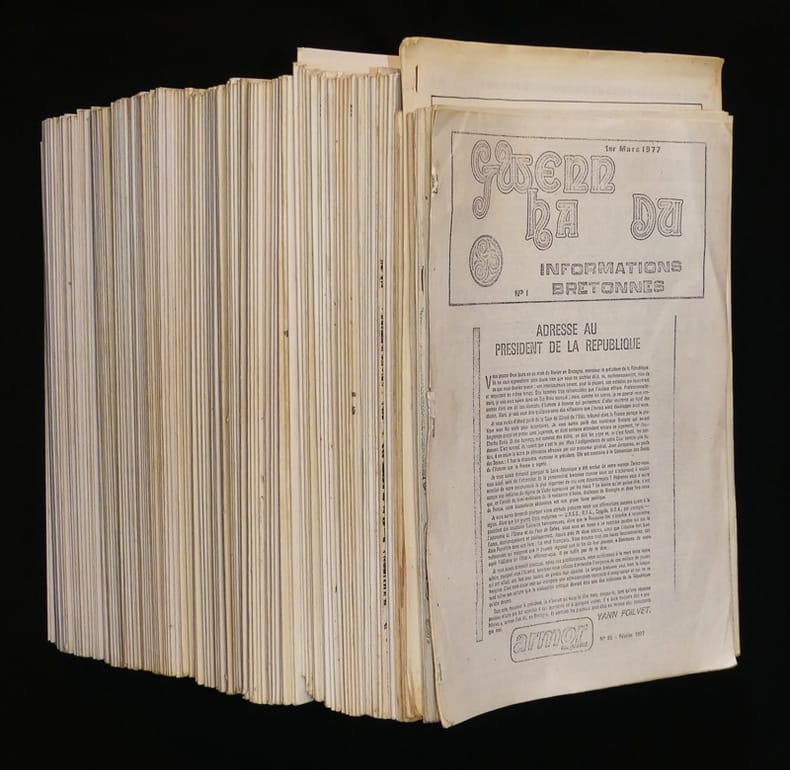
Best.-Nr. qi2415Gwenn ha du Revue "In-4 (de 21 x 32 cm à 22,5 x 31,5 cm), revue agrafée, lot de 178 numéros de la revue nationaliste bretonne ""Gwenn ha du"", ce lot contient les n°1 (1er mars 1977) au n°179 (mai-juin 2007), SAUF le n°15, manquant ; quelques rousseurs, pliures et marques d'usure sur les numéros les plus anciens, par ailleurs bon état général. Livraison a domicile (La Poste) ou en Mondial Relay sur simple demande."
1949Best.-Nr. 19893Paris, A la Girouette, 1949 ; in 8 carré, broché, étui rouge de l’éditeur ; 88 pp., [2] ff. de Table et Achevé d’imprimer, couverture crème rempliée, imprimée en rouge et noir.
1943Best.-Nr. 19896Lyon, Lardanchet (Mâcon, imprimerie Protat Frères), 1943 ; in 8, broché ; 265, [1] pp., couverture blanche rempliée, imprimée en rouge et noir.
1969Original Wraps. 4to. [18] pages. 28 cm. First edition. Winter 1969 issue. Literary magazine of the students at I. S. 55 Ocean Hill (Brownsville Intermediate School) , with support from the principal and various teachers. Profusely illustrated compilation of student drawings and poetry. The magazine, named for the Swahili word for unity or togetherness, contains several poems about healing and black power, while many also express a profound desolation over poverty and social alienation. An important example of the impact of community control on the school system in Brownsville which partly resulted in the city wide teachers strikes of 1968. Includes 5 pages of laid in handwritten notes containing day to day impressions from a (teacher?) on the strikes, the massive drop in student enrollment, and many other incidents; one of the notes is dated April 28, 1969. Many appear to be unfinished letters addressed to an unknown recipient. Subjects: Umoja intermediate school literary magazine. Rare. None listed on OCLC. Light ageing to edges of wraps, overall very clean and fresh. Very good + condition. (SPEC-40-27)
1933Best.-Nr. 20501933 Editions Paul Iribe, Paris, 1933-1934-1935. Format in-4, 9 numéros sont en format "journal". Couvertures et illustrations en couleurs, principalement dus à Paul Iribe. Parution hebdomadaire.
1975311 pages. First English printing of the 1973 French first edition. "A chilling novel about the end of the white world." - dust jacket. "The 'Brave New World' of the 70's. I am still haunted by the drama and suspense and horror of that armada!" - Germaine Bree. "Takes on a whole cluster of polemical issues - over-population, race, the Third World, and the character of liberal thought and sentiment." - Max Lerner. Somewhat above-average wear. Spine leaning. Usual library markings. Clear plastic laminate over dust jacket. Book
1941Very Good Serbo-Croatian Paperback. Roy. 8vo. (23 x 15 cm). In Aljamiado (Serbo-Croatian in Arabic letters), Arabic, and Persian with an introduction in Arabic. The third revised edition of the Waqf Directorate in Sarajevo. 104 p., 4 unnumbered b/w plates. "Ilmihal" [i.e. Catechism] recommended to all who want to know and learn Islamic ceremonies and practice. Learn how to pray, what are basic principles of the Islamic faith, what are the Islamic duties, what are the Islamic holidays, what constitutes proper Islamic behavior, and lots more. This extremely rare catechism book printed in Sarajevo in Croatian with Arabic letters (Aljamiado). This book is one of the late examples of Aljamiado literature beginning in early Andalusia and constitutes one of the rarest examples of the Ottoman book tradition. Aljamiado or Aljamía texts are manuscripts that use the Arabic script for transcribing European languages, especially Romance languages such as Mozarabic, Portuguese, Spanish or Ladino, and Bosnian with its Arebica script. According to Anwar G. Chejne, Aljamiado or Aljamía is "a corruption of the Arabic word ?ajamiyah (in this case it means foreign language) and, generally, the Arabic expression ?ajam and its derivative 'Ajamiyah are applicable to peoples whose ancestry is not of Arabian origin". During the Arab conquest of Persia, the term became a racial pejorative. In linguistic terms, the Aljamía is the use of the Arabic alphabet to transcribe a Romance language. It was used by some people in some areas of Al-Andalus as an everyday communication vehicle, while Arabic was reserved as the language of science, high culture, and religion. The systematic writing of Romance-language texts in Arabic scripts appears to have begun in the fifteenth century, and the overwhelming majority of such texts that can be dated belong to the sixteenth century. A key aljamiado text was the mufti of Segovia's compilation Suma de los principales mandamientos y devediamentos de nuestra santa ley y sunna, of 1462. In later times, Moriscos were banned from using Arabic as a religious language and wrote in Spanish on Islamic subjects. Examples are the Coplas del alhichante de Puey Monzón, narrating a Hajj, or the Poema de Yuçuf on the Biblical Joseph (written in Aragonese). Aljamiado played a very important role in preserving Islam and the Arabic language in the life of the Moriscos. After the fall of the last Muslim kingdom on the Iberian peninsula, the Moriscos (Andalusian Muslims in Granada and other parts of what was once Al-Andalus) were forced to convert to Christianity or leave the peninsula. They were forced to adopt Christian customs and traditions and to attend church services on Sundays. Nevertheless, some of the Moriscos kept their Islamic belief and traditions secretly through the usage of Aljamiado. In 1567, Philip II of Spain issued a royal decree in Spain, which forced Moriscos to abandon using Arabic on all occasions, formal and informal, speaking and writing. Using Arabic in any sense of the word would be regarded as a crime. They were given three years to learn the language of the Christian Spanish, after which they would have to get rid of all Arabic written material. Moriscos translated all prayers and the sayings of their prophet Mohammed into Aljamiado transcriptions of the Spanish language while keeping all Qur'anic verses in the original Arabic. Aljamiado scrolls were circulated amongst the Moriscos. Historians came to know about Aljamiado literature only in the early nineteenth century. Some of the Aljamiado scrolls are kept in the Spanish National Library in Madrid. The word aljamiado is sometimes used for other non-Semitic languages written in Arabic letters. For example, Bosnian and Albanian texts written in Arabic script during the Ottoman period have been referred to as aljamiado. However, many linguists prefer to limit the term to Romance languages, instead of using Arebica to refer to the use of Arabic script for Slavic languages... Not in OCLC.
1788Best.-Nr. HIS3081MGenève. 1788. In-8° 233pp. Broché. Édition originale tiré sous le voile de l'anonymat.