44 658 résultats
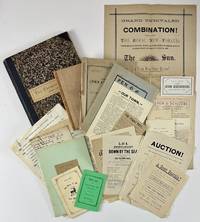
1900réf. 13367Various locations in Connecticut New Jersey and Massachusetts 1900. Forty-one total issues most folded sheets some in wrappers some bound into boards detailed as below plus a folder of ephemeral items. Overall very good condition. An unprecedented collection of amateur journalism encompassing the career of William G. Snow 1863-1945 a prominent amateur editor publisher and printer who worked mostly in New England. Snow was born and died in Meriden Connecticut and in-between lived in New Jersey New York and Massachusetts. During his professional life Snow worked at a print shop in Hartford a dry goods commission house in New York and a lumber company in Massachusetts. When he returned to Meriden he served as the sales and advertising manager of the Meriden Britannia Company and its successor the International Silver Company. Snow's passion however was not in his professional work but rather his decades of work in amateur journalism. The present collection spans as far as we can tell his entire career as a creator of amateur magazines and includes the following: 1 The Penny Post. Vol. 1 No. 1. West Meriden CT: April 1877. 4pp. on a single folded sheet. Even toning minor wear. Very good. A very crude and unrecorded amateur magazine that was likely Snow's first attempt at the hobby. He would have been thirteen or just turned fourteen at the time of its publication. The first page contains some notices and part of a story called "The Frogs Picnic" which ends abruptly. The inner two pages contain the same price list for some address cards and the last page also advertises cards and other job print items. The small masthead indicates the magazine is "A Four Eight Column Amateur Paper" which is "Devoted to the interests of all classes." 2 Every Month bound with: Pen and Press. West Meriden CT: 1878-1879. Fifteen issues each between 4 and 8 pages bound together in contemporary tan paper-covered boards calf backstrip. A rare collection gathering all twelve of Snow's Every Month first two issues titled The Every Month and the only three issues of his first attempt at Pen and Press. The twelve-issue run of Every Month was published between April 1878 and March 1879. Snow then retitled the magazine Pen and Press publishing three issues between October 1879 and February 1880 as volume two with the subtitle "Formerly 'Every Month.'" He would have been fifteen and sixteen at the time he printed these publications. Every Month is held by just four institutions in OCLC Connecticut Museum of Culture & History Connecticut State Library the University of Georgia and AAS while OCLC records just two institutional holdings of Pen and Press at the University of Georgia and AAS. 3 The Sun. West Granville MA: 1880-1881. Nineteen issues most issues between 6 and 8 pages plus a one-page Supplement. A complete run of one of Snow's better-known amateur periodicals which he published at the tender age of seventeen after his family moved to Massachusetts. This paper is sometimes referred to in the amateur journalism hobby as The Granville Sun including in the typed history of the paper affixed to the front pastedown here. This history which is illustrated with a faded photograph of the house in which the Snows lived in West Granville Massachusetts where the paper was also printed was probably compiled by William Snow's son Glover Snow himself an amateur journalist. Another typed notice dated in Meriden in 1942 clarifies the seemingly incongruous volume and issue numbers on the issues of The Sun. In short this magazine begins as volume two issue sixteen because it was meant to follow the fifteen issues of Every Month and Pen and Press described above. Besides the first issue The Sun was printed in a much larger and more professional-looking format than Snow's previous work. 4 Pen and Press four issues. Bayonne N.J.: Pen and Press Publishing Co. January to April 1884. 43pp. String bound. An omnibus volume of the first only four issues of Snow's second attempt at Pen and Press this time published as a "Monthly Journal Devoted to Science Literature and Education in Bayonne" after the Snows moved to New Jersey in 1884. In addition to the issues this group includes the wrappers for the third issue. We're not sure how long this publication ran; the only institutional holding in OCLC is at Rutgers which seems to have the second issue only. 5 Our Town. Vol. 1 No. 1. Granville MA: Spring 1889. 3pp. on a single folded sheet. Though there is no publication information given on this amateur magazine we have reason to know it was produced by Snow given its inclusion in a scrapbook of Snow's publications we have also offered. The issue is unusual as it only uses three of the four available pages and has no masthead. It was probably a piece of job printing done by Snow to promote the town of Granville and its surroundings as most of the content implies. The only holding in OCLC is at AAS. 6 Pen & Scissors. Vol. I No. 1. Meriden CT: 1900. Issued by William Snow in September 1900. Snow mentions in a passage about the publication that he produced it out of "a desire to know what the boys of to-day were doing in amateur journalism." We believe this is the only issue of Pen & Scissors produced by Snow and constitutes his last foray into the hobby. His son Glover Atwater Snow would go on to revive Pen & Scissors beginning in 1911. OCLC reports three institutional holdings at the Alexander Turnbull Library in New Zealand NYPL and AAS. 7 Collection of William G. Snow's Job Printing and Ephemeral Items Relating to His Amateur Journalism. The periodicals above are rounded out with a collection of additional materials documenting the amateur journalism and printing career of William G. Snow. This includes a large unrecorded broadside in which Snow pairs his own amateur magazine The Sun with The Rural New Yorker a prominent New York agrarian publication to offer a subscription special; unrecorded prospectus for Snow's last publication Pen & Scissors; four business or calling cards; a few typed documents relating to amateur journalism; ten small broadsides or handbills of job printing advertising events in Meriden Granville or New York; and two pamphlets of job printing unrelated to amateur journalism. unknown
1900réf. 13367Various locations in Connecticut New Jersey and Massachusetts 1900. Forty-one total issues most folded sheets some in wrappers some bound into boards detailed as below plus a folder of ephemeral items. Overall very good condition. An unprecedented collection of amateur journalism encompassing the career of William G. Snow 1863-1945 a prominent amateur editor publisher and printer who worked mostly in New England. Snow was born and died in Meriden Connecticut and in-between lived in New Jersey New York and Massachusetts. During his professional life Snow worked at a print shop in Hartford a dry goods commission house in New York and a lumber company in Massachusetts. When he returned to Meriden he served as the sales and advertising manager of the Meriden Britannia Company and its successor the International Silver Company. Snow's passion however was not in his professional work but rather his decades of work in amateur journalism. The present collection spans as far as we can tell his entire career as a creator of amateur magazines and includes the following: 1 The Penny Post. Vol. 1 No. 1. West Meriden CT: April 1877. 4pp. on a single folded sheet. Even toning minor wear. Very good. A very crude and unrecorded amateur magazine that was likely Snow's first attempt at the hobby. He would have been thirteen or just turned fourteen at the time of its publication. The first page contains some notices and part of a story called "The Frogs Picnic" which ends abruptly. The inner two pages contain the same price list for some address cards and the last page also advertises cards and other job print items. The small masthead indicates the magazine is "A Four Eight Column Amateur Paper" which is "Devoted to the interests of all classes." 2 Every Month bound with: Pen and Press. West Meriden CT: 1878-1879. Fifteen issues each between 4 and 8 pages bound together in contemporary tan paper-covered boards calf backstrip. A rare collection gathering all twelve of Snow's Every Month first two issues titled The Every Month and the only three issues of his first attempt at Pen and Press. The twelve-issue run of Every Month was published between April 1878 and March 1879. Snow then retitled the magazine Pen and Press publishing three issues between October 1879 and February 1880 as volume two with the subtitle "Formerly 'Every Month.'" He would have been fifteen and sixteen at the time he printed these publications. Every Month is held by just four institutions in OCLC Connecticut Museum of Culture & History Connecticut State Library the University of Georgia and AAS while OCLC records just two institutional holdings of Pen and Press at the University of Georgia and AAS. 3 The Sun. West Granville MA: 1880-1881. Nineteen issues most issues between 6 and 8 pages plus a one-page Supplement. A complete run of one of Snow's better-known amateur periodicals which he published at the tender age of seventeen after his family moved to Massachusetts. This paper is sometimes referred to in the amateur journalism hobby as The Granville Sun including in the typed history of the paper affixed to the front pastedown here. This history which is illustrated with a faded photograph of the house in which the Snows lived in West Granville Massachusetts where the paper was also printed was probably compiled by William Snow's son Glover Snow himself an amateur journalist. Another typed notice dated in Meriden in 1942 clarifies the seemingly incongruous volume and issue numbers on the issues of The Sun. In short this magazine begins as volume two issue sixteen because it was meant to follow the fifteen issues of Every Month and Pen and Press described above. Besides the first issue The Sun was printed in a much larger and more professional-looking format than Snow's previous work. 4 Pen and Press four issues. Bayonne N.J.: Pen and Press Publishing Co. January to April 1884. 43pp. String bound. An omnibus volume of the first only four issues of Snow's second attempt at Pen and Press this time published as a "Monthly Journal Devoted to Science Literature and Education in Bayonne" after the Snows moved to New Jersey in 1884. In addition to the issues this group includes the wrappers for the third issue. We're not sure how long this publication ran; the only institutional holding in OCLC is at Rutgers which seems to have the second issue only. 5 Our Town. Vol. 1 No. 1. Granville MA: Spring 1889. 3pp. on a single folded sheet. Though there is no publication information given on this amateur magazine we have reason to know it was produced by Snow given its inclusion in a scrapbook of Snow's publications we have also offered. The issue is unusual as it only uses three of the four available pages and has no masthead. It was probably a piece of job printing done by Snow to promote the town of Granville and its surroundings as most of the content implies. The only holding in OCLC is at AAS. 6 Pen & Scissors. Vol. I No. 1. Meriden CT: 1900. Issued by William Snow in September 1900. Snow mentions in a passage about the publication that he produced it out of "a desire to know what the boys of to-day were doing in amateur journalism." We believe this is the only issue of Pen & Scissors produced by Snow and constitutes his last foray into the hobby. His son Glover Atwater Snow would go on to revive Pen & Scissors beginning in 1911. OCLC reports three institutional holdings at the Alexander Turnbull Library in New Zealand NYPL and AAS. 7 Collection of William G. Snow's Job Printing and Ephemeral Items Relating to His Amateur Journalism. The periodicals above are rounded out with a collection of additional materials documenting the amateur journalism and printing career of William G. Snow. This includes a large unrecorded broadside in which Snow pairs his own amateur magazine The Sun with The Rural New Yorker a prominent New York agrarian publication to offer a subscription special; unrecorded prospectus for Snow's last publication Pen & Scissors; four business or calling cards; a few typed documents relating to amateur journalism; ten small broadsides or handbills of job printing advertising events in Meriden Granville or New York; and two pamphlets of job printing unrelated to amateur journalism. unknown books
1638réf. 46402371Paris, Au Bureau d’Adresse, rue de la Calandre au grand Coq., 1638-41 ; 4 volumes, veau fauve marbré, encadrement de doubles filets dorés, dos ornés. (Reliures de l’époque) I) Titre, 1 f. blanc, 2 ff. n. ch. (avis au lecteur et table), 408 pp. (conférences 1 à 50.)II) Titre (daté 1654), 4 ff. n. ch. (dédicace et table), 420 pp. (conférences 51 à 100.)III) Titre (daté de 1654), 2 ff. de table, pp. 9 à 524 (conférences chiffrées 101 à 185, plusieurs renfermant 2 conférences par numéro.)IV) Quatrième centurie... titre (daté 1641), 1 f. blanc, 2 ff. de table, 460 pp. (100 conférences chiffrées 186 à 295.) Rarissime publication donnée par Théophraste et Eusèbe Renaudot. Il s’agit, dit E. Hatin dans Th. Renaudot et ses “innocentes inventions” p. 137 de NOTRE PREMIER RECUEIL SCIENTIFIQUE.Dès 1633, Renaudot tenait à son Bureau d’adresse une “académie ouverte à tous les bons esprits, qui venaient conférer en public de toutes les plus belles manières de physique, de morale, mathématiques et autres disciplines, et laquelle était une des plus belles et plus utiles institutions qu’eût faites Renaudot au jugement même de plusieurs de ses ennemis.” Les comptes-rendus de cette académie suivent de près la célèbre Gazette et les Petites Affiches, débuts du journalisme en France. Le goût des réunions littéraires était alors fort répandu. On se réunissait chez Melle de Gournay, Balzac et Ménage pour parler de langue et de littérature. Renaudot, le premier, organisa des conférences scientifiques tous les lundis de 2 à 4 heures. Le programme était donné à l’avance et le compte rendu était publié en livraisons. Les sujets étaient variés. Pour n’en citer que quelques uns : la matière première, le mouvement perpétuel, le feu, l’air, l’eau, deux frères monstrueux dans un même corps, petite fille velue, les 3 soleils, les mélancoliques sont-ils les plus ingénieux ou prudents ?, du siège de la folie, l’homme est-il plus enclin à l’amour que la femme ?, l’écho, l’origine des vents, le flux et reflux de la mer, astrologie judiciaire, le cocuage, embaumements, somnambulisme, cabbale, comètes, pierre philosophale, du vide, si les couleurs sont réelles, le sommeil, la goutte, les fards, le tabac, la rosée, remèdes chimiques, talismans, volcans, eaux minérales, mal de mer, incubes et succubes, origine des pierres précieuses, métempsychose, noblesse commerçante, truffes et champignons, si la musique fait plus de bien que de mal, sterilité, ivrognerie, hiéroglyphes, feux follets, hermaphrodites, nègres, licornes, plantes sensitives, mandragore, etc.Physique, chimie, ésotérisme, philosophie, médecine, pharmacie, histoire naturelle, métaphysique, morale, politique, hygiène, tous les sujets sont abordés dans ce recueil extraordinaire qui est l’ancêtre de toutes les annales scientifiques.Reliure du tome IV abimée, mouillures sur ce même tome.
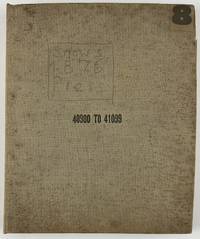
1916réf. 13382Various locations in Connecticut 1916. 43pp. containing dozens of publications and ephemeral items tipped or pasted in. Quarto. Contemporary ledger book bound in tan buckram repurposed as a scrapbook with manuscript title on front cover reading "Snow's 1876 Press." Moderate foxing and staining to covers minor edge wear. A unique assemblage of material collected into a scrapbook by Glover Atwater Snow 1896-1969 an amateur journalist from Connecticut. Glover Atwater Snow would continue his father's work in amateur journalism and exceed his father's precociousness beginning his printing and amateur journalism career by the tender age of eight. Snow's father William Gamaliel Snow was a prominent early practitioner of amateur journalism. The early portion of the scrapbook contains numerous issues of amateur magazines produced by William G. Snow including seven issues of Every Month two issues of Pen and Press and the premier issues of both Our Town and Pen & Scissors. The book also includes four of William Snow's business cards a mock-up of the first issue of Pen & Scissors and a prospectus for the same. The contents then shift to material produced by Glover Atwater Snow beginning with some early job printing and an early letterpress letter sent to a friend. Of chief interest among Glover Snow's material are his mock-up of the first issue of his first amateur magazine Snow's 1876 Press and a copy of the first issue itself dated April 1904. In addition the scrapbook contains some of Snow's printed envelopes and other ephemera additional job printing including a handful of amateur magazines titled The Star and a one-page extra of The Willowbrook News dated January 15 1910 and listing Glover as manager. The scrapbook includes issues two through six of Snow's 1876 Press dated between January and October 1911; interestingly the subtitle of this publication is "Operated by the Second Generation" an obvious nod from Glover to his father. The scrapbook is rounded out by more ephemeral items and a consecutive run of eleven issues of Pen & Scissors which William Snow began with the one issue in 1900 and Glover continued beginning in November 1911 and ending in April 1916. Glover Snow assembled the present scrapbook in a retired receipt ledger from his father's employer International Silver Company. The date of assembly was necessarily 1916 the date of the final issue of Pen & Scissors or sometime afterwards. A wonderful collection of material spanning two generations of amateur journalism -- father and son. unknown
1916réf. 13382Various locations in Connecticut 1916. 43pp. containing dozens of publications and ephemeral items tipped or pasted in. Quarto. Contemporary ledger book bound in tan buckram repurposed as a scrapbook with manuscript title on front cover reading "Snow's 1876 Press." Moderate foxing and staining to covers minor edge wear. A unique assemblage of material collected into a scrapbook by Glover Atwater Snow 1896-1969 an amateur journalist from Connecticut. Glover Atwater Snow would continue his father's work in amateur journalism and exceed his father's precociousness beginning his printing and amateur journalism career by the tender age of eight. Snow's father William Gamaliel Snow was a prominent early practitioner of amateur journalism. The early portion of the scrapbook contains numerous issues of amateur magazines produced by William G. Snow including seven issues of Every Month two issues of Pen and Press and the premier issues of both Our Town and Pen & Scissors. The book also includes four of William Snow's business cards a mock-up of the first issue of Pen & Scissors and a prospectus for the same. The contents then shift to material produced by Glover Atwater Snow beginning with some early job printing and an early letterpress letter sent to a friend. Of chief interest among Glover Snow's material are his mock-up of the first issue of his first amateur magazine Snow's 1876 Press and a copy of the first issue itself dated April 1904. In addition the scrapbook contains some of Snow's printed envelopes and other ephemera additional job printing including a handful of amateur magazines titled The Star and a one-page extra of The Willowbrook News dated January 15 1910 and listing Glover as manager. The scrapbook includes issues two through six of Snow's 1876 Press dated between January and October 1911; interestingly the subtitle of this publication is "Operated by the Second Generation" an obvious nod from Glover to his father. The scrapbook is rounded out by more ephemeral items and a consecutive run of eleven issues of Pen & Scissors which William Snow began with the one issue in 1900 and Glover continued beginning in November 1911 and ending in April 1916. Glover Snow assembled the present scrapbook in a retired receipt ledger from his father's employer International Silver Company. The date of assembly was necessarily 1916 the date of the final issue of Pen & Scissors or sometime afterwards. A wonderful collection of material spanning two generations of amateur journalism -- father and son. unknown books
1905réf. c2410150320xbvkU.S.A., St. Paul - Minnesota, Ingersoll View Company, 1905. 100 colour-stereograph plates (ca. 9 x 18 cm) with captions under the photographs and extensive description on the rear, loose in the publisher's black cardboard box (ca. 9,5 x 19 x 7,5 cm).
1998Signed and inscribed by Gary Webb upon half-title page. xxviii, 548 pages. Footnotes, glossary and index. "Shows how the L.A. crack market flourished through a breathtaking combination of government negligence, greed, and criminal conduct... Demonstrates that U.S. government agencies, including the CIA, DEA and FBI, were aware of the activities of this well-connected drug network and did little or nothing to stop it. Indeed, in several instances documented here, the Justice Department, the CIA, and the secret National Security Council unit run by Oliver North, took extraordinary steps to protect the ring from public exposure. In the final chapters Webb reveals the conflict that led to his newspaper's stunning repudiation of its own series - and at what cost he stood by his story." - from dust jacket. Webb was found dead in his home in 2004 with two gunshot wounds to his head. Curiously, his death was ruled a suicide. Clean and unmarked with light wear. Dust jacket now in archival-grade mylar. A quality signed copy of this heroic work. Book
réf. 153682Paris, 1827-1829 19 plaquettes en un vol. in-8, basane fauve racinée, dos lisse orné, tranches marbrées (reliure de l'époque). Coiffes rognées, mais bon exemplaire.
1903A very rare copy of this, the first appearance of The War on the Rebate, Chapter 1 of Part 2 of Ida Tarbell's ground-breaking History of the Standard Oil Company. This 14-page chapter includes a one-page illustration of J.D. Rockefeller by George Varian, plus photos of William C. Scofield, Daniel Shurmer, John Teagle, George Rice, and Benjamin Butler. This chapter deals with organized espionage, the Scofield-Shurmer-Teagle Case, and related matters. With this work, Tarbell invented what we know today as investigative journalism. She was motivated to expose the methods of J.D. Rockefeller's Standard Oil as she felt he had unfairly damaged her father's oil business. The New York University Department of Journalism ranked this study as the fifth best work of 20th-century American journalism. Also contained in this issue is an intersting article entitled The Lone Fighter, by Ray Stannard Baker, which argues the U.S. is not a free country and Americans are not free, due to labor bosses, and government by and for 'The Bosses". Binding intact. Unmarked. Above-average but not excessive external wear. Moderate moisture exposure. Dozens of pages of glorious illustrated ads. A sound vintage copy. Book
1904A very rare copy of this, the first appearance of Cutting to Kill, Chapter 3 of Part 2 of Ida Tarbell's ground-breaking History of the Standard Oil Company. This 14-page chapter deals with J.D. Rockefeller's fervent desire to learn every detail of the oil trade, to be able to reach its remotest point, to control even its weakest factor - as this was his ideal of doing business. Illustrated with facsimiles of documents. With this work, Tarbell invented what we know today as investigative journalism. She was motivated to expose the methods of J.D. Rockefeller's Standard Oil as she felt he had unfairly damaged her father's oil business. The New York University Department of Journalism ranked this study as the fifth best work of 20th-century American journalism. Also included is an intersting article by Ray Stannard Baker which examines the corner in labor in San Francisco, where unions hold undisputed sway. The Owl Drug Co. boycott is discussed and photos of Walter Mac Arthur, Eugene E. Schmitz, and P.H. McCarthy are included. Also included is war correspondent Frank H. Schell's personal account of his experience at the Battle of Antietam, the bloodiest day in American history. Binding intact. Unmarked. Above-average external wear. Moderate moisture exposure. Dozens of glorious illustrated ads. A worthy vintage copy. Book
1904A very rare copy of this, the first appearance of A Modern War For Independence, Chapter 6 of Part 2 of Ida Tarbell's ground-breaking History of the Standard Oil Company. This 18-page chapter deals with the united opposition of producers which developed against J.D. Rockefeller's heavy-handed dominance of their industry. Illustrated with photos of A.D. Wood, Lewis Emery Jr., Thomas W. Phillips, Peter Theobald, E.H. Jennings, David Kirk, Michael Murphy, James W. Lee, Hugh King, and Clarence Walker. With this work, Tarbell invented what is known today as investigative journalism. She was motivated to expose the methods of J.D. Rockefeller's Standard Oil as she felt he had unfairly damaged her father's oil business. The New York University Department of Journalism ranked this study as the fifth best work of 20th-century American journalism. Also included is a fascinating illustrated article by P.T. McGrath entitled The Peril of the Icebergs which discusses the horrors of ships colliding with icebergs, strongly foreshadowing the Titanic disaster eight years later. Dozens of glorious illustrated ads. Binding intact. Unmarked. Average wear. Lacking covers, backstrip, and half of page 85 which contained ads. A worthy vintage copy. Book
1903A very rare copy of this, the first appearance of chapter seven, The Crisis of 1878, of Ida Tarbell's ground-breaking History of the Standard Oil Company. This feature of 16 pages includes photos of: the company's tank farm at Olean, NY; John L. McKinney; Torpedoed oil wells with side-flow and upright flow; A.J. Cassatt; M.N. Allen; a 25,000 oil tank on fire; and a one-page illustration of the hanging in effigy of "Buck" McCandless. With this work, Tarbell invented what we know today as investigative journalism. She was motivated to expose the methods of J.D. Rockefeller's Standard Oil as she felt he had unfairly damaged her father's oil business. The New York University Department of Journalism ranked this study as the fifth best work of 20th-century American journalism. Also contained in this issue is a most scathing 15-page photo-illustrated article on the corruption pervasive in Pittsburgh, PA. Also included is a 9-page article entitled Waifs of the (New York) Street which describes, with illustrations, the heart-breaking life of children forced to work as 'newsboys, peddlers, messengers, and bootblacks that swarm by day and night through every crowded street of busy New York.' Binding intact. Unmarked. Above-average wear. This copy lacks: covers; backstrip; pages 1-2 (title page and first half of table of contents); Advertising pages 133-136. Book
1996réf. RO80056462IMPRESSIONS CEPI. 1965 - 1996. In-4. Cartonné. Bon état, Couv. convenable, Dos satisfaisant, Intérieur frais. 24 à 36 pages par numéros. Nombreuses illustrations et photos en noir et blanc, dans le texte. Revues rangées dans des classeurs .. . . . Classification Dewey : 70-Journalisme, édition. Journaux
184940x28. 352p. 416p. 512p. 3 Vols. Tres primeros años de publicación. Cada año, cosido pero sin encuadernación. El tomo de 1852 corte en últimas páginas. Ilstr.
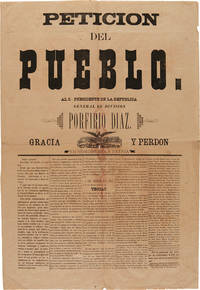
1890réf. 55735N.p. but Puebla: Tip. Rinconada de Manzanares ca.1890s. Broadside Calling for Porfirio Díaz to Pardon Journalists and Political Prisoners An apparently unrecorded broadside from Mexico printed during the reign of President Porfirio Díaz who served a total of thirty-one years as the chief executive and effectively the dictator of Mexico. As with other dictatorial regimes Díaz had a contentious and sometimes violent relationship with the press. He is known to have very occasionally condoned if not initiated the murder and imprisonment of journalists though he also often courted journalists to give them the impression that he was on their side expecting support in return. As a result Diaz often favored imprisonment over the outright assassination of journalists. During his dictatorship Díaz sent numerous dissident politicians and journalists to the prisons of Belén or San Juan de Ulúa though being sent to the former was widely considered tantamount to a death sentence anyway. Journalists and political enemies were just two groups subject to Díaz's theory of rule - that cruel means though unfortunate were justified by the end result of national progress. The present broadside calls for clemency from Díaz in his dealings with imprisoned journalists and politicians. The author of the broadside mentions past injustices related to journalists and political prisoners. In the first column the text mentions Ignacio Ramirez and his pen name "el Nigromante;" Ramirez was a liberal writer and thinker who often defended the rights of indigenous peoples in Mexico. Here the author accuses the conservative party of trying to intimidate Ramirez and many others like him by putting "the hand of an enraged hitman on the neck of the liberal journalist." a rough translation. The text also references the Third Battle of Puebla fought on April 2 1867 and won by Porfirio Díaz. At the conclusion of that battle instead of executing the imperialist Mexican prisoners Díaz released them after they signed a promise not to take up further arms against the Mexican republic. The text appeals to Díaz's demonstrated sense of mercy and reads in part and in English translation: "We the members of the working class know well and have witnessed your energetic courage in the battlefields as an intrepid and worthy son of Mars but now also this time we do not demand but we beg to have the happiness and satisfaction to see and admire him as a hero of clemency for imprisoned journalists.and more so for his afflicted families who at this moment endure the crying and perhaps even the misery and fatal consequences of that prison in which the heads of those anguished families reside." The text also calls for clemency or pardons for a long list of political prisoners. The names of the prisoners held at Belén occupy the last column-and-a-half of the broadside. At the conclusion of the text there is a notice that indicates the petitioners have 4000 signatures in their favor for the demands made here. OCLC is silent on this broadside. It is at least an exceedingly rare if not a unique surviving example of the political tensions between President Díaz and his political opponents and journalists in Mexico at the end of the 19th century and a powerful and important entry in the ever-present struggle for the freedom of the press. Broadside 23½ x 15¾ inches printed in five columns with masthead showing a version of Mexico's coat of arms with eagle holding rattlesnake perched on crossed pikes above a cannon. Uniformly toned. Old folds and wrinkles short splits and minor loss at crossfolds mild staining. Overall good plus. unknown
1890réf. 55735N.p. but Puebla: Tip. Rinconada de Manzanares ca.1890s. Broadside Calling for Porfirio Díaz to Pardon Journalists and Political Prisoners An apparently unrecorded broadside from Mexico printed during the reign of President Porfirio Díaz who served a total of thirty-one years as the chief executive and effectively the dictator of Mexico. As with other dictatorial regimes Díaz had a contentious and sometimes violent relationship with the press. He is known to have very occasionally condoned if not initiated the murder and imprisonment of journalists though he also often courted journalists to give them the impression that he was on their side expecting support in return. As a result Diaz often favored imprisonment over the outright assassination of journalists. During his dictatorship Díaz sent numerous dissident politicians and journalists to the prisons of Belén or San Juan de Ulúa though being sent to the former was widely considered tantamount to a death sentence anyway. Journalists and political enemies were just two groups subject to Díaz's theory of rule - that cruel means though unfortunate were justified by the end result of national progress. The present broadside calls for clemency from Díaz in his dealings with imprisoned journalists and politicians. The author of the broadside mentions past injustices related to journalists and political prisoners. In the first column the text mentions Ignacio Ramirez and his pen name "el Nigromante;" Ramirez was a liberal writer and thinker who often defended the rights of indigenous peoples in Mexico. Here the author accuses the conservative party of trying to intimidate Ramirez and many others like him by putting "the hand of an enraged hitman on the neck of the liberal journalist." a rough translation. The text also references the Third Battle of Puebla fought on April 2 1867 and won by Porfirio Díaz. At the conclusion of that battle instead of executing the imperialist Mexican prisoners Díaz released them after they signed a promise not to take up further arms against the Mexican republic. The text appeals to Díaz's demonstrated sense of mercy and reads in part and in English translation: "We the members of the working class know well and have witnessed your energetic courage in the battlefields as an intrepid and worthy son of Mars but now also this time we do not demand but we beg to have the happiness and satisfaction to see and admire him as a hero of clemency for imprisoned journalists.and more so for his afflicted families who at this moment endure the crying and perhaps even the misery and fatal consequences of that prison in which the heads of those anguished families reside." The text also calls for clemency or pardons for a long list of political prisoners. The names of the prisoners held at Belén occupy the last column-and-a-half of the broadside. At the conclusion of the text there is a notice that indicates the petitioners have 4000 signatures in their favor for the demands made here. OCLC is silent on this broadside. It is at least an exceedingly rare if not a unique surviving example of the political tensions between President Díaz and his political opponents and journalists in Mexico at the end of the 19th century and a powerful and important entry in the ever-present struggle for the freedom of the press. Broadside 23½ x 15¾ inches printed in five columns with masthead showing a version of Mexico's coat of arms with eagle holding rattlesnake perched on crossed pikes above a cannon. Uniformly toned. Old folds and wrinkles short splits and minor loss at crossfolds mild staining. Overall good plus. unknown books
2015réf. SBBI-mon0000143294The Slow Journalism Company Ltd 2015. paperback. Acceptable. Please see the condition note after this for details if this is missing please consider Acceptable to mean poor quality that could include major staining water damage writing missing dustjacket etc etc. Our books are dispatched from a Yorkshire former cotton mill. We list via barcode/ISBN so please note that the images are stock images and may not be the exact copy you receive furthermore the details about edition and year might not be accurate as many publishers reuse the same ISBN for multiple editions and as we simply scan a barcode or enter an ISBN we do not check the validity of the edition data when listing. If you're looking for an exact edition please don't order at least not without checking with us first although we don't always have time to check. We aim to dispatch prompty the service used will depend on order value and book size. We can ship to most countries see our shipping policies. Payment is via Abe only. The Slow Journalism Company Ltd paperback
1922Folio (Large); 1st edition. Period Cloth, Folio (newspaper), ca 600 pages. Bound volume of the ACWA's Yiddish paper. (Its English language counterpart was called ADVANCE) The Amalgamated Clothing Workers of America originalted as a heavily Jewish & Italian union out of the successful 1910 strike against Hart, Schaffner & Marx in Chicago, aided by middle class progresssives like Jane Addams and the Women's Trade Union League. "Among it's founding cadre, " note Buhle, Buhle & Georgakas (Encyclopedia of the American Left, pp. 16-18) , "nearly every variety of left-wing politics was represented: Lithuanian revolutionary nationalism, Bohemian free-thought, Italian syndicalism, the revoltionary unionism of the IWW, Jewish and Italian anarchism, the orthodox socialism of the American Socialist Party...and thetactically bolder socialism of the Jewish Bund. " This political rainbow is cleary evident in the pages of the FORTSCHRITT.SUBJECT(S): Jews -- Employment -- Periodicals. Labor unions. OCLC: 40576795. OCLC lists 5 holdings, of unclear completeness, worldwide (JTS, U of I, Dept of Labor, YIVO, IISH). Front board has edgewear, paper is browning and somehwat fragile, but with minimal wear . Good Condition thus. (yid-35-2)
1882réf. RO80047769IMP. MENETIERE A.. Sept 1880 - Fév 1882. In-4. Cartonné. Etat d'usage, Couv. défraîchie, Mors fendus, Intérieur frais. 1120 pages (8 pages par numéro, soit 140 numéros). Nombreuses illustrations en noir et blanc, dans le texte (en 1ère page de chaque numéro). Textes sur 2 colonnes. Dos toilé rouge. Coins et tranches des plats frottés. Quelques déchirures, traces d'humidité et légers manques sur les premières pages altérant légèrement la lecture du texte. Quelques marges usées. Manque sur la couverture du n°140, dans le texte de la page 605 à 616.. . . . Classification Dewey : 70-Journalisme, édition. Journaux
Mérida de Yucatán, Imprenta de Castillo y Compañía. 1845. 484p. 8º mayor. Holandesa algo rozada. Lomo de piel con dorados, con corte. Puntos de óxido. Buen ejemplar
1925Very Good Turkish, Ottoman (1500-1928) Original wrappers. No bdg. Wear spine, dispersed pages. Roy. 8vo. (24 x 17 cm). In Ottoman script (Old Turkish with Arabic letters). 197, 6 p., 5 panoramic folded huge b/w plates (Including the photographic plts.; 1-) Turkish Convention May, 13, 1923, Detroit, Mich by Photo Craft Byallen -23x39 cm-; 2-) [Among the Young Turks in Detroit, -23x106 cm-; 3-) In the White House with the President, -23x106 cm-; 4-) Islamic Society in the US, -32x40 cm-; 5-) Among the Young Turkish people in Chicago, -23x26 cm-). First and only edition of this exceedingly rare travel account of America by Dr. Mehmed Fuad [Umay], (1885-1963), who was a Turkish doctor and the founder of Himâye-i Etfâl [i.e. Society for the Protection of Orphans], a society that was established in 1921 to provide orphanages to children of the deceased soldiers in the Turkish War of Independence; began visiting many of the Turkish colonies in the US, giving lectures and raising a considerable amount of money for the establishment of these orphanages in Turkey. On 21 March 1923, Fuad Bey was granted permission from the Grand National Assembly of Turkey to go to the US in order to raise funds among the Ottoman immigrants for immediate war relief. Thus, for the first time, humanitarian action became an organized effort by fostering diaspora mobilization. Fuad Bey arrived in Ellis Island on 6 April 1923 on a ship named SS Aquitania and headed to the Ottoman Welfare Association at 35 Rivington Street. In the first meeting held by the Ottoman Welfare Association for the benefit of Turkish Orphan Society, Fuad Bey notes that a total of USD 17,500 was raised in just six hours. To those who donated over USD 1,000, a personally autographed picture of Mustafa Kemal was given by Fuad Bey. He visited the Turkish colonies in Wisconsin, Illinois, Michigan, New York, New Jersey, Massachusetts and Rhode Island. He lectured about the Turkish War of Independence (1919-1922) and the success of the struggle, and many Turkish and Kurdish workers residing in these cities donated their life savings to support the construction of orphanages and the reconstruction of the entire country. Fuad's visit to Peabody, Massachusetts aroused exceptional excitement among the Turkish and Kurdish immigrants. It was the first chance for the Muslim Anatolian immigrants to manifest their national pride and attachment to the homeland. At the same time, their socioeconomic achievement was evidenced with the arrival of Fuad Bey in Peabody in an auto decorated with a large American flag and followed by a dozen autos filled with Turks, the machines decorated with American and Turkish flags.". A day before his arrival, the Turks refrained from work and "went around with badges in honor of his coming. Mehmed Fuad noted that there were around 600 Turks when he visited Peabody in 1923. Despite their small number, they had established Kizilay [i.e. Turkish Red Crescent] society. After being shown some of the tanneries in Peabody and Salem, Fuad gave an address to the Turks and Kurds at the Peabody Institute. The scene was described as: "All the Turks in town were present. They made a spectacle of the doctor's visit, many of them taking a day off. They wore badges in his honor and displayed in front of the Institute the American and Turkish flags. Great enthusiasm was shown. Baskets of roses were carried down the aisles and the flowers were bought at any price, bunches of money being put in the baskets. It was said that USD 8,000 was raised among the Turks of this city for Dr. Fuad Bey to take back with him.". Fuad Bey visited Peabody for a second time on 14 August 1925, as he came for the National Conference of Social Workers held in Denver, Colorado in June, 1925. When he arrived in Massachusetts, he was met by a delegation of Turkish people from [.]". (Source: Ottoman Immigrants and the Formation of Turkish Red Crescent Societies in the United States). No printed copy in OCLC.; Özege 727.; TBTK 11126.
réf. DADAX0190694165New unknown
1921Folio (Large); 1st edition. Period Cloth, Folio (newspaper), ca 600 pages. Bound volume of the ACWA's Yiddish weekly. (Its English language counterpart was called ADVANCE) The Amalgamated Clothing Workers of America originalted as a heavily Jewish & Italian union out of the successful 1910 strike against Hart, Schaffner & Marx in Chicago, aided by middle class progresssives like Jane Addams and the Women's Trade Union League. "Among it's founding cadre, " note Buhle, Buhle & Georgakas (Encyclopedia of the American Left, pp. 16-18) , "nearly every variety of left-wing politics was represented: Lithuanian revolutionary nationalism, Bohemian free-thought, Italian syndicalism, the revoltionary unionism of the IWW, Jewish and Italian anarchism, the orthodox socialism of the American Socialist Party...and the tactically bolder socialism of the Jewish Bund. " This political rainbow is cleary evident in the pages of the FORTSCHRITT. Subjects:Jewish labor unions -- United States -- Periodicals. Yiddish newspapers -- United States -- Periodicals. Labor movement -- New York -- Periodicals. OCLC: 40576795. OCLC lists 5 holdings, of unclear completeness, worldwide (JTS, U of I, Dept of Labor, YIVO, IISH). Paper very brown and fragile, lacking 2 leaves from the first issue and the remaining first 6 leaves loose with some loss. otherwise Good Condition.(yid-35-3)
1922Folio (Large); 1st edition. Period Cloth, Folio (newspaper), ca 600 pages. Bound volume of the ACWA's Yiddish paper. (Its English language counterpart was called ADVANCE) The Amalgamated Clothing Workers of America originalted as a heavily Jewish & Italian union out of the successful 1910 strike against Hart, Schaffner & Marx in Chicago, aided by middle class progresssives like Jane Addams and the Women's Trade Union League. "Among it's founding cadre, " note Buhle, Buhle & Georgakas (Encyclopedia of the American Left, pp. 16-18) , "nearly every variety of left-wing politics was represented: Lithuanian revolutionary nationalism, Bohemian free-thought, Italian syndicalism, the revoltionary unionism of the IWW, Jewish and Italian anarchism, the orthodox socialism of the American Socialist Party...and thetactically bolder socialism of the Jewish Bund. " This political rainbow is cleary evident in the pages of the FORTSCHRITT.SUBJECT(S): Jews -- Employment -- Periodicals. Labor unions. OCLC: 40576795. OCLC lists 5 holdings, of unclear completeness, worldwide (JTS, U of I, Dept of Labor, YIVO, IISH). Aproximately 25 leaves are loose, with occational text loss at the edges. Paper is browning and somehwat fragile, but generally with minimal wear otherwise. Good Condition thus. (yid-35-2A )
réf. SONG0742561739Used: Good unknown