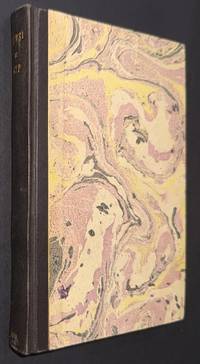
1910réf. 135903New York: P. F. Collier & Son 1910. Hardcover. Very Good. Reprint. Volume V only. Embossed purple cloth with gold lettering on spine. Cloth shows some spotty fading and staining pages lightly browned else a very good or better copy. Crime mystery and romance in historic courts with a special introduction and illustrations. P. F. Collier & Son hardcover books
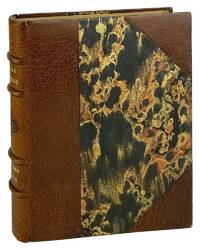
1972réf. 4362Darmstadt Germany: Scientia Verlag Aalen 1972. Full-Leather. Collectible; Fine. The 1972 facsimile reproduction of this 1760 French classic of economics. Bright and Near Fine in its handsome full-leather. Thick 16mo 312 pgs. Scientia Verlag Aalen unknown books
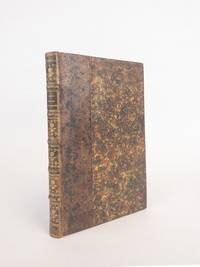
1896réf. 350813Paris: Leon Chailley 1896. 196p. marbled boards and leather spine with alternate title "Jews! by Gyp" and year in gilt original cover bound in very good. The illustrations by "Bob" are actually by the author. Anti-Semitic satirical fiction by the prolific female novelist and right-wing anarchist. Leon Chailley unknown books
1926réf. 31594Paris: Chez A. & G. Mornay 1926. Very Good. Paris: Chez A. & G. Mornay 1926. First Illustrated Edition Limited to 1000 copies of which this is no. 257. Small quarto; mid-century three-quarter brown crushed morocco over marbled boards gilt spine in five compartments top edge gilt marbled endpapers original wrappers bound in; 401pp.; illus. throughout. Very light wear to leather spine a shade sunned brief spotting at spine crown attractive Montreal bookseller ticket of Libraire Deom to front pastedown else a Very Good to Near Fine example. Chez A. & G. Mornay unknown books
1928réf. 31595Paris: Editions Mornay 1928. Near Fine. Paris: Éditions Mornay 1928. First Illustrated Edition Limited to 1000 copies of which this is no. 146. Small quarto; mid-century three-quarter brown crushed morocco over marbled boards gilt spine in five compartments top edge gilt marbled endpapers original wrappers bound in; 362pp.; frontispiece illus. throughout. Very light wear to leather spine a shade sunned attractive Montreal bookseller ticket of Libraire Deom to front pastedown else a Near Fine example. Editions Mornay unknown books
1791réf. 18566Paris: Chez Petit & Maugi 1791. 8vo. Modern wrappers. 30 pages. Some light spotting. 8vo. In the introduction the editor voices his strongly anti-Jacobin sentiments- "traitez les jacobins comme on traite les fous et le bonheur pourra renaître en France." The author writes warning the people of the falseness behind the "liberties" touted to the people. M & W III 24413 Chez Petit [&] Maugi unknown books
1881réf. 352135Brussels: Gay et Doucé 1881. No. 113 of 500 hand-numbered copies on Van Gelder Hollande. Engraved frontispiece by Chauvet portrait and facsiimile letter. Title page printed in red and black. xxix 267 5 pp. 1 vols. 8vo. Quarter blue morocco spine gilt preserving printed front wrapper. Signed and dated by G. Legman 1957. No. 113 of 500 hand-numbered copies on Van Gelder Hollande. Engraved frontispiece by Chauvet portrait and facsiimile letter. Title page printed in red and black. xxix 267 5 pp. 1 vols. 8vo. Pia 416; Kearney Biblio. of Jules & Jean Gay 3092; Private Case 1197; Gay-Lemonnyer II 150 Gay et Doucé unknown books
1791réf. 1353601Paris: Imprimerie Nationale 1791. First Edition. Octavo 4 35 pages 8 pages; G; Side-sewn pamphlet with original blue wrappers; Covers show moderate wear overall with light plus curling to corners moderate wear to paper on spine and light soiling overall; Textblock has light plus age-toning overall light curling to some corners an ink emendation from a former owner illegible on title page and substantial ink emendations to the insides of the front and back covers. 1353601. Special Collections. Imprimerie Nationale unknown books
1909réf. 226846London Arthur L. Humphreys 1909. 1909. 8vo. Translated from French. Title page printed in red and black. Full tan calf spine with five raised bands with gilt lettering and date front cover stamped in gilt with five brown stamped tri-leaves a.e.g. Very good. 347 pages. Ink signature on the first page after front free endpaper. No bookplates. Hardcover. Very Good. London, Arthur L. Humphreys, 1909. hardcover books
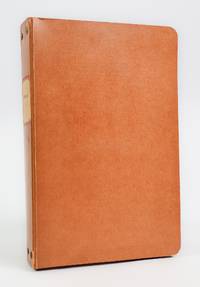
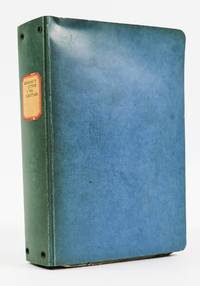
1784réf. 1418419Bruxelles Brussels: n.p. 1785; 1784. Softcover. Octavo xii 104 pages and Octavo xx 180 pages. Bound in contemporary paper wraps with a 20th century orange plastic case attached to the text blocks with metal rods. Case has paper label to spine binder's green and white label inside front cover and scuffing throughout. Wraps have chipping to edges and heavy scuffing and dust soiling throughout. Text blocks have light penciling light foxing splitting to gutters and age-toning throughout; last two leaves of Mémoire have their top edges folded forward. Shelved in Room F Box 1. 1418419. Special Collections - Upstairs. [n.p.] unknown books
1789réf. 14145Dublin: P. Byrne 1789. FIRST IRISH EDITION. Contemporary calf spine and edges lightly worn; generally an excellent copy with a contemporary signature of Juliana Pratt dated 1843 on title. . First edition a variant of a two-volume work published in London with few copies located in America. We do not know the priority of this Irish edition. After a preliminary trip to Berlin in early 1786 Mirabeau was dispatched that July on a mission to the royal court of Prussia. Returning in January he published a full account in his Secret History of the Court of Berlin 1787. This account denounced the Prussian court as scandalous and corrupt described the King of Prussia as weak and overly emotional and labeled Prince Henry of Prussia brother of Frederick the Great and a guest of the French court as narrow-minded and incompetent. The resulting uproar was an extreme embarrassment for the French government which quickly censored the book but could not prevent its widespread notoriety. Mirabeau’s episode provided inspiration to many more radical publishers who came to regard him as a leader of the coming revolution. Even Thomas Jefferson who was serving as the United States Minister to France during this period wrote to Mirabeau complimenting his “writings and talents” and provided him with materials that Jefferson wanted Mirabeau to use in future publications. P. Byrne unknown books
1792réf. 002715Paris: Le Jay 1792. Second edition. Wraps. Very Good. 8vo. 2 176 pp. Plain wrappers partially uncut. Scattered light foxing. Le Jay unknown books
réf. 1418440Softcover. Quarto 4 8 24 24 22 30 16 19 1 23 3 23 3 22 2 24 2 67 3 27 3 24 30 27 1 37 1 30 26 61 pages. In Good minus condition. Bound in contemporary blue paper wraps with a 20th century blue outer case secured by metal bars. Spine has a paper label; has age-toning scuffing and chipping to paper throughout with vertical tears at head/tail from metal bars. Covers have shelfwear to edges and scuffing and creasing throughout. Text block has deckled edges; has age-toning and light scuffing to edges and light dust soiling to top edge; has an open tear to lower fore corner of pp. 21-22 of huitième letter text unimpacted a closed tear to fore edge of pp. 7-8 treizième letter which has been repaired with tissue that caused it to be partially stuck to the preceding leaf and age-toning light penciling to margins creasing to leaves and heavy splitting to gutters throughout. Text in French. Shelved in box 2 in room F. This volume contains the complete issues 1 and 2 of Mirabeau's famous revolutionary newspaper Journal des États-Généraux published right at the start of the Estates-General in early May 1789 along with all nineteen Lettres de comte de Mirabeau à ses commettans. Originally published as a direct commentary by the Count of Mirabeau on the happenings of the Estates-General the Royal Council officially banned his Journal on May 7 1789. To circumvent the ban Mirabeau rebranded his publication as direct "letters" to the constituents in Provence who elected him to the Third Estate. Since deputies had a legal right to report back to their electors the royal censors could not easily stop him. 1418440. Special Collections - Upstairs. unknown books
1787réf. 209922Dublin: Whitestone Byrne Cash Moore and Jones 1787. hardcover. very good. 2 volumes bound in 1 503 pages scattered foxing 8vo rebound in mottled calf slightly rubbed with tan leather labels. Dublin: Whitestone Byrne Cash Moore and Jones 1787. Very good . Whitestone, Byrne, Cash, Moore, and Jones unknown books
1775réf. 1376974Londres London: n.p. 1775. First Edition. Hardcover. Octavo 275 2 pages. In Very Good condition. Bound in 18th century quarter acid-washed calf marbled paper boards. Gilt titling and tooling to spine. Light rubbing and wear primarily to extremities lower front hinge. Text block partially unopened along the fore edge. With all 5 cancels as called for in the 'Avis au relieur.' M7 cancel loose but present. Shelved case 10. ESTC: 28190. Anonymous but by Gabriel-Honoré de Riquetti comte de Mirabeau. With final two errata leaves. The imprint is false; probably printed on the continent. Comte de Mirabeau's first published book. Mirabeau published his Essay on Despotism which denounced the arbitrariness of royal power: "le despotisme n'est pas une forme de gouvernement . s'il en était ainsi ce serait un brigandage criminel et contre lequel tous les hommes doivent se liguer." 1376974. Shelved Dupont Bookstore. [n.p.] hardcover books
1784réf. 39553London i.e. Paris: J. Johnson St. Paul's Church-Yard 1784. Original blue patterned wrappers spine wrappers shorn stitched untrimmed. xii 203 1 blank pp. Mild occasional foxing binding a bit shaken. Very Good. Howes calls this "another issue" of the first edition. OCLC declares "The imprint is false being a repetition of that on the French edition printed in London; probably printed in Paris" OCLC 85860350 noting facsimiles. Lathrop Harper noted "The book was of course not allowed to be printed in France and the writer was living in London at this time" Harper Catalog 224 - 154. As a hereditary organization limited to officers of the American Revolution and their eldest male descendants the Order reflects "the true seat of nobility" inconsistent with a new republican society. Alarmed the author says the Society will quoting from the version in English language "strip the middle and lower ranks of life of all influence and of all importance; consign them to the most palpable contempt and reduce them to the completest nullity." This "military nobility" will inevitably become "a civil nobility and an aristocracy the more dangerous because being hereditary it will perpetually increase in the course of time and will gather strength from the very prejudices it will engender; because originating neither in the constitution nor the law the law has provided no means to controul it and it will incessantly overbear the constitution." Howes M653aa. OCLC 4949019. J. Johnson, St. Paul's Church-Yard unknown books
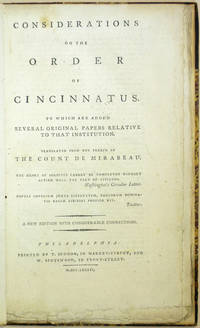
1786réf. 41762Philadelphia: Printed by T. Seddon 1786. A new edition with considerable corrections. 19th c. three quarter morocco over marbled boards. A very good untrimmed copy; chips to spine ends; scuffed tips owners bookplates on front end-papers and first blank; tight binding. iv 68 pp. 8vo. First American edition. "The Society was not greeted so warmly in the United States. Within months of the adoption of the Institution critics began to charge that the members planned to use the Society to impose a hereditary aristocracy on the new American republic. The leading critic was a South Carolina judge Aedanus Burke. In a pamphlet titled Considerations on the Society or Order of Cincinnati published in Charleston in late 1783 and soon republished all over the country Burke charged that the Cincinnati would form an American aristocracy dominating the government and extinguishing the liberties of the people. Dozens of other critics soon joined Burke and resolutions denouncing the Cincinnati were introduced into several state legislatures. At a moment when Americans were deeply anxious about the future of their untried experiment in republican government the Society of the Cincinnati stirred fears of a conspiracy to seize power and create a new aristocracy as the first step toward re-establishing a monarchy over America" societyofthecincinnati.org. Mirabeau picks up this argument in his "highly controversial imitation" of Burke's work which was suggested to Mirabeau by Ben Franklin" See Echeverria & Wilkie The French Image of America. Provenance: Frank Maier whose collection of American First editions was auctioned in 1909 bookplate Ganevoort-Lansing Collection to NYPL Tiffany & Co. bookplate and William S.S.Horton M.D. manuscript collector armorial bookplate. Sabin 49395. Howes M653. Evans 19803. Echeverria & Wilkie: 786/49 JCB III: 3084. Printed by T. Seddon hardcover books
réf. 2356S.n.: s.l. 1785. . 8vo 19th century marbled marbled boards red leather spine with some wear over hinges. Institutionally common scarce in trade. Place of publication has been variously suggested as London Brussels or Geneva. Attacking the Bank of Spain for speculation in the form of stock-jobbing. The Second of five works on finance published in 1785 the first being De la Caisse dscompte after the present work the next one being Lettre du comte de Mirabeau a M. Le Couteulx de la Noraye sur la Banque de Saint-Charles & sur la Caisse-d'escompte. The fourth volume was Sur les actions de la Compagnie des Eaux de Paris and the final volume was Rponse du comte de Mirabeau l'crivain des administrateurs de la Compagnie des eaux de Paris. "These several works written with energy and often with violence attacked the private interests of too many individuals not to arouse against the author much hatred insult and calumny. Imputations of ignorance were lavished upon him but not one of his pretended mistakes as pointed out nor one of is proofs controverted. He was likewise taxed with venality and his accusers forgot that in the interests of the government which secretly encouraged but publicly disavowed him ands in those of a few bankers ruined or having sustained serious losses he was attacking and driving to despair opulent and powerful stock-jobbers who would have paid him munificently for his silence had he chosen to accept their money." ÑSee Vol. IV pp. 156Ð158 of Memoirs of Mirabeau.by Himself His Father His Uncle and His Adopted Son. London: Edward Churton 1835Ð1836 S.n.: s.l., 1785. hardcover books
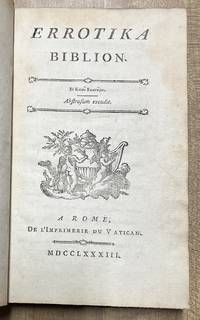
1783réf. 321855Rome: Vatican 1783. hardcover. iv 192 pages. Copper engraved title-page vignette with 2 cupids. 8vo full contemporary brown mottled calf gilt-decorated spine rather worn rubricated edges. Rome: Vatican 1783. First Edition. Very good. Written while Mirabeau was imprisoned in the castle of Vincennes. Erotika was included in the Papal Index of prohibited books. Vatican unknown books
1783réf. 22332Rome i.e. Paris or Neuchatel: de l'imprimerie du Vatican 1783. First edition 8vo pp. iv 192; title-page vignette 2 cupids; bound in modern dark brown morocco gilt a.e.g. by Wood; light wear a few contemporary manuscript notes fine. A compendium of curiosities culled from ancient writings in an effort to present indelicate subjects such as onanism tribalism etc. in a manner acceptable to the general public. Written while Mirabeau was imprisoned in the castle of Vincennes the book was according to Kearney pursued with such vigor by the authorities that only fourteen copies of the first edition have survived - a number almost assuredly inaccurate. Following a second edition of 1792 Errotika was included in the Papal Index of prohibited books. "A further edition was ordered to be destroyed in 1826 by the Royal Court of Paris and for 'outrages against public morality and good manners' there were two other prosecutions in 1856 and 1868" Kearney. The book was published in several subsequent editions and was included by Apollinaire along with some of Mirabeau's other prison writings in his scholarly edition of 1910 issued in the Bibliotheque des Curieux series. Barbier II 172. Graesse IV 535. Kearney Private Case 1190. Kearney Erotic Literature p. 80. Not in Brunet. de l'imprimerie du Vatican unknown books
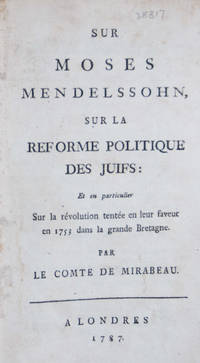
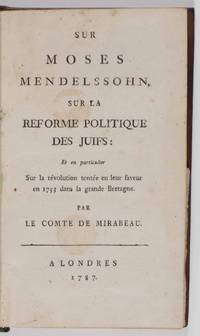
1787réf. 38317London: NP 1787. First edition. Hardcover. g. Octavo. 68 130pp. Original spotted calf with gold lettering and tooling on spine. Marbled endpapers and paper edges. Decorative head- and tailpieces. Honoré Gabriel Riqueti comte de Mirabeau 1749-1791 was a leader of the early stages of the French revolution. A noble before 1789 Mirabeau was involved in numerous scandals that left his reputation in ruins. However during the early years 1789-91 of the French Revolution he rose to the top and became the voice of the people. A successful orator he was the leader of the moderate position favoring a constitutional monarchy built on the model of Great Britain. Mirabeau became interested in the Jewish question during his visits to Holland in 1776 England in 1784 and Prussia in 1786. Influenced by the enlightened members of the Jewish communities in the capitals of these three countries he was particularly attracted by the image of Moses Mendelssohn. In "Sur Moses Mendelssohn sur la réforme politique des Juifs" a book resulting from the author's journey Mirabeau argued that the faults of the Jews were those of their circumstances. Although his main reason for admiring Mendelssohn was that 'humanity and truth' seemed much clearer to him than 'the dark phantoms of the Talmudists' he did not consider Judaism an immoral faith and he defended it against attacks both old and new. In the course of his argument he repeated Christian Wilhelm von Dohm's assertion that 'the Jew is more of a man than he is a Jew'. Quoting from Turgot and Rousseau in support of his pro-Jewish arguments Mirabeau affirms that history proves that 'the Jews considered as men and as citizens were greatly corrupted only because they were denied their rights'. Like Dohm he advocated preserving some measure of Jewish autonomy a view he developed in his memorandum to Frederick the Great of Prussia "De la monarchie prussienne" 1788 but he envisaged it as a transitory phenomenon; the organized Jewish community would wither away and die as the Jews entered fully into the economic and social life of the majority. Mirabeau continued to work for the emancipation of the Jews as he saw it. In the debate of Dec. 24 1789 he denied Rewbell's assertion that 'they the Jews do not regard themselves as citizens' and followed Clermont-Tonnerre in stating that the very fact that the Jews were requesting equality was proof of their desire to cease being Jewish in any separatist way. Binding rebacked but retaining most of its original spine. Calf darkened and partly cracked along edges. Front hinge starting. Previous owner's annotation in Latin along outer margin of page 68. Text in French. Binding in overall fair interior in very good condition. Moses Mendelssohn 1729-1786 was a German Jewish philosopher to whose ideas the Haskalah the 'Jewish enlightenment' of the eighteenth and nineteenth centuries is indebted. Although himself a practicing orthodox Jew he has been referred to as the father of Reform Judaism. Born to a poor Jewish family in Dessau and originally destined for a rabbinical career Mendelssohn educated himself in German thought and literature and from his writings on philosophy and religion came to be regarded as a leading cultural figure of his time by both Christian and Jewish inhabitants of the Holy Roman Empire. Christian Wilhelm von Dohm 1751-1820 was a German historian and political writer. Although a Christian he was a staunch advocate for Jewish emancipation. In 1781 at the suggestion of his friend Moses Mendelssohn Dohm published a two-volume work entitled "Über die Bürgerliche Verbesserung der Juden" On the Civil Improvement of the Jews which argued for Jewish political equality on humanitarian grounds. It was widely praised by the Jewish communities in Berlin Halberstadt and Surinam. Stanislas Marie Adélaïde comte de Clermont-Tonnerre 1757-1792 was a French military officer and a politician during the French Revolution. He was twice elected president of the National Constituent Assembly where he advocated a moderate liberal policy especially in the matter of removing restrictions for the Jews and Protestants. NP hardcover books
1787réf. D19716London 1787. First Edition . Hardcover. Near Fine. London: 1787. Half red morocco with gilt spine and marbled paper over boards. The most notable titled rebel to espouse the cause of political liberty and to hold office in Revolutionary France Count Mirabeau was also among the most distinguished advocates of Jewish emancipation in his troubled country. In this book published two years before the fall of the Bastille he turns the blazing intensity of the Enlightenment on the views of Moses Mendelssohn a man he greatly admired. Mirabeau draws strong philosophical similarities between Mendelssohn in Prussia and another heroic iconoclast Thomas Jefferson in Virginia. hardcover books
1787réf. 48852A Londres i.e. Strasbourg: N.p. 1787. First edition. Hardcover. Very good. Two parts octavo. 68130pp. Cancel title page. Contemporary tree calf; gilt spine in compartments morocco lettering piece; marbled endleaves; silk ribbon marker. Light soiling at title and a few leaves occasional mild foxing. A very good copy handsomely bound. First edition of this polemical work by the celebrated French statesman and political writer Gabriel-Honoré Riquetti comte de Mirabeau 1749-1791. Here he argues "that the degradation of the Jews was due to the squalid conditions in which they were being compelled to live. It was chiefly based on what he had seen in Germany where among other developments he witnessed part of the Pantheismusstreit the public controversy over Lessing's Spinozism which erupted in the 1780s and in which Mirabeau firmly took the side of the deceased Lessing and the Spinozistes" Israel Radical Enlightenment 716. Moses Mendelssohn 1729-1786 was considered the greatest Jewish philosopher of his time. Mirabeau devotes much of the present work to the public arguments of the Pantheismusstreit in which Mendelssohn was challenged either to demonstrate the fallibility of Christian dogma or to convert to Christianity. With a bio-bibiography of Mendelssohn and an account of the Naturalization Act of 1753 in England which gave full civil rights to Jews but was revised soon after. References: Bamberger 584. Cioranescu 45331. ESTC T-83507. Meyer Moses Mendelssohn Bibliographie 733. [N.p.] hardcover books
1783réf. 180319007Rome actually Neuchatel Switzerland: De l'Imprimerie du Vatican Francois Mallet 1783. First Edition. Hardcover. Very Good. First edition. iv 192 pp. Original red boards spine lettered in gilt. Very Good with light wear to boards and foxing. British publisher novelist book collector and bibliographer Michael Sadleir's copy with his small bookplate on paste down. A rare work of erotica written in prison in Paris while the author was sentenced to die for "abduction and seduction." Erika Delbecque Special Collections Librarian at University of Reading writes of this book: Organised by different sexual practices and perversions into eleven chapters including topics such as bestiality 'Béhéma' female homosexuality 'L'Anandryne' and nymphomania 'La Linguanmanie' it purports to offer a history of human sexual behaviour. Mirabeau draws on quotes from the Bible and ancient sources to provide historical examples of each sexual practice and attacks the corruption of the clergy and the aristocracy in the process. De l'Imprimerie du Vatican (Francois Mallet) hardcover books
1758réf. 8067Paris 1758. Second Edition of parts I-III first Edition of part IV. 8 192; 2 266 4; 6 264; 8 278 81pp. 2 vols. 4to. Contemporary mottled calf with gilt spines red morocco labels; covers a bit rubbed spine extremities and corners worn with slight chipping otherwise a very good copy internally crisp and clean. Frontispiece lacking as is often the case. Bookplates of A. de Seville. Second Edition of parts I-III first Edition of part IV. 8 192; 2 266 4; 6 264; 8 278 81pp. 2 vols. 4to. A work of fundamental importance whose appearance created a sensation throughout Europe was widely translated and reprinted and earned its author an international reputation "greater than that of any other economist before or after not excluding Adam Smith or Karl Marx." Schumpeter p. 175n Mirabeau argues that wealth is the product of population -- in particular agriculture -- and that a large populartion is desirable that religious toleration free enterprise a more equitable system of taxation and distribution of wealth were necessary components of a vital economy. The first three parts appeared in 1756; by 1758 Mirabeau had fallen under the influence of Quesnay and issued the fourth part in which the latter's influence is very much felt. The two between them it may be said founded the school of the physiocrats. A fifth and sixth part were added in 1760. Kress 5735; Higgs 1631; Goldsmith 9317 unknown books