621 résultats
1956réf. 2090202120401934Labor Law Association 1956. Soft Cover. Fine. Number of books: 1 Labor Law Association paperback
1968réf. 2081502111703644Takahashi shoten 1968. Soft Cover. Fine. Number of pages: 239 16p Size: 19cm Takahashi shoten paperback
1962réf. 2090502113711005Not Available 1962. Soft Cover. Fine. The book is in fine condition. Not Available paperback
1981réf. 2083002117802437Employment Law Practice Center 1981. Soft Cover. Fine. Number of pages: 210p Size: 21cm Employment Law Practice Center paperback
1988réf. 2082502113905299Published by Labor Law Association 1988. Soft Cover. Fine. Number of books: 1 Published by Labor Law Association paperback
1929réf. 2080302106804644Not Available 1929. Soft Cover. Fine. The book is in fine condition. Not Available paperback
1967réf. 2090502113707991Not Available 1967. Soft Cover. Fine. The book is in fine condition. Not Available paperback
1996réf. 2083002115802909Socioeconomic Productivity Headquarters 1996. Soft Cover. Fine. Number of books: 1 book Socioeconomic Productivity Headquarters paperback
1994réf. 2083002117803105Working Standards Examination 1994. Soft Cover. Fine. Number of pages: 237p Size: 21cm Working Standards Examination paperback
réf. 50424679-6Used - Good. Former library copy. Pages intact with minimal writing/highlighting. The binding may be loose and creased. Dust jackets/supplements are not included. Includes library markings. Stock photo provided. Product includes identifying sticker. Better World Books: Buy Books. Do Good. unknown
1989Signed by one of contributors on front end paper. No other marks or inscriptions. No creasing to covers or to spine. Very clean very tight pages with bright unmarked boards, slightly dusty, very slightly foxed page edges and no bumping to corners. 405pp. A collection of papers covering different area of Africa and examining forced labour and labour migration during the 19th and 20th centuries from Senegal to Tanzania, Kenya, Mozambique, South Africa and Namibia.
réf. 0967050529-11-1Minnesota Department of Economic Security. Very Good. It's a well-cared-for item that has seen limited use. The item may show minor signs of wear. All the text is legible with all pages included. It may have slight markings and/or highlighting. Minnesota Department of Economic Security unknown
réf. 10146comprenant la description des fleurs annuelles, vivaces et bulbes de pleine terre, suivies de classements divers indiquant l’emploi de ces plantes et l’époque de leur floraison. Avec des exemples de leur ornementation en divers genres. In 8 demi-toile muette. Faux-titre, VII, 1563 pages, plus de 1300 figures dans le texte, 3 plans dépliants dont un en couleurs. Paris chez Vilmorin-Andrieux & Cie, sans date. Un petit angle supérieur droit page de faux de titre. Bon état d’ensemble
réf. 0080377610.Ghardcover. Good. Access codes and supplements are not guaranteed with used items. May be an ex-library book. hardcover
réf. 16053Without date or place. Between 1816 and 1833. 1p. 12mo. On bifolium with the verso of the second leaf addressed to 'J. T. Smith esqr.' In fair condition on aged and worn paper. The letter begins: 'My dear Sir May I rely upon the kindness you have so often shewn me in adding once more to your many attentions - it is to introduced the bearer who is my eldest son to the librarian in order to his obtaining leave to read and also to copy out any extract from the Harleian or other collections.' He explains that the Marquess Wellesley 'who as Steward of the Kings Household is sone of the Trustees of the Museum has asked me for the copy of a pedigree of his family from one of the Harleian MSS. of which my son has theh reference'. Without date or place. [Between 1816 and 1833.] unknown
1986Previous owner's name/label to front end paper. No other marks or inscriptions. No creasing to covers, very faint crease to spine. A very clean very tight copy with bright unmarked, very slightly sunned boards, foxing to top of page edges and no bumping to corners. 368pp. Results of the UN University survey on migrant workers to the Arab world from seven Asian countries - Bangladesh, India, Pakistan, Sri Lanka, Republic of Korea, The Philippines and Thailand. Scarce.
réf. a95469Washington DC March 1993 first edition. Smithsonian. 4to wraps. Light depository library marks. not paginated consecutively about 100 pages. VG. . paperback
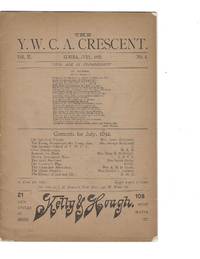
1892réf. 164651892. Young Women's Christian Association. The Y.W.C.A. Crescent July 1892 an early organizational newsletter carrying the motto "Our Aim is Progress" and documenting the public identity of the Young Women's Christian Association during the late nineteenth-century expansion of women's religious educational employment and associational activity. The emphatic language of "progress" places the publication within a culture of organized female self-improvement and collective advancement providing contemporary evidence of how a women-led Christian association presented its aims to members and readers. Without further description of the issue's internal articles its strongest interpretive value lies in this representation of YWCA community identity and the language through which women's organized activity was framed in the 1890s. The Y.W.C.A. Crescent. Vol. 2 No. 4. Young Women's Christian Association July 1892. Newsletter bearing the slogan "Our Aim is Progress." Pagination place of publication dimensions and specific internal contents are not supplied. As the fourth number of the publication's second volume the issue demonstrates an established serial publishing effort by the Association and provides material evidence of the periodical culture through which women's voluntary organizations maintained a recognizable institutional voice. An exact surviving example is independently cataloged under this title volume number and date. The issue belongs to the broader history of women's associational print culture at the close of the nineteenth century when newsletters and organizational periodicals helped sustain communities formed around religious fellowship education employment assistance and women's social development. The phrase "Our Aim is Progress" is particularly evocative of the aspirational vocabulary used by women's organizations seeking to define expanded roles for women within modern urban and professional life although the specific contents of this issue should not be inferred without examination. Covers loose or separated from the body of the newsletter; otherwise no specific defects supplied; overall very good. An early YWCA periodical useful for the study of women's organizational culture institutional publishing and the rhetoric of female advancement in the 1890s. unknown
1892réf. 164651892. Young Women's Christian Association. The Y.W.C.A. Crescent July 1892 an early organizational newsletter carrying the motto "Our Aim is Progress" and documenting the public identity of the Young Women's Christian Association during the late nineteenth-century expansion of women's religious educational employment and associational activity. The emphatic language of "progress" places the publication within a culture of organized female self-improvement and collective advancement providing contemporary evidence of how a women-led Christian association presented its aims to members and readers. Without further description of the issue's internal articles its strongest interpretive value lies in this representation of YWCA community identity and the language through which women's organized activity was framed in the 1890s. The Y.W.C.A. Crescent. Vol. 2 No. 4. Young Women's Christian Association July 1892. Newsletter bearing the slogan "Our Aim is Progress." Pagination place of publication dimensions and specific internal contents are not supplied. As the fourth number of the publication's second volume the issue demonstrates an established serial publishing effort by the Association and provides material evidence of the periodical culture through which women's voluntary organizations maintained a recognizable institutional voice. An exact surviving example is independently cataloged under this title volume number and date. The issue belongs to the broader history of women's associational print culture at the close of the nineteenth century when newsletters and organizational periodicals helped sustain communities formed around religious fellowship education employment assistance and women's social development. The phrase "Our Aim is Progress" is particularly evocative of the aspirational vocabulary used by women's organizations seeking to define expanded roles for women within modern urban and professional life although the specific contents of this issue should not be inferred without examination. Covers loose or separated from the body of the newsletter; otherwise no specific defects supplied; overall very good. An early YWCA periodical useful for the study of women's organizational culture institutional publishing and the rhetoric of female advancement in the 1890s. unknown books
1883réf. 1151581883 A Paris, Guimmaumin & Cie, éditeurs / Auguste Ghio, éditeur - 1883 - In-8, broché - 127 p.
2008réf. SONG1570185921Brand: BNA Books 2008-10-30. Supplement. paperback. Used: Good. 7.00x1.50x10.00. Buy with confidence. Excellent Customer Service & Return policy. Brand: BNA Books paperback
réf. 57341792-6Progressive Business Publications. Used - Good. Pages intact with minimal writing/highlighting. The binding may be loose and creased. Dust jackets/supplements are not included. Stock photo provided. Product includes identifying sticker. Better World Books: Buy Books. Do Good. Progressive Business Publications unknown
réf. 260519024Audio CD. Used: Very Good. 5x5x0. Very good condition. From a private collection. Comes from non smoking home. unknown
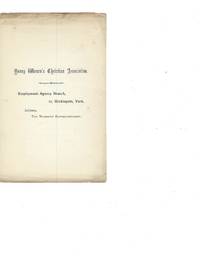
1890réf. 164641890. Young Women's Christian Association. Employment Agency Branch 1890s an organizational pamphlet documenting the policies governing a YWCA employment agency in York and the institutional mechanisms used to connect women seeking paid work with prospective employment. By the late nineteenth century YWCA branches had expanded beyond religious fellowship to provide practical services including housing vocational instruction and employment placement for women; YWCA histories record the establishment of employment bureaus and typewriting training during this period. The present pamphlet shows that employment-assistance system in practice through formal agency policies providing primary-source evidence for the study of women's labor charitable and religious social-service networks vocational placement and the changing economic position of women in late Victorian Britain. Young Women's Christian Association. Employment Agency Branch. York: Young Women's Christian Association 1890s. Self-wrappers. Pagination and dimensions not supplied. The pamphlet sets forth policies for the Association's Employment Agency Department defining the administrative framework through which the branch managed employment assistance. Its significance lies in the practical structure it records: rather than merely advocating women's economic independence the agency created a formal mechanism through which applicants and employers could be brought into contact under organizational supervision. This activity belongs to a broader late nineteenth-century transformation in women's work when employment opportunities were still strongly divided by gender but were beginning to expand into clerical professional retail medical and other occupations previously less accessible to women. The York employment agency belongs to the wider history of women's voluntary organizations intervening directly in the labor market by providing placement services training and institutional support. Such services were particularly significant for women navigating an employment landscape in which occupational options and wages remained constrained by gender. The pamphlet therefore offers evidence not simply of YWCA philanthropy but of the administrative infrastructure developed to facilitate women's entry into paid work. No specific physical defects are supplied; overall very good. A concise primary source documenting how a late Victorian women's organization translated social-service aims into a structured employment-placement program. unknown
1890réf. 164641890. Young Women's Christian Association. Employment Agency Branch 1890s an organizational pamphlet documenting the policies governing a YWCA employment agency in York and the institutional mechanisms used to connect women seeking paid work with prospective employment. By the late nineteenth century YWCA branches had expanded beyond religious fellowship to provide practical services including housing vocational instruction and employment placement for women; YWCA histories record the establishment of employment bureaus and typewriting training during this period. The present pamphlet shows that employment-assistance system in practice through formal agency policies providing primary-source evidence for the study of women's labor charitable and religious social-service networks vocational placement and the changing economic position of women in late Victorian Britain. Young Women's Christian Association. Employment Agency Branch. York: Young Women's Christian Association 1890s. Self-wrappers. Pagination and dimensions not supplied. The pamphlet sets forth policies for the Association's Employment Agency Department defining the administrative framework through which the branch managed employment assistance. Its significance lies in the practical structure it records: rather than merely advocating women's economic independence the agency created a formal mechanism through which applicants and employers could be brought into contact under organizational supervision. This activity belongs to a broader late nineteenth-century transformation in women's work when employment opportunities were still strongly divided by gender but were beginning to expand into clerical professional retail medical and other occupations previously less accessible to women. The York employment agency belongs to the wider history of women's voluntary organizations intervening directly in the labor market by providing placement services training and institutional support. Such services were particularly significant for women navigating an employment landscape in which occupational options and wages remained constrained by gender. The pamphlet therefore offers evidence not simply of YWCA philanthropy but of the administrative infrastructure developed to facilitate women's entry into paid work. No specific physical defects are supplied; overall very good. A concise primary source documenting how a late Victorian women's organization translated social-service aims into a structured employment-placement program. unknown books