656 résultats
1972réf. mon0000584191HMSO 1972T. paperback. Acceptable. in x in x in. NOT an ex-library book. Pages are clean but cover has foxing stains along edges. HMSO paperback
réf. 798troisième édition entièrement refondue et très augmentée. In 8 cartonné.Pièce de titre imprimée, Faux-titre,frontispice illustré et gravé,titre,VII,568 pages.non rogné.Dondey-Dupré père & fils 1824(1/3 de la page de faux-t coupé)bon exemplaire Méthode ayant pour objet de régler le bon emploi du temps à l'aide d'une série de tableaux synoptiques présentant la suite rationnelle et progressive des occupations de la naissance à l'âge adulte.Il reprit ce plan qu'il développa à part dans son Essai sur l'Emploi du Tems,publié pour la première fois en 1808.Mêlé de très bonne heure à la politique militante,attaché à l'administration de la guerre sous le directoire, le Consulat et l'Empire,auteur d'un très grand nombre d'écrits d'actualité,Jullien de Paris (1775-1848),eut jusque dans les premières années du gouvernement de Juillet, eut une grande activité de publiciste. Buisson,Dictionnaire de Pédagogie
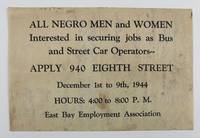
1944réf. 3081N.p. but perhaps Oakland or Berkeley 1944. Very good. Printed broadside 5.25 x 8 inches. Minor foxing and staining light edge wear penciled note covering most of verso. A small and apparently unrecorded broadside calling for African Americans interested in working as bus drivers and street car operators in the San Francisco Bay Area during the latter portion of World War II. The notice calls for interested parties to apply at the offices of the East Bay Employment Association between 4:00 and 8:00 PM between December 1 and 9 1944. We could locate no information on the East Bay Employment Association but it was almost certainly located in either Oakland or Berkeley. This employment advertisement was perhaps the result of a wartime shortage of bus drivers and street car operators in the Bay Area. We could locate no other copies of this interesting and somewhat mysterious broadside. unknown
1847réf. 162581847. Goddard Emily L. Archive of thirteen letters of recommendation and certification 1847-1853 documents a woman teacher establishing her professional qualifications across the common schools of western Massachusetts. Written by school officials and other individuals in Barre Wilbraham New Salem Athol Petersham and surrounding communities the letters certify Goddard's eligibility to teach in particular districts or attest to her general qualifications for common-school instruction. Spanning six years the correspondence records the repeated process by which a woman teacher obtained written approval and recommendations as she sought successive teaching positions in antebellum New England. Thirteen manuscript letters 1847-1853 concerning Emily L. Goddard's qualifications and employment as a teacher in western Massachusetts. The documents originate from multiple towns including Barre Wilbraham New Salem Athol and Petersham and consist principally of certifications and recommendations addressing Goddard's ability to teach a common school. The individual letters preserve the assessments she carried between districts as evidence of her preparation and prior work. Their geographic range and successive dates trace a professional record extending beyond a single appointment or school and show how recommendations from local authorities could accompany a teacher seeking employment elsewhere. Goddard's papers date from the expansion of the Massachusetts common-school movement when public education reform increased demand for teachers and teaching became an increasingly important occupation for women. Women's employment in common schools expanded substantially during the nineteenth century although hiring certification salaries and continued employment remained subject to local school authorities. This archive records those practices through one teacher's surviving credentials: thirteen documents produced over six years as Goddard accumulated certifications and endorsements in several Massachusetts communities. Fold lines and creases with very little foxing; handwriting remains clear and legible throughout. All thirteen letters in very good condition. A sustained documentary record of a woman building a teaching career within the local certification and recommendation practices of antebellum Massachusetts. unknown
réf. 16266Working Girls' Society. Circular of the Working Girls' Society late nineteenth century sets out the rules and benefits of a New York organization created for wage-earning women. The Society provided working women with rooms for social meetings classes reading and recreation after working hours while its bylaws governed membership and access to the organization's facilities. Contemporary accounts of New York working girls' clubs describe them as cooperative organizations in which members pursued self-education social activity and practical assistance rather than simply receiving charity. Circular of the Working Girls' Society. New York: Working Girls' Society n.d. Bylaws governing membership and use of the Society's library and rooms at 222 West 38th Street. The circular describes benefits available to members including special vacation privileges and discounted railway tickets combining educational and social provisions with practical assistance for women earning wages in the city. The regulations document the daily administration of a women's club formed around the needs of an expanding urban female workforce and show how membership could provide access to books meeting rooms instruction recreation and reduced-cost travel. The circular survives from the period in which working women's clubs expanded in New York; by the early twentieth century contemporary descriptions traced the movement to clubs organized during the 1880s and emphasized their classes member government and opportunities for social intercourse and self-improvement. Two very light horizontal folds and light thumb-soiling with a 2-inch tear at the bottom of the center fold; overall Very Good Condition. unknown
1911réf. 182771911. Imperial size albumen portraits of faculty and students at American Medical College. St. Louis Missouri 1911. Large photo measures 24 x 20 inches. 40 subjects every one of them male except for a single female student listed below as "F Heflin." Photographed by Hays Studio. Mounted to photographer's board. The American Medical College a medical school founded in 1873 graduated its first woman in 1888. In 1911 the American Medical College combined with the Barnes Medical College. The following year the combined school became the Medical Department of the National University of Arts and Sciences in St. Louis. The National University then merged with the St. Louis College of Physicians and Surgeons around 1915. Female students like this one would have come in at a significant disadvantage proving her qualifications against skepticism in a field notorious for gender discrimination. The value of female doctors for female patients in particular has been profound. Board scuffed on one side does not affect images or text. Chipped at corner and top does not affect images or text. Overall very good condition. Expressions and details in images clear. unknown
réf. GOR006782046Paperback. Very Good. paperback
1999112 pages. Features: Human Smugglers - Running refugees into the U.S. from the Akwesasne Reserve; Chinese migrants risk their lives to be smuggled to North America; Patrolling 'Little Korea' - illegals from all over jump the U.S. border in southern B.C.; Chinese migrants seek release in B.C.; The Tragedy of Andrew Rich - teen Innu suicide victim; Problems with Emploi Quebec; Britain's hereditary peers fall victim to reform; Plunge of Flight 990 off Massachusetts; Feature Article - Wayne Gretzky's New World - he talks of family, life, and the public perils of selling himself; Bill Gates - as Microsoft fights antitrust findings, rivals gear up in the battle for web markets; Smart Appliances are set to rival the PC's role; Chris Staples and his Vancouver ad agency Palmer Jarvis DDB; Photo of young entrepreneur award recipients Stephen J.P. Comeau and Michael-Andreas Kuttner with their mentor, Wendy Paquette; Photos and short write-ups of additional entrepreneurs: Colleen Kennedy, Paul Wareham, Mark McLane, Allen and Tim McCandless, Ariel and Ron Shlien, Dave Zakutin, Kirt Eliza Kootoo, Chris Bond, Ken Zorniak, Daniel and Garnette Weber, Alan and Ian Andreasen, Susan Ireland, Daniel Sacks; Johan Arnet, and Samson Hartland; Brian Scudamore and 1-800-Got-Junk?; The Harry Potter Series; Pianist Naida Cole; Alexei Yashin and Carol Alt; and more. Clean, bright and unmarked with very light wear. One-inch opening to top of cover fold. A high-quality copy. Book
1952290 pages. "This plan has two principal objects as follows: i) to act as a general and flexible guide to all concerned as to the manner in which planning control within the area of the plan will be discharged, and particularly as to the kind of development for which planning permission is likely to be granted by the Local Planning Authority. ii) to designate land as subject to compulsory acquisiton by any Minister, Local Authority or Statutory Undertaker." - from Foreword. Topics treated in this volume include: Regional Setting and Characteristics; Development of Settlement Pattern and Main Land Use Features; Communications and Transport; Employment, Industry and Population; Agriculture, Derelict and Marginal Land, and Forestry; Economic Geology and Mineral Resources; Housing; Public Utility, Educational, Library, Health, Recreational and Social Services; Landscape and Development in Rural Areas; Camping and Caravanning; Archaeology, Ancient Monuments and Buildings of Special Architectural or Historic Interest; Development by Government Departments; Programming; Summary of Analysis. Former reference library markings. Average wear. Binding intact. A sound copy. Book
1952301 pages. "This plan has two principal objects as follows: i) to act as a general and flexible guide to all concerned as to the manner in which planning control within the area of the plan will be discharged, and particularly as to the kind of development for which planning permission is likely to be granted by the Local Planning Authority. ii) to designate land as subject to compulsory acquisiton by any Minister, Local Authority or Statutory Undertaker." - from Foreword to Part I. This part considers the following towns: Bodmin, Bude-Stratton; Falmouth; Fowey; Launceston; Lostwitheil, Newquay, Padstow, Saltash, St. Austell, Torpoint, Truro. For each of these towns the text is divided into the following sections and includes diagrams relating to Population and the Location and Growth of each town: introduction and brief description; Historical Summary and Population Trends since 1801; Regional Communications; Mineral Resources; Population Structure in relation to Employment; Topography and Existing Land Use; Housing; Public Utilities; Social Services; Analysis of Urban Survey; Other Primary Land Uses; Programming. Former reference library markings. Average wear. Binding intact. A sound copy. Book
1919réf. 163201919. Ministry of Reconstruction Women's Advisory Committee. Report of the Sub-Committee Appointed to Consider the Position after the War of Women Holding Temporary Appointments in Government Departments 1919 addresses the status of women recruited into temporary government service during World War I and the terms under which they might remain in public employment after demobilization. The report concerns the transition from wartime labor to the permanent Civil Service including questions of women's eligibility for continued appointment equality of treatment with male colleagues pay and the assignment of clerical duties. Produced as the British government confronted the employment consequences of women's expanded wartime service it records official consideration of whether women who had entered departments under emergency conditions should retain a place in the postwar state workforce. Ministry of Reconstruction. Women's Advisory Committee. Report of the Sub-Committee Appointed to Consider the Position after the War of Women Holding Temporary Appointments in Government Departments. Presented to Parliament by Command of His Majesty. London: Published by His Majesty's Stationery Office 1919. Folio. 8 pages. The sub-committee consisted of six women and two men and was charged specifically with examining the position of women holding temporary government appointments after the war. Its recommendations address routes by which women might become permanent government employees and argue for treatment on terms comparable to male colleagues including questions of equal pay and the expectation that women should not automatically be assigned additional clerical work because of their sex. As an official parliamentary publication rather than an outside campaign tract the report documents how women's wartime employment had become an administrative question within government itself. Women entered British government departments in substantially increased numbers during World War I filling posts created or expanded by wartime administration while large numbers of men were serving in the armed forces. The end of the war raised immediate questions about whether these appointments would be terminated converted into permanent positions or reorganized along sex-segregated lines. This report preserves the Women's Advisory Committee's intervention in that process and records specific arguments over permanence pay duties and women's place in the postwar Civil Service. Modern blue card wrappers with paper label. Very good condition. An official 1919 statement of the employment claims advanced for women whose wartime government service had demonstrated their capacity to perform work previously reserved largely for men. unknown
réf. 16266Circular of the Working Girls' Society. Bylaws for one of the first organizations in New York that was created specifically to support women workers. Extremely rare.Two very light horizontal fold marks. Light thumb-soiling. 2" tear at bottom of center fold. Very good condition. The Working Girls' Society was designed to provide space for girls and women to gather take classes and socialize after working hours; it was dedicated to providing working women with a safe and clean space that could help them advance their professional lives. Information in the bylaws related to membership and to members' uses of the organization's library and rooms at 222 West 38th Street. Perks of joining the society the club even include special vacation benefits and discounted train tickets. An extremely rare early document that details the social communities which developed around a larger urban female workforce in the late 19th century. Extremely scarce OCLC Worldcat lists no other known copies of this document in any institution of library worldwide. unknown books
1859réf. 165681859. Parkes Bessie Rayner. The Market for Educated Female Labor 1859 argues that girls and young women should receive education or vocational training sufficient to support themselves rather than being prepared exclusively for marriage. Parkes wrote amid organized efforts to expand employment opportunities for middle-class women and in the same year that the Society for Promoting the Employment of Women was established. She rejects the assumption that marriage guaranteed lifelong financial support observing "The daughter may marry but her husband may die.or be too poor to support her and her children; let her at least be trained beforehand to some possible way of getting her bread." Her argument treats women's preparation for paid work as an ordinary parental responsibility rather than an emergency measure reserved for poverty. Parkes Bessie Rayner. The Market for Educated Female Labor. 1859. First edition. 6 pages present of an original 8 lacking the final two pages. Unbound measuring 8 1/4 x 5 inches. The text was delivered as a paper at the 1859 Bradford meeting of the Association for the Promotion of Social Science. Parkes states "We lay it down as a primary social law conceded by all political economists that a father ought to provide for all his children or give them the means of providing for themselves." She further counters the idea that paid employment among middle-class women was exceptional: "Probably every person present has a female relative or intimate friend whom trade-failure the exigencies of a numerous household or the early death of husband or father has compelled to this course; it is the experience of every family." The surviving text consequently links women's education to specific economic contingencies including business failure large households widowhood and the death of a father or husband. Parkes was then a central figure in the Langham Place circle and a founding editor of the English Woman's Journal established in 1858 to address women's employment education legal disabilities and related reforms. Her paper appeared as these activists were moving from publication and debate toward practical employment initiatives; the Society for Promoting the Employment of Women was founded in 1859 to train women and open additional occupations to them. At the time this description was prepared no copies were recorded in American institutional holdings consulted; OCLC search results remain subject to cataloging changes and should be reconfirmed. Repairs to the upper right corner and right edge of page 1 and a small repair to the left edge of page 6. Lacking the final two pages; good condition. The surviving six pages preserve Parkes's direct argument that women's education should provide the means for economic self-support in circumstances she described as common within middle-class families. unknown
réf. 16574Women Employment Lucy Wilson. "Women and Legislation." Vigilance Association for the Defence of Personal Rights. June 20 1874. Original paper wrappers. 4 pages. First edition. 8 1/2 x 5 in. A Letter addressed to the Editors of the Leeds Mercury. "These measures all point to one conclusion that motherhood is a crime. The woman who is guilty of it unless.she is rich and independent shall not eat bread for six months thereafter or twelve as the House may determine." In this open letter Wilson decries legislation which would forbid new mothers from working yet fails to provide any public assistance for them to care for their families. "No Act has been passed decreeing that such women shall not suffer cold or hunger or to 'deem that they commit an offence' if they are hungry." Vigilance Association for the Defence of Personal Rights was a British organization dedicated to watching restraining and influencing legislation especially in matters affecting the interests of women and the personal rights and liberties of the people. Small losses along spine. Very good condition. unknown books
1935réf. 2111902160500458Not Available 1935. Soft Cover. Fine. Number of copies: Central Employment Placement Secretariat Not Available paperback
réf. 2081002109001728Employment Problem Study Group N.A. Soft Cover. Fine. Number of pages: 2 books Size: 26cm Employment Problem Study Group paperback
réf. 2090202118204604Not Available N.A. Soft Cover. Fine. The book is in fine condition. Not Available paperback
2001réf. x-0415252415Routledge 2001. Hardcover. New. 1st edition. 292 pages. 9.25x6.25x1.00 inches. Routledge hardcover
1994réf. 2081502111907407Employment 1994. Soft Cover. Fine. Number of pages: 229p Size: A4 fine Employment paperback
1919réf. 149951919. National Federation of Business and Professional Women's Clubs plaque 1919 commemorates the founding year of a national organization created to coordinate and advance the interests of business and professional women. Established on July 16 1919 after wartime efforts to identify women's professional skills and experience the Federation developed from organizing associated with the Women's War Council and the mobilization of women workers during World War I. Its formation preceded ratification of the Nineteenth Amendment in 1920 and placed questions of women's employment professional advancement and political participation within a national organizational structure. Large bronze embossed seal of the National Federation of Business and Professional Women's Clubs mounted on wood and dated 1919. The Federation was organized at its first national convention in St. Louis in July 1919 under the leadership of Lena Madesin Phillips with Gail Laughlin elected its first national president. Early Federation work included a national survey of business and professional women addressing their status qualifications opportunities and working conditions providing an organized basis for advocacy concerning women's economic and professional life. The plaque dates from the Federation's founding year when women were entering professional occupations in greater numbers while still lacking federally protected voting rights nationwide. The organization continued to advocate on issues affecting working women and to promote professional development leadership and economic opportunity. The bronze seal mounted on wood survives as an organizational artifact from the Federation's establishment in 1919 one year before ratification of the Nineteenth Amendment extended constitutional protection for women's suffrage nationwide. unknown
1910réf. 175081910. Women Employment Feminism and Women's Rights Summary of Eight Papers and Discussions Upon the Disabilities of Mothers as Workers. London: Fabian Women's Group 1910. Measures 8.5" x 5" inches. 32 pages. This pamphlet summarizes the problems that arise from the modern expectation of women to work difficult industrial jobs as well as the traditional duties of motherhood. This pamphlet was produced by the Fabian Women's Group which acted as a suffrage pressure group directed at the Labour Party that also advocated for women workers. The summarized section was edited by Charlotte Payne Townshend wife of George Bernard Shaw. Paper titles include: The Physical Disabilities of Maternity The Influence of Hygiene and Physical Culture upon the Disabilities of Motherhood The Effects upon children of the Mother's Activity Outside the Home and more. From "Motherhood and Industrial Work" Frau Lily Braun states: "The evils of exploited labor are seen at their worst in the employment of married women with children. The wages of many a workman do not suffice for family maintenance and the wife's work is absolutely essential to make up what is needed.In the early morning she starts for her work; and the cooking washing cleaning and sewing must be done in the evening by an overtaxed wearied woman. Premature age and spiritual exhaustion are the result." Some minor stains from rusted staples in the gutter of the spine not affecting text. Overall in very good condition. unknown
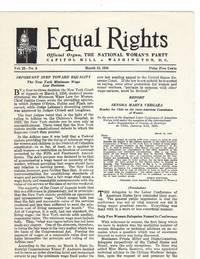
1936réf. 160251936. National Woman's Party. Equal Rights March 15 1936 documents the organization's campaign for legal equality at a time when women's workplace legislation divided American feminists over whether sex-specific protections advanced or restricted women workers. Founded in 1916 by Alice Paul and Lucy Burns during the suffrage campaign the National Woman's Party continued after ratification of the Nineteenth Amendment by advocating the Equal Rights Amendment then commonly associated with the Lucretia Mott Amendment and by opposing laws that imposed legal distinctions based solely on sex. This issue addresses the New York minimum wage controversy international equal-rights efforts and proposed workplace protections for women and children. National Woman's Party. Equal Rights. Vol. 22 No. 6. March 15 1936. 4 pages. 8 1/2 x 11 inches. Official organ of the National Woman's Party. The issue reports on the New York minimum wage case after the New York Court of Appeals struck down the state law regulating minimum wages for women; the United States Supreme Court subsequently affirmed that judgment in Morehead v. New York ex rel. Tipaldo on June 1 1936. It also discusses the Equal Rights Treaty signed at Montevideo by Cuba Ecuador Paraguay and Uruguay part of the National Woman's Party's effort to establish sex equality in international law. Another article addresses workplace hygiene and a resolution requiring employers to provide women with separate quarters for washing changing clothes and general use as well as seats for women and children when the work did not require them to remain standing. Published two years before enactment of the Fair Labor Standards Act of 1938 the issue records a central dispute in interwar women's rights politics: whether legislation written specifically for women offered necessary labor protection or created legal distinctions that could restrict women's employment and undermine demands for equal rights. The National Woman's Party pursued the latter argument while simultaneously campaigning internationally for legal equality between the sexes. The March 1936 issue therefore preserves contemporary evidence of the relationship among the Equal Rights Amendment campaign minimum wage litigation international treaty advocacy and debates over sex-specific workplace regulation. In excellent condition. unknown
réf. 6236ou traité de pharmacie pratique et théorique,deuxième édition revue,corrigée et considérablement augmentée. Par M.M.GUIBOURT 2 tomes en 2 volumes in 8 demi-cuir fauve, titre,tomaison,roulette dorées filets à froid Tome 1er faux-titre,titre,XXXV 1 page d’errata,638 pages rousseurs en début et fin de volume Tome deuxième faux-titre,titre , 701 pages,2 pages de catalogue 21 planches gravées dont deux dépliantes dessins de A.TALLE gravure de ADAM.Tranches marbrées.Rousseurs en début et fin de volume,mouillure brune en marge extérieure de la page 689 à la planche V, G.S Chaudé libraire éditeur 1834
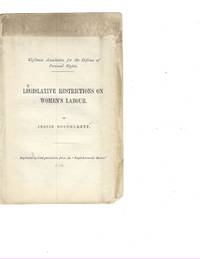
1873réf. 165771873. Boucherett Jessie. Legislative Restrictions on Women's Labour 1873 challenges proposed factory legislation limiting the hours and conditions under which women including mothers of young children could work arguing that such measures deprived adult women of authority over their own employment while providing no substitute for lost wages. Boucherett identifies the principle underlying the legislation as itself objectionable: "Another objection is that the Bill confirms the principle that women are not capable of deciding for themselves." Her opposition arose from the practical circumstances of women whose earnings supported themselves and their children placing employment restrictions within a larger debate over women's legal independence wages and control of their own labor. Boucherett Jessie. Legislative Restrictions on Women's Labour. London: Frederick Bell & Co. 1873. First edition. Reprinted by kind permission from the Englishwoman Review for the Vigilance Association for the Defence of Personal Rights. 12 pages. Original paper wrappers. 8 x 5 inches. Boucherett acknowledges the protective rationale behind the proposed measures writing "It has caused some surprise that Bills framed for so benevolent a purpose should have met with opposition from an unexpected quarter" before detailing their possible consequences for working women. She argues that reducing women's access to factory employment without guaranteeing family maintenance could produce "much suffering and some crime" since "it would always be difficult and sometimes impossible for a woman to provide sufficient food for herself and four or five little children." Her argument therefore distinguishes between women with independent means and wage-earning women for whom statutory restrictions could immediately reduce the household's supply of food and other necessities. Boucherett had founded the Society for Promoting the Employment of Women in 1859 and spent much of her career seeking expanded training and occupations for women; this pamphlet applies the same concern for economic independence to parliamentary attempts to regulate female industrial labor. Its publication also formed part of a contemporary controversy over proposals associated with Alexander Mundella and John Lubbock to extend restrictions governing women's factory employment. Rather than opposing regulation solely in the name of laissez-faire principles Boucherett bases her case on women's need to earn wages their responsibility for dependent children and their right to make employment decisions for themselves. Toning to front wrapper with a few chips and losses along the right edge. Good condition. unknown
réf. 16320This document was created with the intent of finding employment and for women contracted on temporary terms to work in government-appointed positions during World War I. The Committee advised that women have options to become permanent members of the government workforce and be treated equally with male colleagues i.e. equal pay not having additional clerical duties etc. Ministry of Reconstruction. Women's Advisory Committee. Report of the Sub-Committee Appointed to Consider the Position after the War of Women Holding Temporary Appointments in Government Departments. Presented to Parliament by Command of His Majesty. London: Published by his Majesty's Stationery Office 1919.Modern blue card wrappers with paper label. 8 page folio. Very good condition. The sub-committee which wrote this was composed of six women and two men demonstrating the interest and respect for women's work and labor contributions during World War I. unknown books