677 résultats
1991Very Good Paperback. Some sunning to spine and very slight wear to cover. Clean copy. xx + 382p.
1975Pencil underlining to some chapters and previous owner's name to front end paper. No creasing to covers or to spine. A clean very tight copy with bright unmarked boards and no bumping to corners. 344pp. In this Open University book the authors have attempted to re-unite the various sub-disciplines of sociology including occupational sociology and industrial sociology.
réf. Z1-X-017-02807European Commission Directorate-General for Employment Industrial Relations and Social Affairs. Used - Good. Ships from UK in 48 hours or less usually same day. Your purchase helps support Sri Lankan Children's Charity 'The Rainbow Centre'. Ex-library so some stamps and wear but in good overall condition. 100% money back guarantee. We are a world class secondhand bookstore based in Hertfordshire United Kingdom and specialize in high quality textbooks across an enormous variety of subjects. We aim to provide a vast range of textbooks rare and collectible books at a great price. Our donations to The Rainbow Centre have helped provide an education and a safe haven to hundreds of children who live in appalling conditions. We provide a 100% money back guarantee and are dedicated to providing our customers with the highest standards of service in the bookselling industry. European Commission, Directorate-General for Employment, Industrial Relations and Social Affairs unknown
1991Paris, La découverte 1991. In-8 broché de 127 pages. Collection Repères. Très bon état
1910réf. 175081910. Women Employment Feminism and Women's Rights Summary of Eight Papers and Discussions Upon the Disabilities of Mothers as Workers. London: Fabian Women's Group 1910. Measures 8.5" x 5" inches. 32 pages. This pamphlet summarizes the problems that arise from the modern expectation of women to work difficult industrial jobs as well as the traditional duties of motherhood. This pamphlet was produced by the Fabian Women's Group which acted as a suffrage pressure group directed at the Labour Party that also advocated for women workers. The summarized section was edited by Charlotte Payne Townshend wife of George Bernard Shaw. Paper titles include: The Physical Disabilities of Maternity The Influence of Hygiene and Physical Culture upon the Disabilities of Motherhood The Effects upon children of the Mother's Activity Outside the Home and more. From "Motherhood and Industrial Work" Frau Lily Braun states: "The evils of exploited labor are seen at their worst in the employment of married women with children. The wages of many a workman do not suffice for family maintenance and the wife's work is absolutely essential to make up what is needed.In the early morning she starts for her work; and the cooking washing cleaning and sewing must be done in the evening by an overtaxed wearied woman. Premature age and spiritual exhaustion are the result." Some minor stains from rusted staples in the gutter of the spine not affecting text. Overall in very good condition. unknown
1910réf. 175081910. Women Employment Feminism and Women's Rights Summary of Eight Papers and Discussions Upon the Disabilities of Mothers as Workers. London: Fabian Women's Group 1910. Measures 8.5" x 5" inches. 32 pages. This pamphlet summarizes the problems that arise from the modern expectation of women to work difficult industrial jobs as well as the traditional duties of motherhood. This pamphlet was produced by the Fabian Women's Group which acted as a suffrage pressure group directed at the Labour Party that also advocated for women workers. The summarized section was edited by Charlotte Payne Townshend wife of George Bernard Shaw. Paper titles include: The Physical Disabilities of Maternity The Influence of Hygiene and Physical Culture upon the Disabilities of Motherhood The Effects upon children of the Mother's Activity Outside the Home and more. From "Motherhood and Industrial Work" Frau Lily Braun states: "The evils of exploited labor are seen at their worst in the employment of married women with children. The wages of many a workman do not suffice for family maintenance and the wife's work is absolutely essential to make up what is needed.In the early morning she starts for her work; and the cooking washing cleaning and sewing must be done in the evening by an overtaxed wearied woman. Premature age and spiritual exhaustion are the result." Some minor stains from rusted staples in the gutter of the spine not affecting text. Overall in very good condition. unknown books
1979réf. 206544Couverture souple. Broché. 179 pages. Couverture légèrement défraîchie.
1997Ex-library copy with usual stamps, stickers etc. Binding is solid and text/interior is clean and free of marking of any kind. 364 pages, very clean copy with sharp corners, perfect interior. B&w photos, tables, charts. Text is in French
1960réf. 238201960. Civil rights law and racial justice ephemera from circa 1961 to 1975 documenting the expansion of anti discrimination policy from state and local campaigns into federal employment regulation fair housing advocacy administrative enforcement and the 1970s critique of institutional racism. The six publications move from the Kentucky Advisory Committee's reporting on discrimination in Louisville Lexington Frankfort and Hopkinsville through the federal legal apparatus created around the Civil Rights Act of 1964 and Executive Order 11246 then into national organizing and statistical analysis of racial disparities during the following decade. By 1975 Fact Sheets on Institutional Racism framed inequalities in business ownership banking education housing media health and government as products of "White Control and Minority Oppression" extending the group's documentary range from laws against discriminatory acts to an analysis of the institutions in which racial inequality persisted. Archive of six pamphlets and ephemeral publicationseach approx 7 x 8 inches to 8 x 10 inches United States circa 1961 to 1975. 1 Kentucky Advisory Committee to the U.S. Commission on Civil Rights. Kentucky. Circa 1961. Report on civil rights activity in Louisville Lexington Frankfort and Hopkinsville addressing public accommodations employment housing and the development of the Kentucky Commission on Human Rights. Its introduction describes the state committee reports as "on-the-spot findings of informed and conscientious citizens seeking to discover the extent of denials of equal justice in their respective States and possible remedies" while also recording the activity of religious groups in breaking racial barriers. 2 Fair Housing for All: We Welcome Neighbors of Any Race Creed or Color. Circa 1960s. Public facing fair housing advocacy piece built around the image of a house enclosing the words "FOR ALL" explicitly joining residential integration to opposition to discrimination by race creed or color. 3 U.S. Commission on Civil Rights. Equal Employment Opportunity Under Federal Law: A Guide to Federal Law Prohibiting Discrimination on Account of Race Religion or National Origin in Private and Public Employment. Clearinghouse Publication No. 17. August 1969. The guide sets out "The Duty of Nondiscrimination" and procedures for filing employment discrimination complaints then explains coverage under the Civil Rights Act of 1964 the Equal Employment Opportunity Commission Executive Order 11246 for federal contractors and subcontractors the National Labor Relations Act Section 1981 the Civil Rights Act of 1968 Title VI federal employment state and local government employment and "Affirmative Steps Toward Equal Employment Opportunity." 4 State of Kansas Commission on Civil Rights. The Kansas Act Against Discrimination. Circa 1972 or later. The introductory note traces the statute from its passage in 1953 through amendments in 1961 1963 1965 1967 1970 and 1972. Those amendments successively extended protection into employment hotels and restaurants broader public accommodations and real estate transactions while enlarging the Commission's investigatory and subpoena powers and in 1972 authorizing investigation of complaints of sex discrimination. 5 YWCA of the U.S.A. National Convocation on Racial Justice. Americana Hotel New York City June 15 1972. Program for a national meeting organized around plenary sessions and morning and afternoon panels naming Senator Hugh Scott Representative Ronald V. Dellums Representative Shirley Chisholm Dr. Reginald Wilson Hon. Richard Hatcher and Hon. McGeorge Bundy among its speakers. 6 Foundation for Change Inc. and Council for Interracial Books for Children. Fact Sheets on Institutional Racism: White Control and Minority Oppression. August 1975. Organized under the headings Economy Health Housing Education Media Government and Census the publication compiles contemporary statistics from sources including the U.S. Bureau of the Census Black Enterprise Ebony Jet and the Economic Priorities Report. Its economy section reports that Black Americans owned 1.2 percent of business equity 1.2 percent of farm equity and 0.1 percent of stock equity; that only one of 650 seats on the American Stock Exchange belonged to a Black firm; and that Black Americans held 72 of 14000 directorships among the 1000 largest corporations. The publications record successive stages in the institutional response to racial discrimination. The Kentucky report belongs to the period when state advisory committees gathered local testimony and documented unequal treatment before the principal federal civil rights legislation of the mid 1960s; the Kansas pamphlet records how one state repeatedly enlarged the jurisdiction and enforcement powers of its civil rights commission between 1953 and 1972. The 1969 federal employment guide shows the resulting network of statutes executive authority complaint procedures commissions and sanctions through which nondiscrimination became an administrative responsibility extending across private employment public employment organized labor and federal contracting. The fair housing piece translates the same legal and political struggle into direct public persuasion while the 1972 YWCA program places elected officials including Dellums and Chisholm within a national organizational campaign for racial justice. By 1975 Fact Sheets on Institutional Racism measured disparities that remained after more than a decade of civil rights legislation citing ownership corporate governance banking and income statistics to argue that formal legal equality had not altered the distribution of economic power. Light handling and edge wear scattered toning and occasional spotting or soiling visible to wrappers; manuscript notation and institutional library markings to the Kentucky report; contents generally clean and legible. Overall good condition. A compact documentary record of the movement from prohibiting racial discrimination in law to enforcing those prohibitions through public institutions and confronting the economic and institutional inequalities that remained. unknown
1960réf. 238201960. Civil rights law and racial justice ephemera from circa 1961 to 1975 documenting the expansion of anti discrimination policy from state and local campaigns into federal employment regulation fair housing advocacy administrative enforcement and the 1970s critique of institutional racism. The six publications move from the Kentucky Advisory Committee's reporting on discrimination in Louisville Lexington Frankfort and Hopkinsville through the federal legal apparatus created around the Civil Rights Act of 1964 and Executive Order 11246 then into national organizing and statistical analysis of racial disparities during the following decade. By 1975 Fact Sheets on Institutional Racism framed inequalities in business ownership banking education housing media health and government as products of "White Control and Minority Oppression" extending the group's documentary range from laws against discriminatory acts to an analysis of the institutions in which racial inequality persisted. Archive of six pamphlets and ephemeral publicationseach approx 7 x 8 inches to 8 x 10 inches United States circa 1961 to 1975. 1 Kentucky Advisory Committee to the U.S. Commission on Civil Rights. Kentucky. Circa 1961. Report on civil rights activity in Louisville Lexington Frankfort and Hopkinsville addressing public accommodations employment housing and the development of the Kentucky Commission on Human Rights. Its introduction describes the state committee reports as "on-the-spot findings of informed and conscientious citizens seeking to discover the extent of denials of equal justice in their respective States and possible remedies" while also recording the activity of religious groups in breaking racial barriers. 2 Fair Housing for All: We Welcome Neighbors of Any Race Creed or Color. Circa 1960s. Public facing fair housing advocacy piece built around the image of a house enclosing the words "FOR ALL" explicitly joining residential integration to opposition to discrimination by race creed or color. 3 U.S. Commission on Civil Rights. Equal Employment Opportunity Under Federal Law: A Guide to Federal Law Prohibiting Discrimination on Account of Race Religion or National Origin in Private and Public Employment. Clearinghouse Publication No. 17. August 1969. The guide sets out "The Duty of Nondiscrimination" and procedures for filing employment discrimination complaints then explains coverage under the Civil Rights Act of 1964 the Equal Employment Opportunity Commission Executive Order 11246 for federal contractors and subcontractors the National Labor Relations Act Section 1981 the Civil Rights Act of 1968 Title VI federal employment state and local government employment and "Affirmative Steps Toward Equal Employment Opportunity." 4 State of Kansas Commission on Civil Rights. The Kansas Act Against Discrimination. Circa 1972 or later. The introductory note traces the statute from its passage in 1953 through amendments in 1961 1963 1965 1967 1970 and 1972. Those amendments successively extended protection into employment hotels and restaurants broader public accommodations and real estate transactions while enlarging the Commission's investigatory and subpoena powers and in 1972 authorizing investigation of complaints of sex discrimination. 5 YWCA of the U.S.A. National Convocation on Racial Justice. Americana Hotel New York City June 15 1972. Program for a national meeting organized around plenary sessions and morning and afternoon panels naming Senator Hugh Scott Representative Ronald V. Dellums Representative Shirley Chisholm Dr. Reginald Wilson Hon. Richard Hatcher and Hon. McGeorge Bundy among its speakers. 6 Foundation for Change Inc. and Council for Interracial Books for Children. Fact Sheets on Institutional Racism: White Control and Minority Oppression. August 1975. Organized under the headings Economy Health Housing Education Media Government and Census the publication compiles contemporary statistics from sources including the U.S. Bureau of the Census Black Enterprise Ebony Jet and the Economic Priorities Report. Its economy section reports that Black Americans owned 1.2 percent of business equity 1.2 percent of farm equity and 0.1 percent of stock equity; that only one of 650 seats on the American Stock Exchange belonged to a Black firm; and that Black Americans held 72 of 14000 directorships among the 1000 largest corporations. The publications record successive stages in the institutional response to racial discrimination. The Kentucky report belongs to the period when state advisory committees gathered local testimony and documented unequal treatment before the principal federal civil rights legislation of the mid 1960s; the Kansas pamphlet records how one state repeatedly enlarged the jurisdiction and enforcement powers of its civil rights commission between 1953 and 1972. The 1969 federal employment guide shows the resulting network of statutes executive authority complaint procedures commissions and sanctions through which nondiscrimination became an administrative responsibility extending across private employment public employment organized labor and federal contracting. The fair housing piece translates the same legal and political struggle into direct public persuasion while the 1972 YWCA program places elected officials including Dellums and Chisholm within a national organizational campaign for racial justice. By 1975 Fact Sheets on Institutional Racism measured disparities that remained after more than a decade of civil rights legislation citing ownership corporate governance banking and income statistics to argue that formal legal equality had not altered the distribution of economic power. Light handling and edge wear scattered toning and occasional spotting or soiling visible to wrappers; manuscript notation and institutional library markings to the Kentucky report; contents generally clean and legible. Overall good condition. A compact documentary record of the movement from prohibiting racial discrimination in law to enforcing those prohibitions through public institutions and confronting the economic and institutional inequalities that remained. unknown books
2018réf. 500119217Ellipses 2018 80 pages 14x19x1cm. 2018. Broché. 80 pages.
réf. 16260Broadside calling on women to join a mass demonstration against reductions to the WPA 1937 documents organized opposition to cutbacks in one of the New Deal's principal employment programs during the continuing economic instability of the Great Depression. Addressing women specifically the broadside argues that WPA reductions threatened not only workers directly employed by the program but wage standards more broadly warning that increased unemployment would place downward pressure on earnings. Its appeal places women within contemporary campaigns over public employment wages and federal responsibility for economic relief. Broadside calling women to protest WPA cuts. Issuer not identified. 1937. 8.5 × 11 inches. The text urges women to participate in a mass demonstration protesting cuts to WPA funding and asks them to consider both their direct relationship to federal work programs and the wider consequences of rising unemployment. By connecting reduced WPA employment with falling wages the broadside frames the demonstration as a labor issue extending beyond current relief workers and calls upon women to participate in organized political action against the reductions. Very fragile with small tears and chips along the top and right edges; overall Good Condition. The broadside preserves direct evidence of women being recruited into Depression-era labor protest and of arguments linking New Deal employment programs to wage conditions across the broader workforce. unknown
réf. 16260Broadside calling on women to join a mass demonstration against reductions to the WPA 1937 documents organized opposition to cutbacks in one of the New Deal's principal employment programs during the continuing economic instability of the Great Depression. Addressing women specifically the broadside argues that WPA reductions threatened not only workers directly employed by the program but wage standards more broadly warning that increased unemployment would place downward pressure on earnings. Its appeal places women within contemporary campaigns over public employment wages and federal responsibility for economic relief. Broadside calling women to protest WPA cuts. Issuer not identified. 1937. 8.5 × 11 inches. The text urges women to participate in a mass demonstration protesting cuts to WPA funding and asks them to consider both their direct relationship to federal work programs and the wider consequences of rising unemployment. By connecting reduced WPA employment with falling wages the broadside frames the demonstration as a labor issue extending beyond current relief workers and calls upon women to participate in organized political action against the reductions. Very fragile with small tears and chips along the top and right edges; overall Good Condition. The broadside preserves direct evidence of women being recruited into Depression-era labor protest and of arguments linking New Deal employment programs to wage conditions across the broader workforce. unknown books
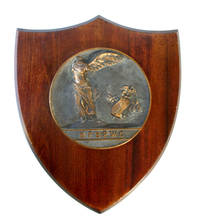
1919réf. 149951919. National Federation of Business and Professional Women's Clubs plaque 1919 commemorates the founding year of a national organization created to coordinate and advance the interests of business and professional women. Established on July 16 1919 after wartime efforts to identify women's professional skills and experience the Federation developed from organizing associated with the Women's War Council and the mobilization of women workers during World War I. Its formation preceded ratification of the Nineteenth Amendment in 1920 and placed questions of women's employment professional advancement and political participation within a national organizational structure. Large bronze embossed seal of the National Federation of Business and Professional Women's Clubs mounted on wood and dated 1919. The Federation was organized at its first national convention in St. Louis in July 1919 under the leadership of Lena Madesin Phillips with Gail Laughlin elected its first national president. Early Federation work included a national survey of business and professional women addressing their status qualifications opportunities and working conditions providing an organized basis for advocacy concerning women's economic and professional life. The plaque dates from the Federation's founding year when women were entering professional occupations in greater numbers while still lacking federally protected voting rights nationwide. The organization continued to advocate on issues affecting working women and to promote professional development leadership and economic opportunity. The bronze seal mounted on wood survives as an organizational artifact from the Federation's establishment in 1919 one year before ratification of the Nineteenth Amendment extended constitutional protection for women's suffrage nationwide. unknown
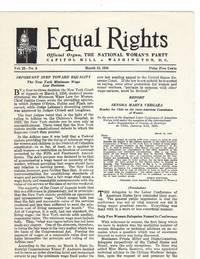
1936réf. 160251936. National Woman's Party. Equal Rights March 15 1936 documents the organization's campaign for legal equality at a time when women's workplace legislation divided American feminists over whether sex-specific protections advanced or restricted women workers. Founded in 1916 by Alice Paul and Lucy Burns during the suffrage campaign the National Woman's Party continued after ratification of the Nineteenth Amendment by advocating the Equal Rights Amendment then commonly associated with the Lucretia Mott Amendment and by opposing laws that imposed legal distinctions based solely on sex. This issue addresses the New York minimum wage controversy international equal-rights efforts and proposed workplace protections for women and children. National Woman's Party. Equal Rights. Vol. 22 No. 6. March 15 1936. 4 pages. 8 1/2 x 11 inches. Official organ of the National Woman's Party. The issue reports on the New York minimum wage case after the New York Court of Appeals struck down the state law regulating minimum wages for women; the United States Supreme Court subsequently affirmed that judgment in Morehead v. New York ex rel. Tipaldo on June 1 1936. It also discusses the Equal Rights Treaty signed at Montevideo by Cuba Ecuador Paraguay and Uruguay part of the National Woman's Party's effort to establish sex equality in international law. Another article addresses workplace hygiene and a resolution requiring employers to provide women with separate quarters for washing changing clothes and general use as well as seats for women and children when the work did not require them to remain standing. Published two years before enactment of the Fair Labor Standards Act of 1938 the issue records a central dispute in interwar women's rights politics: whether legislation written specifically for women offered necessary labor protection or created legal distinctions that could restrict women's employment and undermine demands for equal rights. The National Woman's Party pursued the latter argument while simultaneously campaigning internationally for legal equality between the sexes. The March 1936 issue therefore preserves contemporary evidence of the relationship among the Equal Rights Amendment campaign minimum wage litigation international treaty advocacy and debates over sex-specific workplace regulation. In excellent condition. unknown
1919réf. 149951919. National Federation of Business and Professional Women's Clubs plaque 1919 commemorates the founding year of a national organization created to coordinate and advance the interests of business and professional women. Established on July 16 1919 after wartime efforts to identify women's professional skills and experience the Federation developed from organizing associated with the Women's War Council and the mobilization of women workers during World War I. Its formation preceded ratification of the Nineteenth Amendment in 1920 and placed questions of women's employment professional advancement and political participation within a national organizational structure. Large bronze embossed seal of the National Federation of Business and Professional Women's Clubs mounted on wood and dated 1919. The Federation was organized at its first national convention in St. Louis in July 1919 under the leadership of Lena Madesin Phillips with Gail Laughlin elected its first national president. Early Federation work included a national survey of business and professional women addressing their status qualifications opportunities and working conditions providing an organized basis for advocacy concerning women's economic and professional life. The plaque dates from the Federation's founding year when women were entering professional occupations in greater numbers while still lacking federally protected voting rights nationwide. The organization continued to advocate on issues affecting working women and to promote professional development leadership and economic opportunity. The bronze seal mounted on wood survives as an organizational artifact from the Federation's establishment in 1919 one year before ratification of the Nineteenth Amendment extended constitutional protection for women's suffrage nationwide. unknown books
1936réf. 160251936. National Woman's Party. Equal Rights March 15 1936 documents the organization's campaign for legal equality at a time when women's workplace legislation divided American feminists over whether sex-specific protections advanced or restricted women workers. Founded in 1916 by Alice Paul and Lucy Burns during the suffrage campaign the National Woman's Party continued after ratification of the Nineteenth Amendment by advocating the Equal Rights Amendment then commonly associated with the Lucretia Mott Amendment and by opposing laws that imposed legal distinctions based solely on sex. This issue addresses the New York minimum wage controversy international equal-rights efforts and proposed workplace protections for women and children. National Woman's Party. Equal Rights. Vol. 22 No. 6. March 15 1936. 4 pages. 8 1/2 x 11 inches. Official organ of the National Woman's Party. The issue reports on the New York minimum wage case after the New York Court of Appeals struck down the state law regulating minimum wages for women; the United States Supreme Court subsequently affirmed that judgment in Morehead v. New York ex rel. Tipaldo on June 1 1936. It also discusses the Equal Rights Treaty signed at Montevideo by Cuba Ecuador Paraguay and Uruguay part of the National Woman's Party's effort to establish sex equality in international law. Another article addresses workplace hygiene and a resolution requiring employers to provide women with separate quarters for washing changing clothes and general use as well as seats for women and children when the work did not require them to remain standing. Published two years before enactment of the Fair Labor Standards Act of 1938 the issue records a central dispute in interwar women's rights politics: whether legislation written specifically for women offered necessary labor protection or created legal distinctions that could restrict women's employment and undermine demands for equal rights. The National Woman's Party pursued the latter argument while simultaneously campaigning internationally for legal equality between the sexes. The March 1936 issue therefore preserves contemporary evidence of the relationship among the Equal Rights Amendment campaign minimum wage litigation international treaty advocacy and debates over sex-specific workplace regulation. In excellent condition. unknown books
2001réf. 500137504Ramsay 2001 2x22x14cm. 2001. Broché.
2013réf. 500134962Robert Laffont 2013 198 pages 13x2x20 2cm. 2013. Broché. 198 pages. Exemplaire de bibliothèque déclassé
1974Previous owner's name inside front cover. No other marks or inscriptions. Small crease to upper corner of rear cover, none to spine. A very clean crisp very tight copy with bright unmarked boards and no bumping to corners. 117pp.
réf. 3516Paris, Robert Laffont, Éd. Gonthier, 1968, 248 pp., in-8, couv. répar.
1967réf. 127183Couverture souple. Broché. 128 pages.
1984réf. 149784Couverture souple. Broché. 128 pages. Plastification et marques de bibliothèque.
2000No marks or inscriptions. No creasing to covers or to spine. A very clean very tight copy with bright unmarked boards, slight dustiness to top of page edges and no bumping to corners. 212pp. Livelihoods in rural Africa are changing in response to disappearing job prospects, falling agricultural output and collapsing infrastructure. Responses to these challenges are very different in different parts of Africa. This book explains why.
1987No marks or inscriptions to contents. No creasing to covers. A very clean very tight copy with bright boards, slight marking to front cover and bump to spine foot. 28pp. Accounts of disturbing social conditions involving young children working in Litton Mill and Cressbrook Mill in Derbyshire in the first half of the 19th century. Typescript publication with some illustrations.