1982ref. 132457Washington DC: the Commission 1982. Paperback. ix 280p. 12p. appendices 8.5x11 inches wraps light handling weardate stamped and then crossed off in marker on front wrap and first page else good condition. Clarence Thomas chaired the commission. the Commission paperback books
1991ref. 80802Washington: the Commission 1991. 13p. 6x9.5 inches text in Spanish very good pamphlet in stapled green wraps. Includes some information on people with AIDS. the Commission unknown books
1991ref. 80803Washington: the Commission 1991. 19p. 6x9.5 inches text in Spanish very good pamphlet in stapled tan wraps. the Commission unknown books
1938ref. 48531Washington DC: GPO 1938. Paperback. xi 99p. 8.5x11 inches wraps slightly worn head of spine chipped faint dampstain on front wrap. Running title: Unemployment census 1937. GPO paperback books
ref. Z1-C-058-02028Institute for Employment Studies. Used - Good. Ships from UK in 48 hours or less usually same day. Your purchase helps support Sri Lankan Children's Charity 'The Rainbow Centre'. Ex-library so some stamps and wear but in good overall condition. 100% money back guarantee. We are a world class secondhand bookstore based in Hertfordshire United Kingdom and specialize in high quality textbooks across an enormous variety of subjects. We aim to provide a vast range of textbooks rare and collectible books at a great price. Our donations to The Rainbow Centre have helped provide an education and a safe haven to hundreds of children who live in appalling conditions. We provide a 100% money back guarantee and are dedicated to providing our customers with the highest standards of service in the bookselling industry. Institute for Employment Studies unknown
ref. 2404Paris, Gauthier-Villars, 1924 In-12 relié 293 pages. Éperviers, Verveux, Échiquiers, Sennes, Trubles, etc. Montage, entretien, réparation. 65 croquis et illustrations par Rivemale et Calbet reliure demi percaline pradel sur les dos piece de titre et auteur en cuir rouge . Bel exemplaire
2020ref. 500114979Prat Editions 2020 238 pages 13x19 8x1 8cm. 2020. Broché. 238 pages.
2020ref. 500115261Prat Editions 2020 238 pages 13x19 8x1 8cm. 2020. Broché. 238 pages.
2020ref. 500120115Prat Editions 2020 238 pages 13x19 8x1 8cm. 2020. Broché. 238 pages.
2004ref. 100138892Edward Elgar Publishing Ltd 2004 141 pages 16 2x2 2x23 4cm. 2004. Cartonné jaquette. 141 pages.
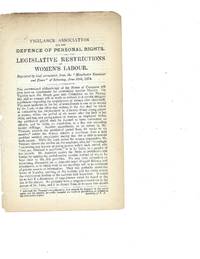
1874ref. 165761874. Vigilance Association for the Defence of Personal Rights. Legislative Restrictions on Women's Labour 1874 opposes proposed factory legislation that would prevent women from returning to industrial employment for six months after childbirth. The Association argues that a measure presented as protection would fall most heavily on women whose families depended upon their wages asking "Who in thousands of cases where there is no helper will assure them and their children bread" Its objections connect employment restrictions to married women's precarious legal and economic position particularly women deserted or unsupported by husbands and left without an enforceable claim upon their husbands' earnings. Vigilance Association for the Defence of Personal Rights. Legislative Restrictions on Women's Labour. Extract reprinted by kind permission from the Manchester Examiner and Times of Saturday June 20th 1874. London: Vigilance Association for the Defence of Personal Rights 1874. First edition extract. 4 pages. Original paper wrappers. 8 1/2 x 5 inches. The pamphlet challenges legislation directed specifically at working women while leaving wealthier women free from comparable interference. Addressing married workers it notes that there are ".many married women deserted or uncared for by their husbands" and argues that "no marriage law secures to the wife a share in the earnings of the father of her children." The text consequently treats freedom to work not as an abstract principle but as an immediate question of food wages and support for women and children and calls upon women themselves to oppose the proposed restriction. The pamphlet belongs to the Vigilance Association's campaign against statutory limitations imposed specifically upon adult women's labor during the parliamentary debates surrounding the Factory Acts in 1874. Its argument exposes a central conflict in nineteenth-century labor reform: legislation intended to protect women workers could also restrict their access to wages without providing an alternative means of family support. At the time this description was prepared no copies were located in American institutions through the OCLC search consulted; institutional records are subject to revision and should be reconfirmed. Condition information was not supplied. The four-page tract records an organized women's-rights response to factory regulation that linked employment freedom directly to marriage law household income and women's economic dependence. unknown
1874ref. 165761874. Vigilance Association for the Defence of Personal Rights. Legislative Restrictions on Women's Labour 1874 opposes proposed factory legislation that would prevent women from returning to industrial employment for six months after childbirth. The Association argues that a measure presented as protection would fall most heavily on women whose families depended upon their wages asking "Who in thousands of cases where there is no helper will assure them and their children bread" Its objections connect employment restrictions to married women's precarious legal and economic position particularly women deserted or unsupported by husbands and left without an enforceable claim upon their husbands' earnings. Vigilance Association for the Defence of Personal Rights. Legislative Restrictions on Women's Labour. Extract reprinted by kind permission from the Manchester Examiner and Times of Saturday June 20th 1874. London: Vigilance Association for the Defence of Personal Rights 1874. First edition extract. 4 pages. Original paper wrappers. 8 1/2 x 5 inches. The pamphlet challenges legislation directed specifically at working women while leaving wealthier women free from comparable interference. Addressing married workers it notes that there are ".many married women deserted or uncared for by their husbands" and argues that "no marriage law secures to the wife a share in the earnings of the father of her children." The text consequently treats freedom to work not as an abstract principle but as an immediate question of food wages and support for women and children and calls upon women themselves to oppose the proposed restriction. The pamphlet belongs to the Vigilance Association's campaign against statutory limitations imposed specifically upon adult women's labor during the parliamentary debates surrounding the Factory Acts in 1874. Its argument exposes a central conflict in nineteenth-century labor reform: legislation intended to protect women workers could also restrict their access to wages without providing an alternative means of family support. At the time this description was prepared no copies were located in American institutions through the OCLC search consulted; institutional records are subject to revision and should be reconfirmed. Condition information was not supplied. The four-page tract records an organized women's-rights response to factory regulation that linked employment freedom directly to marriage law household income and women's economic dependence. unknown books
ref. 10146comprenant la description des fleurs annuelles, vivaces et bulbes de pleine terre, suivies de classements divers indiquant l’emploi de ces plantes et l’époque de leur floraison. Avec des exemples de leur ornementation en divers genres. In 8 demi-toile muette. Faux-titre, VII, 1563 pages, plus de 1300 figures dans le texte, 3 plans dépliants dont un en couleurs. Paris chez Vilmorin-Andrieux & Cie, sans date. Un petit angle supérieur droit page de faux de titre. Bon état d’ensemble
1999ref. 0947Editions dOrganisation 1999 Broché Couverture glacée illustrée éditeur 178 pages Bon état - 1er plat corné 260 g
1950ref. 100139Couverture souple. Brochure. 16 pages.
ref. 0880992093New. paperback. New. Satisfaction Guaranteed or your money back. paperback
1928ref. 3495322Berlin, Hobbing, 1928. XVI, 301 S. Mit Tabellen und graphischen Darstellungen. Hlwd (Stempel auf Titel).
in-8°, 294 pp., broche, couv. illustree. Bel exemplaire (pli a la couv.). [DV-16]
1998library sticker on spine; library stamp on title page and catalogue page; text tight and bright. A practical guide to getting back to work after redundancy or early retirement, aimed at the 40-55 age group, which offers advice on deciding what direction to take, with ideas for how to look for a job, how to retrain, when to consider self-employment, and how to adjust to change Ex-Library
1953Previous owner's name and slight foxing to front end paper. No other marks or inscriptions to contents. No creasing to covers or to spine. A very clean very tight copy with unmarked black cloth boards, slightly dusty page edges and minor rubbing to corners. 256pp. Over eighty professions for the boys of the 1950s. Illustrated with black & white photographs. A scarce book.
1998No marks or inscriptions. No creasing to covers or to spine. A lovely clean very tight copy with bright unmarked boards and no bumping to corners. 248pp. A practical effective program to transform managers into skilled facilitators.
1979No marks or inscriptions. No creasing to covers or to spine. A very clean very tight copy with bright unmarked slightly foxed boards and no bumping to corners. 40pp. A discussion of the means needed to further the aims of the proletariat.
ref. BN725316mit press 1975. work in america work in america w.e.upjohn institute for employment research mit press 1975 unknown
1873ref. 165661873. Taylor Whately Cooke. The Employment of Married Women in Manufacture 1874. First edition of a paper delivered at the Social Science Congress in Norwich in October 1873 opposing proposed legislation that would restrict or prohibit married women's employment in British manufacturing. Taylor challenges the argument that married women should be excluded from factory labor because of their maternal and domestic responsibilities emphasizing the financial consequences for working-class families dependent upon women's earnings. He condemns the inconsistency of restricting married women's industrial employment while permitting women in agriculture and domestic service to continue working without comparable legal limitations. His argument addresses a central dispute in Victorian labor reform: whether legislation intended to protect women from industrial exploitation could instead deprive them of economic independence and impose unequal restrictions upon their employment. Taylor Whately Cooke. The Employment of Married Women in Manufacture. A Paper Read at the Social Science Congress Held at Norwich October 1873. London: Frederick Bell & Co. Steam Printers King's Rd. Chelsea 1874. First edition. 12 pages. Original paper wrappers measuring 8 x 5¼ inches. Reprinted for the Vigilance Association for the Defence of Personal Rights the pamphlet develops an economic and legal argument against restricting married women's factory employment. Taylor writes: "It is at first sign a very humane sentiment no doubt to assert that married women should be relieved from all hard work because of the duties which maternity casts upon them; but when as that the same time you relieve them of some fifteen shillings a-week without providing any substitute you must not be surprised if they themselves do not view your condescension in the same light." His reference to fifteen shillings a week places the loss of wages rather than the stated benevolence of protective legislation at the center of his objection. The pamphlet appeared during parliamentary debates preceding the Factory Act of 1874 which further regulated the working hours of women and young persons in textile factories. The Vigilance Association for the Defence of Personal Rights opposed legislation that restricted adult women's freedom to contract for employment particularly when comparable restrictions did not apply to men. Taylor's comparison of factory workers with women employed in agriculture and domestic service exposes the unequal treatment of female occupations under proposed labor regulations. His paper documents opposition to sex-specific industrial legislation within the nineteenth-century movement for women's legal and economic rights. Very good condition. unknown