17.154 resultados
ref. ORD-2456Edition 1921. Tome 3: Etranger. Edité par l'Exportateur Français. In-8 cartonnage de l'éditeur, 497pp. Nombreuses publicités en noir et blanc et 17 belles publicités couleurs h.-t. reproduisant pour la plupart des affiches, dont le Lion Noir en frontispice. Bon exemplaire.
ref. ORD-2457du 31 octobre 1792, l'An premier de la République Française. Toulon. Surre. 1792. In-4 (181 x 235mm) de 6 pages imprimées.
ref. 42968Lyon, Mougin-Rusand, 1898, in 8° broché, 544 pages, non coupé.
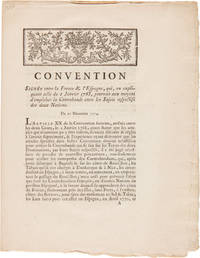
1775ref. 14145Versailles. 1775. Further Regulation of Colonial Trade An important treaty between France and Spain with significant ramifications for their colonial holdings in America. Herein Vergennes and the Conde d'Aranda further define commercial arrangements between the two countries in an attempt to control contraband. This had special impact for the Caribbean basin where the colonies of both powers were required to ship goods through European ports. Dissatisfaction over this prohibition was a key factor in the Louisiana Rebellion of 1768. This convention was agreed to at Versailles on Dec. 27 1774. Not in Wroth. 8pp. Quarto. Printed self-wrappers. Fine. DAVENPORT 155. unknown books
1825ref. 38259New York: Corrected and published by Edmund M. Blunt 1825. First edition under this title of this perennially popular and relied-upon guide for figuring the weight of packages and casks based on their depth and breadth. The work was originally published in 1816 but was found to be so full of errors that it was republished in this "corrected" edition under a new title in 1825. Blunt was also the publisher of the essential navigation guide THE AMERICAN COAST PILOT. 4196pp. plus 20pp. of advertisements. Tall narrow octavo. Contemporary calf gilt morocco label. Hinges cracked boards worn. Tanned scattered foxing. Fair. AMERICAN IMPRINTS 19773. hardcover books
ref. 234651S.l., 1790 in-4, 27 pp., broché sous couverture factice de papier coquille du XIXe. Salissures aux 2 premiers ff.
ref. 204628[Paris], Imprimerie de P. Prault, 1743 placard in-folio (53 x 38 cm), texte sur deux colonnes, en feuille, bords ébarbés, une déchirure à la pliure centrale.
ref. 163988S.l., 1791 in-8, 44 p., dérelié.
ref. 190785[Paris], Hacquart, s.d. (1821) in-8, 38 pp., dérelié.
1837ref. ABC_47982London 1837. Folio 32 x 20.5 cm. William Clowes 1837-1845; T. R. Harrison 1848-1872. Later stiff blue paper wrappers with white title-label on the front cover blue sprinkled edges. Ad. 11 in beige paper wrappers. With several tables of data. 14 volumes. Rare collection of 14 volumes containing transcriptions of British diplomatic correspondence with other countries relating to the slave trade in the 19th century printed for the British government. Although slavery in the British Empire was abolished in 1807 enslaved people in the colonies were not freed until 1838. In the present volumes which mostly date from 1837-1846 directly after slavery was abolished in most British colonies the British government urges other countries to help put a halt to the now illegal slave trade. The present collection contains the correspondence between Britain and numerous countries in Europe the Americas and North Africa especially France Spain the United States and Austria. The letters describe the ships carrying enslaved people in detail also mentioning their ports of call so they could be more easily found and stopped. Of particular interest are the transcriptions of slave trade acts from various countries as well as the treaties between France and chiefs in African colonies which are difficult to find in print anywhere else.The letters reveal the profound change in attitude towards slavery in the middle of the 19th century. The tone of the correspondence with countries that were quick in abolishing slavery like Denmark is very different than that of the countries that were much slower like the Netherlands and various countries in Latin America. However the letters especially make clear how difficult it must have been to find and stop the ships that were illegally carrying enslaved people. The owners of the vessels often hid their illegal practices behind obscure transactions and renamings which made finding them arduous and sometimes dangerous. It was the task of British commissioners and naval officers to try to uncover the network behind the Atlantic slave traders and bring them to justice. By collaborating with other countries the courts succeeded in the condemnation of over 600 vessels engaged in the slave trade and the liberation of nearly 80000 enslaved people.Ad 11 with blue library stamp on the title-page "Bibliothèque du palais de la paix". All volumes in good to very good condition some very slight browning and foxing some marginal notes in most volumes. unknown
ref. 1949Carcassonne, 1818 - in-4o : 4 pp.
ref. 151195S.l., 1762 in-8, [4]-420 pp., cartonnage Bradel de papier marbré (reliure moderne). Infime restauration de papier aux coins supérieurs des premiers ff., mais bon exemplaire.
ref. 71919Nice, L'Eclaireur de Nice, 1931, in 8° oblong broché, agrafé, 64 pages ; couvetrure illustrée.
ref. 201615Paris, Imprimerie de Mme Vve Agasse, 1817 in-4, xij-95 pp., en feuilles, cousu.
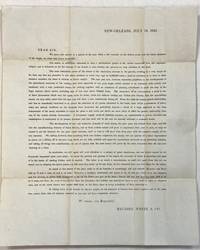
1843ref. 41470New Orleans 1843. Printed folio sheet folded to 4 pp each page 9-1/4" x 11-1/4." Printed on recto of first leaf only interior pages blank addressed in ink on last page to Captain J. Keyes Florence Alabama. Old folds address page worn. Blank hole where seal was broken no text affected. Text clean. Very Good. The head of the firm Maunsel White of New Orleans was an energetic Irish immigrant. He married the daughter of a wealthy Creole merchant allied with Andrew Jackson. Wikipedia says "White maintained a lifelong friendship with Jackson for whom he served as a cotton factor from 1826 until Jackson's death in 1845." White carefully delivers hopeful but cautious news to his clients. He celebrates "the marvellous increase in the growth" of cotton "resulting in a crop larger by far than any that has preceded it." However "the next crop will show a considerable falling off. From the onset the season opened unfavorably" because of rains and other weather problems. But "new and extensive channels of trade infused fresh vigor and life into the manufacturing districts of Great Britain." The Letter demonstrates the importance of the South's commercial connection with England. He reminds his customers of "a subject of great importance and one which cannot be too frequently impressed upon your mind; we mean the picking and ginning of the staple the necessity of which is sometimes lost sight of in the desire of sending Cotton early to market." This necessity of course would be met with slave labor. We do not locate this printed letter on OCLC as of November 2025 although OCLC records several items relating to Maunsel White: a letter from Andrew Jackson to White in 1842; the firm's business records at the University of North Carolina; and a similar letter on the cotton trade from 1841 at the Library of Congress OCLC 1284917506. unknown
1843ref. 41470New Orleans 1843. Printed folio sheet folded to 4 pp each page 9-1/4" x 11-1/4." Printed on recto of first leaf only interior pages blank addressed in ink on last page to Captain J. Keyes Florence Alabama. Old folds address page worn. Blank hole where seal was broken no text affected. Text clean. Very Good. The head of the firm Maunsel White of New Orleans was an energetic Irish immigrant. He married the daughter of a wealthy Creole merchant allied with Andrew Jackson. Wikipedia says "White maintained a lifelong friendship with Jackson for whom he served as a cotton factor from 1826 until Jackson's death in 1845." White carefully delivers hopeful but cautious news to his clients. He celebrates "the marvellous increase in the growth" of cotton "resulting in a crop larger by far than any that has preceded it." However "the next crop will show a considerable falling off. From the onset the season opened unfavorably" because of rains and other weather problems. But "new and extensive channels of trade infused fresh vigor and life into the manufacturing districts of Great Britain." The Letter demonstrates the importance of the South's commercial connection with England. He reminds his customers of "a subject of great importance and one which cannot be too frequently impressed upon your mind; we mean the picking and ginning of the staple the necessity of which is sometimes lost sight of in the desire of sending Cotton early to market." This necessity of course would be met with slave labor. We do not locate this printed letter on OCLC as of November 2025 although OCLC records several items relating to Maunsel White: a letter from Andrew Jackson to White in 1842; the firm's business records at the University of North Carolina; and a similar letter on the cotton trade from 1841 at the Library of Congress OCLC 1284917506. unknown books
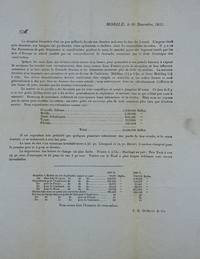
1857ref. 70300Mobile AL: J. E. DuMont & Co 1857. Printed circular letter on blue paper 11 ¼ x 9 ¼ text entirely in French. A periodic report from the company offering its assessment of the cotton market with statistics showing number of bales shipped from various ports New Orleans Mobile Atlantic States Texas and Florida and with comparisons between 1856-57 and 1857-58 through September of each year; this report notes improvements in the financial situation from its previous report translation: "as money is more abundant our banks have been able to expand their operations and thus facilitate cotton transactions" despite "frequent and considerable fluctuations in prices during the month the market having been depressed by notices from Europe." The only reference we have found for J. E. DuMont & Co. is an 1859 partnership dissolution suit filed in Mobile's Chancery Court that describes the company as a "general and commission-merchant in Mobile"; the case eventually found its way to the Alabama Supreme Court. Addressed verso of integral leaf to Messrs. J. & C. Heydecker in New York old fold lines else very good. J. E. DuMont & Co unknown
1857ref. 70300Mobile AL: J. E. DuMont & Co 1857. Printed circular letter on blue paper 11 ¼ x 9 ¼ text entirely in French. A periodic report from the company offering its assessment of the cotton market with statistics showing number of bales shipped from various ports New Orleans Mobile Atlantic States Texas and Florida and with comparisons between 1856-57 and 1857-58 through September of each year; this report notes improvements in the financial situation from its previous report translation: "as money is more abundant our banks have been able to expand their operations and thus facilitate cotton transactions" despite "frequent and considerable fluctuations in prices during the month the market having been depressed by notices from Europe." The only reference we have found for J. E. DuMont & Co. is an 1859 partnership dissolution suit filed in Mobile's Chancery Court that describes the company as a "general and commission-merchant in Mobile"; the case eventually found its way to the Alabama Supreme Court. Addressed verso of integral leaf to Messrs. J. & C. Heydecker in New York old fold lines else very good. J. E. DuMont & Co unknown books
1742ref. 168051742 basane mouchetée, dos à nerfs. in-4, LVI-722pp., (1f.), P. Mouchet 1742
ref. 165484Londres, et se trouve à Paris, Duchesne, 1756 in-8, 215-[1] pp., avec un frontispice gravé par Sornique d'après Charles Eisen, basane fauve, dos à nerfs cloisonné et fleuronné, encadrement de simple filet à froid sur les plats, simple filet doré sur les coupes, tranches rouges (reliure de l'époque). Coiffes frottées, coins émoussés, mais bon exemplaire.
ref. 189577Suivant la copie de Paris, 1758 3 parties en un vol. in-12, [2]-100-84-180 pp., avec un frontispice allégorique par Charles Eisen, basane fauve marbrée, dos à nerfs cloisonné et fleuronné, pièce de titre cerise, tranches mouchetées (reliure de l'époque). Epidermures et frottis à la reliure.
ref. 207428Paris, Imprimerie de Laporte, rue des Poitevins, s.d. (1789) in-8, 4 pp., broché.
ref. 69638P., Berche et Tralin, 1880, in 12 broché, 316 pages ; couverture défraichie.
1803ref. 26351Chantenay 1803 1 BON DE LIVRAISON document ORIGINAL d'1 page manuscrite à l'encre brune, format : 12,5 x 20 cm, sur papier crème, signature illisible (CHANTENAY) 9 FLOREAL AN 11 (29 AVRIL 1803),
1798ref. 26350LORIENT CAUDAN 1798 1 REÇU document ORIGINAL d'1 page manuscrite à l'encre brune, format : 9,5 x 15,6 cm, sur papier velin crème, ligné, et filigrané,signatures manuscrites : FRANCY (fondé de pouvoir pour CRUCY FRERES CHANTIER DE CAUDAN LOUIS CRUCY- LORIENT) et EVEN, LE 17 VENDÉMIAIRE AN 7 (8 OCTOBRE 1798),