[Cuba]. [Trade]ABAA
16.533 resultados
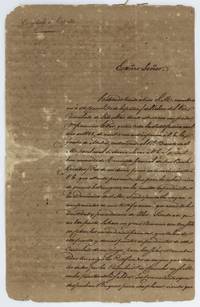
1828ref. 2401Gibraltar 1828. Good. 3pp. on a bifolium. Previously folded with separations. Tanned somewhat brittle. An interesting example of official communications concerning trade between colonial Cuba and the Spanish mainland. In this manuscript letter date March 14 1828 the new Spanish Vice Consul in Gibraltar writes to the Governor General of Cuba concerning several topics. These include the regulation of shipping to Cuba and by implication the rest of the Caribbean through Gibraltar particularly of French ships leaving Mediterranean ports. Also discussed is keeping track of individuals particularly merchants going to Cuba by means of identification papers and other documents. The consul also reminds the colonial government of the importance of documenting duties and tariffs paid for shipping cargo and goods. unknown books
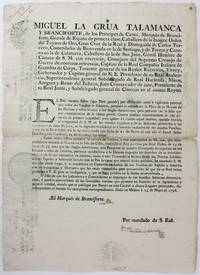
1796ref. 5074Mexico City: May 13 1796. About very good. Broadside 17 x 12.25 inches. Old fold lines. Slight separation and loss at center fold slightly affecting a few letters. Minor wear else. Proclamation made by the Viceroy of New Spain authorizing trade between Cuba and the United States. The Caribbean was in tumult in the 1790s with Toussaint L'Ouverture overthrowing the French colonial government and outlawing slavery. Likewise in Cuba there was a similar revolt against slavery demanding abolition and equality -- both revolutions were of substantial concern to slaveholders in the American South. Specifically the present decree mentions flour and other vital foodstuffs as a measure against shortages in Cuba intended to prevent further trouble. "Para precaver la escasez de viveres y con especialidad de harinas que verosimilmente causaria la guerra concedio El Rey Permiso por Real Orden de 25 Junio de 93. para que los Anglo-Americanos.pudiesen conducirlos a la Havana pagando los derechos los puertos habilitados de España." The Viceroy at the time was Don Miguel de la Grua Talamanca de Carini y Branciforte First Marques de Branciforte. The Marques was notoriously corrupt even for colonial Spain having gained position through marriage to the Prime Minister's sister. He made sure to make some profit on everything that passed through his hands including taking advantage of the war in Cuba to remove the French from their lands and sell them to his benefit. A rare and interesting decree. We locate a single copy in OCLC at the University of Minnesota. May 13 unknown books
ref. 243381Collection Collection des principaux économistesParis, Guillaumin, 1851 fort vol. in-8, 932 pp., demi-basane brune, dos à nerfs orné, tranches marbrées (reliure de l'époque). Rousseurs. Mors supérieur en partie fendu.
ref. 244522Collection Collection des principaux économistesParis, Guillaumin, 1843 fort vol. in-8, 1008 pp., demi-basane brune, dos à nerfs orné, tranches marbrées (reliure de l'époque). Qqs rousseurs. Petite mouillure angulaire. Dos abîmé.
ref. 21544Very Good- Plus. A remarkably scarce survivor from the 'Florida Land Boom' of the 1920s. Printed by the prestigious Record Company in St. Augustine this promotional piece was designed with a dual-purpose strategy: while the front panels lure the tourist with the world-famous beach and surf the inner panels pivot sharply toward permanent settlement homeownership and commercial investment. Unlike later post-war brochures that focused almost exclusively on family vacations this "Land Boom" artifact treats Daytona as a viable year-round "Metropolis of the Florida East Coast" making it a vital primary source for Florida urban development history. KEY FEATURES: Description: St. Augustine FL: Record Company Printers n.d. circa 1925-1928. First Edition. Folding Brochure. Octavo-sized 8-panel brochure 16 total sections; 3 x 6 inches folded opening to a panoramic 6 x 24.5 inches. Color illustrated wraps. The Print History: Published by The Record Company St. Augustine a firm celebrated in the 1920s for its high-quality county histories and regional promotional literature. The 'Hard Sell': Beyond tourism the text explicitly promotes Daytona for 'Business and Professional Men' citing agricultural opportunities retail growth and the city's status as a hub for 'Home-Builders.' Visuals: Features high-quality rotogravure-style monochrome and tinted photography showing the iconic driving beach early resort architecture and civic infrastructure. Scarcity: No single copies located in OCLC WorldCat or major institutional databases at the time of cataloging. A rare ephemeral survivor of the Florida pre-Depression boom. Specs: 16 distinct sections total front and back of 8 panels. CONDITION: Very Good. A superior copy of a fragile ephemeral item. Carefully handled with no tears splits or separations at the folds. Modest even age-toning to the paper stock as expected; color on the cover panels remains vibrant and crisp. Faint tide-mark on panel 2-3. HISTORICAL SIGNIFICANCE The 1920s in Florida were a fever dream of development and Daytona was at the center of the storm. This brochure captures the moment before the 1926 hurricane and the 1929 crash a time when the 'Daytona Beach' brand was being solidified. It represents the transition of Florida from a frontier to a curated tropical paradise designed for the Northern middle class. The emphasis on home-buying rather than just hotel stays is the "smoking gun" of the Land Boom era. It reflects the efforts of the Daytona Beach Chamber of Commerce to stabilize the local economy by attracting permanent capital rather than just seasonal visitors. SUBJECTS: Florida Land Boom Daytona Beach History Real Estate Promotion 1920s Tourism St. Augustine Printing Urban Development Volusia County Ephemera Promotional Brochure Americana Florida History. unknown
ref. 167815Paris, Baudouin, 1789 in-8, 58 pp., dérelié.
ref. 208521À Paris, chez Treuttel et Wurtz, an X - 1802 2 vol. in-8, XI-[1]-350 pp. et 405 pp., 2 cartes dépliantes (la Russie européenne et la Russie asiatique), demi-veau blond moucheté à coins, dos lisses ornés, rubans torsadés dorés, pièces de titre et de tomaison, tranches jonquille (rel. de l'époque). Qqs rousseurs sur une carte mais bon exemplaire.
ref. 21545Very Good. A visually striking and architecturally significant promotional booklet designed to position DeLand as the intellectual and cultural capital of the Florida Land Boom. Featuring high-concept graphic layouts and a dual-front cover design tête-bêche style this 28-page work emphasizes the city's unique identity as 'The Athens of Florida' through its educational institutions and citrus wealth. KEY FEATURES Visuals: Profusely illustrated with sophisticated graphic borders monochrome photography of Stetson University and local citrus groves and a vibrant full-color illustration on the inside cover. Binding: Original stapled pictorial wraps; 8 x 9.25 inches. Features a unique 'Dual-Front' graphic orientation where both the front and rear wraps serve as primary thematic covers. Content: Extensive focus on DeLand as the 'Educational Center of Florida' detailing the climate the citrus industry and the cultural life of the 'Athens' of the south. Imprint: Attributed to the Record Company of St. Augustine based on typography and OCLC records. Rarity: Scarce; OCLC locates only three institutional copies all held within Florida libraries FSU UF and the University of Miami. CONDITION Very Good -- A crisp carefully handled copy. Features a gentle vertical fold to the center likely from original mailing. A faint previous owner's name is visible on the 'fishing scene' cover but does not obscure the artwork. Internally clean with staples firm and no rust migration. Specs: 8 x 9.25 inches / 28 pages plus wraps.St. Augustine: Record Co. n.d. c. 1925-1927. First Edition. Stapled Wraps. HISTORICAL SIGNIFICANCE -- During the mid-1920s while coastal Florida cities sold surf and sand DeLand marketed itself as a refined inland 'Athens'. This prospectus is a prime example of the high-budget promotional material produced by the Record Company which utilized avant-garde graphic design to distinguish DeLand from the more rowdy 'boom towns' of the era. The booklet captures the city during its golden age of citrus and academic expansion at John B. Stetson University. Its dual-cover design-one side focusing on the sporting life fishing and the other on civic/educational status-reflects the sophisticated marketing tactics used to attract the 'educated' class of Northern investors and settlers. SUBJECTS: DeLand Florida Stetson University Florida Land Boom Citrus Industry St. Augustine Printing Educational History Volusia County Ephemera Promotional Prospectus Americana Florida History. unknown
First and only edition, [2], 30pp., stitched as issued in blue paper wrappers, a very good copy. The author argues against putting an additional duty on sugar "which... would be a great hardship on the sugar-planter in the West Indies, and very little benefit to the revenue...". He sets out all the costs involved in producing sugar, such as the price of slaves and the cost of keeping them, the higher freight costs, insurance, cost of animals and contributions to the defence force. Finally, he states the advantages of the sugar trade for Britain and shows how an additional duty would be to the detriment of the trade. Goldsmiths'-Kress, 8163; Hanson, 5917; Sabin, 40397; ESTC gives the British Library as the only UK hold.
1831ref. 4902Allen deutschen Völkern und ihren Regierungen, und ganz besonders den deutschen Volksvertretern zur Beherzigung gewidmet. Mit 1 gefalt. Tabelle. Stuttgart u. Tübingen, J. G. Cotta, 1831. Gr.-8vo. (23,5 x 15,5 cm). Titel, 74 S. Typographischer Orig.-Umschlag.
1976ref. 053718Istanbul: DISK: Türkiye Devrimci Isçi Sendikalari Konfederasyonu 1976. 1st Edition . Soft cover. Very Good. Paperback. Cr. 8vo. 20 x 14 cm. In Turkish. 63 1 p. 3 unnumbered b/w plates. This is one of the early books on May 1 in Turkey printed by the Turkish Revolutionary Workers' Confederation of Trade Unions. Cover art illustrated by Turkish painter Orhan Taylan 1941-. In the Ottoman Empire the first celebration of Labour Day was organized in Skopje in 1909. In Istanbul Labour Day was first celebrated in 1912. No celebrations could be organized between 1928 and 1975. On 1 May 1976 the Confederation of Revolutionary Trade Unions of Turkey DISK organized a rally on Taksim Square with mass participation one year ago "Bloody First May" which was an attack on leftist demonstrators on 1 May 1977 International Workers' Day in Taksim Square Istanbul Turkey. This booklet was printed for the commemoration of this celebration. Orhan Taylan was born in Samsun to an artist mother in 1941. Graduated from Robert College 1960 and the Fine Arts Academy of Rome 1965. First solo painting exhibition in 1968. Took leading positions in artists' organizations 1975-1978. Organized mural painting symposiums and executed several murals 1976-80. His paintings were exhibited in London Amsterdam and Moscow within Turkish Highlights exhibitions between 1988 and 1990. Aside from regular exhibitions in Istanbul and Ankara his works were also shown in solo gallery exhibitions in Paris New York Geneva and Athens. Orhan Taylan exhibits mainly figurative oil paintings and occasionally metal sculptures and drawings. Lives and works in Istanbul. During the 1971 Military coup taken in custody on summer midnight together with his wife and cartoonist Tan Oral. All his archives and hundreds of books destroyed. 1977 Group exhibitions in Paris and Berlin. The May 1 poster wins 1st prize in the International Poster Competition of the World Federation of Trade Unions Prag. Source: Turkish Painting - Visual Art Encyclopedia. This is the first appearance of this art before it's winning the prize in 1977. Rare. DISK: Türkiye Devrimci Isçi Sendikalari Konfederasyonu paperback
ref. 70474Paris, Imprimerie Royale, 1785 in-4, 2 pp., vignette, dérelié.
ref. 203410Paris, Imprimerie royale, 1789 in-4, 2 pp., un f. vierge, en feuille.
ref. ORD-3232du 14 octobre 1792, l'An premier de la République Française. Toulon. Surre. 1792. In-4 (181 x 235mm) de 3 pages imprimées. Le cartouche en en-tête du décret porte curieusement la mention L'An deuxième de la République Française.
ref. 197677[Paris], Imprimerie d'Everat, s.d. (1816) in-4, 4 pp., dérelié.
ref. 230806Paris, Imprimerie nationale, 1791 in-4, titre, 40 pp., [2] pp. n. ch. [État des marchandises prohibées à l'entrée et à la sortie], broché, couv. papier marbré postérieur
ref. 203463Paris, Imprimerie royale, 1747 in-4, 3 pp., en feuille.
1761ref. 0056611761 Toulouse, Imprimerie de la Veuve de Me Bernard Pijon, 1761. Deux parties reliées en un volume in-quarto (230 X 181 mm) basane fauve marbrée, dos à nerfs, caissons ornés de fleurons et fers dorés, pièce de titre basane beige, tranches mouchetées en rouge (Reliure de l'époque) ; (1) f. de titre, 229 pages, (1) f. blanc - 34 pages.
ref. 202725Paris, Baudouin, (1791) in-8, 20 pp., broché.
ref. 226459[Cambrai], Defrémery-Déhollain, s.d. (1817) in-4, 68 pp., en feuilles, cousu. Petites mouillures claires suprapaginales.
ref. 33495Amsterdam, George Gallet, 1704. In-12, plein veau moucheté de l'époque, dos à nerfs orné de compartiments dorés, pièce de titre de maroquin rouge, tranches mouchetées (coiffe inf. et un coin usés, qqs épid.), (10), 274, (2) p., vignette de titre à la Sphère.
ref. 26680Paris, Imprimerie nationale, [1791]. In-8, broché, couverture papier marbré moderne, 8 p.
ref. 218739Paris, Frères Vaillant, & Nicolas Prévost, 1738 2 vol. in-12, XXI-444 et [2]-XII-456 pp., avec 9 tableaux dépliants hors-texte, veau fauve moucheté, dos lisse orné à la grotesque, encadrement de filets dorés sur les plats, simple filet doré sur les coupes, roulette intérieure, tranches dorées (reliure de l'époque). Petite mouillure angulaire à la fin du tome 1, petite restauration à certains mors.
ref. 230773Paris, Frères Vaillant, & Nicolas Prévost, 1738 2 vol. in-12, XXI-444 et [2]-XII-456 pp., avec 10 tableaux dépliants hors-texte, veau fauve marbré, dos à nerfs cloisonnés et fleuronnés, encadrement de simple filet à froid sur les plats, coupes guillochées, tranches rouges (reliure de l'époque).
ref. 242668A La Haye, chez Antoine van Dole, 1740 2 vol. petit in-12, (20)-259 pp. et (12)-262 pp., (8) pp. de Catalogue de l'éditeur, avec 10 tableaux dépliants hors-texte, broché, couverture papier marbré de l'époque. Dos renforcé par de la toile.