ALMANACH DU COMMERCE DE PARIS, des départements, de l'Empire français, et des principales villes du monde;Livre Rare Book
5377 resultados
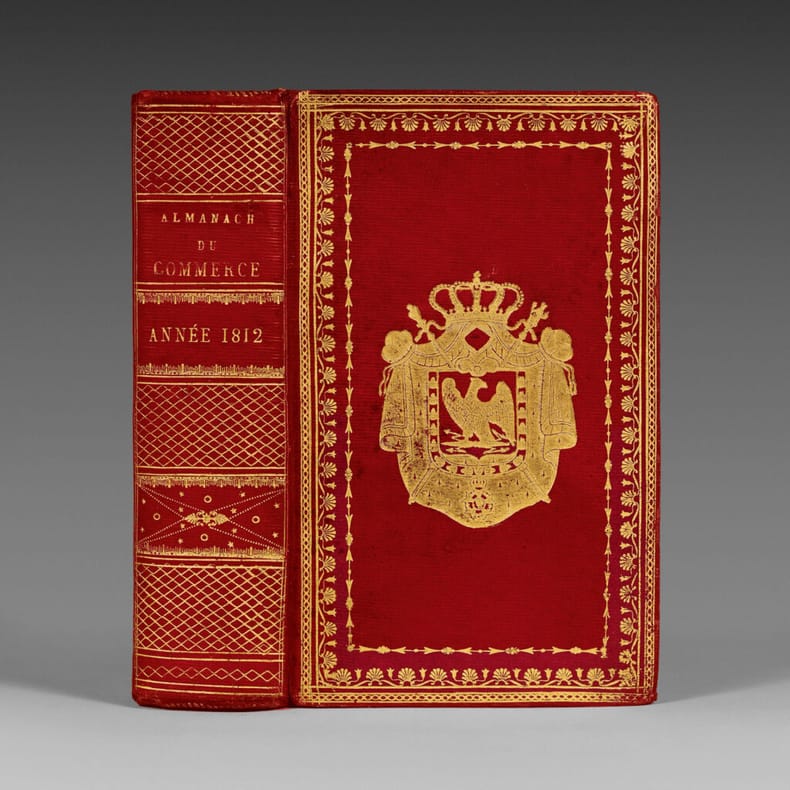
ref. LCS-18198L’Almanach du Commerce pour l’année 1812 relié en maroquin rouge de l’époque aux armes de l’Empereur Napoléon Ier. Paris, chez J. de la Tynna, Propriétaire-Rédacteur, rue J. J. Rousseau, n° 20. In-8 de 1039 pp. Plein maroquin rouge, encadrement de filets et roulette dorés autour des plats, armoiries de l’Empereur Napoléon Ier au centre des plats, dos lisse richement orné, coupes décorées, doublures et gardes de tabis bleu, tranches dorées. Reliure armoriée de l’époque. 211 x 129 mm.
ref. 24854A Londres, Chez Fletcher Gyles, dans Holborn, 1755. (4), 430, (6, Table des Chapitres) pp. 12mo. Contemporary half calf, spine gilt in compartments, gilt lettering, floral ornament in each compartment, green paper covered boards, all edges red. Kress 5423; Goldsmiths 8989; Einaudi 846; INED 933; Higgs 938; En Français dans le Texte, 159; Leblanc 57; Antoin E. Murphy, Richard Cantillon: entrepreneur and economist; T. Hutcheson, Before Adam Smith, pp. 163-178. First edition of Cantillon's great work, 'the most systematic statement of economic principles before Adam Smith's Wealth of Nations' (Roll, p. 121). 'The economic repute of Cantillon, for a time completely obscured by the glory of Adam Smith, can never have rested upon the popularity of his little book, now one of the scarcest works in economic literature .. The influence of the book is evidenced not only by the number but by the distinction of its students, including Gournay, Quesnay, Mirabeau, Turgot, and Adam Smith. It gave birth to Mirabeau's l'Ami des Hommes and apparently suggested much of the Tableau Oeconomique of Quesnay and parts of the Wealth of Nations .. Cantillon avoided, as Jevons has pointed out, the one-sidedness of the Physiocrats; and yet has been marked out as a Physiocrat .. Jevons thought Cantillon wrote 'with the scientific precision of a Cairnes or a Cournot,' and Prof. Marshall refers to his 'thoroughly scientific manner of discussion' .. In France the Essai has been pretty continuously read (see e.g. Ganilh, Des Systèmes d'Economie Politique, 2d. ed. 1821), and so stimulating and suggestive does it remain that its direct influence may be found to be not yet exhausted' (Palgrave, i, pp. 214f). Roll has called this work 'the most systematic statement of economic principles, before the Wealth of Nations' (History of Economic Thought, p. 121).Cantillon, a French banker of Irish extraction, was influenced by Petty, but his own influence was principally felt by the Physiocrat school: Higgs maintains that Quesnay took his fundamental principle of Physiocracy from the Essai. The Essai was written about 1730 and circulated in manuscript. Cantillon died in 1734 and the work was first published in 1755 in French, not in English, as stated on the title.The Essai has been quoted by Smith, Condillac, and Quesnay, plagiarised by Harris and Postlethwayt, and called by Jevons 'more emphatically than any other single work the cradle of political economy'. The work is divided into three sections: a general introduction to political economy, a treatise on currency, and a study of foreign commerce and exchange.'Since the 'discovery' of Cantillon by the English-speaking world following Jevons's enthusiastic article (1881), no less than justice has been done to the merits of the Essay .. Jevons himself noted that Cantillon had presented a treatment of currency, foreign exchanges, banking and credit which, judged against the work of its period, he felt to be 'almost beyond praise' .. It was likewise recognized as early as Jevons that Cantillon had set out the leading ideas of Adam Smith's 'important doctrine concerning wages in different employments' .. and that the Essay contained .. 'an almost complete anticipation of the Malthusian theory of population' (The New Palgrave, i, p. 318). - A very good copy.