15.859 resultados
ref. 011345Three Boat Cards. ca. 1925. Swampscott Massachusetts. Crowell & Boyden Boats. Three cards offering Boats to Let or for Sale. Each card measures 2 1/2 x 4 inches. Boats For Fishing and Rowing. Fishing Tackle to Rent. All are in very good condition. Quite scarce. The lot. unknown
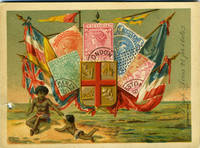
ref. 17429Paris: Bognard. Color trade card blank on the verso with two Pacific Islanders on the sand at the lower left with ocean behind and a collage of Australian items superimposed against the sky. With an Australian crest in the middle of the collage facsimiles of stamps from Australian colonies and international flags. With 'Stamp Series 20 for 10 cts' printed vertically at the right hand edge and Bognard Paris below that. 4 1/2 x 3 1/4". With a small circular perforation at the left edge. Bognard unknown
1892ref. 18107France 1892. Very good condition. Trade card for the most successful cigarette merchant in Egypt Nestor Gianaclis named after the man who founded the Egyptian cigarette industry in 1871 when he set up a factory in the Khairy Pasha palace in Cairo. Gianaclis' cigarettes made with imported Turkish tobacco became so popular with the British officers stationed in Egypt that the company began exporting to the UK and eventually to Europe and the US. With gilt text and gilt highlighted chromolithographic illustrations of 9 medals Bruxelles 1891; Paris Calcutta Toulon and two crests De S. A. le Khedive d'Egypte at the left and at the right "Et de la Cour de S. A. le Prince Heritier de Grece. 2 7/8 x 1 1/2 unknown
1892ref. 285644Brooklyn: E.W. Bliss 1892. hardcover. very good-. Frontispiece pictures of the factory and of international medals won. Many full page & half page illustrations. 389pp. small 8vo flexible blue cloth back cover gently creased; small hole in spine light damp-stains on the bottom margins of a few pages. Brooklyn: E.W. Bliss 1892. Ninth edition. Bliss was the premier manufacturer of heavy industrial sheet metal. E.W. Bliss unknown
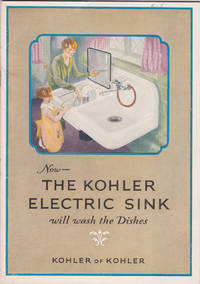
1926ref. 014184Kohler WI: Kohler Co. 1926. First edition. Octavo. 23 pp; numerous b/w photographs. Illustrated stapled wraps. VG a clean unmarked copy; covers clean with minor wear. Cover title: "Now-The Kohler electric sink will wash the dishes." Kohler introduced its electric sink in 1926. From title page "Dedicated to women who do their own work; to women who direct the work of others; to women who do the work of others.". First Edition. Soft Cover. Very Good. Kohler Co. Paperback
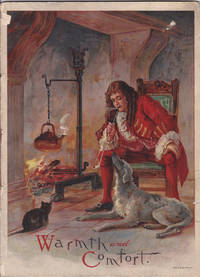
1905ref. 014073Dowagiac MI: Estate of P.D. Beckwith 1905. Quarto. 31 pp; numerous b/w illustrations. Cord-bound wraps with color lithograph covers. Good copy only pages soiled with pencil notations on several pp; 1" tear on foredge of backcover small chip near top of spine light edgewear. The catalogue presents the full line of Round Oak warm-air furnaces and combination heaters hot-water attachments casings pipes & registers. First Edition. Soft Cover. Very Good. Estate of P.D. Beckwith Paperback
1908ref. 9111Cincinnati: Lunkenheimer Co. 1908. Edition Unknown. orig. publisher's cloth. A very good copy. 8vo. The catalog is illus. throughout. A thick catalog of metal machinery oilers valves etc. A good reference. Lunkenheimer Co. hardcover books
1892ref. 285644Brooklyn: E.W. Bliss 1892. hardcover. very good-. Frontispiece pictures of the factory and of international medals won. Many full page & half page illustrations. 389pp. small 8vo flexible blue cloth back cover gently creased; small hole in spine light damp-stains on the bottom margins of a few pages. Brooklyn: E.W. Bliss 1892. Ninth edition. Bliss was the premier manufacturer of heavy industrial sheet metal. E.W. Bliss unknown books
1932ref. 7392London:: Trade Journals Ltd. Special Number 1932. original printed wrappers. Fine. Folio. Articles on current technology; many ads. Trade Journals Ltd., unknown
1869ref. 28703Trenton N.J.: Printed at the True American Office 1869. 3.75" x 5.5". Original printed gold-colored wrappers stitched. 11 1 blank pp. Light wrapper wear Very Good. OCLC 55187463 1- Rutgers as of 3/12. Printed at the True American Office unknown
1869ref. 28703Trenton N.J.: Printed at the True American Office 1869. 3.75" x 5.5". Original printed gold-colored wrappers stitched. 11 1 blank pp. Light wrapper wear Very Good. OCLC 55187463 1- Rutgers as of 3/12. Printed at the True American Office unknown books
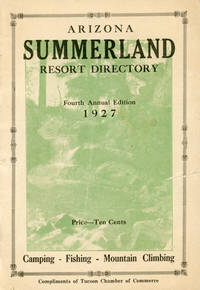
1927ref. 50318Phoenix: A. C. Taylor Printing CO. 1927 1927. ARIZONA. First edition of the Fourth Annual edition. 8vo. Color pictorial wrappers 24 pp. double column illustrated maps advertisements. A guide to Arizona's summer resorts dude ranches working ranches camping fishing hot springs mountain climbing lodges etc. in the 1920s. Booklet is organized by sections and provides much information regarding what is available in each geographic sector of Arizona. Covers are moderately used light wear to the spine ends and to the fore-edges of the front and rear covers else a good copy of a scarce item A. C. Taylor Printing CO., 1927] unknown
1921ref. 56649Washington DC: Government Printing Office. Good with no dust jacket; Usual library markings fold-out map edges . foxed. 1921. First Printing. Hardcover. Blue cloth. 35 fold-out maps. Tables figures maps fold-out maps and index. A solid copy with all fold-outs and maps present and in good condition. ; Ex-Library; 8vo 8" - 9" tall; 147 pages . Government Printing Office hardcover
1931ref. 90295Washington DC: United States Government Printing Office 1931. Presumed First Edition First printing. Wraps. Good. iv 85 3 pages. Illustrated front cover. Footnotes. Illustrations photographs and drawings/diagrams. Tabular Data. Appendix. Bibliography. Check List. Cover has some tears wear and soiling. Foreword by Axel H. Oxholm Director of the National Committee on Wood Utilization. The contents address Factors to Consider First by Nelson S. Perkins; Judging the Exterior Construction; The Plan; Structural Features and Mechanical Installations. Axel H. Oxholm was also at one time chief Lumber division Bureau of foreign and domestic commerce. United States Department of commerce. Nelson Secor Perkins 14 Apr 1894 - 1 Aug 1985 was a noted author and authority and is regarded as one of the key pioneers in the development and use of plywood. The National Committee on Wood Utilization was organized by Herbert Hoover as Secretary of Commerce and comprised about 200 members representing manufacturers distributors and consumers of forest products. Its object was to work for closer utilization of the U.S.'s timber resources. The committee whose headquarters were in the Department of Commerce Washington D.C. worked in close cooperation with a number of official and private organizations notably the Bureau of Standards of the Department of Commerce and the Forest Products Laboratory of the Forest Service Department of Agriculture. President Roosevelt by Executive Order 6179-B Abolished of the National Committee on Wood Utilization. Dated June 16 1933 the Executive Order stated "There is hereby abolished The National Committee on Wood Utilization. All the property of every kind files and records etc. belonging thereto are hereby transferred to the custody of the Secretary of Commerce for such disposition as he may determine; provided that if the forest products industries desire to continue in their own quarters and at their own expense the work heretofore performed by the National Committee on Wood Utilization the Secretary of Commerce may permit them to have access to or the use of the records and files of the Committee." Plywood is a composite material manufactured from thin layers or "plies" of wood veneer that have been stacked and glued together. It is an engineered wood from the family of manufactured boards which include plywood medium-density fibreboard MDF oriented strand board OSB and particle board or chipboard. All plywoods bind resin and wood fibre sheets cellulose cells are long strong and thin to form a composite material. The sheets of wood are stacked such that each layer has its grain set typically see below perpendicular to its adjacent layers. This alternation of the grain is called cross-graining and has several important benefits: it reduces the tendency of wood to split when nailed at the edges; it reduces thickness swelling and shrinkage providing improved dimensional stability; and it makes the strength of the panel consistent across all directions. There is usually an odd number of plies so that the sheet is balanced that is the surface layers have their grains set parallel to one another. This balance reduces warping. Because plywood is bonded with grains running against one another and with an odd number of composite parts it has high stiffness perpendicular to the grain direction of the surface ply. Smaller thinner and lower-quality plywoods may only have their plies layers arranged at right angles to each other. Some better-quality plywood products by design have five plies in steps of 45 degrees 0 45 90 135 and 180 degrees giving strength in multiple axes. United States Government Printing Office paperback
1926ref. 56761Washington:: Government Printing Office . 1926-1927. Second edition. publisher's lettered cloth. Cloth spotted; tight and sound. 8vo. Illustrated including three large folding plates. Government Printing Office, . hardcover
1935ref. 510786Government Printing Office 1935. FIRST EDITION. Hardcover. Very Good/No Jacket. First Edition First Printing. Published by Government Printing Office 1935. Octavo. Hardcover. Book is very good. No dust jacket. Government Printing Office hardcover
1908ref. 318147London : Unionist Free Trade Club 1908. First Edition. Softcover. Very good copy in the original stiff-card wrappers; edges slightly nicked and dust-dulled as with age. Remains particularly and surprisingly well-preserved; tight bright clean and especially sharp-cornered. Physical description: 456p. ; 21cm. Subjects: Free trade. Commerce. London : Unionist Free Trade Club paperback
2003ref. 62349Washington DC: U.S. Government Printing Office 2003. Presumed first edition/first printing. Wraps. Very good. No dust jacket as issued. iii 87 p. Serial No. 108-36. The purpose of this hearing was to examine issues associated with organ donation. Appearing as witnesses were members of the organ donation community. Among the topics discussed were new measures and initiatives that were felt to hold some promise for increasing donation rates. U.S. Government Printing Office paperback
2004ref. 64004Washington DC: U.S. Government Printing Office 2004. Presumed first edition/first printing. Wraps. Good. No dust jacket as issued. iii 260 p. Illustrations. Serial No. 108-58. This was the third hearing held by this subcommittee on Medicaid which was viewed as a critical component of the Nation's health care safety net. Challenges facing Medicaid were fiscal especially the rate of escalating costs. U.S. Government Printing Office paperback
1991ref. 62287Washington DC: U. S. Government Printing Office 1991. Presumed first edition/first printing. Wraps. Very good. No dust jacket as issued. iii 411 p. Serial No. 102-55. This appears to be Congress's first hearing on the implementaton of the Clean Air Act since the passage of the 1990 amendments. U. S. Government Printing Office paperback
2006ref. 90555Washington DC: U. S. Government Printing Office 2006. Presumed First Edition First printing. Wraps. Very good. iii 1 53 7 pages. The Chairman opened the hearing by saying "we’re anxious that this hearing be productive that while we explore these differences between the United States and our neighbor Canada we can better understand what is dividing us. And I think all of us hope for a new beginning with Canada. This is—however is an issue that has bedeviled people on both sides of the border. And a desire to have greater understanding and perhaps open up opportunities for further dialogue is the motive behind this hearing. So today’s hearing is going to examine the economic impacts of the Canadian softwood lumber dispute on the competitiveness and the survival of the American forest-products sector." The Chairman further stated "While I recognize the importance to consumers of an affordable supply of lumber that privilege neither outweighs nor is incompatible with trade laws of this country. Ultimately trade laws and trade agreements are to the advantage of American consumers but free trade assumes fair competition. Neither appears to be fully intact in the North American lumber market. This debate has lasted more than 20 years and we have two options before us. We can continue along a path of patchwork of tariffs and quotas or we can seek to resolve the differences in our lumber systems. We can continue to act as two countries with two markets or we can proceed as one continent with a shared market that abides by the same market rules. I realize that this dispute has strained relations with our neighbor to the north and that is most unfortunate. I deeply value our relationship with Canada which Churchill described once as the lynchpin of the English-speaking world. We share security and our democratic interests on this continent and throughout the world. Canada and the United States also have a very special economic relationship. Indeed we essentially form one large common market. For my part I want to extend to the new Canadian Government my sincere hope of a renewed North American relationship. The prompt resumption of negotiations with the United States on the softwood issue can and should be the inaugural act of that new relationship. The faster we can resolve our differences the sooner companies on both sides of the border can reassert themselves in the world market. If litigation is pursued at the expense of mutual settlement however I fear both countries and both economies will suffer. Mills on both sides of the border will continue to close and other nations beyond this continent will gladly fill in the gap. With respect to the U.S. Government I want to point out that the Canadian lumber dispute is the largest trade case in our history. This Administration and this Senator are both strong proponents of free trade. However my ability to continue supporting free-trade agreements rests upon confidence that U.S. industries are fully protected under U.S. trade law; by that meaning that they and their competitors are playing by the same rules. I applaud our officials at Commerce and USTR for the time and the gray hairs they have invested in this case and I very much look forward to their report." U. S. Government Printing Office paperback
2013ref. 67817Washington DC: U. S. Government Printing Office 2013. Presumed first edition/first printing. Wraps. Good. Corner of front cover and several pages creased. vi 381 p. Includes illustrations. Occasional footnotes. Title continues: "and the Subcomittee on Health of the COmmittee on Energy and Commerce House of Representatives One Hundred Twelfth Congress First Session October 12 2011. Serial No. 112-94." From Wikipedia: "Food marketing brings together the producer and the consumer. It is the chain of activities that brings food from farm gate to plate. The marketing of even a single food product can be a complicated process involving many producers and companies. For example fifty-six companies are involved in making one can of chicken noodle soup. These businesses include not only chicken and vegetable processors but also the companies that transport the ingredients and those who print labels and manufacture cans. The food marketing system is the largest direct and indirect nongovernment employer in the United States. There are three historical phases of food marketing: the fragmentation phase before 1870 1880 the unification phase 1880 1950 and the segmentation phase 1950 and later. In the fragmentation phase the United States was divided into numerous geographic fragments because transporting food was expensive leaving most production distribution and selling locally based. In the unification phase distribution was made possible by railroads coordination of sales forces was made possible by the telegraph and telephone and product consistency was made possible by advances in manufacturing. This new distribution system was led by meat processors such as Armour and Swift in midwestern cities and by companies such as Heinz Quaker Oats Campbell Soup and Coca-Cola which sold their brands nationally. Advertising in print media and direct marketing through demonstrations at stores and public venues were among the prime marketing tools. The initial Crisco campaign in 1911 was an example. In the segmentation phase 1950 and later radio television and internet advertising made it possible for a wider range of competing products to focus on different benefits and images and thus appeal to different demographic and psychographic markets. Distribution via the new national road system strengthened national brands." U. S. Government Printing Office paperback
1979ref. 63957Washington DC: U.S. Government Printing Office 1979. Presumed first edition/first printing. Wraps. Good. No dust jacket as issued. iv 163 p. 23 cm. Illustrations. Serial No. 96-65. Health manpower was a major concern of the COngress. In 1976 the Health Professions Educational Assistance Act was enacted. The expiration of the authorization was approaching at the time of this hearing and the Committee was looing for input and possible soutions from the witnesses. U.S. Government Printing Office paperback
1991ref. 62296Washington DC: U.S. Government Printing Office 1991. Presumed first edition/first printing. Wraps. Good. No dust jacket as issued. Distribution label on back cover. iv 817 p.; 24 cm. Illustrations. Occasional footnotes. Serial No. 101-206. The purpose of these hearings was to prepare the subcommittee to respond to whatever directives were issued to the Energy and Commerce Committee under the terms of the agreement reached at the budget summitt. The Subcommittee had before it six main initiatives: Medicaid Infant Mortality Amendments Medicaid Child Health Amendments Medicaid Frail Elderly COmmunity Care Amendments; Medicaid community rehabilitation services amendoments Medicaid Hospice Amendments and Medicaid AIDS and HIV Amendments. U.S. Government Printing Office paperback
2005ref. 63970Washington DC: U.S. Government Printing Office 2005. Presumed first edition/first printing. Wraps. Good. No dust jacket as issued. iii 154 p. Includes illustrations. Serial No. 109-75. This hearing had two panels to address all options in addressing the looming physician payment issue and concerns over the Sustainable Growth Rate SGR. U.S. Government Printing Office paperback