TAVERNIER , Jean-BaptisteLivre Rare Book
15.859 resultados
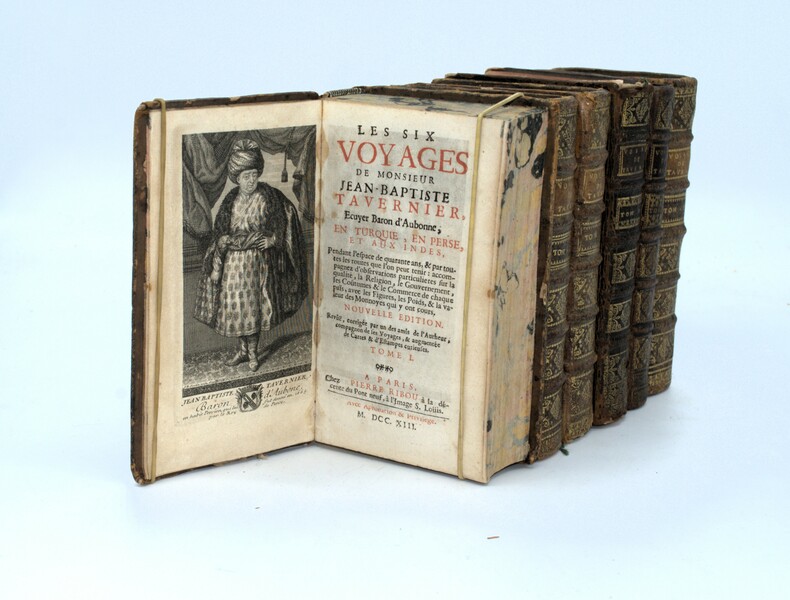
1713ref. PHO-1341A Paris, Chez Pierre Ribou et Rouen chez Jean Baptiste Machuel (tome 5), 1713. 6 volumes in-12, relié plein veau époque, dos à nerfs orné avec pièce de titre et tomaison, tranches marbrées, Tome 5, reliure légèrement différent avec tranches rouges, coins et coiffes usés .T1,27p-501p-1f(table); T2, 1f-465-1f (table);T3 ,1f-402-3f(table);T4,1f-367-2f(table);T5 ,3f(titre, épître)-467-2f(table),T6 3f(titre, épitre)244 -2f (table) .Illustré de 63 planches la plupart repliées, dont un portrait et 3 grandes cartes (manque la carte du Japon) ; quelques vignettes dans le texte , quelques planches au tome 5 volantes, 1 planche doublée.
1818P., Firmin Didot, 1818. Deux volumes in-4 reliés demi basane (reliure d'époque), dos longs ornés, plats de papier vert, coins vélin, gardes blanches, tranches mouchetées, frontispice (armoiries des Etats de Languedoc)-XIX-584 pages-5 cartes et plans dépliants ; frontispice (armoiries de Carcassonne, Narbonne, Castelnaudary et Limoux)-VIII-carte en couleur dépliante du département de l'Aude-679 pages-5 plans et cartes. Carte du Canal des Deux Mers sous les murs de Carcassonne, plan et élévation du pont de Marengo, plan et élévation du pont aqueduc de Fresquel,carte du canal et de la Robine de Narbonne, tableau synoptique du Canal du Midi ; Vue de Carcassonne, plan de l'ancienne cité de Carcassonne, vue de Castelnaudary, vue de Narbonne romaine, vue de Narbonne. Quelques frottements sur les plats, un début de fente à un mors inférieur au tome 1. Bel et agréable exemplaire dans sa reliure d'époque. L'ascension de C-J. Trouvé est tout d'abord liée à l'Empire, dont il sera baron en 1809, puis sa carrière se poursuit sous la Restauration avec Charles X. Il a été préfet de l'Aude de 1803 à 1816. En 1807 il organise un important recensement de la population et de l'agriculture puis des enquêtes sur l'industrie et l'enseignement . Son ouvrage donne un large panorama du département tant du point de vue de la population que des activités, de l'enseignement, des contributions.
ref. 15890A Paris, Chez Moutardier, Cerioux, (an) 8 (1799-1800). With 2 engraved plates. 2 volumes. (2), 8, 368 pp.; (2), 356 (last page misnumbered 561) pp. 8vo. Contemporary half calf, corners, green and red labels with gilt lettering. Not in Musset-Pathay; not in Kress; not in Goldsmiths; Einaudi 6099 (for the English edition). First French edition. Mainly devoted to agriculture, but also supplying useful information on population, commerce, industry. The first English edition appeared in 1780. The additional Recherches by the translator cover the pages 83-end of volume 2. For the period before 1790 the travel accounts as given by Young form an important part of the economic literature, owing to the absence of regular reporting by permanent agencies: see at length: Schumpeter, History of economic analysis. - With an engraved bookplate on the front paste-down of each volume. Copy from the library of Edmond Vallée, with his small owner's stamp on flyleaves.
1976ref. mon0000365055Stationery Office Books 01/04/1976 00:00:01. paperback. Good. in x in x in. Ex-library book usual marking. Clean copy in good condition. Stationery Office Books paperback
1939ref. 2091502135501147Binjiang Chamber of Commerce and Industry 1939. Soft Cover. Fine. Number of pages: 2 4 303p Size: 16x24cm Binjiang Chamber of Commerce and Industry paperback
1933ref. 2091502135307713Not Available 1933. Soft Cover. Fine. Volume: 1 Not Available paperback
1910ref. 2091502135501018Mukden Chamber of Commerce 1910. Soft Cover. Fine. Number of pages: 2 Size: 19x26cm Mukden Chamber of Commerce paperback
1931ref. 2091502135500838Yingkou Chamber of Commerce 1931. Soft Cover. Fine. Number of pages: Transcription 80p Size: 26cm Yingkou Chamber of Commerce paperback
Cádiz, en la Real de Marina, y Real Audiencia de Contratación de D. Manuel Espinosa de los Monteros, 1762, 20,5 x 14,5 cm., piel de época, lomo cuajado, 158 págs., incluso varias figuras intercaladas y dos grabados xilográficos de una nave al comienzo de cada parte. (Ejemplar con taladro de insecto marginal en 19 hojas, sin afectar al texto. El nombre del autor de esta obra figura al fin de la última hoja).
1988Very Good Turkish Original working fisches, notes, their envelopes and trimmed advertisements collection (most of ads. are photocopy). Some of them are unpublished, some is used for his articles and his book 'From Pera to Beyoglu' as sources. Apprx. 350 papers in 3 modern files. Selected contents: (All notes contains 1840-1950 years). Restaurants of Istanbul in the 19th and early 20th centuries, food types, their menus, prices, discount days, special programs, their chefs and managers; hotels, accommodation prices; music shops and their owners and founders; buildings, architects; patisseries; cinemas, their history, matinees of the movies, ticket prices; every non-Muslim shops and tradesmen of Pera; their old and new addresses; booksellers, antique shops; and everything on social life of Pera - Galata area which are shedding light on the social history of Istanbul in its period like that first coming of circus, fires... The notes mostly have sources with their abbreviations and sources are some journals, periodicals in its period and selections from literature.
42 volumes, orig. uniform cloth. "The aim of this series is to provide access to contemporary sources for the history of English publishing and bookselling, including controversy over copyright legislation and freedom of the press, from the Restoration through the early nineteenth century. To this end, we have gathered from libraries in Great Britain and the United States a comprehensive working collection of pamphlets, broadsides and memoirs, amounting to 156 individual titles, reprinted in forty-two volumes".?Introduction.
The board (300 x 320 mm) features four examples of spines (230 x 45 mm), the whole backed with marbled paper to represent the endpapers (corners rubbed), at the head of the board is a large black morocco label with a gilt boarder entitled "Specimens of Bookbindings", plus three additional separate models of spines. This has the appearance of being dated to the 1890's with the titles on the dummy samples being of Dickens novels and periodicals (i.e. Strand Magazine, Sunday at Home, etc.). However, the sample "Stand Magazine" is lettered Jan.-June 1921.
ref. 17005A Paris, De l'Imprimerie de P.G. Le Mercier, 1766. Two works in one volume. 4, 180, lxxii, 4, 4 pp.; 8, (also numbered 242)-328, (also numbered 56)-164 (also numbered 196)-212 (also numbered 288)-306 (also numbered 168)-190 pp.; 1-56 (also numbered 328)-397, (1) pp. 4to. Contemporary marbled calf, spine gilt with raised bands, some damage to foot of spine, corners worn and bumped, some staining to binding, small damage to upper band. First work: Conlon 59:417. First edition. Contains: Exposition du sujet de la consultation. - Mémoire pour les officiers de la Conservation de Lyon & Avis des députés du commerce sur ce Mémoire. - Projet de la déclaration proposé par les députés. - Observations de MM. de Lyon sur ce projet, & réponse à ces observations. - Projet de déclaration fourni par MM. de Lyon, & réfutation de ce projet. - Consultation. - Pièces justificatives.Second work: Kress 6362; Conlon 66:321; not in Goldsmiths; not in Einaudi; not in INED.First edition.Important collection, containing many memoirs from numerous Chambers of Commerce, not published elsewhere. At the end of the Avertissement is the following announcement: 'Le lecteur est prié de n'avoir aucun égard aux chiffres des pages, quelques circonstances survenues depuis l'impression de l'ouvrage, ont exigé un nouvel ordre dans les pièces, & ont interverti celui des chiffres'.Contains, among others: Représentations des six Corps des Négocians de Paris - Représentations des Jurisdictions Consulaires de Paris - Mémoire des Syndics de la Chambre de Commerce de Normandie - Premier Avis de MM. les Députés du Commerce - Second Avis de MM. les Députés du Commerce - Mémoire des Prieur & Juge-Consuls de Rouen - Mémoire des Prieur & Controlleur des Bourges Communes de Toulouse & de Montpellier - Projet de Déclaration - etc. etc.
ref. 18576A Rennes, Chez J. Vatar; A Paris, Chez la Veuve de B. Brunet, 1760-1772. With engraved frontispiece and 4 engraved plates. 2 volumes. xxxviii, 38, 284, (6) pp.; viii, 392, (8) pp. 8vo. Contemporary marbled calf, richly gilt spines with raised bands and gilt lettering, with the gilt stamped armes of the États de Bretagne on the covers, slightly rubbed. INED 1-2 & 3243-3244 lists different issues but no second volume with the date 1772; Higgs 2179 & 5423; Goldsmiths 37378 & 10838.1; Einaudi 48 & 49; not in Kress; not in Mattioli. One of at least two editions for volume one from the year of publication, the other being in 12mo and with a completely different collation. The 12mo edition has no frontispiece and three plates. First edition of volume one, second edition of volume two, all published. The second volume is identical to the volume published in 1762 but for the date on the title-page. Louis-Paul Abeille was an economist of the Physiocratic school, inspector-general of manufactures in France and later secretary to the council of the bureau of commerce. Montaudouin was a lawyer from Nantes. These reports were the only ones published although a third report was planned. The Société d'Agriculture was the first society of this type established in France, founded through Gournay's influence. Its members were to examine the state of agriculture, commerce and manufacturing industry. For the arms see: Olivier, Hermal and Roton, Reliures Armoriées Françaises, plate 1576, nr 3.
ref. 18066A Amsterdam, Chez Jacques Coeur, à la corne d'Abondance (Paris), 1756. 3 volumes. xii, 372 pp.; 406 pp.; 350 pp. 8vo. Contemporary marbled calf, spines richly gilt in compartments, labels with gilt lettering and numbering. Mars 27; Weulersse, i, p. xxvii; Kress 5526; Goldsmiths 9082; Einaudi 2659; Mattioli 1481; INED 2079; Higgs 1145. First edition, second issue. Einaudi's copy is identical with ours, about the Kress and Goldsmiths copies not much can be said, both collections contain more than one copy and they both indicate that there is one copy with a third volume with the indication 'Nouvelle édition', as does our third volume. According to Mars, Ange Goudar, cet inconnu, essai bio-bibliographique, the third volume came from the same press as the first two volumes but with a different ornamental typography. Between the first issue and this issue, there appeared, according to Mars, a parisian contrefaçon, all published in 1756. This is the main work of Goudar. It was used by the demographer Süssmilch in his Die goetliche ordnung. Voltaire had a copy in his library and Diderot wrote about the book in a letter to Sophie Volland. Preceding Mirabeau's l'Ami des Hommes by a few months, it marks an important date in the history of political economy, and made Goudar one of the leading figures of the school of 'des agrariens et populationnistes', not to be mixed with the Physiocrats, which they preceded and with whom they disagreed on various points. 'Of the pre-physiocratic French writers who approached the population problem in terms of agricultural values and reforms, Ange Goudar (1720-1791) was the most important' (Spengler, French predecessors of Malthus, pp. 56-67.) Spengler's analysis is elaborate and shows the crucial importance of this work. - Some corners somewhat damaged.
ref. 17125A Leyde, 1754. Title printed in red and black. vi, (8), 408 pp. 12mo. Contemporary red morocco, gilt fillets on sides, spine richly gilt with gilt stamped ornaments and gilt lettering, all edges gilt, some very, very light wear, one scratch to front cover, corners lightly bumped, a beautiful copy. Kress 5381; Goldsmiths 8916; Higgs 742; Leblanc, De Thomas More à Chaptal, 123; Weulersse, i, p. xix; INED 3607; not in Einaudi (other editions); not in Menger. Second edition. In all, four editions were published in 1754. The work was being published as a translation but was actually written by Louis-Joseph Plumart (or Plumard) de Dangeul who used the pseudonym of John Nickolis. 'd'Argenson admire beaucoup cet ouvrage, qu'il place même audessus de l'Esprit des Lois de Montesquieu.' (Stourm, p. 98). 'Documentation particulièrement riche, accompagnée d'observations personnelles sur la population, les classes sociales, le commerce, l'économie.' (INED) 'Mid-eighteenth-century populationism is best represented in the works of Plumard de Dangeul, Goyon de la Plambaine and Jaubert. Dangeul was concerned primarily to combat celibacy, the principal check (in his opinion) to population growth; for he looked upon such growth as a 'certain sign' of the 'health of the body politic', as a stimulator of agriculture and manufactures, and as a partial source of relief to the taxpayers (the cost of government being relatively fixed).' 'The forces unfavorable to population growth operated more powerfully in some social classes than in others. Both the marriage rate and fertility within marriage were lower in the military class than in any other group; they increased in the following order: magistrates, financiers, merchants, artisans, comfortable laborers, and uncomfortable laborers. In general, Dangeul concluded, the French social system valued least and burdened most heavily the more useful classes, and thereby checked their increase and that of the population as a whole' (Spengler, French predeccessors of Malthus, pp. 82-86). - With a handwritten ex-dono by the author on second blank leaf, binding by Derome (?).
1751In-4°; pp. (4), 144, bianca F12; al frontespizio incisione su legno con il leone veneziano; con frontespizio proprio con il medesimo legno seguono da p. 117: “Terminazione degl’illustrissimi ed eccell. deputati ed aggionti alla regolazione del commercio e cinqe savi della mercanzia in proposito delle bollette d’uscida”, p. 131: “Obblighi ed incombenze del ragionato appuntadore nella dogana da mar volgarmente detta nuovo stallaggio; approvati dall’eccell. Senato 1761” dove l’ultimo decreto è datato 1780. Bell’esemplare in cartonato rustico coevo. Ex libris papadopoli. Interessante per la grande quantità di merci elencate tra cui anche “libri a a stampa e vecchi usati”, quadri di pittura antica e nuova”, e le mercanzie provenienti dal Levante, ma anche da Bosnia, Erzegovina, Albania.
ref. 18392A Amsterdam, Chez Marc-Michel Rey, 1776. 2 volumes. xx, 389, (3) pp.; (4), 474, (2) pp. 8vo. Contemporary marbled calf, spine gilt with red labels and gilt lettering, red edges. INED 4116; Einaudi A.867; not in Kress; not in Goldsmiths; Leblanc 113; Mattioli 3269. First edition of this very interesting expostion dealing with the laws of society, the relation between men, man and society, natural and positive law, the role of economics, demography, luxury, property, religion, individual liberty, liberty of the press, free speech, etc. etc. and how society should be organized, governed and managed, this is both a work of sociology, economics, politics and legislation seeking the well-being and happiness of societies and population through proper and rational legislation and organization. 'Économie politique. Doctrine plus agrarienne que populationniste, très proche de celle des physiocrates' (INED, giving a long and extensive analysis of the work). There are sections discussing population (Schmid advocates a continuous increase), family life, property (he defends private ownership of land), luxury, religious toleration, (Schmid is in favour), taxation (Schmid favours direct over indirect taxation), commerce (he advocates, among other things, free trade for the colonies and an autonomous government) and war. One of the best expositions of the body of economic thought of the time.Further sections deal with: De l'Autorité souveraine; Des Forces de la Société; Des Rapports d'une Société avec les autres Sociétés; Du bonheur de la Société; Des Loix positives. George-Louis Schmid (or Schmidt), born in Avenstein in 1720, entered the service of the Duke of Saxe-Weimar and retired in 1757 to Nyon in the Vaud. He had close relations with Voltaire, Diderot and d'Alembert and the other leading philosophes of the 18th century. He belonged, together with authors such as Rillet de Saussure, Delolme and Iselin to a group of important Swiss authors actively participating in the European debates of those days and historians now believe that Swiss authors like these were unique in their attempts to reconcile traditional republican and Christian standards of social justice with the imperatives of economic growth. For this reason, they came to occupy a central position in European debates and the essay competitions of the Economic Society of Bern were closely watched elsewhere in Europe. - Some occasional browning. An excellent copy of a scarce work.
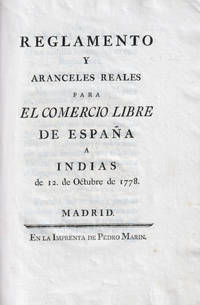
1778ref. 10011Madrid: Pedro Marín 1778. First Edition Primera edición. Hardcover Tapa dura. 265x195mm. 10½x7¾". Madrid Pedro Marín 1778. En folio 265 x 195mm. Frontispicio con el escudo real de España grabado al cobre 2 19 262 pp. Encuadernación en piel de época sin el tejuelo de la lomera. Primera edición del Decreto de Carlos III por el que se establece el comercio libre con América y Filipinas y se finaliza con el monopolio del comercio a las Indias que venían ejerciendo Cádiz y Sevilla permitiendo a otras ciudades que lo soliciten comerciar con el nuevo continente. Este Reglamento articulado en 55 puntos fue promulgado por Carlos III como parte de las reformas borbónicas con el fin de incrementar el intercambio comerical entre España y América; se habilitaron 13 puertos españoles y 24 puertos americanos: San Juan de Puerto Rico Santo Domingo Monte-Christi Santiago de Cuba Batabanó La Habana Isla de Margarita Trinidad Campeche Golfo de Santo Tomás de Castilla Omoa Cartagena de Indias Santa Marta Río de la Hacha Portobelo Chagres Tierra Firme Montevideo Buenos Aires Valparaíso La Concepción Arica Callao y Guayaquil. Se excluyó a Venezuela hasta 1788 para proteger los intereses de la Real Compañía Guipuzcoana de Caracas que se disolvió en 1785 y a México por el temor de que la prosperidad de este territorio provocara la despreocupación hacia otras zonas menos activas lo que iba contra la idea rectora del proyecto. Cuatro años más tarde en 1789 se amplió el comercio libre a México y en 1797 a otros países de Europa. Ejemplar en gran papel de amplios márgenes. Pedro Marín hardcover
1778ref. 9984Madrid: Pedro Marín 1778. First Edition Primera edición. Hardcover Tapa dura. 284x197mm. 11¼x7¾". Madrid Pedro Marín 1778. En folio 284 x 197mm. Frontispicio con el escudo real de España grabado al cobre 2 19 262 pp. Encuadernación en piel de época sin el tejuelo de la lomera. Primera edición del Decreto de Carlos III por el que se establece el comercio libre con América y Filipinas y se finaliza con el monopolio del comercio a las Indias que venían ejerciendo Cádiz y Sevilla permitiendo a otras ciudades que lo soliciten comerciar con el nuevo continente. Este Reglamento articulado en 55 puntos fue promulgado por Carlos III como parte de las reformas borbónicas con el fin de incrementar el intercambio comerical entre España y América; se habilitaron 13 puertos españoles y 24 puertos americanos: San Juan de Puerto Rico Santo Domingo Monte-Christi Santiago de Cuba Batabanó La Habana Isla de Margarita Trinidad Campeche Golfo de Santo Tomás de Castilla Omoa Cartagena de Indias Santa Marta Río de la Hacha Portobelo Chagres Tierra Firme Montevideo Buenos Aires Valparaíso La Concepción Arica Callao y Guayaquil. Se excluyó a Venezuela hasta 1788 para proteger los intereses de la Real Compañía Guipuzcoana de Caracas que se disolvió en 1785 y a México por el temor de que la prosperidad de este territorio provocara la despreocupación hacia otras zonas menos activas lo que iba contra la idea rectora del proyecto. Cuatro años más tarde en 1789 se amplió el comercio libre a México y en 1797 a otros países de Europa. Ejemplar en gran papel de amplios márgenes. Pedro Marín hardcover
ref. 3971, Paris, Videcocq 1852 et s., 85années en 85 vol., demi-basane brune/fauve, tit. & tom. dorés sur dos à faux nerfs, filets simples et filets multiples dorés, rel. au chiffre de «M.Ribardière», (rel. très frottées avec nombreuses épidermures, accrocs et mq. de cuir, coiffes émoussées dont 5arrachées, 2dos manquants, 1vol. dérelié, papier jauni).
ref. 17046A Paris, De l'Imprimerie ordinaire du corps législatif, et se vend chez Rondonneau, mars 1806. xii, 224, iv, 164, (4, advertisments) pp. 4to. Contemporary half calf, spine gilt in compartments, gilt lettering, marbled boards, corners, very lightly rubbed. Kress B.5003; Goldsmiths 19258; Einaudi 162; INED 94 (only the last iv, 164 pp.); Martin & Walter, 545. First edition. 'Ambroise-Marie Arnould (1750-1812), a French economist, was director of the board of commerce under the Revolution. His works contain valuable information upon the theory of trade, the state of the balance of trade in Europe during the 18th century, French finances, etc. He advocated the division of France into departments according to their homogeneous economical nature; and appealed to all maritime nations to confederate against the menacing power of England' (Palgrave, i, p. 58). The last 164 pages contain the 'Notes et pièces justificatives', with tables throughout the text.
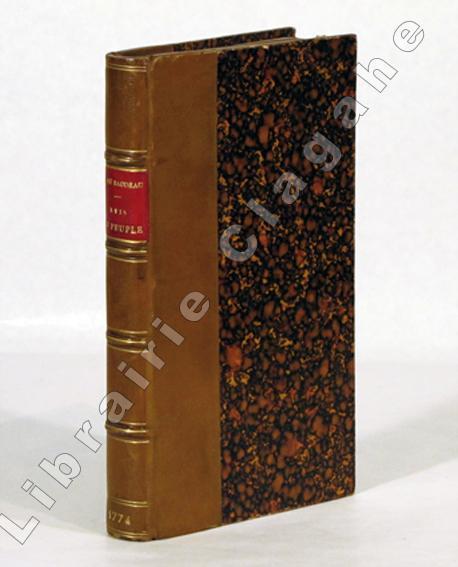
1774ref. 18311Amsterdam et Paris, Fr. Ambr. Didot aîné, 1774 ; in-12 (178 mm), demi-veau caramel, dos à nerfs décorés de filets dorés, pièce de titre rouge, date en queue, non rogné (reliure du XIXe) ; 324 pp.
ref. 18480A Bruxelles, et se trouve à Paris, Chez la Veuve Esprit, 1785. 152 pp. 8vo. Modern half citron morocco, spine gilt with raised bands, gilt lettering, marbled boards, top edge gilt, a lovely copy. Kress B.820; Goldsmiths 12849; INED 735bis; Leblanc, De Thomas More à Chaptal, 132; not in Einaudi. First edition, very rare. It is a reply to Roubaud's work Representation to the Magistrates ...... The author denounces the French policies rergarding wheat and criticizes the absolute freedom of its trade and circulation. He proposes the maintenance of the legislation in force, but he tempers it by proposing the creation of companies of commerce, which will have the sole authority to import or export in the kingdom. They will have to create, in the important cities, granaries where the farmers and proprietors will be able to carry the unsold grains, which are bought for them at a fixed price. The author concludes his study with a critique of Necker's Traité de l'Administration des Finances with regard to the paragraphs relating to grains, which contradict the propositions set out in his own work (Leblanc, our translation). 'The unlimited freedom of the grain trade has many disadvantages for the economy and the population. Bourdon proposes a more moderate system: to set up a trading company entrusted exclusively with the export and import of grain, the establishment of public granaries, the fixing of the price of bread in each place, and so on. This system, moreover, would make it possible to abolish taxes without diminishing the revenues of the king: levying a duty on the quintal of wheat (INED, our translation).