[Kansas Trade Sign]:Biblio.com
15.997 resultados
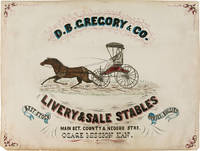
1870ref. 55334Osage Mission Ks. N.d. ca. 1870s. Hand-Painted Trade Sign for a Kansas Livery Stable A remarkable and very attractive handmade sign for D.B. Gregory's livery stable in Osage Mission Kansas. Undated the style of the sign suggests a date of the 1870s. The center of the sign shows a lovely illustration in profile of a horse pulling a single-rider four-wheeled carriage along a dirt road. The text above the illustration reads "D.B. Gregory & Co." and below: "Livery & Sale Stables / Best Stock / Horse & Buggies / Main Bet. County & Neosho Strs. / Osage Mission Kan." The lettering is in black with blue and purple shadowing and "Osage Mission Kan." is drawn in a very ornate style. The entire sign is decorated with purple watercolor ornamentation. On the verso is a pencil sketch of the horse and the lower half of the carriage likely a preliminary sketch for the finished illustration. David B. Gregory born in 1846 in Iowa established his livery business with his brother in Osage Mission now St. Paul Neosho County Kansas by the early 1870s. An advertisement in the March 23 1873 issue of the OSAGE MISSION TRANSCRIPT describes Gregory's livery as having a "fine and well selected stock of horses and carriages.the best matched teams for style and speed in the city. Saddle horses for ladies and gents a specialty that defy competition." Settlers came to the region around Osage Mission in the 1840s following the founding of nearby Fort Scott in 1842. Osage Mission itself was founded in 1847 by Father John Schoenmakers as a mission to local Indian tribes and then grew into a town in its own right serving as a trading post and gateway for commerce and westward exploration. By the late 1860s it had grown to nearly 900 people with a hotel boarding house saloon stables general store hardware store and blacksmith. A rare significant and informative survival from the American frontier. Hand-drawn and hand-painted watercolor sign on a 14 x 18¾-inch sheet of cardstock. Pencil sketch for the same sign on the verso. Small chips at lower corners some light soiling. Very good. unknown
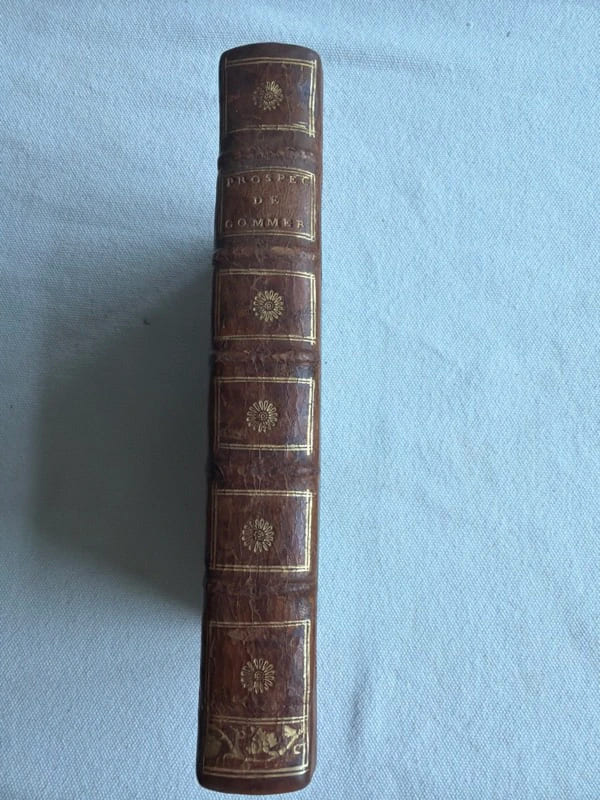
ref. 17699La Haye, Jean Neaulme, 1720. In-12, [8]-187-[19] pp. 1 pl., veau marbré fauve de l'époque, triple filet doré en encadrement sur les plats cantonnés de fleurons dorés, dos lisse orné de caissons et fleurons dorés, pièce de titre rouge, tranches dorées (coiffe arasée, mors fendus, épidermures, quelques rousseurs, dernier cahier relié dans le désordre).
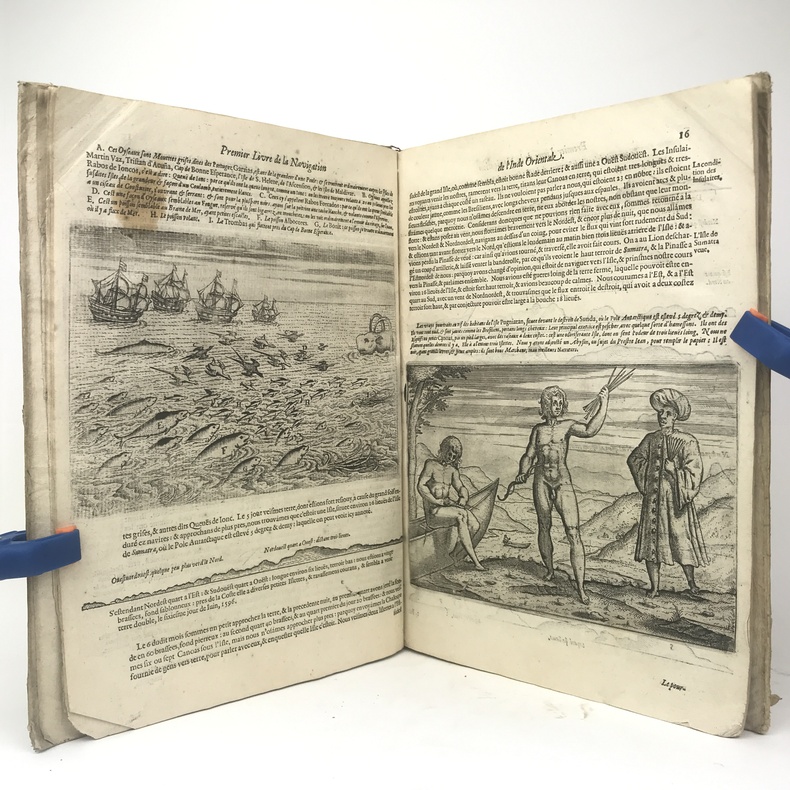
1609ref. PHO-11431 volume in-folio (33 x 23 cm), vélin rigide parchemin (reliure de l'époque), dos lisse titré à l'encre, nombreuses écritures manuscrites sur les plats, 5 à 53-[1] feuillets. Page de titre, 3 premiers feuillets et feuillets 51 et 52 manquants, charnière fendue ,mouillure sur 5 ff et manque de papier en marge , galerie de vers avec manque. Seconde édition française, illustrée de 55 gravures sur bois in-texte.
1798ref. PHO-1092Deuxième reliure de la première édition. Édition originale in-4 sur grand papier, remise en circulation en 1841 avec un nouveau titre avec la mention fictive "nouvelle édition" (quelques exemplaires imprimés en 1798 n'avaient toujours pas trouvé preneur). Une édition octavo en six volumes a également été publiée. in-4 ,y compris l'atlas. Avec 16 (10 dépliantes) dont 15 cartes gravées, 1 planche gravée et table dépliante. - Beau demi-cuir contemp , dos lisse avec titre et tomaison , petits manques au dos , quelques mouillures intermittentes et vieille trace d’humidité (T1), déchirure carte hydrographique sans manque. xii, cxliv, 628, [3] ; xvi, 676, [2] ;[xi], 431, [1];[2],viii, 158pp.
ref. 231706Paris, Frères Estienne, 1769 in-8, viij pp., 382 pp., un f. n. ch., 34 pp., demi-basane fauve, dos à nerfs cloisonné et fleuronné, coins en vélin moucheté, tranches mouchetées de rouge (reliure de l'époque). Discrètes restaurations aux coiffes.
1990ref. mon0000365033TSO 29/08/1990 00:00:01. paperback. Good. in x in x in. Ex-library book usual marking. Clean copy in good condition. TSO paperback
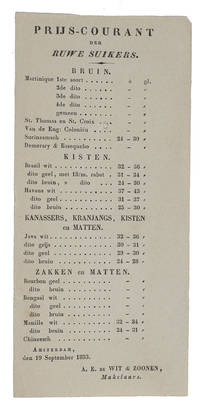
1721ref. LC4D1MQ3QGJ6Amsterdam 1721. 1 leaf 21 x 8 cm; 1 leaf 20.5 x 8 cm; 1 leaf 17.5 x 8 cm. Jacobus van Egmond Ad 1: Text printed on both sides each in a border built up from typographic ornaments. Ad 2: Text printed on one side. Ad 3: Text printed on one side. 3 documents. Ad. 1: Rare VOC ships manifest for cargo shipped from the East Indies - Batavia and Ceylon Sri Lanka - on 22 East-Indiamen sailing on 1 December 1720 from Batavia and on 15 November from Ceylon. The list includes more than 100 different colonial wares and gives the weights in pounds or the lengths in feet: from pepper more than 6.5 million pounds cloves 694000 pounds cinnamon 604000 pounds and coffee more than 1.77 million pounds to 962 pounds of Javanese cardamom some jewels and rariora and many feet of silk and linen cloth. Small wormhole affecting two characters otherwise in good condition.Ad. 2: Rare list of the results of the auctions of colonial wares organized in 1781 by the Chambers of the VOC Amsterdam 30 April 1781; Zeeland 7 May; Delft 15 May; Rotterdam 17 May; Hoorn 22 May; Enkhuizen 23 May including pepper cinnamon nutmeg etc. with the prices fetched. With a small tear not affecting the text. Still in good condition.Ad. 3: Price list of the various varieties of raw sugar: brown sugar from Martinique Surinam etc.; sugar packed in chests from Brazil Havana; in bales from Bengal Manilla etc.Small hole not affecting the text.l Ad. 1: cf. Landwehr VOC 1123-1134 other manifests. ASIA BOOK HISTORY & PRINTING HISTORY MARITIME HISTORY Broadsides Ephemera & Pamphlets Ceylon Economic History & Trade Indonesia / Dutch East Indies VOC hardcover
1870ref. WRCAM55334Osage Mission Ks 1870. Hand-drawn and hand-painted watercolor sign on a 14 x 18 3/4-inch sheet of cardstock. Pencil sketch for the same sign on the verso. Small chips at lower corners some light soiling. Very good. A remarkable and very attractive handmade sign for D.B. Gregory's livery stable in Osage Mission Kansas. Undated the style of the sign suggests a date of the 1870s. The center of the sign shows a lovely illustration in profile of a horse pulling a single-rider four-wheeled carriage along a dirt road. The text above the illustration reads "D.B. Gregory & Co." and below: "Livery & Sale Stables / Best Stock / Horse & Buggies / Main Bet. County & Neosho Strs. / Osage Mission Kan." The lettering is in black with blue and purple shadowing and "Osage Mission Kan." is drawn in a very ornate style. The entire sign is decorated with purple watercolor ornamentation. On the verso is a pencil sketch of the horse and the lower half of the carriage likely a preliminary sketch for the finished illustration. David B. Gregory born in 1846 in Iowa established his livery business with his brother in Osage Mission now St. Paul Neosho County Kansas by the early 1870s. An advertisement in the March 23 1873 issue of the OSAGE MISSION TRANSCRIPT describes Gregory's livery as having a "fine and well selected stock of horses and carriages.the best matched teams for style and speed in the city. Saddle horses for ladies and gents a specialty that defy competition." Settlers came to the region around Osage Mission in the 1840s following the founding of nearby Fort Scott in 1842. Osage Mission itself was founded in 1847 by Father John Schoenmakers as a mission to local Indian tribes and then grew into a town in its own right serving as a trading post and gateway for commerce and westward exploration. By the late 1860s it had grown to nearly 900 people with a hotel boarding house saloon stables general store hardware store and blacksmith. A rare significant and informative survival from the American frontier. unknown books
1805ref. 2612Leipzig: E. Z. Steinacker 1805. 3 parts small oblong 4to 178 x 219 mm. 20; 18; "19" recte 20 pp. Each part with half-title only titles supplied on the wrappers. 12 plates of oval hand-colored tinted aquatints by Geissler. Occasional light foxing to text. Publisher's original pale green printed wrappers some wear and creasing sewing loose in part 1.Only Edition a high spot of nineteenth-century German book illustration a fine copy in the rare original wrappers. In impressionistic prose an anonymous author delivers a dozen diverting vignettes of salesmen and their customers at the annual Leipzig trade fair weaving stories around Geissler's masterly hand-colored aquatints. This delightful suite was issued in parts published to coincide with the two 1804 Leipzig fairs at Easter and Michaelmas and the 1805 Easter fair. Together Geissler's aquatints and the text portray fortunetellers a peep show and its barker performing jugglers and musicians Russian dancers Transylvanian and Greek merchants in their native dress shoemakers Jewish clothing vendors processions of horses for sale horse traders and peddlers and fraudsters of every ilk. One of the oldest trade fairs in Europe by the eighteenth century the Leipzig fair had become the main venue for trade with Eastern Europe a perfect artistic subject for Geissler who had spent most of his twenties traveling through Russia and the Ukraine.Geissler's first subject part 1 Scene 1 is a second-hand bookseller. Surrounded by trunks of dusty books and pictures this poorly dressed oddball is a master of patter. His efforts to sell two popular 17th-century prayerbooks Arndt's Paradies-Gärtlein and Michael Cubach's Gebetbuch to a couple of wary customers is rendered verbatim. Other than the fact that the books are recommended for their usefulness the tactics of persuasion have not changed in two centuries. Meanwhile in the background two street urchins "two sons of the Vorstadt poorer outlying areas of town from the Order of the Barefoot" steal a defective copy of a red-bound issue of the Taschenbuch "wishing to return it to precisely the place mentioned in the title" i.e. their pockets. A poor book collector arrives; he is granted credit. This inimitable scene is completed by two more characters a French emigré hoping to find a "La Fontainesque novel" for a few pennies and a poet for hire shown from the back in the aquatint whose tragi-comic portraits are gleaned from their clothing hairstyles and gestures as rendered by Geissler.Equally astute and moving are the portraits of Russians and Eastern Europeans who appear in five scenes. In the final chapter in part 2 the anonymous author - an "unnamed Leipzig man of letters a friend of Geissler's who worked for a Modemagazin fashion magazine probably Baumgartner's" Wustmann p. 23 - quotes Geissler's own description of the wild Russian dancing and singing of the last night of the fair in a moving paean to Slavic soulfullness sharply contrasted with Germanic stiffness.The son of a Leipzig goldsmith and mineral dealer Geissler had trained at the Art Academy there but his major influence was the illustrator Johann Salomo Richter from whom he learned the taste for hand-colored aquatint portraits of the common people and genre scenes of everyday life. Geissler spent 1790 to 1798 in Russia serving as the expedition artist with the German scientist Peter Simon Pallas on his travels in the Caucasus and southern Russia. On his return to Leipzig Geissler published the Pallas works as well as his own illustrated accounts of Russian customs and costumes. Creatively gifted Geissler was also skilled at marketing his works. He established close relations with Leipzig publishers for whom he produced numerous children's books. The present "Scenes from the Leipzig Fair" was his most important publication during the period between his return from Russia and the Napoleonic wars. He later produced illustrated reportages of the Battle of the Nations Völkerschlacht in Leipzig and individual war images for newspapers almanacs and even peep shows. In the US OCLC locates copies at Brown Rice University and University of Wisconsin. Lipperheide 828 DfG 5; G. Wustmann C. G. H. Geissler der Zeichner der Völkerschlacht Leipzig 1912 pp. 23-24 and 115 note 24;; Rümann Die illustrierten deutschen Bücher des 19. Jahrhunderts 1926 504; Thieme Becker 13:351-2. E. Z. Steinacker unknown books
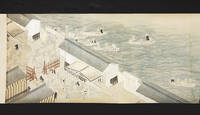
ref. 5736Japan: late Edo. Until the late 17th century the Chinese had been permitted to move in Japan quite freely for trading purposes. But in 1689 due to the rise of smuggling activities the Chinese were restricted like the Dutch to a compound on the eastern tip of Nagasaki - called the "Tojin yashiki" "Chinamen's mansions" - surrounded by a moat and walls with gates which could be locked from the outside. Inside were housed on average 2000 Chinese merchants and sailors along with interpreters inspectors and staff. This scroll depicts two large Chinese ships just off Nagasaki surrounded by a number of smaller transport and supply ships. It is clear that these smaller ships are Japanese based on the clothes the crewmen are wearing. The numerous Japanese government officials are dressed in black robes; they are inspecting the arriving goods sugar raw silk and finished fabrics along with antiques. The final section of the scroll depicts a portion of Tojin yashiki. We see the arriving transport ships warehouses government workers inspecting the arriving goods laborers carrying goods etc. This scroll - based on a scroll at the City Museum of Kobe entitled "Nagasaki tokan koeki zukan" - is unfinished in several ways: it has not been fully colored and it is clearly incomplete at the end. Nevertheless this is a marvelous record of the early trading days in Japan with the outside world. Minor worming carefully repaired otherwise in fine condition. hardcover books
1930ref. 19955Leicester UK: Cascelloid ca. 1930s. Very good . Oblong 4to. album. Blue leather-covered boards. Contains 29 color photographs all 9" by 6.5" approx. mounted on rectos one each of light-gray cardboard leaves. About very good plus overall. Moderate rubbing and edgewear to boards. Several pages display mild soiling and offsetting from photos. Prints just a bit yellowed but remain sharp vivid and clean. Beautifully-produced trade catalogue from the Cascelloid "Palitoy" company displaying a wide range of baby dolls and other toys. Several uncomfortable designs of black children with pitch-dark skin date this catalogue at roughly the 1930s when the Cascelloid company was dubbed the "House of Constant Progress" by the industry press for its material innovations with the plastics Bexoid and Plastex. One page features a celluoid model by the noted designer Mary Lucie Attwell a doll named "Diddums." The catalogue also displays the company's offerings of animal dolls die-cast trucks pool toys golf and ping-pong sets rattles pinwheels and more. Needless to say color photography was not the norm at this time and this catalogue comprises a beautiful set of vivid and sharp photographic prints. A truly exceptional example unlike anything we've seen: simultaneously surreal and nostalgic. [Cascelloid] hardcover books
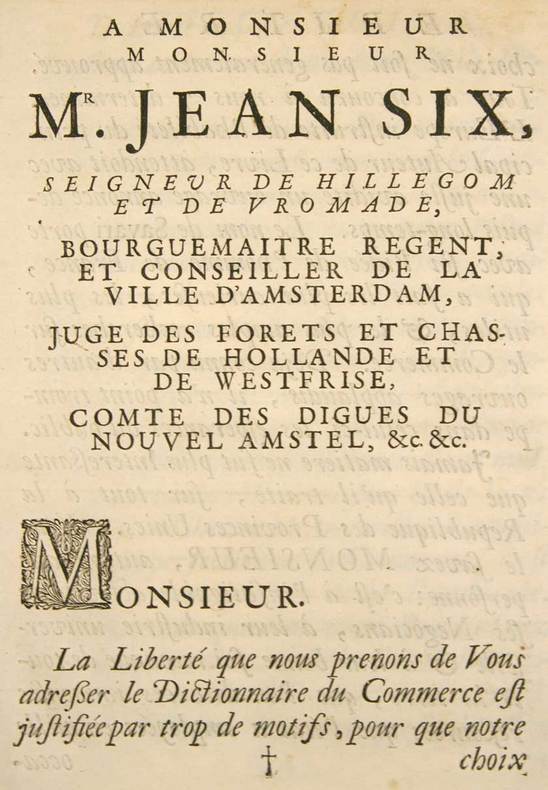
ref. 128479aafAmsterdam, chez les Jansons à Waesberge M. DCC XXVI, (Janssonius van Waesbergen), (1726), in-4to, With a folding engraved portrait of the dedicace ‘Jan Six, Heer van Hillegom en van Vromade’ bourgmestre d’Amsterdam, by Houbraken, and 2 large allegorical engraved headpieces (Pool after A. Coypel) + 2 endpieces. Main text printed in two columns. Collation: Vol. 1) XXXVIII + folded engr. front + 2030 col. ; Vol. 2) 2000 col., title-pages printed in red & black, hw ownership on free fly ‘Nunc à J. Louïs Panchaud’ à Wufflens & Appartient à Gabriel Tachenon. 1731 , avec un prix ‘coutte L 296’, reliure plein veau d’époque, qqs restaurations aux coiffes, pages de gardes en papier dominoté d’origine, bel exemplaire.
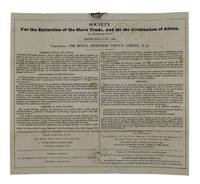
ref. AQ30000Single leaf mulready letter- sheet folded addressed to 'Mrs Clive Sanderstead Croydon Surrey' postmarked Frome with the 306 duplex cancellation to folded front and further post-marks of Croydon and Frome dated September 1844 to folded verso. Some tears to folds margins without loss of text remains of opened wax seal and old paper repairs to recto. The earliest of several known variants of this rare plea for donations for the Society for the Extinction of the Slave Trade and for the Civilization of Africa printed on the reverse of a 'Mulready' penny postal stationary sheet. First issued on 1 May 1840 in parallel with the world's first stamp - the Penny Black - these pre-paid self-folding letter sheets featured an engraved design by John Thompson after William Mulready 1786-1863 and were valid for use from 6th May. Much to postal reformer Rowland Hill's surprise unlike their adhesive philatelic counterpart the Mulready covers quickly proved unpopular both with customers and stationers - who relied upon the sale of writing paper for letters - alike. They were superseded by the introduction of simpler postal stationary with impressions akin to stamps in the top left hand corner in 1841; Mulready sheets were subsequently withdrawn from sale during the early 1840s. Despite their unpopularity soon after issue the promotional opportunities provided by advertising on the verso of the Mulready letter-sheets were seized upon by commercial and voluntary associations alike. Insurance companies banks newspapers publishers and religious institutions are all known to have advertised in such a manner; many made this stationary available in quantity at a discounted rate to ensure wide circulation to the writing desks of the literate across Britain. Advertisements for The Society for the Extinction of the African Slave Trade are known to have featured on nine slightly different advertisements to the verso of the Mulready one- and two-penny letter-sheets; this is the earliest known advertising that 'Shortly will be Published' an Abridgement of Buxton's The African Slave Trade London 1840 implying that these were issued in the very first year of the stationary's use. The fact that no fewer than four works published by John Murray are also advertised could indicate that the cost of producing these pre-paid advertising letter sheets was borne by the publisher. 'A subscription of One Guinea and upwards per annum constitutes an Annual Member. A donation of Ten Guineas and upwards constitutes a Life Member Subscriptions and donations of a smaller amount will be thankfully received.' Founded by English politician Fowell Buxton 1786-1845 in June 1839 with the aim not only of finally extinguishing the Slave Trade in Africa some decades after the original abolition of the Trade in Britain her colonies and the United States but also to 'watch over and befriend the interests of Africa' and form a commercial 'Company which shall cultivate portions of her soil'. As noted in this advertisement which sought 'subscriptions and donations' this included persuading the British Government's sending an expedition see item number 36 led by the Royal Navy to explore the Niger river which despite the death of a full third of the those involved largely to fever did secure the signing of several treaties against the slave trade with tribes in modern day Nigeria. As this advertisement - signed by secretary Irish clergyman and missionary John Trew 1792-1869 notes further expeditions 'into the interior of Africa' were envisaged at 'considerable expense' to the society; however the Society was acrimoniously dissolved in 1843 - the year before this letter-sheet was used - before any such expeditions could be repeated. Stanley Gibbons Queen Victoria Vol. 1 Pt. 1 SG MA480a. Dimensions unfolded: 220 x 200 mm; folded: 133 x 88 mm. unknown
ref. AQ27989vs.: vs. 1820-40s An archive comprised of sixty-eight loose articles of late Georgian and early Victorian manuscript and printed ephemera relating to the purchase of alcohol including a number of bill-heads for merchants in inter alia Glasgow and London. The majority of the manuscript material - predominantly receipts and purchase orders - are addressed to Nottingham-based wine merchant Thomas Bailey 1785-1856 father of poet Philip James Bailey 1816-1902 noted author of Festus 1839. The elder Bailet who established his business in 1817 relinquished control in the 1830s in order to devote himself more fully to his roles as newspaper editor and author. The later material in this archive dating to the 1840s is addressed to Bailey's son-in-law and successor John Brown. A remarkable opportunity to acquire an archive of mid-nineteenth century commercial material directly connected to the provincial wine and spirit trade. . [vs.], [1820-40s] unknown
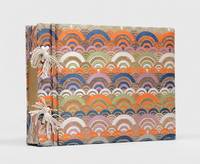
1934ref. 180258Japan: 1934. A last-ditch attempt to repair Anglo-Japanese relations A well-preserved photo album presented by the Japanese government to members of the Barnby mission. This delegation was "unofficial and supposed to deal solely with commercial issues but the Japanese government and media treated it as if it had a political purpose much to the embarrassment of the British Embassy" Cortazzi p. 141. WorldCat lists no other examples. After the invasion of Manchuria and Japan's withdrawal from the League of Nations in 1933 a pro-Japanese group in Britain centred on Neville Chamberlain attempted to repair relations between the two countries. The group was led by Colonel Lord Barnby the former president of the Federation of British Industries and staffed by representatives of the Iron and Steel Federation and the banking firm Seligman Brothers. Officially its goal was to investigate business opportunities in the new colony but as the Japanese ambassador Matsudaira Tsuneo wrote "its real aim is to promote friendly relations between Japan and Britain and between Britain and Manchukuo" Nish p. 19. The delegation was greeted by an audience with the emperor much to the horror of the British ambassador Robert Clive who suspected that their friendliness was simply a ruse to persuade the British to "accept a subordinate position in East Asia" Cortazzi p. 142. The mission caused such a stir that it was debated in parliament on 7 November 1934 where Viscount Cecil of Chelwood asked whether the Japanese government had been properly informed of its non-political nature. The first photograph shows the mission meeting with the Japanese delegation and the final photograph shows the interior of a railway car. There are also many photographs of traditional Japanese sports and performing arts as well as the scenery of famous places like Nara Hakone and Kyushu. Oblong folio. With 60 gelatin silver photographs landscape or portrait approximately 105 x 152 mm mounted recto and verso on grey card with captions in English. Original patterned brocade white thread musubi-toji binding spine ends capped with patterned brocade gilt-speckled endpapers gilt edges. Brocade fresh a little frayed at edges a few leaves sometime strengthened with tape at the gutter photographs bright with a little toning and silvering at edges: a very good example. Hugh Cortazzi British Envoys in Japan 1859-1972 2021; Ian Nish Anglo-Japanese Alienation 1919-1952: Papers of the Anglo-Japanese Conference on the History of the Second World War 1982. unknown
1843ref. 24188St. Louis: John B. Sarpy 1843. Folio. 2 pp. 12 1/2 x 7 1/2 inches. Docketed on verso fold lines with some separation a few repaired. A manuscript affidavit written by fur magnate John Baptiste Sarpy of Pierre Chouteau & Co. that gives one a granular sense of the difficulities of running a frontier business dependent on mountain men like Jim Bridger and Frapp. A remarkable window onto the business dealings of famed mountain man Jim Bridger this signed manuscript affidavit of John B. Sarpy testifies to his actions on behalf of the estate of fellow fur trader Henry Fraeb also known as Frapp who was killed by Indians in the Rocky Mountains. Sarpy who was a partner in the major fur firm Pierre Chouteau &. Co. had worked closely with Frapp and knew him well. In his affidavit he writes about the Chouteau Company's concerns about Jim Bridger Frapp's partner at the time of his demise and the difficulty of getting Bridger to pay his debts. Written in St. Louis Sarpy's affidavit states: "On the 8th day of August last he was appointed . . . administrator of the estate of Henry Fraeb then lately deceased. Said Fraeb had been a trader in the mountains & was at the time of his death in partnership with a man of the name of James Bridger & said Bridger & Fraeb were indebted to the firm of Pierre Chouteau Jr. & Co. & it was feared by the members of said firm that unless some one became the administrator of the said Fraeb the said Bridger might interpose difficulties in the settlement of the accounts existing between them & Bridger & Fraeb & for the purpose of doing justice to themselves as well as to the said Fraeb the said Sarpy applied for letters of administration which were granted to him as above mentioned. The said Bridger has however since this time been here & has settled in full the accounts existing between the firm of Pierre Chouteau Jr. & Co. & the said Bridger & Fraeb. And the said Sarpy says that no property has come into his hands as the administrator of the said Fraeb although it may be that the said Fraeb has property in the mountain country or in the hands of James Bridger his former partner." Though he may have been one of the greatest and most beloved mountain men of all time Jim Bridger was not the best debtor in the world nor did Pierre Chouteau & Co. forget business. John B. Sarpy unknown
ref. 39235In-8 (157 x 95 mm), veau marbré de lépoque, dos à 5 nerfs, orné de compartiments fleuronnés et cloisonnés, palettes, tranches rouges, 427 p., (5) pages de table. Londres, Fletcher Gyles dans Holborn [i.e. Paris?], 1756.
ref. 152855S.l. [Douai], s.d. (1791) in-4, [113] pp. (seules les 21 premières sont chiffrées), couvertes d'une écriture fine et lisible (environ 40 lignes réglées par page), avec 11 figures aquarellées dans le texte, et 9 pl. hors-texte (dont deux ff. doubles volants, et une grande carte dépl. aux contours rehaussés de couleurs, représentant le tracé du cours de la Sambre depuis la frontière jusqu'à Namur), en feuilles.
ref. 222527Genève, et se trouve à Paris, Damonneville, 1758 2 vol. in-12, viij pp., 228 pp., veau fauve marbré, dos à nerfs cloisonné et fleuronné, pièces de titre et de tomaison, chaînette dorée sur les coupes, tranches marbrées (reliure de l'époque). Un mors inférieur fendu, petite galerie de vers infra-paginale à la fin du volume I.
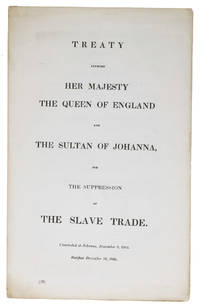
1845ref. ABC_48495Johanna Anjouan 1845. Ca. 32.5 x 20.5 cm. Original paper wrappers. 5 1 blank pp. Historically important treaty between Queen Victoria of the United Kingdom of Great Britain and Ireland 1819-1901 and Sultan Selim dates unknown of Johanna present-day Anjouan for the suppression of the slave trade. The treaty was concluded in November 1844. The present work is the ratified version from 10 December 1845 signed by Sultan Selim and Christopher Wyvill 1792-1863 captain of the HMS Cleopatra and formation commander of the British Royal Navy in Africa between 1849-1853. The publication is exceptionally rare. We have not been able to find any printed copies anywhere else either in sales records or libraries. The archives of the UK parliament make mention of the treaty but it appears to be otherwise unknown.In the present work the Sultan of Anjouan states that: "There shall be no dealing in slaves in our territory and no slaves shall be imported to be sold in our country". He further allows the British to inspect Anjouan ships and take them to an English port if they are found engaging in slave trade. The present treaty which is of significant historical importance is an excellent example of the measures that were undertaken across the world to stop the slave trade.The leaves are slightly creased and browned around the edges. Otherwise in good condition. AFRICA EUROPE HISTORY LAW PHILOSOPHY & POLITICS Broadsides Ephemera & Pamphlets Law & Politics Slavery Southern Africa UK - United Kingdom unknown
1667ref. ABC_508101667. Ca. 23.5 x 26.5 cm and ca. 20 x 24 cm. With a woodcut decorated initial on each ordinance. Two closely related Dutch Republic broadsides both concerned with the suppression of fraud in the spice trade under the monopoly and protection of the Dutch East India Company. Together they form a vivid legal response to widespread commercial adulteration of imported spices particularly pepper nutmeg and mace reflecting both the economic importance and vulnerability of the Dutch spice trade in the 17th century. Both texts are issued as public ordinances intended for proclamation and posting throughout the provinces and both impose heavy fines and confiscation for violations alongside rewards for informants and penalties distributed between officials and local relief funds.The first proclamation from 16 September 1667 responds to reports of severely compromised pepper entering the Dutch Republic via England explicitly referencing the aftermath of the Great Fire of London. The text describes burnt pepper imported after the disaster which is said to retain only the outward appearance of pepper while being stripped of all quality and even emitting a foul smell. Authorities warn that such material is being mixed with genuine spice and sold fraudulently undermining both consumers and the reputation of the VOC.The second later and more extensive proclamation of 22 November 1669 significantly broadens the scope of earlier regulations. Rather than focusing solely on pepper it addresses systematic adulteration across a wide range of spices including pepper nutmeg mace and powdered spice residues. It describes the importation of dust powder and refuse of spices from abroad which are being reprocessed and mixed with genuine goods or artificially manipulated such as being moistened with water to increase weight and deceive buyers.The margins of both of the ordinances are cut short the first ordinance shows some browning and a minor tear. Otherwise in good condition. unknown
1667ref. ABC_508101667. Ca. 23.5 x 26.5 cm and ca. 20 x 24 cm. With a woodcut decorated initial on each ordinance. Two closely related Dutch Republic broadsides both concerned with the suppression of fraud in the spice trade under the monopoly and protection of the Dutch East India Company. Together they form a vivid legal response to widespread commercial adulteration of imported spices particularly pepper nutmeg and mace reflecting both the economic importance and vulnerability of the Dutch spice trade in the 17th century. Both texts are issued as public ordinances intended for proclamation and posting throughout the provinces and both impose heavy fines and confiscation for violations alongside rewards for informants and penalties distributed between officials and local relief funds.The first proclamation from 16 September 1667 responds to reports of severely compromised pepper entering the Dutch Republic via England explicitly referencing the aftermath of the Great Fire of London. The text describes burnt pepper imported after the disaster which is said to retain only the outward appearance of pepper while being stripped of all quality and even emitting a foul smell. Authorities warn that such material is being mixed with genuine spice and sold fraudulently undermining both consumers and the reputation of the VOC.The second later and more extensive proclamation of 22 November 1669 significantly broadens the scope of earlier regulations. Rather than focusing solely on pepper it addresses systematic adulteration across a wide range of spices including pepper nutmeg mace and powdered spice residues. It describes the importation of dust powder and refuse of spices from abroad which are being reprocessed and mixed with genuine goods or artificially manipulated such as being moistened with water to increase weight and deceive buyers.The margins of both of the ordinances are cut short the first ordinance shows some browning and a minor tear. Otherwise in good condition. BOOK HISTORY & PRINTING LAW PHILOSOPHY & POLITICS LOW COUNTRIES Broadsides Ephemera & Pamphlets Law & Politics Netherlands VOC unknown
1760ref. 0041101760 Sans lieu d'édition [Paris], ni nom d'éditeur [Chaubert et Hérissant], 1760. In-quarto (206 X 265 mm) demi-basane fauve à coins, dos cinq nerfs, pièce de titre chagrin grenat, tranches rouges (reliure de l'époque) ; (1) f. blanc, VIII (dont titre)-336 pages, (1) f. blanc. Pièce de titre renouvelée. Ex-libris ancien collé sur le premier contreplat.
ref. 226806Paris, Desaint, 1769 in-4, 260 pp., xxvj pp., un f. n. ch. d'errata, avec un tableau dépliant hors texte, vélin rigide de remploi, dos à nerfs (reliure de l'époque).
1759ref. 9039A Copenhague, chez les Frères Cl. & Ant. Philibert, 1759-1765. 5 tomes en 3 vol. in-folio, veau, dos orné à nerfs, pièces de titre en maroquin rouge et de tomaison en maroquin vert, tranches rouges (reliure de l'époque).