17.154 resultados
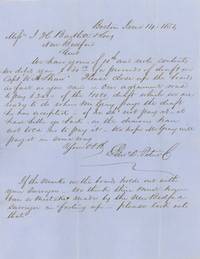
1855ref. List3333Massachusetts New York Maine Pennsylvania and others 1855. Fifty letters with four empty envelopes or covers. Forty-four letters addressed to I.H. Bartlett & Sons: two from the 1830s eight from the 1840s and thirty-four from the 1850s. With five letters addressed to Capt. John C. Blanchard 1838 1839 1844 and 1849 and one to Cumston & Hatch N.d. Overall excellent to Near Fine. Ivory Hovey Bartlett 1794–1871 was a merchant and whale oil seller based in New Bedford Massachusetts. Bartlett moved to New Bedford from Plymouth in 1819 first dealing in grain and later transitioning to general merchandise and whaling.1 Whale oil and spermaceti were widely used in lamps and as lubricant and whalebone baleen was used for structure in items like umbrellas and corsets. In the nineteenth century whaling was the basis of New Bedford’s economy—supporting shipbuilding refineries toolworks and more—making it the wealthiest city in North America at the peak of the industry in the midcentury. Whaling declined in the 1860s with the rise of petroleum which could be both used as a lubricant and distilled into kerosene for lighting. Offered here is a collection of letters mainly to Bartlett’s company I.H. Bartlett & Sons with five to Captain John C. Blanchard of Searsport Maine and one to Cumston & Hatch. The latter is unknown; Blanchard was in the cotton and sugar trades sailing between the US Europe and West Indies. Letters to Bartlett are mainly from other mercantile firms; they pay bills make purchases discuss oil prices and occasionally complain. For instance Robert Robinson of Portland Maine writes: “I have just got 4 Casks of my oil 3 of the last and 1 of the invoice of 30th ult. I cannot understand why my oil should be keep back in this way. Hyde had seven casks by yesterdays Boat the same boat which mine came by it seem’s as if the fates where against this Oil as yesterday boat did not arrive untill late yesterday afternoon and this mornings boat has arrived without the balance there must be something wrong somewhere . I must say I think such neglect should be made known but perhaps it would be better to suffer for fear of the future. I shall not be able to get off any oil untill tomorrow as the oil was not out of the boat untill this morning. it is not thirteen days since that one cask left New Bedford .”. October 13 1852 Most of Bartlett’s customers buy whale oil though beef molasses and coal are also discussed but some are interested in whalebone; as are Wright Bros & Co a Philadelphian umbrella manufacturer who write to complain about market speculation: “The fact appears to us that speculation and the calculation of holders put the price kept it so high that it considerably lessened consumption – so much so of late that some have been disposed to slide it off below New Bedford rates very quietly.” October 23 1852 The letters to all parties are generally all business except for two of the five to John Blanchard: one from his wife Caroline Houston and one from fellow Searsport captain David Nickels Jr. 1823–1888 who writes from Bangor: “I see by to day’s Mercantile gazette that you are in trouble I can sympathize with you God knows I have had a good share of it since I left the land of Gospel light and liberty as the good people say in their prayers I have been in this place fifteen days you doubtless knew I was chartered by Capt Pendleton to go from Leith to Bangor for a cargo of slates and from here to Boston I sailed from Leith on the 27th of November last for this place I got as far as the Orkney Islands on the 30th of November the wind blowing heavy from the westward and having a pilot belonging to the Orkneys on board I concluded to take the harbour of Longhope and lay till a shift of wind or till it moderated . in spite of all our endeavouring we were driven on shore broke the keel out of her filled as high as the lower deck which was on the 3d of December and on the 22d of March we left the Orkney Islands after having been near four months there When I got here I found the man who was to freight the Barque from here to Boston had neglected to place funds in the hands of the slate agent of this place consequently he refuses to put slates on board of the vessel till he receives funds from Boston .”. May 13 1849 Overall a look at the dealings of maritime merchants in the mid-nineteenth century particularly in the critical east coast whaling industry. 1 “Death of a Well-Known Merchant” The Standard-Times February 6 1871 2. unknown
1849ref. 88888Boston: Published by the Family 1849. First Edition. First printing. Octavo. Contemporary full gilt-tooled morocco; all edges gilt; 1462pp; engraved frontispiece portrait Edward Rawson and one portrait plate Rebecca Rawson. Binding rubbed at spine and board edges; small loss to leather at crown; scattered foxing somewhat heavier to frontispiece and portrait else a tight Good or better copy. One modern manuscript leaf with added genealogical information laid in by a previous owner. Early ownership signature "E.D. Baird" to front endpaper. Uncommon first edition in what would appear to be a presentation binding of this detailed genealogy which includes a brief 12-pp biography of Edward Rawson first Secretary of the Massachusetts Bay Colony. An enlarged second edition was issued in 1875. SABIN 68019. Published by the Family unknown
1849ref. 88888Boston: Published by the Family 1849. First Edition. First printing. Octavo. Contemporary full gilt-tooled morocco; all edges gilt; 1462pp; engraved frontispiece portrait Edward Rawson and one portrait plate Rebecca Rawson. Binding rubbed at spine and board edges; small loss to leather at crown; scattered foxing somewhat heavier to frontispiece and portrait else a tight Good or better copy. One modern manuscript leaf with added genealogical information laid in by a previous owner. Early ownership signature "E.D. Baird" to front endpaper. Uncommon first edition in what would appear to be a presentation binding of this detailed genealogy which includes a brief 12-pp biography of Edward Rawson first Secretary of the Massachusetts Bay Colony. An enlarged second edition was issued in 1875. SABIN 68019. Published by the Family unknown books
1855ref. List3333Massachusetts New York Maine Pennsylvania and others 1855. Fifty letters with four empty envelopes or covers. Forty-four letters addressed to I.H. Bartlett & Sons: two from the 1830s eight from the 1840s and thirty-four from the 1850s. With five letters addressed to Capt. John C. Blanchard 1838 1839 1844 and 1849 and one to Cumston & Hatch N.d. Overall excellent to Near Fine. Ivory Hovey Bartlett 1794–1871 was a merchant and whale oil seller based in New Bedford Massachusetts. Bartlett moved to New Bedford from Plymouth in 1819 first dealing in grain and later transitioning to general merchandise and whaling.1 Whale oil and spermaceti were widely used in lamps and as lubricant and whalebone baleen was used for structure in items like umbrellas and corsets. In the nineteenth century whaling was the basis of New Bedford’s economy—supporting shipbuilding refineries toolworks and more—making it the wealthiest city in North America at the peak of the industry in the midcentury. Whaling declined in the 1860s with the rise of petroleum which could be both used as a lubricant and distilled into kerosene for lighting. Offered here is a collection of letters mainly to Bartlett’s company I.H. Bartlett & Sons with five to Captain John C. Blanchard of Searsport Maine and one to Cumston & Hatch. The latter is unknown; Blanchard was in the cotton and sugar trades sailing between the US Europe and West Indies. Letters to Bartlett are mainly from other mercantile firms; they pay bills make purchases discuss oil prices and occasionally complain. For instance Robert Robinson of Portland Maine writes: “I have just got 4 Casks of my oil 3 of the last and 1 of the invoice of 30th ult. I cannot understand why my oil should be keep back in this way. Hyde had seven casks by yesterdays Boat the same boat which mine came by it seem’s as if the fates where against this Oil as yesterday boat did not arrive untill late yesterday afternoon and this mornings boat has arrived without the balance there must be something wrong somewhere . I must say I think such neglect should be made known but perhaps it would be better to suffer for fear of the future. I shall not be able to get off any oil untill tomorrow as the oil was not out of the boat untill this morning. it is not thirteen days since that one cask left New Bedford .”. October 13 1852 Most of Bartlett’s customers buy whale oil though beef molasses and coal are also discussed but some are interested in whalebone; as are Wright Bros & Co a Philadelphian umbrella manufacturer who write to complain about market speculation: “The fact appears to us that speculation and the calculation of holders put the price kept it so high that it considerably lessened consumption – so much so of late that some have been disposed to slide it off below New Bedford rates very quietly.” October 23 1852 The letters to all parties are generally all business except for two of the five to John Blanchard: one from his wife Caroline Houston and one from fellow Searsport captain David Nickels Jr. 1823–1888 who writes from Bangor: “I see by to day’s Mercantile gazette that you are in trouble I can sympathize with you God knows I have had a good share of it since I left the land of Gospel light and liberty as the good people say in their prayers I have been in this place fifteen days you doubtless knew I was chartered by Capt Pendleton to go from Leith to Bangor for a cargo of slates and from here to Boston I sailed from Leith on the 27th of November last for this place I got as far as the Orkney Islands on the 30th of November the wind blowing heavy from the westward and having a pilot belonging to the Orkneys on board I concluded to take the harbour of Longhope and lay till a shift of wind or till it moderated . in spite of all our endeavouring we were driven on shore broke the keel out of her filled as high as the lower deck which was on the 3d of December and on the 22d of March we left the Orkney Islands after having been near four months there When I got here I found the man who was to freight the Barque from here to Boston had neglected to place funds in the hands of the slate agent of this place consequently he refuses to put slates on board of the vessel till he receives funds from Boston .”. May 13 1849 Overall a look at the dealings of maritime merchants in the mid-nineteenth century particularly in the critical east coast whaling industry. 1 “Death of a Well-Known Merchant” The Standard-Times February 6 1871 2. unknown books
ref. 4971Imprimerie J. Biere à Bordeaux, 1933 – in-8 – Broché, rel. cartonnage édit. d'ép.
1748ref. 8019Blois, Chez Philibert-Joseph Masson, 1748. 2 parties en un volume in-12 (165 x 94 mm), frontispice gravée, (4) ff. : titre, Avertissement, Approbation, Privilège du Roy, 388 pp. Reliure basane mouchetée, dos à nerfs orné de fleurons dorés, intérieur en très bel état, tranches rouges mouchetées, roulettes dorées sur coupes (effacées), tache sombre en haut du premier plat, ex-libris manuscrit ancien sur garde. Bon exemplaire.
First edition, small 8vo, xvi, 140, [2]pp., title page frayed at margins, just touching text without loss of any complete letter, title soiled, brown stain to fore-edge of final 10 leaves, disbound.
ref. 207031Nevers, Imprimerie de J.-B. Lefebvre le Jeune, 1793 in-4, 7 pp., en feuilles, traces d'humidité.
1893ref. 171903Z. Takenouchi. 明治 26 1893. Striking black and white wood engraved illustrations 32pp 26.6 x 19.5cm very good copy. This is a fascinating catalogue of Takenouchi Safes from 1893 with detailed illustrations specifications and prices. Takenouchi was the first safe manufacturer in Japan and the business was very successful numbering the Royal Household and major companies amongst their clients. The idea of the business started soon after Yokohama was opened as a trading port. The founder's father an iron monger was asked to repair a British businessman's safe after it was damaged by fire. He learned how effective the safe was in protecting its contents from the fire. Since fires were frequent and hazardous in Japan his son Zenjiro Takenouchi founded the business to produce fireproof safes in Japan. The company obtained numerous patents and had the reputation for safes that were extremely robust and difficult to break-in. This reputation still survives today. The catalogue includes beautiful engravings of the company's shopfront factory and trademarks and of numerous versions of its safes. These show the thick steel doors which were elegantly decorated with distinctively Japanese designs including images of pine trees. The inner drawers of the safes were made of paulonia wood which protects the contents from humidity. The brochure gives specifications and prices weighing scales also illustrated details of the effectiveness of safes letters of appreciation from clients who managed to rescue their valuables from fire hazards and a list of businesses who used their safes. The clients included Mitsui Trading Company branches in China and India and Kanematsu in Sydney. . Z. Takenouchi. unknown
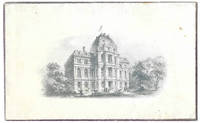
1865ref. 10246Boston: the hotel 1865. Menu printed on silk 30 x 10.5 cm. one leaf printed verso only. Illustrated with an engraving of vignettes of freight transport via ship and train. WITH: Printed envelope 8 x 13 cm. with an engraving. A handsome menu printed on silk for a banquet celebrating the Boards of Trade of the Western Cities given by the City of Boston at the Revere Hotel. Revere House was one of the city's leading hotels hosting guests that included Charles Dickens Jenny Lind and Walt Whitman. Daniel Webster addressed audience from the steps of the portico. The engraving on the envelope depicts the hotel from across Boston's Bowdoin Square. The hotel has had an additional structure added to the previously flat roof. The bill of fare for the Western Boards of Trade included Green Turtle Soup Baked Shad in a Wine Sauce Leg of Southshore Mutton in Caper Sauce Duffield's Ham Pate de Foie and much more. In remarkably fine condition with only the slightest fraying to the edges of the silk. The envelope with an engraving of the Boston's City Hall has some light soil but is near fine. the hotel hardcover
1865ref. 10246Boston: the hotel 1865. Menu printed on silk 30 x 10.5 cm. one leaf printed verso only. Illustrated with an engraving of vignettes of freight transport via ship and train. WITH: Printed envelope 8 x 13 cm. with an engraving. A handsome menu printed on silk for a banquet celebrating the Boards of Trade of the Western Cities given by the City of Boston at the Revere Hotel. Revere House was one of the city's leading hotels hosting guests that included Charles Dickens Jenny Lind and Walt Whitman. Daniel Webster addressed audience from the steps of the portico. The engraving on the envelope depicts the hotel from across Boston's Bowdoin Square. The hotel has had an additional structure added to the previously flat roof. The bill of fare for the Western Boards of Trade included Green Turtle Soup Baked Shad in a Wine Sauce Leg of Southshore Mutton in Caper Sauce Duffield's Ham Pate de Foie and much more. In remarkably fine condition with only the slightest fraying to the edges of the silk. The envelope with an engraving of the Boston's City Hall has some light soil but is near fine. the hotel hardcover books
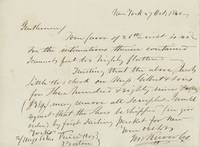
1849ref. List3334New York City 1849. Eight letters. Overall excellent. A small collection of letters to Boston-based grocers Silas Pierce & Co. sent from New York by steamboat with notes on covers or stamps reading “Boat Mail” or “Steam Boat Mail”. Five of the letters are from Wyckoff & Scrymser which was likely owned by a member or members of the prominent New York Wyckoff family the Scrymser surname first appears in the Wyckoff family history in 18411. Wyckoff & Scrimser discuss sweet and red wine prices “opperations in Trent” likely Trento Italy delayed shipments and issues with products; for instance: “The Harmony has not yet made her appearance neither the Aselia the non arrival of the latter is very perplexing but we see no remedy for it. . Annexed please find the sales of the Raisins amount Nett proceeds to your Co Nine Thousand One Hundred Seventy Four 06/100 Dollars which we hope may be found correct and satisfactory. There were a number of the parcels that were sold from the wharf but rejected which we were obliged to and store that the objections might not be known &c. The half boxes . did not have any external appearance of damage and could onky be known by opening. We rather congratulated ourselves that we have got off so well with this fruit as we had strong fears of the result.” December 29 1843 Also discussing business with Italy is a letter from Wm. A Lüs on behalf of Ferd. Baller & Co. of Messina which traded in citrus fruit: “The principal object of my friends is to introduce their Brand favorably into your market & their efforts to do this will alone be sufficient to secure you a superior article of fruit & other Goods; . they are also in the position of obtaining any other Sicilian produce at the most advantageous terms while at Messina or Palermo through their agent there.” August 30 1849 Demand for citrus products was high as it had been discovered late in the 18th century that citrus prevented and cured scurvy. Demand was so great in fact that some researchers partly credit the citrus trade with creating the Sicilian mafia.2 A letter from the Bank of Commerce in New York discusses credit and lastly Joseph Knowles possibly of the Massachusetts-based Thomas Knowles & Company sends an intriguing note: “Your favor of the 26th inst is rec’d For the intimations therein contained I cannot feel too highly flattered — Trusting that the above Jacob Little Co’s check on Messrs Gilbert & Sons for Three hundred eighty nine dollars $389 may remove all scruples – I would request that the shoes be shipped in good order by first sailing packet for New York”. October 27 1840 This is plausibly related to the investor and stock speculator Jacob Little 1794–1865 known for his short-selling tactics and generally considered as Knowles suggests unscrupulous.3 Of interest to researchers of mercantile history in the northeast and steamboat mail. 1 Mr. and Mrs. M. B. Streeter Eds. The Wyckoff Family in America: A Genealogy The Tuttle Company 1934: 310. 2 Arcangelo Dimico Alessia Isopi and Ola Olsson “Origins of the Sicilian Mafia: The Market for Lemons” The Journal of Economic History 77 no. 4 December 2017: 1083–1115. 3 “The Convertible Bonds: How Jacob Little Manipulated Matters Years Ago” The New York Times February 23 1882. unknown
1849ref. List3334New York City 1849. Eight letters. Overall excellent. A small collection of letters to Boston-based grocers Silas Pierce & Co. sent from New York by steamboat with notes on covers or stamps reading “Boat Mail” or “Steam Boat Mail”. Five of the letters are from Wyckoff & Scrymser which was likely owned by a member or members of the prominent New York Wyckoff family the Scrymser surname first appears in the Wyckoff family history in 18411. Wyckoff & Scrimser discuss sweet and red wine prices “opperations in Trent” likely Trento Italy delayed shipments and issues with products; for instance: “The Harmony has not yet made her appearance neither the Aselia the non arrival of the latter is very perplexing but we see no remedy for it. . Annexed please find the sales of the Raisins amount Nett proceeds to your Co Nine Thousand One Hundred Seventy Four 06/100 Dollars which we hope may be found correct and satisfactory. There were a number of the parcels that were sold from the wharf but rejected which we were obliged to and store that the objections might not be known &c. The half boxes . did not have any external appearance of damage and could onky be known by opening. We rather congratulated ourselves that we have got off so well with this fruit as we had strong fears of the result.” December 29 1843 Also discussing business with Italy is a letter from Wm. A Lüs on behalf of Ferd. Baller & Co. of Messina which traded in citrus fruit: “The principal object of my friends is to introduce their Brand favorably into your market & their efforts to do this will alone be sufficient to secure you a superior article of fruit & other Goods; . they are also in the position of obtaining any other Sicilian produce at the most advantageous terms while at Messina or Palermo through their agent there.” August 30 1849 Demand for citrus products was high as it had been discovered late in the 18th century that citrus prevented and cured scurvy. Demand was so great in fact that some researchers partly credit the citrus trade with creating the Sicilian mafia.2 A letter from the Bank of Commerce in New York discusses credit and lastly Joseph Knowles possibly of the Massachusetts-based Thomas Knowles & Company sends an intriguing note: “Your favor of the 26th inst is rec’d For the intimations therein contained I cannot feel too highly flattered — Trusting that the above Jacob Little Co’s check on Messrs Gilbert & Sons for Three hundred eighty nine dollars $389 may remove all scruples – I would request that the shoes be shipped in good order by first sailing packet for New York”. October 27 1840 This is plausibly related to the investor and stock speculator Jacob Little 1794–1865 known for his short-selling tactics and generally considered as Knowles suggests unscrupulous.3 Of interest to researchers of mercantile history in the northeast and steamboat mail. 1 Mr. and Mrs. M. B. Streeter Eds. The Wyckoff Family in America: A Genealogy The Tuttle Company 1934: 310. 2 Arcangelo Dimico Alessia Isopi and Ola Olsson “Origins of the Sicilian Mafia: The Market for Lemons” The Journal of Economic History 77 no. 4 December 2017: 1083–1115. 3 “The Convertible Bonds: How Jacob Little Manipulated Matters Years Ago” The New York Times February 23 1882. unknown books
1940ref. 33897N.P.: Privately Printed ca. 1940. 1940. ARIZONA. 8 12 '" x 9" pages with text black and white and color photographs of points of interest folded twice to 9" x 4." Pictographic map annual climate accommodations etc. Attractive bright copy. Privately Printed, [ca. 1940]. unknown
1828ref. 5231Guanajuato: Imprenta del Supremo Gobierno a Cargo del C.J.M. Caranco 1828. Good plus. 229pp. plus folding chart. Disbound. Minor foxing and wear. Apparently unrecorded pamphlet that publishes an early statistical and narrative account of the economical and governmental situation in early Guanajuato. The work was printed four years after the adoption of the federal constitution and the organization of the Mexican states. It furnishes an account of agriculture industry government and haciendas and well as statistics on population and economic production. With one folding chart that depicts rural hacienda and ranch production; an interesting snapshot of the early economic life of the central Mexican state. Not in OCLC. Imprenta del Supremo Gobierno a Cargo del C.J.M. Caranco unknown
1817ref. 5224Veracruz 1817. Good plus. 230pp. plus folding plate. Disbound. Light staining from removed wrappers. Later ownership inscription at foot of title page. Trimmed close affecting initial page numbers. Light dampstaining and tanning internally. An interesting contemporary tract concerning the fall off in agricultural industrial and mineral production in New Spain during the War for Independence. The author José Maria Quiros was a bureaucrat at the Spanish colonial consulate in Veracruz and is therefore particularly attentive to shipping and exports. A folding chart at the rear prints annual production numbers for products and materials in each of the three categories. A handful of copies in OCLC. unknown
1844ref. 5316Puebla: Imprenta Antigua en el Portal de las Flores 1844. About very good. 20pp. Original printed wrappers. Light dampstaining and spotting. Even toning. Scarce pamphlet containing rules and regulations for the tribunal that adjudicated commercial and trade disputes in Puebla just prior to the Mexican-American War. The texts articulates the jurisdiction and power of the court its form and function and the responsibilities of its officers and appointees. In attractive printed yellow wrappers; OCLC records this imprint but notes no locations. Imprenta Antigua en el Portal de las Flores unknown
1828ref. 5231Guanajuato: Imprenta del Supremo Gobierno a Cargo del C.J.M. Caranco 1828. Good plus. 229pp. plus folding chart. Disbound. Minor foxing and wear. Apparently unrecorded pamphlet that publishes an early statistical and narrative account of the economical and governmental situation in early Guanajuato. The work was printed four years after the adoption of the federal constitution and the organization of the Mexican states. It furnishes an account of agriculture industry government and haciendas and well as statistics on population and economic production. With one folding chart that depicts rural hacienda and ranch production; an interesting snapshot of the early economic life of the central Mexican state. Not in OCLC. Imprenta del Supremo Gobierno a Cargo del C.J.M. Caranco unknown books
1817ref. 5224Veracruz 1817. Good plus. 230pp. plus folding plate. Disbound. Light staining from removed wrappers. Later ownership inscription at foot of title page. Trimmed close affecting initial page numbers. Light dampstaining and tanning internally. An interesting contemporary tract concerning the fall off in agricultural industrial and mineral production in New Spain during the War for Independence. The author José Maria Quiros was a bureaucrat at the Spanish colonial consulate in Veracruz and is therefore particularly attentive to shipping and exports. A folding chart at the rear prints annual production numbers for products and materials in each of the three categories. A handful of copies in OCLC. unknown books
1844ref. 5316Puebla: Imprenta Antigua en el Portal de las Flores 1844. About very good. 20pp. Original printed wrappers. Light dampstaining and spotting. Even toning. Scarce pamphlet containing rules and regulations for the tribunal that adjudicated commercial and trade disputes in Puebla just prior to the Mexican-American War. The texts articulates the jurisdiction and power of the court its form and function and the responsibilities of its officers and appointees. In attractive printed yellow wrappers; OCLC records this imprint but notes no locations. Imprenta Antigua en el Portal de las Flores unknown books
1954ref. 022125Mobile Alabama: The Merchants National Bank of Mobile. 30pgs including wraps. A scarce promotional pamphlet with lost of dat and some 1950 era historic photos of Mobile. Size: Thin 4to - over 9¾" - 12" Tall . VG Minus. Pictorial Wrappers. circa 1954/content. 1954. The Merchants National Bank of Mobile unknown
1920ref. 362949Tokyo: Gaimusho tsushokyoku daisanka 1920. First Edition. A bilingual pamphlet detailing the origins of and the official Japanese response to the 1913 Alien Land Law passed in California. The law prohibited foreigners who were not eligible to obtain citizenship from purchasing land or entering into leases longer than three years. It applied almost entirely to Asian immigrants who were barred from becoming naturalized American citizens. This book opens with a brief introduction and the text of the California law followed by the texts of the official protests made by the Japanese government to officials in Washington DC along with the American diplomatic responses. The Japanese protests are refreshingly narrative and detailed rather than legalistic in style. Among the American respondents is William Jennings Bryan acting in his official capacity as Secretary of State in the Woodrow Wilson administration. 18 2 58 1 English 79 Japanese pages. OCLC: 835810960 Waseda; 840108220 National Diet Library 44716908 Trinity College. NB: 4216338 has the same title but only 28 pages. First edition first printing. Covers foxed and spotted spine ends a bit chipped else very good. Gaimusho tsushokyoku daisanka unknown
1920ref. 362512Tokyo: Gaimusho tsushokyoku daisanka 1920. First Edition. A bilingual pamphlet detailing the origins of and the official Japanese response to the 1913 Alien Land Law passed in California. The law prohibited foreigners who were not eligible to obtain citizenship from purchasing land or entering into leases longer than three years. It applied almost entirely to Asian immigrants who were barred from becoming naturalized American citizens. This book opens with a brief introduction and the text of the California law and is followed by the texts of the official protests made by the Japanese government to officials in Washington DC along with the American diplomatic responses. The Japanese protests are refreshingly narrative rather than legalistic in style. Among the American respondents is William Jennings Bryan acting in his official capacity as Secretary of State in the Woodrow Wilson administration. 18 2 58 1 English 79 Japanese pages. OCLC: 835810960 Waseda; 840108220 National Diet Library. No US holdings. First edition first printing. Covers foxed and spotted spine ends a bit chipped else very good. Gaimusho tsushokyoku daisanka unknown
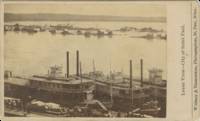
1870ref. List3896St. Paul Minnesota 1870. Carte de visite measuring 2 ½ x 4 inches captioned "Levee View-City of Saint Paul. / Whitney & Zimmeram Photographers St. Paul Minn. Excellent. A carte de visite photograph of steamboats on the levee in St. Paul Minnesota on the Mississippi River. By the time of Minnesota statehood in 1858 its Upper and Lower Levees together were one of the busiest ports in the country though activity was slowed by the 1862 Dakota War.1 The photograph is attributed to Whitney & Zimmerman. Joel E. Whitney 1822-d. born in Maine was the first photographer in St. Paul known for his portraits of Minnesota volunteers in the Civil War and of Indigenous Minnesotans.2 Charles A. Zimmerman 1844-1909 was a French-born photographer who immigrated to the US in 1848. The two worked as partners in the 1860s and 1870s and are together best known for their series of views of Minnehaha Falls.3 1 Joe Lepsche "The Upper Levee: Memories of Its People And Its Place in St. Paul History" Ramsey County History 33 no. 1 Spring 1998:18-21. 2 "Joel Emmons Whitney" The Autry Museum of the American West accessed May 28 2026 https://collections.theautry.org/mwebcgi/mweb.exerequest=record;id=PE65213;type=701. 3 "Charles A. Zimmerman" Smithsonian American Art Museum accessed May 28 2026 https://americanart.si.edu/artist/charles-zimmerman-7133. unknown
1870ref. List3887654359St. Paul Minnesota 1870. Carte de visite measuring 2 ½ x 4 inches captioned "Levee View-City of Saint Paul. / Whitney & Zimmeram Photographers St. Paul Minn. Excellent. A carte de visite photograph of steamboats on the levee in St. Paul Minnesota on the Mississippi River. By the time of Minnesota statehood in 1858 its Upper and Lower Levees together were one of the busiest ports in the country though activity was slowed by the 1862 Dakota War.1 The photograph is attributed to Whitney & Zimmerman. Joel E. Whitney 1822-d. born in Maine was the first photographer in St. Paul known for his portraits of Minnesota volunteers in the Civil War and of Indigenous Minnesotans.2 Charles A. Zimmerman 1844-1909 was a French-born photographer who immigrated to the US in 1848. The two worked as partners in the 1860s and 1870s and are together best known for their series of views of Minnehaha Falls.3 1 Joe Lepsche "The Upper Levee: Memories of Its People And Its Place in St. Paul History" Ramsey County History 33 no. 1 Spring 1998:18-21. 2 "Joel Emmons Whitney" The Autry Museum of the American West accessed May 28 2026 https://collections.theautry.org/mwebcgi/mweb.exerequest=record;id=PE65213;type=701. 3 "Charles A. Zimmerman" Smithsonian American Art Museum accessed May 28 2026 https://americanart.si.edu/artist/charles-zimmerman-7133. unknown