15.771 resultados
ref. 1219s.l.: s.n. . . 8vo side-stitched; age-darkened and chipped; uncut and unopened; bottom lower right of all leaves dog-eared not affecting text. Sabin 105462Ñnot differentiating between this 14 pp. printing and one with 8 pp. The American Antiquarian Society's copy of the 14 pp. edition has a contemporary ownership signature dated 12 June 1810" on title. A Federalist pamphlet in the Massachusetts gubernatorial campaign of 1810 s.l.: s.n., . unknown books
ref. 3267Marseille, Imprimerie Samat et Cie, 1906. 1 volume in-4, 341 pp., très nombreuses illustrations photographiques en noir et blanc, 3 cartes dépliantes in fine, reliure toile d'éditeur, coiffes émoussées, petit accroc sur le dos, intérieur en bon état.
1830ref. 843271830 Paris, Imprimerie de Selligue, 1830, plaquette in 8° brochée, 76 pages ; couverture bleue imprimée de parution.
ref. 34359Marseille, Imprimerie Marseillaise, 1911, in 12 broché, couverture cartonnée, 265 pages ; nombreuses publicités sur papier rose, en début et fin d'ouvrage ; couvetrure légèrement fanée. RARE.
Second Edition, 4to, half-title, [4], 30, [2] pp., signed on p. 27: John Anstie, with a final leaf containing a resolution of the Wool Meeting at the Crown and Anchor, March 17, 1788, stitched as issued. Although John Anstie wrote several pamphlets about the wool trade there does not seem to be a first edition of this work.
ref. 6184Registre de la maison Louis Comandon Cognac Kakena, copies de lettres du 8 novembre 1888 au 24 février 1889. grand in quarto : 500 feuillets et 82 pp. de répertoire, 1/2 rel. verte d'ép. Pièce de titre rouge, belle vignette illustrée noir et or sur le premier plat.
ref. 6185Registre de la maison Louis Comandon Cognac Kakena, copies de lettres du 25 février 1889 au 29 juillet 1889. grand in quarto : 500 feuillets et 82 pp. de répertoire, 1/2 rel. verte d'ép. Pièce de titre rouge, belle vignette illustrée noir et or sur le premier plat.
ref. 6186Registre de la maison Louis Comandon Cognac Kakena, copies de lettres du 21 mai 1890 au 17 novembre 1890. grand in quarto : 497 feuillets et 82 pp. de répertoire, 1/2 rel. verte d'ép. Pièce de titre rouge, belle vignette noir et or sur le premier plat.
ref. 6187Registre de la maison Louis Comandon Cognac Kakena, copies de lettres du 21 novembre au 28 février 1891. grand in quarto : 496 feuillets et 82 pp. de répertoire, 1/2 rel. verte d'ép. Pièce de titre rouge, belle vignette noir et or sur le premier plat.
ref. 6188Registre de la maison Louis Comandon Cognac Kakena, copies de lettres du 25 mars 1891 au 15 août 1891. grand in quarto : 502 feuillets et 82 pp. de répertoire, 1/2 rel. verte d'ép. Pièce de titre rouge, belle vignette illustrée noir et or sur le premier plat.
ref. 6189Registre de la maison Louis Comandon Cognac Kakena, copies de lettres du 11 juillet 1893 au 1er mars 1894. grand in quarto : 500 feuillets et 82 pp. de répertoire, 1/2 rel. verte d'ép. Pièce de titre rouge, belle vignette noir et or sur le premier plat.
ref. 6190Registre de la maison Louis Comandon Cognac Kakena, copies de lettres du 3 mars 1894 au 19 octobre 1894. grand in quarto : 491 feuillets, 1/2 rel.
ref. 111438Paris, Imprimerie Royale, 1782 in-4, 6 pp.
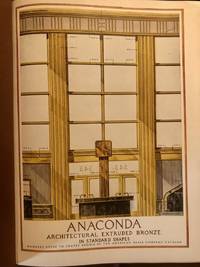
1937ref. 3439Waterbury Connecticut: The American Brass Company 1937. Second Edition. Hardcover. Very Good. 4to. Pp. 8 404 plates followed by several pages of index referring to plate numbers. Illustrated title page. Plates depict the fixtures in silhouette. Bound in light brown cloth with stamped lettering on front cover and spine. Light wear commensurate with age and the address label of a former owner on a few pages and notably on front cover where a remnant presumably remains. Included is an 8pp. paper wraps "Supplement to Anaconda Architectural Extruded Shapes saddle-stapled dated 1947. An impressive variety of brass flourishes presented at the ahem height of the American skyscraper as the defining characteristic of the modern city. Flutings entablatures dado moldings doors cornices pilasters mullions and a multitude of other fixtures are featured. The American Brass Company hardcover
1909ref. Q2425New York: Apollo Studios 1909. Paperback. Near fine. A simple easily acquired and inexpensive means of manual training at home--for adults and children." Staplebound 27pp. 8.5 x 3.75 inches. Light toning else Near Fine. Replete with illustrations of beautiful Arts & Crafts style home goods that could be fashioned by an unskilled child or adult using the Metalography kits and item-specific patterns and stencils for metal chasing/repoussage an ancient technique that enjoyed renewed enthusiasm during the Arts & Crafts Movement. The projects advertised here include kits for building basic objects like trays and tins; piercing work is also incorporated into some designs. Quintessential "Arts & Crafts" in multiple regards the text on the cover ties in the interest in manual training characteristic of Progressive Era education. A contemporary of Tiffany & Co. the Apollo Studios grew out of New York firm Bernard Rice's Sons. They made picture frames vanity and desk sets and similar items often featuring intricate cutwork. Possibly the earliest Apollo Studios promotional booklet noting "patent pending" one was issued by the end of 1909. There do not appear to be any Apollo Studios publications in OCLC. Apollo Studios paperback
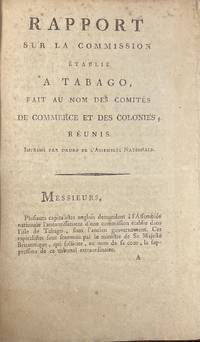
1791ref. 3649Paris: Imprimerie Nationale 1791. First edition. Bound in later hardpaper boards covered with pastepaper spine with red gilt leather title vignette. Untrimmed. Paper tanned. Otherwise in very good condition. First edition. Bound in later hardpaper boards covered with pastepaper spine with red gilt leather title vignette. 18 2 blank p. Official report on the 1786 “Commission de Tabago” an extraordinary tribunal established to examine debts between British creditors and settlers after the French conquest of the island. First edition of the National Assembly’s official report on the controversial “Commission de Tabago” an extraordinary tribunal established in 1786 under the ancien régime to review debts between British capitalists and settlers after the French conquest of Tobago. The report reconstructs the background of the island’s transfer: originally ceded to Britain in 1763 Tobago had been largely settled and financed by British investors who lent capital for the development of sugar estates secured by mortgages. Following the French conquest 1781 and definitive cession Treaty of Paris 1783 the treaty guaranteed the inhabitants’ property rights under English law. Nevertheless in 1786 the Conseil du Roi created a special commission at Tobago to investigate alleged usury and excessive interest rates in these mortgage contracts. The commission—presided by the governor and ordonnateur—confiscated titles annulled or reduced debts and declared most English claims void provoking losses estimated at over 13 million livres. This Rapport examines the legality of the tribunal under both French and English law concluding that it was arbitrary unconstitutional and in violation of the 1783 peace treaty. The committees show that English statutes were misquoted that the island’s existing courts Common Pleas and Chancery already had proper jurisdiction and that no disputes existed before the commission was imposed. The report also denounces the suppression of trial by jury and the disregard of due process. It recommends—and the Assembly accepted—that the entire commission and its judgments be annulled thereby restoring lawful jurisdiction in the colony. The episode marked one of the last acts of French administration on Tobago which was recaptured by Britain in April 1793 returned to France in 1802 under the Treaty of Amiens and formally surrendered under the Treaty of Paris in 1814. An important Revolutionary document reflecting early attempts to reconcile French constitutional principles with colonial administration and international treaty obligations. Not in Sabin. No records on RBH. WorldCat locates 6 copies. . [Imprimerie Nationale] unknown
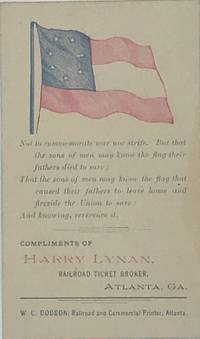
1885ref. 65930Atlanta GA: W.C. Dodson Railroad and Commercial Printer 1885. Trade card 2 ¾ x 4 ¾ inches recto printed entirely in blue; verso prints the first National Flag of the Confederacy with verse "Compliments" of Lynan in part: "that the sons of men may know the flag that caused their fathers to leave home and fireside the Union to save." OCLC locates but three items printed by Dodson. Very good. W.C. Dodson, Railroad and Commercial Printer) unknown
1885ref. 65930Atlanta GA: W.C. Dodson Railroad and Commercial Printer 1885. Trade card 2 ¾ x 4 ¾ inches recto printed entirely in blue; verso prints the first National Flag of the Confederacy with verse "Compliments" of Lynan in part: "that the sons of men may know the flag that caused their fathers to leave home and fireside the Union to save." OCLC locates but three items printed by Dodson. Very good. W.C. Dodson, Railroad and Commercial Printer) unknown books
1833ref. 34458v.p. including Antwerp London Havana Pensacola New York 1833. Folio. 12 3/4 x 8 inches. 21 leaves plus two additional manuscript leaves laid in. Contemporary half calf and marbled boards manuscript label on front board. Bookseller's label on front pastedown. Account book of Atlantic trading voyages. An interesting manuscript ship's log containing financial accounts for the brigs Nimrod and Jasper for an eight year period from 1826 to 1833 while they were under the command of a Captain John Hill. The two ships made numerous voyages between the United States Europe and the Caribbean. The present log book contains line accounts of expenditures for journeys from London and Marseilles to New York and Norfolk in 1827; from Antwerp to London in 1828; from Philadelphia to the West Indies in 1829; from Madeira to the Turks Islands in 1831; from the West Indies to Pensacola to Havana in 1832; from the Indies to New York in 1833; and other similar voyages. The log also contains two copies of an 1832 letter written in Havana by Hill to merchants there inquiring about the price of molasses and a list of port charges at several major way points. A fascinating artifact of trans-Atlantic trade in the 1820s and 1830s. unknown
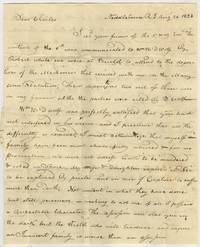
1823ref. BK0184Middletown Rhode Island 1823. Autograph letter signed three pages on a folded sheet with integral address panel to Charles E. Dudley in Albany and Newport postal markings. 7 ¾ x 9 ¾ inches. Old folds scattered staining and some marginal losses a few affecting text. Good to very good. A letter from Newport mariner John Wood concerning his acrimonious departure from the DeWolf family's Mary Ann plantation in Cuba and the ensuing legal dispute with James DeWolf and Charles Collins. Wood was almost certainly the same John Wood whose signature appears on an 1806 Newport agreement for an illegal voyage transporting enslaved Africans from Cape Coast to Havana now held by the Smithsonian's National Museum of African American History and Culture.1 By 1823 he was residing on the Mary Ann plantation one of several Cuban estates belonging to the DeWolfs among the most prominent families involved in the American slave trade. His relationship with DeWolf and Collins had evidently collapsed over his obligations on the estate resulting in what he describes as his forced departure from Cuba under apparently dangerous conditions with his family and a contentious effort to settle their accounts. Writing to his friend Charles E. Dudley then mayor of Albany and a New York state senator Wood reports that three mechanics who had resided with him on the plantation had recently given depositions in Bristol Rhode Island. Two of the three had testified in his favor though all had been called by DeWolf. Wood was particularly incensed by the circumstances surrounding his family's departure from Cuba writing: "I must acknowledge that myself & family have been most shamefully abused & for no provocation we were set adrift liable to be murdered & robbed on Shore My Wife & Daughter exposed at Sea to be captured By pirates and in case of Capture to suffer more than Death; Not content in what they have done but still persevere in wishing to rob me of all I possess a Respectable Character. The assassin will stab you in the dark but the Wretch who will traduce and injure an Innocent family is worse than an assassin." Wood goes on to describe receiving two writs from DeWolf and Collins and transcribes an August 8 letter from James DeWolf explaining his decision to pursue legal action despite their previous discussions of an amicable settlement: "Lest you should think me inconsistent in causing an action to be brought after the last conversation we had I take leave to explain my wishes to come to an amicable settlement by referring to men as we talked remains the same my object is to put the business in a legal and proper train for bringing it to a close . & to enable me to avail of the testimony of the people who were on the Estate with you." Wood expected the Rhode Island Supreme Court meeting at Bristol the following month to appoint referees to settle the accounts. The precise origin of the disagreement is not stated though the depositions of the mechanics and the references to outstanding accounts suggest a dispute over Wood's contractual obligations or activities on the plantation. Wood 1770-1826 was a Newport merchant and captain with longstanding connections to Atlantic commerce. He died at Cape Coast West Africa in 1826 three years after writing the present letter. James DeWolf 1764-1837 then serving in the United States Senate had amassed a substantial fortune through the slave trade and his Cuban plantation interests. Charles Collins his brother-in-law had served as collector of customs at Bristol from 1804 to 1820 an appointment closely connected to the family's slave-trading operations. The Mary Ann plantation is documented in the DeWolf Papers at the Rhode Island Historical Society which include inventories from 1818 and 1820 and contemporary plans of the plantation grounds. The present letter preserves Wood's account of his treatment by the DeWolf family together with his transcription of DeWolf's explanation for pursuing legal action. 1 "Agreement facilitating illegal trade of enslaved Africans" National Museum of African American History & Culture accessed October 12 2026 https://nmaahc.si.edu/object/nmaahc_2019.28.1. . unknown
1823ref. BK0184Middletown Rhode Island 1823. Autograph letter signed three pages on a folded sheet with integral address panel to Charles E. Dudley in Albany and Newport postal markings. 7 ¾ x 9 ¾ inches. Old folds scattered staining and some marginal losses a few affecting text. Good to very good. A letter from Newport mariner John Wood concerning his acrimonious departure from the DeWolf family's Mary Ann plantation in Cuba and the ensuing legal dispute with James DeWolf and Charles Collins. Wood was almost certainly the same John Wood whose signature appears on an 1806 Newport agreement for an illegal voyage transporting enslaved Africans from Cape Coast to Havana now held by the Smithsonian's National Museum of African American History and Culture.1 By 1823 he was residing on the Mary Ann plantation one of several Cuban estates belonging to the DeWolfs among the most prominent families involved in the American slave trade. His relationship with DeWolf and Collins had evidently collapsed over his obligations on the estate resulting in what he describes as his forced departure from Cuba under apparently dangerous conditions with his family and a contentious effort to settle their accounts. Writing to his friend Charles E. Dudley then mayor of Albany and a New York state senator Wood reports that three mechanics who had resided with him on the plantation had recently given depositions in Bristol Rhode Island. Two of the three had testified in his favor though all had been called by DeWolf. Wood was particularly incensed by the circumstances surrounding his family's departure from Cuba writing: "I must acknowledge that myself & family have been most shamefully abused & for no provocation we were set adrift liable to be murdered & robbed on Shore My Wife & Daughter exposed at Sea to be captured By pirates and in case of Capture to suffer more than Death; Not content in what they have done but still persevere in wishing to rob me of all I possess a Respectable Character. The assassin will stab you in the dark but the Wretch who will traduce and injure an Innocent family is worse than an assassin." Wood goes on to describe receiving two writs from DeWolf and Collins and transcribes an August 8 letter from James DeWolf explaining his decision to pursue legal action despite their previous discussions of an amicable settlement: "Lest you should think me inconsistent in causing an action to be brought after the last conversation we had I take leave to explain my wishes to come to an amicable settlement by referring to men as we talked remains the same my object is to put the business in a legal and proper train for bringing it to a close . & to enable me to avail of the testimony of the people who were on the Estate with you." Wood expected the Rhode Island Supreme Court meeting at Bristol the following month to appoint referees to settle the accounts. The precise origin of the disagreement is not stated though the depositions of the mechanics and the references to outstanding accounts suggest a dispute over Wood's contractual obligations or activities on the plantation. Wood 1770-1826 was a Newport merchant and captain with longstanding connections to Atlantic commerce. He died at Cape Coast West Africa in 1826 three years after writing the present letter. James DeWolf 1764-1837 then serving in the United States Senate had amassed a substantial fortune through the slave trade and his Cuban plantation interests. Charles Collins his brother-in-law had served as collector of customs at Bristol from 1804 to 1820 an appointment closely connected to the family's slave-trading operations. The Mary Ann plantation is documented in the DeWolf Papers at the Rhode Island Historical Society which include inventories from 1818 and 1820 and contemporary plans of the plantation grounds. The present letter preserves Wood's account of his treatment by the DeWolf family together with his transcription of DeWolf's explanation for pursuing legal action. 1 "Agreement facilitating illegal trade of enslaved Africans" National Museum of African American History & Culture accessed October 12 2026 https://nmaahc.si.edu/object/nmaahc_2019.28.1. . unknown books
1833ref. 34458v.p. including Antwerp London Havana Pensacola New York 1833. Folio. 12 3/4 x 8 inches. 21 leaves plus two additional manuscript leaves laid in. Contemporary half calf and marbled boards manuscript label on front board. Bookseller's label on front pastedown. Account book of Atlantic trading voyages. An interesting manuscript ship's log containing financial accounts for the brigs Nimrod and Jasper for an eight year period from 1826 to 1833 while they were under the command of a Captain John Hill. The two ships made numerous voyages between the United States Europe and the Caribbean. The present log book contains line accounts of expenditures for journeys from London and Marseilles to New York and Norfolk in 1827; from Antwerp to London in 1828; from Philadelphia to the West Indies in 1829; from Madeira to the Turks Islands in 1831; from the West Indies to Pensacola to Havana in 1832; from the Indies to New York in 1833; and other similar voyages. The log also contains two copies of an 1832 letter written in Havana by Hill to merchants there inquiring about the price of molasses and a list of port charges at several major way points. A fascinating artifact of trans-Atlantic trade in the 1820s and 1830s. unknown books
1954ref. 016005Sceaux Chez Jean-Jacques Pauvert 1954 In-12 Broché Ed. originale
1900ref. 26434Liebig Company 1900. Very good condition. Set of six beautifully colored lithographic trade cards of Australia including a kangaroo image issued by the Liebig company with the text in Italian. The set is titled "In Australia". The Italian set is identical to the French edition but more uncommon. One of the most graphic sets produced by this European company which enjoyed an international market in the late 19th and early 20th century. Pictured are indigenous peoples a kangaroo and an emu natural scenery and an exotic plant; farming and ranching and seaport scenes. Liebig Company unknown
1900ref. 26433Liebig Company 1900. Very good condition. Set of six beautifully colored lithographic trade cards of Australia including a kangaroo image issued by the Liebig company with the text in French. The set is titled "L'Australie". One of the most graphic sets produced by this European company which enjoyed an international market in the late 19th and early 20th century. Pictured are indigenous peoples a kangaroo and an emu natural scenery and an exotic plant; farming and ranching and seaport scenes. Liebig Company unknown