14.674 resultados
1951ref. 014789Paris Editions Jeanne Bucher 1951 En feuilles, couverture rempliée illustrée Dédicacé par l'illustrateur
Madrid, Edit. Cuadernos para el Diálogo, 1967. 251 p. 8º. Rústica editorial ilustrada. Muy buen ejemplar.
1961ref. 2080502106601409Not Available 1961. Soft Cover. Fine. Volume: 1 Not Available paperback
ref. 87319Cpaperback. Good. 8x5x0. Clean unmarked pages but the corners are creased and curled. The cover has some curling wear rubbing and creasing. paperback
ref. 0332647749.Ghardcover. Good. Access codes and supplements are not guaranteed with used items. May be an ex-library book. hardcover
1901ref. 8982Salisbury N.C.: Our Own Print the company 1901. Booklet stapled in wrappers 15.5 x 13.4 cm. 17 pages. Illustrated throughout. Fore-corners rounded. Original mailing envelope. Date estimate from date of the exit of "Messrs. Key & Co." of Statesville from the distilling industry which was 1899-1901 see page 4. A descriptive price list or trade catalogue of the various whiskies produced by the D.R. Arey Distilling Company of Salisbury North Carolina. A somewhat detailed description of the company's distilling and aging processes precede "Our Wholesale House" which they had acquired from Key & Co. The remainder of the catalogue is the price list of spirits with illustrations. Dougal or Dugal 1856-1922 built his distillery from the mountain still on up and his career was spent staying ahead of Prohibitions shifting borders. North Carolina ushered in Prohibition early in 1908 Arey moved north to Virginia just across the border. In publisher's illustrated wrapper printed in black. Near fine. Also present is the original mailing envelope stamped and canceled though the date remains unreadable. The envelope is a bit soiled and edgeworn. Our Own Print (the company) unknown books
1989ref. 016216Paris Balland - collection "Le Commerce des idées". 1989 In-8 Broché, couverture illustrée
1940Alcan, Presses Universitaires de France 1940, grand In-8 broché de 462 pages. Tache sur la couverture, intérieur frais.
1854P., Durand & Dumoilin, 1854. In-8 relié demi toile rouge, 208 pages.
1818P., Firmin Didot, 1818. Deux volumes in-4 reliés demi basane (reliure d'époque), dos longs ornés, plats de papier vert, coins vélin, gardes blanches, tranches mouchetées, frontispice (armoiries des Etats de Languedoc)-XIX-584 pages-5 cartes et plans dépliants ; frontispice (armoiries de Carcassonne, Narbonne, Castelnaudary et Limoux)-VIII-carte en couleur dépliante du département de l'Aude-679 pages-5 plans et cartes. Carte du Canal des Deux Mers sous les murs de Carcassonne, plan et élévation du pont de Marengo, plan et élévation du pont aqueduc de Fresquel,carte du canal et de la Robine de Narbonne, tableau synoptique du Canal du Midi ; Vue de Carcassonne, plan de l'ancienne cité de Carcassonne, vue de Castelnaudary, vue de Narbonne romaine, vue de Narbonne. Quelques frottements sur les plats, un début de fente à un mors inférieur au tome 1. Bel et agréable exemplaire dans sa reliure d'époque. L'ascension de C-J. Trouvé est tout d'abord liée à l'Empire, dont il sera baron en 1809, puis sa carrière se poursuit sous la Restauration avec Charles X. Il a été préfet de l'Aude de 1803 à 1816. En 1807 il organise un important recensement de la population et de l'agriculture puis des enquêtes sur l'industrie et l'enseignement . Son ouvrage donne un large panorama du département tant du point de vue de la population que des activités, de l'enseignement, des contributions.
233pp., br.orig., 19cm., estampe, bon état
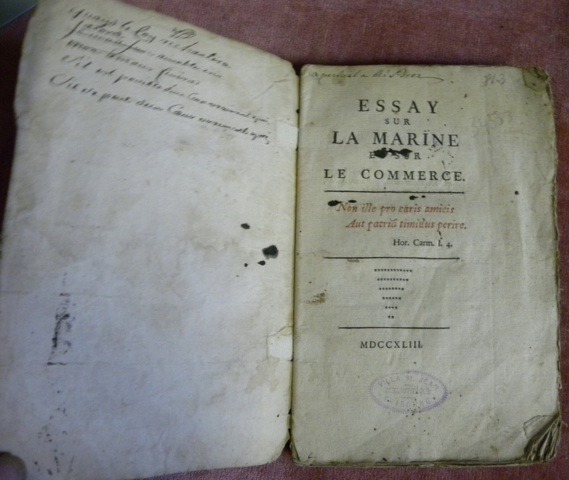
ref. 34584Sans lieu, 1743, 215x140mm, 176pages, broché. Couverture papier marbré, non rogné, coins cornés, cachet de bibliothèque sur la page de titre.
ref. 24854A Londres, Chez Fletcher Gyles, dans Holborn, 1755. (4), 430, (6, Table des Chapitres) pp. 12mo. Contemporary half calf, spine gilt in compartments, gilt lettering, floral ornament in each compartment, green paper covered boards, all edges red. Kress 5423; Goldsmiths 8989; Einaudi 846; INED 933; Higgs 938; En Français dans le Texte, 159; Leblanc 57; Antoin E. Murphy, Richard Cantillon: entrepreneur and economist; T. Hutcheson, Before Adam Smith, pp. 163-178. First edition of Cantillon's great work, 'the most systematic statement of economic principles before Adam Smith's Wealth of Nations' (Roll, p. 121). 'The economic repute of Cantillon, for a time completely obscured by the glory of Adam Smith, can never have rested upon the popularity of his little book, now one of the scarcest works in economic literature .. The influence of the book is evidenced not only by the number but by the distinction of its students, including Gournay, Quesnay, Mirabeau, Turgot, and Adam Smith. It gave birth to Mirabeau's l'Ami des Hommes and apparently suggested much of the Tableau Oeconomique of Quesnay and parts of the Wealth of Nations .. Cantillon avoided, as Jevons has pointed out, the one-sidedness of the Physiocrats; and yet has been marked out as a Physiocrat .. Jevons thought Cantillon wrote 'with the scientific precision of a Cairnes or a Cournot,' and Prof. Marshall refers to his 'thoroughly scientific manner of discussion' .. In France the Essai has been pretty continuously read (see e.g. Ganilh, Des Systèmes d'Economie Politique, 2d. ed. 1821), and so stimulating and suggestive does it remain that its direct influence may be found to be not yet exhausted' (Palgrave, i, pp. 214f). Roll has called this work 'the most systematic statement of economic principles, before the Wealth of Nations' (History of Economic Thought, p. 121).Cantillon, a French banker of Irish extraction, was influenced by Petty, but his own influence was principally felt by the Physiocrat school: Higgs maintains that Quesnay took his fundamental principle of Physiocracy from the Essai. The Essai was written about 1730 and circulated in manuscript. Cantillon died in 1734 and the work was first published in 1755 in French, not in English, as stated on the title.The Essai has been quoted by Smith, Condillac, and Quesnay, plagiarised by Harris and Postlethwayt, and called by Jevons 'more emphatically than any other single work the cradle of political economy'. The work is divided into three sections: a general introduction to political economy, a treatise on currency, and a study of foreign commerce and exchange.'Since the 'discovery' of Cantillon by the English-speaking world following Jevons's enthusiastic article (1881), no less than justice has been done to the merits of the Essay .. Jevons himself noted that Cantillon had presented a treatment of currency, foreign exchanges, banking and credit which, judged against the work of its period, he felt to be 'almost beyond praise' .. It was likewise recognized as early as Jevons that Cantillon had set out the leading ideas of Adam Smith's 'important doctrine concerning wages in different employments' .. and that the Essay contained .. 'an almost complete anticipation of the Malthusian theory of population' (The New Palgrave, i, p. 318). - A very good copy.

ref. 16035No place, 1757. 2 volumes. (2), 302 pp.; (2), 392 pp. 12mo. Contemporary marbled calf, spines gilt in compartments, red labels with gilt lettering, marbled edges, small loss of calf to front cover of volume 2, very lightly rubbed. McCulloch 46; Kress 5600; Goldsmiths 9242; Higgs 1465; not in Einaudi; Conlon 57:669; not in Mattioli. First French edition, first published in 1744. The French translator, J.P. de Gua de Malves, added extensive comments and therefore this French version is sought after. Sir Matthew Decker, director of the East India Company, merchant and pamphleteer, was born in Amsterdam. In the present work he urges the replacement of all customs and excise duties by a single tax on the consumption of luxury goods - a kind of income tax with the merits, as it was conceived in the eighteenth century, that the taxpayer voluntarily assesses himself by choosing to consume such articles and to such an extent as he wishes. Decker argues strongly against restrictions on trade, emphasizing the significance of industry and trade to the welfare of the country. He would exempt the houses inhabited by the poor from all duties - not on grounds of social sympathy but because it would necessarily lower their wages and consequently increase the competitive strength of British exports; he advocates the luxury tax because it would check luxury, the bane of virtue and industry. He was opposed to monopolies and bounties and was skeptical as to whether trade can ultimately be forced into 'an unnatural channel,' thus anticipating the discussion on the operation of natural laws in the economic world. In some respects he is considered an important precursor of Adam Smith. 'The first part of the work is devoted to a detailed criticism of the fiscal difficulties under which England is labouring; the second part to showing the intricate connection between the trade of a country and the value of the land; while in the third part Decker displays the great sources of wealth and prosperity possessed by England (and over her two chief rivals, France and Holland), and shows how the references he suggests would permit her to avail herself of these, her natural strength' (Palgrave, i, p. 519).
ref. 16593A Berlin, 1757. iv, xviii, 435, (1) pp. 12mo. Contemporary marbled calf, spine richly gilt with raised bands, gilt lettering, red edges. Higgs 1474; Kress 5617 (incomplete copy); Weulersse, i, xx; this edition not in Goldsmiths, Einaudi & INED. The best edition. Including the 'Arrêt du Conseil d'Etat du Roi, qui, entr'autres dispositions, ordonne que le commerce de toute espèce de grains sera libre entièrement par terre et par les rivières, de province à province, dans l'intérieur du Royaume. Du 17 Septembre 1754', to which referrence is made in the Avertissement. The basic importance of agriculture in the life of the French nation was equally emphasized by C.J. Herbert, who held labor and land to be the primary resources of a nation, and agriculture its basic industry. Upon agriculture depended a nation's power and wealth, its ability to colonize, the fruitfulness of its commerce, and the capacity of its territory to support population. Having demonstrated the basic importance of agriculture to the political and economic strength of France, Herbert indicated that French agriculture was languishing, and its revivification was essential to the aggrandizement of the nation and to the felicity of its inhabitants; ..... Herbert advocated the improvement of grain markets and prices through inauguration of the right to export grain, modifications in the tax system, and the establishment of a research bureau to discover how agriculture could be improved, and why some provinces were more favorable to agriculture, manufacturing, and population growth than others. (Spengler, French predecessors of Malthus, pp. 67-72). Valuable work, cited with praise by Adam Smith.
ref. 17189A Amsterdam, Aux dépens de la Compagnie, 1754. Two works bound in one volume. 258 pp.; (2), xiv, 186 pp. 12mo. Contemporary marbled calf, spine gilt in compartments, red labels with gilt lettering, joint lightly rubbed. First work: Kress 5376; Goldsmiths 8914; Einaudi 4196; INED 3409; Higgs 738; not in Mattioli. Second edition, published in the year of its first publication. 'Economique. Richesse acquises par la France depuis Henri IV grâce à son commerce maritime; état de la Grande Bretagne, puis celui de la France de Louis XV comparé à la France de Louis XIV; nécessité du commerce maritime; examen de la traite des nègres, des colonies, du commerce du Nord, etc.' (INED). ). Deals with the colonies both French and English, Canada, etc.'Devenuz assez rare' quoted by Higgs. Pierre-André O'Heguerty, Comte de Magnières (1700-1763), was received in 1718 as 'avocat au Parlement de Paris' and became the President of the 'Conseil supérieur de l'Ile de Bourbon' in 1741. The above work was published in 1754, and reprinted in 1756 at the end of the Discours politiques de Hume. This is the second seperate edition. In this work he gives a translation of the Navigation Act, suggesting that such an Act should also be developped for France (Leblanc, De Thomas More à Chaptal, 381).The folding plate gives the 'produit du travail des nègres.'Second work: Kress S.3978; Higgs 766 (erroneously claiming 2 volumes); cf.: Goldsmiths 8818; INED 1734 (both listing the 1753 edition); not in Einaudi.Second edition.The first edition appeared in 1753. Includes remarks on the introduction of luxury through the system of John Law. The author's name spelled on the titlepage as: Deon de Beaumont. Copy with the pages 93/4 and 119/20 in the revised version, the cancelled versions removed. Annotations on first flyleaves and title. - Stamp of Ville d'Orange, Bibliothèque Municipale on half-title of second work and on the last page of the first work, second stamp Bibliothèque d'Orange on half title second work, half-title of second work strengthened in inner margin and repaired on verso, armorial ex-libris 'Lud. de Sausin' on front paste-down, a little foxed, author's name in ink on title of first work, and some contemporary handwritten notes on the front free blanks concerning these works and the authors.
ref. 24626Paris Chez H. Agasse, An XIII 1805 in 8 (21x13) 1 volume reliure demi basane claire de l'époque, dos lisse muet (petites épidermures), faux-titre, titre XVI et 300 pages, un faux-feuillet non chiffré d'errata, avec une une grande carte gravée dépliante in fine (par J.D. Barbié du Bocage, An XIII, 1805). Ouvrage enrichi d'une carte où se trouvent tracés, 1°. la navigation intérieure d'une grande partie de la Russie européenne et celle de l'ancienne Pologne; 2°. le tableau de l'Europe, servant à indiquer les routes que suit le commerce de Russie par la mer Baltique et la Mer-Noire pour les ports de la Méditerranée; 3°. le plan des cataractes du Niéper. Antoine Anthoine de Saint-Joseph, 1749-1826, relate dans cet ouvrage son expérience pour tenter de former une union économique et commerciale entre la France et la Russie en utilisant la Mer Noire et le Bosphore. Edition originale sans nom d'auteur. Bon exemplaire ( Photographies sur demande / We can send pictures of this book on simple request )
1743ref. 9349Sans lieu, sans nom, 1743. In-8 de 176 pages, plein veau marbré, dos à nerfs orné de filets et fleurons dorés, pièce de titre rouge, filet doré sur les coupes, tranches rouges. Premiers et derniers feuillets légèrement empoussiérés.
ref. 39235In-8 (157 x 95 mm), veau marbré de lépoque, dos à 5 nerfs, orné de compartiments fleuronnés et cloisonnés, palettes, tranches rouges, 427 p., (5) pages de table. Londres, Fletcher Gyles dans Holborn [i.e. Paris?], 1756.
ref. 5465, Liege, Lardinois, 1858., Relie, original cuir, 10,5x18cm, 278pp.
1803ref. PHO-2211Paris, Baudoin, Germinal an xi (1803), in-4 (26,5x21,5cm), 2 ff.- 522 pp.-1 f. d'errata, brochage d’attente manquant au dos et dernier plat, dos cassé, pages cornées, non rogné tel que paru. Illustré de 7 planches, manque les 3 cartes.
ref. 220Petit in 8 demi-cuir muet à petits coins,pièce de titre cuir,176 pages,sans lieu,sans mention d'auteur ni d'éditeur,1743.Première édition,très rare (Barbier II-241)
1755ref. 1031561755 A Londres, et se vend à Paris, Quai des Augustins, chez Guillyn, au Lys d'or - 1755 - Deux volumes in-12 (17 x 10,5 cm) - Plein veau blond de l'époque - Filets et fleurons dorés - Etiquette de titre et de tomaison sur fond brun, toutes tranches rouges - 24 + xlj + 460 + 472 pages - Table des chapitres en fin du tome I. Complet en deux volumes
1818ref. 132921818 P., Madame Huzard, Mars 1818, 1 vol. in-8° (213 x 135 mm) cousu sous son brochage gris d'attente, pièce de titre imprimée collée au dos, de 419 pp. (faux-titre et titre inclus).Légèreement écorné, très bel exemplaire non rogné par ailleurs.
1940ref. 78886Couverture souple. Broché. 462 pages. Couverture légèrement défraîchie.