ANGLO-JAPANESE TRADEBiblio.com
5770 risultati
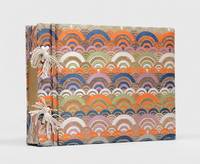
1934rif. 180258Japan: 1934. A last-ditch attempt to repair Anglo-Japanese relations A well-preserved photo album presented by the Japanese government to members of the Barnby mission. This delegation was "unofficial and supposed to deal solely with commercial issues but the Japanese government and media treated it as if it had a political purpose much to the embarrassment of the British Embassy" Cortazzi p. 141. WorldCat lists no other examples. After the invasion of Manchuria and Japan's withdrawal from the League of Nations in 1933 a pro-Japanese group in Britain centred on Neville Chamberlain attempted to repair relations between the two countries. The group was led by Colonel Lord Barnby the former president of the Federation of British Industries and staffed by representatives of the Iron and Steel Federation and the banking firm Seligman Brothers. Officially its goal was to investigate business opportunities in the new colony but as the Japanese ambassador Matsudaira Tsuneo wrote "its real aim is to promote friendly relations between Japan and Britain and between Britain and Manchukuo" Nish p. 19. The delegation was greeted by an audience with the emperor much to the horror of the British ambassador Robert Clive who suspected that their friendliness was simply a ruse to persuade the British to "accept a subordinate position in East Asia" Cortazzi p. 142. The mission caused such a stir that it was debated in parliament on 7 November 1934 where Viscount Cecil of Chelwood asked whether the Japanese government had been properly informed of its non-political nature. The first photograph shows the mission meeting with the Japanese delegation and the final photograph shows the interior of a railway car. There are also many photographs of traditional Japanese sports and performing arts as well as the scenery of famous places like Nara Hakone and Kyushu. Oblong folio. With 60 gelatin silver photographs landscape or portrait approximately 105 x 152 mm mounted recto and verso on grey card with captions in English. Original patterned brocade white thread musubi-toji binding spine ends capped with patterned brocade gilt-speckled endpapers gilt edges. Brocade fresh a little frayed at edges a few leaves sometime strengthened with tape at the gutter photographs bright with a little toning and silvering at edges: a very good example. Hugh Cortazzi British Envoys in Japan 1859-1972 2021; Ian Nish Anglo-Japanese Alienation 1919-1952: Papers of the Anglo-Japanese Conference on the History of the Second World War 1982. unknown
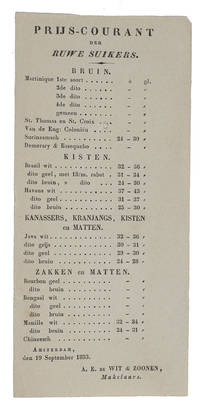
1721rif. LC4D1MQ3QGJ6Amsterdam 1721. 1 leaf 21 x 8 cm; 1 leaf 20.5 x 8 cm; 1 leaf 17.5 x 8 cm. Jacobus van Egmond Ad 1: Text printed on both sides each in a border built up from typographic ornaments. Ad 2: Text printed on one side. Ad 3: Text printed on one side. 3 documents. Ad. 1: Rare VOC ships manifest for cargo shipped from the East Indies - Batavia and Ceylon Sri Lanka - on 22 East-Indiamen sailing on 1 December 1720 from Batavia and on 15 November from Ceylon. The list includes more than 100 different colonial wares and gives the weights in pounds or the lengths in feet: from pepper more than 6.5 million pounds cloves 694000 pounds cinnamon 604000 pounds and coffee more than 1.77 million pounds to 962 pounds of Javanese cardamom some jewels and rariora and many feet of silk and linen cloth. Small wormhole affecting two characters otherwise in good condition.Ad. 2: Rare list of the results of the auctions of colonial wares organized in 1781 by the Chambers of the VOC Amsterdam 30 April 1781; Zeeland 7 May; Delft 15 May; Rotterdam 17 May; Hoorn 22 May; Enkhuizen 23 May including pepper cinnamon nutmeg etc. with the prices fetched. With a small tear not affecting the text. Still in good condition.Ad. 3: Price list of the various varieties of raw sugar: brown sugar from Martinique Surinam etc.; sugar packed in chests from Brazil Havana; in bales from Bengal Manilla etc.Small hole not affecting the text.l Ad. 1: cf. Landwehr VOC 1123-1134 other manifests. ASIA BOOK HISTORY & PRINTING HISTORY MARITIME HISTORY Broadsides Ephemera & Pamphlets Ceylon Economic History & Trade Indonesia / Dutch East Indies VOC hardcover
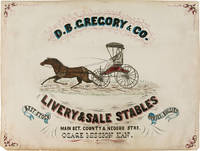
1870rif. 55334Osage Mission Ks. N.d. ca. 1870s. Hand-Painted Trade Sign for a Kansas Livery Stable A remarkable and very attractive handmade sign for D.B. Gregory's livery stable in Osage Mission Kansas. Undated the style of the sign suggests a date of the 1870s. The center of the sign shows a lovely illustration in profile of a horse pulling a single-rider four-wheeled carriage along a dirt road. The text above the illustration reads "D.B. Gregory & Co." and below: "Livery & Sale Stables / Best Stock / Horse & Buggies / Main Bet. County & Neosho Strs. / Osage Mission Kan." The lettering is in black with blue and purple shadowing and "Osage Mission Kan." is drawn in a very ornate style. The entire sign is decorated with purple watercolor ornamentation. On the verso is a pencil sketch of the horse and the lower half of the carriage likely a preliminary sketch for the finished illustration. David B. Gregory born in 1846 in Iowa established his livery business with his brother in Osage Mission now St. Paul Neosho County Kansas by the early 1870s. An advertisement in the March 23 1873 issue of the OSAGE MISSION TRANSCRIPT describes Gregory's livery as having a "fine and well selected stock of horses and carriages.the best matched teams for style and speed in the city. Saddle horses for ladies and gents a specialty that defy competition." Settlers came to the region around Osage Mission in the 1840s following the founding of nearby Fort Scott in 1842. Osage Mission itself was founded in 1847 by Father John Schoenmakers as a mission to local Indian tribes and then grew into a town in its own right serving as a trading post and gateway for commerce and westward exploration. By the late 1860s it had grown to nearly 900 people with a hotel boarding house saloon stables general store hardware store and blacksmith. A rare significant and informative survival from the American frontier. Hand-drawn and hand-painted watercolor sign on a 14 x 18¾-inch sheet of cardstock. Pencil sketch for the same sign on the verso. Small chips at lower corners some light soiling. Very good. unknown
1778rif. 180090London: Printed for and sold by G. Baxter 1778. Trading in Asia made easy First edition of a series of tables "compiled with the greatest exactness and which has been allowed to be the truest tables and countenanced and recommended by the Armenian and Portugal Merchants who are continually trading from port to port in the East-Indies." Places treated of include Madras Bengall Malacca Siam Goa Bombay Surat Muscat Manilla and Canton with details given of gold and silver weights coins and exchanges including Bengall Batty tables grain measures liquid and dry measures port charges and customs on exports and commodities. According to the anonymous author "The whole hath been found to be very useful to all persons trading to those parts and hath detected the many frequent frauds and impositions committed by the natives" title. Quarto 200 x 160 mm. pp. iv 96. Contemporary marbled paper boards new calf spine red morocco label. Ownership inscription of one Wm. Richardson at head of half-title printed bookplate of T. D'A. Lucas M. D. to front pastedown; resewn when rebacked a few leaves guarded in the gutter; a very good copy. ESTC T152270 locating the Göttingen copy only. hardcover
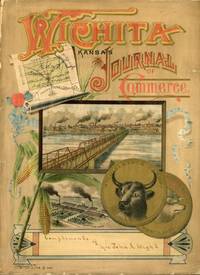
1888rif. 54232Wichita Kansas: Eagle Printing House 1888. 1888. KANSAS. First edition.4to. Original color pictorial wrappers 92 pp. introduction numerous illustrations numerous advertisements mostly printed in double column. This promotional publication by the Wichita Board of Trade was published to counter the "malignant attacks" conducted by "powerful newspapers all over the country" who have "deliberately leveled their batteries at Wichita." The promotional contains an historical overview of Wichita in the cattle trade information on crops and capabilities of Kansas and calls Wichita "The Southwestern Metropolis." Illustrations include street cars telegrams churches private residences and schools. Containing also a directory of wholesale business information on Wichita's railroads and railway connections lists of industrial enterprises the meat packing centers the livestock market and information on taxes and building enterprises. In addition there are numerous advertisements for various businesses in Wichita. Light cosmetic touch-up to the spine and extremities by a master paper conservator else an attractive informational and scarce promotional for Wichita. Housed in a quarter leather and color decorated boards with raised bands and titles stamped in gilt on the spine. Not in Adams Herd. Not in Graff Eberstadt or Howes. OCLC locating only three copies. Considered to be very scarce with only a few known surviving copies. Eagle Printing House, 1888. hardcover
1818rif. 127276London: J. M. Richardson 1818. One of the outstanding exponents of the theory of international trade in the nineteenth century First separate edition of this anonymous tract originally published in The Pamphleteer Volume XII number 23. Arnold Plant declared that "the anonymous author of this tract should take his place with Ricardo J. S. Mill Longfield Mangoldt and Edgeworth as one of the outstanding exponents of the theory of international trade in the nineteenth century. His use of algebraic symbols in setting out the ratios between the quantities of commodities his method of ascertaining from these ratios which of a number of commodities can be most advantageously exported and imported his demonstration that the ratios used may be either those of quantities of different commodities within the same countries or of the same commodities in different countries will bear comparison with for instance Professor Viner's own lucid exposition well over a century later" Plant introduction to 1933 reprinting pp. 40-41. Although the tract was reprinted in the Pamphleteer in the same year it has otherwise left little trace. Octavo 197 x 120 mm. Recent quarter cloth paper label to spine marbled paper sides. Light marking to cloth some very faint scattered foxing else an excellent copy. See Goldsmiths' 22070 for The Pamphleteer. hardcover
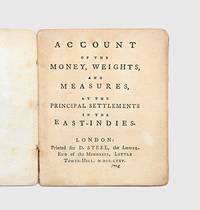
1775rif. 191552London: Printed for D. Steel 1775. Catties cowries candarines and comashees An otherwise untraced pocket reference for supercargos with alphabetically arranged sections for major destinations along eastern trade routes including China Medina Mecca Bengal Bombay and Batavia. The final page concerns Japan evidence of British commercial dealings with the Dutch East India Company. Pages 19-24 concern the sterling value of local coins offering exchange rates for the Chinese tael a Bengali English crown and for sequins dollars piastres and other currencies used in Arabia. For Bengal a special section discusses sea shells cowries as a currency for "coolies labourers and other small payment" over 2400 cowries making one "current rupee". The publisher David Steel 1734-1799 specialized in handbooks charts maps and other maritime material for naval use and for seaborne commerce. Trading out of his warehouse at Little Tower Hill Steel built a publishing empire that was continued by his son of the same name and his daughter-in-law Penelope Steel. The latter continued the business alone following David Steel the younger's death in 1803. In 1775 Steel published two other longer works for the India and China trade including the 56-page Indian Trader's Complete Pocket-Assistant which was an expanded form of the present handbook. Small duodecimo pp. 24. Sewn into contemporary marbled wrappers edges trimmed. Housed in custom grey card box. 1974 ownership signature of one E. Harris on inner front cover; date added in same ink on title page. Covers rubbed some browning internally: well-preserved. Not in ESTC or Witt. unknown
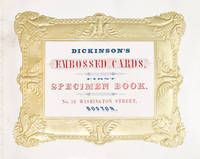
1842rif. 232013Boston: Samuel N. Dickinson 1842. Printed title in blue and red within an embossed gilt ornamental frame one printed "Notice" from the publisher dated June 1842 49 specimens of embossed cards many tinted some printed all mounted to stiff card stock; and 7 sheets of "Embossed Specimens of Printed Billets" sewn to a stiff printed card. Oblong 4to. Bound in an album of contemporary half calf and marbled paper boards with red leather label on upper cover stamped in gilt "Dickinson's Embossed Cards" calf shows much deterioration and corrosion although the sewing is still intact 28 specimen cards have been removed and are no longer present some minor soiling and foxing but generally vey clean and sound internally custom morocco backed folding box. Printed title in blue and red within an embossed gilt ornamental frame one printed "Notice" from the publisher dated June 1842 49 specimens of embossed cards many tinted some printed all mounted to stiff card stock; and 7 sheets of "Embossed Specimens of Printed Billets" sewn to a stiff printed card. Oblong 4to. With a very interesting presentation note from a previous Philadelphia owner Alfred Darrach dated 1928 affixed to the front pastedown identifying the original owner his grandfather as Christian Gobrecht 1785-1844 artist engraver embosser inventor engraver to the U.S. Mint and from 1840-1844 the 4th United States Engraver of the Mint where he was responsible for the creation of several new models and designs including the famous Seated Liberty design which appeared on a variety of American coins from 1836 through 1890. Gobrecht designed many notable medals coins and dies during his career but he also "invented a speaking doll and later a camera lucida. He also produced engravings for calico printers and dies for bookbinders. He engraved the brass dies for embossing the Morocco covers of the Boston Token from 1831 - 1836 as well as the eagle cover of the Philadelphia Token. Among the medals he engraved were the Charles Willson Peale medal the Franklin Institute medal etc ." - DAB. A remarkable specimen album in and of itself all the more so for having belonged to one of America's most important engravers. We cannot say for sure but it is entirely likely that if Gobrecht himself did not design many of the dies for this embosser he may have used the album for his own work and possibly removed the cards which are no longer present. Samuel N. Dickinson unknown
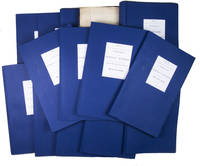
1837rif. ABC_47982London 1837. Folio 32 x 20.5 cm. William Clowes 1837-1845; T. R. Harrison 1848-1872. Later stiff blue paper wrappers with white title-label on the front cover blue sprinkled edges. Ad. 11 in beige paper wrappers. With several tables of data. 14 volumes. Rare collection of 14 volumes containing transcriptions of British diplomatic correspondence with other countries relating to the slave trade in the 19th century printed for the British government. Although slavery in the British Empire was abolished in 1807 enslaved people in the colonies were not freed until 1838. In the present volumes which mostly date from 1837-1846 directly after slavery was abolished in most British colonies the British government urges other countries to help put a halt to the now illegal slave trade. The present collection contains the correspondence between Britain and numerous countries in Europe the Americas and North Africa especially France Spain the United States and Austria. The letters describe the ships carrying enslaved people in detail also mentioning their ports of call so they could be more easily found and stopped. Of particular interest are the transcriptions of slave trade acts from various countries as well as the treaties between France and chiefs in African colonies which are difficult to find in print anywhere else.The letters reveal the profound change in attitude towards slavery in the middle of the 19th century. The tone of the correspondence with countries that were quick in abolishing slavery like Denmark is very different than that of the countries that were much slower like the Netherlands and various countries in Latin America. However the letters especially make clear how difficult it must have been to find and stop the ships that were illegally carrying enslaved people. The owners of the vessels often hid their illegal practices behind obscure transactions and renamings which made finding them arduous and sometimes dangerous. It was the task of British commissioners and naval officers to try to uncover the network behind the Atlantic slave traders and bring them to justice. By collaborating with other countries the courts succeeded in the condemnation of over 600 vessels engaged in the slave trade and the liberation of nearly 80000 enslaved people.Ad 11 with blue library stamp on the title-page "Bibliothèque du palais de la paix". All volumes in good to very good condition some very slight browning and foxing some marginal notes in most volumes. AFRICA AMERICAS EUROPE HISTORY LAW PHILOSOPHY & POLITICS Latin America Law & Politics North Africa North America Slavery South America UK - United Kingdom unknown
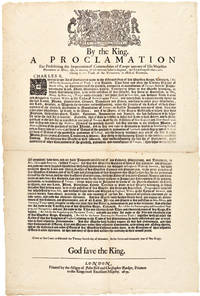
1675rif. 45901London: Printed by the Assigns of John Bill and Christopher Barker 1675. Enforcing the Triangular Trade: The Basis for the British Colonial System A rare broadside reiterating and reinforcing the decree of the English government that all foreign goods destined for British colonies must first pass through England a policy of mercantilism later termed the "triangle trade." "This program permitted the profits from colonial trade and commerce to center in England promoted British shipping and enabled the British government to support itself by taxing this trade as it flowed through England" - DAH. The English government began its mercantilist policies under the Commonwealth government in a series of "navigation acts" which regulated English trade. The first Navigation Act passed in 1651 targeted Dutch commerce. It stipulated that only English ships could carry freight into English territories and that if a ship was not English it could only carry goods from the country from whence it hailed i.e. Dutch ships could only import Dutch goods etc. Acts passed in 1660 and 1663 under the Restoration government of Charles II isolated trade even further mandating that British colonial goods only be imported to England and forbidding English trade on anything other than English vessels. This policy of trade which was continued for the next two hundred years marked the ascent of British colonial mercantilism and planted the seeds of discontent which resulted in the American Revolution one hundred years later. The present proclamation is an enforcement of the Navigation Act of 1663 An Act for the Encouragement of Trade under which "no commodities of the growth production or manufacture of Europe shall be imported into any land island plantation colony territory or place to his Majesty belonging." In other words all European trade to the American and East Indian colonies of the English had to pass through English ports en route. As the law is being disobeyed to the detriment of trade and tax revenue the proclamation extends power for enforcement to the officials of the realm. It states: ".whereas his Majesty is well informed that notwithstanding the said Act of Parliament great quantities of other commodities.have been and are daily imported into several of his colonies plantations and territories in Asia Africa and America.and that his Majesties subjects of some of his colonies and plantations have not onely sic supplied themselves with such commodities not shipped in England.but have conveyed them by land and water to other of his Majesties colonies and plantations to the great prejudice of his Majesties customs and of the trade and navigation of this kingdom." An important proclamation which illustrates the difficulty in maintaining and enforcing the laws central to the first British Empire. Old fold lines. Repaired with tissue on verso along vertical fold. A few other small tears or tissue repairs. Very good. ESTC R25339. WING C3378. GOLDSMITHS' 2112. STEELE I:3619. KRESS S1421. DAH III p.374. unknown
1787rif. 162443London: Printed by Charles Eyre and Andrew Strahan 1787 i.e. 1788. Among the earliest Parliamentary responses to the British slave trade First edition of the first British law to regulate slave shipping preserved in its original volume of yearly parliamentary acts. The law bound 54th in this volume pioneered techniques of popular abolitionist appeal. The Slave Trade Act 1788 limited the number of enslaved persons that could be transported on British ships. It also required that all ships carried a doctor to monitor the conditions of the enslaved persons. The Act was supported through Parliament by Sir William Dolben 1727-1814 and Charles Stanhope 1753-1816. LoGerfo notes of their campaign that "the machinery used to appeal to the literate public would also be used in the future" p. 450. This volume collects 57 acts passed by the 16th Parliament of Great Britain which met from November 1787 to July 1788 and was led by Pitt the Younger. Like all Parliamentary statutes of this period the Slave Trade Act was separately printed with a general title page for inclusion in the yearly volumes of acts. Most of these statutes were printed with their own title pages included in the signatures and pagination - here all such pages have been removed. These laws were printed in limited numbers usually estimated at around 1100 copies only. The volume includes laws against chimney sweeps and child labour and measures to compensate dispossessed American loyalists in the years after the Revolution. Folio 304 x 191 mm pp. 1012 = 900 title pages of individual acts removed. Woodcut device to title page woodcut head- tailpieces and initials to contents. Contemporary quarter sheep spine lettered and with black morocco label in gilt marbled paper sides. Bumping and wear minor loss to spine ends joints cracked but holding firm slight browning and foxing to endpapers and contents slight marking to edges: a good copy. ESTC N58828; N58797 Slave Trade Act. James W. LoGerfo "Sir William Dolben and "The Cause of Humanity": The Passage of the Slave Trade Regulation Act of 1788" Eighteenth-Century Studies Vol. 6 No. 4 Jun. 1973. unknown
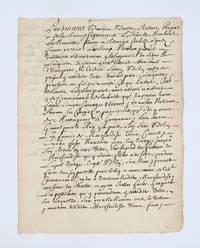
1688rif. 368775Montreal 1688. In French. 2pp. recto and verso on a single leaf. Signed by Perrot Bleinz and notary Benigne Basset. With an English transcription. Quarto. Old folds. Near fine. Provenance: Archibald de Léry MacDonald; Lawrence Lande. Exhibition: An Exhibition of Early Documents and Printed Material Relating to the Beginnings of Trade in North America from the Private Collection of Dr. Lawrence M. Lande McGill University May 30-July 15 1985 with an 8-page exhibition catalogue. In French. 2pp. recto and verso on a single leaf. Signed by Perrot Bleinz and notary Benigne Basset. With an English transcription. Quarto. Scarce seventeenth century voyageur fur trade contract for an expedition to the wilderness to trade with the Ottawa signed by one of the most important early traders and explorers of Canada and the upper midwest. "Partnership agreements such as this one of Nicholas Perrot are of great rarity" Lande. Perrot 1644-1717 was an explorer interpreter trader commandant diplomat and seigneur. He was one of the best-known figures in the early fur trade of New France particularly during the latter part of the 17th century and took possession of large tracts of land in the Great Lakes region in the name of King Louis XIV. His travels commonly took him deep into unexplored territory and he was the first Frenchman to explore the Upper Mississippi in what is now Wisconsin and Minnesota. Perrot arrived in New France about 1660 as a young donné or contracted assistant in the company of Jesuit Missionaries and travelled to the western Great Lakes region where he gained the friendship of the local First Nations people by trading guns for furs believing that they were entitled to defend themselves from their enemies. He also took the opportunity to learn several Native languages which served him well during his career. Perrot soon entered the fur trade full time and began forming business partnerships. He enlisted himself as a translator with government authorities and participated in peacekeeping missions to bring warriors of several First Nations together to sign peace treaties. By 1685 he was appointed Commandant-in-Chief at Bais des Puants present day Green Bay Wisconsin and surrounding regions and travelled to the upper reaches of the Mississippi River in the territory of the Sioux tribes where he built Fort St. Antoine in present-day Minnesota. During the spring of 1687 in preparation for taking part in raids on Indian villages in the Seneca country Perrot left his store of furs with the Jesuits at St. Francois-Xavier mission in present-day Wisconsin. While out with the raid party a fire at the mission destroyed his entire fur inventory valued at more than 40000 livres. Financially ruined Perrot returned to Montreal to deal with creditors and renew partnership agreements like the present. In the summer of 1688 Perrot partnered with Simon Bleinz to undertake an expedition to trade with the Ottawa Indians and other Nations. Perrot had always been a staunch ally of Governor Frontenac and had obtained a fur trade license from the governor for this venture to ensure that his activities were in keeping with the rules and regulations of the trade. The agreement states that Perrot would supply Bleinz with goods food provisions a canoe and other necessary supplies for the voyage and that Bleinz would convey the goods to the trading area and do all that he was able for the success of the partnership. Bleinz had the option of taking at his own expense six shirts two capots or hooded coats of blanket cloth moosehide or other material and one rifle to trade for his own personal profit. The pelts resulting from the venture were to be distributed evenly amongst Bleinz another unnamed associate of the partnership and Perrot. An "apichimon" or bonus of six beaver pelts was to be paid to Bleinz by the partnership upon the successful conclusion of the expedition. "Perrot who was often unappreciated even during his lifetime was France's best representative among the Indians of the west. His knowledge of the languages of the country his natural eloquence the happy blend of daring and coolness that were the essence of his character had made it possible for him to win the esteem confidence and even affection of the Indians. The Potawatomis the Menominees the Foxes the Miamis the Mascoutens and the Sioux granted him with the honours of the pipe of peace the rights and prerogatives enjoyed by their own chiefs. His credit was not less among the Ottawas and the Hurons. During the last four decades of the 17th century at a time when alliance with the nations of the west was indispensable in order to ward off the Iroquois peril and allow access to new territories Perrot thanks to the influence that he had acquired rendered valuable assistance to the colony" Dictionary of Canadian Biography. The present document is from the famed collection of Lawrence M. Lande 1906-1998 detailed as item 107 in his second bibliography of his collection The Founder of our Monetary System John Law Compagnie des Indes & the Early Economy of North America Montreal: 1984. Lande began collecting manuscript material relating John Law the Compagnie des Indes and the fur trade - North America's first economy - as early as the 1960s principally working with dealers Izzy Ehrlich and Alfred Van Peteghem purchasing material from the collections of Thomas Phillips Philip Sang and historian Archibald Lery MacDonald the assemblage of which Van Peteghem termed an "unparalleled feat." All of the printed material and many of the documents were donated by Lande in his lifetime; however a grouping of the manuscript items including the present document were sold by his heirs after his death. Lande Founder of our Monetary System 107 unknown
rif. 10960Scroll 385 x 8560 mm. with fine colored paintings using brush ink & various colors of wash of the route and major features along the way. Japan: mid-Edo. The route from Edo today’s Tokyo to Nagasaki and vice versa by land and by sea was one of the major thoroughfares and trade routes of Edo-period Japan. The Dutch and Chinese had been allowed to establish exclusive trading outposts in Nagasaki and Edo was the heart of domestic commerce and administration. Foreign goods especially silks other luxury items raw materials useful to the military and medicinal goods flowed through Nagasaki to Edo and the rest of Japan while Japanese goods including copper silver and porcelain were transported to Nagasaki for export. Most of the silver was sent to China to settle the trade balance. From the late 1670s to the 1740s Japan was the world’s largest copper producer and exporter. This route also carried the head of Nagasaki’s Dejima trading post to Edo for frequent mandatory ceremonial audiences with the shogun. The beginning of our scroll depicts the land route from Edo to Kyoto and then on to Osaka. The famous battleship Atake Maru is seen docked at the mouth of the Sumida River. Starting from Edo Castle in the great capital the scroll proceeds to Nagoya and Kyoto along the TÅkaidÅ road which was the most important highway of the Edo period. It depicts in great detail and with manuscript labels: stations on the route; bridges; major castles temples and shrines; the palace at Kyoto; other notable buildings; important geographical features including Mount Fuji partly shrouded in clouds; and towns and villages along the way. Distances are given and travellers are well-depicted showing their various clothing. Also shown are ships and skiffs in the nearby sea. We see more landmarks along the TÅkaidÅ road from Kyoto to the commercial hub and port city of Osaka an extension built in the 1620s. Arriving at Osaka we view the great castle the city’s canals and other sites. The rest of the scroll shows the hazardous passage from Osaka to Nagasaki through the 400 km. long Inland Sea Seto Naikai. The accomplished artist depicts the two main routes and alternate routes depending on the weather one for summertime in the open sea and the other hugging the coast for wintertime. Another route is shown that involved landing in the Bungo area of Kyūshū island and crossing overland to Nagasaki. Navigating through the Inland Sea with its 3000 plus islands and rocky outcroppings presented enormous problems in the era before modern navigation systems. Shown in very great detail are areas of turbulence including famous whirlpools numerous islands rock formations landscapes for orientation anchorages harbors along the way and fishing areas. The route then passes through the narrow Kanmon Strait the stretch of water separating the main island of Honshu and Kyūshū to the Sea of Japan finally arriving in Nagasaki. Dejima is prominently shown. A foreign ship is shown passing the GotÅ islands making its way to Nagasaki. Our scroll is finely drawn in black ink and heightened with wash in green blue gray pink and red. The routes are drawn from a partial “bird’s-eye” perspective with lovely vistas of mountains and islands and villages and towns. In fine condition preserved in an oldish wooden box which has the inscription on the outside of the lid 江戸長崎海陸é“ä¸çµµå›³ “From Edo to Nagasaki Travel by Land and by Sea Illustrated”. Inside this lid is the ownership inscription of RyÅra Gakuto. unknown
1770rif. 97Birmingham or Sheffield 1770. Oblong folio. 390 x 220 mm. 15 1/4 x 8 3/4 inches. Vellum spine over decorative blue paper wrappers paper label with title in Italian on upper board and ink title in Italian on spine. Paper stock toned with age a few leaves with staining in the margin otherwise in good condition. Silversmith model book containing 80 full-page engravings of candles sticks and holders candelabra pitchers plates salt and pepper shakers serving utensils silverware and other household pieces. Each image is beautifully and careful engraved with rich detail and ornamentation. Each includes a printed product number as well as one in ink with a different item number and a price. Although there is no title-page or signatures of engravers this large sales catalogue appears to be English as some of the engravings have English words of explanation engraved in the text. The binding is definitely Italian and the paper label is in an Italian hand. The watermark is a "fleur de lis" pattern suggesting an international company manufacturing the silver. There were only a few English companies with the capacity to export at this time including silver works in Sheffield and Birmingham both of which by 1770's had established networks of dealers selling their wares across the continent. This catalogue with specific Italian connections is very unusual and suggests the scope of the business had reached export capacity by the third quarter of the century. The most important Italian silver makers at this time were Giardini of Rome and Venuti of Naples. . unknown
1762rif. ABC_508791762. Various sizes. Ad 1-3: Contemporary sturdy paper wrappers sewn on 3 vellum supports; ad 4: the 12 documents are held together by a narrow paper wrapper with the text: "Onafgedaane Indiësche zaaken concentreerende de Amphioen Societeyt" and a string. With 12 manuscript documents and a manuscript on paper in 2 different hands. 15 1 blank; 3 ll. Collection of thirteen Dutch manuscripts concerning the Amfioensociëteit Amfioen Society documenting both its establishment in 1745 and its dissolution half a century later. Founded by the Dutch East India Company VOC to maintain its monopoly on the opium trade in the Dutch East Indies the Amfioensociëteit controlled one of the colony's most profitable monopolies until its liquidation in 1794.The earliest manuscript ads 1-3 contains the charter octrooi granted to the society for the period 1745-1755 together with its renewal for 1755-1765. Although the original charter was printed in Batavia in 1745 and survives in a single known copy that edition does not include the renewal. The present manuscript further contains a third text added in a different hand and dated November 1762 concerning the management of the society's outstanding affairs. Written on paper bearing the watermark of the VOC Chamber of Amsterdam it was probably intended for official administrative use.The remaining twelve documents relate to the financial settlement following the dissolution of the society in 1794. Most date from 1793 1794 and 1797 with one document dated 1807 reflecting the prolonged liquidation process. They concern the distribution of assets among shareholders outstanding debts and other administrative matters arising from the winding up of the company. Several documents are signed by Pieter van de Weert dates unknown cashier of the Amfioensociëteit while others mention Jacob Mossel 1704-1761 governor-general of the Dutch East Indies and the society's first director and Gerard Maximiliaan Taets van Amerongen 1727-1788 who was married to Mossel's daughter. Although several documents are headed "Copie" they are contemporary manuscript records rather than later transcripts many containing calculations annotations and other traces of active administrative use. Together they document the final years of the Amfioen Sociëteit and the administration of its dissolution.The wrappers of ads 1-3 are somewhat water stained with worm holes in the back wrapper and final leaf. The leaves are somewhat water stained especially the 3 final leaves an ink stain on leaf 12; the remaining 12 documents are folded several with small tears in the margins without loss of text occasional mild soiling. Otherwise in good condition.l Cf. Landwehr VOC 1449 printed copy of ad 1; STCN 240022416 1 copy; Wit Herman de 2012. Aandeelhouders van de opgeheven Amfioensociëteit in 1801. hardcover
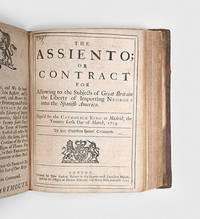
1713rif. 68433London: Printed by John Baskett 1713. Spain Grants Britain a Monopoly on the Slave Trade in the Americas First edition in English of one of the most important documents in the history of slavery in the Americas and in the political and financial history of Europe and the Americas in the early 18th century. This copy is housed in a large sammelband containing dozens of original documents and extracts related to English-Spanish relations. Though the term "assiento" could refer to any number of Spanish contracts "the Assiento" almost always refers to the "Assiento de Negros": a monopoly contract granted by the Spanish crown between 1528 and 1779 for the sole right to import slaves from Africa into the Spanish colonies. Normally granted to individual companies the 1713 Assiento was granted directly to the British crown as part of negotiations for the Treaty of Utrecht which ended the War of Spanish Succession. In the decades following this 1713 Assiento an estimated 200000 enslaved Africans were transported across the Atlantic. The document grants sole privilege for the trade to the British crown for a period of thirty years expiring in 1743. The agreement consisting of forty-two articles allows for a maximum of 4800 slaves to be introduced to the colonies each year with a provision for increasing that annual amount each year by paying an added duty places limits on sale prices sets the cost of the duty to be paid for each enslaved person allows for the use of British or Spanish ships and mariners in the slave trade provides for the French Guinea Company's extraction from the colonies and establishes the details of precisely where British ships would be allowed to travel and trade. The British were also granted the unique privilege to send one vessel with a cargo of up to 500 tons of other trade goods to the Spanish colonies each year. While the Assiento seemed a lucrative deal most Assientists over the years saw considerable losses due to the difficulty of cross-Atlantic trade and the duties paid to the Spanish king. The real benefit to its grantees was not profits from the slave trade but rather the illegal ability to send other contraband on board their vessels to the otherwise closed-off Spanish markets in the New World. Britain was eager to get their own products overseas and to deny this revenue stream to the French who had held the Assiento since 1701 thereby preventing them from refilling their coffers too quickly and upsetting the balance of power in Europe after the costly War of the Spanish Succession. Queen Anne delegated the Assiento privilege to the South Sea Company which had recently been established to pay off Britain's considerable national debt. The privilege was largely granted to them as an encouragement to investors in order to allow the Company to achieve its original purpose more readily. Ultimately however it proved to be a costly and unprofitable endeavor for the South Sea Company who were able to import only about one-third of their allowed quota of slaves each year were frequently interrupted by war and were required to render twenty-five percent of their profits to King Philip V of Spain. The present example comes from the British Foreign Office Library inlaid and bound into a folio volume of other treaties between Great Britain and Spain arranged chronologically by treaty date. Over the course of many years the library of the Great Britain Foreign Office inlaid copies of nearly every treaty involving Great Britain to folio size and bound them together by region. The library was dispersed in the late 20th century with most of the volumes and particularly the American volumes sold by this company. Most of the other treaties with Spain within this volume are clippings or extracts from larger works or true copies in manuscript of treaties dated between the years 1176 and 1739. Included in the volume however is a separately printed English edition of the Treaty between Great Britain and Spain as part of the Treaty of Utrecht ESTC T51509. There are two issues of the Assiento treaty; this is the issue with a semicolon after "Assiento" and no punctuation after "or" on the titlepage. A crucially important document in the history of colonial trade Spanish-British relations English finances and slavery in the Americas. Folio. 19th-century half roan and marbled paper boards. Boards worn some restoration at joints. Text trimmed and inlaid into folio sheets bound in volume of treaties between Great Britain and Spain. Bookplate of the British Foreign Office Library on front pastedown. HANSON 1896. ESTC T4476. EUROPEAN AMERICANA 713/85. JCB 1III:175. SABIN 2227. SPERLING 34. hardcover
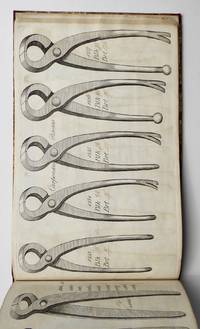
1812rif. 4628TRADE CATALOGUE - STEEL GOODS. Book of Steel Toys. Birmingham n.p. c.1812. A remarkable trade catalogue of steel goods for the household ladies and gentlemen's personal effects gardening tools and instruments for trades and professions. This is a treasure trove of visual information about a vast range of now obsolete tools and the objects required for daily life in the age of Jane Austen: spinet tuning keys muffin toasters cheese tasters sugar hatchets teeth cleaning sets netting vices boot hooks and so on. Particularly fascinating is the distinction between tradesmen's tools and those specifically marketed for amateurs. These are described in the individual engravings as well as in the engraved and letterpress leaf after the index leaf where the contents of 9 oak chests of tools for gentlemen are itemised as well as chests of garden tools turners tools and mahogany chests of tools for cleaning gentlemen's guns. Among the articles listed in the index are 'Lady's hammers' and 'Lady's sets of garden tools' but these do not seem to be the articles engraved on the corresponding plates. Engraved trade catalogues of this sort were used by salesmen to solicit orders from retailers. The prices entered in manuscript are selling prices on which the retailer received a discount probably 25% see below. Stamped brass and silverware catalogues turn up from time to time but catalogues of steel goods are much rarer. Unusually too this catalogue is provided with a letterpress index. Normally the engraved leaves would be gathered up in different combinations for individual salesmen hence the plates are numbered in manuscript. In this example they do not exactly follow the printed index so the 'missing' engravings 49 and 50 may never have been present but the presence of stubs suggests that pls. 35–40 which from the index showed corkscrews were once present and have been removed from the volume. There is a similar volume in the Public Library of Cincinnati and Hamilton County also with a printed index and 51 leaves of plates. There is a printer's imprint W. Tolley and Son on the first plate. This may be the William Tolley engraver and copperplate printer active in Birmingham from before 1790 to 1830. The name of the agent is on a label on the upper cover: 'Muntz & Purden Book no. 29 discount 25%' indicating that the MS prices are retail prices. Oblong folio 235 x 375mm; letterpress 'Index to book of steel toys' folding letterpress and engraved leaf 'Gentlemen's Tool Chests' and 46 leaves of plates many printed recto and verso from 80 engraved plates. There is a gap in the pagination and stubs between 34 and 41 and these leaves have presumably been removed; pls 49 and 50 are also missing but there are no stubs so may never have been present. Manuscript additions. The index leaf is annotated 'Livre 64456 W&L' this has been varnished over; every item is neatly priced and in some cases additional products are described for example the ice skates 48 shillings plain or 60 shillings hollow ground could be had with leather straps and buckles for another 18 shillings per dozen pl. 70; small marginal tears in first two and last leaf strengthened with tissue on verso; recent half morocco and marbled boards; from the Forschungsinstitut für Geschichte der Zahnheilkunde with stamp on index leaf and several plates. n.p. hardcover
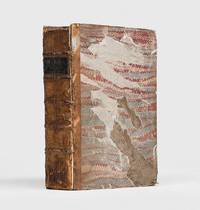
1713rif. 186652London: Printed for John Baskett Printer to the Queens most Excellent Majesty And by the Assigns of Thomas Newcomb and Henry Hills deceas'd 1713. A foundational document in the transatlantic slave trade First edition of a major development of the transatlantic slave trade which greatly expanded the market for British slave traders in the Americas and helped establish Britain as the predominant slave trading power. After the War of the Spanish Succession Spain ceded to Britain the exclusive right to import African slaves into Spanish America. This monopoly the Assiento was delegated to the newly formed South Sea Company and held until 1750. The supposed value of the Assiento was the basis of the South Sea Bubble. In fact the restrictive terms - slave numbers were capped and all shipments were heavily taxed by the Spanish Crown - resulted in the South Sea Company never making substantial profit from the agreement. Nonetheless the Assiento played a major role in boosting and consolidating Britain's role in the Atlantic slave trade. The front free endpaper contains a detailed contemporary owner's note naming the binder of the volume - John Worrall - the price paid how it was constructed and how the book should be used: a very unusual survival. The notes state "This book Intituled State Pamphlets was bound by John Worrall for 2s. 2d. and containes 425 leaves". Little is recorded of John Worrall. He was apprenticed from 1674 to 1682 and was working at Warwick Court in 1709 and at Fleet Ditch in 1722. He died in 1726 all from Howe p. 103. The notes continue that the contents are consecutively numbered in manuscript and to use that numbering not the pagination of the original pamphlets. It specifies that "Remarks" are to be "entred in the proper cleane leaves as the observation thereof sees best" - blanks are bound between the tracts. It then notes that the manuscript table should be placed as the second leaf as is found. It refers the reader to another volume with more detailed instructions - it is evident the volume was held in a library which anticipated wide use. The nine other works bound in the volume - an inventory is available on request - date from 1688 to 1714 and are tracts on religion law and politics alongside the Treaty of Utrecht. It includes Jonathan Swift's first political work A Discourse of the Contests and Dissensions between the Nobles and Commons in Athens and Rome 1701 - this copy is the second issue with most of the first edition type corrected and reset. 10 works bound in 1 vol. quarto 206 x 156 mm. Contemporary calf red morocco label to style covers ruled in blind edges sprinkled red. 19th-century ownership signature "S. Louise Langdon" to verso of manuscript contents leaf. Joints and extremities restored slight staining to endpapers a little browned occasional trimming to pagination. Overall very good. ESTC T4476 another issue only has Baskett in the imprint; Kress 5020; Sabin 2227. Ellic Howe A List of London Bookbinders 1648-1815 1950. unknown
1883rif. 188758China and Britain: 1883-1911. Prickly heat mosquitos coolies yelling and no ice every alternate day - makes life not worth living A voluminous record of the business and social affairs of Henry Whistler 1861-1951 a representative of the merchants Evans Pugh & Co. and the chair of the British Municipal Council. Offering an immediacy often missing from company archives it reveals a world in which personal relations greased the wheels of commerce and a life of long hours punctuated with intrigue and drama. Armed with a £100 life insurance policy Whistler arrived in Hankow in December 1885. After the obligatory tourism "Went through native city No ambition to go there again" - 23 December 1885 he settled into an expatriate life. He led the council from 1896 to 1897 and 1898 to 1904 was appointed the Dutch vice-consul in the late 1880s and served as chairman of the Hankow Club. His businesslike entries of varying lengths note important events and commercial information. Dozens of associates recur: Sir Robert Bredon the customs commissioner; personnel from many firms e.g. Tokmakoff Molotkoff & Co. the tea giant; Alexander Price the secretary of the chamber of commerce; and the veteran Scottish trader J. R. Reddie. Evans Pugh & Co. traded in hides rhubarb tobacco and tea and it later developed an interest in land sales. He notes orders and the names of brokers arrivals and departures and commercial gossip as well as costs and prices land auctions and other transactions. His colleague J. A. Hawes is a perpetual problem being "frequently under the influence of liquor and unable to attend to his business. Mr Behrend tells me that J.A.H. has been of no use in the tearoom this year" 26 June 1897 and 28 May 1901. The volume for 1896 includes a lengthy memorandum regarding extensions to Hankow's concessions. In Beijing in October Whistler made representations to Sir Claude MacDonald the British minister and Sir Robert Hart the head of the maritime customs on behalf of his firm and the municipal council. "HBM Consuls in this affair as well as in almost all matters treat British interests with great contempt" 7 October 1896. In 1897 Whistler married Emma Augusta Howard b. 1874 the daughter of a customs official. Later volumes reveal the strain his work placed on their relationship. In the summer heat or amid the Boxer threat he retreated to Lushan Kuling and Shanghai. Insubordinate servants "Dismissed my boy 'Afa' for cheek and squeezing" - 27 July 1887 and diarrhoea are part of the daily grind. Horseracing cricket and parties at Victoria Hall afford welcome relief. Whistler spent time in Britain in 1891 1895 and 1902-03 although whenever he was in Britain he still transacted business relating to his China affairs. "Having done more than my share of work for the British Municipal Council" 2 March 1905 he took his final leave in 1907 tipping in a copy of the RSVP card for his farewell dinner at the Hankow Club on 11 March. Other accompanying ephemera include his 1897 certificate of registration in Hankow and his wedding invitation. Together 29 Letts desk diaries including 26 octavo and 3 duodecimo. Legible manuscript entries throughout. Original green cloth spine and front covers lettered in gilt marbled endpapers and edges bookmarkers. Trunk 370 x 570 x 155 mm: lid lettered "H. Whistler Shanghai" handles key lock no longer functional. General signs of handling as expected: a very good collection. hardcover
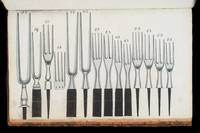
1792rif. 12195Düsseldorf: s.n. 1792. Contemporary mottled calf rebacked restored marbled endleaves. ILLUSTRATED PATTERN AND PRICE BOOK OF STEEL KNIVES AND FORKS MANUFACTURED AT SOLINGEN with the strict governmental guidelines for craftsmen and their commercial partners. The "City of Blades" Solingen was the largest sword knife and scissor manufacturer in the West. It employed over four thousand workers and exported globally. Through their rigid guild system est. 1571 the knife makers protected their trade secrets. Legal standards and strictures ensured the Solingen bladesmiths dominated the market and were the sole suppliers to elite merchants who commissioned bulk orders and custom products. Ordinary tradesmen - like the owner of this book - could only purchase ready-made items and had to pay cash. KNIVES FOR COBBLERS WOOD- AND LEATHERWORKERS BUTCHERS HUNTERS FARMERS TAILORS GARDENERS WEAVERS AND COOKS form the largest section in the volume. Each blade has a schematic manuscript illustration with separate costs for the work of smiths and for grinders. Many models adopt Dutch English French Flemish and Portuguese designs for the local chic and for export. Only the leatherwork knives are illustrated in watercolor 95 pieces marking a specialty of the owner of this sample book. THE SECTION ON FORKS HAS ONE HUNDRED THIRTY-EIGHT WATERCOLOR ILLUSTRATIONS and price lists of large carving tools to dainty ones for desserts 65 models. This other house specialty addressed the increasing adoption of forks by upper- and middle-class families in later 18th-century Europe. ANOTHER SECTION SHOWS HANDLES. These were exclusively manufactured by artisans called Reyder. Each of the two hundred three models listed was available in a range of specified styles and materials. The cost of each type of custom work like turning polishing and coloring is itemized. THE MOST PRIZED EXAMPLES ARE OF FINELY DECORATED BONE EBONY ANTLER GOAT HORN GUAIAC OR PALM WOOD. Look-alikes of "false deer horn" "false guaiac wood" etc. fit other budgets with imitation luxury finishes and less expensive materials. The illustrated examples of knives showcase eighteen different handle decoration options including black red white yellow or green dye black marbling and fine lacquer painting in abstract or foliate patterns. Seven handles are inscribed with German verse. In good condition some light staining hand soiled throughout. ¶Daniels Vollständige Beschreibung der Schwert-Messer- und übrigen Stahl-Fabriken zu Solingen 30-62. s.n. unknown