15.859 Ergebnisse
1988Best.-Nr. 70271Chicago IL: Commerce Clearing House Inc. Fine. Paperback. FREE UPGRADE to Courier/Priority Shipping Upon Request - IN STOCK AND IMMEDIATELY AVAILABLE FOR SHIPMENT - TEXT PRISTINE - 407 pages. -- with a bonus offer--; 040932; CCH Tax Law Editors; Commerce Clearing House Inc.1988 Guidebook To New York Taxes . 1988. Commerce Clearing House, Inc. paperback
1988Best.-Nr. 70270Chicago IL: Commerce Clearing House Inc. Fine. Paperback. FREE UPGRADE to Courier/Priority Shipping Upon Request - IN STOCK AND IMMEDIATELY AVAILABLE FOR SHIPMENT - TEXT PRISTINE UNMARKED - 230 pages -- with a bonus offer--; 040931; Commerce Clearing House Inc. Tax Law Editors; CCH Tax Law Editors 1988 Guidebook to New Jersey Taxes . 1988. Commerce Clearing House, Inc. paperback
1947Best.-Nr. 38468New York: Want List - the Book Trade Weekly. As New. Hardcover. FREE UPGRADE to Courier/Priority Shipping Upon Request – – IN STOCK AND IMMEDIATELY AVAILABLE FOR SHIPMENT - -- with a bonus offer--; T-Shapsr; Shapiro S. R. editor; Want List - The Book Trade Weekly United States Cumulative Book Auction Records - 1945 - 7 . 1947. Want List - the Book Trade Weekly hardcover
Best.-Nr. Z1-C-021-00626DTI Export Publications. Used - Good. Ships from UK in 48 hours or less usually same day. Your purchase helps support Sri Lankan Children's Charity 'The Rainbow Centre'. Ex-library so some stamps and wear but in good overall condition. 100% money back guarantee. We are a world class secondhand bookstore based in Hertfordshire United Kingdom and specialize in high quality textbooks across an enormous variety of subjects. We aim to provide a vast range of textbooks rare and collectible books at a great price. Our donations to The Rainbow Centre have helped provide an education and a safe haven to hundreds of children who live in appalling conditions. We provide a 100% money back guarantee and are dedicated to providing our customers with the highest standards of service in the bookselling industry. DTI Export Publications unknown
Best.-Nr. Z1-G-025-01790The Stationery Office. Used - Good. Ships from UK in 48 hours or less usually same day. Your purchase helps support Sri Lankan Children's Charity 'The Rainbow Centre'. Ex-library so some stamps and wear but in good overall condition. 100% money back guarantee. We are a world class secondhand bookstore based in Hertfordshire United Kingdom and specialize in high quality textbooks across an enormous variety of subjects. We aim to provide a vast range of textbooks rare and collectible books at a great price. Our donations to The Rainbow Centre have helped provide an education and a safe haven to hundreds of children who live in appalling conditions. We provide a 100% money back guarantee and are dedicated to providing our customers with the highest standards of service in the bookselling industry. The Stationery Office unknown
1778Best.-Nr. 37240Madrid: Pedro Marin 1778. Commercial Policy in Spanish America Detailed rules and regulations governing Spain's late 18th-century commercial policy in Latin America with a preliminary section of nineteen pages providing a summary of the articles and tariffs documented in the main portion of the text. With this REGLAMENTO. the Crown terminated Cadiz and Seville's monopoly of trade with Spanish America allowing other cities of the realm to participate. In addition to much information on commerce and numerous tariffs on a large variety of Spanish and American goods several sections discuss shipping ports and other maritime activities directly related to commercial activity. The work also includes the text of concessions granted to Louisiana. Quarto. Contemporary mottled calf spine gilt extra. Light shelf wear corners rubbed. Contemporary ownership inscription on titlepage modern bookplate on front pastedown clipped booksellers' descriptions pasted to front free endpaper. Text quite clean. Very good plus. PALAU 255843. SABIN 68890. MEDINA BHA 4845. unknown
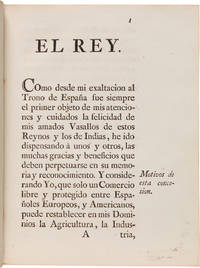
1778Best.-Nr. 37240Madrid: Pedro Marin 1778. Commercial Policy in Spanish America Detailed rules and regulations governing Spain's late 18th-century commercial policy in Latin America with a preliminary section of nineteen pages providing a summary of the articles and tariffs documented in the main portion of the text. With this REGLAMENTO. the Crown terminated Cadiz and Seville's monopoly of trade with Spanish America allowing other cities of the realm to participate. In addition to much information on commerce and numerous tariffs on a large variety of Spanish and American goods several sections discuss shipping ports and other maritime activities directly related to commercial activity. The work also includes the text of concessions granted to Louisiana. Quarto. Contemporary mottled calf spine gilt extra. Light shelf wear corners rubbed. Contemporary ownership inscription on titlepage modern bookplate on front pastedown clipped booksellers' descriptions pasted to front free endpaper. Text quite clean. Very good plus. PALAU 255843. SABIN 68890. MEDINA BHA 4845. unknown books
Best.-Nr. 13411aafGenève, G.W. Brooke, 1893-1927, in-4°, reliures en toile ornée, demi-parchemin et brochées.
1787Best.-Nr. 11148Londres, sans nom, 1787. In-8 de XLVIII-344 pages, demi-basane brune à coins, dos lisse avec filet et titre dorés, tranches rouges. Coiffes et coins un peu frottés. Nom de possesseur à la plume au titre.
1920Best.-Nr. 362949Tokyo: Gaimusho tsushokyoku daisanka 1920. First Edition. A bilingual pamphlet detailing the origins of and the official Japanese response to the 1913 Alien Land Law passed in California. The law prohibited foreigners who were not eligible to obtain citizenship from purchasing land or entering into leases longer than three years. It applied almost entirely to Asian immigrants who were barred from becoming naturalized American citizens. This book opens with a brief introduction and the text of the California law followed by the texts of the official protests made by the Japanese government to officials in Washington DC along with the American diplomatic responses. The Japanese protests are refreshingly narrative and detailed rather than legalistic in style. Among the American respondents is William Jennings Bryan acting in his official capacity as Secretary of State in the Woodrow Wilson administration. 18 2 58 1 English 79 Japanese pages. OCLC: 835810960 Waseda; 840108220 National Diet Library 44716908 Trinity College. NB: 4216338 has the same title but only 28 pages. First edition first printing. Covers foxed and spotted spine ends a bit chipped else very good. Gaimusho tsushokyoku daisanka unknown
1920Best.-Nr. 362512Tokyo: Gaimusho tsushokyoku daisanka 1920. First Edition. A bilingual pamphlet detailing the origins of and the official Japanese response to the 1913 Alien Land Law passed in California. The law prohibited foreigners who were not eligible to obtain citizenship from purchasing land or entering into leases longer than three years. It applied almost entirely to Asian immigrants who were barred from becoming naturalized American citizens. This book opens with a brief introduction and the text of the California law and is followed by the texts of the official protests made by the Japanese government to officials in Washington DC along with the American diplomatic responses. The Japanese protests are refreshingly narrative rather than legalistic in style. Among the American respondents is William Jennings Bryan acting in his official capacity as Secretary of State in the Woodrow Wilson administration. 18 2 58 1 English 79 Japanese pages. OCLC: 835810960 Waseda; 840108220 National Diet Library. No US holdings. First edition first printing. Covers foxed and spotted spine ends a bit chipped else very good. Gaimusho tsushokyoku daisanka unknown
1915Best.-Nr. 10258Various places 1915. Twenty-six trade cards all illustrated with portraits of the proprietors some with real photo illustrations. Various sizes largest 16.5 x 15.5 cm. some printed both sides. The businesses include restaurants cafes a grocer an oyster house a fruit house lunch counter confectionery & ice cream fish and canned goods a hotel with fishing parties a "Schlitz Forum & Cafe" a beer bottler a nurseryman wine & liquor shop a saloon a buffet and short order lunch counter a chop house a summer garden dining hall and candy shop. Boston Mass. Brooklyn N.Y. Iowa New Orleans Vermont Providence Rhode Island Springfield Ill. New Bedford Mass. Bainbridge Bradford & Walnutport Penn. Iowa Rochester Rensselaer & Syracuse N.Y. Philadelphia Two Rivers Wisc. Lake Mills Wisc. Metamora Ill. Toledo Ohio and others. Condition varies but most are very good or better. unknown
1915Best.-Nr. 10258Various places 1915. Twenty-six trade cards all illustrated with portraits of the proprietors some with real photo illustrations. Various sizes largest 16.5 x 15.5 cm. some printed both sides. The businesses include restaurants cafes a grocer an oyster house a fruit house lunch counter confectionery & ice cream fish and canned goods a hotel with fishing parties a "Schlitz Forum & Cafe" a beer bottler a nurseryman wine & liquor shop a saloon a buffet and short order lunch counter a chop house a summer garden dining hall and candy shop. Boston Mass. Brooklyn N.Y. Iowa New Orleans Vermont Providence Rhode Island Springfield Ill. New Bedford Mass. Bainbridge Bradford & Walnutport Penn. Iowa Rochester Rensselaer & Syracuse N.Y. Philadelphia Two Rivers Wisc. Lake Mills Wisc. Metamora Ill. Toledo Ohio and others. Condition varies but most are very good or better. unknown books
Best.-Nr. 24270A Amsterdam, Et se trouve à Paris chez Duchesne, 1756. xlvii, (1), 352 pp. 12mo. Contemporary marbled calf, spine richly gilt with raised bands, red label with gilt lettering, red edges. Echerverria & Wilkie 56/40; Sabin 75520; Chadenat 4121; JFBL S61; INED 4034; Higgs 1501; Kress 5567; Conlon 56:1257; not in Goldsmiths; not in Einaudi. First edition, and very rare, of this work which discusses in 18 letters and at the moment the Seven Years' War was about to start, the consequences of the presence of various European nations in North America with the aim to find some sort of balance of power between the various colonizing European nations, to avoid a war and to encourage commerce and trade. 'There are several issues of this edition occasioned by cancellanda (D4-5, D11-12, E10, G11, and I5-8, all of which are present in this copy). No copy is known, however, that is not a mixture of both canellanda and cancellantia: thus, what the original text was as first printed is problematic. (.....) In the two BN copies, (....), the imprint date has been alterted in manuscript to read M.DCC.LVII. (This is also the case with the present copy where the second 'I' has been added in manuscript.) This is a series of letters dated July-September 1756, forming an essay on international power politics with special reference to European colonial systems in America' (Echeverria & Wilkie).'Intéressant pour l'origine de la guerre du Canada' (Chadenat). 'A consideration of Europe's involvement in North America with a view to establishing a balance of power among the colonizing nations which would eliminate war and encourage commerce' (JFBL). 'Déterminer la nature des divers équilibres propres aux différentes colonies septentrionales et méridionales des peuples de l'Europe, en étudiant les variations de leurs cultures, leur commerce, leur population, leurs différentes distances, etc.' (INED). - Contemporary signature and author's name in blank portion of title.
Best.-Nr. ORD-16352Sans indication de lieu ni de date [Genève. Pellet. 1780]. In-4 (183 x 261mm) dos lisse maroquin rouge orné de filets et d'un semis d'étoiles or, plats veau raciné à double encadrement de filets or, gardes marbrées, bien complet des 23 tableaux et des 50 cartes dressées par Bonne, la plupart dépliants. Menus défauts mais bon exemplaire.
Best.-Nr. 11307A Avignon, Et se vend à Lyon, Chez REGUILLIAT, Libraire, Place Louis Legrand, 1770 - In-8 dans une sobre et saine reliure demi chagrin cognac, dos à cinq nerfs et titre au petit fer dans le second caisson, signet de soie, bel exemplaire de reliure postérieures, XVJ - 272 pages, piqûres sporadiques, petits manques papier sur les 4 premières pages, mouillures sans gravité sur les dix première pages. Très agréable.
1803Best.-Nr. 001778Paris Chez Gérard, Imprimerie de Munier 1803. Trois volumes in-8 (205 x 130 mm), demi-veau glacé bleu marine, dos lisse orné or et à froid, tranches mouchetées (reliure milieu 19e s.). Seconde édition française, ornée d'une carte dépliante et de 11 planches gravées sur acier d'après les dessins de l'auteur, représentant le Mont Vernon et la maison du Général Washington, les Chutes du Niagara, le Cap-Diamant, etc. Ex-libris Mr de Gaudechart. (dos très légèrement passé, quelques défauts, frottements sur les plats, quelques manques de cuir tome 1, quelques petites déchirures marginales, t. 3 sur les 30 premières pages mouillure angulaire, rousseurs). // Three octavo volumes (205 x 130 mm), dark blue glazed half calf, smooth spine tooled in gilt and blind, sprinkled edges (middle of 19th-cent. binding). Second french edition, illustrated with a folding map and 11 plates engraved on steel after the author's drawings, depicting Mont Vernon and General Washington's house, Niagara Falls, Cap-Diamant, etc. Bookplate Mr de Gaudechart. (spine a little bit faded, some defects, rubbings on covers, some lack of leather vol. 1, some little tears, vol. 3 water-stain on top corner of the 30 first pages, spots).
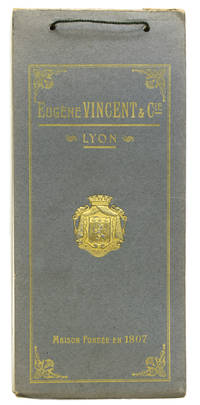
1907Best.-Nr. 302671Lyon: Imprimerie Gougenheim Frères 1907. 30 numbered chromolithograph plates. Thin oblong 8vo 9-3/4 x 4-1/4 in. Printed gray wrappers stapled and with hole punches and string gold foil stamped arms on front cover. Light wear to covers. With the distribution stamp of Albert Martin 6 Rue des Tonneliers Marseille. 30 numbered chromolithograph plates. Thin oblong 8vo 9-3/4 x 4-1/4 in. A finely printed trade catalogue illustrating the liqueurs and brandies offered by the Lyon wine distributors Eugéne Vincent & Cie including Crème de Cacoa-chouva various brands of curaçao and triple sec anisette fruit brandies Peronneau absinthe and Grog Americain a bottled punch. Imprimerie Gougenheim Frères unknown
1907Best.-Nr. 302671Lyon: Imprimerie Gougenheim Frères 1907. 30 numbered chromolithograph plates. Thin oblong 8vo 9-3/4 x 4-1/4 in. Printed gray wrappers stapled and with hole punches and string gold foil stamped arms on front cover. Light wear to covers. With the distribution stamp of Albert Martin 6 Rue des Tonneliers Marseille. 30 numbered chromolithograph plates. Thin oblong 8vo 9-3/4 x 4-1/4 in. A finely printed trade catalogue illustrating the liqueurs and brandies offered by the Lyon wine distributors Eugéne Vincent & Cie including Crème de Cacoa-chouva various brands of curaçao and triple sec anisette fruit brandies Peronneau absinthe and Grog Americain a bottled punch. Imprimerie Gougenheim Frères unknown books
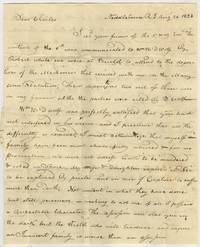
1823Best.-Nr. BK0184Middletown Rhode Island 1823. Autograph letter signed three pages on a folded sheet with integral address panel to Charles E. Dudley in Albany and Newport postal markings. 7 ¾ x 9 ¾ inches. Old folds scattered staining and some marginal losses a few affecting text. Good to very good. A letter from Newport mariner John Wood concerning his acrimonious departure from the DeWolf family's Mary Ann plantation in Cuba and the ensuing legal dispute with James DeWolf and Charles Collins. Wood was almost certainly the same John Wood whose signature appears on an 1806 Newport agreement for an illegal voyage transporting enslaved Africans from Cape Coast to Havana now held by the Smithsonian's National Museum of African American History and Culture.1 By 1823 he was residing on the Mary Ann plantation one of several Cuban estates belonging to the DeWolfs among the most prominent families involved in the American slave trade. His relationship with DeWolf and Collins had evidently collapsed over his obligations on the estate resulting in what he describes as his forced departure from Cuba under apparently dangerous conditions with his family and a contentious effort to settle their accounts. Writing to his friend Charles E. Dudley then mayor of Albany and a New York state senator Wood reports that three mechanics who had resided with him on the plantation had recently given depositions in Bristol Rhode Island. Two of the three had testified in his favor though all had been called by DeWolf. Wood was particularly incensed by the circumstances surrounding his family's departure from Cuba writing: "I must acknowledge that myself & family have been most shamefully abused & for no provocation we were set adrift liable to be murdered & robbed on Shore My Wife & Daughter exposed at Sea to be captured By pirates and in case of Capture to suffer more than Death; Not content in what they have done but still persevere in wishing to rob me of all I possess a Respectable Character. The assassin will stab you in the dark but the Wretch who will traduce and injure an Innocent family is worse than an assassin." Wood goes on to describe receiving two writs from DeWolf and Collins and transcribes an August 8 letter from James DeWolf explaining his decision to pursue legal action despite their previous discussions of an amicable settlement: "Lest you should think me inconsistent in causing an action to be brought after the last conversation we had I take leave to explain my wishes to come to an amicable settlement by referring to men as we talked remains the same my object is to put the business in a legal and proper train for bringing it to a close . & to enable me to avail of the testimony of the people who were on the Estate with you." Wood expected the Rhode Island Supreme Court meeting at Bristol the following month to appoint referees to settle the accounts. The precise origin of the disagreement is not stated though the depositions of the mechanics and the references to outstanding accounts suggest a dispute over Wood's contractual obligations or activities on the plantation. Wood 1770-1826 was a Newport merchant and captain with longstanding connections to Atlantic commerce. He died at Cape Coast West Africa in 1826 three years after writing the present letter. James DeWolf 1764-1837 then serving in the United States Senate had amassed a substantial fortune through the slave trade and his Cuban plantation interests. Charles Collins his brother-in-law had served as collector of customs at Bristol from 1804 to 1820 an appointment closely connected to the family's slave-trading operations. The Mary Ann plantation is documented in the DeWolf Papers at the Rhode Island Historical Society which include inventories from 1818 and 1820 and contemporary plans of the plantation grounds. The present letter preserves Wood's account of his treatment by the DeWolf family together with his transcription of DeWolf's explanation for pursuing legal action. 1 "Agreement facilitating illegal trade of enslaved Africans" National Museum of African American History & Culture accessed October 12 2026 https://nmaahc.si.edu/object/nmaahc_2019.28.1. . unknown
1823Best.-Nr. BK0184Middletown Rhode Island 1823. Autograph letter signed three pages on a folded sheet with integral address panel to Charles E. Dudley in Albany and Newport postal markings. 7 ¾ x 9 ¾ inches. Old folds scattered staining and some marginal losses a few affecting text. Good to very good. A letter from Newport mariner John Wood concerning his acrimonious departure from the DeWolf family's Mary Ann plantation in Cuba and the ensuing legal dispute with James DeWolf and Charles Collins. Wood was almost certainly the same John Wood whose signature appears on an 1806 Newport agreement for an illegal voyage transporting enslaved Africans from Cape Coast to Havana now held by the Smithsonian's National Museum of African American History and Culture.1 By 1823 he was residing on the Mary Ann plantation one of several Cuban estates belonging to the DeWolfs among the most prominent families involved in the American slave trade. His relationship with DeWolf and Collins had evidently collapsed over his obligations on the estate resulting in what he describes as his forced departure from Cuba under apparently dangerous conditions with his family and a contentious effort to settle their accounts. Writing to his friend Charles E. Dudley then mayor of Albany and a New York state senator Wood reports that three mechanics who had resided with him on the plantation had recently given depositions in Bristol Rhode Island. Two of the three had testified in his favor though all had been called by DeWolf. Wood was particularly incensed by the circumstances surrounding his family's departure from Cuba writing: "I must acknowledge that myself & family have been most shamefully abused & for no provocation we were set adrift liable to be murdered & robbed on Shore My Wife & Daughter exposed at Sea to be captured By pirates and in case of Capture to suffer more than Death; Not content in what they have done but still persevere in wishing to rob me of all I possess a Respectable Character. The assassin will stab you in the dark but the Wretch who will traduce and injure an Innocent family is worse than an assassin." Wood goes on to describe receiving two writs from DeWolf and Collins and transcribes an August 8 letter from James DeWolf explaining his decision to pursue legal action despite their previous discussions of an amicable settlement: "Lest you should think me inconsistent in causing an action to be brought after the last conversation we had I take leave to explain my wishes to come to an amicable settlement by referring to men as we talked remains the same my object is to put the business in a legal and proper train for bringing it to a close . & to enable me to avail of the testimony of the people who were on the Estate with you." Wood expected the Rhode Island Supreme Court meeting at Bristol the following month to appoint referees to settle the accounts. The precise origin of the disagreement is not stated though the depositions of the mechanics and the references to outstanding accounts suggest a dispute over Wood's contractual obligations or activities on the plantation. Wood 1770-1826 was a Newport merchant and captain with longstanding connections to Atlantic commerce. He died at Cape Coast West Africa in 1826 three years after writing the present letter. James DeWolf 1764-1837 then serving in the United States Senate had amassed a substantial fortune through the slave trade and his Cuban plantation interests. Charles Collins his brother-in-law had served as collector of customs at Bristol from 1804 to 1820 an appointment closely connected to the family's slave-trading operations. The Mary Ann plantation is documented in the DeWolf Papers at the Rhode Island Historical Society which include inventories from 1818 and 1820 and contemporary plans of the plantation grounds. The present letter preserves Wood's account of his treatment by the DeWolf family together with his transcription of DeWolf's explanation for pursuing legal action. 1 "Agreement facilitating illegal trade of enslaved Africans" National Museum of African American History & Culture accessed October 12 2026 https://nmaahc.si.edu/object/nmaahc_2019.28.1. . unknown books
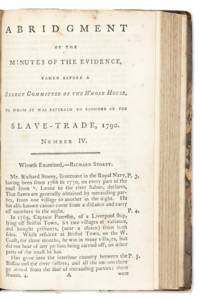
1789Best.-Nr. 187101789. Committee of the Whole House of the British Parliament investigation into the Atlantic slave trade recorded in Abridgment of the Minutes of the Evidence Taken Before a Committee of the Whole House to Whom It Was Referred to Consider of the Slave Trade published 1789 to 1791 presenting one of the earliest parliamentary documentary compilations addressing the operation and human consequences of the transatlantic slave trade. The volumes preserve testimony gathered during parliamentary inquiries that examined the practices of British slave traders and the treatment of enslaved Africans transported across the Atlantic. These proceedings formed part of the political campaign in Britain that eventually culminated in the abolition of the British slave trade in 1807. The collected evidence includes statements from ship surgeons naval officers merchants and other witnesses whose accounts describe the conditions experienced by enslaved Africans during capture transport and plantation labor. Abridgment of the Minutes of the Evidence Taken Before a Committee of the Whole House To Whom It Was Referred to Consider of the Slave Trade. London: 1789-1791. First edition first printing. Four volumes bound in two books. The compilation reproduces testimony presented before Parliament concerning the organization and operation of the slave trade and includes firsthand statements describing the physical suffering and resistance of enslaved Africans during transport. Surgeon Alexander Falcon-Bridge who had firsthand experience aboard slave ships described acts of despair among captives: he "Has known several enslaved persons to refuse sustenance with a design to starve themselves. refusing to take medicines when sick because they wished to die. Many other slaves expressed the same." Another witness Royal Navy surgeon Thomas Trotter recorded the emotional trauma experienced by captives during embarkation noting that "Slaves on being brought on board showed signs of extreme distress and despair from a feeling of their situation and regret at being torn from friends and connections." The volumes therefore preserve testimony that exposed the violence and human suffering embedded within the Atlantic slave trading system. During the eighteenth century European and American traders transported millions of Africans across the Atlantic through a commercial system that relied on maritime networks linking West Africa the Caribbean and the Americas. Parliamentary investigations of the slave trade in the late eighteenth century were fueled in part by abolitionist activism and public campaigns demanding government inquiry into the practice. Publications of witness testimony such as this abridged parliamentary record circulated evidence used by reformers advocating the end of the trade. Four volumes bound in two books with folding table in the fourth volume. Octavo format. Contemporary marbled quarter calf bindings with modern bookplates on the front past down. Wear present with most spine titles lacking and foxing primarily affecting the title pages; text remains clear. Overall condition very good. unknown
1789Best.-Nr. 187101789. Committee of the Whole House of the British Parliament investigation into the Atlantic slave trade recorded in Abridgment of the Minutes of the Evidence Taken Before a Committee of the Whole House to Whom It Was Referred to Consider of the Slave Trade published 1789 to 1791 presenting one of the earliest parliamentary documentary compilations addressing the operation and human consequences of the transatlantic slave trade. The volumes preserve testimony gathered during parliamentary inquiries that examined the practices of British slave traders and the treatment of enslaved Africans transported across the Atlantic. These proceedings formed part of the political campaign in Britain that eventually culminated in the abolition of the British slave trade in 1807. The collected evidence includes statements from ship surgeons naval officers merchants and other witnesses whose accounts describe the conditions experienced by enslaved Africans during capture transport and plantation labor. Abridgment of the Minutes of the Evidence Taken Before a Committee of the Whole House To Whom It Was Referred to Consider of the Slave Trade. London: 1789-1791. First edition first printing. Four volumes bound in two books. The compilation reproduces testimony presented before Parliament concerning the organization and operation of the slave trade and includes firsthand statements describing the physical suffering and resistance of enslaved Africans during transport. Surgeon Alexander Falcon-Bridge who had firsthand experience aboard slave ships described acts of despair among captives: he "Has known several enslaved persons to refuse sustenance with a design to starve themselves. refusing to take medicines when sick because they wished to die. Many other slaves expressed the same." Another witness Royal Navy surgeon Thomas Trotter recorded the emotional trauma experienced by captives during embarkation noting that "Slaves on being brought on board showed signs of extreme distress and despair from a feeling of their situation and regret at being torn from friends and connections." The volumes therefore preserve testimony that exposed the violence and human suffering embedded within the Atlantic slave trading system. During the eighteenth century European and American traders transported millions of Africans across the Atlantic through a commercial system that relied on maritime networks linking West Africa the Caribbean and the Americas. Parliamentary investigations of the slave trade in the late eighteenth century were fueled in part by abolitionist activism and public campaigns demanding government inquiry into the practice. Publications of witness testimony such as this abridged parliamentary record circulated evidence used by reformers advocating the end of the trade. Four volumes bound in two books with folding table in the fourth volume. Octavo format. Contemporary marbled quarter calf bindings with modern bookplates on the front past down. Wear present with most spine titles lacking and foxing primarily affecting the title pages; text remains clear. Overall condition very good. unknown books
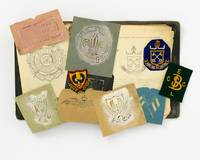
Best.-Nr. 146921The collection comprises: 1 A ring-bound folder containing nearly 100 designs for cap and blazer badges including 40 with mounted examples of the finished embroidered patches. The designs are full-scale pencil drawings some coloured and most with typed or manuscript details of the colours designs and materials e.g. 'Royal Blue Cap. Badge worked all gold'. Badges for schools predominate with some of the wealthier private schools calling for multiple designs. For instance St Peters College has different designs for: Colours Junior Second First and First for prefects tennis cap regular and for prefects house and school prefects rowing cap regular and for prefects and old scholars. Also well represented are sporting clubs mainly baseball and cricket including the South Australian Cricket Association as well as a small number of youth clubs fraternities and other societies. The mount leaves are pulled at the punched holes and a little stained and torn; one leaf is defective; overall an impressive and extraordinary collection. 2 Approximately 300 hand-cut stencils paper or card used to transfer designs to the fabric where they would then be worked over by skilled embroiderers using free-motion or 'Irish' embroidery machines. The stencils include many designs not in the sample book including company logos and many other school and association badges. Of particular note are several relating to the Australian military forces in the Second World War including two for a Royal Australian Air Force pilot's wings one pricked for pouncing one a cut stencil one for what appears to be a torpedoman's shoulder patch and one for the Red Cross Transport Service. Some are dated with the earliest noted being for the West Torrens Cricket Club South Australian Cricket Association premiers 1932-33; the latest date noted is 1940. Companies represented include General Motors-Holden GM-H Amscol Mastakraft itself Howells Electric Motors Amalgamated Airways and the Simson's Electric Light Company Cricket Club. Sporting clubs include the Port Adelaide Football Club and the MCC. 3 Four loose cloth patches one for the S.A. Emergency Fire Service H.Q. Reserve. 4 Half a dozen further pencil designs on paper one relating to the Royal Life Saving Society. A large quantity. unknown
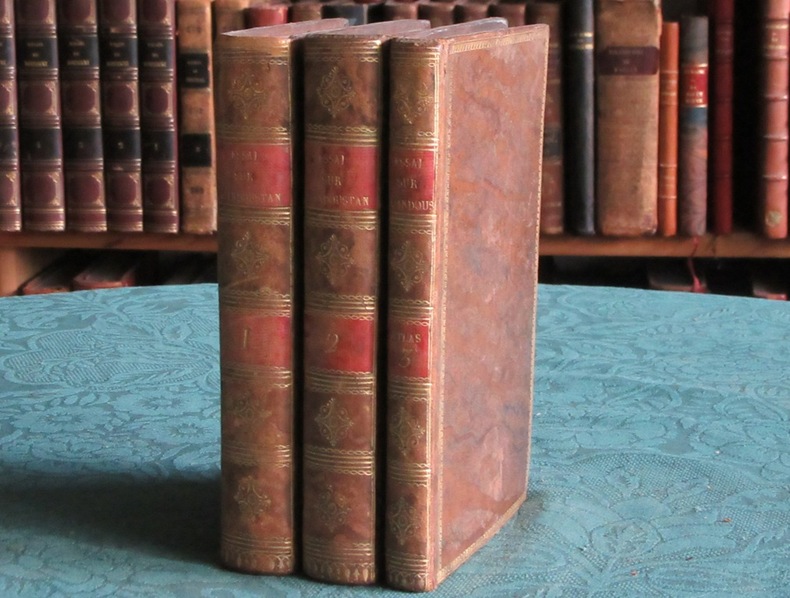
1807Best.-Nr. 18918Ce dernier pris dans une année moyenne, depuis 1702 jusqu'en 1770, époque de la suppression du privilège de l'ancienne compagnie des indes orientales, par Mr Legoux de Flaix, avec 1 atlas comprenant 1 carte dépliante et 14 planches.Edition originale. A Paris, Chez Pougin, libraire - 1807 - (T1 : xvi pp + 459 pp + errata du T1), (T2 : 447 pp + errata du T2).Reliure plein veau de l'époque. Dos lisses ornés de fleurons dorés avec titre et tomaison. Pièce de titre maroquin rouge. Filet doré encadrant les plats. Tranches marbrés. Pas de rousseur. Très bon état. Format in-8°(21x13).Le premier tome traite du commerce intérieur et des importations, et le second volume est entièrement voué aux exportations et dont il passe en revue les différentes marchandises, principalement des tissus et des épices.