14.731 Ergebnisse
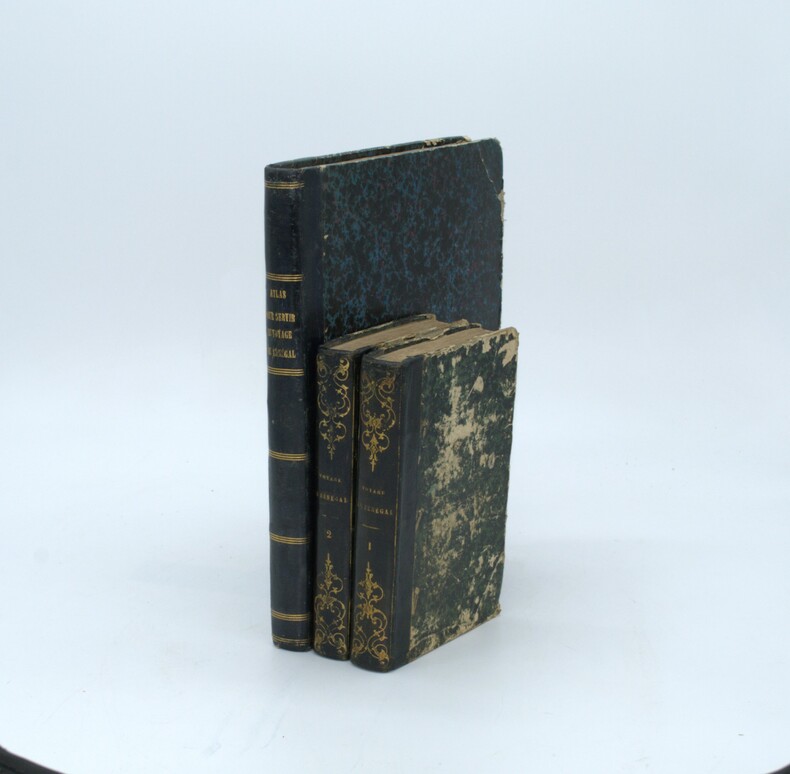
Best.-Nr. 37933Paris,chez Denné jeune en 1797. 2 vols.in-8 en reliure d'époque. Voyage à travers les Provinces d'Entre-Douro et Minho, de Beira, d'Estramadure et d'Alenteju, dans les années 1789 et 1790. Contenant des Observations sur les Moeurs, les Usages, le Commerce, les Edifices publics, les Arts, les Antiquités, ... de ce Royaume. Ouvrage en français traduit par Jacques Murphy. 23 planches dépliantes. 218 et 290 pages. Bon exemplaire avec qques rousseurs et mouillures.
1770Best.-Nr. 24104A Marseille , de l'Imprimerie de Sibié. 1770 in 4 de 15 pages, titre et texte encadrés, maroquin rouge aux Armes de la Ville de Marseille, frises et filets or sur les plats, dos lisse orné à la grotesque, tranches dorées.mors très légèrement frottés. Reliure de l'époque .
Best.-Nr. 19176A Amsterdam, Chez E. van Harrevelt, 1781. 2 volumes. vii, (1), 619, (5) pp.; (4), xvi, 531, (4) pp. 4to. Contemporary marbled calf, spines richly gilt with raised bands and gilt lettering, a bit rubbed. Kress B.415; Einaudi 4732; Goldsmiths 12154; INED 3814; McCulloch 63; not in Mattioli. Last and best edition, first published in 1700. This work has been reprinted through the whole of the 18th century. The author was a well-informed merchant of Amsterdam. During the 18th century the book was constantly revised and enlarged, so that by the end of the century little remained of the original work except the title. The 1781 edition was by far the best counting-house guide that had appeared, being, in this respect, infinitely superior to the dictionaries of Savary and Postlethwayt (McCulloch). - Fine copy on heavy paper.
1752Best.-Nr. 13746A Genève, chez les Frères Cramer & Claude Philibert, 1752. 2 vol. in-4 de (36)-856-162 pp. ; (46)-812 pp., demi-veau brun à coins, dos à nerfs orné de filets dorés, pièces de titre en maroquin rouge (reliure de l'époque).
Best.-Nr. 18786A Rouen, De l'Imprimerie de Dame Besongue, 1789. With 16 tables, some folding, one covering 7 separate pages, and one covering 24 pages. vi, (7)-238 pp. 4to. Modern half morocco, marbled boards, spine gilt in compartments, gilt lettering. Sabin 32638 (incomplete copy); not in Leclerc; Fay 25; not in Howes; Kress B.1719 (incomplete copy); Goldsmiths 13832; not in Einaudi. The first French edition, the rare Quarto edition, translation was due to De Rumare, a magistrate in Rouen. There was another 4to edition printed in 1789, "A Londres, aux dépens de la Compagnie, which did not have the "Table des Matières" (and had 230 pages as a consequence). A detailed exposition and statistical comparison of the imports and exports of Great Britain and the United States, from 1700 to 1783. With each edition, Sheffield substantially revised and enlarged the text. Written in opposition to the bill introduced by Pitt in 1783, proposing to relax the navigation laws in favour of the States, the work was influential in determining the abandonment of the motion. Sheffield points up the weak position of America and continually stresses the growing commercial importance and potential of the West Indies and Canada (especially Newfoundland and Nova Scotia, particularly with regard to fisheries, lumber, and ship-building). Howes writes that the work was very influential in shaping England's trade policy from 1783 to 1789, so detrimental to American commerce and shipping interests as to contribute greatly to the formation of a Federal union, better able, than were the separate federated states, to retaliate against British maritime might.The tables provide extensive statistical information, giving a comparative export and import survey of the trade between the United States and other countries. This translation from the English original was due to De Rumare, magistrate at Rouen. The later Mirabeau translation did not include the statistical tables. - Nice copy with marginal annotations and good margins.
Best.-Nr. 4343ou lettre sur le produit des terres et du commerce de l’Angleterre;sans date(1760)territorial. in 12 demi vélin à petits coins,pas de page de titre 260 pages.Sans lieu ni date Pamphlet économiste contre le luxe de la Grande Bretagne. Importantes considérations sur le commerce,le revenu territorial.RARE
Folio (325 x 190 mm), xl, [8], 5-216, [244]pp., 18 folding plans (9 hand coloured), one folding plate of a boat, and 8 folding tables, cont. ownership initials EB at head of title page, text nice and clean, bound in recent half calf, marbled boards, raised bands. During the eighteenth century the rate of increase of the volume of the trade of the Port fluctuated with the alternating periods of peace and war. Between 1700 and 1770 the commerce of the Port was nearly doubled and from 1770 to 1795 (only 25 years) it again doubled. In 1792 imports into England amounted to ?17,898,000 and exports ?23,674,000. London's share was ?12,072,000 and ?14,743,000 respectively, or nearly 65 per cent. of the whole. The greatest increases in commodities imported were sugar, rum, dyewoods, ginger and pimento from the West Indies. Some idea of the state of congestion that existed in the river at this time may be gathered from the fact that in the Upper Pool, 1,775 vessels were allowed to moor simultaneously in a space adapted for about 545. The position was aggravated also by the large number of craft, estimated at about 3,500, employed to convey cargoes from the moorings to the wharves. Goods remained for weeks at a time in lighters before they could be dealt with; this exposed them to the attacks of the weather and the depredations of river thieves who resorted to the Port in large numbers operating lucrative and well-organised trade in river plunder, at which it is recorded revenue officers notoriously connived. The several classes of thieves were known by designations applied to the recognised branches of their work. Among these may be mentioned River Pirates, Night Plunderers, Light Horsemen, Heavy Horsemen, Scuffle-Hunters and Mud Larks. The wharf proprietors resisted every effort to provide the addition of a single foot of accommodation. So crowded and over burdened did the Port become that trade and navigation were carried on under difficulties which must soon have diverted a large measure of its commerce to other ports. Eventually in 1796 a Parliamentary Committee of the House of Commons was "appointed to enquire into the best mode of providing sufficient accommodation for the increased trade and shipping of the Port." The Committee prepared an exhaustive report but did not succeed in formulating any definite recommendations for improving matters. Despite the urgency of the situation, it was not until 1799 that Parliament authorised the construction of a dock on the Isle of Dogs "for rendering more commodious and better regulating the Port of London" and in particular to secure that "West India produce might be effectually secure from loss by theft or other causes and the public revenue greatly benefited." Ref: Port of London Authority History. ESTC T123672, BL, Marsh's Library, Oxford, Senate House, Univ. of London; Philadelphia, Library of Congress, Minnesota.
Best.-Nr. 11642ou tableau de l’état actuel de cet Empire contenant 1) la description topographique des 15 provinces qui le composent, elle de la Tartarie, des isles & autres pays tributaires qui en dépendent, le nombre et la situation de ses villes, l’état de sa population, les productions variées de son sol, & les principaux détails de son histoire naturelle ; 2) Un précis ces connoissances le plus récemmens parvenues en Europe sur le gouvernement de la religion, des mœurs, & les usages, les arts & les sciences des chinois. In 4 plein cuir fauve raciné à nerfs,pièce de titre chagrin rouge, roulette, caissons dorés. Faux-titre, titre, 798 pages, tranches rouges. A Paris Chez MOUTARD imprimeur-Libraire de la Reine, de Madame, & de Madame Comtesse d’Artois 1785. ( à signaler une découpe page de titre- une pâle mouillure en marge supérieure page 16 puis de la page 392 à 488- puis de la page 775 à la fin)- petits raccommodages. ) bon exemplaire L’abbé GROSIER travailla pendant 40 ans à la composition de l’histoire de la Chine compilée à Pékin par le père MARILLA, sur des documents originaux parue, de 1777 à 1784 en douze volumes ; Il rédigea seul le treizième volume qui complète cette histoire et fut publiée en supplément en 1785. 格鲁贤(Jean-Baptiste Grosier 《中华帝国志》, 巴黎,穆塔(Moutard)出版社,1785年In4,棕色花岗石斑纹小牛皮,书脊有装饰,原版
Madrid, Juan Muñoz, 1729, 31 x 21,5 cm., pergamino de época, 7 h. + 400 págs. (Importante obra sobre los efectos económicos del contrabando y el comercio de mercancías prohibidas en América y Filipinas, sobre todo en tiempos de guerra. Se publicó por primera vez en 1654 , siendo esta edición notablemente aumentada).
1872"For Improvements in Fire-Arms" [England], 25 July 1872. Manuscript Victorian patent document on vellum, folded and docketed, a rare and excellent example of a patent of invention for a guns, granted to William Edward Blake of New York City. Large printed document completed in manuscript and measuring approximately 76 x 51 cm, with original blue paper revenue stamp for five pounds, and a double-sided yellow wax seal measuring 16 cm in diameter. Small perforation at fold, age-toning to verso, otherwise in very good and original condition, a lovely and bright document, as issued, with a scarce large Victorian wax seal in its original round tin case. A round black tin container houses the massive double-sided yellow wax seal, diameter 16 cm (6.25 inches), attached to the document by original red plaited cords, one side being the Great Seal of the Realm, the other being Queen Victoria seated on a fully caparisoned royal horse. Diminutive fissures to sides of seal, otherwise in very good original condition, with vivid and crisp wax impression. The Commissioners of Patents' Journal, September 1872 issue, records this patent, no. 2224, being granted provisional protection for six months, as also stated in the document itself. Rare official patent document for an invention for "improvements in fire-arms" valid for fourteen years and issued to William Edward Blake, an inventor from New York City. Patent number 2224 was valid in the United Kingdom of Great Britain and Ireland, the Channel Islands, and Isle of Wight, with the condition that the specified stamp duty payments were remitted at the times specified, one hundred pounds being payable in the seventh year after the initial patent issue date, for example. Excerpt from the patent: "... Whereas William Edward Blake of the City of New York, United States of America, hath by his petition humbly represented to Us that he is in possession of an Invention for Improvements in Firearms, which the inventor believes will be of great public utility, that he is the first and true inventor thereof... that the same is not in use by any other..." End Excerpt In the following year, 1873 William Edward Blake would receive at least one patent from the United States Patent Office, "for improvements to gun-stocks and spades, patent number 135,624." Blake described this dual-purposed instrument to be especially useful to American soldiers, in particular the Corps of Royal Sappers, Miners, and Engineers, by reducing the weight and number of tools carried over long distances. In essence he devised a two-in-one gun and spade by affixing a small shovel to the gun-stock which served dually as the shoulder rest when firing. It is conceivable that the present patent, valid in the United Kingdom, was for the same apparatus. Little is revealed about Mr. Blake in the present document, apart from his American citizenship and skill in manufacturing firearms for improved efficiency. Further research, however, may find the inventor to be a relation or even a partner of other Blake family gun makers. For example, John Henry Blake, was the manufacturer of a bolt action 7-shot revolving magazine sporting rifle, which was similar to a military type tested by an Ordnance Board of Governor's Island, New York, in July 1891. Blake, P. & E. W. of New Haven, Connecticut, manufactured Model 1821 muskets; the two partners are believed to have been the nephews of Eli Whitney Sr., and also to have been the trustees of the Whitney Armory from 1823 until Eli Whitney Jr. came of age in 1842. And earlier, the firm French, Blake and Kinsley, musket makers, secured a contract for 4,000 stand of arms on 20 October 1808, having delivered at least 2,175 units by 7 October 1812. The Great Seal of the Realm or Great Seal of the United Kingdom (prior to the Treaty of Union the Great Seal of England, then until the Union of 1801 the Great Seal of Great Britain) is a seal that is used to symbolize the Sovereign's approval of important state documents. Sealing wax is melted in a metal mould or matrix and impressed into a wax figure that is attached by cord or ribbon to documents that the monarch wishes to make official. Queen Victoria had to select four different Great Seal designs during the sixty-three years of her reign. England's patent law began to be criticized in the 1850s, for obstructing research and benefiting the few at the expense of public good. According to historian Adrian Johns, the campaign "remains to this day the strongest ever undertaken against intellectual property", coming close to abolishing patents altogether. Despite much public debate, the system wasn't abolished, though it was reformed with the Patent Law Amendment Act of 1852. This simplified the procedure for obtaining patents, reduced fees and created one office for the entire United Kingdom, instead of different systems for England and Wales and Scotland. Around the same time, however, an anti-patent movement began to take shape, and would continue until the early 1870s, spirred by inventors, entrepreneurs, and radical laissez-faire economists. Prominent activists included Isambard Kingdom Brunel, William Robert Grove, William Armstrong and Robert A. MacFie. A new sequence for numbering patents also began in October 1852. Patents applied for between October and December 1852 were numbered from 1-1211. For each subsequent year patents were numbered in annual sequences beginning with the number 1. This system was in place until 1915. Manuscript
1816Constantinople, Odessa, Canary Islands, Spain, Italy, 1816-1818. Manuscript journal chronicling two voyages with a British merchant brig called "Exchange," featuring a sixteen-month voyage for trade at the Turkish city of Constantinople and Russian ruled Odessa only five years after the conclusion of the Anglo-Russian War, and two years prior to Odessa becoming a Free Port, being a detailed nautical log made by Peter Cook, a ship's mate twenty-six years of age. Folio. 88 pages, with authorship signature. A purpose-made document produced by J. Robins & Sons of Southwark, for recording nautical data during a sea voyage, completed in manuscript by the marine. Double leafs measuring approximately 21 x 32 cm, watermarked "O & P 1812" and with the Britannia, string-tied with paper wrappers titled in manuscript to front. Together with a single leaf in the same hand, with a hand coloured manuscript drawing of a mariner's compass to recto, and manuscript notes on Traverse Sailing to verso, made by the same hand circa 1805-1810, measuring approximately 21 x 25 cm. Together with the mariner's pensioner ticket, a legal document made on vellum, completed in manuscript, dated and signed on 22 April 1872 by an administrator of the Board of Trade, measuring approximately 19,5 x 25 cm. Some age-toning, a few leafs chipped at margin, otherwise in very good and original condition. Little is known of the vessel or the writer, other than what is revealed in the present documents. Robert Ashton was the commander of the brig, "SS Exchange" whose home port at the time was Plymouth. Peter Cook, born 1790, was a man of short stature, evidently employed by the mercantile marine. He was placed on the Pension List by the Board of Trade at the Port of Milford, Surrey, effective 1 April 1871, and resided in Tenby in Wales. Manuscript
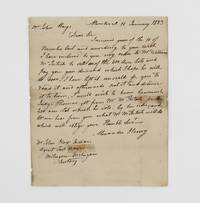
1823Best.-Nr. 374695Montreal 1823. 1p. 1p. "I received yours of the 10 of November last and according to your wish I have inclosed to you my order to Mr. William MacIntosh to sell one of the 400 acre lots and pay you your demand which I hope he will do soon. I have left it unsealed for you to read it and afterwards seal it and deliver to him. I would wish to know how much Judge Thomas got from Mr. MacIntosh for the 400 acre lot which he sold by his order and let me hear from you what Mr. MacIntosh will do . unknown
1823Best.-Nr. 374695Montreal 1823. 1p. 1p. "I received yours of the 10 of November last and according to your wish I have inclosed to you my order to Mr. William MacIntosh to sell one of the 400 acre lots and pay you your demand which I hope he will do soon. I have left it unsealed for you to read it and afterwards seal it and deliver to him. I would wish to know how much Judge Thomas got from Mr. MacIntosh for the 400 acre lot which he sold by his order and let me hear from you what Mr. MacIntosh will do . unknown books
1884Best.-Nr. 370801Boston: 33 to 51 Bowker Street and 49 & 51 Cardon Street printed by Wilson & Son University Press Cambridge 1884. 7 photogravure plates woodcut illustrations throughout text. With printed order slip tipped-in following text publisher's acknowledgment slip laid-in at front. 256pp. Roan cloth decoratively stamped in gilt and black on cover and spine; decorative blind stamping to rear board; minor edge wear mainly at head and tail of spine; illustrated throughout with black-and-white drawings and photographs. 7 photogravure plates woodcut illustrations throughout text. With printed order slip tipped-in following text publisher's acknowledgment slip laid-in at front. 256pp. A beautifully illustrated trade catalog detailing both the remarkable variety and elaborate designs of the Tufts company's commercial soda fountains. 33 to 51 Bowker Street, and 49 & 51 Cardon Street [printed by Wilson & Son, University Press, Cambridge] unknown
1884Best.-Nr. 370801Boston: 33 to 51 Bowker Street and 49 & 51 Cardon Street printed by Wilson & Son University Press Cambridge 1884. 7 photogravure plates woodcut illustrations throughout text. With printed order slip tipped-in following text publisher's acknowledgment slip laid-in at front. 256pp. Roan cloth decoratively stamped in gilt and black on cover and spine; decorative blind stamping to rear board; minor edge wear mainly at head and tail of spine; illustrated throughout with black-and-white drawings and photographs. 7 photogravure plates woodcut illustrations throughout text. With printed order slip tipped-in following text publisher's acknowledgment slip laid-in at front. 256pp. A beautifully illustrated trade catalog detailing both the remarkable variety and elaborate designs of the Tufts company's commercial soda fountains. 33 to 51 Bowker Street, and 49 & 51 Cardon Street [printed by Wilson & Son, University Press, Cambridge] unknown books
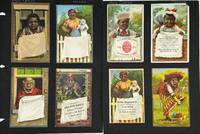
Best.-Nr. 6863398 of the cards are mounted to black album paper 12 are loose all are housed in a three-ring binder. Chips to the edges of several cards but very good overall. For the lot of 110 cards unknown
Best.-Nr. 6863398 of the cards are mounted to black album paper 12 are loose all are housed in a three-ring binder. Chips to the edges of several cards but very good overall. For the lot of 110 cards unknown books
1816Best.-Nr. 40803London: Printed for J. M. Richardson Cornhill Opposite the Royal Exchange 1816. 3-28pp. Light scattered foxing. Bound in modern cloth withdrawal stamp on front pastedown; inoffensive faint blindstamp on blank corner of title leaf. Else Very Good. Our collation matches that of the bibliographers. The nameless author disclaims any "intention to advocate the revival or regret the abolition of the Slave Trade. . . It is a traffic so objectionable in almost every respect that being abolished for the most part I hope never to see it revived and that every endeavour will be made to realize those advantages which the zeal of the authors of the Abolition has induced them to expect." However "The passage of the registration bill would constitute an unwarranted interference of the central power in the planters' private affairs" Ragatz. The property right of the West Indian colonists in their slaves is non-negotiable. Slaves comprise "the most valuable property of our colonists." Parliament's interference with "the private rights and private property of our colonists. . . would absolutely and tyrannically deprive the individuals whose property it is proposed to regulate and affect of those constitutional means of redress which all British subjects are entitled to." The pamphlet prints resolutions of West Indian Planters objecting to any such intrusions on their rights. The anonymous author objects to the African Institution's "representations of the miseries and hardships of slaves and in circulating ignorantly and unguardedly no doubt the most unfounded calumnies on the subject. If these gentlemen were to compare the situation of the Irish peasantry with that of our colonial slaves they would find they were comparing the extreme of wretchedness with comparative comfort." Ragatz 442. LCP Supp. 1608. Sabin 56509. OCLC records 16 locations worldwide as of March 2025. Printed for J. M. Richardson, Cornhill, Opposite the Royal Exchange unknown
1816Best.-Nr. 40803London: Printed for J. M. Richardson Cornhill Opposite the Royal Exchange 1816. 3-28pp. Light scattered foxing. Bound in modern cloth withdrawal stamp on front pastedown; inoffensive faint blindstamp on blank corner of title leaf. Else Very Good. Our collation matches that of the bibliographers. The nameless author disclaims any "intention to advocate the revival or regret the abolition of the Slave Trade. . . It is a traffic so objectionable in almost every respect that being abolished for the most part I hope never to see it revived and that every endeavour will be made to realize those advantages which the zeal of the authors of the Abolition has induced them to expect." However "The passage of the registration bill would constitute an unwarranted interference of the central power in the planters' private affairs" Ragatz. The property right of the West Indian colonists in their slaves is non-negotiable. Slaves comprise "the most valuable property of our colonists." Parliament's interference with "the private rights and private property of our colonists. . . would absolutely and tyrannically deprive the individuals whose property it is proposed to regulate and affect of those constitutional means of redress which all British subjects are entitled to." The pamphlet prints resolutions of West Indian Planters objecting to any such intrusions on their rights. The anonymous author objects to the African Institution's "representations of the miseries and hardships of slaves and in circulating ignorantly and unguardedly no doubt the most unfounded calumnies on the subject. If these gentlemen were to compare the situation of the Irish peasantry with that of our colonial slaves they would find they were comparing the extreme of wretchedness with comparative comfort." Ragatz 442. LCP Supp. 1608. Sabin 56509. OCLC records 16 locations worldwide as of March 2025. Printed for J. M. Richardson, Cornhill, Opposite the Royal Exchange unknown books
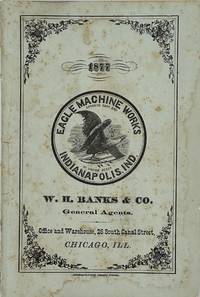
1877Best.-Nr. 54690Indianapolis IN: Indianapolis Journal Co 1877. Trade catalogue. 8vo. 32 pp. 4-page inserted price list dated March 1877. Profusely illustrated with seven black and white wood-engraved plates four large black and white illustrations in text and five striking folding chromolithograph plates. Original printed green wrappers foxed. Very good. A scarce catalogue of heavy agricultural machinery with five brilliantly colored folding plates chromolithographed by Chandler Indianapolis depicting the "double canvass separator Hasselman separator oscillator thresher agricultural engine and the Eagle horse power." Romaine records nothing from this firm. OCLC locates several items from this firm but nothing before 1883. 1219. Indianapolis Journal Co unknown
1877Best.-Nr. 54690Indianapolis IN: Indianapolis Journal Co 1877. Trade catalogue. 8vo. 32 pp. 4-page inserted price list dated March 1877. Profusely illustrated with seven black and white wood-engraved plates four large black and white illustrations in text and five striking folding chromolithograph plates. Original printed green wrappers foxed. Very good. A scarce catalogue of heavy agricultural machinery with five brilliantly colored folding plates chromolithographed by Chandler Indianapolis depicting the "double canvass separator Hasselman separator oscillator thresher agricultural engine and the Eagle horse power." Romaine records nothing from this firm. OCLC locates several items from this firm but nothing before 1883. 1219. Indianapolis Journal Co unknown books
Best.-Nr. 172080TRADE CATALOGUE. Katalog masných výrobku a konserv. Catalogue of meat products and conserves. 100 pp. Oblong 4to publisher's cloth. Prague : Ministerstvo potravinárského prumyslu 1953. A handsome and unusual Eastern European trade catalogue full of edible delights which were probably available more in the imagination than reality in a year when most people's savings were wiped out. OCLC lists Wellesly Stanford and the Tate. hardcover
Best.-Nr. 172080TRADE CATALOGUE. Katalog masných výrobku a konserv. Catalogue of meat products and conserves. 100 pp. Oblong 4to publisher's cloth. Prague : Ministerstvo potravinárského prumyslu 1953. A handsome and unusual Eastern European trade catalogue full of edible delights which were probably available more in the imagination than reality in a year when most people's savings were wiped out. OCLC lists Wellesly Stanford and the Tate. hardcover books
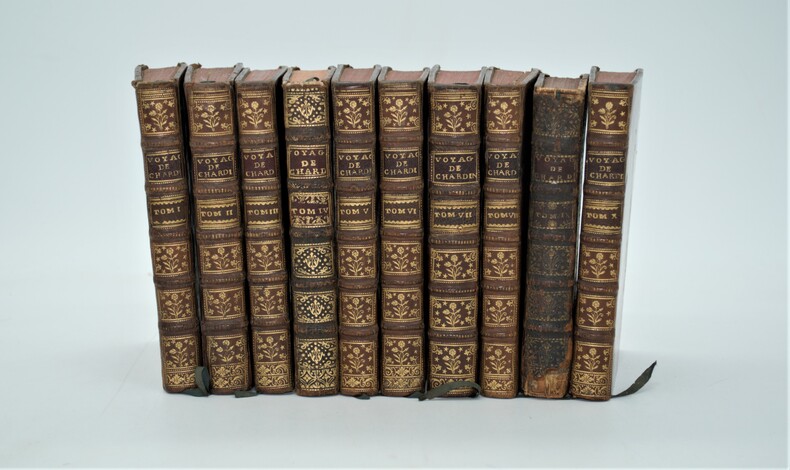
1723Best.-Nr. PHO-9451723, à Paris chez Denys Horthemels , 10 vol., in-12, veau blond de l'époque , dos à 5 nerfs orné avec pièces de tire et tomaison, caissons fleuronnés dorés, tranches rouge , 32p-254, 334, 285, 280, 312, 328, 10 p.-448, 255, 308, 220-(82) pp. , (T 4 et 9 reliure légèrement différente, T4-plats frottés,page de titre réparée ,T 9- imprimé à Rouen,petites rousseurs , manque la page de garde, manque au dos,charnière fendue , plats frottés , coins usés , cachets répétés)
1802Best.-Nr. PHO-1460Paris, Henri Agasse, 1802 , TEXTE et ATLAS , texte : 2 vol. in-8 de LVI-359-[1]-383pp. ,relié demi cuir , dos lisse avec titre et tomaison, plats frottés , coins et coupes usés , manque la page de titre ,XXXI,XXXV à XLVIII , 334 à 337 au tome 1 et les page 245 à 252 au tome 2 et Un ATLAS in-4°, viii-[4]-67 pp.; 43 planches (44), relié demi veau , dos lisse , quelques défauts à la reliure , petites rousseurs à l’atlas et papier légèrement bruni.