OUDER-MEULEN (Cornelis van der).Livre Rare Book

15 859 résultats
1778réf. 12194Amsterdam, Marc-Michel Rey, 1778-1784. 4 parties en 2 vol. in-8 de XVI-200 pp. (8)-234 pp. 8 tableaux, 4 planches numérotées et 1 carte hors-texte ; (6)-250 pp. VI-268 pp. 2 planches hors-texte, demi-basane blonde à petit coins, dos orné à) nerfs, pièces de titre et de tomaison rouges et noires (reliure de l'époque).
1780réf. 16851780 Chez la Veuve Desaint, Paris, 1780. volume in-4, reliure moderne, pleine toile. (2, xv, 6), 956 pages.
1785réf. 151841785 reliure plein veau brun in-quarto carré (binding full calfskin in-quarto), dos 5 nerfs (spine with 5 raised bands) - entre-nerfs à encadrement à filets pleins et filets perlés - fleuron - rinceaux aux angles et petits fers en remplissage (between the raised bands with framing and with gilt full lines and beaded lines - floweret and with foliages carried out with the curved line in angles and small blocking stamp in filling) - pièce de titre comportant le titre abrégé de l'ouvrage sur fond grenat avec filet or (garnet label of the title with the title abbreviated by the work with gilt line), petits manques de cuir sur le dos - en haut et en bas (missing pieces of leather on the spine - at the top and below), coiffes supérieure et inférieure manquantes (are missing the head and tail of the spine), petit accident à l'échancrure de tête du premier plat (small accident in the top indentation of the front cover), charnières fendues (cracked joint), coins émoussés (corners blunt), coupes légèrement frottées par endroits jusqu'au carton (rubbed cuts in places up to the cardboard), toutes tranches rouges (all red edges) - décolorées (colourless edges), pages de garde en papier peignées à motif "coquille sur fond caillouté" (painting endpapers - model shell on paved bottom), texte à manchette (marginal note), sans illustration (no illustration), de naissances de rousseurs à papier jauni sans conséquence pour la compréhension du texte (of beginning of the redness marks in lightly yellowing of paper - no consequence for the understanding of the text), cicatrices de mouillures (scars of waterstains), 604 et 46 pages, 1785 à Paris Chez Knapen et Fils Libraires-Imprimeurs de la Cour des Aides au bas du Pont Saint Michel,
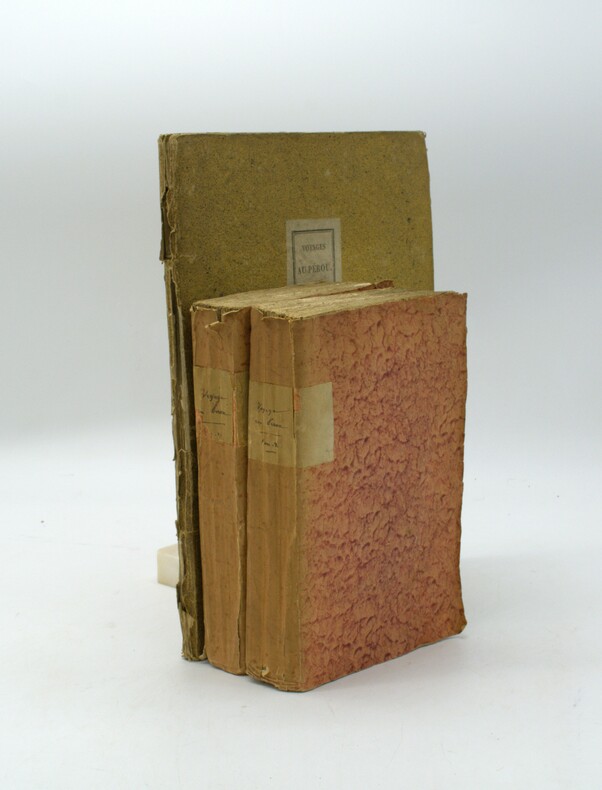
1810réf. PHO-1272Paris, Clament, 1810. 3 vol. In-8° (202 x 136 mm) TOME 1:301pp TOME 2 : [2], 390 pp. ; TOME 3 : 291 pp., avec 4 tableaux et 1 (2) carte dépliante de Mentelle and Chanlaire (Inde) sur papier bleuté , contours coloriés , Tome 1 , relié, demi cuir , dos lisse avec pièce de titre et tomaison, tome 2 et 3 en brochage d’attente papier bleu (non rogné , manque au dos , dos cassé tome 2)
réf. 662471A Paris, chez Cuchet, 1788 2 tomes en 1 vol. in-8, XII-293-[2] pp. et VI-259-[1] pp., basane fauve marbrée, dos lisse orné d'encadrement de filets et de frises dorés, fleurons dorés au centre et en écoinçon, chaînette dorée sur les coupes, tranches jaunes (reliure de l'époque). Petits trous de vers sur les mors et qqs épidermures sur les plats. Mouillures claires en tout début d'ouvrage.
1809réf. PHO-1737Paris, J.G. Dentu, 1809. 3 volumes TEXTE, 2 vol. in-8°,[2]-xii-385, [2]-427 pp. , brochage d’attente orange, étiquette avec titre au dos, quelques frottement. ATLAS, 1 vol. in-4° (290x225),12 planches sous serpente en couleurs et une carte de Lapie, reliure d’attente, titre sur le plat, dos manquant, coutures apparentes, la carte est volante et datée de 1829, elle provient d’un autre ouvrage
1826réf. PHO-1888Paris, Dondey-Dupré, 1826-1827. Grand in-4 (33x25cm), 32 pp. + [1] f., pl., demi-basane fauve, dos lisse orné de filets et de petits fers dorés, auteur et titre dorés, coiffe de tête manquante, quelques rousseurs sur les planches, fente au pli de la carte). Provenance : A. de Sibeud de Ferriol (Grenoble, 1817-1880 ; ex-libris gravé).
réf. 2081002109001333Kyushu Mining Association N.A. Soft Cover. Fine. Number of pages: 372p Size: 27cm Kyushu Mining Association paperback
Madrid, Imprenta de Alban, 1807, 15 x 10,5 cm., piel de época, X + 257 págs. + 1 hoja. (Esta rara obra, escrita bajo seudónimo, es en realidad del ilustrado diplomático y experto en comercio internacional afrancesado Juan Bautista Virio. En ella argumenta los medios usados por Gran Bretaña para perjudicar los intereses de España y señala algunas artimañas empleadas por ese reino para ganarse la opinión internacional. El autor estudia una gran cantidad de oficios e industrias, incluidas la pesca de ballenas y arenques, la pesca en Groenlandia y Terranova, el comercio del carbón, de la lana y textiles, tabaco, vinos, y el comercio de los buques británicos con América, la India y el Báltico).
réf. 12976A Lyon, Chez L'Auteur, Quai des Célestins, 46 angle de la rue de Savoie.Et chez tous les marchands de nouveautés en librairie, 1852 - Brochure In Octavo de 56 pages, plats en papier bois de rose cerné d'un encadrement d'un double filet en noir, agréable titrage en noir de diverses polices, à noter qu'un feuillet d'averstissement est inséré dans le livret - non rogné, non épidermé - pagination marmoréenne.
réf. 16666Ex officina Plantiniana Balthasaris Moreti "Anvers, 1626, in-folio, plein veau sur ais de bois décoré à froid, dos à cinq nerfs, restes de fermoir en laiton et de coins. Reliure de l’époque. Manque en haut du dos (de la coiffe au premier nerf) ; manque de cuir de recouvrement au coin inférieur droit du premier plat. Quelques petits manques sur les nerfs. Petit trou de vers sur les 15 premiers feuillets avec perte de quelques lettres. Mouillure très claire dans l’angle supérieur de quelques feuillets sinon intérieur propre et sain. 8ff. (dont le titre-frontispice) 825pp.-34ff. d’index-2ff. bl. Texte sur deux colonnes. Frontispice allégorique d’après Pierre Paul Rubens, gravé par Cornelis Galle (331mmx202m). Ce frontispice apparait pour la première fois avec la quatrième édition de cet ouvrage en 1617. Titre écrit dans un ovale de laurier, flanqué de personnifications féminines du sage gouvernement et de l'abondance ; La Justice assise en haut au centre entre un lion et une balance ; au-dessous du titre se trouvent un satyre et un homme aux yeux. La première édition du De Justitia est publiée à Louvain en 1605 et connaitra une vingtaine d’éditions au XVIIe siècle. Lessius est en effet le premier théologien à se pencher sérieusement sur les problèmes moraux liés à l’économie de marché et la finance. « Cette oeuvre a joué un rôle primordial dans l’histoire du droit des obligations. Plus d’une fois le prétendu fondateur du droit naturel moderne, le hollandais Hugo Grotius, se borne à donner une simple synthèse dans son Du droit de la guerre et de la paix (De iure belli ac pacis) de ce qu’il a lu dans le De iustitia et iure de Lessius, au point même d’en copier les fausses références. Pour la rédaction de son traité, Lessius fut lui-même fortement inspiré par un collègue un peu plus âgé originaire de Cuenca, Ludovic Molina (1535-1600). Ludovic Molina fut le premier jésuite à adopter le modèle du De iustitia et iure pour aborder toutes les questions juridiques concernant la propriété, les actes illicites, les contrats, les testaments, les taxes, les bénéfices ecclésiastiques, les règles monastiques etc. » (Le droit au creuset de la théologie morale Wim Decock) Provenance : Fr. Iacobivanden Berghe tertii Ordinis St. Francisci Conventus Antverpiensis filii (ex-libris manuscrit au reco du second plat.) Décédé à Anvers le 19 février 1685. Backer-Sommervogel Bibliothèque de la compagnie de Jésus T.IV-1729, N°5 / Basan, Catalogue des estampes d’après P.P. Rubens, p.178 N°30 / Judson & Van de Velde (Corpus Rubenianum XXI), 38. "
réf. 15962Chez Jean-Edme Dufour, imprimeur et libraire "A Maestricht, 1775, 7 vol. in-8 veau tacheté, dos rond sans nerf. Dos encadré d'un double filet doré, roulettes et fleurons ""soleil"" dorés. Reliure de l'époque. T.I 1f.-Frontispice-1f. De titre-3pp. Explication des estampes-Portrait de Raynal-VIIIpp.-carte-439pp (dernière chiffrée 437 par erreur) // T.II Xpp.-frontispice-carte-316pp. // T.III XIIpp.-frontispice-carte-440pp. // T.IV VIII-frontispice-carte-301pp. // T.V VIII-frontispice-carte-296pp. // T.VI VIII-fontispice-carte-287pp. // T.VII VIII-frontispice-carte-326pp. Cohen 854 (qui indique par erreur 8 vol. Tous les volumes sont par ailleurs à la date de 1775 et non 1774-1775). Tous les volumes sont à l'adresse de Maestricht, y compris le vol.V contrairement à ce qu'indique Bancarel. Exemplaire bien complet des 7 figures par Eisen non signées reproduisant celles de l'édition de Gosse fils (La Haye 1774), du portrait et des 7 cartes dépliantes dressées par Bonne. Véritable ""encyclopédie du décolonialisme"", cet ouvrage initialement publié anonymement en 1770 connu près d'une cinquantaine d'édition jusqu'en 1843. Raynal revendique la paternité de l'ouvrage à partir de la troisième édition en 1780, son nom apparaissant sous le portrait. L'ouvrage fut condamné par la censure civile et ecclésiastique et brulé en place publique. Raynal fut également comdamné à l'exil. Il faut néanmoins relativiser la part de Raynal dans la rédaction de l'ouvrage puisque la partie philosophique, quand elle n'est pas de la main de Diderot, est largement empruntée au Baron D'Holbach, à Naigeon et Péchmeja. Pour ce qui concerne le commerce, Raynal a inséré des mémoires du fermier général Paulze, des comtes d'Aranda et de Souza. Cette Histoire des deux Indes constitue l'un des plus virulent réquisitoire contre l'esclavage à l'époque des Lumière. Quelques coins frottés, tout petit manque de cuir à un mors du T.VI sinon très bel exemplaire en fine reliure de l'époque. Cette édition ne comporte pas d'atlas et est complète telle que décrite."
1990réf. mon0000365036Stationery Office Books 07/03/1990 00:00:01. paperback. Good. in x in x in. Ex-library book usual marking. Clean copy in good condition. Stationery Office Books paperback
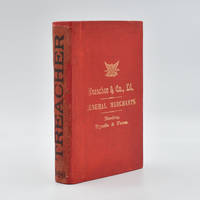
1906réf. 21209251906. Mumbai: The Times Press. 1906. 8vo. Publisher's red cloth upper board lettered in gilt spine lettered in black; advertisements to pastedowns; pp. x iv xxi 1 blank '800' i.e. 802 xi-xviii continued pagination from advertisements at front free endpapers included in pagination; pp. ii-x and xi-xvii printed on pink paper numerous lithographic in-text illustrations throughout p. iv printed in pink 23 ff. plates of which 6 on pink paper 9 in colour and 2 double-page pp. 352-530 'Jewellery and Hall-Marked Goods' printed on thick paper; rebacked with original spine laid down plate facing p. 732 with two central closed cuts browning to 2 ff. tipped-in advertisements after p. 330; a very good copy; contemporary manuscript corrections to p. i. An extensively illustrated and very rare Mumbai-printed trade catalogue advertising goods for the British market in India encompassing an extraordinary range of products from gunpowder to soap and everything in between with numerous coloured plates.Treacher & Co. were a prominent British-run firm operating as merchants druggists and chemists based in Bombay Mumbai and Poona Pune during the late nineteenth and early twentieth centuries. This extensive catalogue presents a vivid picture of colonial consumption and supply advertising an exhaustive array of merchandise including toiletries; crockery; agricultural machinery and flower and vegetable seeds; pipes; sporting equipment and 'Gymkhana kit' including Brooks' bicycle saddles for both men and women bicycle pumps dumbbells and Sandow's Obesity Reducer and Sandow's Combined Developer; alcoholic drinks as well as 'Sparklet's' carbonation tablets and 'Seltzogenes for the production of sodawater lemonade gingerade &c.'; parlour games including board games billiards roulettes and table bowls; cameras; books and medical remedies; jewellery; and more. The catalogue features numerous plates many chromolithographic or printed on coloured paper advertising china sets gunpowder biscuits tar and vinolia soaps California poppy perfumes Windsor & Newton's paints and hair lotions inter alia. A contemporary owner has corrected in manuscript the names of two of Treacher & Co.'s directors to p. i.No copies traced on OCLC or Library Hub. hardcover
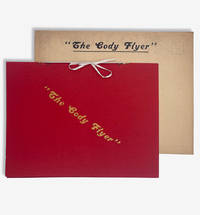
1912réf. 21208461912. Aldershot: Gale and Polden. 1912. 4to. Original red card wrappers lettered in gilt original printed envelope preserved; pp. 11 1 highly illustrated after photographs and drawings printed on yellow blue and white coated paper; wire-stitching removed and replaced with new ties traces of oxidation along gutters final page with a little offsetting from red wrappers; a rare survival with the original printed envelope this a little spotted.Extremely rare trade catalogue for the Cody mono- and biplanes as well as a manned war kite. 'Samuel Franklin Cowdery was born in 1867 in Davenport Iowa was a Wild West showman and early pioneer of manned flight. He changed his name to Cody at age 21 when he was part of a touring Wild West show not to be confused with that of Buffalo Bill Cody. He is most famous for his work on the large kites known as Cody War-Kites that were used by the British in World War I as a smaller alternative to balloons for artillery spotting. Financed by his Wild West shows Cody's unusual interest in manned kites advanced significantly when he enlarged upon Lawrence Hargrave's double-cell box kite to increase its lifting power especially by adding wings on either side. He patented his design in 1901 and it became known as the Cody kite. Cody eventually managed to interest the British Army in his kites. In 1906 he was appointed Chief Instructor of Kiting for the Balloon School in Aldershot and soon after joined the new Army Balloon Factory down the road at Farnborough. The Factory would eventually become the Royal Aircraft Establishment. In 1908 the War Office officially adopted Cody's kites for the Balloon Companies he had been training. This group would in due course evolve into the Air Battalion of the Royal Engineers No. 1 Company of which later became No. 1 Squadron Royal Flying Corps and eventually No. 1 Squadron Royal Air Force. During 1907 he was given full authority as the designer of the the British governments dirigible understructure and propulsion system. On 5 October 1907 Britain's first powered airship British Army Dirigible No 1 and using Cody's engine the Nulli Secundus flew from Farnburough to London. In 1907 the British Army decided to back the development of Cody's powered aeroplane the British Army Aeroplane No 1. His flight of 16 October 1908 is recognized as the first official flight of a piloted heavier-than-air machine in Great Britain. He went on to win a number of aeronautical awards and started developing his own aircraft company. That company produced the Cody Flyer a monoplane for which this pamphlet was issued. On 7 August 1913 he was test flying his latest design the Cody Floatplane when it broke up at 200 feet and he and his passenger the cricketer William Evans were killed' Nat DesMarais Rare Books. The 1908 British Army Aeroplane No.1 was actually Cody's biplane sometimes called Cody 1 later officialy referred to as The Cody Flyer. 'On 16 October at Farnborough it made what is recognised officially as the first sustained powered flight in Great Britain by a heavier-than-air machine covering 423.7m before crash-landing' Virtual Aircraft Museum online.Library Hub locates a single copy in the National Aerospace Library. unknown
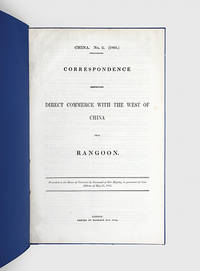
1865réf. 195501London: Printed by Harrison and Sons 1865. First edition containing several detailed reports of British expeditions undertaken in the early 1860s in search of a route into China via the Irrawaddy or Salween rivers. Among the papers is a long 1864 memorandum pp. 68-82 by Dr Clement Williams 1833-1879 the first political agent in Mandalay which draws on his explorations of the Irrawaddy. He argues strongly in favour of a trade route running by steamer along the river as far as Bhamo and onwards to Yunnan by road. Williams subsequently published Through Burmah to Western China 1868 and joined the Sladen Expedition of the same year. Two other accounts are by Lieutenants Gideon Colquhoun Sconce pp. 32-51 and C. E. Watson pp. 55-66 who both surveyed the upper course of the Salween between November 1863 and March 1864. Large quarto 321 x 204 mm. Tables in text. Recent blue limp card wrappers printed title label on front cover. Ex-All Souls College University of Oxford with its 19th-century ink stamp on list of papers; leaves foliated in pencil. Light foxing and creasing: very good. unknown
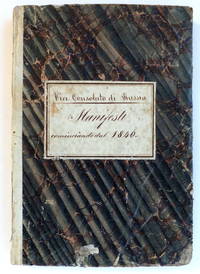
1840réf. 3417Through Russian Waters RUSSIA - TRADE FORMS. Vice Consolato di Russia. Manifesti cominciando dal 1840. Trapani 1840-49. Small folio pp. 196 of pre-printed shipping manifest forms of which 137 completed in ink; contemporary flexible vellum-backed marbled paper boards with ink-lettered label to upper board; corners bumped and spine a little chipped. Fine documentation of the maritime trade from the harbour of Trapani in Sicily. The manifest gives bills of lading from January 1840 to March 1849. The pre-printed manifests are completed in ink giving the name of the freight ship and its captain the destination and then details of its freight i.e. type and quantity of merchandise names of senders and recipients. Trapani boasts some of Europe's oldest salt marshes and salt extraction has been a major business for centuries which still flourishes to the present day. By the nineteenth century Sicilian sea salt was exported to European countries as far away as Norway and Russia. These shipping manifests document that it was sent to destinations as far afield as Constantinople Abo Stavanger Carlscrona Stockholm Bergen Odessa Reval and Riga. Clearly some of the shippers acted on their own account being both captains of the ship and shipper whereas others acted on commission. The shipping routes went through Russian waters which explains the accounts kept by the Russian Vice Consulate.
Paris, chez Giraud-Badin, 1924-1928. 29 volumes petits in-4, brochés. ENSEMBLE EN PARFAIT ETAT. COMMERCE, revue littéraire fondée en 1924 par Marguerite Caetani, se présente sous la forme de vingt-neuf « cahiers trimestriels publiés par les soins de Paul Valéry, Léon-Paul Fargue et Valéry Larbaud ". Elle s’inscrit magistralement dans le champ concurrentiel des revues des années vingt. Commerce joue un rôle de « découvreur » important, s’ouvre au meilleur des auteurs étrangers de son temps et redécouvre des anciens textes capitaux : par son esprit « classique moderne », Commerce réinvente l’héritage classique. elle publie vingt-neuf numéros entre 1924 et 1932. Jean Paulhan participe aussi à sa rédaction. Elle propose en son premier numéro les premiers extraits traduits en français d'Ulysse de James Joyce. Textes de Louis ARAGON, Antonin ARTAUD, André BRETON, Paul CLAUDEL, Pierre DRIEU LA ROCHELLE, T.S. ELIOT, Léon-Paul FARGUE, André GIDE, Thomas HARDY, Max JACOB, James JOYCE, Valéry LARBAUX, Henri MICHAUX, SAINT-JOHN PERSE, Francis PONGE, RIBEMONT-DESSAIGNE, Rainer Maria RILKE, Jacques RIVIERE André SUAREZ, Jules SUPERVIELLE, Paul VALERY, Roger VITRAC. Un certain nombre de textes, comme « Colline » de GIONO et « Nadja » de BRETON y sont parus en pré-originale. Tirage numéroté sur alfa. Founded in 1924, Commerce is a literary review which discovers new talent, welcomes the best of contemporary foreign writing, and rediscovers seminal texts from earlier eras : with its take on the ‘modern classic’, Commerce seeks to reinvent traditional literary history".
1781réf. ABC_50510Pressburg =Bratislava 1781. Ca. 46 x 32 cm. With an engraving of Pressburg Bratislava and an engraved title. A rare and highly evocative example of an 18th-century Preis-courant or commodity price current published in Pressburg modern-day Bratislava capital of Slovakia. Such documents produced at regular intervals often weekly served as indispensable instruments of commerce providing merchants and their correspondents with up-to-date market prices for a wide range of goods.The present work dated 2 April 1781 is a particularly attractive sheet. It combines a finely engraved panoramic view of the city with a densely organised tabular listing of commodities arranged in four columns on both sides. Prices are carefully entered by hand in ink in florins fl. and kreuzer kr. reflecting the customary monetary system of the Habsburg lands. The mixture of printed framework and manuscript additions is characteristic of privately published price currents which were distributed rapidly and updated locally to reflect current market conditions.The range of goods listed points to the thriving trade in raw materials medicinal substances and colonial produce. As was common practice in the 18th century many items are recorded using Latin nomenclature underscoring the documents relevance to apothecaries wholesalers and international merchants alike. Such lists offer a vivid cross-section of early modern trade from local agricultural products to exotic imports circulating along established commercial routes.At the time of publication Pressburg occupied a position of considerable importance within the Habsburg Monarchy. Situated on the Danube it functioned as a major trading hub linking Vienna Buda and the wider regions of Central Europe. Until 1783 it also served as the capital of the Kingdom of Hungary and as a major administrative and cultural centre where German predominated as the language of official and commercial communication. Its mercantile community comprising traders professionals and artisans played a key role in sustaining long-distance trade networks.The work has been folded the folds are slightly torn along the edges. Otherwise in good condition. unknown
1781réf. ABC_50510Pressburg =Bratislava 1781. Ca. 46 x 32 cm. With an engraving of Pressburg Bratislava and an engraved title. A rare and highly evocative example of an 18th-century Preis-courant or commodity price current published in Pressburg modern-day Bratislava capital of Slovakia. Such documents produced at regular intervals often weekly served as indispensable instruments of commerce providing merchants and their correspondents with up-to-date market prices for a wide range of goods.The present work dated 2 April 1781 is a particularly attractive sheet. It combines a finely engraved panoramic view of the city with a densely organised tabular listing of commodities arranged in four columns on both sides. Prices are carefully entered by hand in ink in florins fl. and kreuzer kr. reflecting the customary monetary system of the Habsburg lands. The mixture of printed framework and manuscript additions is characteristic of privately published price currents which were distributed rapidly and updated locally to reflect current market conditions.The range of goods listed points to the thriving trade in raw materials medicinal substances and colonial produce. As was common practice in the 18th century many items are recorded using Latin nomenclature underscoring the documents relevance to apothecaries wholesalers and international merchants alike. Such lists offer a vivid cross-section of early modern trade from local agricultural products to exotic imports circulating along established commercial routes.At the time of publication Pressburg occupied a position of considerable importance within the Habsburg Monarchy. Situated on the Danube it functioned as a major trading hub linking Vienna Buda and the wider regions of Central Europe. Until 1783 it also served as the capital of the Kingdom of Hungary and as a major administrative and cultural centre where German predominated as the language of official and commercial communication. Its mercantile community comprising traders professionals and artisans played a key role in sustaining long-distance trade networks.The work has been folded the folds are slightly torn along the edges. Otherwise in good condition. BOOK HISTORY & PRINTING ECONOMY TRADE & NUMISMATICS EUROPE Broadsides Ephemera & Pamphlets Central Europe Economic History & Trade unknown
1781réf. 704313Göttingen, Victorinus Bossiegel, 1781. Kl.-8°. Gestoch. Frontispitz, gest. Titelvign., 7(2 gef.) Kupfertaf., 9 Bl., 136 Seiten. Schlichter Pappband der Zeit mit kleinem Rückenschild.
1965réf. 015774Veilhes G.P. [Gaston Puel] 1965 In-12 En feuilles, couverture à rabats <
réf. 47179Richard/Caille/Ravier.An VII de la république.2 vols,petits in-8,formats à l'italienne.388 et 482 p.avec Tables. Intérieurs frais.Reliures d'époque avec pièces de titre et tomaison.Tranches rouges.Coins émoussés dans le Tome 2.Coiffes absentes ou usagées.Tome 1: mors inférieurs ouverts.
1945Features: X for Escape - Photo-illustrated article (part 1 of 2) by Flt.-Lieut. Tony Pengelly describes the dramatic Great Escape from Luft Stalag III involving 83 prisoners, 50 of whom were later shot - basis for the classic WWII film The Great Escape starring Steve McQueen; Nice cover illustration by R. York Wilson features brass band practicing; W.A. Irwin becomes new Editor of Maclean's - photo and brief article; Relax - It's Good for You; Bee Business - Ervin Hogarth has 150 bees near Tara, Ontario; Mars Gone Barmy - Maj.-Gen. J.F.C. Fuller argues atomic war cannot be won; Where Milk is Medicine - Europe's lack of food in the aftermath of WWII; Britian's Place in the World; Washington Memo - U.S. Strikers want to keep war wages (52 for 40 or Fight!); Backstage Ottawa - NRMA men (Zombies) were sent to the First Canadian Division on or after VE Day; Is the Union Shop Democratic? - arguments for and against; Sculptors Elizabeth Wyn Wood and Mani Hahn - Photo-illustrated article; "When the Ice-Worms Nest Again" - Brief article discussing Robert Service; Stretch the Meat; and more. Short stories include: Molly Was a Doctor; White Horse; Soft Music. Nice ads for: The Wartime Prices and Trade Board (encouraging the mending of clothes); Imperial Oil (featuring oil exploration); Frigidaire, Kraft Philadelphia Cream Cheese; Canadian Pacific (color illustration of driving of the last spike to celebrate 60 years of progress, 1885-1945); Pepsodent Tooth Paste; Eveready Flashlight Batteries - featuring image of Vancouver radio personality Thora Anders; Arrid deodorant - featuring photo of Gertrude Niesen; Nostalgic one-page Maclean's subscription ad; National War Finance Committee; Nice colour-photo Caterpillar Diesel ad inside back cover features two dozers preparing new rail bed through mountains. 68 pages. Unmarked with average wear. A quality copy of this historic vintage issue. Book
1892417 pages. Index. Appendices. Footnotes. List of sixty black and white illustrations. A rare surviving copy of this important reference, made all the more engaging by today's environment of competing fiat currency devaluations. "Hitherto Numismatists when stydying the Origines of Coinage had confined themselves to the materials presented to them in the earliest money of Lydia, Greece and Italy, and on the other hand the Metrologists had almost completely limited their range of observation to the systems of Babylon, Egypt, Greece and Rome. As the Comparative Method has yielded such excellent results in the study of other human institutions, I have endeavoured by its aid to get some new principles which may throw some fresh light on the first beginnings of monetary and weight systems." - from Preface. Attractive gilt decoration upon green front board. Legible gilt lettering upon backstrip. Average external soiling and wear. Several chips from and lengthy openings along backstrip which has become brittle with age. Narrow opening along most of front hinge. Back hinge open. Bookplate discretely removed inside front board. Unmarked. A tender but worthy copy. Book