15.859 Ergebnisse
1713Best.-Nr. 68433London: Printed by John Baskett 1713. Spain Grants Britain a Monopoly on the Slave Trade in the Americas First edition in English of one of the most important documents in the history of slavery in the Americas and in the political and financial history of Europe and the Americas in the early 18th century. This copy is housed in a large sammelband containing dozens of original documents and extracts related to English-Spanish relations. Though the term "assiento" could refer to any number of Spanish contracts "the Assiento" almost always refers to the "Assiento de Negros": a monopoly contract granted by the Spanish crown between 1528 and 1779 for the sole right to import slaves from Africa into the Spanish colonies. Normally granted to individual companies the 1713 Assiento was granted directly to the British crown as part of negotiations for the Treaty of Utrecht which ended the War of Spanish Succession. In the decades following this 1713 Assiento an estimated 200000 enslaved Africans were transported across the Atlantic. The document grants sole privilege for the trade to the British crown for a period of thirty years expiring in 1743. The agreement consisting of forty-two articles allows for a maximum of 4800 slaves to be introduced to the colonies each year with a provision for increasing that annual amount each year by paying an added duty places limits on sale prices sets the cost of the duty to be paid for each enslaved person allows for the use of British or Spanish ships and mariners in the slave trade provides for the French Guinea Company's extraction from the colonies and establishes the details of precisely where British ships would be allowed to travel and trade. The British were also granted the unique privilege to send one vessel with a cargo of up to 500 tons of other trade goods to the Spanish colonies each year. While the Assiento seemed a lucrative deal most Assientists over the years saw considerable losses due to the difficulty of cross-Atlantic trade and the duties paid to the Spanish king. The real benefit to its grantees was not profits from the slave trade but rather the illegal ability to send other contraband on board their vessels to the otherwise closed-off Spanish markets in the New World. Britain was eager to get their own products overseas and to deny this revenue stream to the French who had held the Assiento since 1701 thereby preventing them from refilling their coffers too quickly and upsetting the balance of power in Europe after the costly War of the Spanish Succession. Queen Anne delegated the Assiento privilege to the South Sea Company which had recently been established to pay off Britain's considerable national debt. The privilege was largely granted to them as an encouragement to investors in order to allow the Company to achieve its original purpose more readily. Ultimately however it proved to be a costly and unprofitable endeavor for the South Sea Company who were able to import only about one-third of their allowed quota of slaves each year were frequently interrupted by war and were required to render twenty-five percent of their profits to King Philip V of Spain. The present example comes from the British Foreign Office Library inlaid and bound into a folio volume of other treaties between Great Britain and Spain arranged chronologically by treaty date. Over the course of many years the library of the Great Britain Foreign Office inlaid copies of nearly every treaty involving Great Britain to folio size and bound them together by region. The library was dispersed in the late 20th century with most of the volumes and particularly the American volumes sold by this company. Most of the other treaties with Spain within this volume are clippings or extracts from larger works or true copies in manuscript of treaties dated between the years 1176 and 1739. Included in the volume however is a separately printed English edition of the Treaty between Great Britain and Spain as part of the Treaty of Utrecht ESTC T51509. There are two issues of the Assiento treaty; this is the issue with a semicolon after "Assiento" and no punctuation after "or" on the titlepage. A crucially important document in the history of colonial trade Spanish-British relations English finances and slavery in the Americas. Folio. 19th-century half roan and marbled paper boards. Boards worn some restoration at joints. Text trimmed and inlaid into folio sheets bound in volume of treaties between Great Britain and Spain. Bookplate of the British Foreign Office Library on front pastedown. HANSON 1896. ESTC T4476. EUROPEAN AMERICANA 713/85. JCB 1III:175. SABIN 2227. SPERLING 34. hardcover books
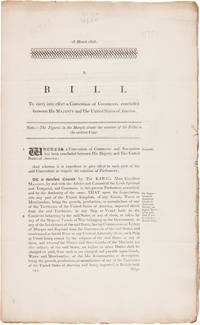
1816Best.-Nr. 39129London: Ordered by the House of Commons to be Printed March 18 1816. Trade Restored After the War of 1812 Official Parliamentary draft printing of a commercial agreement between the United Kingdom and the United States passed just over a year after the signing of the Treaty of Ghent. The convention of commerce establishes that the same import and export duties be applied to goods carried by American and British ships in direct British-American commerce. Duties on and bounties for prize ships and goods are also put on the same terms. This version of the bill would have been printed while the question was being considered by Parliament. Not in Kress or TPL and not listed on OCLC. 2pp. plus docket title printed on verso of second leaf. Folio. Early horizontal folds. Near fine. Untrimmed. unknown books
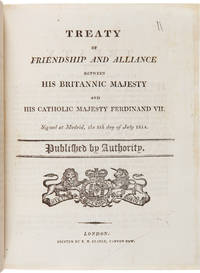
1814Best.-Nr. 38942London: Printed by R.G. Clarke 1814. England Seeks a Trading Foothold in South America The final settlement between England and Spain at the end of the Napoleonic Wars. An important treaty which guarantees for England most favored nation status in the event of the commerce of Spanish America being opened to foreign trade. Includes an article of agreement regarding the injustice and inhumane nature of the traffic in slaves and a SEPARATE ARTICLE stipulating that the king of Spain not engage in any treaty with France "of the nature not known under the domination of the Family Compact." Printed in English and Spanish. Modern half morocco and marbled boards. Near fine. hardcover books
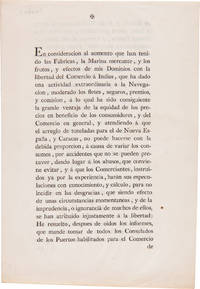
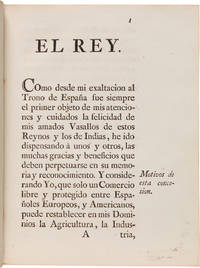
1789Best.-Nr. 47977Madrid. February 28 1789. Spain Regulates Trade with the Americas This royal decree liberalized the tightly controlled trade between Spain New Spain and the Captaincy of Caracas. The Crown hoped to spur navigation and commerce and lessen the incentive for smuggling. Export duties on goods travelling to the Indies were to be slashed by ten percent but penalties against contraband would still be enforced. Two worm holes very minor soiling else fine. unknown books
1801Best.-Nr. 57454Philadelphia: Printed by Zachariah Poulson Junior February 9 1801. With a Contemporary Manuscript Document The official Articles of Association for the Philadelphia Chamber of Commerce adopted when it was founded on January 5 1801 along with a manuscript document regarding changes to those rules written shortly after. The titlepage of the ARTICLES OF ASSOCIATION exists in two states; this is the much rarer state which specifies the month and date in the imprint. The Chamber was established according to these articles "for the purpose of aiding the Trade of the City of Philadelphia by carrying into effect such Rules and Regulations as may from time to time be established with respect to our Commerce and the adjustment of Mercantile differences between each other." The Chamber of Commerce was founded exclusively for merchants with rule XV stating that "No person can become a Member of this Institution who is not a citizen of the United States and a trading merchant of the city of Philadelphia either as a ship owner importer or exporter or a marine insurance broker." This rule was reversed in 1834 when the Chamber of Commerce was absorbed into the Philadelphia Board of Trade and became open to all businessmen. The accompanying manuscript document dated March 2 1801 is addressed to Thomas Willing Francis and regards the proposed reconsideration of Rule XII which states that members may not refuse to submit their accounts to the Chamber in the case of a legal dispute as well as a handful of other motions. Thomas Willing Francis 1767-1815 was a Philadelphia native from a long line of Pennsylvania businessmen. After graduating from the University of Pennsylvania in 1814 he entered the family firm of Willing & Francis - the firm which had sent the first recorded American ship to China for the purpose of trading opium nearly a decade before. He was a founding member of the Chamber of Commerce achieved the rank of captain in the Second Philadelphia City Cavalry and served as a director of numerous other Philadelphia organizations. A significant document in the economic and civic history of Philadelphia with a rare manuscript addition from less than a month after publication and two months after the Chamber's founding. Contemporary marbled wrappers. Spine ends chipped corners a bit worn. Manuscript with some old folds and light creases. Very good. SHAW & SHOEMAKER 1148. SABIN 61974. unknown books
1825Best.-Nr. 38259New York: Corrected and published by Edmund M. Blunt 1825. First edition under this title of this perennially popular and relied-upon guide for figuring the weight of packages and casks based on their depth and breadth. The work was originally published in 1816 but was found to be so full of errors that it was republished in this "corrected" edition under a new title in 1825. Blunt was also the publisher of the essential navigation guide THE AMERICAN COAST PILOT. 4196pp. plus 20pp. of advertisements. Tall narrow octavo. Contemporary calf gilt morocco label. Hinges cracked boards worn. Tanned scattered foxing. Fair. AMERICAN IMPRINTS 19773. hardcover books
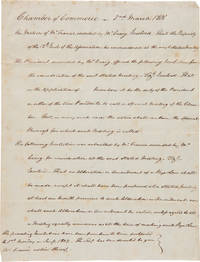
1801Best.-Nr. 56123Great Britain. ca. 1801-1807. British Essay on the Importance of American Trade During the Napoleonic Wars An interesting but unattributed and apparently unpublished manuscript essay with a caption title reading: "Loose Memo. Respectg. American Commerce." The gist of the memo is set forth in the first sentence: "The Americans are at all times the best customers of G.B. - in peace they take 1/3 of her manufactured exports - in War much more." In addition to the eager American market for British goods the author notes that British goods are often trans-shipped via America to other markets where Great Britain would not normally have access thanks to America's neutral status: ".you have only to change the name of the manufacturer & the wants of the Colonists will shut their eyes on the origin of the fabric. I have known Liverpool ware ornamented with the Portrait of Geo. III passed as German manufactures." The author notes that while the understandable economic downturn during the Revolution and for several years after the "peace of '83" resulted in some problematic credit relations between the U.S. and the British market much has changed. "The industry & the enterprise of our countrymen aided no doubt by the enjoyment of a neutral position has enabled them to throw off their dependence on the British merchant or manufacturer. They now have a sufficient capital of their own and a very important proportion of their imports are now paid for in ready money or in bills at short sight." The author explains that American merchants are able to export their surpluses of their own production and surplus British goods to the Continental market and transfer that money directly to creditors in Great Britain with an added perk: "The result of this species of trade must be ruinous to France. She is drained of her wealth to enrich & invigorate her enemy." Finally the author provides a specific example of this favored trading relationship with regard cotton. At this time the author estimates that Great Britain imports three-fifths of all cotton from the United States - some 150000 bags of cotton annually weighing 250lbs. each. The U.S. buys back nearly one-third of all cotton goods manufactured in Great Britain yielding a net profit of over £2.5 million to Great Britain. The author adds that this ratio holds for almost all raw materials produced in the United States. This essay was almost certainly written during the earlier part of the Napoleonic Wars; the author cites an 1801 speech by Lord Grenville which helps narrow the date range and it seems unlikely the Embargo Act of 1807 had been passed yet. Regardless the essay promotes Anglo-American trade and cooperation at least insofar as it enriches Britain and cripples France at a time when other forces were driving the two countries toward war. Light tanning and soiling occasional ink smudges. Very good. unknown books
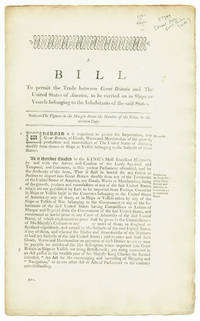
1809Best.-Nr. 47399London. 1809. A Failed Opportunity to Normalize U.S.-British Trade Relations Rare printing of a British Parliamentary "slip bill" seeking to reestablish trade between Great Britain and the United States a few years before the outbreak of the War of 1812 and in the midst of great tension between the two nations. This bill was considered by Parliament in the spring of 1809 in the wake of President Jefferson's rescinding the Embargo Act and following the negotiations between U.S. Secretary of State Robert Smith and British envoy David Erskine which created a glimmer of hope that Anglo-American relations might be repaired after a period of great stress and turmoil. In March 1809 Jefferson signed the Non-Intercourse Act which rescinded the Embargo of 1807 and held out the promise of resuming trade with England and France if either of those nations ended its commercial restrictions toward the United States. The Erskine-Smith negotiations of April held out the promise of improved relations and in May the Parliament considered the present bill which permitted trade between Great Britain and the United States to be carried on in American ships. Unfortunately Prime Minister Canning disavowed the Erskine-Smith Agreement in late May and Anglo-American relations continued to deteriorate culminating in outright warfare in 1812. Slip bills are printed during the legislative process in small numbers for the use of legislators and staff. They are ephemeral items and their survival is rare. A printed note before the text of the bill reads "the figures in the margin denote the Number of the Folios in the written copy" which indicates just how early in the legislative process these bills were printed. OCLC locates only a single copy at the University of Massachusetts. Folio. Lightly tanned around the edges. Near fine. OCLC 49887290. unknown books
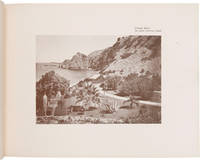
1904Best.-Nr. 21281Los Angeles: Out West Company 1904. Extensive Photographic Illustrations of Southern California Circa 1900 An impressive and beautifully illustrated viewbook of Los Angeles and neighboring communities in Southern California. The nicely produced photographic illustrations depict the stately residences gardens parks beaches public buildings etc. of the just emerging giant city of Los Angeles. Includes a large folding panorama of the downtown business district as it appeared in 1904. Also many images of Catalina Island Santa Monica San Diego Pasadena grape harvesting the Sylmar olive ranch orange orchards etc. 4pp. plus ninety-nine photographic plates two folding. Oblong quarto 11 x 8 inches. Original blind-stamped flexible leather binding with original stitching. Front cover stamped with California poppy design in the Arts & Crafts style. Front flyleaf detached else very good. hardcover books
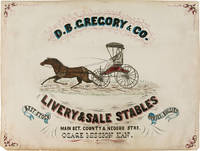
1870Best.-Nr. 55334Osage Mission Ks. N.d. ca. 1870s. Hand-Painted Trade Sign for a Kansas Livery Stable A remarkable and very attractive handmade sign for D.B. Gregory's livery stable in Osage Mission Kansas. Undated the style of the sign suggests a date of the 1870s. The center of the sign shows a lovely illustration in profile of a horse pulling a single-rider four-wheeled carriage along a dirt road. The text above the illustration reads "D.B. Gregory & Co." and below: "Livery & Sale Stables / Best Stock / Horse & Buggies / Main Bet. County & Neosho Strs. / Osage Mission Kan." The lettering is in black with blue and purple shadowing and "Osage Mission Kan." is drawn in a very ornate style. The entire sign is decorated with purple watercolor ornamentation. On the verso is a pencil sketch of the horse and the lower half of the carriage likely a preliminary sketch for the finished illustration. David B. Gregory born in 1846 in Iowa established his livery business with his brother in Osage Mission now St. Paul Neosho County Kansas by the early 1870s. An advertisement in the March 23 1873 issue of the OSAGE MISSION TRANSCRIPT describes Gregory's livery as having a "fine and well selected stock of horses and carriages.the best matched teams for style and speed in the city. Saddle horses for ladies and gents a specialty that defy competition." Settlers came to the region around Osage Mission in the 1840s following the founding of nearby Fort Scott in 1842. Osage Mission itself was founded in 1847 by Father John Schoenmakers as a mission to local Indian tribes and then grew into a town in its own right serving as a trading post and gateway for commerce and westward exploration. By the late 1860s it had grown to nearly 900 people with a hotel boarding house saloon stables general store hardware store and blacksmith. A rare significant and informative survival from the American frontier. Hand-drawn and hand-painted watercolor sign on a 14 x 18¾-inch sheet of cardstock. Pencil sketch for the same sign on the verso. Small chips at lower corners some light soiling. Very good. unknown books
1778Best.-Nr. 37240Madrid: Pedro Marin 1778. Commercial Policy in Spanish America Detailed rules and regulations governing Spain's late 18th-century commercial policy in Latin America with a preliminary section of nineteen pages providing a summary of the articles and tariffs documented in the main portion of the text. With this REGLAMENTO. the Crown terminated Cadiz and Seville's monopoly of trade with Spanish America allowing other cities of the realm to participate. In addition to much information on commerce and numerous tariffs on a large variety of Spanish and American goods several sections discuss shipping ports and other maritime activities directly related to commercial activity. The work also includes the text of concessions granted to Louisiana. Quarto. Contemporary mottled calf spine gilt extra. Light shelf wear corners rubbed. Contemporary ownership inscription on titlepage modern bookplate on front pastedown clipped booksellers' descriptions pasted to front free endpaper. Text quite clean. Very good plus. PALAU 255843. SABIN 68890. MEDINA BHA 4845. unknown books
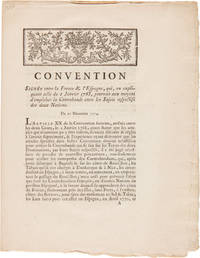
1775Best.-Nr. 14145Versailles. 1775. Further Regulation of Colonial Trade An important treaty between France and Spain with significant ramifications for their colonial holdings in America. Herein Vergennes and the Conde d'Aranda further define commercial arrangements between the two countries in an attempt to control contraband. This had special impact for the Caribbean basin where the colonies of both powers were required to ship goods through European ports. Dissatisfaction over this prohibition was a key factor in the Louisiana Rebellion of 1768. This convention was agreed to at Versailles on Dec. 27 1774. Not in Wroth. 8pp. Quarto. Printed self-wrappers. Fine. DAVENPORT 155. unknown books
1870Best.-Nr. List3896St. Paul Minnesota 1870. Carte de visite measuring 2 ½ x 4 inches captioned "Levee View-City of Saint Paul. / Whitney & Zimmeram Photographers St. Paul Minn. Excellent. A carte de visite photograph of steamboats on the levee in St. Paul Minnesota on the Mississippi River. By the time of Minnesota statehood in 1858 its Upper and Lower Levees together were one of the busiest ports in the country though activity was slowed by the 1862 Dakota War.1 The photograph is attributed to Whitney & Zimmerman. Joel E. Whitney 1822-d. born in Maine was the first photographer in St. Paul known for his portraits of Minnesota volunteers in the Civil War and of Indigenous Minnesotans.2 Charles A. Zimmerman 1844-1909 was a French-born photographer who immigrated to the US in 1848. The two worked as partners in the 1860s and 1870s and are together best known for their series of views of Minnehaha Falls.3 1 Joe Lepsche "The Upper Levee: Memories of Its People And Its Place in St. Paul History" Ramsey County History 33 no. 1 Spring 1998:18-21. 2 "Joel Emmons Whitney" The Autry Museum of the American West accessed May 28 2026 https://collections.theautry.org/mwebcgi/mweb.exerequest=record;id=PE65213;type=701. 3 "Charles A. Zimmerman" Smithsonian American Art Museum accessed May 28 2026 https://americanart.si.edu/artist/charles-zimmerman-7133. unknown books
1940Best.-Nr. 6195Washington: Government Printing Office 1940 . Dated 1942 on cover. Very Good. 24 cm; 392 pages and color folding plates and diagrams. Black and white half-tone photo illustrations throughout. Original gray printed wraps. Some discoloration to wraps minor chips. Government Printing Office paperback books
1893Best.-Nr. 6177Montreal: The Gazette Printing Company 1893. First edition . Very Good. 23 cm; 225 pages and 20 half-tone plates 3 maps two of them folding. Extra half-tone printed title page. Bound in brown pebbled cloth. Slight fray at head; front free endleaf loose else unblemished and in very good condition! Signature of Dugald MacDonald on title page. Valuable reference for the development of commerce in Montreal from the earliest times to the end of the 19th century. The Gazette Printing Company hardcover books
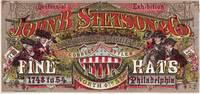
1876Best.-Nr. 13129Philadelphia 1876. Chromolithographed trade card 3 x 6.5 inches. Minor wear paper and adhesive remnants on verso from removal from scrapbook or similar album. Overall very good. A bright and colorful trade card advertising one of Philadelphia's most successful businesses at the time of the 1876 Centennial Exhibition in that city. John B. Stetson 1830-1906 was the son of a successful New Jersey hatter. After being diagnosed with tuberculosis and told he didn't have long to live Stetson traveled west to Colorado for the dry mountain air. Near Pike's Peak sometime in the early 1860s Stetson invented the cowboy hat -- lightweight wide-brimmed waterproof and made out of animal felt usually beaver or rabbit skins. Because it sat easily atop the head offered good protection from the sun could be used to fan the flames of open-air fires and could even carry water Stetson's "Boss of the Plains" style became the most popular hat in the American West. Stetson returned to Philadelphia in 1865 and set up a factory that would turn out millions of hats in the next century and a half. The present trade card emanates from the 1876 Centennial Exhibition celebrating the 100th anniversary of American independence. An illustration of two women and three men show them all wearing Stetson's trademark hats; his address at the time was 1748 to 1754 North 4th Street; his factory would eventually grow to encompass over nine acres and produce over two million hats a year. By 1886 Stetson was the most prolific hat maker in the world. unknown books
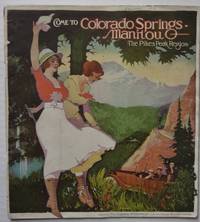
Best.-Nr. 40043COLORADO SPRINGS-MANITOU CHAMBER OF COMMERCE. COME TO COLORADO SPRINGS - MANITOU: THE PIKES PEAK REGION. Colorado Springs: The Chamber 1920s. Square 8vo. Colored illustrated wrappers. 22 pages. Scarce travel promotion for Colorado Springs and region in the 1920s. A richly illustrated many in color booklet of the sites natural wonders as well as tourist resort activities available to the automobile traveler. unknown books
Best.-Nr. 32260TRADE CATALOGUE REVETEMENTS ARTISIQUES DECORATION MURALE. Paris: Coube circa 1895. Oblong 4to. Decorated wrappers. i 26 colored lithographic plates. First edition. Interesting fin-de-siecle French trade catalogue featuring samples of faience bricks and tiles manufactured for hospitals and sanitary facilities. The plates have a high gloss finish which has browned slightly with age. With the rubber stamp of "Charles Soubiran Bordeaux" on the front cover and first printed leaf. Rare. No copies cited by OCLC. unknown books
Best.-Nr. 35911TRADE CATALOGUE Portuguese Door Hardware. Braga: circa 1920's. Oblong folio 15 x 18 1.2 inches. Wrappers. 127 plates. Scarce Portuguese trade catalogue illustrating hundreds of door and furniture hardware samples drawn to scale. Included are escutcheons pulls strap hinges knobs keys etc. Represented are various styles from simple modern styles to elaborate baroque designs. Plates are sepia prints. Many plates signed F. Costa. Plain wrappers worn and chipped and partially missing. Plates have rectangular stamps. unknown books
Best.-Nr. 37490TRADE CARD T.H. WEBSTER TEACHER OF ARCHITECTURE PERSPECTIVE &. London: circa 1810. Engraved card. 2 5/8 x 3 7/8 inches. Webster 1772-1844 revised John Imison's Elements of Science and Art in 1808. On the blank verso he has added his address: No. 6 Clipstone Street. unknown books
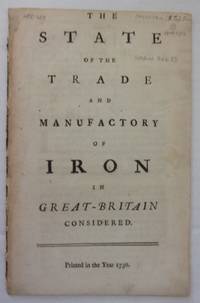
Best.-Nr. 4929AMERICAN IRON TRADE THE STATE OF THE TRADE AND MANUFACTORY OF IRON IN GREAT-BRITAIN CONSIDERED. London: 1750. 8vo. Disbound. 15 pages. First edition. Sabin 90633; Kress S-1991; Goldsmiths' Library 8504. An interesting anonymous tract largely about the trade in iron from the American colonies. Rare. Kress only records a photo copy. 4929. unknown books
Best.-Nr. 35913TRADE CATALOGUE Portuguese Renaissance Furniture. Braga: circa 1920. Oblong folio 10 3/4 x 15 1/2 inches. Wrappers. 12 plates. First edition. Scarce Portuguese trade catalogue illustrating Renaissance styled furniture. Included are designs for wardrobes beds chairs tables cabinets etc. Several plates display arrangements of the furniture in room settings. Plates are sepia prints. Plates are identified in the margins in blue ink. Very good. unknown books
Best.-Nr. 25271TRADE CATALOGUE BOOKBINDING MATERIALS. N.P.: Mochizuki Co. Ltd. n.d. Small folio. Cloth binder. 6 pages 5 pages of samples. This is a trade catalogue from a Japanese firm containing ninety-nine samples of headbands and fifty-two samples of bookmarks. Descriptive text is in Japanese. Fine. unknown books
Best.-Nr. 35912TRADE CATALOGUE Portuguese Metal Household Articles. Braga: circa 1920. Oblong folio 15 x 18 1.2 inches. Wrappers. 53 plates. Scarce Portuguese trade catalogue illustrating hundreds of domestic household articles drawn to scale. Included are picture frames mirrors sculptures trays plaques medallions candlesticks vases etc. They include various styles and feature sculptures influenced by African and Asian themes and elaborate baroque and Renaissance styled pieces. Plates are sepia prints and some signed F. Gortz and M. Silva. Edges of plain wrappers sunned. unknown books
Best.-Nr. 25321TRADE CATALOGUE SAMPLES OF BOOKBINDING CLOTHS. Toyko Japan: Bunyusha Co. 1993. Folio. Printed wrappers. 12 pages. First edition. Contains sixty-six samples of cloths which are decorated in the style of "decoration for Japanese traditional paintings". Very good. unknown books