U S Interstate Commerce CommissionBiblio.com

15 984 résultats
réf. 1168081009.Gpaperback. Good. Access codes and supplements are not guaranteed with used items. May be an ex-library book. paperback
1895réf. 21279Spalding St. Lawrence Boat Co. 1895. Very good overall. Sales flyer for the Ogdensburg NY maker of the "Ethelwynn" the winner of the Seawanhaka cup the oldest American yachting trophy that is still active today. The Ethelwynn was a "half rater" approximately 15ft and designed by William Stephens. She defeated the Spruce IV from England. Flyer with two printed photographs of the boats by J. S. Johnson 1895; the second West & Co. Southsea. One vertical fold; a bit bumped at corners tiny chip lower right corner. 10 x 8 Spalding St. Lawrence Boat Co. unknown
1904réf. 27708New York: Voight & Williams 1904. First printing. Paperback. Good overall. A trade catalog not located on OCLC with blacksmith supplies. Extra material includes a letterhead note from Voight & Williams on Burden Horse shoes and nails pinned to the lower title page and 2 other printed price lists. Large 4to 139pp including index illustrations and diagrams throughout. Printed stiff paper wrappers spine chipped away covers dusty and loose. Internally bright and clean bar some notes on one of the products page 23. Each page has a red border and their name printed over the page. The illustrations are of farrier's and blacksmith's tools and supplies. Voight & Williams paperback
réf. 052652250X.Ghardcover. Good. Access codes and supplements are not guaranteed with used items. May be an ex-library book. hardcover
1915réf. 26803London: John I. Thornycroft & Co. 1915. Paperback. Very good overall. Trade catalog for this shipbuilding firm with many diagrams and printed photos of a wide range of vessels "engined and boilered" by the Thornycroft company. It also includes detailed tables for evaporation specific gravity for fuel oil heat values for coal and oil etc. This was a trade catalog for a large and prosperous firm with an international clientele in a period before W.W.I. During the war the yard at Woolston yard made 26 destroyers 3 submarines and a large number of smaller craft for the Royal Navy. Interestingly John's daughter naval architect Blanche Thornycroft worked alongside her father and after his death testing models calculating and recording results Wikipedia. John I. Thornycroft had shown shipbuilding ability when aged 16 he began building a small steam launch in 1859. it proved to be the first steam launch with enough speed to follow the contenders in the University race. the company developed a water-tube boiler patented in 1885." Wikipedia Detailed tables throughout for example "Table Giving Average Heating Values of Various Coals and Oil Fuels" lists coal heating values from South Wales Best Yorkshire Midlands England Canada the US and Russia. Oil heating values include Russian Fuel Oklahoma Crude Texas Sour Lake Mexican Fuel Oil Roumanian & Texas Residuum Borneo Fuel California Trinidad Crude Shale Oil Blast Furnace Oil and Heavy Tar Oil or Creosote. The vessels pictured "Engined and Boilered" by the firm include H.M. Mystery Vessel; HMTBD Leader; HMTB Destroyer Light Cruiser Customs Cruiser Steam Yacht Cruiser Yacht Side Paddle Tug Sea Going; Shallow Draft Side Paddle Vessel Very Light Shallow Draft Side Paddle Vessel and seven more. Oblong sml. 4to pamphlet 63pp with silk cord binding. Brown card covers red and black embossed titles on front. Closed tear at back spine corner a faint crease along many pages light foxing on title otherwise very good condition. OCLC 39114883 cites 1 copy at the Mariner's Museum Library Virginia. John I. Thornycroft & Co. paperback
1892réf. 18107France 1892. Very good condition. Trade card for the most successful cigarette merchant in Egypt Nestor Gianaclis named after the man who founded the Egyptian cigarette industry in 1871 when he set up a factory in the Khairy Pasha palace in Cairo. Gianaclis' cigarettes made with imported Turkish tobacco became so popular with the British officers stationed in Egypt that the company began exporting to the UK and eventually to Europe and the US. With gilt text and gilt highlighted chromolithographic illustrations of 9 medals Bruxelles 1891; Paris Calcutta Toulon and two crests De S. A. le Khedive d'Egypte at the left and at the right "Et de la Cour de S. A. le Prince Heritier de Grece. 2 7/8 x 1 1/2 unknown
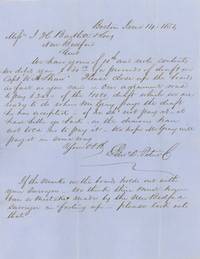
1855réf. List3333Massachusetts New York Maine Pennsylvania and others 1855. Fifty letters with four empty envelopes or covers. Forty-four letters addressed to I.H. Bartlett & Sons: two from the 1830s eight from the 1840s and thirty-four from the 1850s. With five letters addressed to Capt. John C. Blanchard 1838 1839 1844 and 1849 and one to Cumston & Hatch N.d. Overall excellent to Near Fine. Ivory Hovey Bartlett 1794–1871 was a merchant and whale oil seller based in New Bedford Massachusetts. Bartlett moved to New Bedford from Plymouth in 1819 first dealing in grain and later transitioning to general merchandise and whaling.1 Whale oil and spermaceti were widely used in lamps and as lubricant and whalebone baleen was used for structure in items like umbrellas and corsets. In the nineteenth century whaling was the basis of New Bedford’s economy—supporting shipbuilding refineries toolworks and more—making it the wealthiest city in North America at the peak of the industry in the midcentury. Whaling declined in the 1860s with the rise of petroleum which could be both used as a lubricant and distilled into kerosene for lighting. Offered here is a collection of letters mainly to Bartlett’s company I.H. Bartlett & Sons with five to Captain John C. Blanchard of Searsport Maine and one to Cumston & Hatch. The latter is unknown; Blanchard was in the cotton and sugar trades sailing between the US Europe and West Indies. Letters to Bartlett are mainly from other mercantile firms; they pay bills make purchases discuss oil prices and occasionally complain. For instance Robert Robinson of Portland Maine writes: “I have just got 4 Casks of my oil 3 of the last and 1 of the invoice of 30th ult. I cannot understand why my oil should be keep back in this way. Hyde had seven casks by yesterdays Boat the same boat which mine came by it seem’s as if the fates where against this Oil as yesterday boat did not arrive untill late yesterday afternoon and this mornings boat has arrived without the balance there must be something wrong somewhere . I must say I think such neglect should be made known but perhaps it would be better to suffer for fear of the future. I shall not be able to get off any oil untill tomorrow as the oil was not out of the boat untill this morning. it is not thirteen days since that one cask left New Bedford .”. October 13 1852 Most of Bartlett’s customers buy whale oil though beef molasses and coal are also discussed but some are interested in whalebone; as are Wright Bros & Co a Philadelphian umbrella manufacturer who write to complain about market speculation: “The fact appears to us that speculation and the calculation of holders put the price kept it so high that it considerably lessened consumption – so much so of late that some have been disposed to slide it off below New Bedford rates very quietly.” October 23 1852 The letters to all parties are generally all business except for two of the five to John Blanchard: one from his wife Caroline Houston and one from fellow Searsport captain David Nickels Jr. 1823–1888 who writes from Bangor: “I see by to day’s Mercantile gazette that you are in trouble I can sympathize with you God knows I have had a good share of it since I left the land of Gospel light and liberty as the good people say in their prayers I have been in this place fifteen days you doubtless knew I was chartered by Capt Pendleton to go from Leith to Bangor for a cargo of slates and from here to Boston I sailed from Leith on the 27th of November last for this place I got as far as the Orkney Islands on the 30th of November the wind blowing heavy from the westward and having a pilot belonging to the Orkneys on board I concluded to take the harbour of Longhope and lay till a shift of wind or till it moderated . in spite of all our endeavouring we were driven on shore broke the keel out of her filled as high as the lower deck which was on the 3d of December and on the 22d of March we left the Orkney Islands after having been near four months there When I got here I found the man who was to freight the Barque from here to Boston had neglected to place funds in the hands of the slate agent of this place consequently he refuses to put slates on board of the vessel till he receives funds from Boston .”. May 13 1849 Overall a look at the dealings of maritime merchants in the mid-nineteenth century particularly in the critical east coast whaling industry. 1 “Death of a Well-Known Merchant” The Standard-Times February 6 1871 2. unknown
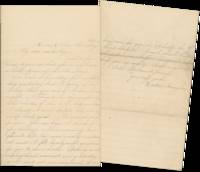
1909réf. List3421Ohio Illinois Michigan and Ontario 1909. Seventy-four letters in thirty-seven envelopes mainly dating between 1885 and 1895. With two undated and one empty envelope. Conditions vary with a few letters having damage intersecting with significant amounts of text and others Near Fine. Overall excellent. A collection of letters mainly sent between Captain William Faragher 1842–1921 and his second wife Harriet Chamberlin 1853–1920 with several from Faragher’s children from his first marriage Burton 1872–1961 and Maude 1875–1952. Most letters are from Chamberlin to Faragher with fourteen from Faragher to Chamberlin. Faragher owned and captained several merchant ships in Lake Erie and Lake St. Clair—presumably sailboats as he frequently complains of having been stuck without wind. He also describes more severe weather out on the lake writing from St. Clair Michigan: “I am anxious to get down from here but as the day advanced the wind began to frisken and it began to snow hard and as it was freezing hard it had rained then snowed and then froze hard saturday night so the poor Venture was in a sad plight but she was in a worse one when we got to where we lay run as it breezed up fresh and the wind dead ahead the water was flying over her in all directions and froze wherever it fell and besides it had turned into a blinding snow storm but we had a certain point to make . she seemed as anxious to get to a place of safety as I did and as the boys say she got there and none too soon as it has been blowing a gale ever since and snowing and freezing but we are in the lee and at a good dock and are comfortable but oh the wind is whistling through the rigging .” November 20 1887 In the 1880s steamships were increasing in popularity on the Great Lakes primarily because of sailboats’ susceptibility to both calm and weather; steamboats were bulky for their capacity and slow but more reliable whereas sailboats could carry overall more cargo.1 Generally steamers took packaged goods and passengers and sailboats mainly schooners took bulk cargo. The Great Lakes were the site of much shipping innovation; Faragher’s fleet was not yet behind the times but steam would overtake sail in the 1880s and 90s. Faragher’s cargo was mainly produce—apples and grapes—though he does mention picking up salt and other materials. His letters indicate that his business involved both shipping and mercantile aspects: he chose and bought the products shipped them to their destination and then also had to find and sell to customers. The grapes in particular seem to cause a lot of trouble: “We left Lorain Sunday morning early and had a nice trip to the Island got there at 4 PM bustled around monday morning and bought 400 baskets of grapes and had them all aboard by dark . it commenced to snow just as we got to Marine City bad bad omen for grapes but imagine my chagrin when I went up town and not a store or commission house wanted a grape folks were full of grapes and there was no sale for them and they said that I had got left and if the truth were known they were glad of it but its a cold day when I get left if trying will lit me out but one thing certain the weather and the lateness of the season were against me but you know I never cross a bridge before I get to it well we hauled up to our old Island Saturday morning and I sold out to my old friend . we had sold since 11 am 190 baskets of grapes . only half our cargo and at a good margin too. People would ask are you the man that was arrested here for selling grapes when told yes they seldom failed to buy but the strangest part was the number of ladies that came to buy”. October 28 1887 Though he does not narrate the incident in which he was arrested for grape peddling—nor does it appear to have made the paper—he later mentions yet another grape-related debacle this time at Port Huron: “Sander and I went to town to sell the grapes today . when down came a city official and wanted to know if I had a license to sell . well I couldent sell another grape without paying 5.00 a day license that was a stormer you see the whole sale men were going to drive me out of the market . but they were not as sharp as they thought they were I went and gave a bill of sale of my whole cargo to a citizen here and he appointed one of his agents to sell the grapes” September 20 1888 Faragher’s letters here do not discuss the financial state of his business but given Chamberlin’s statements it cannot have been all too positive. Chamberlin’s letters depict a woman struggling with her financial circumstances and with how the era’s expectations of her gender intersected with them. In one illustrative letter she writes: “A man drove by here Sat. asking for you. Ms. Lawler has given him her note to collect. He says the interest brings it to nearly fifty dollars. I told him I thought you could not meet it just at present but he said he must have the money and would give you just one week and if it was not paid then he would let the law settle it. Marvin and Laird are his lawyers. Mr. Laird is the one who helped get my money from father’s estate. I would not have them connected in this way about you for – O a great deal!! I have thought and planned till it seems as though my brain would burst. I have inquired about that law regarding taking any more married women as teachers. If Mr. Day would work for me it might perhaps be broken. There will be a vacancy in the Detroit building this fall. Will if I possibly can I want to commence teaching in Sept. The children would have to learn to do more about the house and with both of us earning it seems as though some of these harassing debts must be settled after a time. The frequent calls of men with bills against you have taken away all my pride and I believe I am humble enough to do most anything now.” July 11 1887 In 1887 Ohio passed the Married Women’s Property Act which allowed married women to keep their own property separate from their husbands’—in fact Chamberlin occasionally mentions “her” money in her correspondence. At the same time the state’s Board of Education was debating passing an act that would not only ban school districts from hiring married women as teachers but also fire all the married women it then employed. Newspaper reporting at the time indicates that this measure was not particularly popular not the least because married women tended to be older and more experienced with the job. Chamberlin clearly perceives her role as a wife in a rather more progressive way at one point writing to Faragher that “a true wife” is “not a doll-baby to be kept in finery” N.d. after he had taken out a loan to send her money for a new hat. Throughout their correspondence Chamberlin is perhaps surprisingly open with Faragher about her opinions particularly on his work and their financial affairs; for instance: “I should like to examine your pocket-book after that $25 tax money left it. What are you going to live on up there while you are hunting for freight Sawdust won’t put any fat on your bones. Sailing up and down past Saginaw bay won’t prolong your life or lessen your grey hairs. What are you sailing for anyway For the sake of wearing yourself out and giving employment to two or three men and keeping the Root from rusting out I guess I am naughty!” May 25 1894 She also frequently provides her opinion on whether and at what rate Faragher should sell his two other ships besides the Root the Venture and the Sassacus. She continues in the same letter: “I know I almost had a regular fight yesterday morning right there on the lounge. I wanted to do my housework and I couldn’t. I wanted to sew and I couldn’t sit up long for that. I wanted to help you and I couldn’t. I wanted to earn money and whereas I used to earn fifty-five cents for every hour I worked now I can not earn anything. Then if I could not do for self and family I wanted to make church and S.S. calls but I couldn’t walk for that.” Of course she was at that time prevented from these activities by her health not by gendered standards but she clearly had financial ambitions for herself. After her time as a regular school teacher Chamberlin taught at a Sunday school where she earned a few cents per student and in one letter reported having eighty-one students in a single session. Chamberlin also struggles with the expectations of her as step-mother to Faragher’s two children from his first marriage to Emma Humphrey 1848–1880. She writes: “I get so discouraged sometimes and it seems as though I am in the wrong place as mother. I think of Emma as my sister. I want to do as she would have me. I look upon my work as sacred. And yet sometimes I feel as though life was not worth living.” November 5 1886 She frequently describes conflict with Burt who was then in his late teens to early twenties writing that she could not “have quite the very own mother-love for him” though she is “sure that Emma was not more conscientious in her desires to do right by him than I am” May 20 1891. As it still is today the role of step-mother was a difficult and frequently demonized one with the trauma of losing a mother and wife often in conflict with the feminine duty of maintaining perfect domestic harmony. In general Chamberlin seems to have been somewhat out of step with the feminine ideal of the time even telling Faragher in a letter describing the death of an acquaintance’s baby how glad she was to not have any children of her own. Overall a look at the private lives and difficulties of a middle-class Ohio household as despite the relative prestige of its head being a captain-owner it struggled with debt. Of interest to both historians of Great Lakes trade and those of women’s roles in the late nineteenth century. 1 Dina M. Bazzill “The Missing Link Between Sail and Steam: Steambarges and the Joys of Door County Wisconsin” East Carolina University Program in Maritime Studies Research Report no. 19 2007. unknown
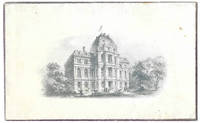
1865réf. 10246Boston: the hotel 1865. Menu printed on silk 30 x 10.5 cm. one leaf printed verso only. Illustrated with an engraving of vignettes of freight transport via ship and train. WITH: Printed envelope 8 x 13 cm. with an engraving. A handsome menu printed on silk for a banquet celebrating the Boards of Trade of the Western Cities given by the City of Boston at the Revere Hotel. Revere House was one of the city's leading hotels hosting guests that included Charles Dickens Jenny Lind and Walt Whitman. Daniel Webster addressed audience from the steps of the portico. The engraving on the envelope depicts the hotel from across Boston's Bowdoin Square. The hotel has had an additional structure added to the previously flat roof. The bill of fare for the Western Boards of Trade included Green Turtle Soup Baked Shad in a Wine Sauce Leg of Southshore Mutton in Caper Sauce Duffield's Ham Pate de Foie and much more. In remarkably fine condition with only the slightest fraying to the edges of the silk. The envelope with an engraving of the Boston's City Hall has some light soil but is near fine. the hotel hardcover
1910réf. 10052Milwaukee: H.C. Schranck Co 1910. Oblong octavo 22.5 x 29 cm. 61 pages numbered 969-1030. Illustrated. FIRST EDITION. Trade catalogue for H.C. Schrank Co. of Milwaukee a manufacturer and distributor of equipment and supplies for bottlers. The catalogue covers a wide range of equipment from carbonating machines to fillers and bottlers crowning and filling machines cappers water stills and labeling machines. Supplies include wooden boxes for bottles siphon bottles and siphon-related parts bottle brushes faucets taps jars and pots for flavors and syrups copper measures and graduating cups corks and caps aprons boots and finger protectors and much more. Sample labels printed in three colors occupy the center portion of the catalogue. Internally with some light stains and rubbing to edges. Attractively re-bound with new endpapers and the original printed cover inlaid into the new marbled boards. Overall very good. Unrecorded. OCLC locates no copies; not in Romaine or Noling. H.C. Schranck Co hardcover
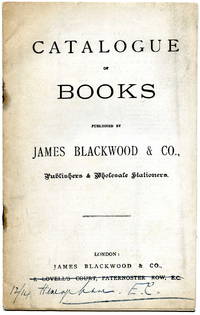
réf. 9187Circa 1910. London: James Blackwood & Co. 8. Lowell's Court Paternoster Row E.C. amended in manuscript to '12/14 Heneage Lane. E.C.'. 12mo 24 pp. Unbound. Text clear and complete. Fair on aged paper with rusting to staples. Hundreds of titles in such series as 'The Unique Library' 'Choice Readings. Books suitable for presents etc.' 'Universal Library of Standard Authors' 'Blackwood's Edition of the Poets' 'Library of Thoughtful Books' and 'Choice Books for Young Persons'. See Image. [Circa 1910.] London: James Blackwood & Co., 8. Lowell's Court, Paternoster Row, E.C. [amended in manuscript to '12/14 Heneage L unknown
réf. 1330660285.Gpaperback. Good. Access codes and supplements are not guaranteed with used items. May be an ex-library book. paperback
réf. 0366302205.Gpaperback. Good. Access codes and supplements are not guaranteed with used items. May be an ex-library book. paperback
réf. 1330876466.Gpaperback. Good. Access codes and supplements are not guaranteed with used items. May be an ex-library book. paperback
réf. 0526501685.Ghardcover. Good. Access codes and supplements are not guaranteed with used items. May be an ex-library book. hardcover
1844réf. 5316Puebla: Imprenta Antigua en el Portal de las Flores 1844. About very good. 20pp. Original printed wrappers. Light dampstaining and spotting. Even toning. Scarce pamphlet containing rules and regulations for the tribunal that adjudicated commercial and trade disputes in Puebla just prior to the Mexican-American War. The texts articulates the jurisdiction and power of the court its form and function and the responsibilities of its officers and appointees. In attractive printed yellow wrappers; OCLC records this imprint but notes no locations. Imprenta Antigua en el Portal de las Flores unknown
1817réf. 5224Veracruz 1817. Good plus. 230pp. plus folding plate. Disbound. Light staining from removed wrappers. Later ownership inscription at foot of title page. Trimmed close affecting initial page numbers. Light dampstaining and tanning internally. An interesting contemporary tract concerning the fall off in agricultural industrial and mineral production in New Spain during the War for Independence. The author José Maria Quiros was a bureaucrat at the Spanish colonial consulate in Veracruz and is therefore particularly attentive to shipping and exports. A folding chart at the rear prints annual production numbers for products and materials in each of the three categories. A handful of copies in OCLC. unknown
1828réf. 5231Guanajuato: Imprenta del Supremo Gobierno a Cargo del C.J.M. Caranco 1828. Good plus. 229pp. plus folding chart. Disbound. Minor foxing and wear. Apparently unrecorded pamphlet that publishes an early statistical and narrative account of the economical and governmental situation in early Guanajuato. The work was printed four years after the adoption of the federal constitution and the organization of the Mexican states. It furnishes an account of agriculture industry government and haciendas and well as statistics on population and economic production. With one folding chart that depicts rural hacienda and ranch production; an interesting snapshot of the early economic life of the central Mexican state. Not in OCLC. Imprenta del Supremo Gobierno a Cargo del C.J.M. Caranco unknown
réf. 0656123494.Ghardcover. Good. Access codes and supplements are not guaranteed with used items. May be an ex-library book. hardcover
1907réf. 50920San Francisco: California State Board of Trade 1907. 1907. 69pp. Illustrations. Charts. Appendix. Map. Offers industrial statistics for a series of years in comparables thereby showing the growth or decline of the particular industry. Information valuable to people wanting to possibly relocate to California . a general description of the state in its entirety as well as by particular regions information on its resources attractions climatic advantages and the opportunities it offers in all branches of human industry. Articles relating to the industrial educational economical social and religious life of the state’s people. Fold-out map 25" x 19 12" attached to inside front wrapper and entitled Geographical Topographical and Railroad Map of California 1907." 2 3/4" split to lower gutter along with 1/2" split to top edge and 1 1/2" split to side edge of front wrapper and with tiny chip to bottom corner. Map fine. California State Board of Trade, 1907. unknown
réf. 1332899722.Gpaperback. Good. Access codes and supplements are not guaranteed with used items. May be an ex-library book. paperback
réf. 026060626X.Ghardcover. Good. Access codes and supplements are not guaranteed with used items. May be an ex-library book. hardcover
1946réf. 52204N. P.: Privately printed n. d. ca 1946. 1946. MICHIGAN. 18 1/2" x 16" one sheet that folds to a 9 1/4" x 4" color pictorial wrappers. One side has eight panels the provide information on the Famous Shore Drive Men's Clubs; Golf; Boys' and Girls' Camps; The Waltonites' Paradise; Bay View Chatauqua; Mackinac Island and more. The other side contains two panels for the front and rear covers two panels to advise about Petoskey as a hub of Northern Michigan and four panels with two maps of Michigan and Petoskey. Very good copy. Privately printed, n. d. (ca 1946). unknown
réf. 0332385698.Ghardcover. Good. Access codes and supplements are not guaranteed with used items. May be an ex-library book. hardcover
réf. 1167101731.Ghardcover. Good. Access codes and supplements are not guaranteed with used items. May be an ex-library book. hardcover