16 874 résultats
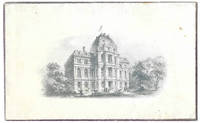
1865réf. 10246Boston: the hotel 1865. Menu printed on silk 30 x 10.5 cm. one leaf printed verso only. Illustrated with an engraving of vignettes of freight transport via ship and train. WITH: Printed envelope 8 x 13 cm. with an engraving. A handsome menu printed on silk for a banquet celebrating the Boards of Trade of the Western Cities given by the City of Boston at the Revere Hotel. Revere House was one of the city's leading hotels hosting guests that included Charles Dickens Jenny Lind and Walt Whitman. Daniel Webster addressed audience from the steps of the portico. The engraving on the envelope depicts the hotel from across Boston's Bowdoin Square. The hotel has had an additional structure added to the previously flat roof. The bill of fare for the Western Boards of Trade included Green Turtle Soup Baked Shad in a Wine Sauce Leg of Southshore Mutton in Caper Sauce Duffield's Ham Pate de Foie and much more. In remarkably fine condition with only the slightest fraying to the edges of the silk. The envelope with an engraving of the Boston's City Hall has some light soil but is near fine. the hotel hardcover books
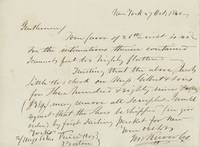
1849réf. List3334New York City 1849. Eight letters. Overall excellent. A small collection of letters to Boston-based grocers Silas Pierce & Co. sent from New York by steamboat with notes on covers or stamps reading “Boat Mail” or “Steam Boat Mail”. Five of the letters are from Wyckoff & Scrymser which was likely owned by a member or members of the prominent New York Wyckoff family the Scrymser surname first appears in the Wyckoff family history in 18411. Wyckoff & Scrimser discuss sweet and red wine prices “opperations in Trent” likely Trento Italy delayed shipments and issues with products; for instance: “The Harmony has not yet made her appearance neither the Aselia the non arrival of the latter is very perplexing but we see no remedy for it. . Annexed please find the sales of the Raisins amount Nett proceeds to your Co Nine Thousand One Hundred Seventy Four 06/100 Dollars which we hope may be found correct and satisfactory. There were a number of the parcels that were sold from the wharf but rejected which we were obliged to and store that the objections might not be known &c. The half boxes . did not have any external appearance of damage and could onky be known by opening. We rather congratulated ourselves that we have got off so well with this fruit as we had strong fears of the result.” December 29 1843 Also discussing business with Italy is a letter from Wm. A Lüs on behalf of Ferd. Baller & Co. of Messina which traded in citrus fruit: “The principal object of my friends is to introduce their Brand favorably into your market & their efforts to do this will alone be sufficient to secure you a superior article of fruit & other Goods; . they are also in the position of obtaining any other Sicilian produce at the most advantageous terms while at Messina or Palermo through their agent there.” August 30 1849 Demand for citrus products was high as it had been discovered late in the 18th century that citrus prevented and cured scurvy. Demand was so great in fact that some researchers partly credit the citrus trade with creating the Sicilian mafia.2 A letter from the Bank of Commerce in New York discusses credit and lastly Joseph Knowles possibly of the Massachusetts-based Thomas Knowles & Company sends an intriguing note: “Your favor of the 26th inst is rec’d For the intimations therein contained I cannot feel too highly flattered — Trusting that the above Jacob Little Co’s check on Messrs Gilbert & Sons for Three hundred eighty nine dollars $389 may remove all scruples – I would request that the shoes be shipped in good order by first sailing packet for New York”. October 27 1840 This is plausibly related to the investor and stock speculator Jacob Little 1794–1865 known for his short-selling tactics and generally considered as Knowles suggests unscrupulous.3 Of interest to researchers of mercantile history in the northeast and steamboat mail. 1 Mr. and Mrs. M. B. Streeter Eds. The Wyckoff Family in America: A Genealogy The Tuttle Company 1934: 310. 2 Arcangelo Dimico Alessia Isopi and Ola Olsson “Origins of the Sicilian Mafia: The Market for Lemons” The Journal of Economic History 77 no. 4 December 2017: 1083–1115. 3 “The Convertible Bonds: How Jacob Little Manipulated Matters Years Ago” The New York Times February 23 1882. unknown
1849réf. List3334New York City 1849. Eight letters. Overall excellent. A small collection of letters to Boston-based grocers Silas Pierce & Co. sent from New York by steamboat with notes on covers or stamps reading “Boat Mail” or “Steam Boat Mail”. Five of the letters are from Wyckoff & Scrymser which was likely owned by a member or members of the prominent New York Wyckoff family the Scrymser surname first appears in the Wyckoff family history in 18411. Wyckoff & Scrimser discuss sweet and red wine prices “opperations in Trent” likely Trento Italy delayed shipments and issues with products; for instance: “The Harmony has not yet made her appearance neither the Aselia the non arrival of the latter is very perplexing but we see no remedy for it. . Annexed please find the sales of the Raisins amount Nett proceeds to your Co Nine Thousand One Hundred Seventy Four 06/100 Dollars which we hope may be found correct and satisfactory. There were a number of the parcels that were sold from the wharf but rejected which we were obliged to and store that the objections might not be known &c. The half boxes . did not have any external appearance of damage and could onky be known by opening. We rather congratulated ourselves that we have got off so well with this fruit as we had strong fears of the result.” December 29 1843 Also discussing business with Italy is a letter from Wm. A Lüs on behalf of Ferd. Baller & Co. of Messina which traded in citrus fruit: “The principal object of my friends is to introduce their Brand favorably into your market & their efforts to do this will alone be sufficient to secure you a superior article of fruit & other Goods; . they are also in the position of obtaining any other Sicilian produce at the most advantageous terms while at Messina or Palermo through their agent there.” August 30 1849 Demand for citrus products was high as it had been discovered late in the 18th century that citrus prevented and cured scurvy. Demand was so great in fact that some researchers partly credit the citrus trade with creating the Sicilian mafia.2 A letter from the Bank of Commerce in New York discusses credit and lastly Joseph Knowles possibly of the Massachusetts-based Thomas Knowles & Company sends an intriguing note: “Your favor of the 26th inst is rec’d For the intimations therein contained I cannot feel too highly flattered — Trusting that the above Jacob Little Co’s check on Messrs Gilbert & Sons for Three hundred eighty nine dollars $389 may remove all scruples – I would request that the shoes be shipped in good order by first sailing packet for New York”. October 27 1840 This is plausibly related to the investor and stock speculator Jacob Little 1794–1865 known for his short-selling tactics and generally considered as Knowles suggests unscrupulous.3 Of interest to researchers of mercantile history in the northeast and steamboat mail. 1 Mr. and Mrs. M. B. Streeter Eds. The Wyckoff Family in America: A Genealogy The Tuttle Company 1934: 310. 2 Arcangelo Dimico Alessia Isopi and Ola Olsson “Origins of the Sicilian Mafia: The Market for Lemons” The Journal of Economic History 77 no. 4 December 2017: 1083–1115. 3 “The Convertible Bonds: How Jacob Little Manipulated Matters Years Ago” The New York Times February 23 1882. unknown books
1940réf. 33897N.P.: Privately Printed ca. 1940. 1940. ARIZONA. 8 12 '" x 9" pages with text black and white and color photographs of points of interest folded twice to 9" x 4." Pictographic map annual climate accommodations etc. Attractive bright copy. Privately Printed, [ca. 1940]. unknown
1828réf. 5231Guanajuato: Imprenta del Supremo Gobierno a Cargo del C.J.M. Caranco 1828. Good plus. 229pp. plus folding chart. Disbound. Minor foxing and wear. Apparently unrecorded pamphlet that publishes an early statistical and narrative account of the economical and governmental situation in early Guanajuato. The work was printed four years after the adoption of the federal constitution and the organization of the Mexican states. It furnishes an account of agriculture industry government and haciendas and well as statistics on population and economic production. With one folding chart that depicts rural hacienda and ranch production; an interesting snapshot of the early economic life of the central Mexican state. Not in OCLC. Imprenta del Supremo Gobierno a Cargo del C.J.M. Caranco unknown
1817réf. 5224Veracruz 1817. Good plus. 230pp. plus folding plate. Disbound. Light staining from removed wrappers. Later ownership inscription at foot of title page. Trimmed close affecting initial page numbers. Light dampstaining and tanning internally. An interesting contemporary tract concerning the fall off in agricultural industrial and mineral production in New Spain during the War for Independence. The author José Maria Quiros was a bureaucrat at the Spanish colonial consulate in Veracruz and is therefore particularly attentive to shipping and exports. A folding chart at the rear prints annual production numbers for products and materials in each of the three categories. A handful of copies in OCLC. unknown
1844réf. 5316Puebla: Imprenta Antigua en el Portal de las Flores 1844. About very good. 20pp. Original printed wrappers. Light dampstaining and spotting. Even toning. Scarce pamphlet containing rules and regulations for the tribunal that adjudicated commercial and trade disputes in Puebla just prior to the Mexican-American War. The texts articulates the jurisdiction and power of the court its form and function and the responsibilities of its officers and appointees. In attractive printed yellow wrappers; OCLC records this imprint but notes no locations. Imprenta Antigua en el Portal de las Flores unknown
1828réf. 5231Guanajuato: Imprenta del Supremo Gobierno a Cargo del C.J.M. Caranco 1828. Good plus. 229pp. plus folding chart. Disbound. Minor foxing and wear. Apparently unrecorded pamphlet that publishes an early statistical and narrative account of the economical and governmental situation in early Guanajuato. The work was printed four years after the adoption of the federal constitution and the organization of the Mexican states. It furnishes an account of agriculture industry government and haciendas and well as statistics on population and economic production. With one folding chart that depicts rural hacienda and ranch production; an interesting snapshot of the early economic life of the central Mexican state. Not in OCLC. Imprenta del Supremo Gobierno a Cargo del C.J.M. Caranco unknown books
1817réf. 5224Veracruz 1817. Good plus. 230pp. plus folding plate. Disbound. Light staining from removed wrappers. Later ownership inscription at foot of title page. Trimmed close affecting initial page numbers. Light dampstaining and tanning internally. An interesting contemporary tract concerning the fall off in agricultural industrial and mineral production in New Spain during the War for Independence. The author José Maria Quiros was a bureaucrat at the Spanish colonial consulate in Veracruz and is therefore particularly attentive to shipping and exports. A folding chart at the rear prints annual production numbers for products and materials in each of the three categories. A handful of copies in OCLC. unknown books
1844réf. 5316Puebla: Imprenta Antigua en el Portal de las Flores 1844. About very good. 20pp. Original printed wrappers. Light dampstaining and spotting. Even toning. Scarce pamphlet containing rules and regulations for the tribunal that adjudicated commercial and trade disputes in Puebla just prior to the Mexican-American War. The texts articulates the jurisdiction and power of the court its form and function and the responsibilities of its officers and appointees. In attractive printed yellow wrappers; OCLC records this imprint but notes no locations. Imprenta Antigua en el Portal de las Flores unknown books
1954réf. 022125Mobile Alabama: The Merchants National Bank of Mobile. 30pgs including wraps. A scarce promotional pamphlet with lost of dat and some 1950 era historic photos of Mobile. Size: Thin 4to - over 9¾" - 12" Tall . VG Minus. Pictorial Wrappers. circa 1954/content. 1954. The Merchants National Bank of Mobile unknown
1920réf. 362949Tokyo: Gaimusho tsushokyoku daisanka 1920. First Edition. A bilingual pamphlet detailing the origins of and the official Japanese response to the 1913 Alien Land Law passed in California. The law prohibited foreigners who were not eligible to obtain citizenship from purchasing land or entering into leases longer than three years. It applied almost entirely to Asian immigrants who were barred from becoming naturalized American citizens. This book opens with a brief introduction and the text of the California law followed by the texts of the official protests made by the Japanese government to officials in Washington DC along with the American diplomatic responses. The Japanese protests are refreshingly narrative and detailed rather than legalistic in style. Among the American respondents is William Jennings Bryan acting in his official capacity as Secretary of State in the Woodrow Wilson administration. 18 2 58 1 English 79 Japanese pages. OCLC: 835810960 Waseda; 840108220 National Diet Library 44716908 Trinity College. NB: 4216338 has the same title but only 28 pages. First edition first printing. Covers foxed and spotted spine ends a bit chipped else very good. Gaimusho tsushokyoku daisanka unknown
1920réf. 362512Tokyo: Gaimusho tsushokyoku daisanka 1920. First Edition. A bilingual pamphlet detailing the origins of and the official Japanese response to the 1913 Alien Land Law passed in California. The law prohibited foreigners who were not eligible to obtain citizenship from purchasing land or entering into leases longer than three years. It applied almost entirely to Asian immigrants who were barred from becoming naturalized American citizens. This book opens with a brief introduction and the text of the California law and is followed by the texts of the official protests made by the Japanese government to officials in Washington DC along with the American diplomatic responses. The Japanese protests are refreshingly narrative rather than legalistic in style. Among the American respondents is William Jennings Bryan acting in his official capacity as Secretary of State in the Woodrow Wilson administration. 18 2 58 1 English 79 Japanese pages. OCLC: 835810960 Waseda; 840108220 National Diet Library. No US holdings. First edition first printing. Covers foxed and spotted spine ends a bit chipped else very good. Gaimusho tsushokyoku daisanka unknown
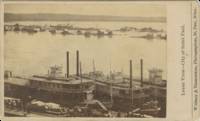
1870réf. List3887654359St. Paul Minnesota 1870. Carte de visite measuring 2 ½ x 4 inches captioned "Levee View-City of Saint Paul. / Whitney & Zimmeram Photographers St. Paul Minn. Excellent. A carte de visite photograph of steamboats on the levee in St. Paul Minnesota on the Mississippi River. By the time of Minnesota statehood in 1858 its Upper and Lower Levees together were one of the busiest ports in the country though activity was slowed by the 1862 Dakota War.1 The photograph is attributed to Whitney & Zimmerman. Joel E. Whitney 1822-d. born in Maine was the first photographer in St. Paul known for his portraits of Minnesota volunteers in the Civil War and of Indigenous Minnesotans.2 Charles A. Zimmerman 1844-1909 was a French-born photographer who immigrated to the US in 1848. The two worked as partners in the 1860s and 1870s and are together best known for their series of views of Minnehaha Falls.3 1 Joe Lepsche "The Upper Levee: Memories of Its People And Its Place in St. Paul History" Ramsey County History 33 no. 1 Spring 1998:18-21. 2 "Joel Emmons Whitney" The Autry Museum of the American West accessed May 28 2026 https://collections.theautry.org/mwebcgi/mweb.exerequest=record;id=PE65213;type=701. 3 "Charles A. Zimmerman" Smithsonian American Art Museum accessed May 28 2026 https://americanart.si.edu/artist/charles-zimmerman-7133. unknown
1870réf. List3896St. Paul Minnesota 1870. Carte de visite measuring 2 ½ x 4 inches captioned "Levee View-City of Saint Paul. / Whitney & Zimmeram Photographers St. Paul Minn. Excellent. A carte de visite photograph of steamboats on the levee in St. Paul Minnesota on the Mississippi River. By the time of Minnesota statehood in 1858 its Upper and Lower Levees together were one of the busiest ports in the country though activity was slowed by the 1862 Dakota War.1 The photograph is attributed to Whitney & Zimmerman. Joel E. Whitney 1822-d. born in Maine was the first photographer in St. Paul known for his portraits of Minnesota volunteers in the Civil War and of Indigenous Minnesotans.2 Charles A. Zimmerman 1844-1909 was a French-born photographer who immigrated to the US in 1848. The two worked as partners in the 1860s and 1870s and are together best known for their series of views of Minnehaha Falls.3 1 Joe Lepsche "The Upper Levee: Memories of Its People And Its Place in St. Paul History" Ramsey County History 33 no. 1 Spring 1998:18-21. 2 "Joel Emmons Whitney" The Autry Museum of the American West accessed May 28 2026 https://collections.theautry.org/mwebcgi/mweb.exerequest=record;id=PE65213;type=701. 3 "Charles A. Zimmerman" Smithsonian American Art Museum accessed May 28 2026 https://americanart.si.edu/artist/charles-zimmerman-7133. unknown
1870réf. List3896St. Paul Minnesota 1870. Carte de visite measuring 2 ½ x 4 inches captioned "Levee View-City of Saint Paul. / Whitney & Zimmeram Photographers St. Paul Minn. Excellent. A carte de visite photograph of steamboats on the levee in St. Paul Minnesota on the Mississippi River. By the time of Minnesota statehood in 1858 its Upper and Lower Levees together were one of the busiest ports in the country though activity was slowed by the 1862 Dakota War.1 The photograph is attributed to Whitney & Zimmerman. Joel E. Whitney 1822-d. born in Maine was the first photographer in St. Paul known for his portraits of Minnesota volunteers in the Civil War and of Indigenous Minnesotans.2 Charles A. Zimmerman 1844-1909 was a French-born photographer who immigrated to the US in 1848. The two worked as partners in the 1860s and 1870s and are together best known for their series of views of Minnehaha Falls.3 1 Joe Lepsche "The Upper Levee: Memories of Its People And Its Place in St. Paul History" Ramsey County History 33 no. 1 Spring 1998:18-21. 2 "Joel Emmons Whitney" The Autry Museum of the American West accessed May 28 2026 https://collections.theautry.org/mwebcgi/mweb.exerequest=record;id=PE65213;type=701. 3 "Charles A. Zimmerman" Smithsonian American Art Museum accessed May 28 2026 https://americanart.si.edu/artist/charles-zimmerman-7133. unknown books
1870réf. List3887654359St. Paul Minnesota 1870. Carte de visite measuring 2 ½ x 4 inches captioned "Levee View-City of Saint Paul. / Whitney & Zimmeram Photographers St. Paul Minn. Excellent. A carte de visite photograph of steamboats on the levee in St. Paul Minnesota on the Mississippi River. By the time of Minnesota statehood in 1858 its Upper and Lower Levees together were one of the busiest ports in the country though activity was slowed by the 1862 Dakota War.1 The photograph is attributed to Whitney & Zimmerman. Joel E. Whitney 1822-d. born in Maine was the first photographer in St. Paul known for his portraits of Minnesota volunteers in the Civil War and of Indigenous Minnesotans.2 Charles A. Zimmerman 1844-1909 was a French-born photographer who immigrated to the US in 1848. The two worked as partners in the 1860s and 1870s and are together best known for their series of views of Minnehaha Falls.3 1 Joe Lepsche "The Upper Levee: Memories of Its People And Its Place in St. Paul History" Ramsey County History 33 no. 1 Spring 1998:18-21. 2 "Joel Emmons Whitney" The Autry Museum of the American West accessed May 28 2026 https://collections.theautry.org/mwebcgi/mweb.exerequest=record;id=PE65213;type=701. 3 "Charles A. Zimmerman" Smithsonian American Art Museum accessed May 28 2026 https://americanart.si.edu/artist/charles-zimmerman-7133. unknown books
1739réf. 6147S. l., s. n., 1739. In-12 (155 x 100 mm), 76-(3)-(1 bl.) pp. Reliure basane d'époque, dos orné de fleurons dorés, tranches rouges, 2 coins ouverts, inscription ancienne sur la page de titre et sur la dernière page blanche. Bon exemplaire.
1925réf. 34680Missoula: Privately printed n.d. ca. 1925. 1925. First edition. Pictorial wrappers. 24 pp. including wrappers. 11" x 8" oblong. Illustrated. A booklet aimed at the tourist encouraging them to come to Western Montana and see all of its' beauty and enjoy all that it has to offer such as trout streams hunting recreational ranches waterfalls etc. You will also see Flathead Valley which is home to the Flathead and Kootenai Indians. Two expansive recreational regions have their gateways at Missoula. One is the Blackfoot valley and the other is the Clearwater region which lies on the Montana-Idaho border. Some of the photographs included are of Missoula's Airport Mount Jumbo Fort Missoula Barracks Holland Lake Falls Seeley Lake Bison on the government range Blodgett Canyon in the Bitter Root Charlo chief of the Confederated Tribes of the Flathead the Flathead River and many more. On the rear wrapper are several pictures of The State University of Montana - Missoula. Lightly tarnished at the top of the front wrapper at fore-edge from what appears to be a paperclip else a fine informative brochure profusely illustrated. Privately printed, n.d. [ca. 1925]. unknown
1950réf. 60816Greenough MT: L.T. Cahoon 1950. Trade card 2 1/2 x 4 inches printed on light card stock and employing several sizes and styles of type. Lee Cahoon of Greenough Montana served as a director of the Western Montana Outfitters and Guides Association in the early 1950s. Very good. #7924. L.T. Cahoon unknown books
réf. 222527Genève, et se trouve à Paris, Damonneville, 1758 2 vol. in-12, viij pp., 228 pp., veau fauve marbré, dos à nerfs cloisonné et fleuronné, pièces de titre et de tomaison, chaînette dorée sur les coupes, tranches marbrées (reliure de l'époque). Un mors inférieur fendu, petite galerie de vers infra-paginale à la fin du volume I.
1805réf. 26322Nantes 1805 1 document ORIGINAL d'1 page recto manuscrite à l'encre brune, format : 18 x 22 cm, sur papier velin bleuté, ligné et filigrané : "G Y ", en tête du chantier de la piperie, feuille des constructions N°544, CERTIFICAT N°544, ATTESTANT QUE MME VEUVE DUBREUIL A PEINT EN NIVOSE, UN CANOT DE DOUZE PIEDS POUR LA FRÉGATE LOUGRE DE L'ÉTAT "L'AMI DES LOIX" PLUS UN AUTRE DE MÊME DIMENSION POUR PORTE MANTEAU DE LA CORVETTE "LE FAUNE", FAIT AU CHANTIER DE LA PIPERIE (CHANTENAY) POUR LE COMPTE DES CRUCY, LE 2 PRAIRIAL AN 13 (22 MAI 1805), signature manuscrite à l'encre brune du Garde Magasin : DORÉ
1799réf. 26325CAUDAN 1799 1 document ORIGINAL d'1 page recto-verso manuscrite à l'encre brune, format : 19 x 31,5 cm, sur papier velin crème, ligné et filigrané : "au cor de chasse", liste des bois avec leurs dimensions et cubes, BORDEREAU D'ACHAT DE BOIS AU CITOYEN (JEAN)LE MOING (LABOUREUR) DE CAUDAN (MORBIHAN), PAR A. FRANCY AGISSANT POUR LE COMPTE DE CRUCY FRÈRES AU CHANTIER DE CAUDAN (LORIENT), LE 18 GERMINAL AN 7 (7 AVRIL 1799), Noté au dos achat de bois par FRANCY,
1811réf. 26329basse-indre 1811 1 document ORIGINAL d'1 page recto-verso manuscrite à l'encre brune, format : 22,5 x 15 cm, sur papier velin bleuté, ligné, lettre signée Jules BONNISSANT, COURRIER INTERNE, ENTRE JOSEPH BONNISSANT CONTREMAITRE RESPONSABLE DU CHANTIER DE CONSTRUCTION NAVALE "CRUCY FRÈRES" A BASSE-INDRE ET CARMAGNOLLE RESPONSABLE DU CHANTIER DE LA PIPERIE (CHANTENAY)"CRUCY FRÈRES" CONSTRUCTION NAVALE, BASSE-INDRE, LE 15 MAI 1811 , adresse au dos manuscrite à l'encre brune : A Monsieur CARMAGNOLLE Au Chantier de la Piperie,
1784réf. 26323Nantes 1784 1 document ORIGINAL d'1 page recto-verso manuscrite à l'encre brune, format : 15 x 23 cm, sur papier velin crème, ligné, FACTURE ADRESSÉE A MR GUIBERT DE SAINT ANDRÉ (SAINT-ANDRÉ-DES-EAUX), MAITRE CHARPENTIER PAR CRUCY PÈRE ET FILS, POUR LA VENTE ET LIVRAISON DE BOIS, LE 29 MARS 1783 ET LE 17 SEPTEMBRE 1784, Nantes, LE 17 SEPTEMBRE 1784,