[SINGAPORE - TRADE].Biblio.com

17 049 résultats
réf. 131113144pp original wrappers creased at corners spine torn with minor loss. Wrappers a little marked. Quarto. Filled with statistics this publication would be ideal for anyone researching Singaporean exports and imports in the mid 1950s. . unknown
réf. 207020Arras, Imprimerie de Guy Delasablonnière, s.d. (1791) placard in-folio de 46 x 35 cm, texte sur deux colonnes séparées par une frise fleurdelisée.
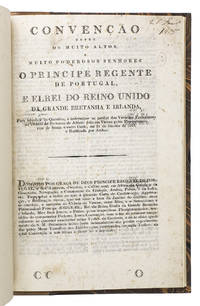
réf. ABC_48887Lisbon: Na Impressão Regia 1815. Modern half calf marbled paper sides with the title and year of publication lettered in gold on the spine. Small folio ca. 28.5 x 18 cm. With the text printed in two columns in Portuguese on the left and in English on the right. Very rare first Portuguese edition of this treaty between Portugal and the United Kingdom of Great Britain and Ireland concerning the indemnification of Portuguese subjects for certain detained slave trade vessels as a result of British actions undertaken in pursuit of the abolition of the slave trade. "Britain agreed to pay compensation for the several Portuguese slavers detained brought before and condemned by British courts on the ground of illegal slave-trading along the African coast prior to 1814" J.P. van Niekerk "British Portuguese and American judges in Adderley Street ." pp. 22-23. Another edition of this same treaty in 8 pages was printed in the same year in Rio de Janeiro with the complete imprint including the place of publication.The present bilateral treaty comprising three articles printed in two columns in Portuguese and English was drafted on 21 January 1815 during the Congress of Vienna a series of international diplomatic meetings held in Vienna from September 1814 to June 1815 concerning the new layout of the European political and constitutional order after the downfall of the French Emperor Napoleon Bonaparte. The signatories of the present treaty were plenipotentiary at the Congress of Vienna formally this treaty was concluded between the Prince Regent of Portugal - future King John VI 1767-1826 - and the King of Great Britain and Ireland George III 1738-1820 as mentioned in the title.A more detailed description is available upon request.With the book plate of "Biblioteca de Hariberto de Miranda Jordão Filho" mounted on the front pastedown. The text leaves with a vague horizontal and vertical fold in the centre a manuscript annotation "21 Janeiro 1815" in brown ink in the upper outer corner of the first page some foxing. Otherwise in good condition.l Gauz Portuguese and Brazilian books in the JCB 815/10; Porbase 3240734 1 copy; WorldCat 1042407673 12791342 38346960 4 copies; cf. Camargo & Moraes Bibl. da Impressão Régia do Rio de Janeiro I 428; Rodrigues 735 & 737 Rio de Janeiro ed.; for more context relating to the treaty: Lesaffer R. "Vienna and the Abolition of the Slave Trade" Oxford Public International Law online via: https://opil.ouplaw.com/page/498; Niekerk J.P. van "British Portuguese and American judges in Adderley Street: the international legal background to and some judicial aspects of the Cape Town Mixed Commissions for the suppression of the transatlantic slave trade in the nineteenth century Part 1" in: The Comparative and International Law Journal of Southern Africa Vol. 37 No. 1 March 2004 pp. 1-39. online via: https://journals.co.za/doi/pdf/10.10520/AJA00104051_114. Na Impressão Regia, unknown
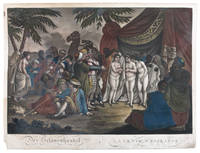
1800réf. I7DD3T6LJ6QQNo place 1800. 27 x 40 cm. Aquatint in contemporary hand colour engraved by "J. L. T." after "J. R. P." Three partly exposed women before a large tent being advertised and inspected by several men dressed in fine oriental garb. On the left is another woman whose price is under discussion while the background shows date palms and two dromedaries.Rather severe water stains and a few small holes in the blank margin; some scuff marks in the image; trimmed closely with loss to lower left corner. A very appealing print. Rare. unknown
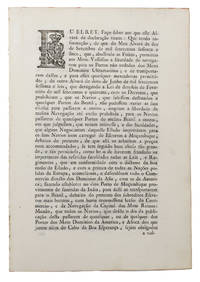
1772réf. ABC_48853Lisbon 1772. Folio ca. 29 x 20 cm. Na Regia Officina Typografica Disbound and subsequently mounted in a modern black stiff paper folder with a printed label mounted on the front wrapper. With a large decorated woodcut initial E incorporating the Portuguese royal coat of arms. 3 1 blank pp. Very rare first issue of two of a late 18th-century decree by the Portuguese King José I 1714-1777 dealing with difficulties in the transportation of enslaved people from Mozambique to Brazil. This text dated 12 December 1772 and signed Rey King at the end is also signed by the notorious Portuguese nobleman and diplomat Marquez de Pombal. Sebastião José de Carvalho e Melo 1st Marquis of Pombal 1699-1782 who was the Secretary of State of the Kingdom during the reign of Dom José I in the period of 1750-1777. It is concluded with a formal text dated 18 December 1772 and signed by João Baptista de Araújo a senior officer of the Secretariat of State.In 1761 Marquez de Pombal prohibited the importation of enslaved people in Portugal and Portuguese India not for humanitarian reasons but because they were needed for labour in Brazil. He stimulated the trade of mostly African enslaved people for that colony and with his support two companies for slave trade were founded the Companhia Geral de Comércio do Grão-Pará e Maranhão and the Companhia Geral de Comércio de Pernambuco e Paraíba. Both companies were privileged and had a monopolistic character. Their lists of shareholders included many Portuguese noblemen and clergy. Between 1757 and 1777 more than 25000 enslaved people were imported to Pará and Maranhão from West African ports.The two issues can be identified by their catchwords on p. 1: issue one shows the catchword as a vol- that catchword was changed in the second issue to a.The inner margin shows some signs of the previous binding. Otherwise in very good condition.l Gauz Portuguese and Brazilian books in the JCB 772/1; WorldCat 1045359449 3 copies; cf. Porbase 2301650 and no copies. unknown
1816réf. 40803London: Printed for J. M. Richardson Cornhill Opposite the Royal Exchange 1816. 3-28pp. Light scattered foxing. Bound in modern cloth withdrawal stamp on front pastedown; inoffensive faint blindstamp on blank corner of title leaf. Else Very Good. Our collation matches that of the bibliographers. The nameless author disclaims any "intention to advocate the revival or regret the abolition of the Slave Trade. . . It is a traffic so objectionable in almost every respect that being abolished for the most part I hope never to see it revived and that every endeavour will be made to realize those advantages which the zeal of the authors of the Abolition has induced them to expect." However "The passage of the registration bill would constitute an unwarranted interference of the central power in the planters' private affairs" Ragatz. The property right of the West Indian colonists in their slaves is non-negotiable. Slaves comprise "the most valuable property of our colonists." Parliament's interference with "the private rights and private property of our colonists. . . would absolutely and tyrannically deprive the individuals whose property it is proposed to regulate and affect of those constitutional means of redress which all British subjects are entitled to." The pamphlet prints resolutions of West Indian Planters objecting to any such intrusions on their rights. The anonymous author objects to the African Institution's "representations of the miseries and hardships of slaves and in circulating ignorantly and unguardedly no doubt the most unfounded calumnies on the subject. If these gentlemen were to compare the situation of the Irish peasantry with that of our colonial slaves they would find they were comparing the extreme of wretchedness with comparative comfort." Ragatz 442. LCP Supp. 1608. Sabin 56509. OCLC records 16 locations worldwide as of March 2025. Printed for J. M. Richardson, Cornhill, Opposite the Royal Exchange unknown
1713réf. 68433London: Printed by John Baskett 1713. Spain Grants Britain a Monopoly on the Slave Trade in the Americas First edition in English of one of the most important documents in the history of slavery in the Americas and in the political and financial history of Europe and the Americas in the early 18th century. This copy is housed in a large sammelband containing dozens of original documents and extracts related to English-Spanish relations. Though the term "assiento" could refer to any number of Spanish contracts "the Assiento" almost always refers to the "Assiento de Negros": a monopoly contract granted by the Spanish crown between 1528 and 1779 for the sole right to import slaves from Africa into the Spanish colonies. Normally granted to individual companies the 1713 Assiento was granted directly to the British crown as part of negotiations for the Treaty of Utrecht which ended the War of Spanish Succession. In the decades following this 1713 Assiento an estimated 200000 enslaved Africans were transported across the Atlantic. The document grants sole privilege for the trade to the British crown for a period of thirty years expiring in 1743. The agreement consisting of forty-two articles allows for a maximum of 4800 slaves to be introduced to the colonies each year with a provision for increasing that annual amount each year by paying an added duty places limits on sale prices sets the cost of the duty to be paid for each enslaved person allows for the use of British or Spanish ships and mariners in the slave trade provides for the French Guinea Company's extraction from the colonies and establishes the details of precisely where British ships would be allowed to travel and trade. The British were also granted the unique privilege to send one vessel with a cargo of up to 500 tons of other trade goods to the Spanish colonies each year. While the Assiento seemed a lucrative deal most Assientists over the years saw considerable losses due to the difficulty of cross-Atlantic trade and the duties paid to the Spanish king. The real benefit to its grantees was not profits from the slave trade but rather the illegal ability to send other contraband on board their vessels to the otherwise closed-off Spanish markets in the New World. Britain was eager to get their own products overseas and to deny this revenue stream to the French who had held the Assiento since 1701 thereby preventing them from refilling their coffers too quickly and upsetting the balance of power in Europe after the costly War of the Spanish Succession. Queen Anne delegated the Assiento privilege to the South Sea Company which had recently been established to pay off Britain's considerable national debt. The privilege was largely granted to them as an encouragement to investors in order to allow the Company to achieve its original purpose more readily. Ultimately however it proved to be a costly and unprofitable endeavor for the South Sea Company who were able to import only about one-third of their allowed quota of slaves each year were frequently interrupted by war and were required to render twenty-five percent of their profits to King Philip V of Spain. The present example comes from the British Foreign Office Library inlaid and bound into a folio volume of other treaties between Great Britain and Spain arranged chronologically by treaty date. Over the course of many years the library of the Great Britain Foreign Office inlaid copies of nearly every treaty involving Great Britain to folio size and bound them together by region. The library was dispersed in the late 20th century with most of the volumes and particularly the American volumes sold by this company. Most of the other treaties with Spain within this volume are clippings or extracts from larger works or true copies in manuscript of treaties dated between the years 1176 and 1739. Included in the volume however is a separately printed English edition of the Treaty between Great Britain and Spain as part of the Treaty of Utrecht ESTC T51509. There are two issues of the Assiento treaty; this is the issue with a semicolon after "Assiento" and no punctuation after "or" on the titlepage. A crucially important document in the history of colonial trade Spanish-British relations English finances and slavery in the Americas. Folio. 19th-century half roan and marbled paper boards. Boards worn some restoration at joints. Text trimmed and inlaid into folio sheets bound in volume of treaties between Great Britain and Spain. Bookplate of the British Foreign Office Library on front pastedown. HANSON 1896. ESTC T4476. EUROPEAN AMERICANA 713/85. JCB 1III:175. SABIN 2227. SPERLING 34. hardcover
1816réf. 40803London: Printed for J. M. Richardson Cornhill Opposite the Royal Exchange 1816. 3-28pp. Light scattered foxing. Bound in modern cloth withdrawal stamp on front pastedown; inoffensive faint blindstamp on blank corner of title leaf. Else Very Good. Our collation matches that of the bibliographers. The nameless author disclaims any "intention to advocate the revival or regret the abolition of the Slave Trade. . . It is a traffic so objectionable in almost every respect that being abolished for the most part I hope never to see it revived and that every endeavour will be made to realize those advantages which the zeal of the authors of the Abolition has induced them to expect." However "The passage of the registration bill would constitute an unwarranted interference of the central power in the planters' private affairs" Ragatz. The property right of the West Indian colonists in their slaves is non-negotiable. Slaves comprise "the most valuable property of our colonists." Parliament's interference with "the private rights and private property of our colonists. . . would absolutely and tyrannically deprive the individuals whose property it is proposed to regulate and affect of those constitutional means of redress which all British subjects are entitled to." The pamphlet prints resolutions of West Indian Planters objecting to any such intrusions on their rights. The anonymous author objects to the African Institution's "representations of the miseries and hardships of slaves and in circulating ignorantly and unguardedly no doubt the most unfounded calumnies on the subject. If these gentlemen were to compare the situation of the Irish peasantry with that of our colonial slaves they would find they were comparing the extreme of wretchedness with comparative comfort." Ragatz 442. LCP Supp. 1608. Sabin 56509. OCLC records 16 locations worldwide as of March 2025. Printed for J. M. Richardson, Cornhill, Opposite the Royal Exchange unknown books
1713réf. 68433London: Printed by John Baskett 1713. Spain Grants Britain a Monopoly on the Slave Trade in the Americas First edition in English of one of the most important documents in the history of slavery in the Americas and in the political and financial history of Europe and the Americas in the early 18th century. This copy is housed in a large sammelband containing dozens of original documents and extracts related to English-Spanish relations. Though the term "assiento" could refer to any number of Spanish contracts "the Assiento" almost always refers to the "Assiento de Negros": a monopoly contract granted by the Spanish crown between 1528 and 1779 for the sole right to import slaves from Africa into the Spanish colonies. Normally granted to individual companies the 1713 Assiento was granted directly to the British crown as part of negotiations for the Treaty of Utrecht which ended the War of Spanish Succession. In the decades following this 1713 Assiento an estimated 200000 enslaved Africans were transported across the Atlantic. The document grants sole privilege for the trade to the British crown for a period of thirty years expiring in 1743. The agreement consisting of forty-two articles allows for a maximum of 4800 slaves to be introduced to the colonies each year with a provision for increasing that annual amount each year by paying an added duty places limits on sale prices sets the cost of the duty to be paid for each enslaved person allows for the use of British or Spanish ships and mariners in the slave trade provides for the French Guinea Company's extraction from the colonies and establishes the details of precisely where British ships would be allowed to travel and trade. The British were also granted the unique privilege to send one vessel with a cargo of up to 500 tons of other trade goods to the Spanish colonies each year. While the Assiento seemed a lucrative deal most Assientists over the years saw considerable losses due to the difficulty of cross-Atlantic trade and the duties paid to the Spanish king. The real benefit to its grantees was not profits from the slave trade but rather the illegal ability to send other contraband on board their vessels to the otherwise closed-off Spanish markets in the New World. Britain was eager to get their own products overseas and to deny this revenue stream to the French who had held the Assiento since 1701 thereby preventing them from refilling their coffers too quickly and upsetting the balance of power in Europe after the costly War of the Spanish Succession. Queen Anne delegated the Assiento privilege to the South Sea Company which had recently been established to pay off Britain's considerable national debt. The privilege was largely granted to them as an encouragement to investors in order to allow the Company to achieve its original purpose more readily. Ultimately however it proved to be a costly and unprofitable endeavor for the South Sea Company who were able to import only about one-third of their allowed quota of slaves each year were frequently interrupted by war and were required to render twenty-five percent of their profits to King Philip V of Spain. The present example comes from the British Foreign Office Library inlaid and bound into a folio volume of other treaties between Great Britain and Spain arranged chronologically by treaty date. Over the course of many years the library of the Great Britain Foreign Office inlaid copies of nearly every treaty involving Great Britain to folio size and bound them together by region. The library was dispersed in the late 20th century with most of the volumes and particularly the American volumes sold by this company. Most of the other treaties with Spain within this volume are clippings or extracts from larger works or true copies in manuscript of treaties dated between the years 1176 and 1739. Included in the volume however is a separately printed English edition of the Treaty between Great Britain and Spain as part of the Treaty of Utrecht ESTC T51509. There are two issues of the Assiento treaty; this is the issue with a semicolon after "Assiento" and no punctuation after "or" on the titlepage. A crucially important document in the history of colonial trade Spanish-British relations English finances and slavery in the Americas. Folio. 19th-century half roan and marbled paper boards. Boards worn some restoration at joints. Text trimmed and inlaid into folio sheets bound in volume of treaties between Great Britain and Spain. Bookplate of the British Foreign Office Library on front pastedown. HANSON 1896. ESTC T4476. EUROPEAN AMERICANA 713/85. JCB 1III:175. SABIN 2227. SPERLING 34. hardcover books
réf. 239941Londres, Pelham Richardson, Ridgway, Manchester, White & Carter, 1841 in-8, 24 pp., dérelié.
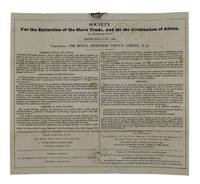
réf. AQ30000Single leaf mulready letter- sheet folded addressed to 'Mrs Clive Sanderstead Croydon Surrey' postmarked Frome with the 306 duplex cancellation to folded front and further post-marks of Croydon and Frome dated September 1844 to folded verso. Some tears to folds margins without loss of text remains of opened wax seal and old paper repairs to recto. The earliest of several known variants of this rare plea for donations for the Society for the Extinction of the Slave Trade and for the Civilization of Africa printed on the reverse of a 'Mulready' penny postal stationary sheet. First issued on 1 May 1840 in parallel with the world's first stamp - the Penny Black - these pre-paid self-folding letter sheets featured an engraved design by John Thompson after William Mulready 1786-1863 and were valid for use from 6th May. Much to postal reformer Rowland Hill's surprise unlike their adhesive philatelic counterpart the Mulready covers quickly proved unpopular both with customers and stationers - who relied upon the sale of writing paper for letters - alike. They were superseded by the introduction of simpler postal stationary with impressions akin to stamps in the top left hand corner in 1841; Mulready sheets were subsequently withdrawn from sale during the early 1840s. Despite their unpopularity soon after issue the promotional opportunities provided by advertising on the verso of the Mulready letter-sheets were seized upon by commercial and voluntary associations alike. Insurance companies banks newspapers publishers and religious institutions are all known to have advertised in such a manner; many made this stationary available in quantity at a discounted rate to ensure wide circulation to the writing desks of the literate across Britain. Advertisements for The Society for the Extinction of the African Slave Trade are known to have featured on nine slightly different advertisements to the verso of the Mulready one- and two-penny letter-sheets; this is the earliest known advertising that 'Shortly will be Published' an Abridgement of Buxton's The African Slave Trade London 1840 implying that these were issued in the very first year of the stationary's use. The fact that no fewer than four works published by John Murray are also advertised could indicate that the cost of producing these pre-paid advertising letter sheets was borne by the publisher. 'A subscription of One Guinea and upwards per annum constitutes an Annual Member. A donation of Ten Guineas and upwards constitutes a Life Member Subscriptions and donations of a smaller amount will be thankfully received.' Founded by English politician Fowell Buxton 1786-1845 in June 1839 with the aim not only of finally extinguishing the Slave Trade in Africa some decades after the original abolition of the Trade in Britain her colonies and the United States but also to 'watch over and befriend the interests of Africa' and form a commercial 'Company which shall cultivate portions of her soil'. As noted in this advertisement which sought 'subscriptions and donations' this included persuading the British Government's sending an expedition see item number 36 led by the Royal Navy to explore the Niger river which despite the death of a full third of the those involved largely to fever did secure the signing of several treaties against the slave trade with tribes in modern day Nigeria. As this advertisement - signed by secretary Irish clergyman and missionary John Trew 1792-1869 notes further expeditions 'into the interior of Africa' were envisaged at 'considerable expense' to the society; however the Society was acrimoniously dissolved in 1843 - the year before this letter-sheet was used - before any such expeditions could be repeated. Stanley Gibbons Queen Victoria Vol. 1 Pt. 1 SG MA480a. Dimensions unfolded: 220 x 200 mm; folded: 133 x 88 mm. unknown
1953réf. 865891953 Bruxelles, Editions de la Librairie Encyclopédique, 1953, grand in 8° broché, 343 pages.
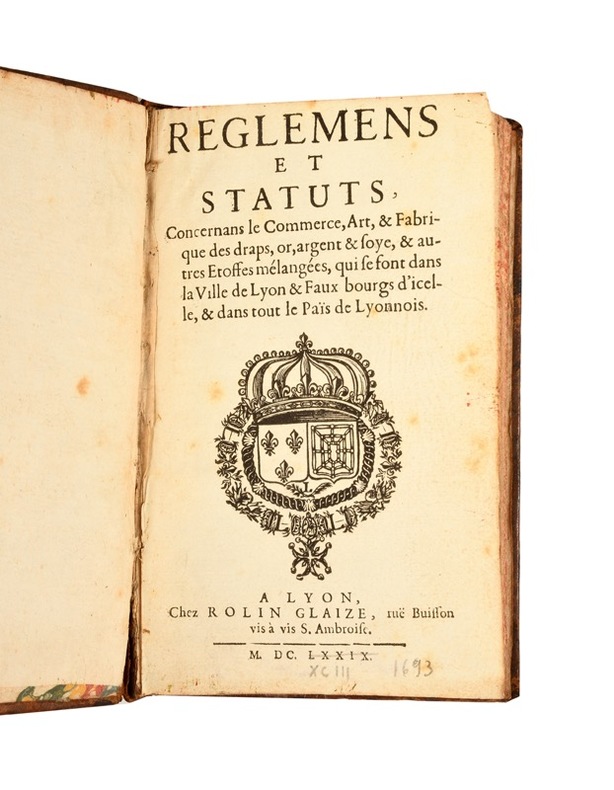
1693réf. 21679Lyon, Rolin Glaize, 1693 (i.e. 1679) ; in-8, veau épidermé de l’époque, dos à nerfs décoré et doré, sans pièce de titre ; 88, [7] pp. de Table.
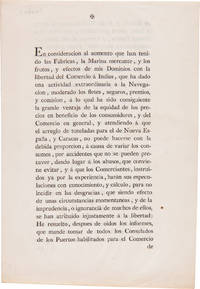
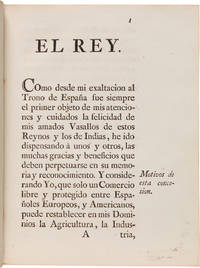
1789réf. 47977Madrid. February 28 1789. Spain Regulates Trade with the Americas This royal decree liberalized the tightly controlled trade between Spain New Spain and the Captaincy of Caracas. The Crown hoped to spur navigation and commerce and lessen the incentive for smuggling. Export duties on goods travelling to the Indies were to be slashed by ten percent but penalties against contraband would still be enforced. Two worm holes very minor soiling else fine. unknown
1789réf. 47977Madrid. February 28 1789. Spain Regulates Trade with the Americas This royal decree liberalized the tightly controlled trade between Spain New Spain and the Captaincy of Caracas. The Crown hoped to spur navigation and commerce and lessen the incentive for smuggling. Export duties on goods travelling to the Indies were to be slashed by ten percent but penalties against contraband would still be enforced. Two worm holes very minor soiling else fine. unknown books
1778réf. 37240Madrid: Pedro Marin 1778. Commercial Policy in Spanish America Detailed rules and regulations governing Spain's late 18th-century commercial policy in Latin America with a preliminary section of nineteen pages providing a summary of the articles and tariffs documented in the main portion of the text. With this REGLAMENTO. the Crown terminated Cadiz and Seville's monopoly of trade with Spanish America allowing other cities of the realm to participate. In addition to much information on commerce and numerous tariffs on a large variety of Spanish and American goods several sections discuss shipping ports and other maritime activities directly related to commercial activity. The work also includes the text of concessions granted to Louisiana. Quarto. Contemporary mottled calf spine gilt extra. Light shelf wear corners rubbed. Contemporary ownership inscription on titlepage modern bookplate on front pastedown clipped booksellers' descriptions pasted to front free endpaper. Text quite clean. Very good plus. PALAU 255843. SABIN 68890. MEDINA BHA 4845. unknown
1778réf. 37240Madrid: Pedro Marin 1778. Commercial Policy in Spanish America Detailed rules and regulations governing Spain's late 18th-century commercial policy in Latin America with a preliminary section of nineteen pages providing a summary of the articles and tariffs documented in the main portion of the text. With this REGLAMENTO. the Crown terminated Cadiz and Seville's monopoly of trade with Spanish America allowing other cities of the realm to participate. In addition to much information on commerce and numerous tariffs on a large variety of Spanish and American goods several sections discuss shipping ports and other maritime activities directly related to commercial activity. The work also includes the text of concessions granted to Louisiana. Quarto. Contemporary mottled calf spine gilt extra. Light shelf wear corners rubbed. Contemporary ownership inscription on titlepage modern bookplate on front pastedown clipped booksellers' descriptions pasted to front free endpaper. Text quite clean. Very good plus. PALAU 255843. SABIN 68890. MEDINA BHA 4845. unknown books
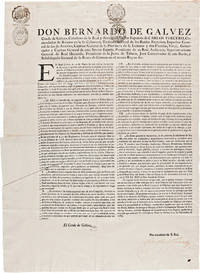
1785réf. 57874Mexico. November 22 1785. Announcing the Compañia Real de Filipinas Regulating Trade with the Philippines A very rare Mexico City printing of the announcement of the creation of the Royal Company of the Philippines by Spanish royal decree in 1785 which regulated and effectively monopolized trade with the Philippines. This copy bears the manuscript rubric of Don Bernardo de Gálvez and signature of his secretary Joseph de Gorraes. Gálvez then Viceroy of New Spain ordered this broadside printed for the reason that "An Establishment so important and of such general interest should be understood and known by all" our translation. The creation of the Royal Company would be particularly relevant to residents of Mexico as most if not all of the trade with the Philippines would come through New Spain. Accompanying the announcement this broadside also prints Articles 1 2 14 21 and 100 of the royal decree which were considered to effectively summarize the purpose and mechanics of the new Company. The articles printed here proclaim that the Company is to enjoy the protection of the Crown for at least twenty-five years establish a fund to back its shares describe how shares and subscriptions could be purchased and organize a general meeting of shareholders. Notably absent from this broadside is the important article of the decree which closed Manila's ports to foreign vessels giving the Company an effective monopoly on all trade between Asia and the Americas. The Royal Company of the Philippines quickly gained vast wealth from this lucrative deal transporting commodities such as indigo coffee sugar spices and cotton across the Pacific. Regardless of its initial success the Company did not endure - the wave of rebellions against Spanish rule in Central and South America in the early 19th century quickly rendered it obsolete and the company was officially dissolved in 1834. A rare broadside announcing this important Royal Decree to the people of the Western Hemisphere; OCLC records only one copy at the Bancroft Library. Broadside printed on two joined sheets of sealed paper 23½ x 17 inches in total. Old folds and light creases a few small worm holes. Very good. OCLC 21747301. unknown
1785réf. 57874Mexico. November 22 1785. Announcing the Compañia Real de Filipinas Regulating Trade with the Philippines A very rare Mexico City printing of the announcement of the creation of the Royal Company of the Philippines by Spanish royal decree in 1785 which regulated and effectively monopolized trade with the Philippines. This copy bears the manuscript rubric of Don Bernardo de Gálvez and signature of his secretary Joseph de Gorraes. Gálvez then Viceroy of New Spain ordered this broadside printed for the reason that "An Establishment so important and of such general interest should be understood and known by all" our translation. The creation of the Royal Company would be particularly relevant to residents of Mexico as most if not all of the trade with the Philippines would come through New Spain. Accompanying the announcement this broadside also prints Articles 1 2 14 21 and 100 of the royal decree which were considered to effectively summarize the purpose and mechanics of the new Company. The articles printed here proclaim that the Company is to enjoy the protection of the Crown for at least twenty-five years establish a fund to back its shares describe how shares and subscriptions could be purchased and organize a general meeting of shareholders. Notably absent from this broadside is the important article of the decree which closed Manila's ports to foreign vessels giving the Company an effective monopoly on all trade between Asia and the Americas. The Royal Company of the Philippines quickly gained vast wealth from this lucrative deal transporting commodities such as indigo coffee sugar spices and cotton across the Pacific. Regardless of its initial success the Company did not endure - the wave of rebellions against Spanish rule in Central and South America in the early 19th century quickly rendered it obsolete and the company was officially dissolved in 1834. A rare broadside announcing this important Royal Decree to the people of the Western Hemisphere; OCLC records only one copy at the Bancroft Library. Broadside printed on two joined sheets of sealed paper 23½ x 17 inches in total. Old folds and light creases a few small worm holes. Very good. OCLC 21747301. unknown books
1939réf. 39574Spokane: Inland-American Ptg. Co. n.d. circa 1939. n.d. circa 1939. PACIFIC NORTHWEST. 10-1/2" x 8" pictorial wrappers. 56pp. Triple column text numerous illustrations. Table of Contents. Double page color map at center entitled "THE INLAND EMPIRE." Map shows parts of Washington Idaho and Montana. Also shown are the principal state highways in Red Lines. Briefly describes the counties in Washington such as Adams Columbia Lincoln Walla Walla et. al.; in Oregon such as Baker Umatilla Union Wallowa; in Idaho such as Benewah Clearwater Kootenai Shoshone; and in Montana such as Flathead Mineral Missoula Sanders et. al. Information about the climate resources agricultural production livestock Spokane Northeastern Washington Big Bend Palouse Country Central Idaho Wenatchee-Okanogan District Valleys of the Yakima et. al. Laid-in is a "Statistical Summary" all having to do with the city of Spokane such as the population beginning in 1880 through an estimated number in 1939; the number of new families arriving and leaving Spokane; post office receipts; commercial banks; telephones building permits motor vehicle registrations and much more. Light erasure mark at the top fore-edge of front wrapper with light wear at the spine else a nice copy of an informative pamphlet. Inland-American Ptg. Co., n.d. (circa 1939). unknown
réf. 002782No Place: No Publisher Printed single sided trade card approximately 125mm x 85mm in size n.d. c.1920 Slightly rubbed telephone number crossed through and replaced beneath in pen otherwise quite bright and clean. T.homas H.atton Lea stained glass designer there are examples of his work near to where he was based at St. Luke's church on Liverpool Street Weaste. First Edition. Unbound. Good. 48mo Oblong. Trade Card. No Publisher Paperback
réf. 138854Paris, Imprimerie Royale, 1835 in-folio, XXVII-205 pp., 51 tableaux statistiques, broché. Dos fragile avec manques, petit manque angulaire à la couverture.
réf. 138857Paris, Imprimerie Royale, 1837 in-folio, XXXI-511 pp., broché. Couverture défraîchie.
réf. 229516Paris, Imprimerie Royale, 1837 in-folio, XXXI-511 pp., broché. Dos bruni.
1804réf. 26292indret 1804 1 reçu ORIGINAL d'une page, manuscrite à l'encre brune, format : 20 x 16 cm, sur papier velin crème, ligné et filigrané, RECU DE FÉLIX CRUCY D'UNE SOMME POUR ARRANGEMENT FAIT ENTRE NOUS, LOUIS CRUCY PÈRE ET FILS ET MATHURIN, SOUS RÉSERVE DES TERMES ULTÉRIEURS DONT QUITTANCE, (SIGNÉ) D. GICQUEAU, NANTES LE 25 JUIN 1817, SIGNATURE MANUSCRITE DE DOMINIQUE GICQUEAU