17 322 résultats
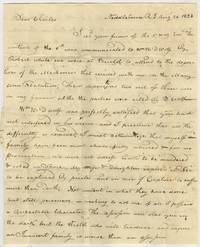
1823réf. BK0184Middletown Rhode Island 1823. Autograph letter signed three pages on a folded sheet with integral address panel to Charles E. Dudley in Albany and Newport postal markings. 7 ¾ x 9 ¾ inches. Old folds scattered staining and some marginal losses a few affecting text. Good to very good. A letter from Newport mariner John Wood concerning his acrimonious departure from the DeWolf family's Mary Ann plantation in Cuba and the ensuing legal dispute with James DeWolf and Charles Collins. Wood was almost certainly the same John Wood whose signature appears on an 1806 Newport agreement for an illegal voyage transporting enslaved Africans from Cape Coast to Havana now held by the Smithsonian's National Museum of African American History and Culture.1 By 1823 he was residing on the Mary Ann plantation one of several Cuban estates belonging to the DeWolfs among the most prominent families involved in the American slave trade. His relationship with DeWolf and Collins had evidently collapsed over his obligations on the estate resulting in what he describes as his forced departure from Cuba under apparently dangerous conditions with his family and a contentious effort to settle their accounts. Writing to his friend Charles E. Dudley then mayor of Albany and a New York state senator Wood reports that three mechanics who had resided with him on the plantation had recently given depositions in Bristol Rhode Island. Two of the three had testified in his favor though all had been called by DeWolf. Wood was particularly incensed by the circumstances surrounding his family's departure from Cuba writing: "I must acknowledge that myself & family have been most shamefully abused & for no provocation we were set adrift liable to be murdered & robbed on Shore My Wife & Daughter exposed at Sea to be captured By pirates and in case of Capture to suffer more than Death; Not content in what they have done but still persevere in wishing to rob me of all I possess a Respectable Character. The assassin will stab you in the dark but the Wretch who will traduce and injure an Innocent family is worse than an assassin." Wood goes on to describe receiving two writs from DeWolf and Collins and transcribes an August 8 letter from James DeWolf explaining his decision to pursue legal action despite their previous discussions of an amicable settlement: "Lest you should think me inconsistent in causing an action to be brought after the last conversation we had I take leave to explain my wishes to come to an amicable settlement by referring to men as we talked remains the same my object is to put the business in a legal and proper train for bringing it to a close . & to enable me to avail of the testimony of the people who were on the Estate with you." Wood expected the Rhode Island Supreme Court meeting at Bristol the following month to appoint referees to settle the accounts. The precise origin of the disagreement is not stated though the depositions of the mechanics and the references to outstanding accounts suggest a dispute over Wood's contractual obligations or activities on the plantation. Wood 1770-1826 was a Newport merchant and captain with longstanding connections to Atlantic commerce. He died at Cape Coast West Africa in 1826 three years after writing the present letter. James DeWolf 1764-1837 then serving in the United States Senate had amassed a substantial fortune through the slave trade and his Cuban plantation interests. Charles Collins his brother-in-law had served as collector of customs at Bristol from 1804 to 1820 an appointment closely connected to the family's slave-trading operations. The Mary Ann plantation is documented in the DeWolf Papers at the Rhode Island Historical Society which include inventories from 1818 and 1820 and contemporary plans of the plantation grounds. The present letter preserves Wood's account of his treatment by the DeWolf family together with his transcription of DeWolf's explanation for pursuing legal action. 1 "Agreement facilitating illegal trade of enslaved Africans" National Museum of African American History & Culture accessed October 12 2026 https://nmaahc.si.edu/object/nmaahc_2019.28.1. . unknown
1823réf. BK0184Middletown Rhode Island 1823. Autograph letter signed three pages on a folded sheet with integral address panel to Charles E. Dudley in Albany and Newport postal markings. 7 ¾ x 9 ¾ inches. Old folds scattered staining and some marginal losses a few affecting text. Good to very good. A letter from Newport mariner John Wood concerning his acrimonious departure from the DeWolf family's Mary Ann plantation in Cuba and the ensuing legal dispute with James DeWolf and Charles Collins. Wood was almost certainly the same John Wood whose signature appears on an 1806 Newport agreement for an illegal voyage transporting enslaved Africans from Cape Coast to Havana now held by the Smithsonian's National Museum of African American History and Culture.1 By 1823 he was residing on the Mary Ann plantation one of several Cuban estates belonging to the DeWolfs among the most prominent families involved in the American slave trade. His relationship with DeWolf and Collins had evidently collapsed over his obligations on the estate resulting in what he describes as his forced departure from Cuba under apparently dangerous conditions with his family and a contentious effort to settle their accounts. Writing to his friend Charles E. Dudley then mayor of Albany and a New York state senator Wood reports that three mechanics who had resided with him on the plantation had recently given depositions in Bristol Rhode Island. Two of the three had testified in his favor though all had been called by DeWolf. Wood was particularly incensed by the circumstances surrounding his family's departure from Cuba writing: "I must acknowledge that myself & family have been most shamefully abused & for no provocation we were set adrift liable to be murdered & robbed on Shore My Wife & Daughter exposed at Sea to be captured By pirates and in case of Capture to suffer more than Death; Not content in what they have done but still persevere in wishing to rob me of all I possess a Respectable Character. The assassin will stab you in the dark but the Wretch who will traduce and injure an Innocent family is worse than an assassin." Wood goes on to describe receiving two writs from DeWolf and Collins and transcribes an August 8 letter from James DeWolf explaining his decision to pursue legal action despite their previous discussions of an amicable settlement: "Lest you should think me inconsistent in causing an action to be brought after the last conversation we had I take leave to explain my wishes to come to an amicable settlement by referring to men as we talked remains the same my object is to put the business in a legal and proper train for bringing it to a close . & to enable me to avail of the testimony of the people who were on the Estate with you." Wood expected the Rhode Island Supreme Court meeting at Bristol the following month to appoint referees to settle the accounts. The precise origin of the disagreement is not stated though the depositions of the mechanics and the references to outstanding accounts suggest a dispute over Wood's contractual obligations or activities on the plantation. Wood 1770-1826 was a Newport merchant and captain with longstanding connections to Atlantic commerce. He died at Cape Coast West Africa in 1826 three years after writing the present letter. James DeWolf 1764-1837 then serving in the United States Senate had amassed a substantial fortune through the slave trade and his Cuban plantation interests. Charles Collins his brother-in-law had served as collector of customs at Bristol from 1804 to 1820 an appointment closely connected to the family's slave-trading operations. The Mary Ann plantation is documented in the DeWolf Papers at the Rhode Island Historical Society which include inventories from 1818 and 1820 and contemporary plans of the plantation grounds. The present letter preserves Wood's account of his treatment by the DeWolf family together with his transcription of DeWolf's explanation for pursuing legal action. 1 "Agreement facilitating illegal trade of enslaved Africans" National Museum of African American History & Culture accessed October 12 2026 https://nmaahc.si.edu/object/nmaahc_2019.28.1. . unknown books
1833réf. 34458v.p. including Antwerp London Havana Pensacola New York 1833. Folio. 12 3/4 x 8 inches. 21 leaves plus two additional manuscript leaves laid in. Contemporary half calf and marbled boards manuscript label on front board. Bookseller's label on front pastedown. Account book of Atlantic trading voyages. An interesting manuscript ship's log containing financial accounts for the brigs Nimrod and Jasper for an eight year period from 1826 to 1833 while they were under the command of a Captain John Hill. The two ships made numerous voyages between the United States Europe and the Caribbean. The present log book contains line accounts of expenditures for journeys from London and Marseilles to New York and Norfolk in 1827; from Antwerp to London in 1828; from Philadelphia to the West Indies in 1829; from Madeira to the Turks Islands in 1831; from the West Indies to Pensacola to Havana in 1832; from the Indies to New York in 1833; and other similar voyages. The log also contains two copies of an 1832 letter written in Havana by Hill to merchants there inquiring about the price of molasses and a list of port charges at several major way points. A fascinating artifact of trans-Atlantic trade in the 1820s and 1830s. unknown books
1954réf. 016005Sceaux Chez Jean-Jacques Pauvert 1954 In-12 Broché Ed. originale
1900réf. 26434Liebig Company 1900. Very good condition. Set of six beautifully colored lithographic trade cards of Australia including a kangaroo image issued by the Liebig company with the text in Italian. The set is titled "In Australia". The Italian set is identical to the French edition but more uncommon. One of the most graphic sets produced by this European company which enjoyed an international market in the late 19th and early 20th century. Pictured are indigenous peoples a kangaroo and an emu natural scenery and an exotic plant; farming and ranching and seaport scenes. Liebig Company unknown
1900réf. 26433Liebig Company 1900. Very good condition. Set of six beautifully colored lithographic trade cards of Australia including a kangaroo image issued by the Liebig company with the text in French. The set is titled "L'Australie". One of the most graphic sets produced by this European company which enjoyed an international market in the late 19th and early 20th century. Pictured are indigenous peoples a kangaroo and an emu natural scenery and an exotic plant; farming and ranching and seaport scenes. Liebig Company unknown
1900réf. 23450Liebig Company 1900. Very good condition. Set of six beautifully colored lithographic trade cards of Australia including a kangaroo image issued by the Liebig company with the text in French. The set is titled "L'Australie". One of the most graphic sets produced by this European company which enjoyed an international market in the late 19th and early 20th century. Pictured are indigenous peoples a kangaroo and an emu natural scenery and an exotic plant; farming and ranching and seaport scenes. Liebig Company unknown
réf. 29379Melbourne: McPherson's Proprietary Limited 1935. Paper wrappers pamphlet. Very good condition. 1935 hardware catalogue this edition not recorded on Trove which records only a 1933 edition. The Australian firm specialized in farming machinery. This edition shows locations in Sydney Melbourne Adelaide Perth with an ad for the Adelaide location on back cover. 8vo printed orange paper wrappers 248pp with illustrations and diagrams throughout. Cover illustration by Percy Trompf. A small deliberate hole in top left for attaching the catalogue by chain or string to the counter. Slt wear to cover but overall vgc. Aus library call #: NL338-4762190294M172 for 1933 edition. McPherson's Proprietary Limited unknown
réf. 211926Avignon, Joseph Mouriès, 1758 in-4, 52 pp., broché sous couverture d'attente de papier gris, petites galeries de vers stoppées en marge inférieure.
réf. 237228Paris, chez l'éditeur [Imprimerie de Selligue], 1830 in-16, titre, 214 pp., demi-basane havane racinée, dos lisse, pièce de titre (reliure du XXe siècle). Rousseurs.
réf. 24509In-8, broché, 196 p., non coupé. Paris, S.E.V.P.E.N., 1962.
réf. 206763Paris, Impr. Nationale, (1790) in-8, 8 pp., broché.
réf. 235797Paris, Impr. Nationale, (1790) in-8, 8 pp., broché, couv. papier bleu postérieur.
réf. 40153Bangor: Burr Printing Company n.d. ca 1926. None. First edition. 9" x 8" folded in half in pictorial wrapper. Printed in green and brown ink. 20 pp. double-column illustrations. Pamphlet that promotes travel by car with routes to Bangor motor trips around Bangor Mount Desert Island Lafayette National Park Bar Harbor Castine and Penobscot Bay Mount Katahdin to various lakes and ponds etc. Wrappers lightly soiled and with light wear to the extremities. Very good. Burr Printing Company, n.d. [ca 1926]. unknown
In-8, broché, 196 p., non coupé. Bibliographie critique de 433 entrées. Tableaux dépliants. Index. Bon exemplaire.
réf. ORD-12351Dijon. Capel. 1792. 2 pages in-4 (208 x 268mm), non rogné, bon exemplaire.
réf. ORD-931Avec les réductions réciproques et comparatives desdites monnaies. Précédés des lois monétaires de Belgique. On y a ajouté: 1°le Tarif pour faire le compte de traitemens ou gages des domestiques, loyers de chambres, etc; 2°des sommes en florins et cents des Pays-Bas converties en argent de Belgique, et de cette dernière monnaie en argent des Pays-Bas, etc. Bruxelles. Vve Vanderborght. 1841. In-12 (102 x 170mm) broché, couverture bleue imprimée, 84 pages avec reproductions de quelques pièces de monnaies dans le texte. Qq. pages un peu cornées, couverture lgt piquée avec petit manque au dos, état moyen.
1880réf. 3068Ath Belgium: L.&H. Cambier Frères n.d. ca. 1880 . Rare profusely illustrated trade catalogue from the late 19th century depicting furniture made by L.&H. Cambier Frères of Ath Belgium. The catalogue consists of 107 lithographed plates depicting a wide variety of chairs sofas tables desks beds and more including children's furniture. Plates 108-122 contain decorative borders but no other illustrations presumably so items could be added when Cambier Frères introduced new furniture designs. Apparently it was fine to add items to the catalogue but buyers were advised not to cut out the drawings. "Ne découpez pas les dessins indiquez-nous simplement le numéro de l'objet" it says at the bottom of each plate. Plates 31-33 depict chairs very similar in style to those designed by the German-Austrian cabinet maker Michael Thonet. In fact chair No. 14 on plate 31 is exactly the same as Thonet's iconic No. 14 bistro chair. There's no date given for the catalogue but we estimate ca. 1880 based on the style of furniture. That's also when the brothers Léon and Henri Cambier expanded the Ath factory that their father Emmanuel had founded in 1835. This catalogue is rare with OCLC showing a single institutional holding at the University of Leeds. None in commerce. A wonderful look at European furniture of the late 19th century with numerous detailed illustrations by Breger & Javal Paris. RARE. PHYSICAL DETAILS: Oblong Small Quarto 9.75 x 7 inches; 250 x 178 mm 2 122 pages in original red cloth decorated and lettered in gilt. CONDITION: Small water stain to front cover slight flaring of upper board rubbing and fraying to spine and board edges offsetting to end papers light toning to page extremities. About Very Good. L.&H. Cambier Frères hardcover
1828réf. 4904Lithographierte Handschrift. (Hamburg 1828). Folio. (33,5 x 22,0 cm). 18 nicht nummerierte Blatt. Blauer Glanzpapierumschlag d. Zt. [3 Warenabbildungen]
réf. ORD-132215 octobre 1869 - 4 juin 1870. Bordeaux. Gounouilhou. 1871. In-8 (140 x 220mm) dos lisse toile grise, pièce de titre maroquin noir, plats et gardes marbrés, couverture verte imprimée conservée, 467, (1) pages. Petits défauts, numéros et étiquette de bibliothèque sans cachet, assez bon exemplaire.
1743réf. 9349Sans lieu, sans nom, 1743. In-8 de 176 pages, plein veau marbré, dos à nerfs orné de filets et fleurons dorés, pièce de titre rouge, filet doré sur les coupes, tranches rouges. Premiers et derniers feuillets légèrement empoussiérés.
1830réf. 1232Paris, Treuttel et Wurtz, 1830 ; in-12 de 2 ff., 90 pp., 1 f., demi-veau vert, dos à nerfs orné de motifs dorés et à froid, tranches marbrées.
réf. ORD-1319Première Année (1828). Bordeaux. De l'Imprimerie de Suwerinck. (1828). In-8 (135 x 205mm) plein veau, dos lisse vert, pièces rouges, ornements or (lyres et frises dans le style de l'époque, plats veau brun raciné, tranches jaunes, gardes marbrées, (2), 495 pages. Du N°1 (Février 1828) au N°11 et 12 (décembre 1828). Indispensable table analytique en fin d'ouvrage. Quelques pages brunies mais bon exemplaire dans une agréable reliure assez originale. Hommage d'un des rédacteurs (Merle) au maire de Bordeaux le Vicomte Du Hamel.
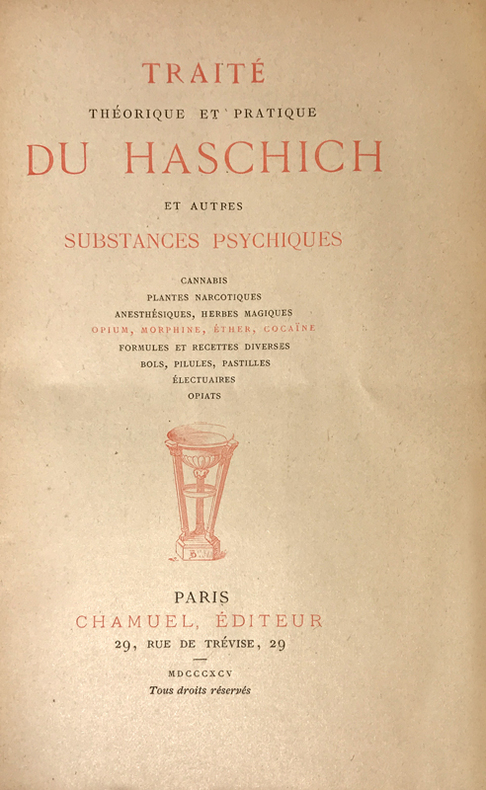
1895réf. 15352Paris, Chamuel, 1895 ; in-12, broché ; 177 pp., (1 bl.), (2) pp. de catalogue, couverture crème rempliée, illustrée, imprimée en vieux-rose et noir, petites figures.
First edition, 28pp., anonymous but known to be by Bohn and the title bears an inscription from him or a member of the Bohn family to the Rev. W. H. Gunner, disbound. "Bohn, Henry George (1796?1884), bookseller and publisher. The information obtained in the practice of his business he also utilised in 'Observations on the Plan and Progress of the Catalogue of the Library of the British Museum,' 1855, in which he suggested various improvements in method, and especially the addition of an index of matters, which he endeavoured to show might be rapidly accomplished by a proper subdivision of labour."?(DNB).