1.370 resultados
1839240 p. 12 mo. Foxed. XLib. Spine taped. **NOTE: A very curious feature of this copy is that the copyright notice is pasted over with a changed version. Jay, the son of the first Chief Justice of the U.S. Supreme court, was a noted attorney and staunch abolitionist. He "castigated the federal government's complicity in the crime of slavery. by contrasting actual federal involvement in slavery with the constitutionally required minimal involvement. He also contrasted the gratuitous complicity with slavery with a vision of what the national government might permissibly do against slavery. Most of Jay 's positions on congressional or executive power were well within the mainstream of legal thought of the day." **PRICE JUST REDUCED! JUN2C/W148 Rear
1963Ex-library book with the usual stamps, stickers, etc. Binding is solid and text/interior is clean and free of marking of any kind. Crease across cover, with sticker removed from cover, sharpie marking at page ends. 258 pages, contents include: Benjamin Lundy: The editor to the public, William Lloyd Garrison, Commencement of the Liberator, The New England Anti-Slavery society, Letter from Beriah Green to Reverend S.S. Jocelyn, Whittier on Justice and Expediency, Elizur Wright, the sin of slavery and its remedy; containing some reflections on the moral influence of African colonization Lewis Tappan speaks of William Lloyd Garrison, Declaration of sentiments of the american Anti-Slavery Society, A Negro writes of racial intermarriage, etc.
2019New English Paperback. Roy. 8vo. (24 x 17 cm). Articles in English and French. Acta Classica Mediterranea. No: 2 - 2019. L'intégration du paysage religieux dans l'espace de la cité: les sanctuaires de l'Ionie entre le 7ème et le 6ème siècle av. J.C. Kenan Eren.; Versinschriften im Codex Pighianus auf f. 74r und v Ulrike Jansen.; A Hellenistic Funerary Stele from Heraion Teikhos (Karaevlialti) Filiz Dönmez-Öztürk - Hüseyin Sami Öztürk.; Not Salamis but Sardes: In the Light of Izmir Archaeology Museum Collection and the Archaeological Finds from Nif (Olympos) Mountain in Izmir Dinçer Savas Lenger - Ömer Tatar.; Inscriptiones Asiae Minoris Hamdi Sahin, Hüseyin Sami Öztürk.
ref. 0666169632.Ghardcover. Good. Access codes and supplements are not guaranteed with used items. May be an ex-library book. hardcover
ref. 0243219504.Gpaperback. Good. Access codes and supplements are not guaranteed with used items. May be an ex-library book. paperback
1963ref. 221701963. Civil Rights African American Slavery and Abolition A complete set of the Adventures in Negro History educational LP series created to promote Black history and culture during the Civil Rights era through dramatized narration and scholarly commentary. Adventures in Negro History: Volumes I-III. Highlight Radio Productions 1963 1966 1969. Three original 12-inch 33⅓ rpm vinyl LPs each record housed in original illustrated jacket. Commissioned by Pepsi-Cola and produced by the Chicago-based Highlight Radio Productions this project brought together historians actors and community leaders in an accessible audio-driven public history format. Each volume explores a distinct theme in African American experience with powerful graphic covers and scholarly liner notes by eminent historians John Hope Franklin and Elsie M. Lewis. 1 Volume I: Adventures in Negro History 1963. Illustrated in stark black and white the cover features a stylized portrait of a bound enslaved man visually evoking the violent conditions of enslavement and the struggle for freedom. The back cover provides capsule biographies of pivotal figures including Estevanico Crispus Attucks and W.E.B. Du Bois as well as dramatizations of "Douglass!" and "Pinchback!" The LP includes dramatized reenactments written and directed by Ossie Davis and is voiced by Ruby Dee Godfrey Cambridge Brock Peters and Roy Glenn. The liner text opens: "We cannot afford to let the story of Negro Americans-who they were how they lived what they did-go untold. This is a job that needs doing in all the classrooms of America." The tone is urgent and pedagogical designed to be played in schools libraries and community centers. 2 Volume II: The Frederick Douglass Years 1817-1895 1966.With a bold blue cover echoing the design of Volume I this LP focuses entirely on Douglass's life from enslavement to abolitionist leader. A full panel on the reverse contains the essay What the Douglass Years Mean to America by John Hope Franklin then Professor of American History at the University of Chicago. Franklin writes: "The Frederick Douglass story is the story of America in the nineteenth century. it is the story of man's struggle for justice and liberty in a society often committed more to self-interest than to high principle." The dramatizations include scenes from Douglass's escape from slavery his debates with white abolitionists and his role during Reconstruction. The same acclaimed voice cast from Volume I returns. 3 Volume III: The Afro-American's Quest for Education - A Black Odyssey 1969.This volume shifts focus to the historical struggle for Black educational access from slavery through desegregation. The cover rendered in burnt sienna and black features a graphic portrait of a bearded elder flanked by line drawings of teachers students and historic Black institutions. On the verso Dr. Elsie M. Lewis Professor of History at Howard University contributes a major essay declaring: "No phase of the American Negro's history is more crucial more dramatic or more moving than his long dogged quest for education." Her commentary frames education as both a right and revolutionary act for African Americans. Like earlier entries Volume III blends narrative scenes with documentary-style commentary. All three LPs are in very good condition with minor edge wear to sleeves. Vinyl appears clean with no visible scratches. These records were not mass-marketed and were distributed largely through educational and community networks making complete sets scarce. unknown
1963ref. 221701963. Civil Rights African American Slavery and Abolition A complete set of the Adventures in Negro History educational LP series created to promote Black history and culture during the Civil Rights era through dramatized narration and scholarly commentary. Adventures in Negro History: Volumes I-III. Highlight Radio Productions 1963 1966 1969. Three original 12-inch 33⅓ rpm vinyl LPs each record housed in original illustrated jacket. Commissioned by Pepsi-Cola and produced by the Chicago-based Highlight Radio Productions this project brought together historians actors and community leaders in an accessible audio-driven public history format. Each volume explores a distinct theme in African American experience with powerful graphic covers and scholarly liner notes by eminent historians John Hope Franklin and Elsie M. Lewis. 1 Volume I: Adventures in Negro History 1963. Illustrated in stark black and white the cover features a stylized portrait of a bound enslaved man visually evoking the violent conditions of enslavement and the struggle for freedom. The back cover provides capsule biographies of pivotal figures including Estevanico Crispus Attucks and W.E.B. Du Bois as well as dramatizations of "Douglass!" and "Pinchback!" The LP includes dramatized reenactments written and directed by Ossie Davis and is voiced by Ruby Dee Godfrey Cambridge Brock Peters and Roy Glenn. The liner text opens: "We cannot afford to let the story of Negro Americans-who they were how they lived what they did-go untold. This is a job that needs doing in all the classrooms of America." The tone is urgent and pedagogical designed to be played in schools libraries and community centers. 2 Volume II: The Frederick Douglass Years 1817-1895 1966.With a bold blue cover echoing the design of Volume I this LP focuses entirely on Douglass's life from enslavement to abolitionist leader. A full panel on the reverse contains the essay What the Douglass Years Mean to America by John Hope Franklin then Professor of American History at the University of Chicago. Franklin writes: "The Frederick Douglass story is the story of America in the nineteenth century. it is the story of man's struggle for justice and liberty in a society often committed more to self-interest than to high principle." The dramatizations include scenes from Douglass's escape from slavery his debates with white abolitionists and his role during Reconstruction. The same acclaimed voice cast from Volume I returns. 3 Volume III: The Afro-American's Quest for Education - A Black Odyssey 1969.This volume shifts focus to the historical struggle for Black educational access from slavery through desegregation. The cover rendered in burnt sienna and black features a graphic portrait of a bearded elder flanked by line drawings of teachers students and historic Black institutions. On the verso Dr. Elsie M. Lewis Professor of History at Howard University contributes a major essay declaring: "No phase of the American Negro's history is more crucial more dramatic or more moving than his long dogged quest for education." Her commentary frames education as both a right and revolutionary act for African Americans. Like earlier entries Volume III blends narrative scenes with documentary-style commentary. All three LPs are in very good condition with minor edge wear to sleeves. Vinyl appears clean with no visible scratches. These records were not mass-marketed and were distributed largely through educational and community networks making complete sets scarce. unknown books
ref. 41110Paris, Gallimard (coll. "L'univers des Formes"), 1967. In-4°, 448p. Reliure pleine toile d'éditeur, sous jaquette illustrée.
1967ref. 31516Gallimard Couverture rigide toile Paris 1967
1967ref. 42218Gallimard Jaquette en état satisfaisant Couverture rigide toile Paris 1967
2015Mm 285x310 Catalogo della mostra di Milano, Mudec - Museo delle culture, 26 marzo - 30 agosto 2015. Volume cartonato, legatura editoriale in mezza tela, piatto posteriore in tela, 339 pagine, numerosissime illustrazioni a colori e in bianco e nero nel testo. Libro in condizioni di nuovo - brand new in original shrinkwrap. SPEDIZIONE IN 24 ORE DALLA CONFERMA DELL'ORDINE.
1917119p. + Plus frontis and full page photographs. Penciled ownership of Mrs. William A. Kump, 1917. 12mo. Original full printed wraps, damp stained at top edge. AFRICA/2
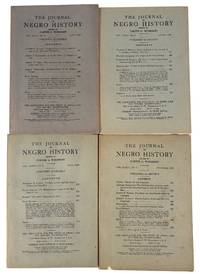
1942ref. 217921942. Woodson Carter Godwin. The Journal of Negro History. 1942-1949. Foundational issues of the journal established by Carter G. Woodson documenting the institutionalization of Black historical scholarship in the United States and advancing early academic study of African American military service political rights and diaspora culture. Issued by the Association for the Study of Negro Life and History which Woodson co-founded in 1915 these volumes situate Black experience within national and Atlantic frameworks including Revolutionary War service Reconstruction governance and twentieth-century military participation. The selection highlights how mid-century scholars constructed a documentary record of African American life in direct response to exclusion from mainstream historiography with particular emphasis on suffrage labor naval service and racial legislation. Woodson Carter Godwin ed. The Journal of Negro History. Washington D.C.: Association for the Study of Negro Life and History 1942 1947 1949. Four issues. 1 Jackson Luther P. "Virginia Negro Soldiers and Seamen in the American Revolution." The Journal of Negro History. Vol. XXVII No. 3. Washington D.C.: ASNLH 1942. Establishes early documentation of African American military participation in the Revolutionary War. Additional contents include Frank J. Klingberg's study of Jamaican legislation 1837 Ronald V. Sires's analysis of the Jamaica Slave Insurrection Loan 1832-1863 and Harold Courlander's "Profane Songs of the Haitian People" presenting vernacular cultural material from Haiti. 2 Wesley Charles H. "Negro Suffrage in the Period of Constitution-Making 1787-1865." The Journal of Negro History. Vol. XXXII No. 2. Washington D.C.: ASNLH 1947. Examines the development of Black political rights before the Civil War. Herbert Aptheker's "The Negro in the Union Navy" and Lawrence D. Reddick's "The Negro in the United States Navy during World War II" connect nineteenth-century and contemporary military service while Mercer Cook's essay surveys modern Haitian literature. 3 Lofton Williston H. "Northern Labor and the Negro during the Civil War." The Journal of Negro History. Vol. XXXIV No. 3. Washington D.C.: ASNLH 1949. Traces relationships between African American workers and Northern labor movements. Sidney Kaplan's "The Miscegenation Issue in the Election of 1864" analyzes race in wartime political discourse and Morris U. Schappes reprints Ernestine L. Rose's address on West Indian emancipation preserving a nineteenth-century abolitionist voice. 4 Bernstein Leonard. "The Participation of Negro Delegates in the Constitutional Convention of 1868 in North Carolina." The Journal of Negro History. Vol. XXXIV No. 4. Washington D.C.: ASNLH 1949. Documents Black political participation in Reconstruction governance. Additional contributions include Joseph H. Taylor on disfranchisement in Alabama Jessie P. Guzman on Monroe Nathan Work's scholarly contributions and a reprinted 1774 letter by Phillis Wheatley identified by Benjamin Quarles. These issues were published during World War II and the early Cold War when African American military service abroad and civil rights struggles at home intensified scholarly and political attention to Black history. Articles on the Union Navy and World War II naval service align with wartime debates over segregation and citizenship while studies of suffrage Reconstruction conventions and disfranchisement reflect renewed examination of constitutional rights in the context of emerging civil rights activism. Four issues in publisher's printed wrappers each approximately 108 to 118 pages. Light wear occasional foxing and minor soiling to wrappers; overall very good to near fine. A cohesive grouping illustrating how Black historians and intellectuals built an evidentiary foundation for African American history as a formal academic discipline in the mid twentieth century. unknown
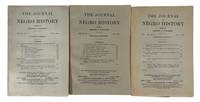
1924ref. 217871924. Woodson Carter Godwin. The Journal of Negro History. Archive of three landmark issues published between 1924 and 1928 documenting the institutional development of African American historical scholarship during the early twentieth century. The material records Black intellectual production historical recovery and scholarly publishing through the Association for the Study of Negro Life and History founded by Carter G. Woodson and Jesse E. Moorland in 1915. These issues include Black scholarship challenging white supremacist interpretations of Reconstruction slavery labor and African diasporic history through archival research and independent academic publication. The journal served as one of the central vehicles through which African American historians established scholarly networks disseminated original research and institutionalized the study of Black history within American intellectual life. The archive provides primary-source evidence for the emergence of modern African American historiography and the scholarly movement that later gave rise to Negro History Week and Black History Month. Woodson Carter Godwin ed. The Journal of Negro History. Lancaster PA and Washington D.C.: The Association for the Study of Negro Life and History 1924 1926 and 1928. Three issues in publisher's printed wrappers comprising Vol. IX No. 3 July 1924; Vol. XI No. 3 July 1926; and Vol. XIII No. 3 July 1928. Each issue measures approximately 10 x 6.5 inches and ranges between 120 and 176 pages. 1 Vol. IX No. 3 July 1924. Devoted primarily to Alrutheus Ambush Taylor's major study "The Negro in South Carolina During the Reconstruction" examining demographic change labor transition religion education and political organization in the post-emancipation South. Written while Taylor served as the first full-time Black researcher employed by Woodson's organization the study foregrounds African American agency during Reconstruction and anticipates interpretive frameworks later expanded by W.E.B. Du Bois in Black Reconstruction. 2 Vol. XI No. 3 July 1926. Continues Taylor's Reconstruction scholarship with "The Negro in the Reconstruction of Virginia" detailing Black political participation church organization disenfranchisement campaigns and the reestablishment of white political control in Virginia after Reconstruction. The article constitutes one of the earliest extended scholarly treatments of Black Reconstruction politics in the state. 3 Vol. XIII No. 3 July 1928. Broadens the journal's scope beyond the Reconstruction South through studies including N. Andrew N. Cleven's "The First Panama Mission and the Congress of the United States" W. Sherman Savage's early survey "The Negro in the History of the Pacific Northwest" and Jean Trapp's "The Liverpool Movement for the Abolition of the English Slave Trade." The issue additionally includes Ruth A. Fisher's extensive 109-page documentary compilation "Extracts from the Records of the African Companies" reproducing archival material relating to British commercial participation in the transatlantic slave trade. These issues record the emergence of African American historical scholarship as an organized intellectual discipline during a period when Black historians faced systematic exclusion from mainstream academic institutions and publishing networks. The journal's sustained attention to Reconstruction history preceded revisionist scholarship that later transformed the field with early interpretations centered on Black political participation labor and institutional development rather than Lost Cause narratives dominant in white historiography of the era. Studies on the Pacific Northwest Panama and British antislavery movements extend the journal's diasporic approach to Black history beyond the American South. Minor edgewear and faint toning to wrappers; overall very good condition. An archive of foundational African American historical scholarship and one of the central publishing achievements of twentieth-century Black intellectual life. unknown
1943ref. 217911943. Woodson Carter Godwin. The Journal of Negro History. Archive of three significant issues published between 1943 and 1946 documenting the continued expansion of African American historical scholarship during the Second World War and immediate postwar period. The material records Black intellectual production historical recovery and interdisciplinary scholarship through the editorial and publishing work of the Association for the Study of Negro Life and History founded by Carter G. Woodson and Jesse E. Moorland in 1915. These issues include archival evidence and field research on slavery Black political organization African diasporic identity labor systems and racial discrimination across the United States the Caribbean and Latin America. The journal served as one of the central institutional vehicles through which African American scholars circulated research challenging dominant white historical narratives while building an international framework for Black historical studies. The archive provides primary-source evidence for the maturation of mid-century African American historiography and the broadening geographic scope of Black intellectual inquiry during the 1940s. Woodson Carter Godwin ed. The Journal of Negro History. Washington D.C.: The Association for the Study of Negro Life and History 1943 and 1946. Three issues in publisher's printed wrappers comprising Vol. XXVIII No. 3 July 1943; Vol. XXXI No. 3 July 1946; and Vol. XXXI No. 4 October 1946. Each issue measures approximately 10 x 6.5 inches and ranges between 111 and 137 pages. 1 Vol. XXVIII No. 3 July 1943. Includes Vincent W. Byas' "Ethnologic Aspects of the Martinique Creole" examining Creole identity and cultural formation in the French Caribbean; John Hope Franklin's influential "Slaves Virtually Free in Ante-Bellum North Carolina" reassessing the legal and social complexities of slavery in the Upper South; W. Sherman Savage's "The Contest over Slavery between Illinois and Missouri" addressing sectional political tensions; and Arthur J. Alexander's "Federal Officeholders in New York State as Slaveholders 1789-1805" documenting Northern political participation in slavery. 2 Vol. XXXI No. 3 July 1946. Features Charles W. Cobb Jr.'s "The Outlook Regarding State FEPC Legislation" analyzing anti-discrimination policy and fair employment campaigns during the early civil rights era; Mozell C. Hill's "The All-Negro Communities of Oklahoma: The Natural History of a Social Movement" documenting Black autonomous communities and rural self-governance in Oklahoma; and Gonzalo Aguirre Beltrán's "Tribal Origins of Slaves in Mexico" tracing African ethnic origins and cultural survivals within Mexican slavery and the broader Atlantic world. 3 Vol. XXXI No. 4 October 1946. Opens with the Annual Report of the Director and includes Bernard H. Nelson's "Confederate Slave Impressment Legislation 1861-1865" examining the forced wartime conscription of enslaved labor; Marion J. Russell's "American Slave Discontent in Records of the High Courts" focusing on legal evidence of enslaved resistance; Bella Gross' "The First National Negro Convention" revisiting antebellum Black political organizing; and John A. Schutz and Maud O'Neil's "Arthur Holt Anglican Clergyman Reports on Barbados 1725-1733" documenting Caribbean plantation society through missionary observation. These issues record the international and interdisciplinary character of African American scholarship under Woodson's editorial leadership during the 1940s. Contributors examine Black political organization labor systems diasporic identity formation and legal structures across multiple regions of the Atlantic world. Work by John Hope Franklin Charles W. Cobb Jr. Gonzalo Aguirre Beltrán and other scholars reflects the journal's role in shaping modern African American and African diasporic historiography during the mid-twentieth century. Light edge toning and faint foxing to wrappers with minor handling wear; overall very good to near fine condition. An archive documenting the intellectual development and international reach of Black historical scholarship in the World War II and immediate postwar era. unknown
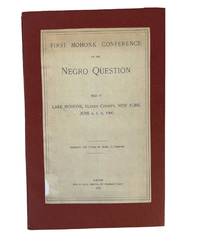
1890ref. 196721890. Barrows Isabel C. ed. First Mohonk Conference on the Negro Question Held at Lake Mohonk Ulster County New York June 4 5 6 1890 1890 records one of the earliest organized national discussions among white reformers politicians and intellectuals addressing the status of African Americans in the decades following Reconstruction. Convened at a moment when Black political rights were being systematically dismantled across the South through disenfranchisement and violence the conference brought together predominantly white Northern and Southern participants to debate labor education and civil status. The proceedings include the intervention of Reconstruction advocate Albion W. Tourgée whose address "The Negro's View of the Race Problem" directly challenged the exclusion of Black voices and concluded with a proposed resolution that failed to gain support. Statements within the conference reflect prevailing racial barriers including the observation that in Philadelphia "a colored man may carry mortar up a ladder but he is not allowed to lay the bricks" underscoring systemic exclusion from skilled labor and economic advancement. Barrows Isabel C. ed. First Mohonk Conference on the Negro Question Held at Lake Mohonk Ulster County New York June 4 5 6 1890. Boston: Geo. H. Ellis 1890. Softcover pamphlet format 142 pages measuring approximately 24 cm. Original front cover preserved and laid in with a color facsimile wrapper supplied for protection. Text printed as conference proceedings compiling speeches discussions and resolutions delivered across the three-day meeting. Produced during the consolidation of Jim Crow policies and the retreat from Reconstruction-era protections this document provides direct evidence of how white-led reform movements framed and debated Black citizenship at the national level. The absence of substantive Black participation alongside Tourgée's protest highlights tensions between advocacy and paternalism within late nineteenth-century reform discourse. As a printed record of policy-oriented discussion the volume supports research into labor exclusion education policy and the ideological foundations of segregation-era governance. Minor staining to lower margins; otherwise very good condition. unknown
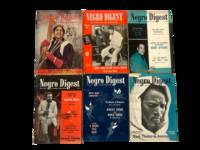
1947ref. 223891947. Johnson John H. founder. Negro Digest 1947-1969 documents African American political thought literary production and cultural criticism across the postwar period the Civil Rights Movement and the emergence of the Black Arts Movement. Published as a digest format periodical the magazine brought together essays fiction journalism and commentary by leading Black writers and public intellectuals establishing a widely circulated forum for debate on race identity labor international politics and the arts. The issues in this archive include contributions by figures such as LeRoi Jones Alice Childress C. Eric Lincoln Arna Bontemps and Barbara Ann Teer supporting research into African American intellectual history Black theater and mid twentieth century print culture. Negro Digest. Chicago: Johnson Publishing Company 1947-1969. Archive of six issues in printed wrappers each approximately 7.5 x 5.5 inches. Issues included are: 1 January 1947 with articles including Richard Wright's "How Jim Crow Feels" Eleanor Roosevelt's contributions and "How Jackie Robinson Took It"; 2 February 1951 featuring "I Didn't Raise My Boy to Be a Fighter" by Lillie Brooks and articles by Walter White and Roi Ottley; 3 November 1961 including "The New Black Renaissance" by Arna Bontemps and commentary by Duke Ellington and C. Eric Lincoln; 4 December 1962 featuring "The Menace of Mediocrity" by C. Eric Lincoln and essays on African American urban life and global politics; 5 April 1967 Second Annual Theater Issue including LeRoi Jones's play Slave Ship and essays by Alice Childress Ronald Milner and others on Black theater and performance; 6 April 1969 Annual Report on Black Theater in America with contributions by Barbara Ann Teer Woodie King Jr. and a roundtable including Sam Greenlee and Hoyt W. Fuller. The issues include essays reportage literary excerpts and visual material documenting cultural and political developments. Published during a period of expanding Black media and activism Negro Digest functioned as a central platform connecting literary production with political discourse tracing shifts from integrationist arguments in the postwar years to the cultural nationalism and artistic experimentation of the late 1960s. The inclusion of theater-focused issues reflects the increasing importance of performance as a site of political expression within the Black Arts Movement while earlier issues address labor segregation and international Black identity. Light edge wear and rubbing particularly to earlier issues; covers remain vibrant with pages clean and intact; overall very good condition. This archive provides sustained documentation of African American intellectual and cultural life across a critical period of twentieth century history. unknown
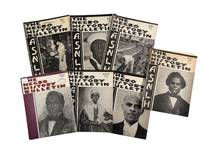
1941ref. 211681941. Woodson Carter G. The Negro History Bulletin. These mid-twentieth century periodicals document the institutionalization of African American historical scholarship and pedagogy under the leadership of Carter G. Woodson whose work established Black history as a formal field of study in the United States. Issued between 1941 and 1949 these issues provide primary evidence of how African American history was researched interpreted and disseminated during a period shaped by World War II migration and ongoing struggles for civil rights. Founded in 1937 at the urging of Mary McLeod Bethune the Negro History Bulletin functioned as an educational tool for teachers and students presenting accessible scholarship on African American life the African diaspora and global Black history. Editorial direction under Woodson emphasized correcting omissions in dominant historical narratives and foregrounding Black agency with content ranging from slavery and Reconstruction to contemporary wartime contributions and cultural production. Woodson Carter G. ed. The Negro History Bulletin. Washington D.C.: Association for the Study of Negro Life and History 1941-1949. Seven issues. Quarto. Stapled wrappers. Archive of seven issues spanning April 1941 through June 1949 each approximately 20-22 pages and measuring 8.5 x 11 inches illustrated with black and white photographs and line drawings. Contents include: 1 April 1941 issue with articles on the Underground Railroad Black communities in Canada and book reviews; 2 May 1944 issue addressing World War II and African American participation across military and civilian life; 3 March 1945 issue featuring Sojourner Truth labor equality free Black populations in antebellum Alabama and racial violence; 4 May 1945 issue examining the Department of Negro Affairs and early American attitudes toward slavery; 5 May 1947 issue including studies of formerly enslaved families such as the Loguens and Tanners suffrage in the South and profiles of Black educators; 6 January 1949 issue with articles on education in Haiti the Negro Little Theatre Movement Negro spirituals and a biography of Frederick Douglass; 7 June 1949 issue addressing intersections of Jewish and Black history modernization in the Virgin Islands regional Black history in Maryland and Virginia and educational policy. These issues were produced during a formative period in the expansion of African American historical consciousness when Woodson's efforts challenged the exclusion of Black experiences from mainstream curricula and scholarly discourse. The Negro History Bulletin operated as a bridge between academic research and classroom instruction shaping generations of teachers and students and contributing to the eventual institutionalization of Black Studies programs in the later twentieth century. The publication continues today as the Black History Bulletin recognized as the longest continuously published journal for practitioners in the field. Clean pages with light handling wear; fragile binding to the earliest issue and a punch hole to the upper corner of the June 1949 issue; overall very good condition. The archive provides a concentrated record of early African American historiography and educational practice during a critical period of intellectual and social transformation. unknown
1961ref. 3987Pittsburgh: Shields Watson & Washington Attorneys at Law 1961. Very good. Together 4 leaves 7 pp. the first two legal-size 14" x 8 1/2" the others slightly shorter; brad bound inside a 14.74 x 9" printed chemise folded to 9" x 3.75". Creases at folds; chemise moderately worn; leaves lightly dust-soiled with one small stain. APPLICATION TO CHARTER AN AFRICAN AMERICAN NON-PROFIT BUSINESS ASSOCIATION. IT WAS CREATED IN RESPONSE TO JIM CROW LAWS THAT REMAINED IN FORCE IN WESTERN PENNSYLVANIA AND ELSEWHERE. THIS SCARCE PRIMARY SOURCE MATERIAL DOCUMENTS THE NEEDS OF AFRICAN AMERICAN BUSINESS OWNERS TO UNITE IN ORDER TO SURVIVE. Our charter shows that the "Negro Licensed Beverage Association of Western Pennsylvania" NLBAWP was a group of African American hotel owners restaurant owners and tavern owners. Lingering Jim Crow laws and other societal forces made it exceptionally difficult for such businesses to succeed in the Pittsburgh area and of course elsewhere. The late 1950s and early 1960s saw the development of similar organizations in Philadelphia National Negro Licensed Beverage Association and New Orleans Negro Tavern Owners Association. Importantly this document lists the goals of the NLBAWP organization: "To foster strengthen and improve business within the Negro community." "To advance the cause of the Negro tavern and hotel owner as a whole." "To give service to members to do things for them which they cannot do for themselves or which can be done better or less expensively if done collectively." "To create and project the proper image of a tavern or hotel owner in the community." "To sponsor aid and assist any charitable or civic project approved by the members." One noteworthy incorporator listed here was Vivian Mason Lane. Lane owned four Pittsburgh taverns in the 1960s and was a community leader through at least the 1980s. She led a neighborhood Chamber of Commerce and ran unsuccessfully for County Commissioner and the State House. The 1966-67 Negro Traveler's Green Book "For Vacation Without Aggravation!" lists a grand total of eight suitable motels tourist homes and restaurants in Pittsburgh. In any event we have been unable to determine what -- if anything -- became of the Negro Licensed Beverage Association of Western Pennsylvania. Shields, Watson & Washington, Attorneys at Law unknown
1961ref. 3987Pittsburgh: Shields Watson & Washington Attorneys at Law 1961. Very good. Together 4 leaves 7 pp. the first two legal-size 14" x 8 1/2" the others slightly shorter; brad bound inside a 14.74 x 9" printed chemise folded to 9" x 3.75". Creases at folds; chemise moderately worn; leaves lightly dust-soiled with one small stain. APPLICATION TO CHARTER AN AFRICAN AMERICAN NON-PROFIT BUSINESS ASSOCIATION. IT WAS CREATED IN RESPONSE TO JIM CROW LAWS THAT REMAINED IN FORCE IN WESTERN PENNSYLVANIA AND ELSEWHERE. THIS SCARCE PRIMARY SOURCE MATERIAL DOCUMENTS THE NEEDS OF AFRICAN AMERICAN BUSINESS OWNERS TO UNITE IN ORDER TO SURVIVE. Our charter shows that the "Negro Licensed Beverage Association of Western Pennsylvania" NLBAWP was a group of African American hotel owners restaurant owners and tavern owners. Lingering Jim Crow laws and other societal forces made it exceptionally difficult for such businesses to succeed in the Pittsburgh area and of course elsewhere. The late 1950s and early 1960s saw the development of similar organizations in Philadelphia National Negro Licensed Beverage Association and New Orleans Negro Tavern Owners Association. Importantly this document lists the goals of the NLBAWP organization: "To foster strengthen and improve business within the Negro community." "To advance the cause of the Negro tavern and hotel owner as a whole." "To give service to members to do things for them which they cannot do for themselves or which can be done better or less expensively if done collectively." "To create and project the proper image of a tavern or hotel owner in the community." "To sponsor aid and assist any charitable or civic project approved by the members." One noteworthy incorporator listed here was Vivian Mason Lane. Lane owned four Pittsburgh taverns in the 1960s and was a community leader through at least the 1980s. She led a neighborhood Chamber of Commerce and ran unsuccessfully for County Commissioner and the State House. The 1966-67 Negro Traveler's Green Book "For Vacation Without Aggravation!" lists a grand total of eight suitable motels tourist homes and restaurants in Pittsburgh. In any event we have been unable to determine what -- if anything -- became of the Negro Licensed Beverage Association of Western Pennsylvania. Shields, Watson & Washington, Attorneys at Law unknown books
1943ref. 217911943. Woodson Carter Godwin. The Journal of Negro History. Archive of three significant issues published between 1943 and 1946 documenting the continued expansion of African American historical scholarship during the Second World War and immediate postwar period. The material records Black intellectual production historical recovery and interdisciplinary scholarship through the editorial and publishing work of the Association for the Study of Negro Life and History founded by Carter G. Woodson and Jesse E. Moorland in 1915. These issues include archival evidence and field research on slavery Black political organization African diasporic identity labor systems and racial discrimination across the United States the Caribbean and Latin America. The journal served as one of the central institutional vehicles through which African American scholars circulated research challenging dominant white historical narratives while building an international framework for Black historical studies. The archive provides primary-source evidence for the maturation of mid-century African American historiography and the broadening geographic scope of Black intellectual inquiry during the 1940s. Woodson Carter Godwin ed. The Journal of Negro History. Washington D.C.: The Association for the Study of Negro Life and History 1943 and 1946. Three issues in publisher's printed wrappers comprising Vol. XXVIII No. 3 July 1943; Vol. XXXI No. 3 July 1946; and Vol. XXXI No. 4 October 1946. Each issue measures approximately 10 x 6.5 inches and ranges between 111 and 137 pages. 1 Vol. XXVIII No. 3 July 1943. Includes Vincent W. Byas' "Ethnologic Aspects of the Martinique Creole" examining Creole identity and cultural formation in the French Caribbean; John Hope Franklin's influential "Slaves Virtually Free in Ante-Bellum North Carolina" reassessing the legal and social complexities of slavery in the Upper South; W. Sherman Savage's "The Contest over Slavery between Illinois and Missouri" addressing sectional political tensions; and Arthur J. Alexander's "Federal Officeholders in New York State as Slaveholders 1789-1805" documenting Northern political participation in slavery. 2 Vol. XXXI No. 3 July 1946. Features Charles W. Cobb Jr.'s "The Outlook Regarding State FEPC Legislation" analyzing anti-discrimination policy and fair employment campaigns during the early civil rights era; Mozell C. Hill's "The All-Negro Communities of Oklahoma: The Natural History of a Social Movement" documenting Black autonomous communities and rural self-governance in Oklahoma; and Gonzalo Aguirre Beltrán's "Tribal Origins of Slaves in Mexico" tracing African ethnic origins and cultural survivals within Mexican slavery and the broader Atlantic world. 3 Vol. XXXI No. 4 October 1946. Opens with the Annual Report of the Director and includes Bernard H. Nelson's "Confederate Slave Impressment Legislation 1861-1865" examining the forced wartime conscription of enslaved labor; Marion J. Russell's "American Slave Discontent in Records of the High Courts" focusing on legal evidence of enslaved resistance; Bella Gross' "The First National Negro Convention" revisiting antebellum Black political organizing; and John A. Schutz and Maud O'Neil's "Arthur Holt Anglican Clergyman Reports on Barbados 1725-1733" documenting Caribbean plantation society through missionary observation. These issues record the international and interdisciplinary character of African American scholarship under Woodson's editorial leadership during the 1940s. Contributors examine Black political organization labor systems diasporic identity formation and legal structures across multiple regions of the Atlantic world. Work by John Hope Franklin Charles W. Cobb Jr. Gonzalo Aguirre Beltrán and other scholars reflects the journal's role in shaping modern African American and African diasporic historiography during the mid-twentieth century. Light edge toning and faint foxing to wrappers with minor handling wear; overall very good to near fine condition. An archive documenting the intellectual development and international reach of Black historical scholarship in the World War II and immediate postwar era. unknown books
1924ref. 217871924. Woodson Carter Godwin. The Journal of Negro History. Archive of three landmark issues published between 1924 and 1928 documenting the institutional development of African American historical scholarship during the early twentieth century. The material records Black intellectual production historical recovery and scholarly publishing through the Association for the Study of Negro Life and History founded by Carter G. Woodson and Jesse E. Moorland in 1915. These issues include Black scholarship challenging white supremacist interpretations of Reconstruction slavery labor and African diasporic history through archival research and independent academic publication. The journal served as one of the central vehicles through which African American historians established scholarly networks disseminated original research and institutionalized the study of Black history within American intellectual life. The archive provides primary-source evidence for the emergence of modern African American historiography and the scholarly movement that later gave rise to Negro History Week and Black History Month. Woodson Carter Godwin ed. The Journal of Negro History. Lancaster PA and Washington D.C.: The Association for the Study of Negro Life and History 1924 1926 and 1928. Three issues in publisher's printed wrappers comprising Vol. IX No. 3 July 1924; Vol. XI No. 3 July 1926; and Vol. XIII No. 3 July 1928. Each issue measures approximately 10 x 6.5 inches and ranges between 120 and 176 pages. 1 Vol. IX No. 3 July 1924. Devoted primarily to Alrutheus Ambush Taylor's major study "The Negro in South Carolina During the Reconstruction" examining demographic change labor transition religion education and political organization in the post-emancipation South. Written while Taylor served as the first full-time Black researcher employed by Woodson's organization the study foregrounds African American agency during Reconstruction and anticipates interpretive frameworks later expanded by W.E.B. Du Bois in Black Reconstruction. 2 Vol. XI No. 3 July 1926. Continues Taylor's Reconstruction scholarship with "The Negro in the Reconstruction of Virginia" detailing Black political participation church organization disenfranchisement campaigns and the reestablishment of white political control in Virginia after Reconstruction. The article constitutes one of the earliest extended scholarly treatments of Black Reconstruction politics in the state. 3 Vol. XIII No. 3 July 1928. Broadens the journal's scope beyond the Reconstruction South through studies including N. Andrew N. Cleven's "The First Panama Mission and the Congress of the United States" W. Sherman Savage's early survey "The Negro in the History of the Pacific Northwest" and Jean Trapp's "The Liverpool Movement for the Abolition of the English Slave Trade." The issue additionally includes Ruth A. Fisher's extensive 109-page documentary compilation "Extracts from the Records of the African Companies" reproducing archival material relating to British commercial participation in the transatlantic slave trade. These issues record the emergence of African American historical scholarship as an organized intellectual discipline during a period when Black historians faced systematic exclusion from mainstream academic institutions and publishing networks. The journal's sustained attention to Reconstruction history preceded revisionist scholarship that later transformed the field with early interpretations centered on Black political participation labor and institutional development rather than Lost Cause narratives dominant in white historiography of the era. Studies on the Pacific Northwest Panama and British antislavery movements extend the journal's diasporic approach to Black history beyond the American South. Minor edgewear and faint toning to wrappers; overall very good condition. An archive of foundational African American historical scholarship and one of the central publishing achievements of twentieth-century Black intellectual life. unknown books
1941ref. 211681941. Woodson Carter G. The Negro History Bulletin. These mid-twentieth century periodicals document the institutionalization of African American historical scholarship and pedagogy under the leadership of Carter G. Woodson whose work established Black history as a formal field of study in the United States. Issued between 1941 and 1949 these issues provide primary evidence of how African American history was researched interpreted and disseminated during a period shaped by World War II migration and ongoing struggles for civil rights. Founded in 1937 at the urging of Mary McLeod Bethune the Negro History Bulletin functioned as an educational tool for teachers and students presenting accessible scholarship on African American life the African diaspora and global Black history. Editorial direction under Woodson emphasized correcting omissions in dominant historical narratives and foregrounding Black agency with content ranging from slavery and Reconstruction to contemporary wartime contributions and cultural production. Woodson Carter G. ed. The Negro History Bulletin. Washington D.C.: Association for the Study of Negro Life and History 1941-1949. Seven issues. Quarto. Stapled wrappers. Archive of seven issues spanning April 1941 through June 1949 each approximately 20-22 pages and measuring 8.5 x 11 inches illustrated with black and white photographs and line drawings. Contents include: 1 April 1941 issue with articles on the Underground Railroad Black communities in Canada and book reviews; 2 May 1944 issue addressing World War II and African American participation across military and civilian life; 3 March 1945 issue featuring Sojourner Truth labor equality free Black populations in antebellum Alabama and racial violence; 4 May 1945 issue examining the Department of Negro Affairs and early American attitudes toward slavery; 5 May 1947 issue including studies of formerly enslaved families such as the Loguens and Tanners suffrage in the South and profiles of Black educators; 6 January 1949 issue with articles on education in Haiti the Negro Little Theatre Movement Negro spirituals and a biography of Frederick Douglass; 7 June 1949 issue addressing intersections of Jewish and Black history modernization in the Virgin Islands regional Black history in Maryland and Virginia and educational policy. These issues were produced during a formative period in the expansion of African American historical consciousness when Woodson's efforts challenged the exclusion of Black experiences from mainstream curricula and scholarly discourse. The Negro History Bulletin operated as a bridge between academic research and classroom instruction shaping generations of teachers and students and contributing to the eventual institutionalization of Black Studies programs in the later twentieth century. The publication continues today as the Black History Bulletin recognized as the longest continuously published journal for practitioners in the field. Clean pages with light handling wear; fragile binding to the earliest issue and a punch hole to the upper corner of the June 1949 issue; overall very good condition. The archive provides a concentrated record of early African American historiography and educational practice during a critical period of intellectual and social transformation. unknown books
1890ref. 196721890. Barrows Isabel C. ed. First Mohonk Conference on the Negro Question Held at Lake Mohonk Ulster County New York June 4 5 6 1890 1890 records one of the earliest organized national discussions among white reformers politicians and intellectuals addressing the status of African Americans in the decades following Reconstruction. Convened at a moment when Black political rights were being systematically dismantled across the South through disenfranchisement and violence the conference brought together predominantly white Northern and Southern participants to debate labor education and civil status. The proceedings include the intervention of Reconstruction advocate Albion W. Tourgée whose address "The Negro's View of the Race Problem" directly challenged the exclusion of Black voices and concluded with a proposed resolution that failed to gain support. Statements within the conference reflect prevailing racial barriers including the observation that in Philadelphia "a colored man may carry mortar up a ladder but he is not allowed to lay the bricks" underscoring systemic exclusion from skilled labor and economic advancement. Barrows Isabel C. ed. First Mohonk Conference on the Negro Question Held at Lake Mohonk Ulster County New York June 4 5 6 1890. Boston: Geo. H. Ellis 1890. Softcover pamphlet format 142 pages measuring approximately 24 cm. Original front cover preserved and laid in with a color facsimile wrapper supplied for protection. Text printed as conference proceedings compiling speeches discussions and resolutions delivered across the three-day meeting. Produced during the consolidation of Jim Crow policies and the retreat from Reconstruction-era protections this document provides direct evidence of how white-led reform movements framed and debated Black citizenship at the national level. The absence of substantive Black participation alongside Tourgée's protest highlights tensions between advocacy and paternalism within late nineteenth-century reform discourse. As a printed record of policy-oriented discussion the volume supports research into labor exclusion education policy and the ideological foundations of segregation-era governance. Minor staining to lower margins; otherwise very good condition. unknown books
1947ref. 223891947. Johnson John H. founder. Negro Digest 1947-1969 documents African American political thought literary production and cultural criticism across the postwar period the Civil Rights Movement and the emergence of the Black Arts Movement. Published as a digest format periodical the magazine brought together essays fiction journalism and commentary by leading Black writers and public intellectuals establishing a widely circulated forum for debate on race identity labor international politics and the arts. The issues in this archive include contributions by figures such as LeRoi Jones Alice Childress C. Eric Lincoln Arna Bontemps and Barbara Ann Teer supporting research into African American intellectual history Black theater and mid twentieth century print culture. Negro Digest. Chicago: Johnson Publishing Company 1947-1969. Archive of six issues in printed wrappers each approximately 7.5 x 5.5 inches. Issues included are: 1 January 1947 with articles including Richard Wright's "How Jim Crow Feels" Eleanor Roosevelt's contributions and "How Jackie Robinson Took It"; 2 February 1951 featuring "I Didn't Raise My Boy to Be a Fighter" by Lillie Brooks and articles by Walter White and Roi Ottley; 3 November 1961 including "The New Black Renaissance" by Arna Bontemps and commentary by Duke Ellington and C. Eric Lincoln; 4 December 1962 featuring "The Menace of Mediocrity" by C. Eric Lincoln and essays on African American urban life and global politics; 5 April 1967 Second Annual Theater Issue including LeRoi Jones's play Slave Ship and essays by Alice Childress Ronald Milner and others on Black theater and performance; 6 April 1969 Annual Report on Black Theater in America with contributions by Barbara Ann Teer Woodie King Jr. and a roundtable including Sam Greenlee and Hoyt W. Fuller. The issues include essays reportage literary excerpts and visual material documenting cultural and political developments. Published during a period of expanding Black media and activism Negro Digest functioned as a central platform connecting literary production with political discourse tracing shifts from integrationist arguments in the postwar years to the cultural nationalism and artistic experimentation of the late 1960s. The inclusion of theater-focused issues reflects the increasing importance of performance as a site of political expression within the Black Arts Movement while earlier issues address labor segregation and international Black identity. Light edge wear and rubbing particularly to earlier issues; covers remain vibrant with pages clean and intact; overall very good condition. This archive provides sustained documentation of African American intellectual and cultural life across a critical period of twentieth century history. unknown books