AUBERY, AntoineLivre Rare Book

393 risultati
1695rif. 112091à Paris, chez la Veuve Mabre Cramoisy 1695 2 volumes. In-16 16,5 x 9,5 cm. Reliures de l’époque veau havane, dos à nerfs encadrés de fers dorés, portrait du cardinal Mazarin en frontispice[24]-582-[12]-623 pp., tables des chapitres. Reliures solides, coiffes usées, coins émoussés et frottés, intérieur frais exempt de rousseurs.
PARIS, Chez Treuttel & Wurtz - 1807 - Edition Originale - Publié & annoté par le Général de GRIMOARD - In-8 - Reliure frottée plein veau de l'époque, coiffes usées - dos lisse à filets & ornements dorés - Pièce de titre cerise, titre doré - 1 mors fragile - XXXII & 362 pages - Bon exemplaire, frais intérieurement - Rare Destiné dès l'enfance à la carrière des armes, Henri de Campion servit en Lorraine, en Franche-Comté sous les ordres de duc de La Force, La Valette, Bernard de Saxe-Weimar et Longueville ; puis en 1638, en Roussillon sous Schomberg, et sous d'Harcourt en Piémont (1640-1641). Il décrit ce général comme impitoyable. De Campion s'attacha au duc de Beaufort. Compromis en 1643 avec le duc de Beaufort dans le complot contre la vie de Mazarin au cours de la Cabale des Importants, il quitta la France pendant quatre ans, puis se rapprocha un peu plus du duc de Longueville, avec lequel il rentra en grâce en France et fit, avec le titre de colonel, la campagne de 1651 à 1654 en Lorraine et en Picardie. À la suite de cette campagne, il se retira dans ses terres de Bosc Féret au Thuit-de-l'Oison et y écrivit ses Mémoires. Cet ouvrage intéressa le public si bien qu'en 1807,cette nouvelle édition originale fut publiée & annotée par le Général de GRIMOARD
Eines von 50 nummerierten Exemplaren der Vorzugsausgabe auf Velin. Der Ganzlederband wurde von Hand in der Buchbinderei Hübel & Denck in Leipzig gebunden. Die bibliophil schönste Ausgabe über Kardinal Mazarin. Tadellos erhalten.
In-4, broché, couverture papier ancien d’attente, 8 p. Édition originale et unique de cette "lettre" composée par Cyrano de Bergerac à l'occasion de l'assassinat du duc Tancrède de Rohan, âgé de 18 ans, par des mazarinistes quelques semaines auparavant lors d'une embuscade dans le bois de Vincennes. Cette mazarinade est distinguée "de toutes les autres" par la critique. D'abord parce que l'auteur revient sur la question de la légitimité de la naissance de Tancrède, notoirement problématique, alors que le parlement avait interdit à ce dernier de porter le nom des Rohan. Mais surtout, car Madame de Rohan y est placée sur un piédestal, que son protestantisme est désigné comme "Christianisme purifié" (p. 7), qualificatif scandaleux dans la France de son temps, ce qui conforte les hypothèses des biographes de Cyrano quant à sa paternité et sa probable appartenance au protestantisme. Sur cet opuscule, cf. longue analyse in : Madeleine Alcover, 'Cyrano relu et corrigé', Droz, 1990, p. 104-105. La pièce, publiée anonymement, est signée "BD" (la marque de Cyrano). (Cyrano, 'Œuvres complètes' (éd. H. Carrier), Champion, 2001, II, p.359-367. Moreau, n°1922. Lachèvre, 'Cyrano, L'autre monde...', Bibliographie, Garnier, 1932, p. VI). Bon exemplaire, bien conservé.
rif. 1220-26Köln i. e. Amsterdam Pierre Marteau 1695. 12°. Titel in Rot und Schwarz 3 Bll. 336 S. 4 Bll. Ldr.-Bd. d. Zeit mit reicher Rückengoldprägung und goldgeprägtem Rückenschildchen. Einband berieben Einriss im Leder am unteren Kapital Kl. Wurmgang am Gelenk gebräunt. Flieg. Bl. mit Besitzvermerk. Spiegel mit Kaufvermerk der 1960er Jahre. VD17 3:607097N Mazarin; Weller Druckorte Bd. 2 S. 55 - Mit fingiertem Druckort erschienens und wohl in Holland gedrucktes Werk das in Dialogform das Leben und Handeln von Jules Mazarin schildert 1602-1661. BEIGEBUNDEN: I. SYNGE Edward La religion d'un honneste homme qui n'est pas theologien de profession. Avec les fondemens et les raisons qui l'e'tablissent. Discours ou l'on prouve la verite de la religion chretienne en general. Traduit de l'Anglois. Amsterdam Pierre Brunel 1694. Titel 221 S 1 S. 3 Bll. Verlagsanzeigen von Pierre Brunel - vgl. ÖNB. BE.2.W.43 ALT PRUNK; II. ROBINSON John. L'etat present de la Suede avec un abregé de l'histoire de ce royaume. Traduit de l'Anglois. Suivant la Copie de Londres Tim Goadwim 1695. Titel 3 Bll. 178 S. 2 Bll. - vgl. ÖNB 62.X.32 ALT PRUNK. Flieg. Blatt mit Besitzvermerk von Anton Ludwig von Beulwitz geb. 1708: Anton. Ludw. von Beulwitz den 17. Aug. Anno 1721. Letztes Blatt mit Lesevermerk wohl auch von Beulwitz' Hand. Köln [i. e. Amsterdam?], Pierre Marteau 1695. unknown
rif. 164526Londres, Imp. de Whittingham et Wilkins, 1861 in-8, 404 pp., percaline brune, plats ornés (rel. de l'éditeur).
1883rif. 001982Poitiers Imprimerie Oudin 1883
rif. AAI32Jouxte la Copie Paris, 1663
1695In -12°, pp. 162 (ma 166: le pp. da 25 a 28 sono ripetute). Prima (rara) edizione in italiano del “Breviarium politicorum” del Mazzarino. Manca legatura. First rare Italian edition of the “Breviarum politicorum” of Mazzarino.
1905rif. 2609230111Paris: Maison Mazarin 1905. hardcover. Like New. 0x0x0. Edition De Luxe. Near fine a superior set. 20 volume set. Bound in publisher's blue cloth. Gilt decorated covers. Top edges gilt. Hardcover. Good binding and cover. Clean unmarked pages. Includes: 1. Serge Panine - Georges Ohnet; 2. The Red Lily Le Lys Rouge - Anatole France; 3. Monsieur Madame and Bebe - Gustave Droz; 4. Prince Zilah - Jules Claretie; 5. Zibeline - Philippe de Massa; 6. A Woodland Queen Reine des Bois - Andre Theuriet; 7. An Attic Philosopher Un Philosophe sous les Toits - Emile Souvestre; 8. Madame Chrysantheme - Pierre Loti; 9. Conscience - Hector Malot; 10. Gerfaut - Charles de Bernard; 11. Fromont and Risler - Alphonse Daudet; 12. The Ink-Stain La Tache d'Encre - Rene Bazin; 13. Jacqueline - Th. Bentzon Mme. Blanc; 14. Cosmopolis - Paul Bourget; 15. A Romance of Youth - Francois Coppee; 16. L'Abbe Constantin - Ludovic Halevy; 17. Monsieur de Camors - Octave Feuillet; 18. Confession of a Child of the Century La Confession d'un Enfant du Siecle - Alfred de Musset; 19. Cinq-Mars - Alfred de Vigny v.1; 20. Cinq-Mars - Alfred de Vigny v.2 This is an oversized or heavy book which WILL require additional postage for Priority Mail or International delivery outside the US. Paris: Maison Mazarin hardcover
1905rif. 1608160030Paris: Maison Mazarin 1/1/1905. Hardcover. Very Good. 0x0x0. Fine bindings. 18 volumes of 20. 23 cm. Super limited edition. One of only 50 sets. Lovely bindings. Full crushed Levant morocco leather bindings. Gilt ruled top edge gilt. Bronze medallion of Cardinal Richelieu set into front covers. Ooze Persian Doublures. Minor shelf wear. Clean unmarked pages. Authors include Droz Souvestre De Massa Malot Claretie Loti De Bernard Bentzon Bazin Daudet Coppee Theuriet and Ohnet. Armorial book plate of Ella Park Lawrence and George Appleton Lawrence. This is an oversized or heavy book that requires additional postage for international delivery outside the US. Paris: Maison Mazarin hardcover
1612rif. Alibris.0036589Gualtherus. 1612. First edition. . Vellum. Good. ex-library vellum cover is worn & soiled title information hand written on spine tears on FFEPs & along hinges label inside front cover stamp & owner's name on FFEP stamps on title page light age toning of pages tears along bottom margin. 812 p. Includes index. 677630 pp. . Corrected spelling of title: David Iuly. Mazzarini Societat. Centum Discursus Supra Psalmum L. Miserere Mei Deus: Et Illius Titulum. In Quibus De peccato Poenitenta et Sanctitate Davidis: Omniu Verbi Diuini Praeconum et Auditorum Bono Latine Redditi Adiecto Quintuplici Indice Gualtherus hardcover
1758rif. 16542A Paris, chez les Libraires associés, 1758.3 vol. au format in-4 (263 x 198 mm) de 1 f. n.fol., xii - 691 pp. ; 2 ff. n.fol. et 820 pp. ; 2 ff. n.fol., 770 pp. et 1 f. n.fol. Reliures uniformes de l'époque de plein veau marbré havane, plats jansénistes, dos à nerfs ornés de filets gras à froid, caissons d'encadrement dorés, caissons d'encadrement dentelés dorés, large fleurons dorés, pièces de titre et de tomaison de maroquin amande, titre doré, tomaison dorée, palette dorée en tête et queue, dentelle dorée sur les coupes, toutes tranches mouchetées.
1577rif. 10995Francofurti ad Moenum ex officina A. Wecheli 1577 Deux tomes en un volume in-folio plein veau, dos à nerfs, caissons décorés, pièc ede titre en maroquin rouge, armes du Cardinal Mazarin en médaillon central sur les plats, frise dorée sur les coupes, [2] blancs, titre et vignette, [4] ff., 313 pp., [16] pages d'index, 383 pp., [23] pages d'index, [bl.], texte en grec et latin, sur deux colonnes. Tampons d'ex-libris de la bibliothèque Le Chartier de Sédouy, notes manuscrites en marge. Mors fendus, petits manques aux coiffes, mouillure claire en marge, rousseurs.
1644In-4° grande; edizione originale; buon esemplare marginoso; pp. 60, al frontespizio stemma calcografico del cardinal Mazzarino cui è dedicata l’opera. Legatura in piena pergamena floscia, piccola lacuna al dorso. Tre piccoli timbri a inchiostro. Ex libris barone Landau.
1646rif. 003066A Paris, chez Augustin Courbé, 1646
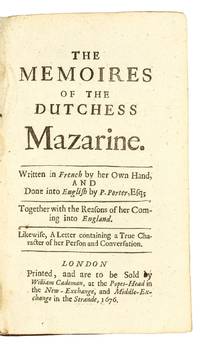
1676rif. 5550London: printed and are to be sold by William Cademan at the Popes-Head in the New-Exchange and Middle-Exchange in the Strande 1676. FIRST EDITION IN ENGLISH a re-issue printed in the same year of ESTC R28396 Wing S355. Hardcover. Fine. A fresh crisp copy bound in original 17th c. sheep corners bumped wear along the hinges a few small scrapes with a later label chipped. The contents are in very fine condition with just a small nick in the blank margin of C7 creasing to a few leaves a bit of staining in the inner margin and a little soiling to the inner blank margin of the title page. License leaf and errata both present pasted to the later free end-papers. With the bookplate of the Earl of Ilchester. The portrait found in the Folger copy is the source of its addition to the ESTC record. I have examined the portrait and it is a later insertion. While Peter Lely did paint the portrait of the duchess from which the engraving is derived the Dutch engraver David Coster was not born until sometime between 1675 and 1686 See RKD Netherlands Institute for Art History. The memoirs of the noblewoman Hortense Mancini niece of Cardinal Jules Mazarin who fled an abusive marriage and sought refuge in various countries before eventually settling in England where she became the mistress of King Charles II and established herself in English society. Although her affairs including an alleged affair with Anne Countess of Sussex caused scandal she was well-regarded and admired by many including Aphra Behn. Upon the death of Charles II she was still welcome at the court of James II and her cousin Mary of Modena. Written after her emancipation from her domineering husband the memoirs are Hortense's effort to defend her reputation against rumors and accusations of alleged transgressions including adultery. First printed in French in 1675 the memoirs became immensely popular. This English edition appeared the year after Hortense's arrival in England. "Hortense Mancini the niece of Cardinal Jules Mazarin and the younger sister of Louis XIV's first love Marie Mancini was said to be one of the most beautiful and charming women of the seventeenth century. Her Mémoires were probably written in Chambéry where she was living under the protection of Charles-Emmanuel II duc de Savoie to whom they are addressed. Many scholars believe however that their author was not Hortense but the abbé de Saint-Réal who based them on conversations with her. Literary creation was often a social pastime of aristocratic women and it was common for them to entrust their efforts to secretaries who were better versed than they in the rules of spelling and grammar. When the text thus produced was an autobiography it became extremely difficult to determine whose truth was being told-the woman's or the secretary's. "The Mémoires may be roughly divided into two parts. In the first the author justifies her separation from her husband; in the second s/he describes the problems she encountered as a renegade wife and refutes the rumors spread about her. "Her story may be briefly summarized as follows: Summoned from Italy at a young age by her uncle Cardinal Mazarin she spent her childhood at the French court where she was for all intents and purposes a member of the royal family. Mazarin married her when she was fifteen to the duc de Meilleraye who became by the provisions of the Cardinal's will the inheritor of his name and fortune. The marriage proved to be a disaster. Her husband was insanely jealous. The narrator writes that because he was afraid to let her out of his sight he insisted on dragging her back and forth across France even when she was in the last stages of pregnancy. He destroyed a stage-set she had constructed for a theatrical entertainment discharged her servants refused to speak to her until she removed her beauty marks and blocked up the passage between their living quarters and those of her brother Philippe. "Worse still driven by religious scrupulosity he squandered Cardinal Mazarin's vast fortune which he considered ill-gotten gains and then confiscated the jewels that constituted Hortense's only personal wealth. Arguing that he had acted illegally and that he had jeopardized their sons' inheritance she demanded a separation which was granted on condition that she be confined to a convent. After a series of highly publicized disputes and legal maneuvers Hortense decided to leave Paris and join her sister Marie now married to the Connétable Colonna and living in Rome. Her subsequent peregrinations and adventures gave rise to scandalous gossip fanned by her husband. "She was accused among other things of having had incestuous relations with her brother of becoming pregnant by a gentleman in her retinue named Courbeville and of having affairs with almost every man she met. The Memoires deal with these reports in several ways. Sometimes they indignantly deny them outright. Sometimes they offer plausible explanations. And frequently they omit any reference to them at all. "The author who may or may not have been Hortense immediately foregrounds the problem inherent in such a project: "It's not that I don't know how difficult it is to speak about oneself wisely; and you are not ignorant either of my natural repugnance for explaining myself about things that concern me: but it is still more natural to defend oneself from slander; at least to those who have been of great service to us. They certainly deserve to be informed that one is not altogether unworthy of having been their recipient. if what I have to tell you seems much more like a novel blame my bad fortune rather than my inclination." Then follows the oft-cited aphorism summing up the aristocratic ideal of feminine conduct: "Je sais que la gloire d'une femme consiste à ne faire parler d'elle" 32: I know that a woman's glory lies in not getting herself talked about. Not getting herself talked about has clearly not been the case for Hortense of whom a great deal has already been said and of whom a great deal more will probably be said as the result of this apology. This opening statement casts her therefore in the role of transgressor-the woman who has gotten herself talked about and who now defies the rules governing a lady's conduct in order to set the record straight. "The Memoires contain novelistic elements such as clandestine escapes perilous journeys and transvestite disguises. The account of her girlhood at court as well as many of the more amusing anecdotes represent her as a high-spirited individual with a penchant for merry pranks. The narrator tells of how during one of her enforced stays in a convent she and Mme de Courcelles tried to wash their feet and ended up inundating the nuns in their beds on the floor below. Another time she says they hid in the parlour behind a grill from which Hortense proved too plump to escape. She also had a flamboyant sense of fun. She loved to play blind-man's bluff and sometimes indulged in rough horseplay once injuring her knee so badly that her leg nearly had to be amputated. At times the narrative voice becomes flip-pant if not downright irreverent."Cholakian Sex Lies and Autobiography: Hortense Mancini's Memoires in Women writers in pre-revolutionary France: strategies of emancipation 1997. printed, and are to be sold by William Cademan, at the Popes-Head in the New-Exchange, and Middle-Exchange in the Strande hardcover
1676rif. 5550London: printed and are to be sold by William Cademan at the Popes-Head in the New-Exchange and Middle-Exchange in the Strande 1676. FIRST EDITION IN ENGLISH a re-issue printed in the same year of ESTC R28396 Wing S355. Hardcover. Fine. A fresh crisp copy bound in original 17th c. sheep corners bumped wear along the hinges a few small scrapes with a later label chipped. The contents are in very fine condition with just a small nick in the blank margin of C7 creasing to a few leaves a bit of staining in the inner margin and a little soiling to the inner blank margin of the title page. License leaf and errata both present pasted to the later free end-papers. With the bookplate of the Earl of Ilchester. The portrait found in the Folger copy is the source of its addition to the ESTC record. I have examined the portrait and it is a later insertion. While Peter Lely did paint the portrait of the duchess from which the engraving is derived the Dutch engraver David Coster was not born until sometime between 1675 and 1686 See RKD Netherlands Institute for Art History. The memoirs of the noblewoman Hortense Mancini niece of Cardinal Jules Mazarin who fled an abusive marriage and sought refuge in various countries before eventually settling in England where she became the mistress of King Charles II and established herself in English society. Although her affairs including an alleged affair with Anne Countess of Sussex caused scandal she was well-regarded and admired by many including Aphra Behn. Upon the death of Charles II she was still welcome at the court of James II and her cousin Mary of Modena. Written after her emancipation from her domineering husband the memoirs are Hortense's effort to defend her reputation against rumors and accusations of alleged transgressions including adultery. First printed in French in 1675 the memoirs became immensely popular. This English edition appeared the year after Hortense's arrival in England. "Hortense Mancini the niece of Cardinal Jules Mazarin and the younger sister of Louis XIV's first love Marie Mancini was said to be one of the most beautiful and charming women of the seventeenth century. Her Mémoires were probably written in Chambéry where she was living under the protection of Charles-Emmanuel II duc de Savoie to whom they are addressed. Many scholars believe however that their author was not Hortense but the abbé de Saint-Réal who based them on conversations with her. Literary creation was often a social pastime of aristocratic women and it was common for them to entrust their efforts to secretaries who were better versed than they in the rules of spelling and grammar. When the text thus produced was an autobiography it became extremely difficult to determine whose truth was being told-the woman's or the secretary's. "The Mémoires may be roughly divided into two parts. In the first the author justifies her separation from her husband; in the second s/he describes the problems she encountered as a renegade wife and refutes the rumors spread about her. "Her story may be briefly summarized as follows: Summoned from Italy at a young age by her uncle Cardinal Mazarin she spent her childhood at the French court where she was for all intents and purposes a member of the royal family. Mazarin married her when she was fifteen to the duc de Meilleraye who became by the provisions of the Cardinal's will the inheritor of his name and fortune. The marriage proved to be a disaster. Her husband was insanely jealous. The narrator writes that because he was afraid to let her out of his sight he insisted on dragging her back and forth across France even when she was in the last stages of pregnancy. He destroyed a stage-set she had constructed for a theatrical entertainment discharged her servants refused to speak to her until she removed her beauty marks and blocked up the passage between their living quarters and those of her brother Philippe. "Worse still driven by religious scrupulosity he squandered Cardinal Mazarin's vast fortune which he considered ill-gotten gains and then confiscated the jewels that constituted Hortense's only personal wealth. Arguing that he had acted illegally and that he had jeopardized their sons' inheritance she demanded a separation which was granted on condition that she be confined to a convent. After a series of highly publicized disputes and legal maneuvers Hortense decided to leave Paris and join her sister Marie now married to the Connétable Colonna and living in Rome. Her subsequent peregrinations and adventures gave rise to scandalous gossip fanned by her husband. "She was accused among other things of having had incestuous relations with her brother of becoming pregnant by a gentleman in her retinue named Courbeville and of having affairs with almost every man she met. The Memoires deal with these reports in several ways. Sometimes they indignantly deny them outright. Sometimes they offer plausible explanations. And frequently they omit any reference to them at all. "The author who may or may not have been Hortense immediately foregrounds the problem inherent in such a project: "It's not that I don't know how difficult it is to speak about oneself wisely; and you are not ignorant either of my natural repugnance for explaining myself about things that concern me: but it is still more natural to defend oneself from slander; at least to those who have been of great service to us. They certainly deserve to be informed that one is not altogether unworthy of having been their recipient. if what I have to tell you seems much more like a novel blame my bad fortune rather than my inclination." Then follows the oft-cited aphorism summing up the aristocratic ideal of feminine conduct: "Je sais que la gloire d'une femme consiste à ne faire parler d'elle" 32: I know that a woman's glory lies in not getting herself talked about. Not getting herself talked about has clearly not been the case for Hortense of whom a great deal has already been said and of whom a great deal more will probably be said as the result of this apology. This opening statement casts her therefore in the role of transgressor-the woman who has gotten herself talked about and who now defies the rules governing a lady's conduct in order to set the record straight. "The Memoires contain novelistic elements such as clandestine escapes perilous journeys and transvestite disguises. The account of her girlhood at court as well as many of the more amusing anecdotes represent her as a high-spirited individual with a penchant for merry pranks. The narrator tells of how during one of her enforced stays in a convent she and Mme de Courcelles tried to wash their feet and ended up inundating the nuns in their beds on the floor below. Another time she says they hid in the parlour behind a grill from which Hortense proved too plump to escape. She also had a flamboyant sense of fun. She loved to play blind-man's bluff and sometimes indulged in rough horseplay once injuring her knee so badly that her leg nearly had to be amputated. At times the narrative voice becomes flip-pant if not downright irreverent."Cholakian Sex Lies and Autobiography: Hortense Mancini's Memoires in Women writers in pre-revolutionary France: strategies of emancipation 1997. printed, and are to be sold by William Cademan, at the Popes-Head in the New-Exchange, and Middle-Exchange in the Strande hardcover books