Rocco, GiuliaMareMagnum
PALLOTTINO, Massimo.MareMagnum
LA PEINTURE ETRUSQUE.
195228x25. 137p. Láms. Color. Trad. R. Skira-Venturi. Enc. Tela ed.

Libreria Fernandez Javier · Espagne40,00 €
167 résultats
2016Minor edgewear and faint shelfwear to wraps. ; Vasi Antichi Dipinti Del Vaticano; 247 pages
195228x25. 137p. Láms. Color. Trad. R. Skira-Venturi. Enc. Tela ed.
1998Il libro è stato dismesso dalla biblioteca di Cilavegna (dunque sono presenti i timbri) di cui disponiamo i documenti di dismissione. Condizioni discrete, abrasione e segni sulla brossura
2015réf. ARTSSS61215Milan, Silvana Editoriale, 2015, 23 x 28, 192 pages cousues sous couverture souple rempliée illustrée. Iconographie en noir & blanc et en couleurs. Catalogue raisonné de la collection étrusque et italique du Musée Antoine Vivenel de Compiègne. Préfaces de Claire Iselin et Françoise Gaultier.
1968réf. 39573Paris, Bibliothèque de l Paris, Bibliothèque de l'amitié 1968. In-8 cartonnage éditeur de 183 pages illustrées. Bon état
réf. 2111, Paris, Librairie Ernest Leroux, 1938., Broche, couverture d' editeur illustre, 14,5x23cm, 207pp + 8 planches hors - texte n/b.
1984Biblioteca dell'"Archivum Romanicum" - Serie II, Linguistica, Vol. 38 (2 tomi) 2 [2 tomi] 25x17.5 cm., LXIX, 333 pp. ; 620, [6] pp, legatura cartonata editoriale, intonso, in italiano
1968Paris, Bibliothèque de l'amitié 1968. In-8 cartonnage éditeur de 183 pages illustrées. Bon état
1640In-4°, (4cc), 203pp, (5cc), vignetta calcografica al frontespizio, fregio e iniziale xilografica, legatura in piena pergamena rigida. Nel 1637 Inghirami pubblicò gli Etruscarum antiquitatum fragmenta, in cui annunciava la scoperta di importanti documenti, contenenti quasi tutta la storia del popolo etrusco e della sua civiltà, nel suo possedimento di Scornello, vicino a Volterra. L'opera suscitò un vastissimo scalpore in tutta Europa. Si trattava in realtà di un falso clamoroso, come venne quasi subito dimostrato. Inghirami difese la genuinità delle sue scoperte in un ampio Discorso (1645), ma il prefetto della Biblioteca apostolica vaticana Leone Allacci dimostrò in modo inconfutabile la falsità dei documenti nell'opuscolo polemico Animadversiones in antiquitatum etruscarum fragmenta. La scrittura nei testi etruschi andava nella direzione sbagliata, da sinistra a destra. Più importante - e più significativo - era il fatto che i testi latini erano scritti in minuscolo. Attingendo a umanisti precedenti, molti dei quali avevano discusso brevemente o di sfuggita l'argomento, Allacci insisteva sul fatto che i romani avevano sempre redatto i loro testi letterari in maiuscolo. Il breve schizzo della storia dell'antica scrittura latina redatto da Allacci fornì il modello per Mabillon, che lo citò nel suo De re diplomatica (1681). In-4°, (4cc), 203pp, (5cc), the title page with copper engraved vignette, wood engraved frieze and initial, full contemporary vellum binding. In 1637 Curzio Inghirami published the Etruscarum antiquitatum fragmenta, in which he announced the discovery of important documents, containing almost the entire history of the Etruscan people and their civilization, in his possession of Scornello, near Volterra. The work caused a huge turmoil throughout Europe. It was actually a sensational fake, as was almost immediately demonstrated. Inghirami defended the genuineness of his discoveries in an extensive Discorso (1645), but the prefect of the Vatican Apostolic Library Leone Allacci irrefutably demonstrated the falsity of the documents in the polemical pamphlet Animadversiones in antiquitatum etruscarum fragmenta. Writing in Etruscan texts went the wrong way, from left to right. More important - and more significant - was the fact that the Latin texts were written in lower case. Drawing on earlier humanists, many of whom had discussed the subject briefly or in passing, Allacci insisted that Romans had always written their literary texts in capital letters. Allacci's short sketch of the history of ancient Latin writing provided the model for Mabillon, who quoted it in his De re diplomatica (1681).
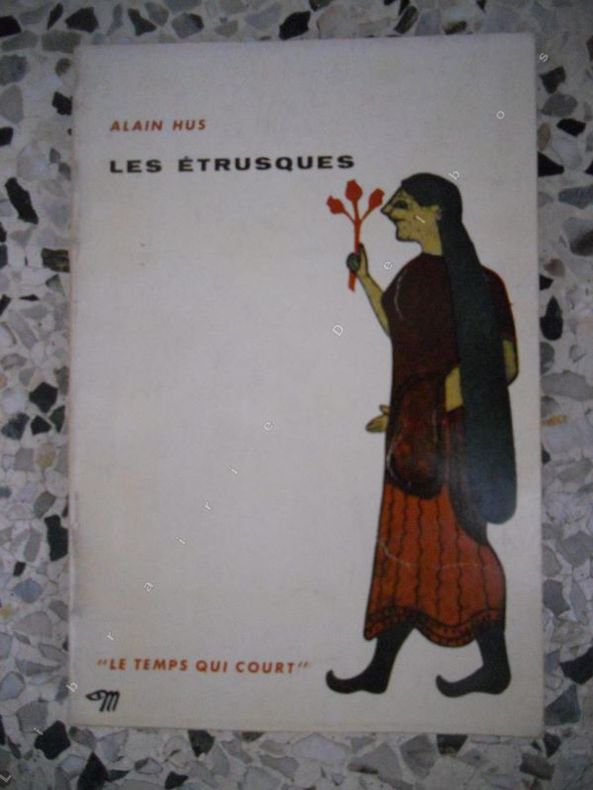
réf. 32380Seuil, collection "Microcosme, le temps qui court" n°12. Format poche. Bon etat, petites traces d'usage sur un livre d'occasion.
réf. 71349Coll. "Encyclopédie de la Méditerranées" n° 25, Aix-en-Provence, éd. Edisud, 2004, in-12, cartonnage souple, couv. ill. coul. éd., 96 pp., nb. cartes et reproductions de documents anciens en noir, sommaire, bibliographie, L'histoire des étrusques qui sont à l'origine du développement des civilisations de la Méditerranée. Pas courant Très bon état
1925réf. 1167891925 A Lyon, Anciens Etablissements Legendre - 1925 - In-8, broché - 39 p.
réf. 23696Paris, Plon, 1967. In-8°, 411p. Reliure pleine toile d'éditeur, sous jaquette illustrée.
réf. 11602Paris, Arthème Fayard, 1957 14 x 22, 281 pp., broché, bon état
réf. 9361Lausanne, La Guilde du Livre 1953, 300X295 mm, 27pages, broché.
1976réf. 50180Fayard, 1976. Format 14x22 cm, 477 pages. Très bon état.
1988cm. 18 x 25,5, xxxvi-224 pp. Biblioteca dell'?Archivum Romanicum? - Serie II: Linguistica 548 gr. xxxvi-224 p.
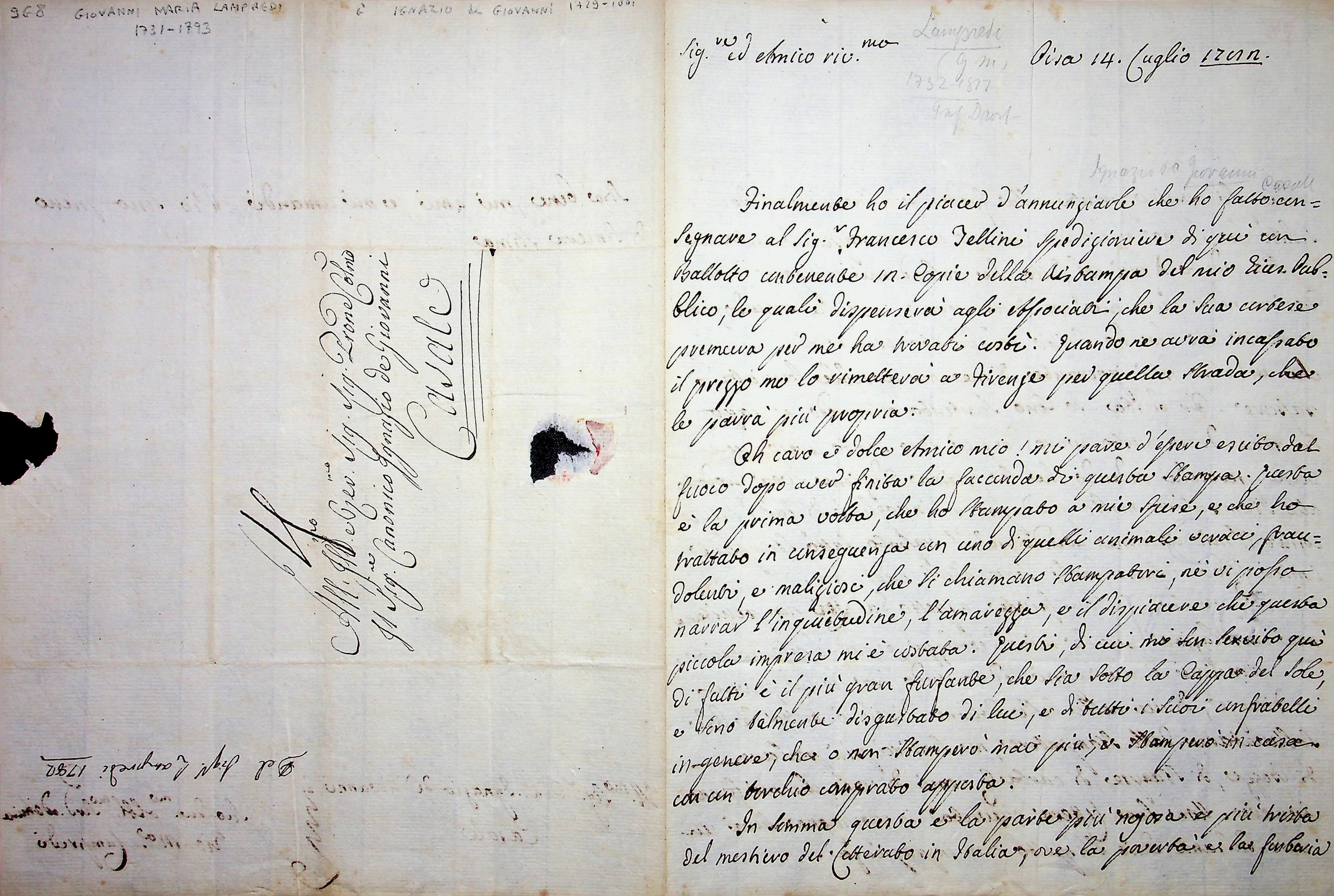
réf. 022655Giovanni Maria Lampredi (1731-1791), juriste Italie, érudit, écrivain, auteur d'un ouvrage sur la culture étrusque. L.A.S., Pisa, 14 juillet 1782, 2p 1/2 in-4. Au prêtre, poète et bibliophile Ignazio de Giovanni (1729-1801). Très intéressante lettre autour de la réimpression de son ouvrage de droit public dont il envoie des exemplaires pour les souscripteurs trouvés par Giovanni. Il est content que l'impressions soit terminée mais s'en prend à l'imprimeur, la plus grande canaille sous le soleil ("il più gran furfante che sia sotto la Cappa del sole"). Il regrette d'avoir financé lui-même l'édition et a laissé des coquilles dans l'ouvrage. Très belle lettre. [556]
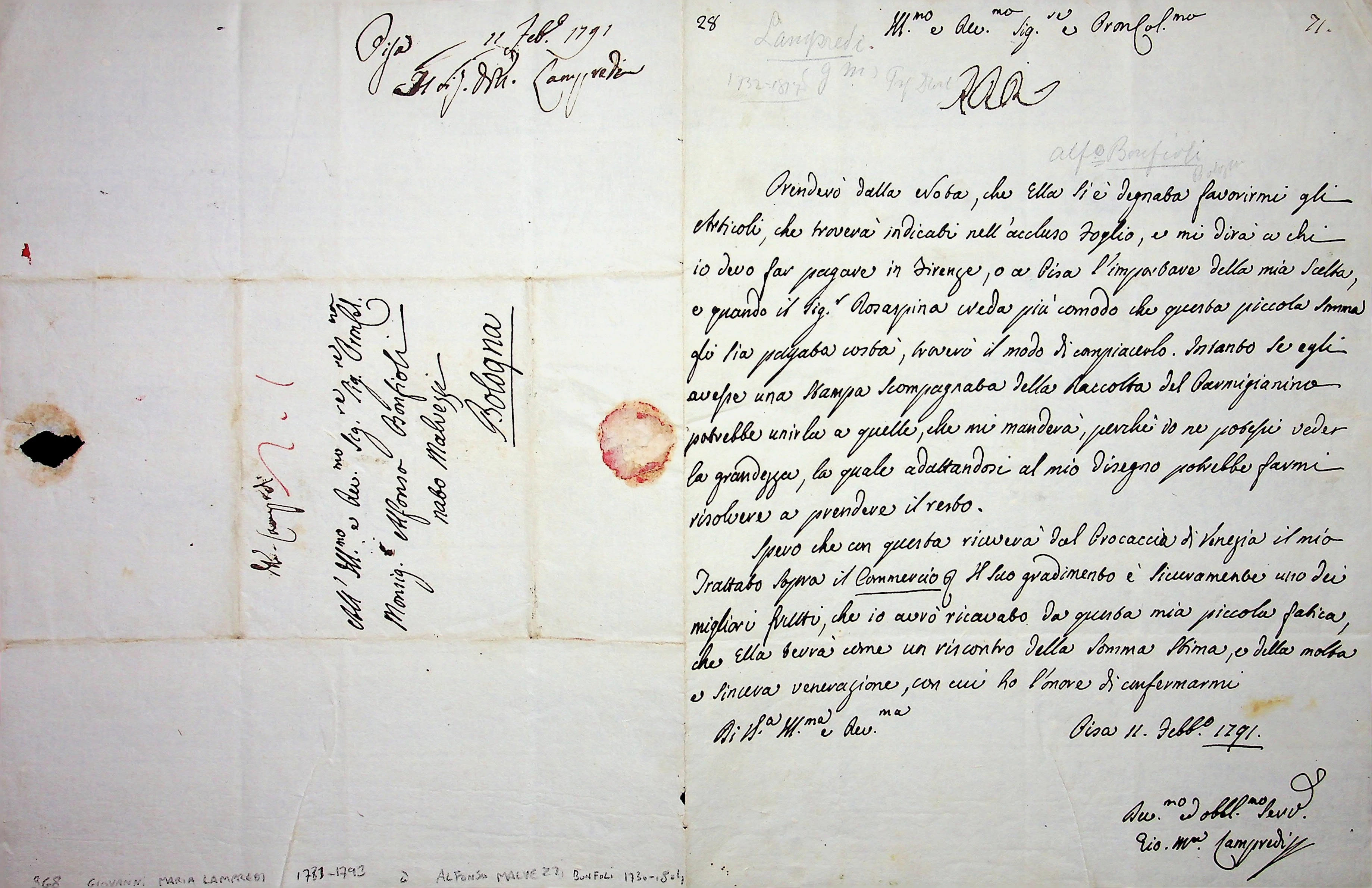
réf. 022656Giovanni Maria Lampredi (1731-1791), juriste Italie, érudit, écrivain, auteur d'un ouvrage sur la culture étrusque. L.A.S., 11 février 1791, 1p in-4. Au scientifique, écrivain Alfonso Malvezzi Bonfioli (1730-1804). Intéressante lettre concernant l'achat d'estampes, mentionnant le graveur Francesco Rosaspina (1762-1841), projetant d'acheter des gravures du Parmesan (Parmigianino). Il annonce aussi l'envoie de son ouvrage Trattato sopra il Commercio dei Popoli Neutrali (traité sur le commerce des nations neutres). Très belle lettre. [556]
1960Book is in excellent condition. Binding is solid and square, covers have sharp corners, exterior shows no blemishes, text/interior is clean and free of marking of any kind. Dust jacket shows edgewear, a small open tear, 498 pages.
in-8°, XI-399 pages, illustre h.t. n/b, dessins, cartes, notes, biblio, broche, couverture illustree. Bel exemplaire. [CA33-5]
1990Very faint shelfwear else fine. ; 263pp, illustrated.; Studies in Mediterranean Archaeology Vol. XCI; 4to - over 9¾" - 12" tall; 263 pages
1959réf. 2092902137303999Bijutsu shubbansha 1959. Soft Cover. Fine. The book is in fine condition. Bijutsu shubbansha paperback
1987Mm 225x225 Progetto Etruschi 1985-1986. Brossura originale, 176 pagine riccamente illustrate in nero. Buona copia, spedizione in 24 ore dalla conferma dell'ordine.
1928réf. 1147201928 Editions Calmann-Lévy, Paris - 1928 - In-8, demi-maroquin à coins bleu, dos à 5 nerfs, titre, nom de l'auteur et sceau du relieur gravés à froid, filets dorés, tranche de tête dorée - Couverture et dos originaux conservés - Reliure EFB avec ex-libris EDM. Fries sur la première page - 255 p. - Il a été tiré de cet ouvrage 1800 exemplaires sur papier vélin du Marais, ex. n°1698.